

Paper Menu >>
Journal Menu >>
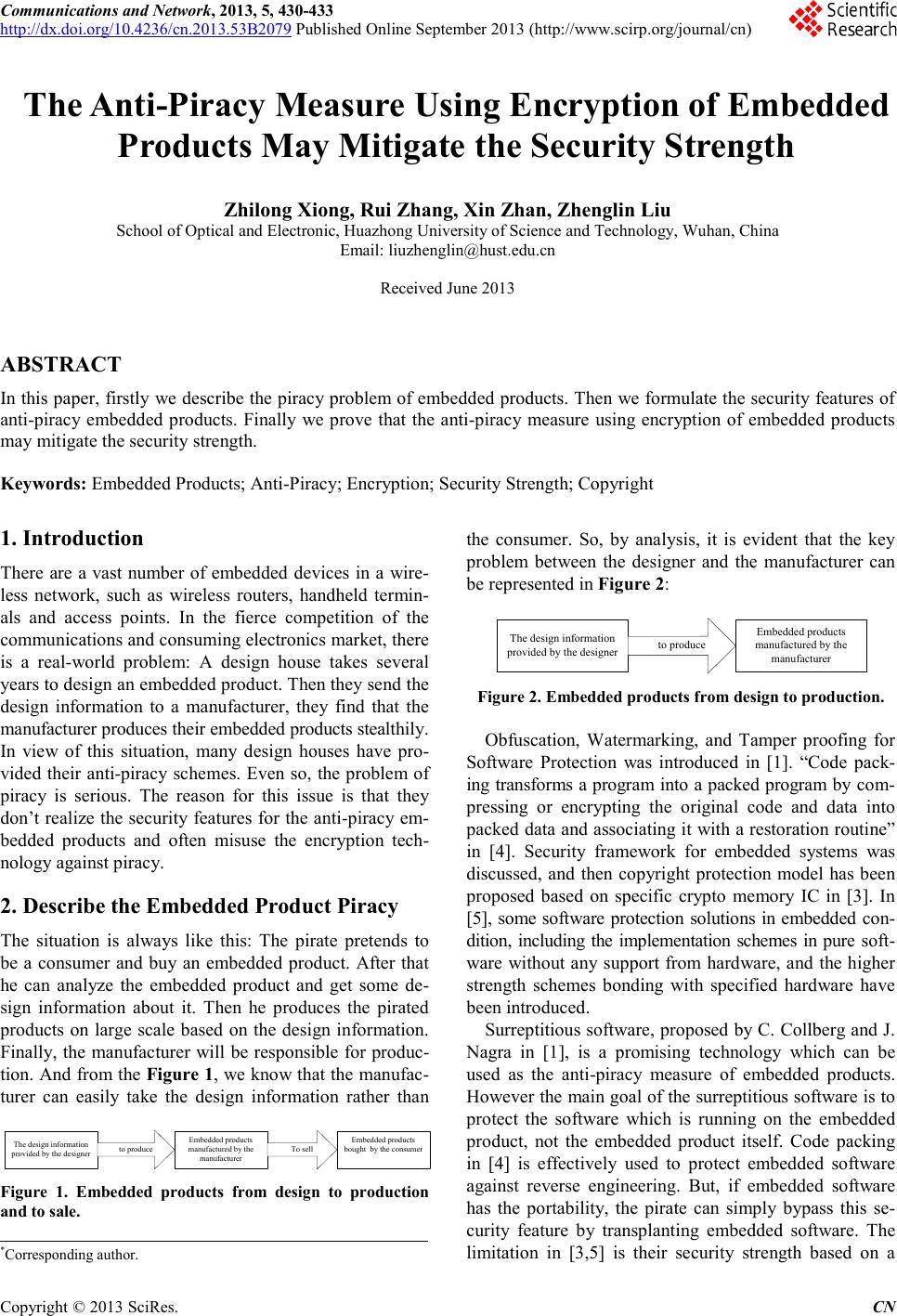 Communications and Network, 2013, 5, 430-433 http://dx.doi.org/10.4236/cn.2013.53B2079 Published Online September 2013 (http://www.scirp.org/journal/cn) Copyright © 2013 SciRes. CN The Anti-Piracy Measure Using Encryption of Embedded Products May Mitigate the Security Strength Zhilong Xiong, Rui Zhang, Xin Zhan, Zhenglin Liu School of Optical and Electronic, Huazhong University of Science and Technology, Wuhan, China Email: [email protected] Received June 2013 ABSTRACT In this paper, firstly we describe the piracy problem of embedded products. Then we formulate the security features of anti-piracy embedded products. Finally we prove that the anti-piracy measure using encryption of embedded products may mitigate t he security str ength. Keywords: Embedded Products; Anti-Piracy; Encryption; Security Strength; Copyright 1. Introduction There are a vast number of embedded devices in a wire- less network, such as wireless routers, handheld termin- als and access points. In the fierce competition of the communications and consuming electronics market, there is a real-world problem: A design house takes several years to design an embedded product. Then they send the design information to a manufacturer, they find that the manufacturer produces their embedded products stealthily. In view of this situation, many design houses have pro- vided their anti-piracy schemes. Even so, the problem of piracy is serious. The reason for this issue is that they don’t realize the security features for the anti-pi rac y em- bedded products and often misuse the encryption tech- nology against piracy. 2. Describ e the Embedded Product Piracy The situation is always like this: The pirate pretends to be a consumer and buy an embedded product. After that he can analyze the embedded product and get some de- sign information about it. Then he produces the pirated products on large scale based on the design information. Finally, the manufacturer will be responsible for produc- tion. And fro m the Figure 1, we know that the manufac- turer can easily take the design information rather than Figure 1. Embedded products from design to production and to sale. the consumer. So, by analysis, it is evident that the key problem between the designer and the manufacturer can be represented in Figure 2: Figure 2. Embedded products fr om design to production. Obfuscation, Watermarking, and Tamper proofing for Software Protection was introduced in [1]. “Code pack- ing transforms a program into a packed program by com- pressing or encrypting the original code and data into packed data and associating it with a restoration ro utine” in [4]. Security framework for embedded systems was discussed, and then copyright protection model has been proposed based on specific crypto memory IC in [3]. In [5], some software protection solutions in embedded con- dition, including the implementation schemes in pure soft- ware witho ut any support from hard ware, and the higher strength schemes bonding with specified hardware have been introduced. Surreptitious software, proposed by C. Collberg and J. Nagra in [1], is a promising technology which can be used as the anti-piracy measure of embedded products. However the main goal of the surre ptitious software is to protect the software which is running on the embedded product, not the embedded product itself. Code packing in [4] is effectively used to protect embedded software against reverse engineering. But, if embedded software has the portability, the pirate can simply bypass this se- curity feature by transplanting embedded software. The limitation in [3,5] is their security strength based on a The design information provided by the designer to produce Embedded products manufactured by the manufacturer To sellEmbedded products bought by the consumer The design information provided by the designer to produce Embedded products manufactured by the manufacturer *Corresponding author. 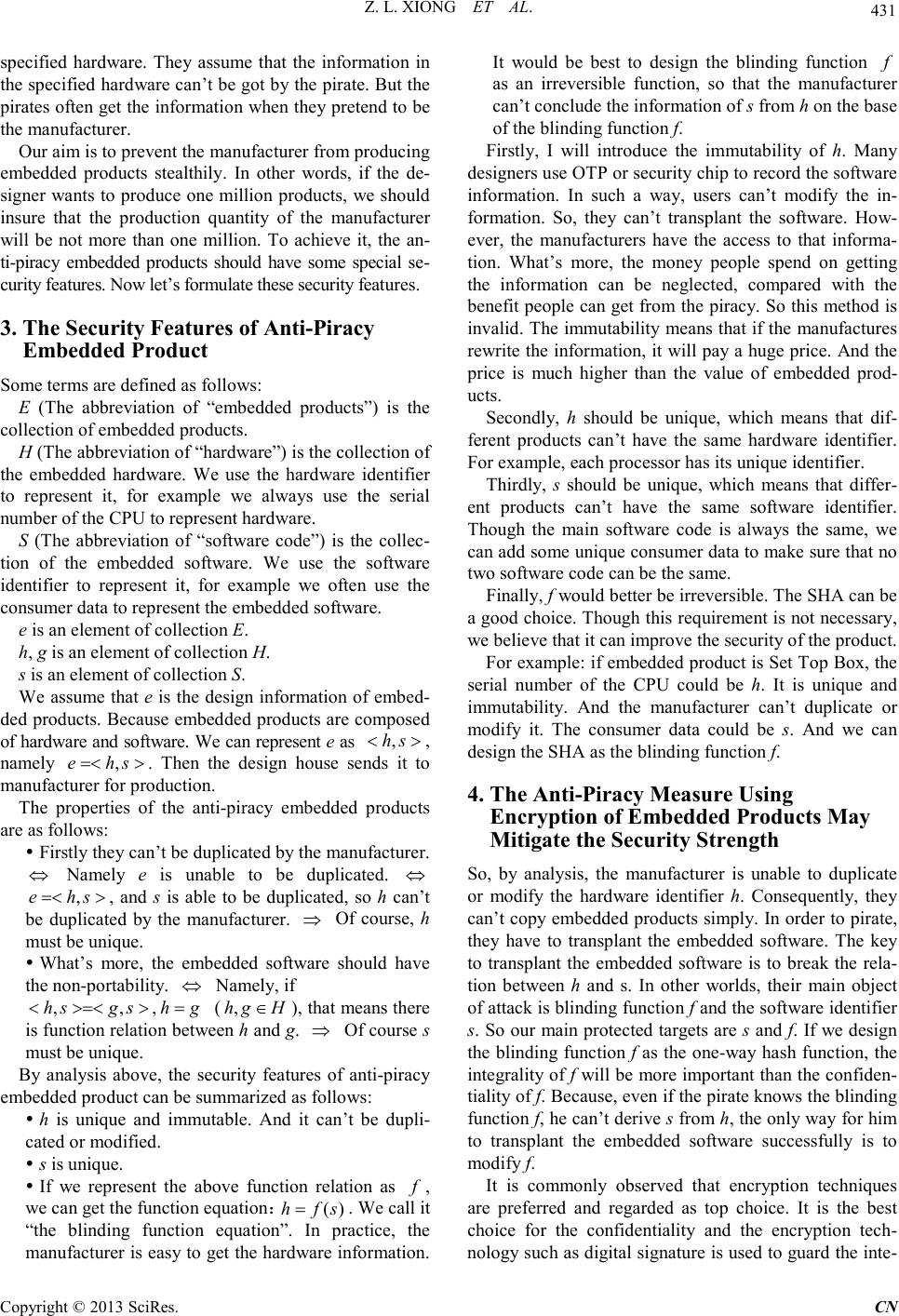 Z. L. XIONG ET AL. Copyright © 2013 SciRes. CN 431 specified hardware. They assume that the information in the specified hardware can’t be got by the pirate. But the pirates often get the information when they pretend to be the manufacturer. Our aim is to prevent the manufacturer from producing embedded products stealthily. In other words, if the de- signer wants to produce one million products, we should insure that the production quantity of the manufacturer will be not more than one million. To achieve it, the an- ti-piracy embedded products should have some special se- curity features. Now let’s formulate these security features. 3. The Security Features of Anti-Piracy Embedded Product Some terms are defined as follows: E (The abbreviation of “embedded products”) is the collection of embedded products. H (The abbreviation of “hardware”) is the collection of the embedded hardware. We use the hardware identifier to represent it, for example we always use the serial number of the CPU to represent hardware. S (The abbreviation of “software code”) is the collec- tion of the embedded software. We use the software identifier to represent it, for example we often use the consumer data to represent the embedded software. e is an element of colle c tion E. h, g is an element of collection H. s is an element of collec tion S. We assume that e is the design information of embed- ded products. Because embedded products are composed of hard ware and so ftware. We can represent e as ,hs<> , namely ,e hs =<> . Then the design house sends it to manufacturer for production. The properties of the anti-piracy embedded products are as follows: Firstl y they can’t be d uplic ated by the manufac turer. ⇔ Namely e is unable to be duplicated. ⇔ ,e hs=<> , and s is able to be duplicated, so h can’t be duplicated by the manufacturer. ⇒ Of course, h must be unique. What’s more, the embedded software should have the non-portability. ⇔ Namely, if ,,hs gs< >=<> , hg= (,hg H∈), tha t mea ns ther e is function relatio n bet ween h and g. ⇒ Of course s must be unique. By analysis above, the security features of anti-piracy embedded product can be summarized as follows: h is unique and immutable. And it can’t be dupli- cated or modified. s is uniq ue. If we represent the above function relation as f, we can get the function equation: () h fs=. We call it “the blinding function equation”. In practice, the manufacturer is easy to get the hardware information. It would be best to design the blinding function f as an irreversible function, so that the manufacturer can’t conclude the information of s from h on the bas e of the blinding function f. Firstly, I will introduce the immutability of h. Many desig ner s use OT P o r security chip to record the software information. In such a way, users can’t modify the in- formation. So, they can’t transplant the software. How- ever, the manufacturers have the access to that informa- tion. What’s more, the money people spend on getting the information can be neglected, compared with the benefit people can get from the piracy. So this method is invalid. T he immutability means that if the manufac tures rewrite the infor mation, it will p ay a huge price. And the price is much higher than the value of embedded prod- ucts. Secondly, h should be unique, which means that dif- ferent products can’t have the same hardware identifier. For example, each processor has its unique identifier. Thirdly, s should be unique, which means that differ- ent products can’t have the same software identifier. Though the main software code is always the same, we can add some unique consumer data to make sure that no two software code can be the same. Finally, f would better be irreversible. The SHA can be a good choice. Tho ugh this req uireme nt is not nece ssar y, we believe that it can improve the securit y of the pro duct. For example: if embedded product is Set Top Box, the serial number of the CPU could be h. It is unique and immutability. And the manufacturer can’t duplicate or modify it. The consumer data could be s. And we can design the SHA as the blinding function f. 4. The Anti-Piracy Measure Using Encryption of Embedded Products May Mitigate the Security Strength So, by analysis, the manufacturer is unable to duplicate or modify the hardware identifier h. Consequently, they can’t copy embedded products simply. In order to pirate, they have to transplant the embedded software. The key to transplant the embedded software is to break the rela- tion between h and s. In other worlds, their main object of attack is bli nding functio n f and the software identifier s. So our main protected targets are s and f. If we design the blinding function f as the one-way hash function, the integrality o f f will be more important than the confiden- tiality of f. Because, e ven if the pirate knows the blinding function f, he can’t derive s from h, the o nl y way for him to transplant the embedded software successfully is to modify f. It is commonly observed that encryption techniques are preferred and regarded as top choice. It is the best choice for the confidentiality and the encryption tech- nology such as digital si gnature is used to guard the inte - 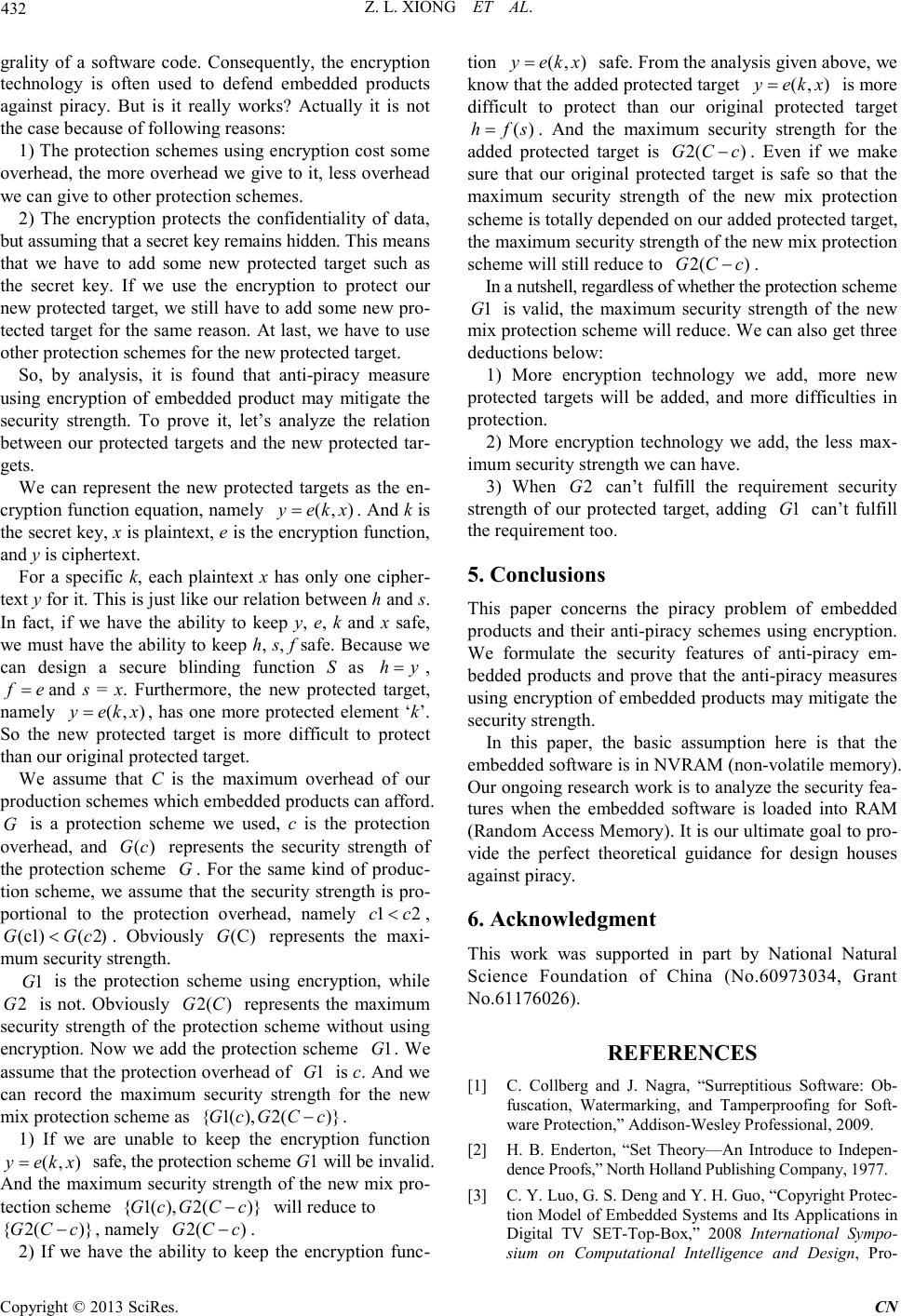 Z. L. XIONG ET AL. Copyright © 2013 SciRes. CN 432 grality of a software code. Consequently, the encryption technology is often used to defend embedded products against piracy. But is it really works? Actually it is not the case because of following reasons: 1) The protec tion sche mes using e ncryptio n cost so me overhead, the more overhead we give to it, less overhead we can give to other prote c tion schemes. 2) The encryption protects the confidentiality of data, but as s umi n g t ha t a se cr et ke y r e mai n s hid d e n. Thi s means that we have to add some new protected target such as the secret key. If we use the encryption to protect our new protected target, we still have to add some new pro- tected target for the same reason. At last, we have to use other protection schemes for the new protected target. So, by analysis, it is found that anti-piracy measure using encryption of embedded product may mitigate the security strength. To prove it, let’s analyze the relation between our protected targets and the new protected tar- gets. We can represent the new protected targets as the en- crypti on fu nctio n equat ion, na mely (,) y ekx=. And k is the secret key, x is plaintext, e is the enc rypt io n func tio n, and y is cip her te xt. For a specific k, each plaintext x has only one cipher- text y for it. This is just like our relation bet ween h and s. In fact, if we have the ability to keep y, e, k and x safe, we must have the ability to keep h, s, f safe. Because we can design a secure blinding function S as hy= , fe= and s = x. Furthermore, the new protected target, namely (,) y ekx=, has one more protected element ‘k’. So the new protected target is more difficult to protect than our original protected ta rget. We assume that C is the maximum overhead of our production schemes which embedded products can afford. G is a protection scheme we used, c is the protection overhead, and ()Gc represents the security strength of the protection scheme G . For the same kind of produc- tion scheme, we assume that the security strength is pro- portional to the protection overhead, namely 12cc< , (c1)( 2)G Gc<. Obviously (C)G represents the maxi- mum securi ty strength. 1G is the protection scheme using encryption, while 2G is not. Obviously 2( ) GC represents the maximum security strength of the protection scheme without using encryption. Now we add the protection scheme 1G . We assume that the protection overhead of 1G is c. A nd we can record the maximum security strength for the new mix protection scheme as {1(),2()}GcG Cc− . 1) If we are unable to keep the encryption function (,) y ekx= safe, the protection scheme G1 will be invalid. And the maxi mum security st rength of the ne w mix pro- tection scheme {1(),2()}GcG Cc− will reduce to { 2()}GCc−, namely 2( )GCc− . 2) If we have the ability to keep the encryption func- tion (,) y ekx= safe. F rom the a na l ysi s give n a b ove , we know that the added protected target (,) y ekx= is mo re difficult to protect than our original protected target () h fs=. And the maximum security strength for the added protected target is 2( )GCc− . Even if we make sure that our original protected target is safe so that the maximum security strength of the new mix protection scheme is totally depended on our added protected target, the ma xi mum secur it y str e ngth o f t he ne w mi x p ro t ec tio n scheme will still re duce to 2( )GCc− . In a nutshell, regardless of whether the protection scheme 1G is valid, the maximum security strength of the new mix protection scheme will reduce. We can also get three deductions below: 1) More encryption technology we add, more new protected targets will be added, and more difficulties in protection. 2) More encryption technology we add, the less max- imum security strength we can have. 3) When 2G can’t fulfill the requirement security strength of our protected target, adding 1G can’t fulfill the require ment too. 5. Conclusions This paper concerns the piracy problem of embedded products and their anti-piracy schemes using encryption. We formulate the security features of anti-piracy em- bedded products and prove that the anti-piracy measures using encryption of embedded products may mitigate the secur ity st re ngth. In this paper, the basic assumption here is that the embedded software is in NVRAM (non-volatile memory). Our ongoing research work is to analyze the security fea- tures when the embedded software is loaded into RAM (Rando m Access Memory). It is our ultimate goal to pr o- vide the perfect theoretical guidance for design houses against piracy. 6. Acknowledgment This work was supported in part by National Natural Science Foundation of China (No.60973034, Grant No.61176026). REFERENCES [1] C. Collberg and J. Nagra, “Surreptitious Software: Ob- fuscation, Watermarking, and Tamperproofing for Soft- ware P r otection,” Addison-Wesley Professional, 2009. [2] H. B. Enderton, “Set Theory—An Introduce to Indepen- dence Proof s ,” Nor th H oll a nd Pub l is hing Compa ny, 1977. [3] C. Y. Luo, G. S. Deng and Y. H. Guo, “Copyright Protec- tion Model of Embedded Systems and Its Applications in Digital TV SET-Top-Box,” 2008 International Sympo- sium on Computational Intelligence and Design, Pro-  Z. L. XIONG ET AL. Copyright © 2013 SciRes. CN 433 posed a System Copyright Protection Model Based on Specific Crypto Memory IC, 2008. [4] Y. Park, “Design and Performance Evaluation of Binary Code Packing for Protecting Embedded Software against Reverse Engineering,” 13th IEEE International Sympo- sium on Obj ect /Component/Service-Oriented Real-Time Distributed Computing, 2010. [5] Z. Y. Yang, “Software Protection Solutions for Embed- ded Systems,” Computer Applications and Software, Vol. 26, No. 8, 2009 . |