

Paper Menu >>
Journal Menu >>
 Communications and Network, 2013, 5, 426-429 http://dx.doi.org/10.4236/cn.2013.53B2078 Published Online September 2013 (http://www.scirp.org/journal/cn) Copyright © 2013 SciRes. CN Dropping Rate Simulation for a Handover Scheme Using Importance Sampling* Dong Liang, Gan Ding, Wuling Qin, Mugen Peng Wireless Signal Processing and Network Lab, Key Laboratory of Universal Wireless Communications (Ministry of Education), Beijing University of Posts and Telecommunications, Beijing, China Email: [email protected], [email protected], qi[email protected], pmg@bupt.edu.cn Received June 2013 ABSTRACT The process of changing the channel associated with the current connection while a call is in progress is under consid- eration. The estimation of dropping rate in handover process of a one dimensional traffic system is discussed. To reduce the sample size of simulation, dropping calls at base station is considered as rare event and simulated with importance sampling - one of rare event simulation approaches. The simulation results suggest the sample size can be tremendously reduced by using importance sam pling. Keywords: Handover; Importance Sampling; Monte Carlo; Dropping Rate 1. Introduction Handover is the process of changing the channel (fre- quency, time slot, spreading code, or combination of them) associated with the current connection while a call is in progress [1]. Usually, continuous service is achieved by supporting handover from one cell to another [2,3]. As shown in Figure 1, it is often initiated eith er by crossing a cell boundary or by deterioration in quality of the sig- nal in the current channel [4]. The handover process starts when the power received by the mobile station from a neighboring cell’s base sta- tion (BS) exceeds the power received from the BS of the current cell by a certain amount, called handover thre- shold. This is the threshold in the received power, below which acceptable communication with the BS of the cur- rent cell is no longer possible [5]. If the power level from the current BS falls below the receiver threshold prior to the mobile being assigned to a channel by the target BS, the call is terminated and the handover attempt fails. Queuing priority schemes give possibility to reduce the blocking probability of new calls, where the calls queuing in handove r queues. Que uing pri ori ty channel assignment strategy is described in [6]. Analysis of a mobile cellular system with handover priority and hysteresis control is given in [7]. Queuing of handover requests is possible, because the mobile station spends some time in handover area, where communications with the current BS decrease in depen- dence of the speed of moving of the mobile station. Each next request into the handover queue can be served ac- cording to certain service discipline. In nowadays broadband wireless networks probabilis- tic parameters of Quality of Service (QoS) like probabil- ity of dropped calls because all channels at the BS are busy is very small, less than10−9. In such cases the Monte Carlo simulation, which is implemented for probabilities not less than 10−5 [8] is useless and for estimation of handover QoS parameters as blocking probabilities is suggested implementation of rare event simulation. Rare event simulation helps to speed up the simulation process, as studied probabilistic parameters of quality of service have very small probability between 10−8 and 10−12, and they can’t be reached with standard Monte Carlo. 2. Modeling of Handover Scheme A simplified handover mechanism is shown in Figure 2, Figure 1. Handover in cell edge. *This work was supported in part by the Fundamental Research Funds for the Central Universities (Research on efficient algorithm and con- fidence probability in system level simulatio ns in wireless communica- tions) (2012RC0113), the Stat e Major Science and Technology Special Projects (Grant No. 2011ZX03003-002- 01, 2012ZX03001028), the Beijing Natural Science Foundation (Grant No. 4131003). 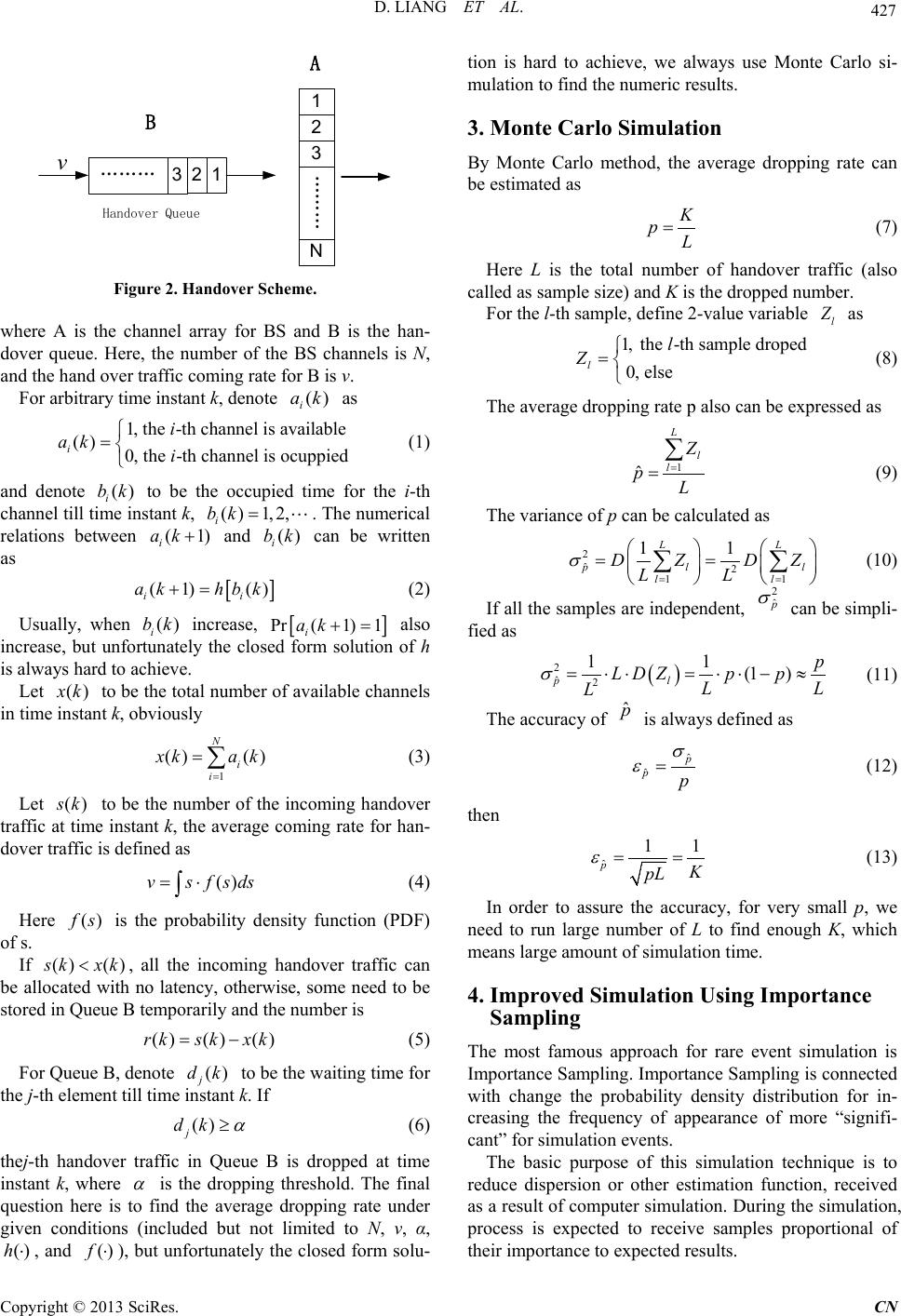 D. LIANG ET AL. Copyright © 2013 SciRes. CN 427 1 1 2 3 ……… Handover Queue 2 3 ……… N A B v Figure 2. Handover Scheme. where A is the channel array for BS and B is the han- dover queue. Here, the number of the BS channels is N, and the hand over traffic coming rate for B is v. For arbitrary time instant k, denote () i ak as 1, the -th channel is available () 0, the -th channel is ocuppied i i ak i = (1) and denote () i bk to be the occupied time for the i-th channel till time instant k, ()1, 2, i bk= . The numerical relations between ( 1) i ak+ and () i bk can be written as [ ] (1)( ) ii akhb k+= (2) Usually, when () i bk increase, [ ] Pr(1) 1 i ak+= also increase, but unfortunately the closed form solution of h is always hard to achieve. Let ()xk to be the total number of available channels in time instant k, obviously 1 () () N i i xka k = = ∑ (3) Let ()sk to be the number of the incoming handover traffic at time instant k, the average coming rate for han- dover traffic is defined as ()vsfsds= ⋅ ∫ (4) Here ()fs is the probability density function (PDF) of s. If () ()sk xk< , all the incoming handover traffic can be allocated with no latency, otherwise, some need to be stored in Queue B temporarily and the number is ()() ()rksk xk= − (5) For Queue B, denote () j dk to be the waiting time for the j-th element till time instant k. If () j dk α ≥ (6) thej-th handover traffic in Queue B is dropped at time instant k, where α is the dropping threshold. The final question here is to find the average dropping rate under given conditions (included but not limited to N, v, α, ()h⋅ , and ()f⋅ ), but unfortunately the closed form solu- tion is hard to achieve, we always use Monte Carlo si- mulation to find the numeric results. 3. Monte Carlo Simulation By Monte Carlo method, the average dropping rate can be estimated as K pL = (7) Here L is the total number of handover traffic (also called as sample size) and K is t he dropped n umber. For the l-th sample, defi ne 2 -value variable l Z as 1, the -th sample droped 0, else l l Z = (8) The average dropping rate p also can be expressed as 1 ˆ L l l Z pL = = ∑ (9) The variance of p can be calculated as 2 ˆ2 11 11 LL pl l ll D ZDZ LL σ = = = = ∑∑ (10) If all the samples are independent, 2 ˆ p σ can be simpli- fied as ( ) 2 ˆ2 11 (1 ) pl p LDZp p LL L σ =⋅⋅= ⋅⋅−≈ (11) The accuracy of ˆ p is always defined as ˆ ˆp p p σ ε = (12) then ˆ 11 p K pL ε = = (13) In order to assure the accuracy, for very small p, we need to run large number of L to find enough K, which means large amount of simulation time. 4. Improved Simulation Using Importance Sampling The most famous approach for rare event simulation is Importance Sampling. Importance Sampling is connected with change the probability density distribution for in- creasing the frequency of appearance of more “signifi- cant” for simulation events. The basic purpose of this simulation technique is to reduce dispersion or other estimation function, received as a result of computer simulation. During the simulation, process is expected to receive samples proportional of their importance to expected results. 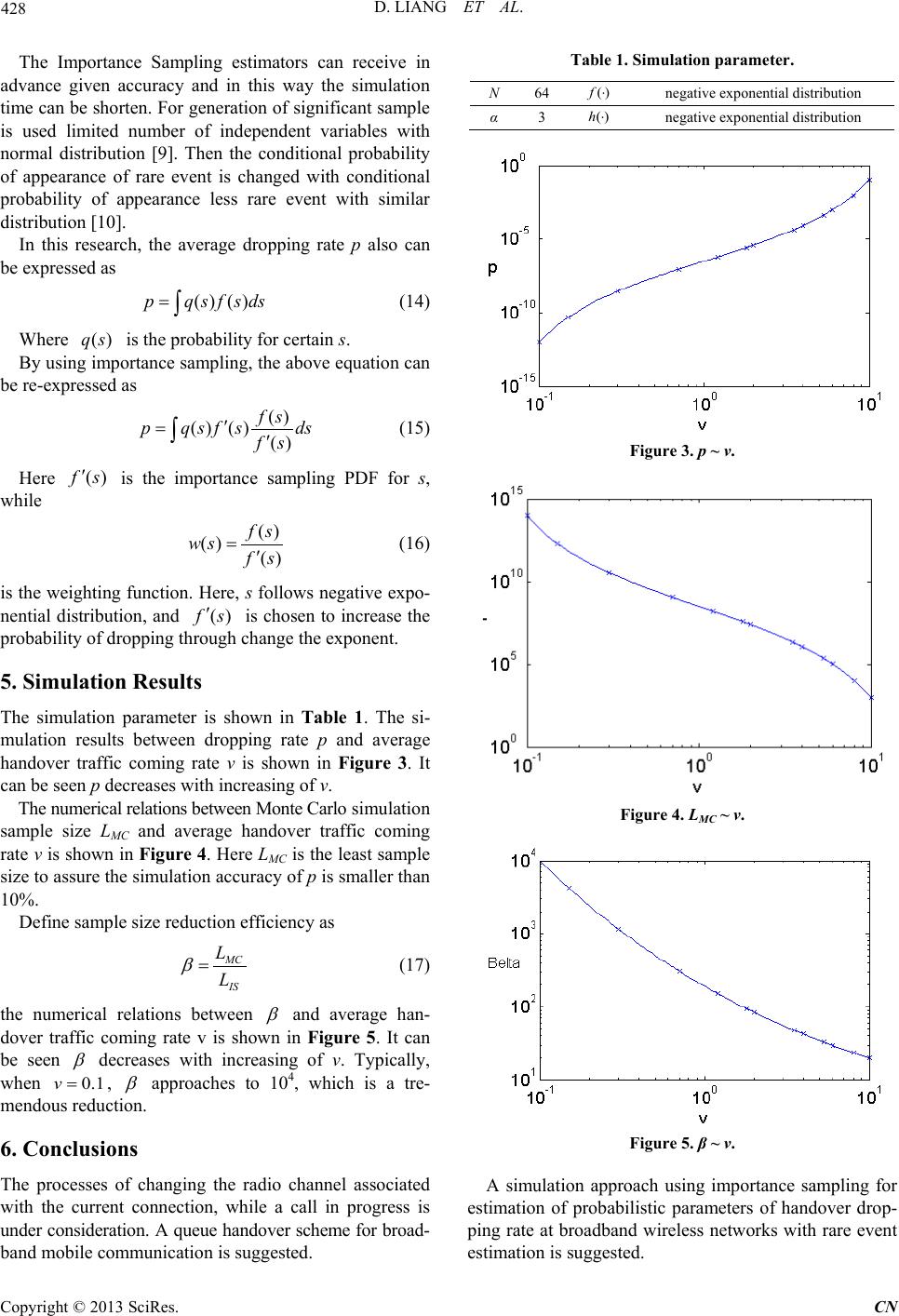 D. LIANG ET AL. Copyright © 2013 SciRes. CN 428 The Importance Sampling estimators can receive in advance given accuracy and in this way the simulation time can be shorten. For generation of significant sample is used limited number of independent variables with normal distribution [9]. Then the conditional probability of appearance of rare event is changed with conditional probability of appearance less rare event with similar distribution [10]. In this research, the average dropping rate p also can be ex pressed as () ()pq sfsds=∫ (14) Where ()qs is the probability for certain s. By using importance sampling, the above equation can be re-expressed as () () ()() fs pqsfsds fs ′ =′ ∫ (15) Here ()fs ′ is the importance sampling PDF for s, while () () () fs ws fs =′ (16) is the weighting f unction. Here, s follows negative expo- nential distribution, and ()fs ′ is chosen to increase the probability of dropping through change the exponent. 5. Simulation Results The simulation parameter is shown in Table 1. The si- mulation results between dropping rate p and average handover traffic coming rate v is shown in Figure 3. It can be seen p decreases with increasing of v. The numerical relations between Monte Carlo simulation sample size LMC and average handover traffic coming rate v is shown in Figure 4. Here LMC is the least sample size to assure the simulation accurac y of p is smaller than 10%. Define sample size reduction efficiency as MC IS L L β = (17) the numerical relations between β and average han- dover traffic coming rate v is shown in Figure 5. It can be seen β decreases with increasing of v. Typically, when 0.1v= , β approaches to 104, which is a tre- mendous reduction. 6. Conclusions The processes of changing the radio channel associated with the current connection, while a call in progress is under consideration. A queue handover scheme for broad- band mobile communication is suggested. Table 1. Simulation parameter. N 64 ()f⋅ negative exponential distribution α 3 ()h⋅ negative exponential distribution Figure 3. p ~ v. Figure 4. LMC ~ v. Figure 5. β ~ v. A simulation approach using importance sampling for estimation of probabilistic parameters of handover drop- ping rate at broadband wireless networks with rare event estimation is suggested.  D. LIANG ET AL. Copyright © 2013 SciRes. CN 429 The simulation results show that the dropping rate de- decreases with increasing of average handover traffic coming rate v. By using importance sampling, the sample size reduction efficiency β decreases with increasing of v. typically, when v is very small and β appro- aches a tremendous reduction. REFERENCES [1] C. H. M. De L ima, M. Bennis and M. Latva-aho, “Statis- tical Analysis of Self-Organizing Networks with Biased Cell Association and Interference Avoidance,” IEEE Transac- tions on Vehicular Technology, Vol. 62, No. 5, 2013, pp. 1950-1961. [2] Y. Zhang, “Handoff Performance in Wireless Mobile Networks with Unreliable Fading Channel,” IEEE Trans- actions on Mobile Computing, Vol. 9, No. 2, 2010, pp. 188-200. http://dx.doi.org/10.1109/TMC.2009.115 [3] Q.-A. Zeng and D. P. Agrawal, “Handoff in Wireless Mobile Networks, Handbook of Wireless Networks and Mobile Computing,” John Wiley & Sons, New York, 2002. [4] H. Kwon, M.-J. Yang, A.-S. Park and S. Venkatesan, “Handover Prediction Strategy for 3G-WLAN Overlay Networks,” IEEE Network Operations and Management Symposium, NOMS 2008, 2008. [5] 3GPP TS 23.009: Handover Procedures. [6] F. Tsvetanov, D. Radev, E. Otsetova-Dudin and S. Rade- va, “Rare Event Simulation for a Handover Priority Scheme,” 20th Telecommunications Forum (TELFOR) Belgrade, 20-22 November 2012. [7] S. Radev and D. Radev, “Modeling of Handover Priority Schemes for Broadband Wireless Networks,” Interna- tional Journal of Applied Research on Information Tech- nology and Computing (IJARITAC), Vol. 1, No 3, 2010, pp. 322-335. http://dx.doi.org/10.5958/j.0975-8070.1.3.025 [8] J. Bucklew, “An Introduction to Rare Event Simulation. Springer Series in Statistics,” Springer-Verlag, Berlin, 2004. http://dx.doi.org/10.1007/978-1-4757-4078-3 [9] E. Ivanova, S. Radeva and D. Radev, “Rare Events and Quality of Services for IPv6 Networks,” Journal of Elec- tro Techniques and Electronics, Vol. 46 No. 7-8, 2011, pp. 12-17. [10] A. Masmoudi, F. Bellili, S. Affes and A. Stephenne, “A New Importance-Sampling-Based Non-Data-Aided Maxi- mum Likelihood Time Delay Estimator,” IEEE Wireless Communications and Networking Conference (WCNC), 2011, pp. 1682-1687. |