

Paper Menu >>
Journal Menu >>
 Vol.3, No.1, 65-68 (2011) Natural Science http://dx.doi.org/10.4236/ns.2011.31009 Copyright © 2011 SciRes. OPEN ACCESS Entropy changes in the clustering of galaxies in an expanding universe Naseer Iqbal1,2*, Mohammad Shafi Khan1, Tabasum Masood1 1Department of Physics, University of Kashmir, Srinagar, India; *Corresponding Author: [email protected] 2Interuniversity Centre for Astronomy and Astrophysics, Pune, India. Received 19 October 2010; revised 23 November 2010; accepted 26 November 2010. ABSTRACT In the present work the approach-thermody- namics and statistical mechanics of gravitating systems is applied to study the entropy change in gravitational clustering of galaxies in an ex- panding universe. We derive analytically the expressions for gravitational entropy in terms of temperature T and average density n of the par- ticles (galaxies) in the given phase space cell. It is found that during the initial stage of cluster- ing of galaxies, the entropy decreases and fi- nally seems to be increasing when the system attains virial equilibrium. The entropy changes are studied for different range of measuring correlation parameter b. We attempt to provide a clearer account of this phenomena. The entropy results for a system consisting of extended mass (non-point mass) particles show a similar behaviour with that of point mass particles clustering gravitationally in an expanding uni- verse. Keywords: Gravitational Clustering; Thermodynamics; Entropy; Cosmology 1. INTRODUCTION Galaxy groups and clusters are the largest known gravitationally bound objects to have arisen thus far in the process of cosmic structure formation [1]. They form the densest part of the large scale structure of the uni- verse. In models for the gravitational formation of struc- ture with cold dark matter, the smallest structures col- lapse first and eventually build the largest structures; clusters of galaxies are then formed relatively. The clus- ters themselves are often associated with larger groups called super-clusters. Clusters of galaxies are the most recent and most massive objects to have arisen in the hiearchical structure formation of the universe and the study of clusters tells one about the way galaxies form and evolve. The average density n and the temperature T of a gravitating system discuss some thermal history of cluster formation. For a better larger understanding of this thermal history it is important to study the entropy change resulting during the clustering phenomena be- cause the entropy is the quantity most directly changed by increasing or decreasing thermal energy of intraclus- ter gas. The purpose of the present paper is to show how entropy of the universe changes with time in a system of galaxies clustering under the influence of gravitational interaction. Entropy is a measure of how disorganised a system is. It forms an important part of second law of thermody- namics [2,3]. The concept of entropy is generally not well understood. For erupting stars, colloiding galaxies, collapsing black holes - the cosmos is a surprisingly or- derly place. Supermassive black holes, dark matter and stars are some of the contributors to the overall entropy of the universe. The microscopic explanation of entropy has been challenged both from the experimental and theoretical point of view [11,12]. Entropy is a mathe- matical formula. Standard calculations have shown that the entropy of our universe is dominated by black holes, whose entropy is of the order of their area in planck units [13]. An analysis by Chas Egan of the Australian National University in Canberra indicates that the col- lective entropy of all the supermassive black holes at the centers of galaxies is about 100 times higher than previ- ously calculated. Statistical entropy is logrithmic of the number of microstates consistent with the observed macroscopic properties of a system hence a measure of uncertainty about its precise state. Statistical mechanics explains entropy as the amount of uncertainty which remains about a system after its observable macroscopic properties have been taken into account. For a given set of macroscopic quantities like temperature and volume, the entropy is a function of the probability that the sys- tem is in various quantumn states. The more states available to the system with higher probability, the  N. Iqbal et al. / Natural Science 3 (2011) 65-68 Copyright © 2011 SciRes. OPEN ACCESS 66 greater the disorder and thus greater the entropy [2]. In real experiments, it is quite difficult to measure the en- tropy of a system. The technique for doing so is based on the thermodynamic definition of entropy. We discuss the applicability of statistical mechanics and thermodynam- ics for gravitating systems and explain in what sense the entropy change S – S0 shows a changing behaviour with respect to the measuring correlation parameter b = 0 – 1. 2. THERMODYNAMIC DESCRIPTION OF GALAXY CLUSTERS A system of many point particles which interacts by Newtonian gravity is always unstable. The basic insta- bilities which may occur involve the overall contraction (or expansion) of the system, and the formation of clus- ters within the system. The rates and forms of these in- stabilities are governed by the distribution of kinetic and potential energy and the momentum among the particles. For example, a finite spherical system which approxi- mately satisfies the viral theorem, contracts slowly compared to the crossing time ~ 12 G due to the evaporation of high energy particles [3] and the lack of equipartition among particles of different masses [4]. We consider here a thermodynamic description for the sys- tem (universe). The universe is considered to be an infi- nite gas in which each gas molecule is treated to be a galaxy. The gravitational force is a binary interaction and as a result a number of particles cluster together. We use the same approximation of binary interaction for our universe (system) consisting of large number of galaxies clustering together under the influence of gravitational force. It is important to mention here that the characteri- zation of this clustering is a problem of current interest. The physical validity of the application of thermody- namics in the clustering of galaxies and galaxy clusters has been discussed on the basis of N-body computer simulation results [5]. Equations of state for internal energy U and pressure P are of the form [6]: 312 2 NT Ub (1) 1 NT Pb V (2) b defines the measuring correlation parameter and is dimensionless, given by [8] 2 0 2,, 23 Wn bGmnTrrdr KT (3) W is the potential energy and K the kinetic energy of the particles in a system. nNV is the average number density of the system of particles each of mass m, T is the temperature, V the volume, G is the universal gravitational constant. ,,nTr is the two particle correlation function and r is the inter-particle distance. An overall study of ,,nTr has already been dis- cussed by [7]. For an ideal gas behaviour b = 0 and for non-ideal gas system b varies between 0 and 1. Previ- ously some workers [7,8] have derived b in the form of: 3 3 1 nT bnT (4) Eq.4 indicates that b has a specific dependence on the combination 3 nT . 3. ENTROPY CALCULATIONS Thermodynamics and statistical mechanics have been found to be equal tools in describing entropy of a system. Thermodynamic entropy is a non-conserved state func- tion that is of great importance in science. Historically the concept of entropy evolved in order to explain why some processes are spontaneous and others are not; sys- tems tend to progress in the direction of increasing en- tropy [9]. Following statistical mechanics and the work carried out by [10], the grand canonical partition func- tion is given by 3 21 3 2 12 ,1 ! N N N N mkT ZTVV nT N (5) where N! is due to the distinguishability of particles. represents the volume of a phase space cell. N is the number of paricles (galaxies) with point mass approxi- mation. The Helmholtz free energy is given by: ln N A TZ (6) Thermodynamic description of entropy can be calcu- lated as: , N V A ST (7) The use of Eq.5 and Eq.6 in Eq.7 gives 3 12 0lnln 13SSnTb b (8) where S0 is an arbitary constant. From Eq.4 we write 3 1 b nbT (9) Using Eq.9, Eq.8 becomes as 3 2 03lnSSb bT (10) Again from Eq.4 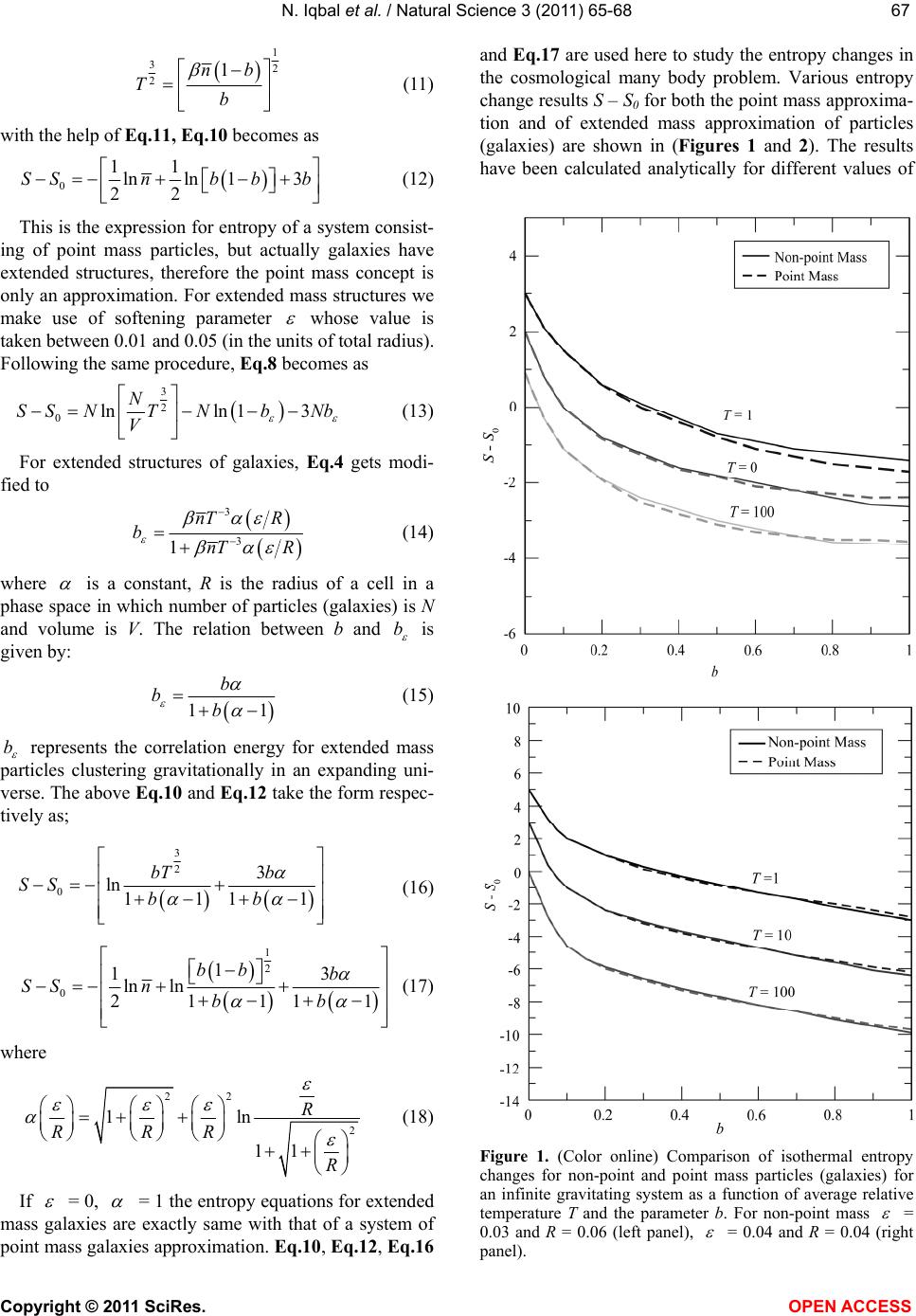 N. Iqbal et al. / Natural Science 3 (2011) 65-68 Copyright © 2011 SciRes. OPEN ACCESS 6767 1 32 21nb Tb (11) with the help of Eq.11, Eq.10 becomes as 0 11 lnln 13 22 SSnb bb (12) This is the expression for entropy of a system consist- ing of point mass particles, but actually galaxies have extended structures, therefore the point mass concept is only an approximation. For extended mass structures we make use of softening parameter whose value is taken between 0.01 and 0.05 (in the units of total radius). Following the same procedure, Eq.8 becomes as 3 2 0lnln 13 N SS NTNbNb V (13) For extended structures of galaxies, Eq.4 gets modi- fied to 3 3 1 nT R bnT R (14) where is a constant, R is the radius of a cell in a phase space in which number of particles (galaxies) is N and volume is V. The relation between b and b is given by: 11 b bb (15) b represents the correlation energy for extended mass particles clustering gravitationally in an expanding uni- verse. The above Eq.10 and Eq.12 take the form respec- tively as; 3 2 0 3 ln 1111 bT b SS bb (16) 1 2 0 1 13 ln ln 21111 bb b SSn bb (17) where 22 2 1ln 11 R RRR R (18) If = 0, = 1 the entropy equations for extended mass galaxies are exactly same with that of a system of point mass galaxies approximation. Eq.10, Eq.12 , Eq.16 and Eq.17 are used here to study the entropy changes in the cosmological many body problem. Various entropy change results S – S0 for both the point mass approxima- tion and of extended mass approximation of particles (galaxies) are shown in (Figures 1 and 2). The results have been calculated analytically for different values of Figure 1. (Color online) Comparison of isothermal entropy changes for non-point and point mass particles (galaxies) for an infinite gravitating system as a function of average relative temperature T and the parameter b. For non-point mass = 0.03 and R = 0.06 (left panel), = 0.04 and R = 0.04 (right panel). 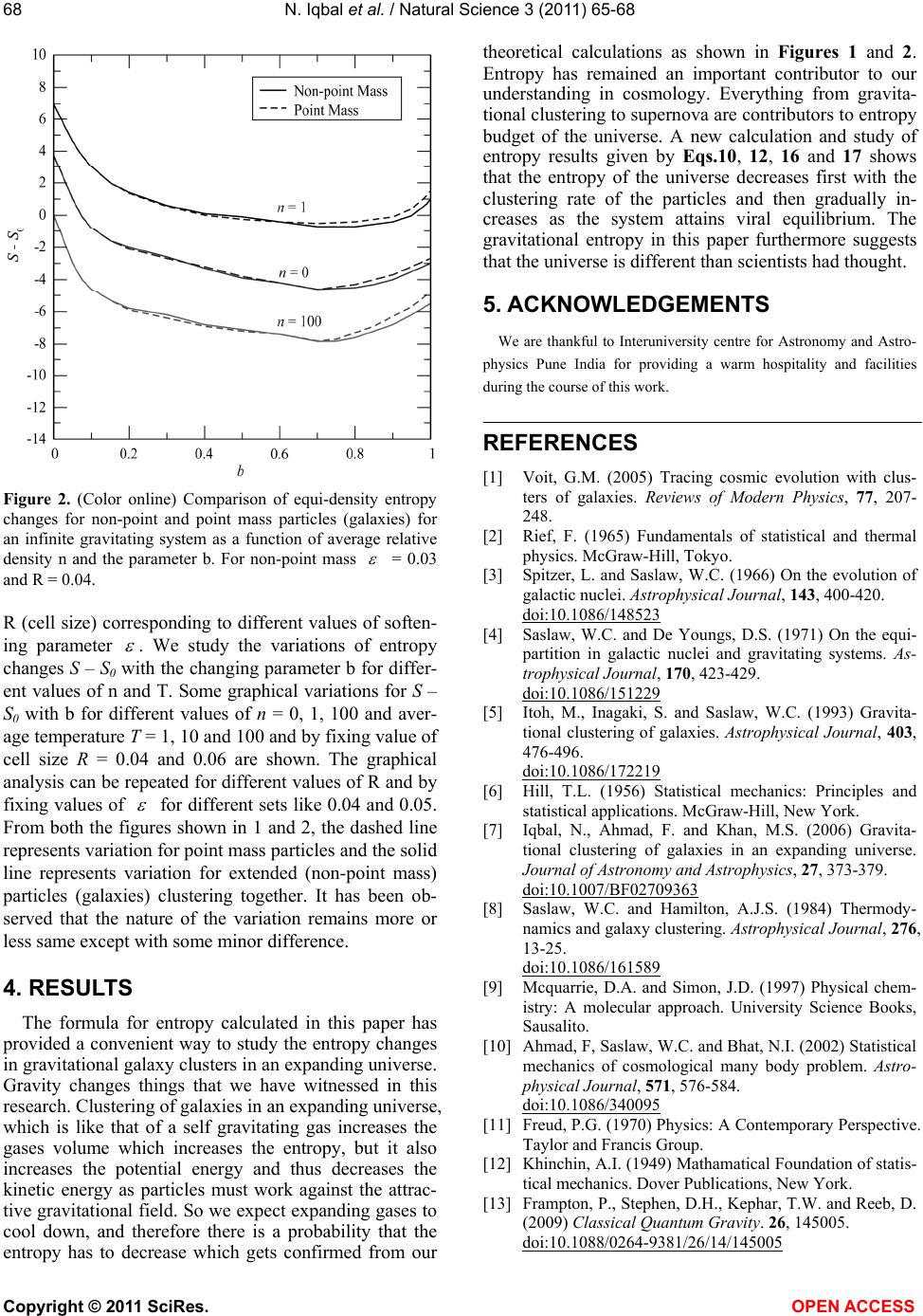 N. Iqbal et al. / Natural Science 3 (2011) 65-68 Copyright © 2011 SciRes. OPEN ACCESS 68 Figure 2. (Color online) Comparison of equi-density entropy changes for non-point and point mass particles (galaxies) for an infinite gravitating system as a function of average relative density n and the parameter b. For non-point mass = 0.03 and R = 0.04. R (cell size) corresponding to different values of soften- ing parameter . We study the variations of entropy changes S – S0 with the changing parameter b for differ- ent values of n and T. Some graphical variations for S – S0 with b for different values of n = 0, 1, 100 and aver- age temperature T = 1, 10 and 100 and by fixing value of cell size R = 0.04 and 0.06 are shown. The graphical analysis can be repeated for different values of R and by fixing values of for different sets like 0.04 and 0.05. From both the figures shown in 1 and 2, the dashed line represents variation for point mass particles and the solid line represents variation for extended (non-point mass) particles (galaxies) clustering together. It has been ob- served that the nature of the variation remains more or less same except with some minor difference. 4. RESULTS The formula for entropy calculated in this paper has provided a convenient way to study the entropy changes in gravitational galaxy clusters in an expanding universe. Gravity changes things that we have witnessed in this research. Clustering of galaxies in an expanding universe, which is like that of a self gravitating gas increases the gases volume which increases the entropy, but it also increases the potential energy and thus decreases the kinetic energy as particles must work against the attrac- tive gravitational field. So we expect expanding gases to cool down, and therefore there is a probability that the entropy has to decrease which gets confirmed from our theoretical calculations as shown in Figures 1 and 2. Entropy has remained an important contributor to our understanding in cosmology. Everything from gravita- tional clustering to supernova are contributors to entropy budget of the universe. A new calculation and study of entropy results given by Eqs.10, 12 , 16 and 17 shows that the entropy of the universe decreases first with the clustering rate of the particles and then gradually in- creases as the system attains viral equilibrium. The gravitational entropy in this paper furthermore suggests that the universe is different than scientists had thought. 5. ACKNOWLEDGEMENTS We are thankful to Interuniversity centre for Astronomy and Astro- physics Pune India for providing a warm hospitality and facilities during the course of this work. REFERENCES [1] Voit, G.M. (2005) Tracing cosmic evolution with clus- ters of galaxies. Reviews of Modern Physics, 77, 207- 248. [2] Rief, F. (1965) Fundamentals of statistical and thermal physics. McGraw-Hill, Tokyo. [3] Spitzer, L. and Saslaw, W.C. (1966) On the evolution of galactic nuclei. Astrophysical Journal, 143, 400-420. doi:10.1086/148523 [4] Saslaw, W.C. and De Youngs, D.S. (1971) On the equi- partition in galactic nuclei and gravitating systems. As- trophysical Journal, 170, 423-429. doi:10.1086/151229 [5] Itoh, M., Inagaki, S. and Saslaw, W.C. (1993) Gravita- tional clustering of galaxies. Astrophysical Journal, 403, 476-496. doi:10.1086/172219 [6] Hill, T.L. (1956) Statistical mechanics: Principles and statistical applications. McGraw-Hill, New York. [7] Iqbal, N., Ahmad, F. and Khan, M.S. (2006) Gravita- tional clustering of galaxies in an expanding universe. Journal of Astronomy and Astrophysics, 27, 373-379. doi:10.1007/BF02709363 [8] Saslaw, W.C. and Hamilton, A.J.S. (1984) Thermody- namics and galaxy clustering. Astrophysical Journal, 276, 13-25. doi:10.1086/161589 [9] Mcquarrie, D.A. and Simon, J.D. (1997) Physical chem- istry: A molecular approach. University Science Books, Sausalito. [10] Ahmad, F, Saslaw, W.C. and Bhat, N.I. (2002) Statistical mechanics of cosmological many body problem. Astro- physical Journal, 571, 576-584. doi:10.1086/340095 [11] Freud, P.G. (1970) Physics: A Contemporary Perspective. Taylor and Francis Group. [12] Khinchin, A.I. (1949) Mathamatical Foundation of statis- tical mechanics. Dover Publications, New York. [13] Frampton, P., Stephen, D.H., Kephar, T.W. and Reeb, D. (2009) Classical Quantum Gravity. 26, 145005. doi:10.1088/0264-9381/26/14/145005 |