

Paper Menu >>
Journal Menu >>
 Creative Education 2013. Vol.4, No.9, 35-40 Published Online Septe mber 201 3 in SciRes (http ://www.scirp.org/journal/ce) http://dx.doi.org/10.4236/ce.2013.49B008 Copyright © 2013 SciRes. 35 Teachers’ Perception towards Total Quality Management Practices in Malaysian Higher Learning Institutions Ahasanul Haque1, Abdullah Sarwar1*, Farzana Yasmin2 1Department of Business Administration, Faculty of Economics and Management Sciences, International Islamic University, Kuala Lumpur, Malaysia 2Faculty of Business and Professional Studies, Management Science University, Kuala Lumpur, Malaysia Email: *[email protected] Received July 2013 The service industry is a rapidly changing industry and this dynamic culture offers a challenge for the service companies to lead or to actually survive in this competitive environment. As the education indus- try is a part of the overall service industry, this raises the need for a solid base to be developed to reach for high quality service in the education industry. Though, adoption of TQM in the higher educational institu- tions is of common practice in the Western world, however, the history of TQM adoption in the Malay- sian higher educational institutions is not very long. Therefore, the main purpose of this study was to identify the factors influencing the level of TQM practices in the Malaysian higher learning institutions based on the teacher’s perceptions. In doing so, this study was conducted in both types of Malaysian higher educational institutions (public and private). Total 300 questionnaires were distributed randomly, out of which 20 6 were returned. After collecting the data, statistical tests were performed using SPSS and Amos. This study has got satisfactory results. Results also show identical results with the previous studies. However, this study has pointed out that there is still room for improvement that affecting the level of TQM practices in the Malaysian educational institutions. Finally, future directions are provided at the end of the paper. Keywords: TQM; Higher Learning Institution; Malaysia; Quality of Life Introduction The service industry is a rapidly changing industry and this dynamic culture offers a challenge for the service companies to lead or to actually survive in this competitive environment. As the education industry is a part of the overall service industry where students are the customers; this particular factor raises the need for a solid base to be developed to reach for high qual - ity service in the education industry. Hence, adaptation of Total Quality Management (TQM) tool can provide the needed qual- ity which wi ll enhance the success of the business. Adoption of TQM in the higher educational institutions is of common pra c ti ce in the Western world (e.g. UK, USA, Aus- tralia, Europe) those adopted TQM in their higher learning in- stitutions with an aim to improve the overall quali ty of the uni- versity to attract more students both from home and abroad (Idrus, 1995). This strategy paid well for the m in reaping a generous amount of revenue from the foreign students (Rampa, 2004). Thus, it is not unusual to observe the great potential of the education industry that has significantly contributed to the developed and the developing countries in terms of sizable eco- nomic advantages and benefits. Though, there are many countries presently offering high quality edu cation around the globe; however, Malaysia’s ac- ceptabi li ty as an international destination for education is yet to come. Thus, there is a need for investigating the teachers’ per- ception on the current level of TQM practices in Malaysian higher learning institutions to identify the present barriers which ha ve been overlooked by the academicians till date. Con- sequently, this study attempts to address the issue to introduce some important indicators of TQM practices currently existed in the Malaysia n higher learning institutions. In addition, policy makers need to find the requirements for sustainable quality education in Malaysia. Literature Revi ew The history of TQM is dated back in 1950’s when Japanese manufacturing industry introduced the concept (Hashmi, 2007). When the Ja pane se realized that there is a need to introduce some special technique through whic h the overall operational process might improve, they gave birth to the concept of TQM (Deming, 1986). According to Brocka and Brocka (1992), TQM is a con- tinuous management process where a whole lot of deliberation is needed in improving the performance of every level of oper - ation by proper management of the both resources; human as well as capital. Töremen, Karakus and Yasan (2009) stated that, organizations are the places which have a defined set of aims and objectives to be achieved. As such, they cannot be thought of as separate from the outside world. To remain competitive, there is always a ne e d to monitor every change that took place inside the organization. This helps is achieving better output for the overall organization. Hence, TQM has become the most vital tool that ensures the organization ’s goals a re achieved and performances are improved (Günbayı & Cevik, 2004). Furthermore, many studies in the literature developed a nd validated TQM critical factors or practices in both manufactur- *Corresponding a uthor.  A. HAQUE ET AL. Copyright © 2013 SciRes. 36 ing and service sectors. According to Waldman (1993), these are calle d “elements”, whereas Dean and Hel ms (1996) describ- ed them as “practices”, Hellsten and Kelfsjo (2000) named them as “techniques”, Reed, Lemak and Montgomery (1996) identi- fied them as “processes” and Sitkin, Sutcliffe and Schroeder (1994) mentioned them as “principles”. Total Quality Management in Education Industry As a modern manageme nt approach, TQM can be used suc- cessfully in education sec t or that are mainly focused on increas- ing the customer satisfaction (Munoz, 1999). Recent researches on TQM have brought a wi dely updated plan for educational reforms and modernization of educational organizations (Mutlu, 2001). The TQM principles have broad applications in educa- tional organizations and have produced desirable outcomes (Munoz, 1999). With these applications, educational institu- tion’s improvement has become a continual process (Sallis, 2002). There is a considerable proximity between the principles of T QM and the principles of effective schools (Balcı, 2002). The practi ce of TQM at schools has provided with a perspective to look at the handicaps facing effective schools and with a tool to remove the obstacles in the way of effective schools ( Ha me - doglu, 2002; Sallis, 2002). In this aspect, the principles of TQM are appropriate for educational settings. “Rapid economic growth, global competition, downsizing, privatization, corporate mergers and the liberalization of global education have caused a surge in demand for TQM implemen- tation in Malaysian higher learning institutions” (Tay, 2001: p. 258). It has become the most prestigious quali ty indicator for measuring the overall quality of an educational institution (Thi- agarajan, 1996). As quality is a fundamental issue in education, the Ma laysian government has al so emphasized in improving the overall education quality for both public and private univer- sities with an aim to attract more foreign students (MOE, 2012). Moreover, the Malaysian government also encourages both pri- vate and public universities to acquire quality certification (ISO 9000, 9002) and TQM adoption with the purpose of meeting international standards (Tenth Malaysia Plan, 2010). However, the current practices of TQM among the various higher learning institutions in Malaysia are not much satisfactory (Ariffin Ahmed & Zain, 2000). Hence, there is a need to upgrade the TQM practices in Malaysia. Attitude towards Implementation The absence of standards and attitudes in the implementation process creates differences in the way employees work, result- ing in educational institution’s maintainability problems (Newby, 1999). Poor documentation of t he development process, in turn, makes educational institutions difficult to maintain and to im- prove (Bostan, 2005). In the education industry, the end product is the students as well as the empl oyees’ satisfaction (Mutlu, 2001). Past studies (Bonnie, 2011; Hashmi, 2007; Oakland & Oakland, 2001; Zhang, 2000) have found that difficulty in im- plementing TQM are the attitude, leadership commit me nt , lac k of understanding and lack of resources. Basi ng on the above literature review, the following hypothes is is drawn: H1: There is a significant relationship between Attitude to- wards Implementation and Teachers’ Perception towards T QM practices. Leadership Commitment Strong leadership and their commitment towards the best practices are of vital importance for any organizations. Thus, there is a need to practi ce the TQM process in e ve ry le vel of the organizational functionality (Sisman & Turan, 2002). As a hu- man focused approach, TQM can make important contributions to the increase of quality of education and the improvement of educational organizations (Hyd e, 1992). As, both the inputs a nd outputs of the educational organizations are human beings, and human beings are the main act ors at all levels and in all pro- cesses of t hese organizations, without t he satisfaction of human beings (both as customers and providers), it is very hard to en- sure the effectiveness of educational organizations (Hashmi, 2007). Therefore, quality issue at this basic level should matte r, if management wants to attain a high quality education system (Lezotte, 1992). Therefore, top management should be c om mit - ted towards their employees with an aim to improve the overall performance (Sisman & Turan, 2002). Basing on the above li- terature review, the following hypothesis is drawn: H2: There is a significant relationship between leadership commitment and teachers’ perception towards TQM practices through attitude towards implementation. Employee Participation According to Stevens (1993), empl oyees are the vital par t of the organization. They are the people who actually execute the tasks. Thus, they should be involved in the decision making process as they some ti me s know better thing then the top man - agement (Chapman & Al-Khawaldeh, 2002). As such, this will help the top management in avoiding the misunderstandings among the employ ees. Beside s, th e mi sunder standi ng and c hange in design problems, there is an additional serious one which is the customers’ increased expectations (Lam, 1996). This makes it really hard to meet the deadline and have a product with a quality high enough to impress the client (Boselie & Wiele, 2002). Hence, there is a need to understand the employees’ requirements with an aim to increase productivity (Guimaraes, 1997). Accordi ng to Dahlgaard and Dahlgaard (2006: p. 271), “in an organization’s management , primarily senior manage- ment decided how the business should operate, including what the pol i c ies and objectives to be; how it should be organized; what jobs to be established; and how they should be done. In early days, it was an unquestioned axiom that if everyone did what the upper management required, the business would be successful”. Basing on the above literature review, the follow- ing hypothes is is drawn: H3: There is a significant relationship be tw een empl oy ee participation and teachers’ perception towards TQM practices through attitude towards implementation. Change Management Both teachers (Yigit & Bayrakdar, 2003) and managers (Yıl- dız, 2006) are aware of their lack of knowledge and skills and the need for a change to implement TQM effectively. There are some psychological, educational, managerial, economica l , cul- tural and systematic problems in the way of succe ssful TQM applications (Hamedoglu, 2002). But the educational institu- tions have the necessary potenti al and determination to solve these problems (Aydın & Sentür k, 2007). Determining the problems and the obstacles in the way of successful TQM im- 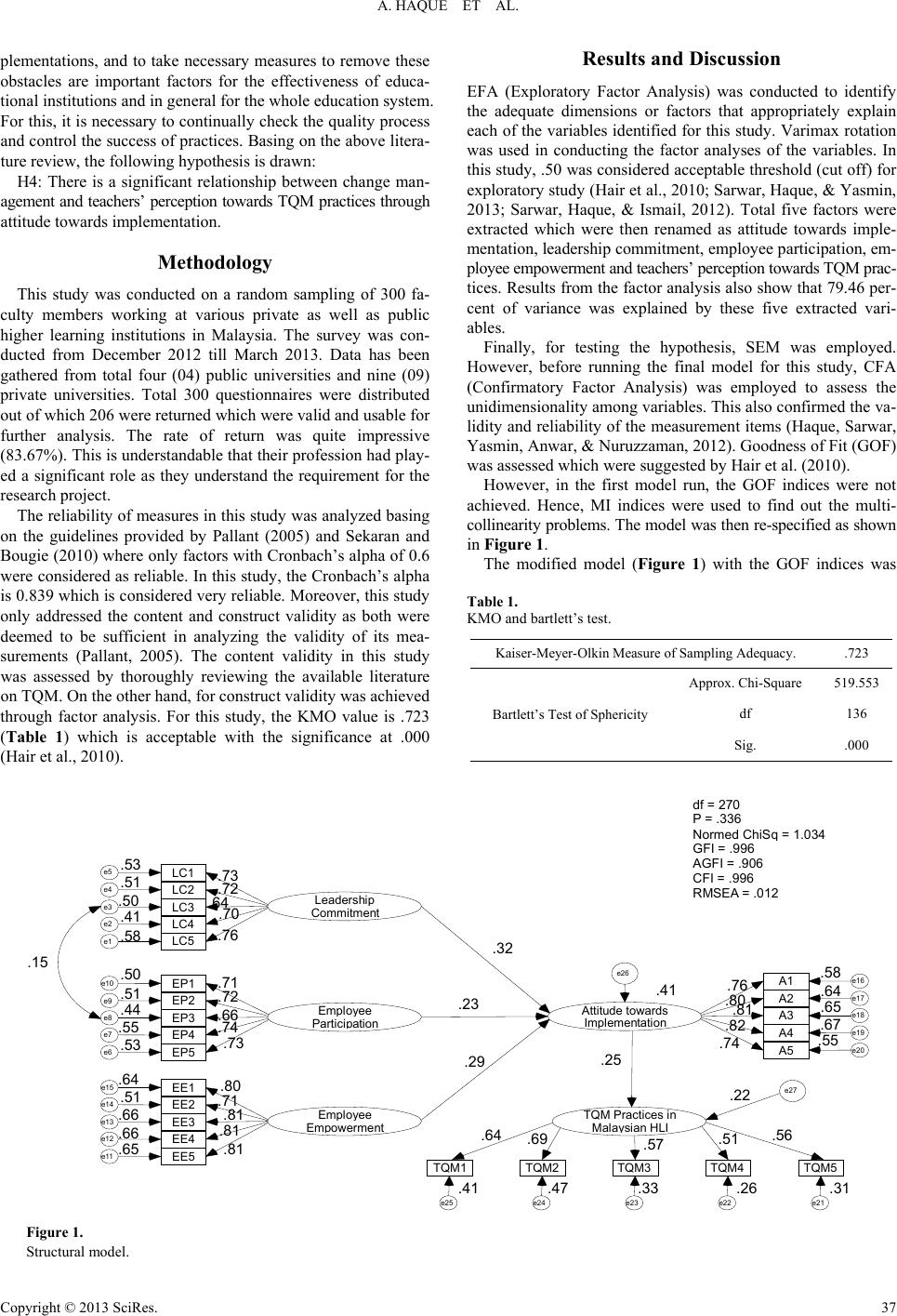 A. HAQUE ET AL. Copyright © 2013 SciRes. 37 plementations, and to take necessary measures to remove these obstacles are important factors for the effectiveness of educa- tional institutions and in general for the whole education system. For this, it is necessary to continually check the quality process and control the success of practice s. Basing on the above litera- ture review, the following hypothesis is drawn: H4: There is a significant relationship between change man- agement and teach ers’ perception towards TQM practices throu gh attitude towards implementation. Methodology This study was conducted on a random sampling of 300 fa- culty members working at various private as well as public higher learning institutions in Malay sia. The survey wa s con- ducted from December 2012 till March 2013. Data has been gathered from total four (04) public universities and nine (09) private universities. Total 300 questionnaires we re distributed out of which 206 wer e returned which were valid and usable for further analysi s. T he rate of return was quite impressive (83.67%). This is understandable that their profession had pl ay - ed a significant role as they understand the requirement for the research project. The relia bi li ty of measures in this study was analyze d ba s ing on the guidelines provided by Pallant (2005) and Sekaran and Bougie (2010) where only factors with Cronbach’s alph a of 0.6 were considered as reliable. In this study, the Cronbach’s alpha is 0.839 whi c h is considered very reliable. Moreover, this study only addressed the content and construct validity as both were deemed to be sufficient in analyzing the validity of its mea- surements (Pallant, 2005). The content validity in this study was assessed by thoroughly reviewing the available literature on TQM. On the other hand, for construct validi ty was achieved through factor analysis. For this study, the KMO value is .723 (Table 1) which is acceptable with the significance at .000 (Hair et al., 2010). Results and Discu ssion EFA (Exploratory Factor Analysis) was conducted to identify the adequate dimensions or factors that appropriately explain each of the variables identified for this study. Varimax rotation was used in conducting the factor analyses of the variables. In this study, .50 was considered acce pt a bl e threshold (cut off) for exploratory study (Hair et al., 2010; Sarwar, Haque, & Yasmin, 2013; Sarwar, Haque, & Ismail, 2012). Total five factors were extracted which were then renamed as attitude towards imple- mentation, leadership commit me nt , employee participation, em- ployee empowermen t an d tea ch ers’ perception towards TQM prac- tices. Results from the factor analysis also show that 79.46 per - cent of variance was explained by these five extracted vari- ables. Finally, for testing the hypothesis, SEM was employed. However, before running the final model for this study, CFA (Confirmatory Factor Analysis) was employed to assess the unidimensionality among variables. This also confirmed the va- lidity and reliability of the measurement items (Haque, Sarwar, Yasmin, Anwar, & Nuruzzaman, 2012). Goodness of Fit (GOF) was assessed whic h were suggested by Hair et al. (2010). However, in the first model run, the GOF indices were not achieved. Hence, MI indices were used to find out the multi- collinearity problems. The model was then re-specified a s shown in Figure 1. The modified model (Figure 1) with the GOF indices was Table 1. KMO and bartlett’s test. Kaiser-Meyer-Olkin Measure of Sampling Adequacy. .723 Bartlett’s Test of Sphericity Approx. Chi-Square 519.553 df 136 Sig. .000 .15 Leadership Commitment .58 LC5 e1 .76 .41 LC4 e2 .64 .50 LC3 e3 .70 .51 LC2 e4 .72 .53 LC1 e5 .73 Employee Participation .53 EP5 e6 .55 EP4 e7 .44 EP3 e8 .51 EP2 e9 .50 EP1 e10 .73 .74 .66 .72 .71 Employee Empowerment .65 EE5 e11 .66 EE4 e12 .66 EE3 e13 .51 EE2 e14 .64 EE1 e15 .81 .81 .81 .71 .80 .41 Attitude towards Implementation .58 A1 e16 .64 A2 e17 .65 A3 e18 .67 A4 e19 .55 A5 e20 .76 .80 .81 .82 .74 .22 TQM Practices in Malaysian HLI .31 TQM5 e21 .26 TQM4 e22 .33 TQM3 e23 .47 TQM2 e24 .41 TQM1 e25 .51 .57 .69 .56 .64 .32 .23 .29 .25 e26 e27 df = 270 P = .336 Normed ChiSq = 1.034 GFI = .996 AGFI = .906 CFI = .996 RMSEA = .012 Figure 1. Structural model. 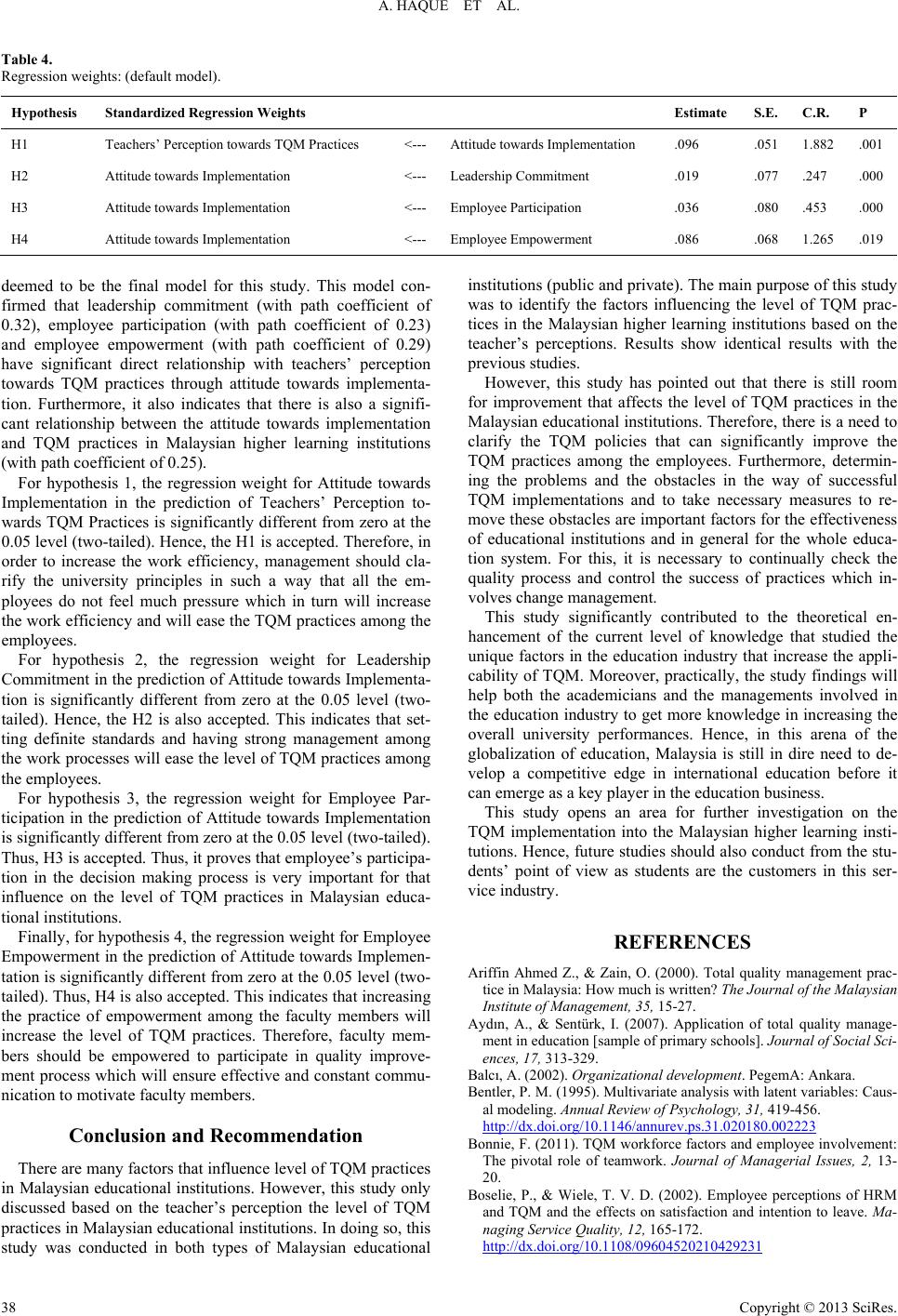 A. HAQUE ET AL. Copyright © 2013 SciRes. 38 Table 4. Regression weights: (default model). Hypothesis Standardized Regression Weights Estimate S.E. C.R. P H1 Teachers ’ Perception towards TQM Practices <--- Attitude towa rds Implementation .096 .051 1.882 .001 H2 Attitude towards Implementation <--- Leadership Commitment .019 .077 .247 .000 H3 Attitude towards Implementation <--- Employee Participation .036 .080 .453 .000 H4 Attitude towards Implementation <--- Employee Empowerment .086 .068 1.265 .019 deemed to be the fina l model for this study. This model con- firmed that leadership commitment (with path coefficient of 0.32), employee participation (with path coefficient of 0.23) and e mpl oy ee empowerment (with path coefficient of 0.29) have significant direct relationship with teachers’ perception towards TQM practices through attitude towards implementa- tion. Furthermore, it also indicates that there is also a signifi- cant relationship between the attitude towards implementation and TQM practices in Malaysian higher learning institutions (with path coefficient of 0.25). For hypothesis 1, the regression weight for Attitude towards Implementation in the prediction of Teachers’ Perception to- wards T QM Practices is significantly different from zero at the 0.05 leve l (two-taile d) . Hence, the H1 is accepted. Therefore, in order to increase the work efficiency, management should cla- rify the university principles in such a way that all the em- ployees do not feel much pressure whic h in turn will increase the work e ffi c iency and will ease the TQM practices among the employees. For hypothes is 2, t he regression weight for Leadership Commitment in the prediction of Attitude towards Implementa- tion is significantly different from zero at the 0.05 level (two- tailed). Hence, the H2 is also accepted. This indicates that set- ting definite standards and having strong management among the work processes will ease the level of TQM practices among the employees. For hypothesis 3, the regression weight for Employee Par- ticipation in the prediction of Attitude towards Implementation is significantly different from zero at the 0.05 level (two-tailed). Thus, H3 is accepted. Thus, it proves t ha t e mpl oyee’s participa- tion in the decision making process is very important for that influence on the level of TQM practices in Malaysian educa- tional institutions. Finally, for hypothesis 4, the regression weight for Employee Empowerment in the prediction of Attitude towards Impl e me n - tation is significantly different from zero at the 0.05 level (two- tailed). Thus, H4 is also accepted. This indicates that increasing the practice of empowerment among the facul ty members will increase the level of TQM practices. Therefore, faculty mem- bers should be empowered to participate in quality improve- ment process which will ensure effective and constant commu- nication to motivate faculty members. Conclusion and Recommendation There are many factors that influence level of TQM practices in Malaysian educational institutions. However, thi s study only discussed based on the teacher’s perception the level of TQM practices in Malaysian educational institutions. In doing so, this study was conducted in both types of Malay sian educational institutions (public and private). The main purpose of this study was to identify the factors influencing the level of TQM prac- tices in the Malaysian higher learning institutions based on the teacher’s perceptions. Results show identical results with the previous studies. However, this study has pointed out that there is still room for improvement that affects the level of TQM practices in the Malaysian educational institutions. Therefore, ther e is a need to clarify the TQM policies tha t can significantly improve the TQM practices among the empl oyees. Furthermore, determi n- ing the problems and the obstacles in the way of successful TQM implementations and to take necessary measures to re- move these obstacles are important factors for t he effectiveness of educational institutions and in general for the whole educa- tion system. For this, it is necessary to continually check the quality process and control the success of practices which in- volves change management. This study significantly contributed to the theoretical en- hancement of the current level of knowledge that studied the unique factors in the education industry that increase the appli- cabili ty of TQM. Moreover, pr act ica l ly , the study findings will help both the acade mi c ia ns and the managements involved in the education industry to get more knowledge in increasing the overall university performances. Hence, in this arena of the globalization of education, Malaysia is still in dire need to de- velop a competitive edge in international education before it can emerge as a key player in the education business. This st ud y opens an area for further investigation on the TQM implementation into the Malaysian higher learning insti- tutions. Hence, future studies should al so conduct from the stu - dents’ point of view as students are the customers in this ser- vice industry. REFERENCES Ariffin Ahmed Z., & Zain, O. (2000). Total quality management prac- tice in Malaysia: How much is written? The Journal of the Malaysian Institute of Management, 35, 15-27. Aydın, A., & Sentürk, I. (2007). Application of total quality manage- men t in education [s a mp l e of primary schools]. Journal of Social Sci- ences, 17, 313-329. Balcı, A. (2002). Organizational development. PegemA: Ankara. Bentler, P. M. (1995). Multivariate analysis with latent variables: Caus- al modeling. Annual Review of Psychology, 31, 419-456. http://dx.doi.org/10.1146/annurev.ps.31.020180.002223 Bonnie, F. (2011). TQM workforce factors and employee involvement: The pivotal role of teamwork. Journal of Managerial Issues, 2, 13- 20. Boselie, P., & Wiele, T. V. D. (2002). Employee perceptions of HRM and TQM and the effects on satisfaction and intention to leave. Ma- naging Service Quality, 12, 165-172. http://dx.doi.org/10.1108/09604520210429231 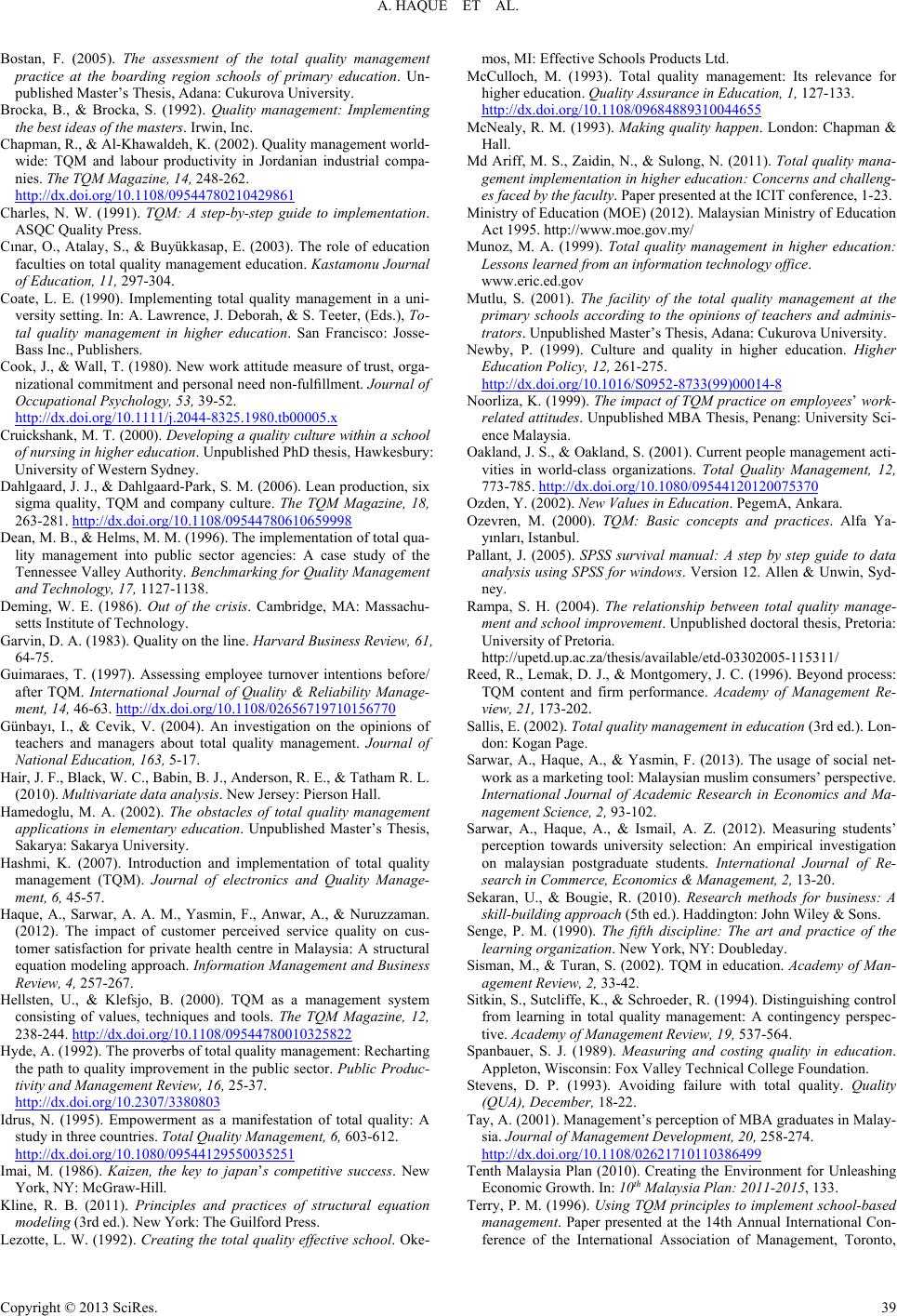 A. HAQUE ET AL. Copyright © 2013 SciRes. 39 Bostan, F. (2005). The assessment of the total quality management practice at the boarding region schools of primary education. Un- published Master’s Thesis, Adana: Cukurova University. Brocka, B., & Brocka, S. (1992). Quality management: Implementing the best ideas of the masters. Irwin, Inc. Chapman, R., & Al-Khawaldeh, K. (2002). Quality management world- wide: TQM and labour productivity in Jordanian industrial c o mp a - nies. The TQM Magazine, 14, 248-262. http://dx.doi.org/10.1108/09544780210429861 Charles, N. W. (1991). TQM: A step-by-step guide to implementation. ASQC Quality Press. Cınar, O., Atalay, S., & Buyükkasap, E. (2003). The role of education faculties on total quality management education. Kastamonu Journal of Education, 11, 297-304. Coate, L. E. (1990). Implementing total quality management in a uni- versity setting. In: A. Lawrence, J. Deborah, & S. Teeter, (Eds.), To- tal quality management in higher education. San Francisco: Josse- Bass Inc., Publishers. Cook, J., & Wall, T. (1980). New work attitude measure of trust, orga- nizational commitment and personal need non-fulfillment. Journal of Occupational Psychology, 53, 39-52. http://dx.doi.org/10.1111/j.2044-8325.1980.tb00005.x Cruickshank, M. T. (2000). Developin g a quality cu lture within a school of nursing in higher education. Unpublished PhD thesis, Hawkesbury: University of Western Sydney. Dahlgaard, J. J., & Dahlgaard-Park, S. M. (2006). Lean production, six si g ma quality, TQM and company culture. The TQM Magazine, 18, 263-281. http://dx.doi.org/10.1108/09544780610659998 Dean, M. B., & Helms, M. M. (1996). The implementation of total qua- lity management into public sector agencies: A case study of the Tennessee Valley Authority. Benchmarking for Quality Management and Technology, 17, 1127-1138. Deming, W. E. (1986). Out of the crisis. Cambridge, MA: Massachu- setts Institute of Technology. Garvin, D. A. (1983). Quality on the line. Harvard Business Review, 61, 64-75. Guimaraes, T. (1997). Assessing employee turnover intentions before/ after TQM. International Journal of Quality & Reliability Manage- ment, 14, 46-63. http://dx.doi.org/10.1108/02656719710156770 Günbayı, I., & Cevik, V. (2004). An investigation on the opinions of teachers and managers about total quality management. Journal of National Education, 163, 5-17. Hair, J. F., Black, W. C., Babin, B. J., Anderson, R. E., & Tatham R. L. (2010). Multivariate data analysis. New Jersey: Pierson Hall. Hamedoglu, M. A. (2002). The obstacles of total quality management applications in elementary education. Unpublished Master’s Thesis, Sakarya: Sakarya University. Hashmi, K. (2007). Introduction and implementation of total quality management (TQM). Journal of electronics and Quality Manage- ment, 6, 45-57. Haque, A., Sarwar, A. A. M., Yasmin, F., Anwar, A., & Nuruzzaman. (2012). The impact of customer perceived service quality on cus- tomer satisfaction for private health centre in Malaysia: A structural equation modeling approach. Information Management and Business Review, 4, 257-267. Hellsten, U., & Klefsjo, B. (2000). TQM as a management system consisting of values, techniques and tools. The TQM Magazine, 12, 238-244. http://dx.doi.org/10.1108/09544780010325822 Hyde, A. (1992). The proverbs of total quality management: Recharting the path to quality improvement in the public sector. Public Produc- tivity and Management Review, 16, 25-37. http://dx.doi.org/10.2307/3380803 Idrus, N. (1995). Empowerment as a manifestation of total quality: A study in three countries. Total Quality Management, 6, 603-612. http://dx.doi.org/10.1080/09544129550035251 Imai, M. (1986). Kaizen, the key to japan’s competitive success. New York, NY: McGraw-Hill. Kline, R. B. (2011). Principles and practices of structural equation modeling (3rd ed.). New York: The Guilford Press. Lezotte, L. W. (1992). Creating the total quality effective school. Oke- mos, MI: Effective Schools Products Ltd. McCulloch, M. (1993). Total quality management: Its relevance for higher education. Quality Assurance in Education, 1, 127-133. http://dx.doi.org/10.1108/09684889310044655 McNealy, R. M. (1993). Making quality happen. London: Chapma n & Hall. Md Ariff, M. S., Zaidin, N., & Sulong, N. (2011). Total quality mana- gement implementation in higher education: Concerns and challeng- es faced by the faculty. Paper presented at the ICIT conference, 1-23. Ministry of Education (MOE) (2012). Malaysian Ministry of Education Act 1995. http://www.moe.gov.my/ Munoz, M. A. (1999). Total quality management in higher education: Lessons learned fro m an information technology office. www.eric.ed.gov Mutlu, S. (2001). The facility of the total quality management at the primary schools according to the opinions of teachers and adminis- trators. Unpublished Master’s Thesis, Adana: Cukurova University. Newby, P. (1999). Culture and quality in higher education. Higher Education Policy, 12, 261-275. http://dx.doi.org/10.1016/S0952-8733(99)00014-8 Noorliza, K. (1999). The impact of TQM practice on employees’ work- related attitudes. Unpublished MBA Thesis, Penang: University Sci- ence Malaysia. Oakland, J. S., & Oakland, S. (2001). Current people management acti- vities in world-class organizations. Total Quality Management, 12, 773-785. http://dx.doi.org/10.1080/09544120120075370 Ozden, Y. (2002). New Values in Education. PegemA, Ankara. Ozevren, M. (2000). TQM: Basic concepts and practices. Alfa Ya- yınları, Istanbul. Pallant, J. (2005). SPSS survival manual: A step by step guide to data analysis using SPSS for windows. Version 12. Allen & Unwin, Syd- ney. Ra mp a , S. H. (2004). The relationship between total quality manage- ment and school improvement. Unpublished doctoral thesis, Pretoria: University of Pretoria. http://upetd.up.ac.za/thesis/available/etd-03302005-115311/ Reed, R., Lemak, D. J., & Montgomery, J. C. (1996). Beyond process: TQM content and firm performance. Academy of Management Re- view, 21, 173-202. Sallis, E. (2002). Total quality management in education (3rd ed.). Lon- don: Kogan Page. Sarwar, A., Haque, A., & Yasmin, F. (2013). The usage of social net- work as a marketing tool: Malaysian mus lim consumers’ perspective. International Journal of Academic Research in Economics and Ma- nagement Science, 2, 93-102. Sarwar, A., Haque, A., & Ismail, A. Z. (2012). Measuring students’ perception towards university selection: An empirical investigation on malaysian postgraduate students. International Journal of Re- search in Commerce, Economics & Management, 2, 13-20. Sekaran, U., & Bougie, R. (2010). Research methods for business: A skill-building approach (5th ed.). Haddington: John Wiley & Sons. Senge, P. M. (1990). The fifth discipline: The art and practice of the learning organization. New York, NY: Doubleday. Sisman, M., & Turan, S. (2002). TQM in education. Academy of Man- agement Review, 2, 33-42. Sitkin, S., Sutcliffe, K., & Schroeder, R. (1994). Distinguishing control from learning in total quality management: A contingency perspec- tive. Academy of Management Review, 19, 537-564. Spanbauer, S. J. (1989). Measuring and costing quality in education. Appleton, Wisconsin: Fox Valley Technical College Foundation. Stevens, D. P. (1993). Avoiding failure with total quality. Quality (QUA), December, 18-22. Tay, A. (2001). Management’s perception of MBA graduates in Malay- sia. Journal of Management Development, 20, 258-274. http://dx.doi.org/10.1108/02621710110386499 Tenth Malaysia Plan (2010). Creating the Environment for Unleashing Economic Growth. In: 10th Malaysia Plan: 2011-2015, 133. Terry, P. M. (1996). Using TQM principles to implement school-based management. Paper presented at the 14th Annual International Con- ference of the International Association of Management, Toronto,  A. HAQUE ET AL. Copyright © 2013 SciRes. 40 August. Thiagarajan, T. (1996). An empirical study of total quality management in Malaysia: A proposed framework of generic application. Unpub- lished PhD Thesis, University of Bradford. Töremen, F., Karakus, M., & Yasan, T. (2009). Total quality manage- men t practices in Turkish primary schools. Quality Assurance in Education, 17, 30-44. http://dx.doi.org/10.1108/09684880910929917 Tribus, M. (1993). Quality management in education. J ournal for Qua- lity and Participation, 16, 12-21. Waldman, D. A. (1993). A theoretical consideration of leadership and total quality management. The Leadership Quarterly, 4, 65-79. http://dx.doi.org/10.1016/1048-9843(93)90004-D Yigit, B., & Bayrakdar, M. (2003). Teachers’ perceptions on the appli- cability of TQM principles at primary schools. Journal of National Education, 158, 723-741. Yıldız, E. (2006). Total quality management in secondar y schools: The case of Iskenderun. Unpublished Master’s Thesis, Hatay: Mustafa Kemal University. Zain, O., Goon, C. A., & Wan Aris, W. H. (1998). Quality services: Policies and practices in Malaysia. Library Management, 19, 11-21. Zainudin, A. (2012). A handbook on SEM: Structural equation model- ling using amos graphics (4th ed.). Kelantan: University Technology MARA Press. Zhang, Z. H. (2000). Developing a model of quality management me- thods and evaluating their effects on business performance. Total Quality Management, 11, 129-137. http://dx.doi.org/10.1080/0954412007071 |