

Paper Menu >>
Journal Menu >>
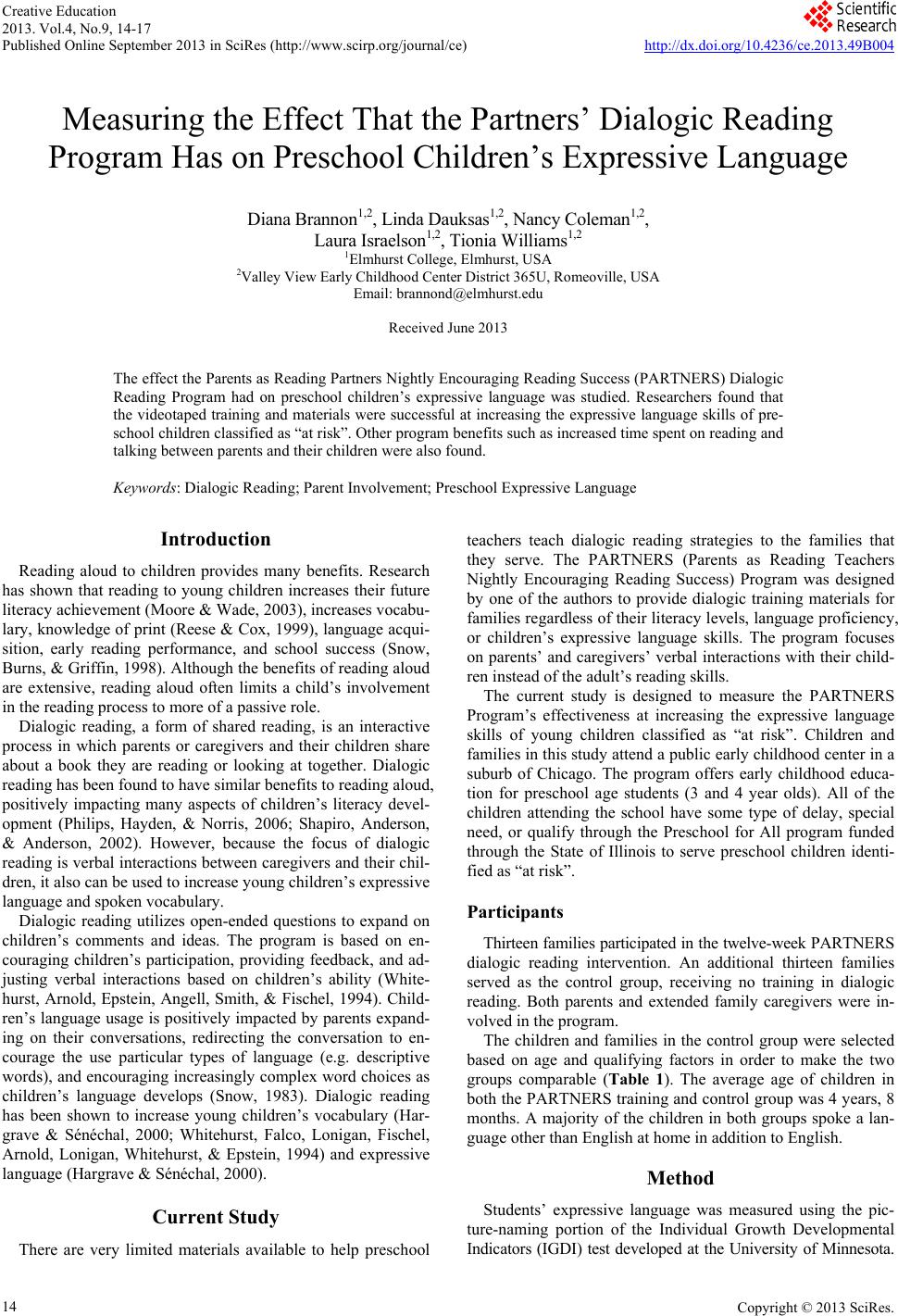 Creative Education 2013. Vol.4, No.9, 14-17 Published Online September 2013 in SciRes (http://www.scirp.org/journal/ce) http://dx.doi.org/10.4236/ce.2013.49B004 Copyright © 2013 SciRes. 14 Measuring the Effect That the Partners’ Dialogic Reading Program Has on Preschool Children’s Expressive Language Diana Bra nnon1,2, Li nda Dauks as1,2, Nancy Coleman1,2, Laura Israelson1,2, Tionia Williams1,2 1Elmhurst College, Elmhurst, USA 2Valley View Early Childhood Center District 365U, Romeoville, USA Email: [email protected] Received June 2013 The effect the Parents as Reading Partners Nightly Encouraging Reading Success (PARTNERS) Dialogic Reading Program had on preschool children’s expressive language was studied. Researchers found that the videotaped training and materials were successful at increasing the expressive language skills of pre- school children classified as “at risk”. Other program benefits such as increased time spent on reading and talking between parents and their children were also found. Keywords: Dialogic Reading; Parent Involvement; Preschool Expressive Language Introduction Reading aloud to children provides many benefits. Research has shown that reading to young children increases their future litera cy achievement (Moore & Wade, 2003), increases vocabu- lary , knowledge of print (Reese & Cox, 1999), language acqui- sition, early reading performance, and school success (Snow, Burns, & Griffin, 1998). Although the benefits of reading aloud are extensive, reading aloud often limits a child’s involvement in the reading process to more of a passive role. Dialogic reading, a form of shared reading, is an interactive process in which parents or caregivers and their children share about a book they are reading or looking at together. Dialogic reading has been found to have similar benefits to reading aloud, positively impacting many aspects of children’s literacy devel- opment (Philips, Hayde n, & Norris, 2006; Shapiro, Anderson, & Anderson, 2002). However, because the focus of dialogic reading is verbal interactions between caregivers and their chil- dren, it also can be used to increase young children’s expressive language and spoken vocabulary. Dialogic reading utilizes open-ended questions to expand on children’s comments and ideas. The program is based on en- couraging children’s participation, providing feedback, and ad- justing verbal interactions based on children’s ability (White- hurst, Arnold, Epstein, Angell, Smith, & Fischel, 1994). Child- ren’s language usage is positively impacted by parents expand- ing on their conversations, redirecting the conversation to en- courage the use particular types of language (e.g. descriptive words), and encouraging increasingly complex word choices a s children’s language develops (Snow, 1983). Dialogic reading has been shown to increase young children’s vocabulary (Har- grave & Sénéchal, 2000; Whitehurst, Falco, Lonigan, Fischel, Arnold, Lonigan, Whitehurst, & Epstein, 1994) and expressive language (Hargrave & Sénéchal, 2000). Current Study There are very limited materials available to help preschool teachers teach dialogic reading strategies to the families that they serve. The PARTNERS (Parents as Reading Teachers Nightly Encouraging Reading Success) Program was designed by one of the authors to provide dialogic training materials for families regardless of their literacy levels, langua ge proficiency, or children’s expressive language skills. The program focuses on parents’ and c aregivers’ verbal interactions with their child- ren instead of the adult’s reading skills. The current study is designed to measure the PARTNERS Program’s effectiveness at increasing the expressive language skills of young children classified as “at risk”. Children and families in this study attend a public early childhood center in a suburb of Chicago. The program offers early childhood educa- tion for preschool age students (3 and 4 year olds). All of the children attending the school have some type of delay, special need, or qualify through the Preschool for All program funded through the State of Illinois to serve preschool children identi- fied as “at risk”. Parti ci pa nt s Thirteen families participated in the twelve-week PARTNE RS dialogic reading intervention. An additional thirteen families served as the control group, receiving no training in dialogic reading. Both parents and extended family caregivers were in- volved in the program. The children and families in the control group were selected based on age and qualifying factors in order to make the two groups comparable (Table 1). The average age of children in both the PARTNERS training and control group was 4 years, 8 months. A majority of the children in both groups spoke a lan- guage other than English at home in addition to English. Method Students’ expressive language was measured using the pic- ture-naming portion of the Individual Growth Developmental Indicators (IGDI) test developed at the University of Minnesota. 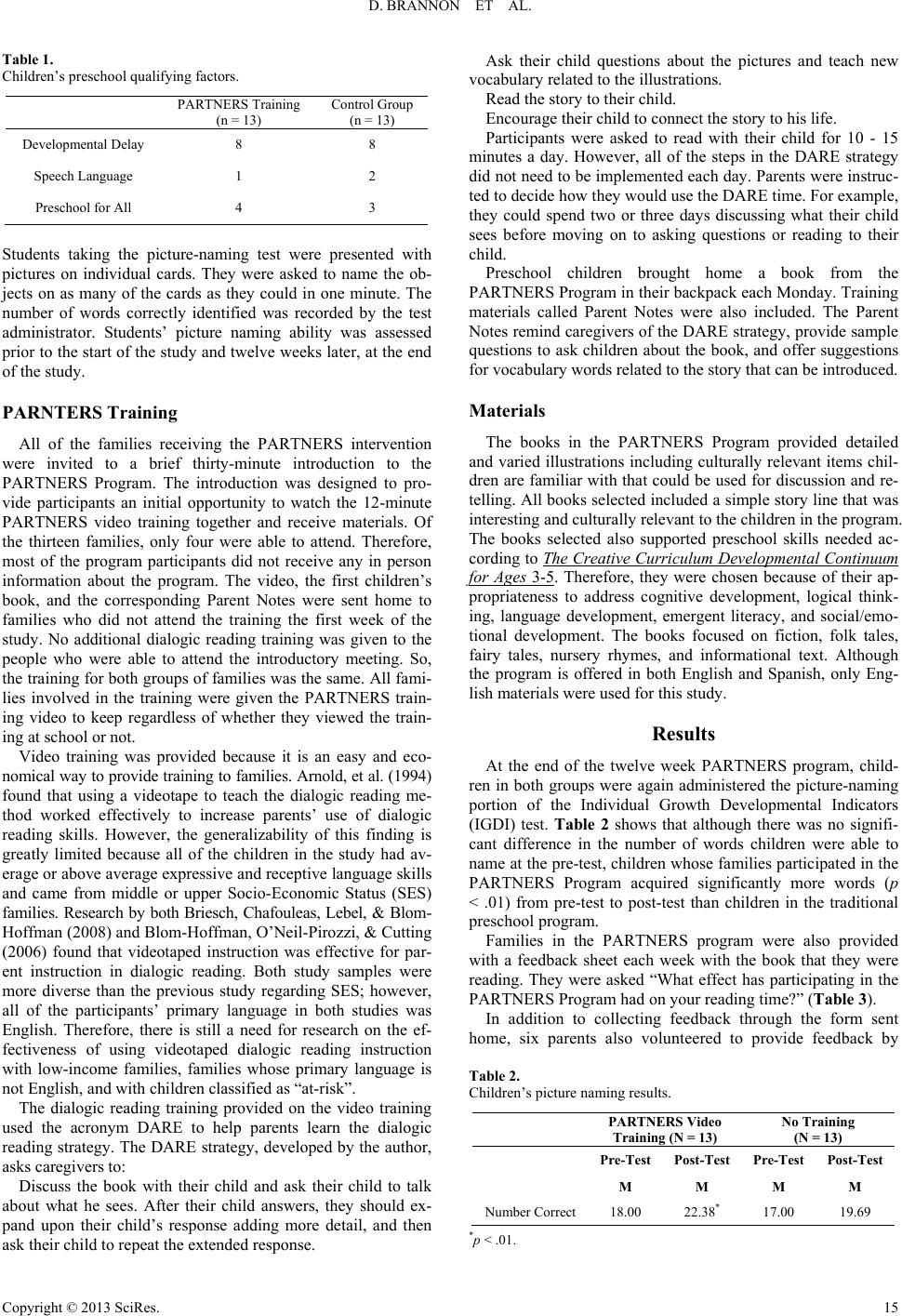 D. BRANNON ET AL. Copyright © 2013 SciRes. 15 Table 1. Children’s preschool qualifying factors. PARTNERS Traini n g (n = 13) Contr ol Group (n = 13) Developmental Delay 8 8 Speech Language 1 2 Preschool for All 4 3 Students taking the picture-naming test were presented with pictures on individual cards. They were asked to name the ob- jects on as many of the cards as they could in one minute. The number of words correctly identified was recorded by the test administrator. Students’ picture naming ability was assessed prior to the start of the study and twelve weeks later, a t the end of the study. PARNTERS Training All of the families receiving the PARTNERS intervention were invited to a brief thirty-minute introduction to the PARTNERS Program. The introduction was designed to pro- vide participants an initial opportunity to watch the 12-minute PARTNERS video training together and receive materials. Of the thirteen families, only four were able to attend. Therefore, most of the program participants did not receive any in person information about the program. The video, the first children’s book, and the corresponding Parent Notes were sent home to families who did not attend the training the first week of the study. No additional dialogic reading training was given to the people who were able to attend the introductory meeting. So, the training for both groups of families was the same. All fami- lies involved in the training were given the PARTNERS train- ing video to keep regardless of whether they viewed the train- ing at school or not. Video training was provided because it is an easy and eco- nomical way to provide traini ng to families. Arnold, e t al. (1994) found that using a videotape to teach the dialogic reading me- thod worked effectively to increase parents’ use of dialogic reading skills. However, the generalizability of this finding is greatly limited because all of the children in the study had av- erage or above average expressive and receptive language skills and came from middle or upper Socio-Economic Status (SES) families. Research by both Briesch, Chafouleas, Lebel, & Blom- Hoffman (2008) and Blom-Hoffman, O’Neil-Pirozzi, & Cutting (2006) found that videotaped instruction was effective for par- ent instruction in dialogic reading. Both study samples were more diverse than the previous study regarding SES; however, all of the participants’ primary language in both studies was English. Therefore, there is still a need for research on the ef- fectiveness of using videotaped dialogic reading instruction with low-income families, families whose primary language is not English, and with children classified as “at-risk”. The dialogic reading training provided on the video training used the acronym DARE to help parents learn the dialogic reading strategy. The DARE strategy, developed by the author, asks caregivers to: Discuss the book with their child and ask their child to talk about what he sees. After their child answers, they should ex- pand upon their child’s response adding more detail, and then ask their child to repeat the extended response. Ask their child questions about the pictures and teach new vocabulary related to the illustrations. Read the story to their child. Encourage thei r child to connect the story to his life. Participants were asked to read with their child for 10 - 15 minutes a day. However, all of the steps in the DARE strategy did not need to be implemented each day. Parents were instruc- ted to decide how they would use the DARE time. For example, they could spend two or three days discussing what their child sees before moving on to asking questions or reading to their child. Preschool children brought home a book from the PARTNERS Program in their backpack each Monday. Training materials called Parent Notes were also included. The Parent Notes remind caregivers of the DARE strategy, provide sample questions to ask children about the book, and offer suggestions for vocabulary words related to the story that can be introduced. Materials The books in the PARTNERS Program provided detailed and varied illustrations including culturally relevant items chil- dren are familiar with that could be used for discussion and re- telling. All books selected included a simple story line that was interesting and culturally relevant to the children in the program. The books selected also supported preschool skills needed ac- cording to The Creative Curriculum Developmental Continuum for Ages 3-5. Therefore, they were chosen because of their ap- propriateness to address cognitive development, logical think- ing, language development, emergent literacy, and social/emo- tional development. The books focused on fiction, folk tales, fairy tales, nursery rhymes, and informational text. Although the program is offered in both English and Spanish, only Eng- lish materials were used for this study. Results At the end of the twelve week PARTNERS program, child- ren in both groups were again administered the picture-naming portion of the Individual Growth Developmental Indicators (IGDI) test. Table 2 shows that although there was no signifi- cant difference in the number of words children were able to name at the pr e-test, children whose families participated in the PARTNERS Program acquired significantly more words (p < .01) from pre-test to post-test than children in the traditional preschool program. Families in the PARTNERS program were also provided with a feedback sheet each week with the book that they were reading. They were asked “What effect has participating in the PARTNERS Program had on your reading time?” (Table 3). In addition to collecting feedback through the form sent home, six parents also volunteered to provide feedback by Table 2. Children’s picture naming results. PARTNERS Video Training (N = 13) No Training (N = 13) Pre-Test Pos t-Tes t Pre-T est Pos t-T est M M M M Number Correct 18.00 22.38* 17.00 19.69 *p < .01. 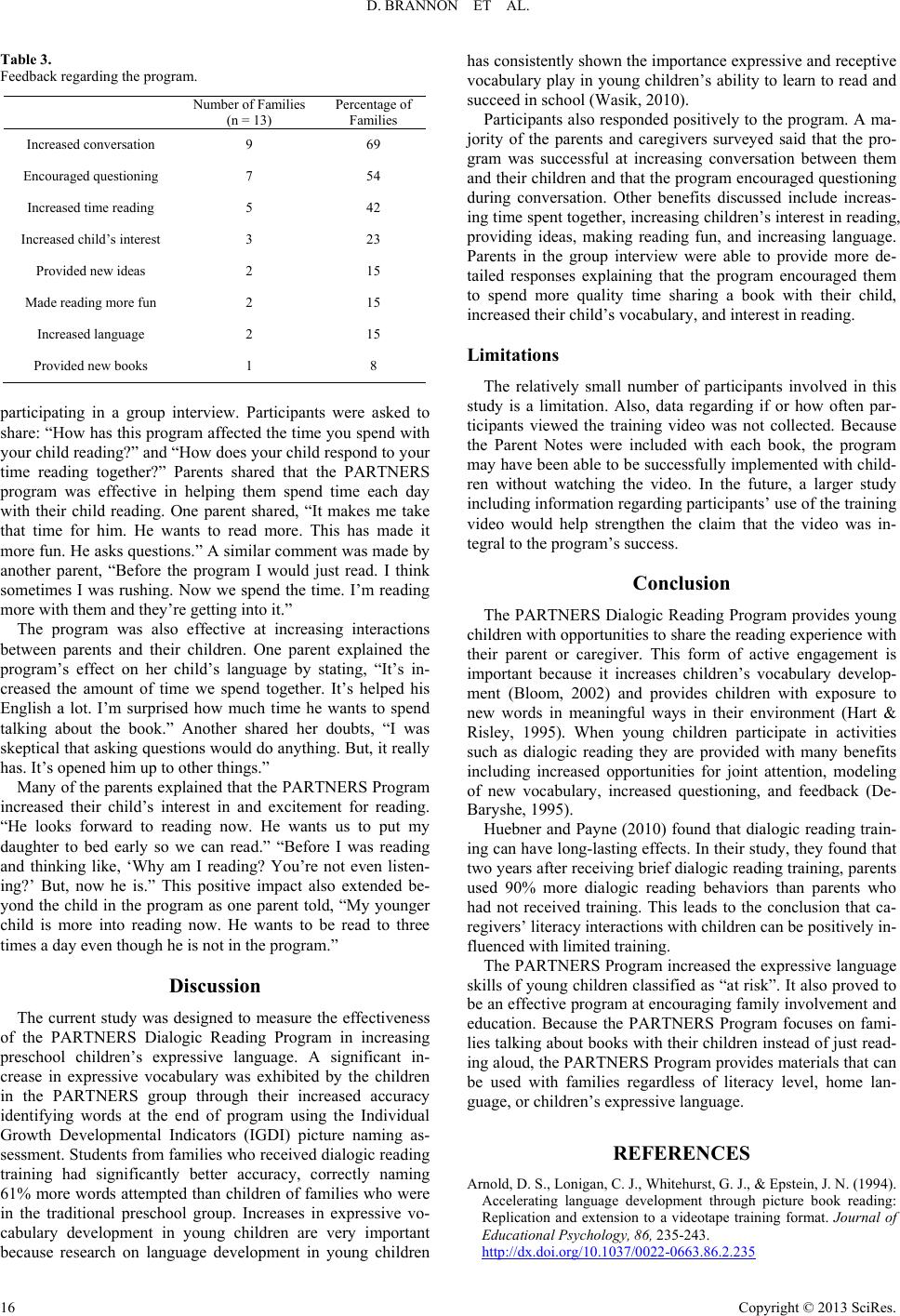 D. BRANNON ET AL. Copyright © 2013 SciRes. 16 Table 3. Feedback regarding the program. Number of Families (n = 13) Percentage of Families Increased conversation 9 69 Encouraged questioning 7 54 Increased time reading 5 42 Increased child’s interest 3 23 Provided ne w ideas 2 15 Made reading more fun 2 15 Increased language 2 15 Provided new books 1 8 participating in a group interview. Participants were asked to share: “How has this program affected the time you spend with your child reading?” and “How does your child respond to your time reading together?” Parents shared that the PARTNERS program was effective in helping them spend time each day with their child reading. One parent shared, “It makes me take that time for him. He wants to read more. This has made it more fun. He asks questions.” A similar comment was made by another parent, “Before the program I would just read. I think sometimes I was rushing. Now we spend the time. I’m reading more with them and they’re getting into it.” The program was also effective at increasing interactions between parents and their children. One parent explained the program’s effect on her child’s language by stating, “It’s in- creased the amount of time we spend together. It’s helped his English a lot. I’m surprised how much time he wants to spend talking about the book.” Another shared her doubts, “I was skeptical that asking questions would do anything. But, it rea lly has. It’s opened him up to other things.” Many of the parents explained that the PARTNERS Program increased their child’s interest in and excitement for reading. “He looks forward to reading now. He wants us to put my daughter to bed early so we can read.” “Before I was reading and thinking like, ‘Why am I reading? You’re not even listen- ing? ’ But, now he is.” This positive impact also extended be- yond the child in the program as one parent told, “My younger child is more into reading now. He wants to be read to three times a day even though he is not in the program.” Discussion The current study was designed to measure the effectiveness of the PARTNERS Dialogic Reading Program in increasing preschool children’s expressive language. A significant in- crease in expressive vocabulary was exhibited by the children in the PARTNERS group through their increased accuracy identifying words at the end of program using the Individual Growth Developmental Indicators (IGDI) picture naming as- sessment. Students from families who received dialogic reading training had significantly better accuracy, correctly naming 61% more words attempted than children of families who were in the traditional preschool group. Increases in expressive vo- cabulary development in young children are very important because research on language development in young children has consistently shown the importance expressive and receptive vocabulary play in young children’s ability to learn to rea d and succeed in school (Wasik, 2010). Participants also responded positively to the program. A ma- jority of the parents and caregivers surveyed said that the pro- gram was successful at increasing conversation between them and their children and that the program encouraged questioning during conversation. Other benefits discussed include increas- ing time spent together, increasing children’s interest in reading, providing ideas, making reading fun, and increasing language. Parents in the group interview were able to provide more de- tailed responses explaining that the program encouraged them to spend more quality time sharing a book with their child, increased their child’s vocabulary, and interest in reading. Limitations The relatively small number of participants involved in this study is a limitation. Also, data regarding if or how often par- ticipants viewed the training video was not collected. Because the Parent Notes were included with each book, the program may have been able to be successfully implemented wit h child- ren without watching the video. In the future, a larger study including information regarding participants’ use of the training video would help strengthen the claim that the video was in- tegral to the program’s success. Conclusion The PARTNERS Dialogic Reading Program provides young children with opportunities to share the reading experience with their parent or caregiver. This form of active engagement is important because it increases children’s vocabulary develop- ment (Bloom, 2002) and provides children with exposure to new words in meaningful ways in their environment (Hart & Risley, 1995). When young children participate in activities such as dialogic reading they are provided with many benefits including increased opportunities for joint attention, modeling of new vocabulary, increased questioning, and feedback (De- Baryshe, 1995). Huebner and Payne (2010) found that dialogic reading train- ing can have long-lasting effects. In their study, they found that two years after receiving brief dialogic reading training, parents used 90% more dialogic reading behaviors than parents who had not received training. This leads to the conclusion that ca- regivers’ literacy interactions with children can be positively in- fluenced with limite d traini ng. The PARTNERS Program increased the expressive language skills of young children classified as “at risk”. It also proved to be an effective program at encouraging family involvement and education. Because the PARTNERS Program focuses on fami- lies talking about books with their children instead of just read- ing aloud, the PARTNERS Program provides materials that can be used with families regardless of literacy level, home lan- guage, or children’s expressive language. REFERENCES Arnold, D. S., Lonigan, C. J., Whitehurst, G. J., & Epstein, J. N. (1994). Accelerating language development through picture book reading: Replication and extension to a videotape training format. Journal of Educational Psychology, 86, 235-243. http://dx.doi.org/10.1037/0022-0663.86.2.235  D. BRANNON ET AL. Copyright © 2013 SciRes. 17 Blom-Hoffman, J., O’Neil-Pirozzi, T. M., & Cutting, J. (2006). Read together, talk together: The acceptability of teaching parents to use dialogic reading strategies via videotaped instruction. Psychology in the Schools, 43, 71-78. http://dx.doi.org/10.1002/pits.20130 Bloom, P. (2002). How children learn the meaning of words. Cam- bridge, MA: MIT Pres s. Briesch, A. M., Chafouleas, S. M., Lebel, T., & Blom-Hoffman, J. A. (2008). Impact of videotaped instruction on dialogic reading strate- gies: An investigation of caregiver imple mentation integrity. Psycho- logy in the Schools, 45, 978-993. http://dx.doi.org/10.1002/pits.20346 DeBaryshe, B. D. (1995). Maternal belief systems: Linchpin in the home reading process. Journal of Applied Developmental Psycholo- gy, 16, 1-20. http://dx.doi.org/10.1016/0193-3973(95)90013-6 Hargrave, A. C., & Sénéchal, M. (2000). A book reading intervention with preschool children wh o have limited vocabularies: The b enefits of regular reading and dialogic reading. Early Childhood Research Quarterly, 15, 75-90. http://dx.doi.org/10.1016/S0885-2006(99)00038-1 Hart, B., & Risley, T. (1995). Meaningful differences in the everyday experience of young childr en. Baltimore, MD: Paul H. Brookes Pub- lishing Com pany. Huebner, C. E., & Payne, K. (2010). Home support for emergent lite- racy: Follow-up of a community-based implementation of dialogic reading. Journal of Applied Developmental Psychology, 31, 195-201. http://dx.doi.org/10.1016/j.appdev.2010.02.002 Moore, M., & Wade, B. (2003). Bookstart: A qualitative evaluation. Educational Re view, 55, 3-13. http://dx.doi.org/10.1080/00131910303250 Philips, L., Hayden, R., & Norris, S . (2006 ). Family literacy matters : A longitudinal parent-child literacy intervention study. Calgary, AB: Temeron. Reese, E., & Cox, A. (1999). Quality of adult book reading affects children’s emergent literacy. Developmental Psychology, 35, 20-28. http://dx.doi.org/10.1037/0012-1649.35.1.20 Shapiro, J., Anderson, J., & Anderson, A. (2002). Storybook reading: What we know and what we should consider. In O. Saracho, & B. Spodek (Eds.), Contempora ry perspectives on l iteracy in early child- hood education (pp. 77-97). Greenwich, CT: Information Ag e Publi- shers. Snow, C. (1983). Literacy and language: Relationships during the pre- school years. Harvard Educational Review, 53, 165-189. Snow, C. E., Burns, M. S., & Griffin, P. (1998). Preventing reading difficulties in young children. Washington DC: National Academy Press. Wasik, B. A. (2010). What teachers can do to promote preschoolers vo- cabulary development: Strategies from an effective language and li- teracy professional development coaching model. Reading Teacher, 63, 621-633. http://dx.doi.org/10.1598/RT.63.8.1 Whitehurst, G. J., Falco, F. L., Lonigan, C., Fischel, J. E., Valdez-Men- chaca, M. C., DeBaryshe, B. D., & Caulfield, M. (1988). Accelerat- ing language development through picture-book reading. Develop- mental Psychology, 24, 552-558. Whitehurst, G. J., & Arnold, D. S., Eps tein, J. N., Angell, A. L., S mith, M., & Fischel, J. E. (1994). A picture book reading intervention in day care and home for children from low-income families. Develop- mental Psychology, 30, 679-689. http://dx.doi.org/10.1037/0012-1649.30.5.679 |