

Paper Menu >>
Journal Menu >>
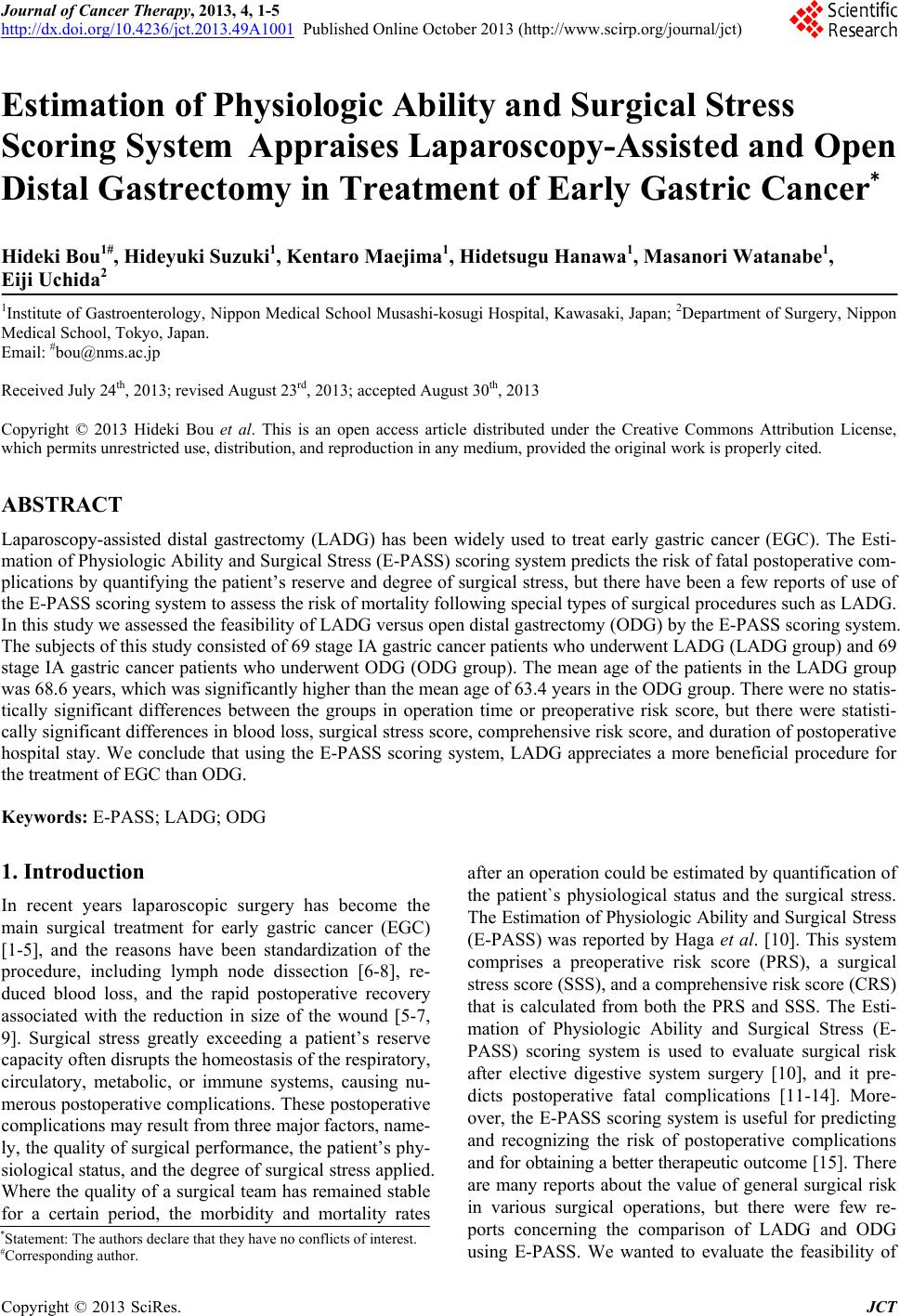 Journal of Cancer Therapy, 2013, 4, 1-5 http://dx.doi.org/10.4236/jct.2013.49A1001 Published Online October 2013 (http://www.scirp.org/journal/jct) 1 Estimation of Physiologic Ability and Surgical Stress Scoring System Appraises Laparoscopy-Assisted and Open Distal Gastrectomy in Treatment of Early Gastric Cancer* Hideki Bou1#, Hideyuki Suzuki1, Kentaro Maejima1, Hidetsugu Hanawa1, Masanori Watanabe1, Eiji Uchida2 1Institute of Gastroenterology, Nippon Medical School Musashi-kosugi Hospital, Kawasaki, Japan; 2Department of Surgery, Nippon Medical School, Tokyo, Japan. Email: #[email protected] Received July 24th, 2013; revised August 23rd, 2013; accepted August 30th, 2013 Copyright © 2013 Hideki Bou et al. This is an open access article distributed under the Creative Commons Attribution License, which permits unrestricted use, distribution, and reproduction in any medium, provided the original work is properly cited. ABSTRACT Laparoscopy-assisted distal gastrectomy (LADG) has been widely used to treat early gastric cancer (EGC). The Esti- mation of Physiologic Ability and Surgical Stress (E-PASS) scoring system predicts the risk of fatal postoperative com- plications by quantifying the patient’s reserve and degree of surgical stress, but there have been a few reports of use of the E-PASS scoring system to assess the risk of mortality following special types of surgical procedures such as LADG. In this study we assessed the feasibility of LADG versus open distal gastrectomy (ODG) by the E-PASS scoring system. The subjects of this study consisted of 69 stage IA gastric cancer patients who underwent LADG (LADG group) and 69 stage IA gastric cancer patients who underwent ODG (ODG group). The mean age of the patients in the LADG group was 68.6 years, which was significantly higher than the mean age of 63.4 years in the ODG group. There were no statis- tically significant differences between the groups in operation time or preoperative risk score, but there were statisti- cally significant differences in blood loss, surgical stress score, comprehensive risk score, and duration of postoperative hospital stay. We conclude that using the E-PASS scoring system, LADG appreciates a more beneficial procedure for the treatment of EGC than ODG. Keywords: E-PASS; LADG; ODG 1. Introduction In recent years laparoscopic surgery has become the main surgical treatment for early gastric cancer (EGC) [1-5], and the reasons have been standardization of the procedure, including lymph node dissection [6-8], re- duced blood loss, and the rapid postoperative recovery associated with the reduction in size of the wound [5-7, 9]. Surgical stress greatly exceeding a patient’s reserve capacity often disrupts the homeostasis of the respiratory, circulatory, metabolic, or immune systems, causing nu- merous postoperative complications. These postoperative complications may result from three major factors, name- ly, the quality of surgical performance, the patient’s phy- siological status, and the degree of surgical stress applied. Where the quality of a surgical team has remained stable for a certain period, the morbidity and mortality rates after an operation could be estimated by quantification of the patient`s physiological status and the surgical stress. The Estimation of Physiologic Ability and Surgical Stress (E-PASS) was reported by Haga et al. [10]. This system comprises a preoperative risk score (PRS), a surgical stress score (SSS), and a comprehensive risk score (CRS) that is calculated from both the PRS and SSS. The Esti- mation of Physiologic Ability and Surgical Stress (E- PASS) scoring system is used to evaluate surgical risk after elective digestive system surgery [10], and it pre- dicts postoperative fatal complications [11-14]. More- over, the E-PASS scoring system is useful for predicting and recognizing the risk of postoperative complications and for obtaining a better therapeutic outcome [15]. There are many reports about the value of general surgical risk in various surgical operations, but there were few re- ports concerning the comparison of LADG and ODG using E-PASS. We wanted to evaluate the feasibility of *Statement: The authors declare that they have no conflicts of interest. #Corresponding author. Copyright © 2013 SciRes. JCT 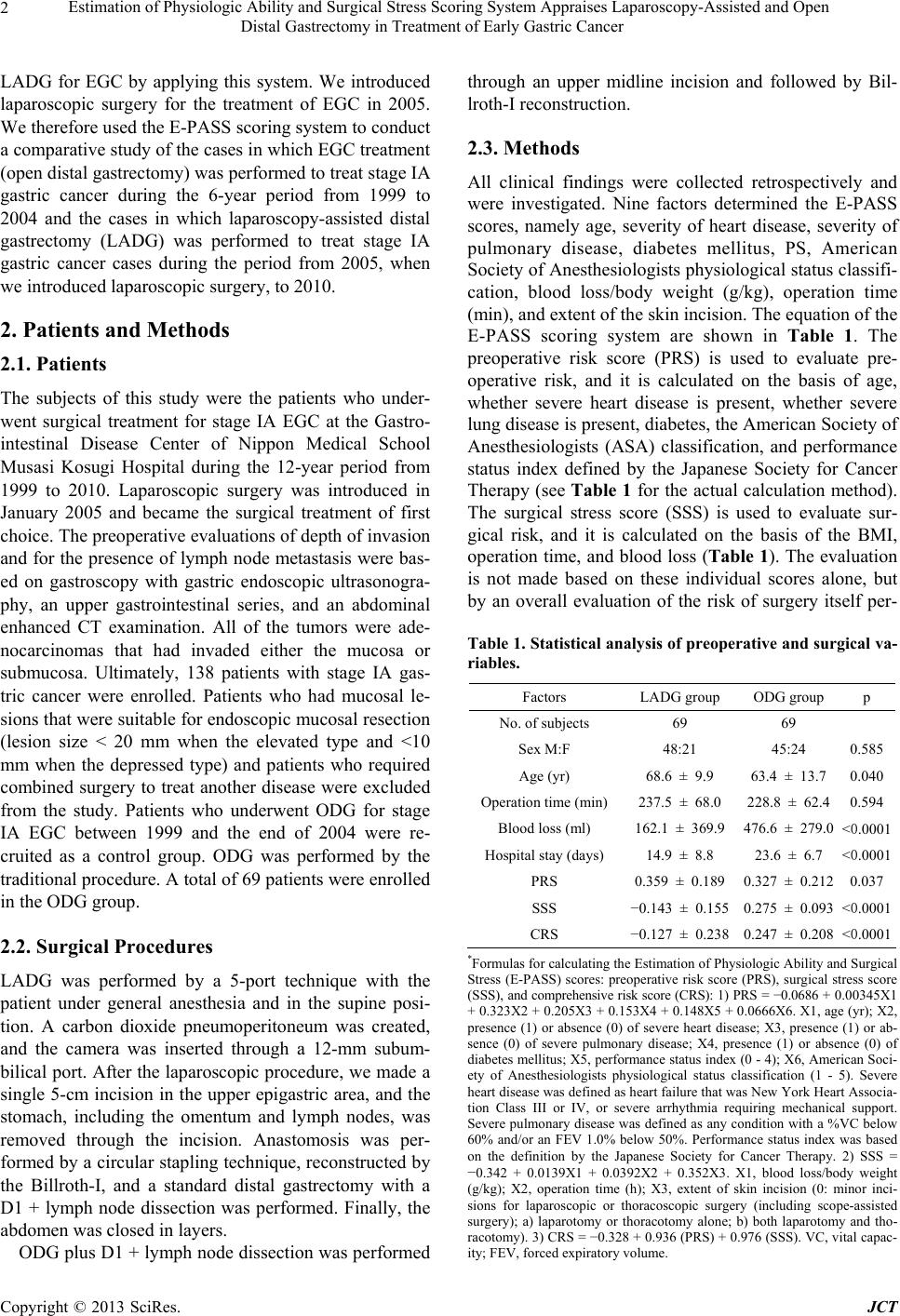 Estimation of Physiologic Ability and Surgical Stress Scoring System Appraises Laparoscopy-Assisted and Open Distal Gastrectomy in Treatment of Early Gastric Cancer 2 LADG for EGC by applying this system. We introduced laparoscopic surgery for the treatment of EGC in 2005. We therefore used the E-PASS scoring system to conduct a comparative study of the cases in which EGC treatment (open distal gastrectomy) was performed to treat stage IA gastric cancer during the 6-year period from 1999 to 2004 and the cases in which laparoscopy-assisted distal gastrectomy (LADG) was performed to treat stage IA gastric cancer cases during the period from 2005, when we introduced laparoscopic surgery, to 2010. 2. Patients and Methods 2.1. Patients The subjects of this study were the patients who under- went surgical treatment for stage IA EGC at the Gastro- intestinal Disease Center of Nippon Medical School Musasi Kosugi Hospital during the 12-year period from 1999 to 2010. Laparoscopic surgery was introduced in January 2005 and became the surgical treatment of first choice. The preoperative evaluations of depth of invasion and for the presence of lymph node metastasis were bas- ed on gastroscopy with gastric endoscopic ultrasonogra- phy, an upper gastrointestinal series, and an abdominal enhanced CT examination. All of the tumors were ade- nocarcinomas that had invaded either the mucosa or submucosa. Ultimately, 138 patients with stage IA gas- tric cancer were enrolled. Patients who had mucosal le- sions that were suitable for endoscopic mucosal resection (lesion size < 20 mm when the elevated type and <10 mm when the depressed type) and patients who required combined surgery to treat another disease were excluded from the study. Patients who underwent ODG for stage IA EGC between 1999 and the end of 2004 were re- cruited as a control group. ODG was performed by the traditional procedure. A total of 69 patients were enrolled in the ODG group. 2.2. Surgical Procedures LADG was performed by a 5-port technique with the patient under general anesthesia and in the supine posi- tion. A carbon dioxide pneumoperitoneum was created, and the camera was inserted through a 12-mm subum- bilical port. After the laparoscopic procedure, we made a single 5-cm incision in the upper epigastric area, and the stomach, including the omentum and lymph nodes, was removed through the incision. Anastomosis was per- formed by a circular stapling technique, reconstructed by the Billroth-I, and a standard distal gastrectomy with a D1 + lymph node dissection was performed. Finally, the abdomen was closed in layers. ODG plus D1 + lymph node dissection was performed through an upper midline incision and followed by Bil- lroth-I reconstruction. 2.3. Methods All clinical findings were collected retrospectively and were investigated. Nine factors determined the E-PASS scores, namely age, severity of heart disease, severity of pulmonary disease, diabetes mellitus, PS, American Society of Anesthesiologists physiological status classifi- cation, blood loss/body weight (g/kg), operation time (min), and extent of the skin incision. The equation of the E-PASS scoring system are shown in Table 1. The preoperative risk score (PRS) is used to evaluate pre- operative risk, and it is calculated on the basis of age, whether severe heart disease is present, whether severe lung disease is present, diabetes, the American Society of Anesthesiologists (ASA) classification, and performance status index defined by the Japanese Society for Cancer Therapy (see Table 1 for the actual calculation method). The surgical stress score (SSS) is used to evaluate sur- gical risk, and it is calculated on the basis of the BMI, operation time, and blood loss (Table 1). The evaluation is not made based on these individual scores alone, but by an overall evaluation of the risk of surgery itself per- Table 1. Statistical analysis of preoperative and surgical va- riables. Factors LADG group ODG groupp No. of subjects 69 69 Sex M:F 48:21 45:24 0.585 Age (yr) 68.6 ± 9.9 63.4 ± 13.7 0.040 Operation time (min)237.5 ± 68.0 228.8 ± 62.4 0.594 Blood loss (ml) 162.1 ± 369.9 476.6 ± 279.0 <0.0001 Hospital stay (days) 14.9 ± 8.8 23.6 ± 6.7 <0.0001 PRS 0.359 ± 0.189 0.327 ± 0.212 0.037 SSS −0.143 ± 0.155 0.275 ± 0.093 <0.0001 CRS −0.127 ± 0.238 0.247 ± 0.208 <0.0001 *Formulas for calculating the Estimation of Physiologic Ability and Surgical Stress (E-PASS) scores: preoperative risk score (PRS), surgical stress score (SSS), and comprehensive risk score (CRS): 1) PRS = −0.0686 + 0.00345X1 + 0.323X2 + 0.205X3 + 0.153X4 + 0.148X5 + 0.0666X6. X1, age (yr); X2, presence (1) or absence (0) of severe heart disease; X3, presence (1) or ab- sence (0) of severe pulmonary disease; X4, presence (1) or absence (0) of diabetes mellitus; X5, performance status index (0 - 4); X6, American Soci- ety of Anesthesiologists physiological status classification (1 - 5). Severe heart disease was defined as heart failure that was New York Heart Associa- tion Class III or IV, or severe arrhythmia requiring mechanical support. Severe pulmonary disease was defined as any condition with a %VC below 60% and/or an FEV 1.0% below 50%. Performance status index was based on the definition by the Japanese Society for Cancer Therapy. 2) SSS = −0.342 + 0.0139X1 + 0.0392X2 + 0.352X3. X1, blood loss/body weight (g/kg); X2, operation time (h); X3, extent of skin incision (0: minor inci- sions for laparoscopic or thoracoscopic surgery (including scope-assisted surgery); a) laparotomy or thoracotomy alone; b) both laparotomy and tho- racotomy). 3) CRS = −0.328 + 0.936 (PRS) + 0.976 (SSS). VC, vital capac- ity; FEV, forced expiratory volume. Copyright © 2013 SciRes. JCT 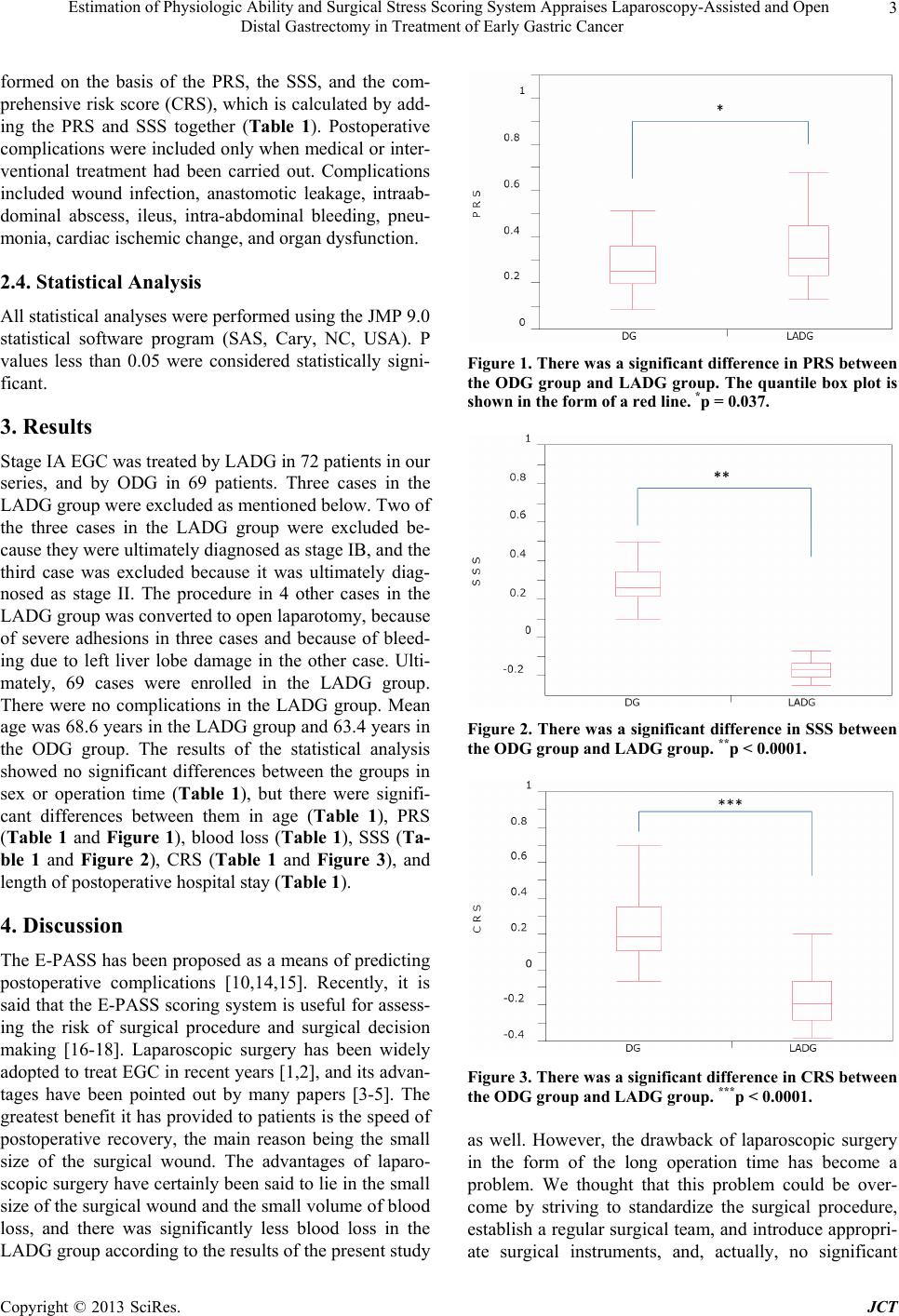 Estimation of Physiologic Ability and Surgical Stress Scoring System Appraises Laparoscopy-Assisted and Open Distal Gastrectomy in Treatment of Early Gastric Cancer 3 formed on the basis of the PRS, the SSS, and the com- prehensive risk score (CRS), which is calculated by add- ing the PRS and SSS together (Table 1). Postoperative complications were included only when medical or inter- ventional treatment had been carried out. Complications included wound infection, anastomotic leakage, intraab- dominal abscess, ileus, intra-abdominal bleeding, pneu- monia, cardiac ischemic change, and organ dysfunction. 2.4. Statistical Analysis All statistical analyses were performed using the JMP 9.0 statistical software program (SAS, Cary, NC, USA). P values less than 0.05 were considered statistically signi- ficant. 3. Results Stage IA EGC was treated by LADG in 72 patients in our series, and by ODG in 69 patients. Three cases in the LADG group were excluded as mentioned below. Two of the three cases in the LADG group were excluded be- cause they were ultimately diagnosed as stage IB, and the third case was excluded because it was ultimately diag- nosed as stage II. The procedure in 4 other cases in the LADG group was converted to open laparotomy, because of severe adhesions in three cases and because of bleed- ing due to left liver lobe damage in the other case. Ulti- mately, 69 cases were enrolled in the LADG group. There were no complications in the LADG group. Mean age was 68.6 years in the LADG group and 63.4 years in the ODG group. The results of the statistical analysis showed no significant differences between the groups in sex or operation time (Table 1), but there were signifi- cant differences between them in age (Table 1), PRS (Table 1 and Figure 1), blood loss (Table 1), SSS (Ta- ble 1 and Figure 2), CRS (Table 1 and Figure 3), and length of postoperative hospital stay (Table 1). 4. Discussion The E-PASS has been proposed as a means of predicting postoperative complications [10,14,15]. Recently, it is said that the E-PASS scoring system is useful for assess- ing the risk of surgical procedure and surgical decision making [16-18]. Laparoscopic surgery has been widely adopted to treat EGC in recent years [1,2], and its advan- tages have been pointed out by many papers [3-5]. The greatest benefit it has provided to patients is the speed of postoperative recovery, the main reason being the small size of the surgical wound. The advantages of laparo- scopic surgery have certainly been said to lie in the small size of the surgical wound and the small volume of blood loss, and there was significantly less blood loss in the LADG group according to the results of the present study Figure 1. There was a si gnificant diffe rence in PRS betwee n the ODG group and LADG group. The quantile box plot is shown in the form of a red line. *p = 0.037. Figure 2. There was a significant difference in SSS between the ODG group and LADG group. **p < 0.0001. Figure 3. There was a significant difference in CRS between the ODG group and LADG group. ***p < 0.0001. as well. However, the drawback of laparoscopic surgery in the form of the long operation time has become a problem. We thought that this problem could be over- come by striving to standardize the surgical procedure, establish a regular surgical team, and introduce appropri- ate surgical instruments, and, actually, no significant Copyright © 2013 SciRes. JCT  Estimation of Physiologic Ability and Surgical Stress Scoring System Appraises Laparoscopy-Assisted and Open Distal Gastrectomy in Treatment of Early Gastric Cancer 4 difference in operation time was observed in this study, and as a result the SSS was significantly lower in the LADG group. On the other hand, surgical risk cannot be concluded to be decreased just because the PRS is lower, because in elderly patients and patients who have high- risk complications the operation sometimes ends in pal- liative surgery rather than seeking curative surgery [16- 18]. In our present study mean age was higher in the LADG group, and the PRS was higher. This means that the preoperative risk was higher in the LADG group, but since the aforementioned SSS was lower, the overall evaluation in the form of the CRS was significantly lower in the LADG group. This also seems to suggest that laparoscopic surgery is more beneficial as a treat- ment for EGC, even if there is some risk. A CRS of 1.0 is said to be the threshold score for postoperative fatal com- plications increasing [10]. In the present study the CRS was significantly lower in the LADG group, but neither score exceeded the threshold. Moreover, the postopera- tive hospital stay was also significantly shorter in the LADG group. Laparoscopic surgery has been described as more beneficial in many papers [1-4], but few of them have reported a comparative study in which the E-PASS was used. In the present study we used the E-PASS to perform an overall evaluation of the surgical treatment for EGC, and based on the results we concluded that sur- gical treatment in the LADG group was more beneficial. This corroborates what has been widely claimed, and it is a result that it was obtained according to an overall eval- uation of the patients’ risk and the risk of surgery itself, a different viewpoint from the past. Based on the above, the E-PASS scoring system is useful for assessing the risks of the operation procedure of EGC. We appreciate that LADG is more feasible than ODG as a surgical treatment for EGC. REFERENCES [1] S. Kitano, N. Shiraishi, I. Uyama, K. Sugihara, N. Ta- nigawa and Japanese Laparoscopic Surgery Study Group, “A Multicenter Study on Oncologic Outcome of Laparo- scopic Gastrectomy for Early Cancer in Japan,” Annals of Surgery, Vol. 245, No. 1, 2007, pp. 68-72. http://dx.doi.org/10.1097/01.sla.0000225364.03133.f8 [2] H. Yano, et al., “The Usefulness of Laparoscopy-Assisted Distal Gastrectomy in Comparison with That of Open Distal Gastrectomy for Early Gastric Cancer,” Gastric Cancer, Vol. 4, No. 2, 2001, pp. 93-97. http://dx.doi.org/10.1007/PL00011730 [3] C. G. Huscher, et al., “Laparoscopic versus Open Subto- tal Gastrectomy for Distal Gastric Cancer: Five-Year Re- sults of a Randomized Prospective Trial,” Annals of Sur- gery, Vol. 241, No. 2, 2001, pp. 232-237. http://dx.doi.org/10.1097/01.sla.0000151892.35922.f2 [4] S. Kitano, et al., “A Randomized Controlled Trial Com- paring Open vs Laparoscopy-Assisted Distal Gastrectomy for the Treatment of Early Gastric Cancer: An Interim Report,” Surgery, Vol. 131, Supplement 1, 2002, pp. S306- S311. http://dx.doi.org/10.1067/msy.2002.120115 [5] K. J. Weber, Reyes CD, Gagner M, Divino CM, “Com- parison of Laparoscopic and Open Gastrectomy for Ma- lignant Disease,” Surgical Endoscopy, Vol. 17, No. 6, 2003, pp. 968-971. http://dx.doi.org/10.1007/s00464-002-8738-5 [6] K. Yasuda, et al., “Rate of Detection of Lymph Node Metastasis Is Correlated with the Depth of Submucosal Invasion in Early Stage Gastric Carcinoma,” Cancer, Vol. 85, No. 10, 1999, pp. 2119-2123. http://dx.doi.org/10.1002/(SICI)1097-0142(19990515)85: 10<2119::AID-CNCR4>3.0.CO;2-M [7] S. Miura, et al., “Laparoscopy-Assisted Distal Gastrec- tomy with Systemic Lymph Node Dissection: A Critical Reappraisal from the Viewpoint of Lymph Node Re- trieval,” Journal of the American College of Surgeons, Vol. 198, No. 6, 2004, pp. 933-938. http://dx.doi.org/10.1016/j.jamcollsurg.2004.01.021 [8] M. Fujiwara, et al., “Laparoscopy-Assisted Distal Gas- trectomy with Systemic Lymph Node Dissection for Early Gastric Carcinoma: A Review of 43 Cases,” Jour- nal of the American College of Surgeons Vol. 196, No. 1, 2003, pp. 75-81. http://dx.doi.org/10.1016/S1072-7515(02)01539-9 [9] K. Fujii, et al., “T Lymphocyte Subsets and Th1/Th2 Bal- ance after Laparoscopy-Assisted Distal Gastrectomy,” Surg Endosc, Vol. 17, No. 9, 2003, pp. 1440-1444. http://dx.doi.org/10.1007/s00464-002-9149-3 [10] Y. Haga, et al., “Estimation of Physiologic Ability and Surgical Stress (E-PASS) for a Surgical Audit in Elective Digestive Surgery,” Surgery, Vol. 135, No. 6, 2004, pp. 586-594. http://dx.doi.org/10.1016/j.surg.2003.11.012 [11] D. Hashimoto, et al., “Can the Physiologic Ability and Surgical Stress (E-PASS) Scoring System Predict Opera- tive Morbidity after Distal Pancreatectomy?” Surgery Today, Vol. 40, No. 7, 2004, pp. 632-637. http://dx.doi.org/10.1007/s00595-009-4112-8 [12] Y. Haga, K. Ikejiri, H. Takeuchi, M. Ikenaga and Y. Wada, “Value of General Surgical Risk Models for Pre- dicting Postoperative Liver Failure and Mortality Fol- lowing Liver Surgery,” Journal of Surgical Oncology, Vol. 106, No. 7, 2012, pp. 898-904. http://dx.doi.org/10.1002/jso.23160 [13] A. Kotera, Y. Haga, J. Kei, M. Okamoto and K. Seo, “Evaluation of Estimation of Physiologic Ability and Sur- gical Stress to Predict In-Hospital Mortality in Cardiac Surgery,” Journal of Anesthesia, Vol. 25, No. 4, 2011, pp. 481-491. http://dx.doi.org/10.1007/s00540-011-1162-z [14] V. M. Banz, P. Studer, D. Inderbitzin and D. Candinas, “Validation of the Estimation of Physiologic Ability and Surgical Stress (E-PASS) Score in Liver Surgery,” World Journal of Surgery, Vol. 33, No. 6, 2009, pp. 1259-1265. http://dx.doi.org/10.1007/s00268-009-9989-2 [15] Y. Oka, et al., “Usefulness of an Estimation of Physiol- ogic Ability and Surgical Stress (E-PASS) Scoring Sys- Copyright © 2013 SciRes. JCT  Estimation of Physiologic Ability and Surgical Stress Scoring System Appraises Laparoscopy-Assisted and Open Distal Gastrectomy in Treatment of Early Gastric Cancer Copyright © 2013 SciRes. JCT 5 tem to Predict the Incidence of Postoperative Complica- tions in Gastrointestinal Surgery,” World Journal of Sur- gery, Vol. 29, No. 8, 2005, pp. 1029-1033. http://dx.doi.org/10.1007/s00268-005-7719-y [16] T. Tang, et al., “Estimation of Physiologic Ability and Surgical Stress (E-PASS) as a Predictor of Immediate Outcome after Elective Abdominal Aortic Aneurysm Sur- gery,” The American Journal of Surgery, Vol. 194, No. 2, 2007, pp. 176-182. http://dx.doi.org/10.1016/j.amjsurg.2006.10.032 [17] J. Hirose, H. Mizuta, J. Ide and K. Nomura, “Evaluation of Estimation of Physiologic Ability and Surgical Stress (E-PASS) to Predict the Postoperative Risk for Hip Frac- ture in Elder Patients,” Archives of Orthopaedic and Trauma Surgery, Vol. 128, No. 12, 2008, pp. 1447-1452. http://dx.doi.org/10.1007/s00402-007-0551-0 [18] K. Koushi, et al., “Using the E-PASS Scoring System to Estimate the Risk of Emergency Abdominal Surgery in Patients with Acute Gastrointestinal Disease,” Surg To- day, Vol. 41, No. 11, 2011, pp. 1481-1485. http://dx.doi.org/10.1007/s00595-010-4538-z |