

Paper Menu >>
Journal Menu >>
 Journal of Applied Mathematics and Physics, 2013, 1, 1-7 Published Online November 2013 (http://www.scirp.org/journal/jamp) http://dx.doi.org/10.4236/jamp.2013.15001 Open Access JAMP Simulation of Thermal Explosion of Catalytic Granule in Fluctuating Temperature Field Igor Derevich, Daria Galdina Department of Applied Mathematics, Faculty of Fundamental Sciences, Moscow State Technical University by N.E. Bauman (BMSTU), Moscow, Russian Federation Email: [email protected], [email protected] Received July 29, 2013; revised August 29, 2013; accepted September 15, 2013 Copyright © 2013 Igor Derevich, Daria Galdina. This is an open access article distributed under the Creative Commons Attribution License, which permits unrestricted use, distribution, and reproduction in any medium, provided the original work is properly cited. ABSTRACT Method for numerical simulation of the temperature of granule with internal heat release in a medium with random temperature fluctuations is proposed. The method utilized the solution of a system of ordinary stochastic differential equations describing temperature fluctuations of the surrounding and granule. Autocorrelation function of temperature fluctuations has a finite decay time. The suggested method is verified by the comparison with exact analytical results. Random temperature b ehavior of granule with internal heat release qualitatively differs fro m the results obtained in the deterministic approach. Mean first passage time of granules temperature intersecting critical temperature is estimated at different regime parameters. Keywords: Stochastic Ordinary Differential Equation; Autocorrelation Function; Heat Explosion; Semenov’s Diagram; Temperature Fluctuations 1. Introduction The catalytic synthesis processes are generally accompa- nied by heat release. Synthesis of heavy hydrocarbons in the Fischer-Tropsch process (GTL technology) is associ- ated with essential heat generation [1]. GTL techno logy can solve a number of environmental and economic problem s. In the Technological Institute for Superhard and Nov el Carbon Materials (Troitsk, Russian Federation), industrial reactor is developed with a capacity of 5000 Nm3/h of syn- thesis gas with a production of 500 kg/h stabilized liquid hy- drocarbons. The reactor used fixed bed of catalyst granules. Exothermic heat of reaction is transferred from the volume of catalytic granules to the boundary of the gran- ules. At the boundary heat is removed to the liquid prod- ucts of the synthesis. Exceeding heat generation over heat transfer leads to uncontrolled growth temperature (thermal explosion). Loss of thermal stability of catalyst granules is responsible of thermal explosion of the reac- tor. Therefore, investigation of critical conditions of thermal explosion is an important practical problem. Reasons leading to thermal explosion in deterministic situation have been well studied [2-6]. There is a critical temperature, the excess of which causes a significant increase in temperature of granules. The situation drasti- cally changes when the temperature of the environment is a random process. In this case there is always a non-zero probability for a temperature fluctuation, the magnitude of which exceeds a critical value, which may lead to the loss of thermal stability. Stud y of the effect of random noise is dedicated to the behavior of systems with explosive features, for example, [7-11]. The results of this study can also be applicable in modeling of igni- tion conditions of dispersed fuel in aircraft and rocket engines, and power stations. Main trends obtained in the paper are helpful for the estimation of the probability of thermal explosion in storages and transportation lines of dispersed combustible materials. Investigation on effect of noise is devoted to the be- havior of systems with explosive behavior [7-11]. Study of random temperature fluctuations was carried out in the framework of probability density fun ction approach [12]. This approach requires the use of modern methods of stochastic processes and functional analysis and yields results which have practical importance. However, the method of the probability density function does not take into account some important details of the complicated chemical kinetics. In this situ ation, it is appropriate to us e the methods of modeling of temperature dynamics which is based on direct numerical solutions of stochastic ordi- 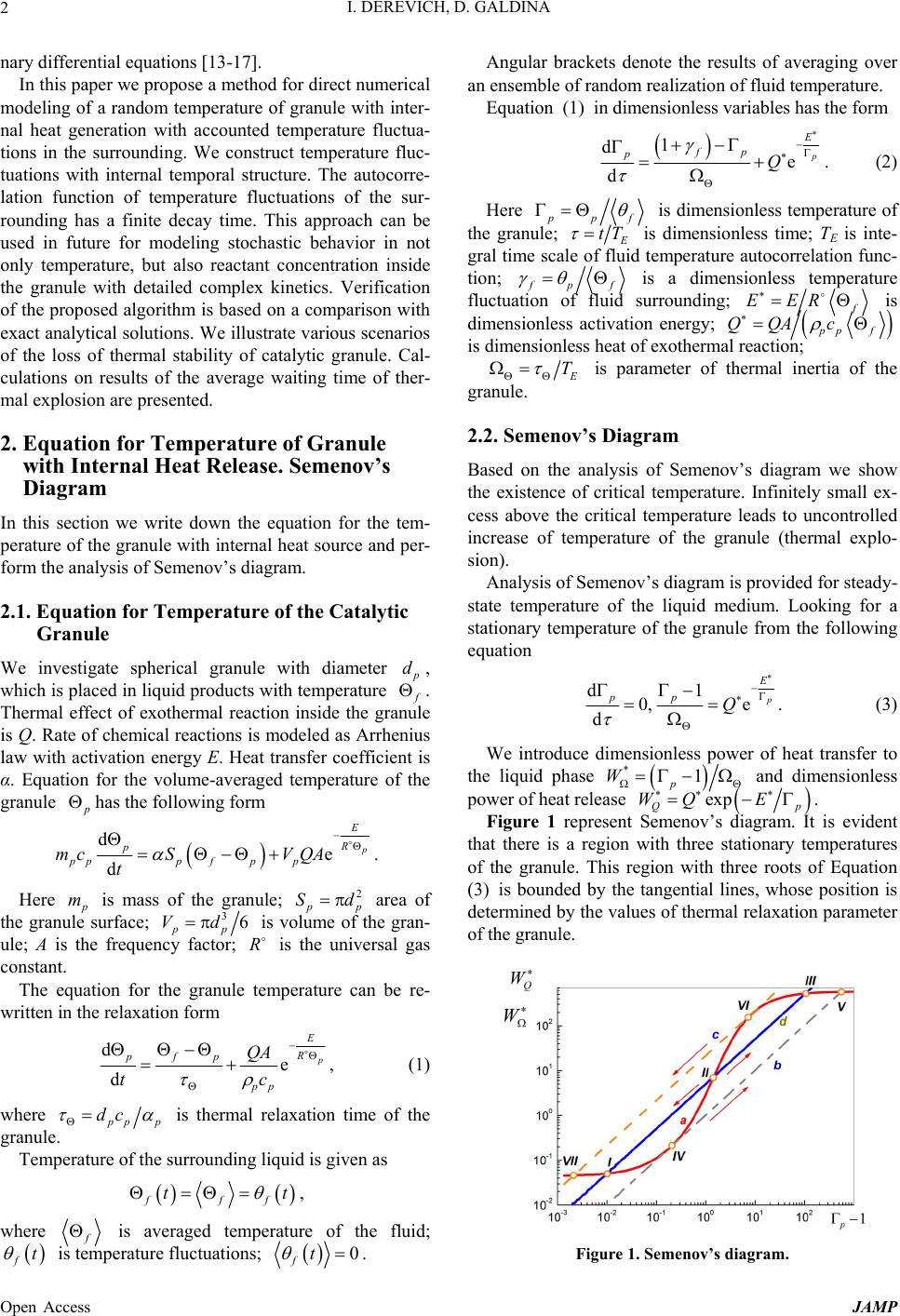 I. DEREVICH, D. GALDINA 2 nary differential equations [13-17]. In this paper we propose a method for direct numerical modeling of a random temperature of granule with inter- nal heat generation with accounted temperature fluctua- tions in the surrounding. We construct temperature fluc- tuations with internal temporal structure. The autocorre- lation function of temperature fluctuations of the sur- rounding has a finite decay time. This approach can be used in future for modeling stochastic behavior in not only temperature, but also reactant concentration inside the granule with detailed complex kinetics. Verification of the proposed algo rithm is based on a comparison with exact analytical solutions. We illustrate va rious scenarios of the loss of thermal stability of catalytic granule. Cal- culations on results of the average waiting time of ther- mal explos ion are pre sented. 2. Equation for Temperature of Granule with Internal Heat Release. Semenov’s Diagram In this section we write down the equation for the tem- perature of the granule with internal heat source and per- form the analysis of Semenov’s diagram. 2.1. Equation for Temperature of the Catalytic Granule We investigate spherical granule with diameter p d, which is placed in liquid products with temperature f . Thermal effect of exothermal reaction inside the granule is Q. Rate of chemical reactions is modeled as Arrhenius law with activation energy E. Heat transfer coefficient is α. Equation for the volume-averaged temperature of the granule p has the following fo rm de d p E R p ppp fpp mc SVQA t . Here p m is mass of the granule; 2 p p Sd area of the granule surface; 36 pp Vd is volume of the gran- ule; A is the frequency factor; is the universal gas constant. R The equation for the granule temperature can be re- written in the relaxation form de d p E R pfp pp QA tc , (1) where p pp dc is thermal relaxation time of the granule. Temperature of the surrounding liquid is given as fff tt , where f is averaged temperature of the fluid; is temperature fluctuations; ft 0 ft . Angular brackets denote the results of averaging over an ensemble of random realization of fluid temperature. Equation (1) in dimensionless variables has the form 1 de d p E fp pQ . (2) Here p pf is dimensionless temperature of the granule; E tT is dimensionless time; TE is inte- gral time scale of fluid temperature autocorrelation func- tion; f pf is a dimensionless temperature fluctuation of fluid surrounding; f EER is dimensionless activation energy; pp f QQA c is dimensionless heat of exothermal reaction; E T is parameter of thermal inertia of the granule. 2.2. Semenov’s Diagram Based on the analysis of Semenov’s diagram we show the existence of critical temperature. Infinitely small ex- cess above the critical temperature leads to uncontrolled increase of temperature of the granule (thermal explo- sion). Analysis of Semenov’s diagra m is provided for steady- state temperature of the liquid medium. Looking for a stationary temperature of the granule from the following equation d1 0, e d p E pp Q . (3) We introduce dimensionless power of heat transfer to the liquid phase *1 p W and dimensionless power of heat release exp Qp WQ E . Figure 1 represent Semenov’s diagram. It is evident that there is a region with three stationary temperatures of the granule. This region with three roots of Equation (3) is bounded by the tangential lines, whose position is determined by the values of thermal relaxation parameter of the granule. Figure 1. Semenov’s diagram. Open Access JAMP 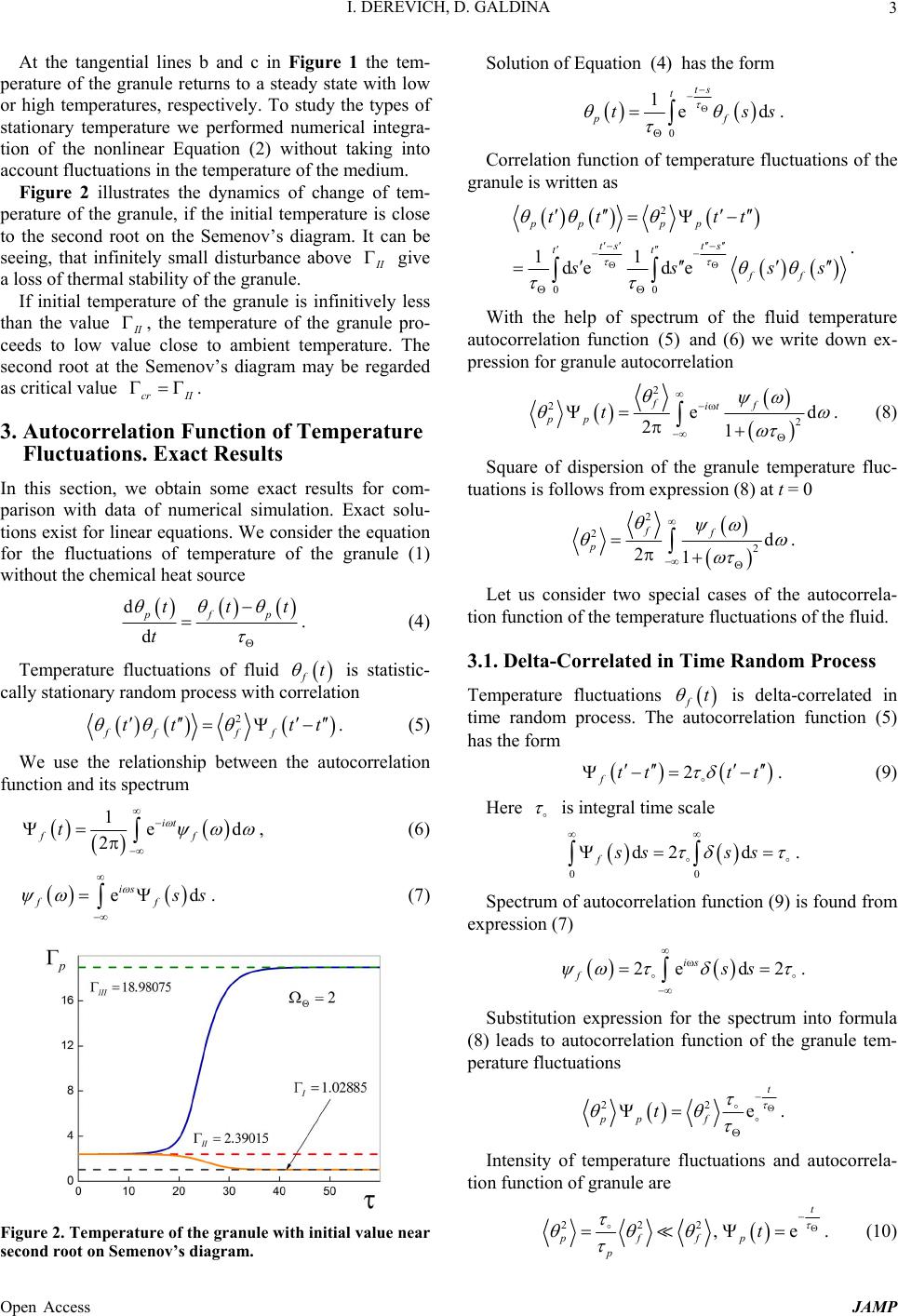 I. DEREVICH, D. GALDINA 3 At the tangential lines b and c in Figure 1 the tem- perature of the granule returns to a steady state with low or high temperatures, respectively. To study the types of stationary temperature we performed numerical integra- tion of the nonlinear Equation (2) without taking into account fluctuations in the temperature of the medium. Figure 2 illustrates the dynamics of change of tem- perature of the granule, if the initial temperature is close to the second root on the Semenov’s diagram. It can be seeing, that infinitely small disturbance above I I give a loss of thermal stability of the granule. If initial temperature of the granule is infinitively less than the value I I, the temperature of the granule pro- ceeds to low value close to ambient temperature. The second root at the Semenov’s diagram may be regarded as critical value . cr II 3. Autocorrelation Function of Temperature Fluctuations. Exact Results In this section, we obtain some exact results for com- parison with data of numerical simulation. Exact solu- tions exist for linear equations. We consider the equation for the fluctuations of temperature of the granule (1) without the chemical heat source d d pfp tt t t . (4) Temperature fluctuations of fluid is statistic- cally stationary random process with correlation ft 2 ff ff tt tt . (5) We use the relationship between the autocorrelation function and its spectrum 1e 2 it f t d f , (6) e is ff d s s . (7) Figure 2. Temperature of the granule with initial value near second root on Semenov’s diagram. Solution of Equation (4) has the form 0 1ed ts t pf ts s. Correlation function of temperature fluctuations of the granule is written as 2 00 11 de de pp pp tst s tt ff tt tt s ss s . With the help of spectrum of the fluid temperature autocorrelation function (5) and (6) we write down ex- pression for granule autocorrelation 2 2 2 ed 21 ff it pp t . (8) Square of dispersion of the granule temperature fluc- tuations is follows from expression (8) at t = 0 2 2 2d 21 ff p . Let us consider two special cases of the autocorrela- tion function of the temperature fluctuations of the fluid. 3.1. Delta-Correlated in Time Random Process Temperature fluctuations is delta-correlated in time random process. The autocorrelation function ft (5) has the form 2 ftt tt . (9) Here is integral time scale 00 dd fss ss . Spectrum of autocorrelation function (9) is found from expression (7) 2e d2 is fss . Substitution expression for the spectrum into formula (8) leads to autocorrelation function of the granule tem- perature fluctuations 22 e t pp f t . Intensity of temperature fluctuations and autocorrela- tion function of granule are 222 ,e t pffp p t . (10) Open Access JAMP  I. DEREVICH, D. GALDINA 4 Delta-correlation approach is correct for granule with high thermal inertia. Autocorrelation functio perature fluctuations of the granule has exponential form w orrelation Function ation of fluid n of tem- ith integral temporary scale equal to the granule relaxa- tion time. 3.2. Exponential Approximation of Autoc Second approach is exponential approxim temperature ft autocorrelation function e E t T ft (11) Spectrum of the autocorrelation function (11) follows from formula (7) 2 2 ed E t itTE f T t . 1E T Correlation of the granule temperature fluctuation is obtained from formula (11) 2 22e d 21 it fE pp T t 22 1 E T Calculation of the above integral under theory of fu- tions with complex variables leads to the result . nc 22 2 ee E t t T E pp f T t . 1E T (12) Square of dispersion of the granule tempera tuations is follows from Equation (12) at t = 0 ture fluc- 2 2 1 f p E T . (13) Autocorrelation function of the gra fluctuation als o obtai ned from Equatinule temperature on (12) ee 1 E t t T E p T tT . E (14) Integral time scale of the granule temp tion is erature fluctua- d pE TttT 0 . One can conclude about existence o two granules types. Granule with small thermal inertia with thermal relaxation time much smaller than integral time scale of flu f id temperature autocorrelation function E T . In that case dispersion of temperature fluctuations of the granule and fluid is close 22 p f , and integral time scale of granule temperature fluctuations is E TT . For granule with high thermal inertia E T dispersion of granule temperature flucess then fluid tuations is l 22 p Ef T . Integral time scale of tem- perature fluctuations is close to ure relaxation time T granule temperat , and granule autocorrelation function de- cays as p ptext gorithm emperature of surrou rrelation ly on theic ordinary equations. (see, also Equation (10)). Obtained exact results will be used for testing numeri- cal al of simulation of temperature of granule in a random tndings. 4. System of Stochastic Differential Equations Analytical results show that modeling autoco function with finite relaxation time is possible on base of stochast Write down system of differential equations for tem- perature fluctuations of fluid and the granule with heat release d d f f , (15) 1 d d E f ptt t Here ep pt Q . (16) lta-correlatedis seeded Gaussian random process with de function 2 2tt tt . Integration of the system of Equations (15) and (16) is carried out by explicit Euler method 11nn nn ff f , * 1 1*e 1n p E fp nn pp Q nn . Here n is the number of temporary steps; randon- crement of seeded process is modeled as m i 2 2 nn , where n is random realization of the normalized Gausess (white noise) with zero mean and unit dispersion. re 3 nclude that increasing the thermal inertia re- du sian proc Figu illustrates the effect of thermal inertia of the granules on temperature fluctuations without heat source. It can be co ces the amplitude of temperature fluctuations of the granule. Figure 4 shows influence of thermal inertia of the granule on dispersion of temperature fluctuations. The Open Access JAMP 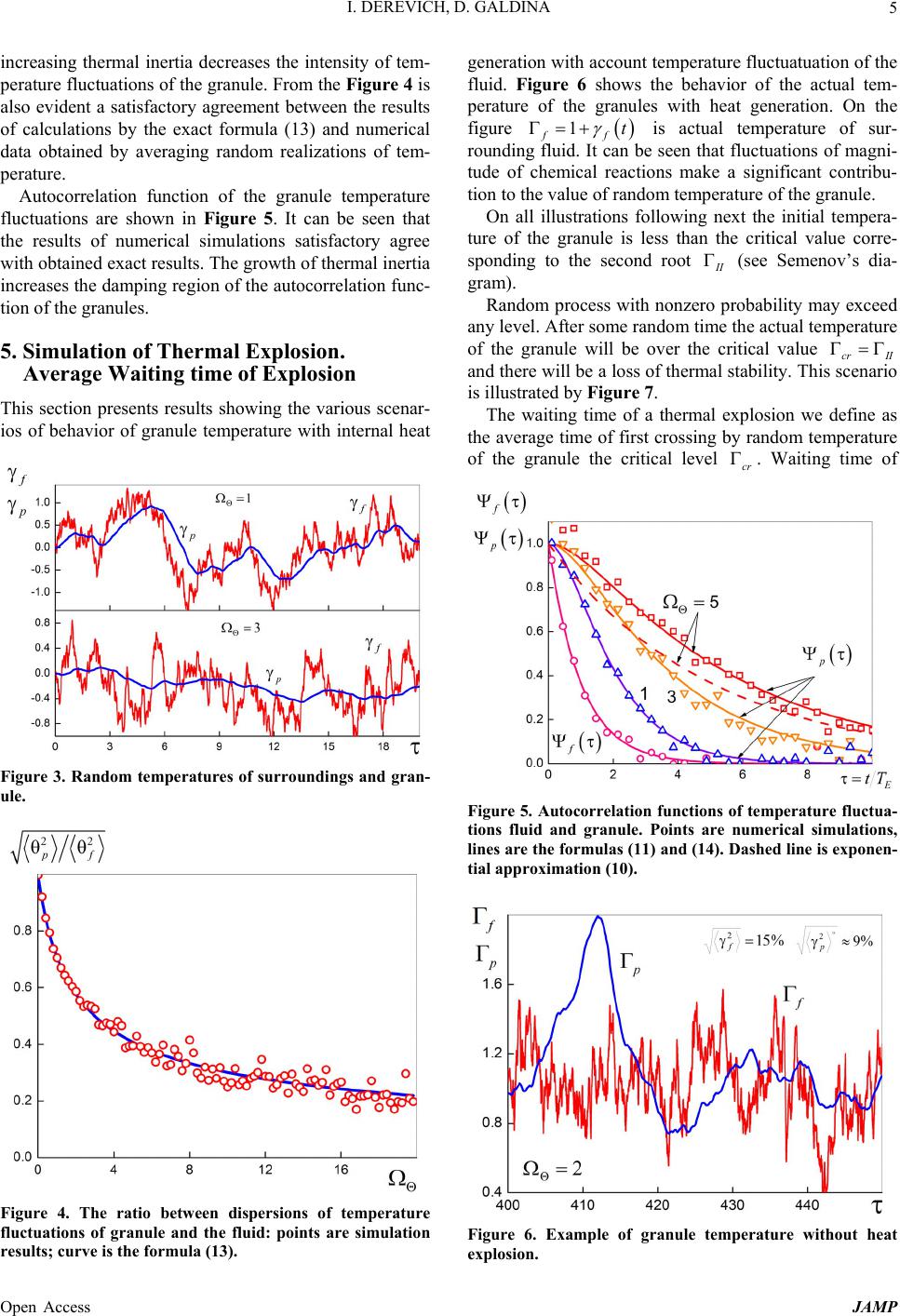 I. DEREVICH, D. GALDINA 5 increasing thermal inertia decreases the intensity of tem- pe s of numerical simulations satisfactory agree w g time of Explosion scenar- al heat rature fluctuations of the granule. From the Figure 4 is also evident a satisfactory agreement between the results of calculations by the exact formula (13) and numerical data obtained by averaging random realizations of tem- perature. Autocorrelation function of the granule temperature fluctuations are shown in Figure 5. It can be seen that the result ith obtained ex act results. The growth of thermal inertia increases the damping region of the autocorrelation func- tion of the g ranules. 5. Simulation of Thermal Explosion. Average Waitin This section presents results showing the various ios of behavior of granule temperature with intern Figure 3. Random temperatures of surroundings and gran- ule. generation with account temperature fluctuatuation of the fluid. Figure 6 shows the behavior of the actual tem- perature of the granules with heat generation. On the figure 1 ff t is actual temperature of sur- rounding fluid. It can be seen that fluctuations of magni- tude of chemical reactions make a significant contribu- tion to the value of random temperature of the granule. On all illustrations following next the initial tempera- ture of the granule is less than the critical value corre- sponding to the second root I I gram). Random process with nonzero probability may exceed any level. After some random ti the actual temperature of (see Semenov’s dia- me the granule will be over the critical value cr II and there will be a loss of thermal stability. This scenario is illustrated by Figure 7. The waiting time of a thermal explosion we define as the average time of first crossing by random temperature of the granule the critical level cr . Waiting time of Figure 5. Autocorrelation functions of temperature fluctua- tions fluid and granule. Points are numerical simulations lines are the formulas (11) and (14). Dashed line is exponen, - tial approximation (10). Figure 4. The ratio between dispersions of temperature fluctuations of granule and the fluid: points are simulation results; curve is the formula (13). Figure 6. Example of granule temperature without heat explosion. Open Access JAMP 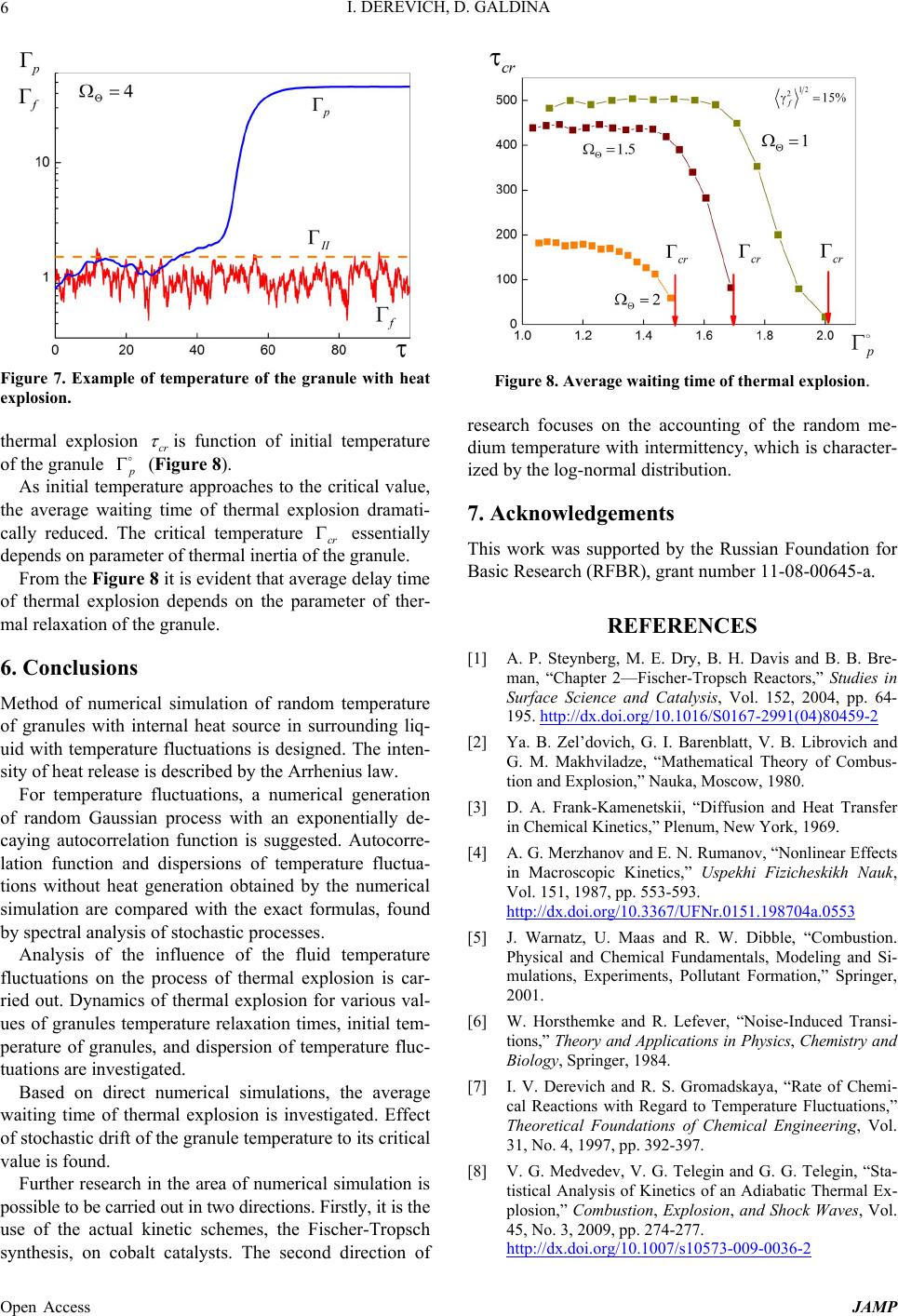 I. DEREVICH, D. GALDINA 6 Figure 7. Example of temperature of the granule with heat explosion. thermal explosion cr is function of initial temperature of the granule p mp (Fi eratur gure 8). As initial tee approaches to the critical value, the average waiting time of thermal explosion dramati- cally reduced. The critical temperature essentially depends on parameter of thermal inertiagranule. From the Figure 8 it is ev ident that averag e delay time of thermal explosion depends on the parameter of ther- mal relaxation of the granule. 6. Conclusions Method of numerical simulation of random temperatue of granules with internal heat source in surrounding l- release is described by the Arrhenius law. flu ss explosion for various val- erature relaxation times, initial te and dispersion of temperature fluc- al va cr of the r iq uid with temperature fluctuations is designed. The inten- ity of heatsFor temperature ctuations, a numerical generation of random Gauian process with an exponentially de- caying autocorrelation function is suggested. Autocorre- lation function and dispersions of temperature fluctua- tions without heat generation obtained by the numerical simulation are compared with the exact formulas, found by spectral analysis of stochastic processes. Analysis of the influence of the fluid temperature fluctuations on the process of thermal explosion is car- ried out. Dynamics of thermal ues of granules temp perature of granules, m- tuations are investigated. Based on direct numerical simulations, the average waiting time of thermal explosion is investigated. Effect of stochastic drift of the granule temperature to its critic lue is found. Further research in the area of numerical simulation is possible to be carried out in two directions. Firstly, it is the use of the actual kinetic schemes, the Fischer-Tropsch synthesis, on cobalt catalysts. The second direction of Figure 8. Average waiting time of thermal explosion. research focuses on the accounting of the random me- dium temperature with intermittenc y, which is character- ized by the log-normal distribution. 7. Acknowledgements This work was supported by the Russian Foundation for Basic Research (RFBR), grant number 11-08-00645-a. REFERENCES [1] A. P. Steynberg, M. E. Dry, B. H. Davis and B. B. Bre- man, “Chapter 2—Fischer-Tropsch Reactors,” Studies in Surface Science and Catalysis, Vol. 152, 2004, pp. 64- 195. http://dx.doi.org/10.1016/S0167-2991(04)80459-2 [2] nd [4] A. G. Merzhanov and E. N. Rumanov, “Nonlinear Effects Uspekhi Fizicheskikh Nauk, 3. Ya. B. Zel’dovich, G. I. Barenblatt, V. B. Librovich a G. M. Makhviladze, “Mathematical Theory of Combus- tion and Explosion,” Nauka, Moscow, 1980. [3] D. A. Frank-Kamenetskii, “Diffusion and Heat Transfer in Chemical Kinetics,” Plenum, New York, 1969. in Macroscopic Kinetics,” Vol. 151, 1987, pp. 553-59 http://dx.doi.org/10.3367/UFNr.0151.198704a.0553 [5] J. Warnatz, U. Maas and R. W. Dibble, “Combustion. Physical and Chemical Fundamentals, Modeling and Si- mulations, Exmation,” Springer, 2001. i- al Ex- periments, Pollutant For [6] W. Horsthemke and R. Lefever, “Noise-Induced Transi- tions,” Theory and Applications in Physics, Chemistry and Biology, Springer, 1984. [7] I. V. Derevich and R. S. Gromadskaya, “Rate of Chem cal Reactions with Regard to Temperature Fluctuations,” Theoretical Foundations of Chemical Engineering, Vol. 31, No. 4, 1997, pp. 392-397. [8] V. G. Medvedev, V. G. Telegin and G. G. Telegin, “Sta- tistical Analysis of Kinetics of an Adiabatic Therm plosion,” Combustion, Explosion, and Shock Waves, Vol. 45, No. 3, 2009, pp. 274-277. http://dx.doi.org/10.1007/s10573-009-0036-2 Open Access JAMP 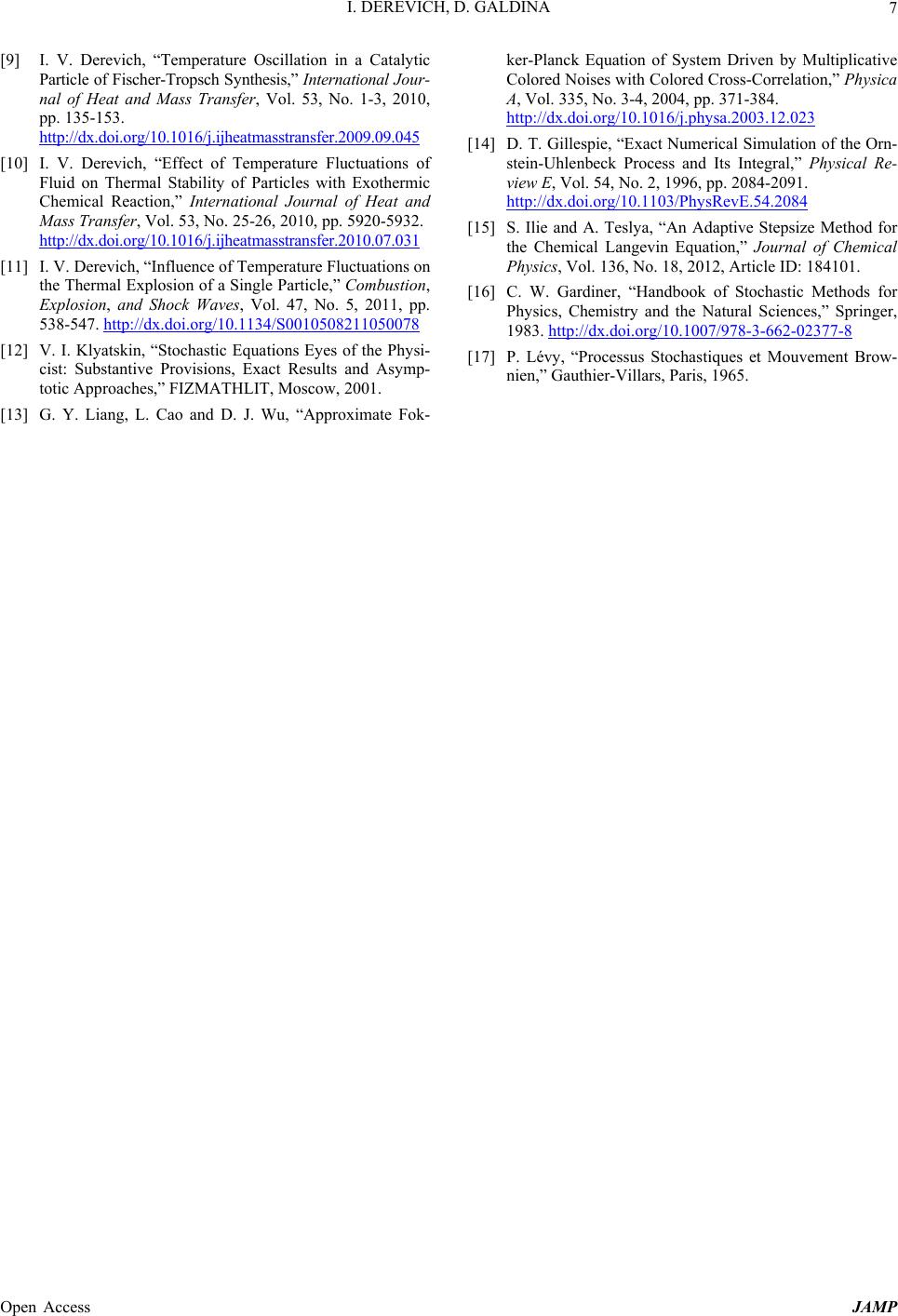 I. DEREVICH, D. GALDINA 7 [9] I. V. Derevich, “Temperature O Particle of Fischer-Tropsch Synthesi s,” International J scillation in a Catal our- ytic nal of Heat and Mass Transfer, Vol. 53, No. 1-3, 2010, pp. 135-153. http://dx.doi.org/10.1016/j.ijheat masst ransfer.200 9.09.045 [10] I. V. Derevich, “Effect of Temperature Fluctuations of .ijheatmasstran sfer.2010.07.03 1 Fluid on Thermal Stability of Particles with Exothermic Chemical Reaction,” International Journal of Heat and Mass Transfer, Vol. 53, No. 25-26, 2010, pp. 5920-5932. http://dx.doi.org/10.1016/j 34/S0010508211050078 [11] I. V. Derevich, “Influence of Temperature Fluctuations on the Thermal Explosion of a Single Particle,” Combustion, Explosion, and Shock Waves, Vol. 47, No. 5, 2011, pp. 538-547. http://dx.doi.org/10.11 [12] V. I. Klyatskin, “Stochastic Equations Eyes of the Physi- cist: Substantive Provisions, Exact Results and Asymp- totic Approaches,” FIZMATHLIT, Moscow, 2001. [13] G. Y. Liang, L. Cao and D. J. Wu, “Approximate Fok- ker-Planck Equation of System Driven by Multiplicative Colored Noises with Colored Cross-Correlation,” Physica A, Vol. 335, No. 3-4, 2004, pp. 371-384. http://dx.doi.org/10.1016/j.physa.2003.12.023 [14] D. T. Gillespie, “Exact Numerical Simulation of the Orn- stein-Uhlenbeck Process and Its Integral,” Physical Re- view E, Vol. 54, No. 2, 1996, pp. 2084-2091. http://dx.doi.org/10.1103/PhysRevE.54.2084 [15] S. Ilie and A. Teslya, “An Adaptive Stepsize Method for the Chemical Langevin Equation,” Journal of Chemical Physics, Vol. 136, No. 18, 2012, Article ID [16] C. W. Gardiner, “Handbook of Stochastic M : 184101. ethods for Physics, Chemistry and the Natural Sciences,” Springer, 1983. http://dx.doi.org/10.1007/978-3-662-02377-8 [17] P. Lévy, “Processus Stochastiques et Mouvem nien,” Gauthier-Villars, Paris, 1965. ent Brow- Open Access JAMP |