

Paper Menu >>
Journal Menu >>
 Surgical Science, 2013, 4, 411-414 http://dx.doi.org/10.4236/ss.2013.410080 Published Online October 2013 (http://www.scirp.org/journal/ss) HIV Quadruple Limb Gangrene: An Unusual Presentation and Review of Literature Edwin Omon Edomwonyi*, John Enekele Onuminya, Alfred Oghogho Ogbemudia, Osita Chizoba Nwokike, Emeka Blessius Kesieme Department of Orthopaedics and Traumatology, Irrua Specialist Teaching Hospital, Irrua, Nigeria Email: *[email protected] Received August 7, 2013; revised August 28, 2013; accepted September 3, 2013 Copyright © 2013 Edwin Omon Edomwonyi et al. This is an open access article distributed under the Creative Commons Attribution License, which permits unrestricted use, distribution, and reproduction in any medium, provided the original work is properly cited. ABSTRACT Vasculitis is one of the less common but important cons equence in patients with Hu man Immunodeficiency Virus (HIV) infections and presentation with multiple limb gangrene is rare. We therefore report a novel case of quadruple limb gangrene in a patient with HIV infection. Keywords: HIV; Quadruple Limb Gangrene; Presentation; Amputation; Irrua 1. Introduction Quadruple limb gangrene associated with HIV infection is rare. The common aetiologies of gangrene of th e limbs are trauma, diabetes mellitus and artherosclerosis [1]. However, systemic lupus erythematosus, progressive sclerosis, henoch scholein syndrome, takayasu arteritis, antineutrophil cystoplasmic antibody (ANCA) associated vasculitis, gangrene associated with procoagulant states due to malignancy, and anticardiolipin antibody syn- drome are some important causes of gangrene of the ex- tremities. Rare causes of gangrene include heparin in- duced thrombocytopenia (HIT), hemolytic uremic syn- drome (HUS) and Human immunodeficiency virus (HIV) infection [2]. HIV infection is multisystemic, and cardiovascular involvement is not an exception. It may present with ar- terial occlusive disease, aneurismal disease, aortic dis- section or AV fistula [2,3]. Vasculitis is one of the less common but important consequences of HIV. Peripheral arterial disease (PAD) is more prevalent in the HIV- infected population than in the general population. Wide- spread digital ischaemic changes and gangrene of the hands and feet are uncommon in patients with HIV in- fection [2-7]. A few cases of one or two limb gangrene associated with HIV infection have been reported from other centres [2-10]. The only reported case of quadruple limb amputation reported in our environment was due to trauma [1]. Quadruple gangrene of the extremities associated with HIV infection is therefore reported to highlight the rare complication and challenges. Relevant literature is also reviewed. 2. Case Report A 28-year-old southern lady presented wounds in both upper and lower limb of two months duration via the Accident and Emergency department of Irrua Specialist Teaching Hospital, Irrua. She was in her usual state of health until 6 months prior to presentation when she de- veloped pepperish/tingling sensations on both upper and lower limbs. She wasn’t a known hypertensive or dia- betic. Subsequently, she noticed that the feet became swollen and later ulcerated. She sought help in a native herbal home where topical herbal preparation was ap- plied on scarification marks. Three months later, darken- ing of the toes was noticed which gradually spread to both feet with loss of sensation. A month later, a similar process repeated itself in both upper limbs following the same chronology. The husband was a long distant driver who abandoned her in the course of the ailment claiming he does not un- derstand the nature of the ailment. She never smoked cigarette, ingest tobacco. No past history of suggestive of coronary disease or stroke. On examination, we saw an emanciated young lady in mild painful distress. She was pale with bilateral inguinal lymphadenopathy. Nil axil- lary lymph node enlargement. Vitals were within normal range. She was hemodynamically stable. Abdomen and *Corresponding a uthor. C opyright © 2013 SciRes. SS 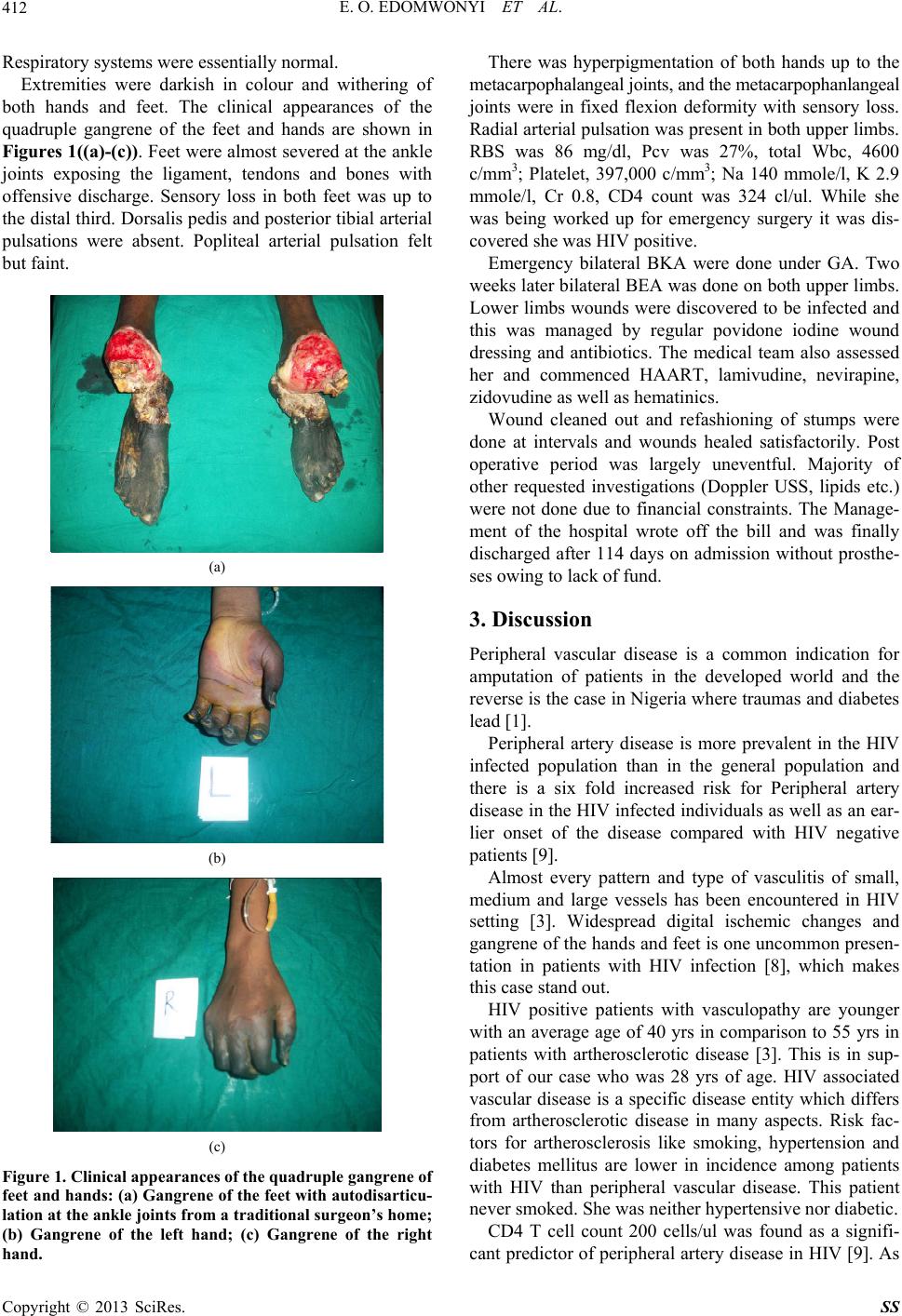 E. O. EDOMWONYI ET AL. 412 Respiratory systems were essentially normal. Extremities were darkish in colour and withering of both hands and feet. The clinical appearances of the quadruple gangrene of the feet and hands are shown in Figures 1((a)-(c)). Feet were almost severed at the ankle joints exposing the ligament, tendons and bones with offensive discharge. Sensory loss in both feet was up to the distal third. Dorsalis pedis and posterior tibial arterial pulsations were absent. Popliteal arterial pulsation felt but faint. (a) (b) (c) Figure 1. Clinical appearances of the quadruple gangrene of feet and hands: (a) Gangrene of the feet with autodisarticu- lation at the ankle joints from a traditional surgeon’s home; (b) Gangrene of the left hand; (c) Gangrene of the right hand. There was hyperpigmentation of both hands up to the metacarpophalangeal joints , and the metacarpophanlangeal joints were in fixed flexion deformity with sensory loss. Radial arterial pulsation was present in both upper limbs. RBS was 86 mg/dl, Pcv was 27%, total Wbc, 4600 c/mm3; Platelet, 397,000 c/mm3; Na 140 mmole/l, K 2.9 mmole/l, Cr 0.8, CD4 count was 324 cl/ul. While she was being worked up for emergency surgery it was dis- covered she was HIV positive. Emergency bilateral BKA were done under GA. Two weeks later bilateral BEA was done on both upper limbs. Lower limbs wounds were discovered to be infected and this was managed by regular povidone iodine wound dressing and antibiotics. The medical team also assessed her and commenced HAART, lamivudine, nevirapine, zidovudine as well as hematinics. Wound cleaned out and refashioning of stumps were done at intervals and wounds healed satisfactorily. Post operative period was largely uneventful. Majority of other requested investigations (Doppler USS, lipids etc.) were not done due to financial constraints. The Manage- ment of the hospital wrote off the bill and was finally discharged after 114 days on admission without prosthe- ses owing to lack of fund. 3. Discussion Peripheral vascular disease is a common indication for amputation of patients in the developed world and the rever se is the cas e in Nigeri a where tr aumas an d diabe tes lead [1]. Peripheral artery disease is more prevalent in the HIV infected population than in the general population and there is a six fold increased risk for Peripheral artery disease in the HIV infected individuals as well as an ear- lier onset of the disease compared with HIV negative patients [9]. Almost every pattern and type of vasculitis of small, medium and large vessels has been encountered in HIV setting [3]. Widespread digital ischemic changes and gangrene of the hands and feet is one uncommon presen- tation in patients with HIV infection [8], which makes this case stand out. HIV positive patients with vasculopathy are younger with an average age of 40 yrs in comparison to 55 yrs in patients with artherosclerotic disease [3]. This is in sup- port of our case who was 28 yrs of age. HIV associated vascular disease is a specific disease entity which differs from artherosclerotic disease in many aspects. Risk fac- tors for artherosclerosis like smoking, hypertension and diabetes mellitus are lower in incidence among patients with HIV than peripheral vascular disease. This patient never sm oked. She was ne i ther hyp ertensive nor dia be t ic. CD4 T cell count 200 cells/ul was found as a signifi- cant predictor of peripheral artery disease in HIV [9]. As Copyright © 2013 SciRes. SS  E. O. EDOMWONYI ET AL. 413 shown in this case CD4 count of patients with HIV vas- culopathy are less than normal in 90% and the CD4/CD8 ratio is usually reversed, indicated of advanced Immu- nosuppression [3]. Infection, occlusive disease due to hypercoagulable states, vasculitis is some of the mecha- nisms suggested for gangrene of the extremities in HIV. Psychiatric symptoms complicating amputation is not out of place as noticed in our patient, the physical reality of mutilation, bod y image changes and diagnos is of HIV in a patient is strong enough stress. Risk of HIV was obvious in this patient; the husband being a long distance driver who even neglected the pa- tient when she became ill. She was seriously handi- capped financially. Hence, she was unable to do most investigation and her bills had to be written off after sev- eral weeks of neglect following discharge from hospital. 3.1. Etiology of Gangrene in HIV Vasculitis, occlusive disease and infections, hypercoagu- lable states. Deficiency of protein C and free protein S, antiThrombin III. Anti phospholip id syndrome have been implicated as mechanism. Antiretroviral medications could lead to endothelial damage too. 3.2. Clinical Feature 1) Male preponderance for obscure reasons; 2) Rest pain of the limbs from ischemia; 3) Intermittent claudication Gangrene. 3.3. Diagnosis HIV associated gangrene may be associated with a known pathogen or trigger or may occur in the absence of one. To determine this, either a serological test, stain- ing of smears, light microscopy, culture, immunohisto- chemistry testing and viral markers may be done de- pending on the clin ical presentation. Work up for protein C, S, antithro mbin III, antinuclear antibodies, antiphospholipid antibodies. Ankle index (AB1) testing would help to identify those with Periph- eral vascular disease. Doppler study of the vascular system is essential. Spotting within the arterial wall test described as string of pearl sign [3]. Diagnostic angiography would identify the location of occlusive or aneurysm. Care should be taken to heparinize these patients before the procedure because of the high risk of thrombosis. 3.4. Management HIV vasculopathy and gangrene represent an advanced stage of the disease process. It is advisable to commence HAART irrespective of the CD4 count. Patients with unsalvageable limb should have primary amputation. When limb is salvageable, treatment options include endovascular procedure like thrombectomy, thrombolysis or by-pass procedures. Limb salvage rate has been in the region of 27% [3]. Widespread ischemic necrosis and gangrene may require treatment with corti- costeroids (in the event of vasculitis), thrombolytic agents (for thrombotic component), or both. Vascular surgical principles should be adhered to and management should be individu alized. When patien ts present late with gangrene as in the index case amputation is the option of surgical treatment and in this case the morbidity was high. The challenges were multiple in ev ery respect. 4. Conclusions Quadruple limb gangrene associated with HIV infection is a rare and novel report from Irrua. In the light of the foregoing, this is a wakeup call for clinicians. Clinicians should consider HIV as an important cause of limb gan- grene and screen for presence of HIV antibodies while evaluating a patient with non-traumatic limb gangrene. Early detection and timely commencement of appro- priate treatment may prevent vascular complication and subsequent gangrene in asymptomatic patients. REFERENCES [1] J. E. Onuminya, P. O. Obekpa, H. C. Ihezue, N. D. Ukegbu and B. O. Onabowale, “Major Amputation in Nigeria: A Plea to Educate Traditional Bone Setters,” Tropical Doctor, Vol. 30, No. 3, 2000, pp. 133-135. [2] V. S. S. Malladi, S. Abkari and V. R. Srinivasan, “Gan- grene Associated with HIV,” In: A. Vigin, Ed., Current Concepts and Management Options, InTech, 2011, pp. 105-112. www.intechopen.com [3] T. V. Malaudzi, J. V. Robbs, W. Pillay, et al., “Thromec- tomy in HIV Related Peripheral Arterial Thrombosis: A Preliminary Report,” European Journal of Vascular and Endovascular Surgery, Vol. 30, No. 1, 2005, pp. 102-106. [4] A. L. Rakrani, A. Basavraj and R. Madraki, “Vasculitis with Digital Gangrene in a Patient with HIV Infection,” Journal of the Association Physicians of India, Vol. 51, 2003, pp. 299-301. [5] M. W. Saif, R. Bona and B. Greenberg, “AIDs and Thrombosis: Restrospective Study of 131 HIV-Infected Patients,” AIDs Patient Care and STDs, Vol. 15, No. 6, 2001, pp. 311-320. http://dx.doi.org/10.1089/108729101750279687 [6] D. Demopoulos, W. Hendson, K. Technau, et al., “Vas- culopathy in HIV-Infected Children—A Case Series,” SA Journal of Child Health, Vol. 3, No. 1, 2009, pp. 27-30. [7] Y. K. Ye; Y. Zeng; X. M. Li, et al., “HIV Infection: An Independent Risk Factor of Peripheral Artery Patient,” Journal of Acquired Immune Deficiency Syndromes, Vol. 53, No. 2, 2010, pp. 276-278. http://dx.doi.org/10.1097/QAI.0b013e3181ba1c31 Copyright © 2013 SciRes. SS  E. O. EDOMWONYI ET AL. Copyright © 2013 SciRes. SS 414 [8] J. V. Robs and N. Paruk, “Management of HIV Vasculo- pathy—A South African Experience,” European Journal of Vascular and Endovascular Surgery, Vol. 39, No. S1, 2010, pp. S25-S31. [9] D. Periard, M. Casvassini, P. Taffe, et al., “High Preva- lence of Peripheral Artery Disease in HIV-Infected Per- sons,” Clinical Infectious Diseases, Vol. 46, No. 5, 2008, pp. 761-767. [10] L. Scholtz, “Vascular Manisfestations of HIV/AIDs,” Cardiovascular and Interventional Radiology, Vol. 27, No. 5, 2004, pp. 422-426. |