

Paper Menu >>
Journal Menu >>
 Advances in Literary Study 2013. Vol.1, No.4, 34-38 Published Online October 2013 in SciRes (http://www.scirp.org/journal/als) http://dx.doi.org/10.4236/als.2013.14009 Copyright © 2013 SciRes. 34 Death Shall Have No Dominion: Representations of Grandfathers’ Death in Contemporary Picturebooks* Konstantinos D. Malafantis Faculty of Primary Education, National and Kapodistrian University of Athens, Athens, Greece Email: [email protected] Received July 17th, 2013; revised August 11th, 2013; accepted October 8th, 2013 Copyright © 2013 Konstantinos D. Malafantis. This is an open access article distributed under the Creative Commons Attribution License, which permits unrestricted use, distribution, and reproduction in any medium, provided the origina l w o rk is properly cited. The topic of death usually advocates the resistance of language, therefore creators search for linguistic or visual codes suitable for expressing the unutterable loss of beloved people in contemporary picture or il- lustrated books for children. For that reason, the meaning of death is portrayed in picturebooks with an immediate and symbolic way in both text and picture. Adopting a visual and textual approach, we exam- ine the ways in which authors and illustrators portray the relationship between grandparent and grand- children in picturebooks. Many stories in children’s literature deal with the archetypal pattern of death and present it in a way which enables young readers to come to terms with it. In such stories, young pro- tagonists, and thus young readers, are introduced into questions of ageing and decay, and inevitably of death, through an imaginative “travel” in time and space which is engendered by the grandparent’s en- chanting storytelling. Death comes to be viewed as simply a stage toward reunion with eternal nature in the hereafter. The grandparent’s death is pictured as a “justifiable” event, integrated in the life cycle. Be- reavement and grief seem to rely on the principal motifs of nature-as-space and nature-as-knowledge, which eventually manage to negate the dominion of death upon life. Keywords: Grandfathers’ Death; Picturebooks; Children’s Literature Introduction Death, just like birth, is an essential part of human experi- ence and an archetypal theme in literature. According to Phil- ippe Ariès (1977/1991), in his landmark study of the subject, death is a socially constructed phenomenon in Western culture and one can recognize several changing social attitudes to it through the centuries. Death is mysterious and overwhelming; a meaningless monster, according to the eminent historian, that lurks at the edge of our consciousness, ready to destroy us and demolish whatever meaning we attribute to our lives. In today’s world we encounter an “invisibility of death”, a somewhat pa- radoxical situation, in that we deny the existence of death so effectively that we no longer develop personal and communal resources to give it meaning. Death’s invisibility corroborates its terror; our culture’s loss of spirituality reinforces the mean- inglessness of death. Contemporary children’s books deal with the subject through unraveling the mystery and the invisibility in it. People should not fear death; writers should not hesitate to represent it as far as death is not considered any more as a dark or unspeakable taboo. Death in Picturebooks As an inescapable condition, rather than just the end of exis- tence, death has to be approached by both adults and children with as much sensitivity and understanding as birth. Death normally evokes grief, mourning and bereavement but, apart from this intolerable pain, it should be in most cases compre- hensible, even by young children. Many stories in children’s literature deal with death and present it in a way which enables young readers to come to terms with it. Actually, several death-related books for children emphasize in hilarious ways the importance of coping with death and loss. One such book is Babette Cole’s Drop Dead (1997), in which death is described with great humor and funny illustrations as an integral part of the essential circle of human life. There are also more sophisti- cated stories for young audiences such as the controversial yet beloved novel by Katherine Paterson Bridge to Terabithia (1977), which challenge the conventional boundaries of ac- ceptable themes for children’s literature, by taking the topics of death and loss in an uncompromising way. Picturebooks on grief, bereavement, and mourning have so much to offer to children (Dennis, 2012; Corr, 2003-2004; Mc- George, 1998). Doubtless, death as a topic usually advocates the resistance of language used to describe it. The creators of modern picturebooks search for linguistic codes suitable for expressing the unutterable loss of beloved people. Picturebooks can vividly represent incidents from everyday life, the character *According to Judeo-Christian narrative “death shall have no dominion”,as religion gives the promise of eternal life. In the same way, Dylan Thomas’s p oem “And death shall have no dominion”, celebrates the undying and eternal s trength of the human spirit. It is because of this strengt h that death does not claim ultimate victory over humanity. We never truly lose our beloved persons, as the y live on in our memory and spirit. 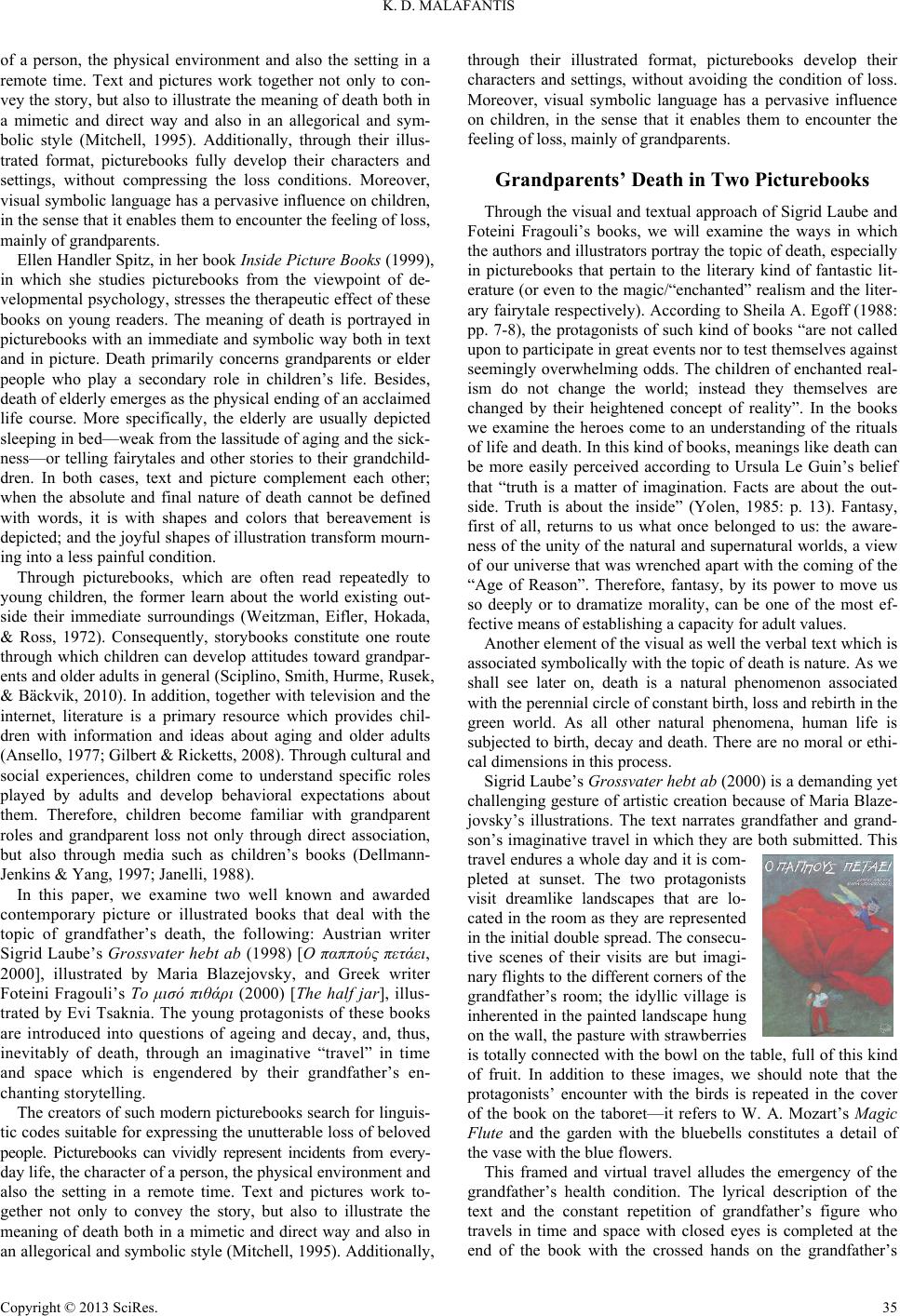 K. D. MA LAFANTIS Copyright © 2013 SciRes. 35 of a person, the physical environment and also the setting in a remote time. Text and pictures work together not only to con- vey the story, but also to illustrate the meaning of death both in a mimetic and direct way and also in an allegorical and sym- bolic style (Mitchell, 1995). Additionally, through their illus- trated format, picturebooks fully develop their characters and settings, without compressing the loss conditions. Moreover, visual symbolic language has a pervasive influence on children, in the sense that it enables them to encounter the feeling of loss, mainly of grandparents. Ellen Handler Spitz, in her book Inside Picture Books (1999), in which she studies picturebooks from the viewpoint of de- velopmental psychology, stresses the therapeutic effect of these books on young readers. The meaning of death is portrayed in picturebooks with an immediate and symbolic way both in text and in picture. Death primarily concerns grandparents or elder people who play a secondary role in children’s life. Besides, death of elderly emerges as the physical ending of an acclaimed life course. More specifically, the elderly are usually depicted sleeping in bed—weak from the lassitude of aging and the sick- ness—or telling fairytales and other stories to their grandchild- dren. In both cases, text and picture complement each other; when the absolute and final nature of death cannot be defined with words, it is with shapes and colors that bereavement is depicted; and the joyful shapes of illustration transform mourn- ing into a less painful condition. Through picturebooks, which are often read repeatedly to young children, the former learn about the world existing out- side their immediate surroundings (Weitzman, Eifler, Hokada, & Ross, 1972). Consequently, storybooks constitute one route through which children can develop attitudes toward grandpar- ents and older adults in general (Sciplino, Smith, Hurme, Rusek, & Bäckvik, 2010). In addition, together with television and the internet, literature is a primary resource which provides chil- dren with information and ideas about aging and older adults (Ansello, 1977; Gilbert & Ricketts, 2008). Through cultural and social experiences, children come to understand specific roles played by adults and develop behavioral expectations about them. Therefore, children become familiar with grandparent roles and grandparent loss not only through direct association, but also through media such as children’s books (Dellmann- Jenkins & Yang, 1997; Janelli, 1988). In this paper, we examine two well known and awarded contemporary picture or illustrated books that deal with the topic of grandfather’s death, the following: Austrian writer Sigrid Laube’s Grossvater hebt ab (1998) [Ο παππούς πετάει, 2000], illustrated by Maria Blazejovsky, and Greek writer Foteini Fragouli’s Το μισό πιθάρι (2000) [The half jar], illus- trated by Evi Tsaknia. The young protagonists of these books are introduced into questions of ageing and decay, and, thus, inevitably of death, through an imaginative “travel” in time and space which is engendered by their grandfather’s en- chanting storytelling. The creators of such modern picturebooks search for linguis- tic codes suitable for expressing the unutterable loss of beloved people. Picturebooks can vividly represent incidents from every- day life, the character of a person, the physical environment and also the setting in a remote time. Text and pictures work to- gether not only to convey the story, but also to illustrate the meaning of death both in a mimetic and direct way and also in an allegorical and symbolic style (Mitchell, 1995). Additionally, through their illustrated format, picturebooks develop their characters and settings, without avoiding the condition of loss. Moreover, visual symbolic language has a pervasive influence on children, in the sense that it enables them to encounter the feeling of loss, mainly of grandparents. Grandparents’ Death in Two Picturebooks Through the visual and textual approach of Sigrid Laube and Foteini Fragouli’s books, we will examine the ways in which the authors and illustrators portray the topic of death, especially in picturebooks that pertain to the literary kind of fantastic lit- erature (or even to the magic/“enchanted” realism and the liter- ary fairytale respectively). According to Sheila A. Egoff (1988: pp. 7-8), the protagonists of such kind of books “are not called upon to participate in great events nor to test themselves against seemingly overwhelming odds. The children of enchanted real- ism do not change the world; instead they themselves are changed by their heightened concept of reality”. In the books we examine the heroes come to an understanding of the rituals of life and death. In this kind of books, meanings like death can be more easily perceived according to Ursula Le Guin’s belief that “truth is a matter of imagination. Facts are about the out- side. Truth is about the inside” (Yolen, 1985: p. 13). Fantasy, first of all, returns to us what once belonged to us: the aware- ness of the unity of the natural and supernatural worlds, a view of our universe that was wrenched apart with the coming of the “Age of Reason”. Therefore, fantasy, by its power to move us so deeply or to dramatize morality, can be one of the most ef- fective means of establishing a capacity for adult values. Another element of the visual as well the verbal text which is associated symbolically with the topic of death is nature. As we shall see later on, death is a natural phenomenon associated with the perennial circle of constant birth, loss and rebirth in the green world. As all other natural phenomena, human life is subjected to birth, decay and death. There are no moral or ethi- cal dimensions in this process. Sigrid Laube’s Grossvater hebt ab (2000) is a demanding yet challenging gesture of artistic creation because of Maria Blaze- jovsky’s illustrations. The text narrates grandfather and grand- son’s imaginative travel in which they are both submitted. This travel endures a whole day and it is com- pleted at sunset. The two protagonists visit dreamlike landscapes that are lo- cated in the room as they are represented in the initial double spread. The consecu- tive scenes of their visits are but imagi- nary flights to the different corners of the grandfather’s room; the idyllic village is inherented in the painted landscape hung on the wall, the pasture with strawberries is totally connected with the bowl on the table, full of this kind of fruit. In addition to these images, we should note that the protagonists’ encounter with the birds is repeated in the cover of the book on the taboret—it refers to W. A. Mozart’s Magic Flute and the garden with the bluebells constitutes a detail of the vase with the blue flowers. This framed and virtual travel alludes the emergency of the grandfather’s health condition. The lyrical description of the text and the constant repetition of grandfather’s figure who travels in time and space with closed eyes is completed at the end of the book with the crossed hands on the grandfather’s 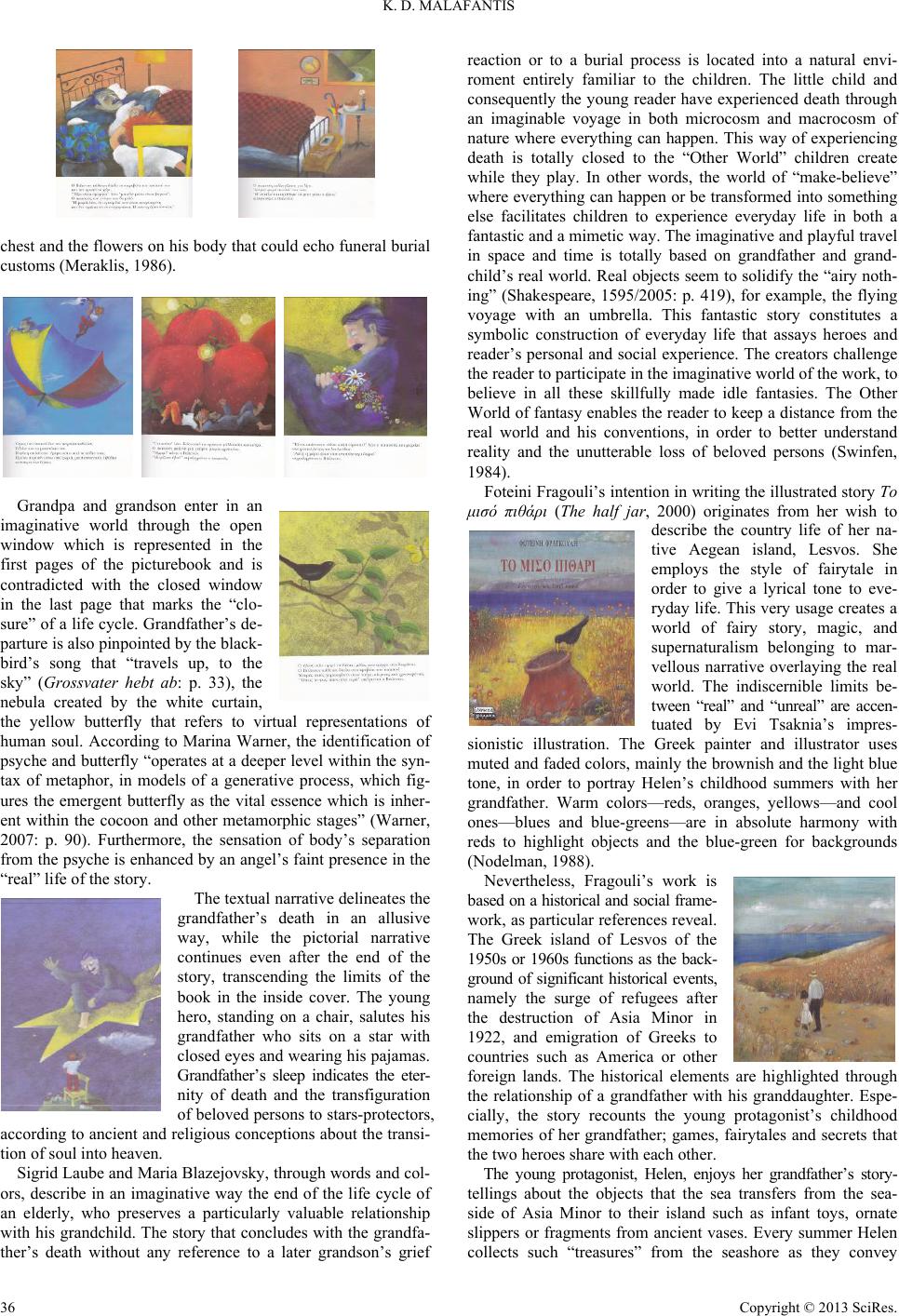 K. D. MA LAFANTIS Copyright © 2013 SciRes. 36 chest and the flowers on his body that could echo funeral burial customs (Meraklis, 1986). Grandpa and grandson enter in an imaginative world through the open window which is represented in the first pages of the picturebook and is contradicted with the closed window in the last page that marks the “clo- sure” of a life cycle. Grandfather’s de- parture is also pinpointed by the black- bird’s song that “travels up, to the sky” (Grossvater hebt ab: p. 33), the nebula created by the white curtain, the yellow butterfly that refers to virtual representations of human soul. According to Marina Warner, the identification of psyche and butterfly “operates at a deeper level within the syn- tax of metaphor, in models of a generative process, which fig- ures the emergent butterfly as the vital essence which is inher- ent within the cocoon and other metamorphic stages” (Warner, 2007: p. 90). Furthermore, the sensation of body’s separation from the psyche is enhanced by an angel’s faint presence in the “real” life of the story. The textual narrative delineates the grandfather’s death in an allusive way, while the pictorial narrative continues even after the end of the story, transcending the limits of the book in the inside cover. The young hero, standing on a chair, salutes his grandfather who sits on a star with closed eyes and wearing his pajamas. Grandfather’s sleep indicates the eter- nity of death and the transfiguration of beloved persons to stars-protectors, according to ancient and religious conceptions about the transi- tion of soul into heaven. Sigrid Laube and Maria Blazejovsky, through words and col- ors, describe in an imaginative way the end of the life cycle of an elderly, who preserves a particularly valuable relationship with his grandchild. The story that concludes with the grandfa- ther’s death without any reference to a later grandson’s grief reaction or to a burial process is located into a natural envi- roment entirely familiar to the children. The little child and consequently the young reader have experienced death through an imaginable voyage in both microcosm and macrocosm of nature where everything can happen. This way of experiencing death is totally closed to the “Other World” children create while they play. In other words, the world of “make-believe” where everything can happen or be transformed into something else facilitates children to experience everyday life in both a fantastic and a mimetic way. The imaginative and playful travel in space and time is totally based on grandfather and grand- child’s real world. Real objects seem to solidify the “airy noth- ing” (Shakespeare, 1595/2005: p. 419), for example, the flying voyage with an umbrella. This fantastic story constitutes a symbolic construction of everyday life that assays heroes and reader’s personal and social experience. The creators challenge the reader to participate in the imaginative world of the work, to believe in all these skillfully made idle fantasies. The Other World of fantasy enables the reader to keep a distance from the real world and his conventions, in order to better understand reality and the unutterable loss of beloved persons (Swinfen, 1984). Foteini Fragouli’s intention in writing the illustrated story Το μισό πιθάρι (The half jar, 2000) originates from her wish to describe the country life of her na- tive Aegean island, Lesvos. She employs the style of fairytale in order to give a lyrical tone to eve- ryday life. This very usage creates a world of fairy story, magic, and supernaturalism belonging to mar- vellous narrative overlaying the real world. The indiscernible limits be- tween “real” and “unreal” are accen- tuated by Evi Tsaknia’s impres- sionistic illustration. The Greek painter and illustrator uses muted and faded colors, mainly the brownish and the light blue tone, in order to portray Helen’s childhood summers with her grandfather. Warm colors—reds, oranges, yellows—and cool ones—blues and blue-greens—are in absolute harmony with reds to highlight objects and the blue-green for backgrounds (Nodelman, 1988). Nevertheless, Fragouli’s work is ba sed on a historical and social frame- work, as particular references reveal. The Greek island of Lesvos of the 1950s or 1960s functions as the back- ground of significant historical events, namely the surge of refugees after the destruction of Asia Minor in 1922, and emigration of Greeks to countries such as America or other foreign lands. The historical elements are highlighted through the relationship of a grandfather with his granddaughter. Espe- cially, the story recounts the young protagonist’s childhood memories of her grandfather; games, fairytales and secrets that the two heroes share with each other. The young protagonist, Helen, enjoys her grandfather’s story- tellings about the objects that the sea transfers from the sea- side of Asia Minor to their island such as infant toys, ornate slippers or fragments from ancient vases. Every summer Helen collects such “treasures” from the seashore as they convey  K. D. MA LAFANTIS Copyright © 2013 SciRes. 37 refugees’ memories. Additionally, the heroine’s memories of her child- hood are complemented by her grandfather’s fairytales that con- stitute a fairytale world where both the grandchild and the reader can discover hidden desires such as the restoration to the lost homelands of Asia Minor. Helen, even after her grandfather’s death, feels his pres- ence both in everyday life and her dreams. Many years after, the grandfather’s advice to Helen, through a dream, “to love and to remember” the lost homelands (Το μισό πιθάρι: p. 29), motivates the heroine to find in the cellar of her house the punnets full of broken ancient vases which she was collecting as a child from the beach every summer. The granddaughter’s reinterpretation of the past helps her to better understand her relationship with her grandfather as much as his inevitable loss. The heroine returns to external life, rich from experiences and treasures which she derived from the initiation travel with her grandfather. The preservation of the deceased grandfather’s memory signifies the symbolic triumph of life over death, according to Petrarch’s idea of “fama” (Hardie, 2012). Dreams and traditional stories combined will enable the heroine to understand herself and realize that the half jar from pieces—fragments of experiences and memories, songs and stories—represents the water memory both of the other sea- shore, the ancestral hearth of Asia Minor, and of her childhood. Literature relying on that combination “can remind us of this loophole in our rationality, and challenge our casual assurance, particularly if the dream world asserts its own substantiality. That dream may have as much validity as real life” (Hume, 1984: p. 127). Foteini Fragouli’s authorial pen and Evi Tsaknia’s color pal- ette create a dreamlike story in and out of time and space. Past and present time are tied metaphorically with the “water chain”, which is the Aegean Sea, and elucidate the meaning of in- comprehensible words, such as the word “river”, that the grandfather used to say every time he was narrating fairytales and parables to his grandchild. The seawater that both grandfather and granddaughter are viewing invites them to an imaginative voyage in a natural environment. The heroes’ gaze acti- vates memories, facts, historical pe- riods, individual experiences, love, pain, etc. The eyes, actually, do not function as a mirror of nature, but as a mirror of mind. The eye itself is the vehicle of imaginative thought if we consider Aristotle’s decla- ration in De Anima (III, vii. 15: pp. 176-177) that “The soul never thinks without a mental image”. The young heroine will never stop “communicating” with her grandfather as the reverie of the birthplace of Asia Minor will connect the two of them forever. The maritime birthplace has the power to give life even to the lifeless and to make articulate even the mute, as Gaston Bachelard has declared (1981). Some Conclusions The two picturebooks analyzed in this paper do not reenact the figure of grandparent in a stereotypical way as a “set of shared expectations focused upon a particular position” (Scott, 1970: p. 25; see also Beland & Mills, 2001; McElhoe, 1999). These expectations, which include beliefs about what goals or values the grandparent represents, are complemented by the grandfather’s dreamlike representation. The imaginative de- lineation of grandfather’s relationship with his grandchildren in picturebooks and/or illustrated books attains a better result when it provokes the young reader to stand back, take a second look, doubt, and reflect (Zipes, 2009). It seems clear that deal- ing with the meaning of death through fantasy or imagination is beneficial for young people, because fantasy is considered as the most valuable attribute of the human mind (Chukovsky, 1963). The imaginative approach of death has also therapeutic value in the sense that it defuses children’s anxieties and facili- tates the resolution of emotional conflicts (Bettelheim, 1976/ 1995). Furthermore, death comes to be viewed as simply a stage toward reunion with eternal nature in the hereafter. The idea that life is an eternal course which is never suspended, as the beloved persons, even after their death, “exist” as psychological presences, abolishes the sense of an ending. Instead, it subjects the idea of continuity and equilibrium of nature which consists a vivifying power, perfect and complete (“Yet nature is made by no mean/but nature makes that mean”, as William Shake- speare [1609-1610/2005: p. 1129] wrote). Text and pictures invite young readers to incorporate themselves in the physical universe and to synchronize their biological rhythm with the imperturbable rhythm of the physical environment. In such a context, the grandparent’s death is pictured as a “justifiable” event, integrated in the life cycle. Bereavement and grief seem to rely on the principal motifs of nature-as-space and nature- as-knowledge, which eventually manage to negate the domin- ion of death upon life. REFERENCES Primary Works Aristotle (1940). De Anima III, vii. 15. Athens: Pap yros. Ansello, E. F. (1977). Age and ageism in children’s first literature. Educational Gerontology, 2, 255-274. http://dx.doi.org/10.1080/0360127770020305 Ariès, P. (1991). The hour of our death. The classic history of Western attitudes toward death over the last one thousand years. (Trans. H. Weaver). Oxford: Oxford University Press. (Originally published as L’ homme devant la mort. Paris: Editions du Seuil, 1977). Bachelard, G. (1981). L’ eau et les rêves. Essai sur l’ imagination de la matière. Paris: Corti J. (Original work published 1942 ). Beland, R. M., & Mills, T. L. (2001). Positive portrayal of grandparents in current children’s literature. Journal of Family Issues, 22, 639-651. http://dx.doi.org/10.1177/019251301022005006 Bettelheim, B. (1995). Η γοητεία των παραμυθιών. Μια ψυχαναλυτική προσέγγιση. (Trans. H. Asteriou). Athens: Glaros. (Originally pub-  K. D. MA LAFANTIS Copyright © 2013 SciRes. 38 lished as The uses of enchantment. The meaning and importance of fairy tales. New York: Knopf, 1976) . Chukovsky, K. I. (1963). From two to five. Berkeley: University of California Press. Cole, B. (1997). Drop dead. (Illustrations by the author). New York: Knopf Books for Young Readers. Corr, C. A. (2003-2004). Bereavement, grief, and mourning in death- related literature for children. Omega, 48, 337- 363. Dellmann-Jenkins, M., & Yang, L. (1997). The portrayal of older peo- ple in award-winning literature for children. Journal of Research in Childhood Education, 12, 96-100. http://dx.doi.org/10.1080/02568549709594720 Dennis, M. R. (2012). Do grief self-help books convey contemporary perspectives on grieving? Death Studies, 36, 393-418. http://dx.doi.org/10.1080/07481187.2011.553326 Egoff, S. A. (1988). Worlds within. Children’s fantasy from the Middle Ages to today. Chicago and L ond on: American Library Association. Fragouli, F. (2000). Το μισό πιθάρι [The half jar]. (Illustrations by Evi Tsaknia). Athens: Ellinika Grammata. Gilbert, C. N., & Ricketts, K. G. (2008). Children’s attitudes toward older adults and ageing: A synthesis of research. Educational Ger- ontology, 34, 570-586. http://dx.doi.org/10.1080/03601270801900420 Hardie, P. (2012). Rumour and renown. Representations of Fama in Western literature. Cambridge: Cambridge University Press. Hume, K. (1984). Fantasy and mimesis. Responses to reality in Wes- tern literature. London and New York: Methuen. Janelli, L. M. (1988). Depictions of grandparents in children’s literature. Educational Gerontology, 14, 193-202. http://dx.doi.org/10.1080/0380127880140303 Laube, S. (2000). Ο παππούς πετάει. (Illustrations by Maria Blaze- jovsky. Trans. Chara Stroni). Athens: Castor. (Originally published as Grossvater hebt ab, Wien: Jungbrunnen-Verl ag, 1998). McElhoe, J. S. (1999). Images of grandparents in children’s literature. New Advocate, 12, 249-258. McGeorge, C. (1998). Death and violence in some Victorian school reading books. Children’s Literature in Education, 29, 109-117. http://dx.doi.org/10.1023/A:1022411126021 Meraklis, M. G. (1986). Ελληνική Λαογραφία. Ήθη και Έθιμα (Greek folklore. Customs and traditions) (3rd ed.). Athens: Odysseus. Mitchell, W. J. T. (1995). Picture theory. Essays on verbal and visual representation. Chicago & London: The University of Chicago Press. Nodelman, P. (1988). Words about pictures. The narrative art of chil- dren’s picture books. Athens & London: The University of Georgia Press. Paterson, K. (1977). Bridge to Terabithia. (Illustrations by Donna Diamond). New York: HarperCollins. Sciplino, C., Smith, P. K., Hurme, H., Rusek, M., & Bäckvik, P. (2010). Representations of grandparents in children’s books in Britain, Italy, Greece, Finland, and Poland. Journal of Intergenerational Relation- ships, 8, 298-316. http://dx.doi.org/10.1080/15350770.2010.498760 Scott, W. R. (1970). Social processes and social structures. An intro- duction to sociology. New York: Holt, Rinehart & Winston. Secondary Sources Shakespeare, W. (2005). A Midsummer’s Night Dream. In S. Wells, & G. Taylor (Eds.), The Oxford Shakespeare. The complete works (2nd ed.). Oxford: Oxford University Press. (Original work published 1595). Shakespeare, W. (2005). The Winter’s Tale. In S. Wells, & G. Taylor (Eds.), The Oxford Shakespeare. The complete works (2nd ed.). Ox- ford: Oxford University Press. (Original work published 1609-1610). Spitz, E. H. (1999). Inside picture books. New Haven: Yale University Press. Swinfen, A. (1984). In defence of fantasy. A study of the genre in Eng- lish and American literature since 1945. London: Routledge and Kegan Paul. Warner, M. (2007). Fantastic metamorphoses, other worlds. Ways of telling the self (2nd ed.). New York: Oxford University Press. Weitzman, L. J., Eifler, D., Hokada, E., & Ross, C. (1972). Sex-role socialization in picture books for preschool children. American Journal of Sociology, 77, 1125-115 0. http://dx.doi.org/10.1086/225261 Yolen, J. (1985). Review of The Language of the Night, by Ursula K. Le Guin. Book World. Zipes, J. (2009). Why fantasy matters too much. Journal of Aesthetic Education, 43, 75- 91. http://dx.doi.org/10.1353/jae.0.0039 |