

Paper Menu >>
Journal Menu >>
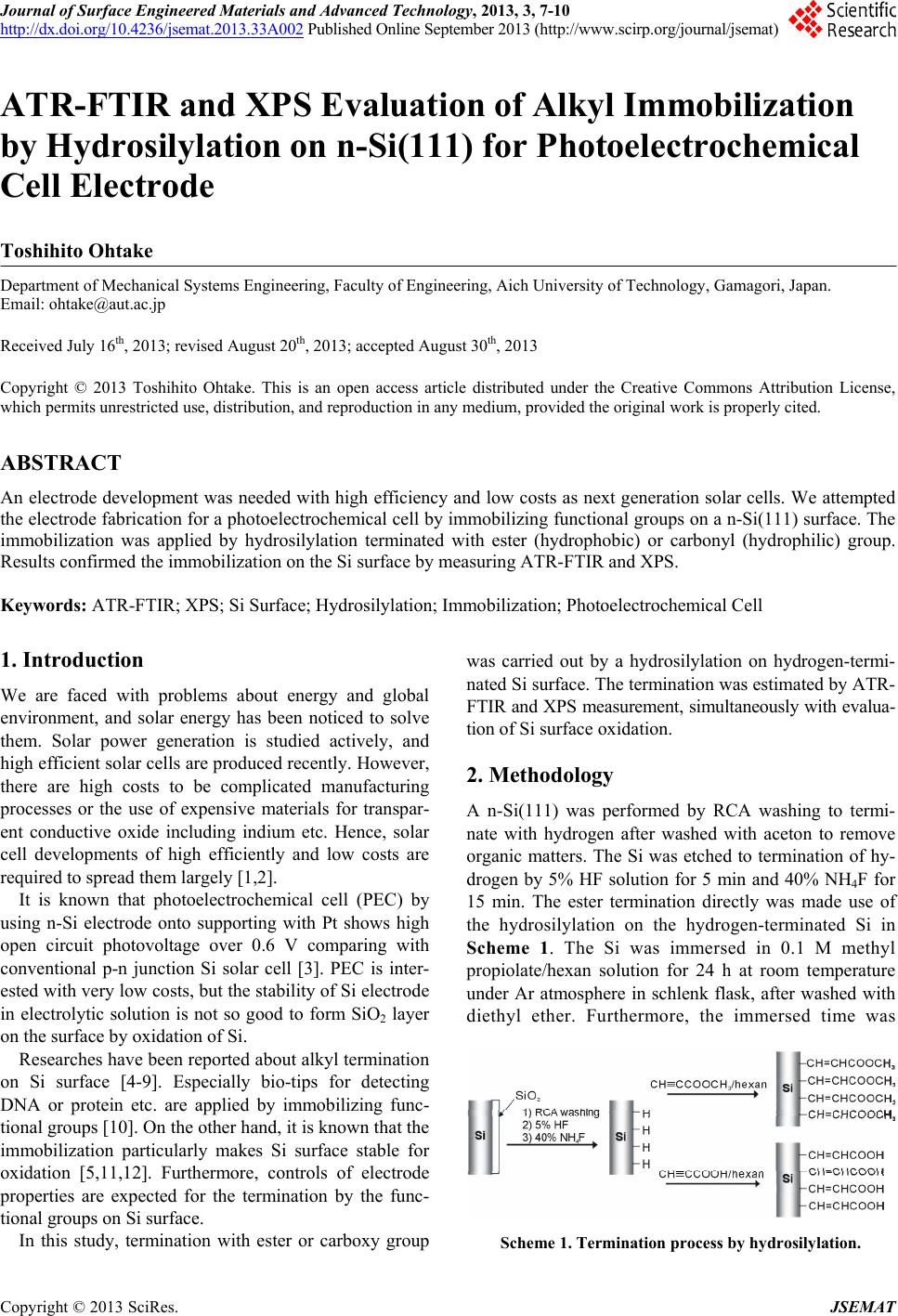 Journal of Surface Engineered Materials and Advanced Technology, 2013, 3, 7-10 http://dx.doi.org/10.4236/jsemat.2013.33A002 Published Online September 2013 (http://www.scirp.org/journal/jsemat) 7 ATR-FTIR and XPS Evaluation of Alkyl Immobilization by Hydrosilylation on n-Si(111) for Photoelectrochemical Cell Electrode Toshihito Ohtake Department of Mechanical Systems Engineering, Faculty of Engineering, Aich University of Technology, Gamagori, Japan. Email: [email protected] Received July 16th, 2013; revised August 20th, 2013; accepted August 30th, 2013 Copyright © 2013 Toshihito Ohtake. This is an open access article distributed under the Creative Commons Attribution License, which permits unrestricted use, distribution, and reproduction in any medium, provided the original work is properly cited. ABSTRACT An electrode development was needed with high efficiency and low costs as next generation solar cells. We attempted the electrode fabrication for a photoelectrochemical cell by immobilizing functional groups on a n-Si(111) surface. The immobilization was applied by hydrosilylation terminated with ester (hydrophobic) or carbonyl (hydrophilic) group. Results confirmed the immobilization on the Si surface by measuring ATR-FTIR and XPS. Keywords: ATR-FTIR; XPS; Si Surface; Hydrosilylation; Immobilization; Photoelectrochemical Cell 1. Introduction We are faced with problems about energy and global environment, and solar energy has been noticed to solve them. Solar power generation is studied actively, and high efficient solar cells are produced recently. However, there are high costs to be complicated manufacturing processes or the use of expensive materials for transpar- ent conductive oxide including indium etc. Hence, solar cell developments of high efficiently and low costs are required to spread them largely [1,2]. It is known that photoelectrochemical cell (PEC) by using n-Si electrode onto supporting with Pt shows high open circuit photovoltage over 0.6 V comparing with conventional p-n junction Si solar cell [3]. PEC is inter- ested with very low costs, but the stability of Si electrode in electrolytic solution is not so good to form SiO2 layer on the surface by oxidation of Si. Researches have been reported about alkyl termination on Si surface [4-9]. Especially bio-tips for detecting DNA or protein etc. are applied by immobilizing func- tional groups [10]. On the other hand, it is known that the immobilization particularly makes Si surface stable for oxidation [5,11,12]. Furthermore, controls of electrode properties are expected for the termination by the func- tional groups on Si surface. In this study, termination with ester or carboxy group was carried out by a hydrosilylation on hydrogen-termi- nated Si surface. The termination was estimated by ATR- FTIR and XPS measurement, simultaneously with evalua- tion of Si surface oxidation. 2. Methodology A n-Si(111) was performed by RCA washing to termi- nate with hydrogen after washed with aceton to remove organic matters. The Si was etched to termination of hy- drogen by 5% HF solution for 5 min and 40% NH4F for 15 min. The ester termination directly was made use of the hydrosilylation on the hydrogen-terminated Si in Scheme 1. The Si was immersed in 0.1 M methyl propiolate/hexan solution for 24 h at room temperature under Ar atmosphere in schlenk flask, after washed with diethyl ether. Furthermore, the immersed time was Scheme 1. Termination process by hydrosilylation. Copyright © 2013 SciRes. JSEMAT 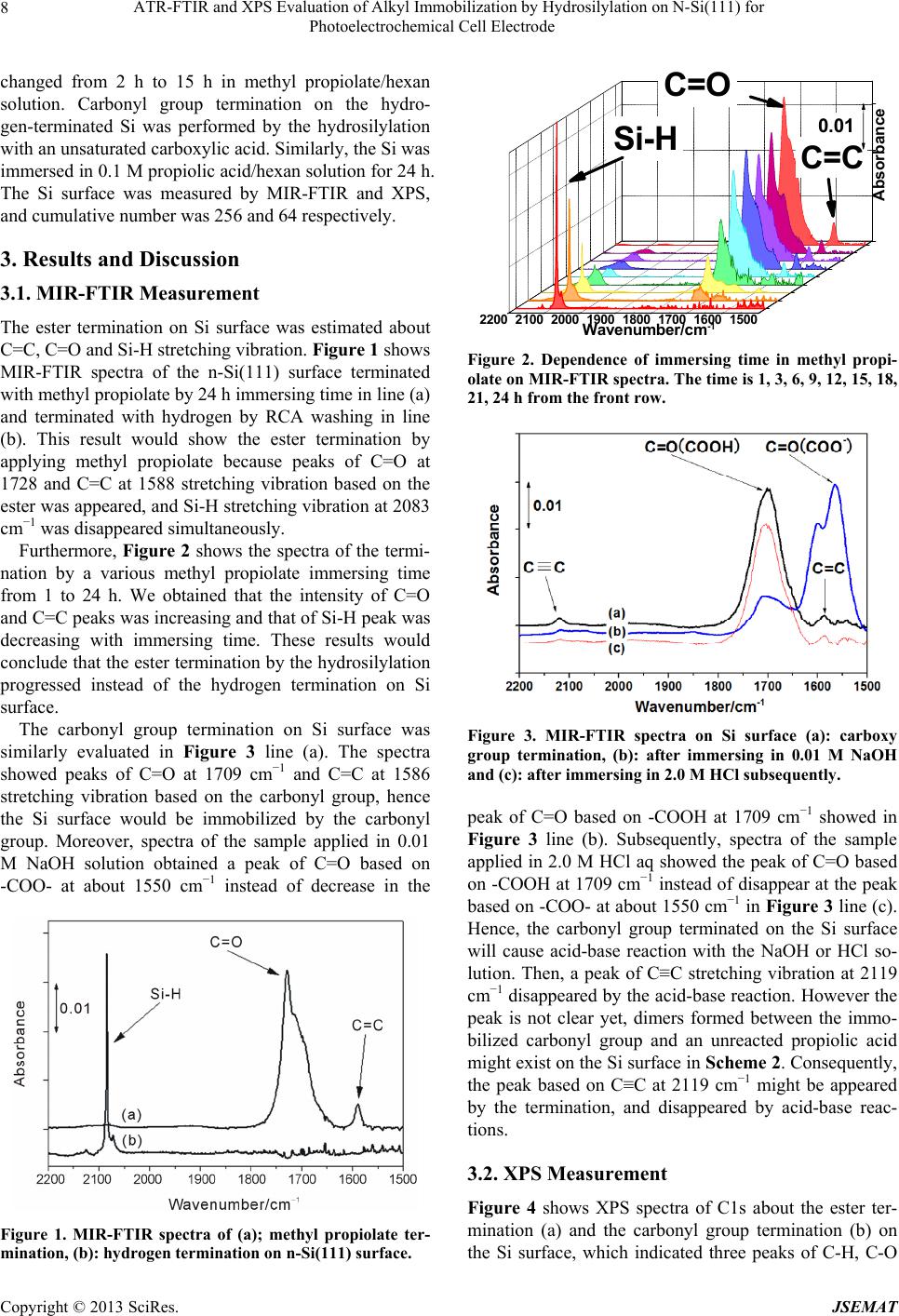 ATR-FTIR and XPS Evaluation of Alkyl Immobilization by Hydrosilylation on N-Si(111) for Photoelectrochemical Cell Electrode 8 changed from 2 h to 15 h in methyl propiolate/hexan solution. Carbonyl group termination on the hydro- gen-terminated Si was performed by the hydrosilylation with an unsaturated carboxylic acid. Similarly, the Si was immersed in 0.1 M propiolic acid/hexan solution for 24 h. The Si surface was measured by MIR-FTIR and XPS, and cumulative number was 256 and 64 respectively. 3. Results and Discussion 3.1. MIR-FTIR Measurement The ester termination on Si surface was estimated about C=C, C=O and Si-H stretching vibration. Figure 1 shows MIR-FTIR spectra of the n-Si(111) surface terminated with methyl propiolate by 24 h immersing time in line (a) and terminated with hydrogen by RCA washing in line (b). This result would show the ester termination by applying methyl propiolate because peaks of C=O at 1728 and C=C at 1588 stretching vibration based on the ester was appeared, and Si-H stretching vibration at 2083 cm−1 was disappeared simultaneously. Furthermore, Figure 2 shows the spectra of the termi- nation by a various methyl propiolate immersing time from 1 to 24 h. We obtained that the intensity of C=O and C=C peaks was increasing and that of Si-H peak was decreasing with immersing time. These results would conclude that the ester termination by the hydrosilylation progressed instead of the hydrogen termination on Si surface. The carbonyl group termination on Si surface was similarly evaluated in Figure 3 line (a). The spectra showed peaks of C=O at 1709 cm−1 and C=C at 1586 stretching vibration based on the carbonyl group, hence the Si surface would be immobilized by the carbonyl group. Moreover, spectra of the sample applied in 0.01 M NaOH solution obtained a peak of C=O based on -COO- at about 1550 cm−1 instead of decrease in the Figure 1. MIR-FTIR spectra of (a); methyl propiolate ter- mination, (b): hydrogen termination on n-Si(111) surface. 2200 2100 20001900 1800 17001600 1500 C=C Si-H C=O Wavenumbe r/c m-1 Absorbance 0.01 Figure 2. Dependence of immersing time in methyl propi- olate on MIR-FTIR spectra. The time is 1, 3, 6, 9, 12, 15, 18, 21, 24 h from the front row. Figure 3. MIR-FTIR spectra on Si surface (a): carboxy group termination, (b): after immersing in 0.01 M NaOH and (c): after immersing in 2.0 M HCl subsequently. peak of C=O based on -COOH at 1709 cm−1 showed in Figure 3 line (b). Subsequently, spectra of the sample applied in 2.0 M HCl aq showed the peak of C=O based on -COOH at 1709 cm−1 instead of disappear at the peak based on -COO- at about 1550 cm−1 in Figure 3 line (c). Hence, the carbonyl group terminated on the Si surface will cause acid-base reaction with the NaOH or HCl so- lution. Then, a peak of C≡C stretching vibration at 2119 cm−1 disappeared by the acid-base reaction. However the peak is not clear yet, dimers formed between the immo- bilized carbonyl group and an unreacted propiolic acid might exist on the Si surface in Scheme 2. Consequently, the peak based on C≡C at 2119 cm−1 might be appeared by the termination, and disappeared by acid-base reac- tions. 3.2. XPS Measurement Figure 4 shows XPS spectra of C1s about the ester ter- mination (a) and the carbonyl group termination (b) on the Si surface, which indicated three peaks of C-H, C-O Copyright © 2013 SciRes. JSEMAT 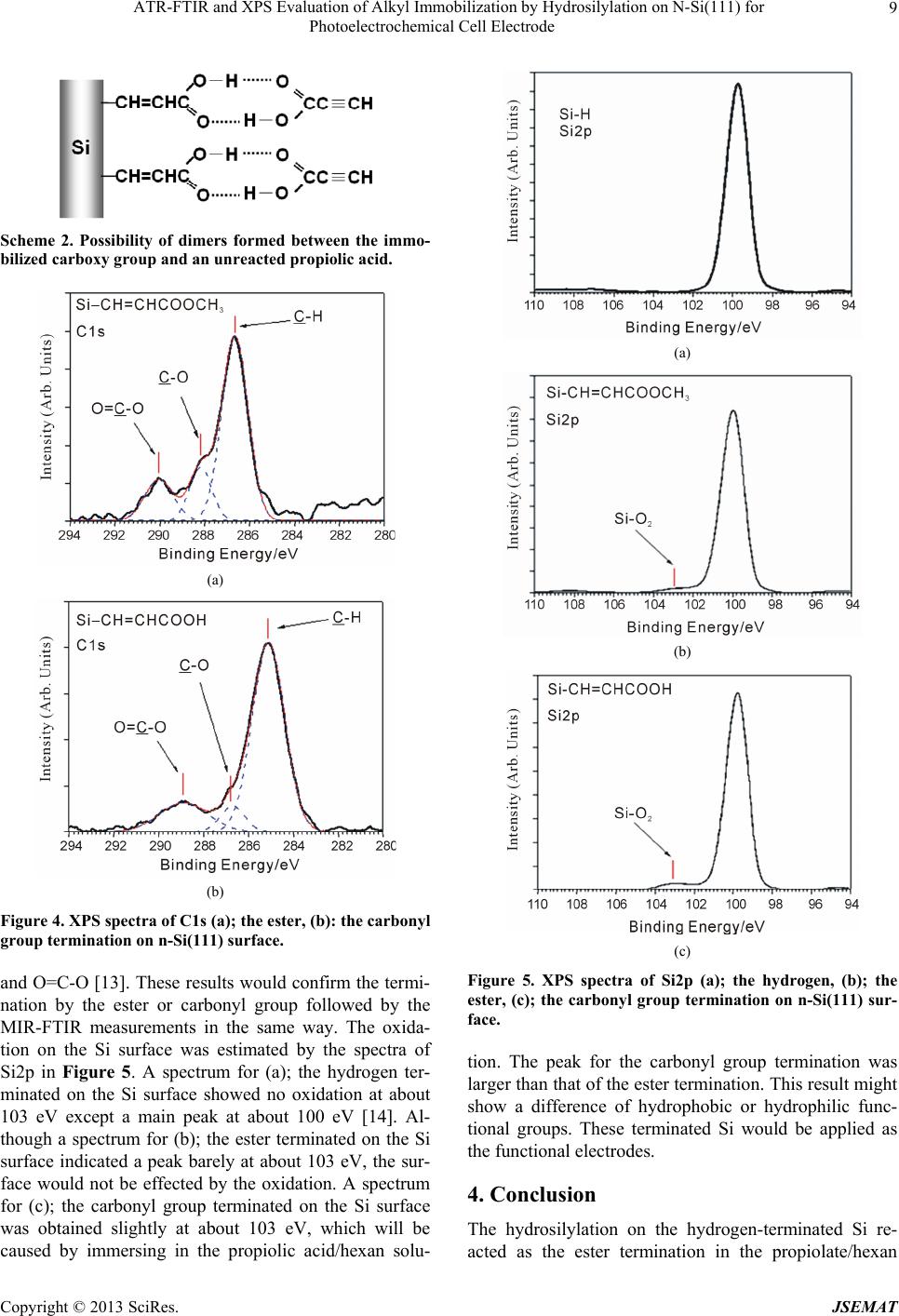 ATR-FTIR and XPS Evaluation of Alkyl Immobilization by Hydrosilylation on N-Si(111) for Photoelectrochemical Cell Electrode 9 Scheme 2. Possibility of dimers formed between the immo- bilized carboxy group and an unreacted propiolic acid. (a) (b) Figure 4. XPS spectra of C1s (a); the ester, (b): the carbonyl group termination on n-Si(111) surface. and O=C-O [13]. These results would confirm the termi- nation by the ester or carbonyl group followed by the MIR-FTIR measurements in the same way. The oxida- tion on the Si surface was estimated by the spectra of Si2p in Figure 5. A spectrum for (a); the hydrogen ter- minated on the Si surface showed no oxidation at about 103 eV except a main peak at about 100 eV [14]. Al- though a spectrum for (b); the ester terminated on the Si surface indicated a peak barely at about 103 eV, the sur- face would not be effected by the oxidation. A spectrum for (c); the carbonyl group terminated on the Si surface was obtained slightly at about 103 eV, which will be caused by immersing in the propiolic acid/hexan solu- (a) (b) (c) Figure 5. XPS spectra of Si2p (a); the hydrogen, (b); the ester, (c); the carbonyl group termination on n-Si(111) sur- face. tion. The peak for the carbonyl group termination was larger than that of the ester termination. This result might show a difference of hydrophobic or hydrophilic func- tional groups. These terminated Si would be applied as the functional electrodes. 4. Conclusion The hydrosilylation on the hydrogen-terminated Si re- acted as the ester termination in the propiolate/hexan Copyright © 2013 SciRes. JSEMAT  ATR-FTIR and XPS Evaluation of Alkyl Immobilization by Hydrosilylation on N-Si(111) for Photoelectrochemical Cell Electrode Copyright © 2013 SciRes. JSEMAT 10 solution, and was confirmed by the MIR-FTIR meas- urements. Similarly, the carbonyl group termination was also performed and estimated in the propiolic acid/hexan solution, and the Si surface was immobilized by the hy- drophobic or hydrophilic functional groups. Although the Si surface was hardly oxidized by XPS measurement, it will be necessary to form more pure Si surface. REFERENCES [1] K. L. Chopra, P. D. Paulson and V. Dutta, “Thin-Film Solar Cells: An Overview,” Progress in Photovoltaics, Vol. 12, No. 2-3, 2004, pp. 69-92. doi:10.1002/pip.541 [2] A. Goetzberger, C. Hebling and H. W. Schock, “Photo- voltaic Materials, History, Status and Outlook,” Materials Science and Engineering: Reports, Vol. 40, No. 1, 2003, pp. 1-46. doi:10.1016/S0927-796X(02)00092-X [3] Y. Nakato, K. Ueda, H. Yano and H. Tsubomura, “Effect of Microscopic Discontinuity of Metal Overlayers on the Photovoltages in Metal-Coated Semiconductor-Liquid Junction Photoelectrochemical Cells for Efficient Solar Energy Conversion,” The Journal of Physical Chemistry, Vol. 92, No. 8, 1988, pp. 2316-2324. doi:10.1021/j100319a043 [4] M. R. Linford and C. E. D. Chidsey, “Alkyl Monolayers Covalently Bonded to Silicon Surfaces,” Journal of the American Chemical Society, Vol. 115, No. 26, 1993, pp. 12631-12632. doi:10.1021/ja00079a071 [5] M. R. Inford, P. Fenter, P. M. Eisenberger and C. E. D. Chidsey, “Alkyl Monolayers on Silicon Prepared from 1-Alkenes and Hydrogen-Terminated Silicon,” Journal of the American Chemical Society, Vol. 117, No. 11, 1995, pp. 3145-3155. doi:10.1021/ja00116a019 [6] A. Bansal, X. L. Li, I. Lauermann, N. S. Lewis, S. I. Yi and W. H. Weinberg, “Alkylation of Si Surfaces Using a Two-Step Halogenation/Grignard Route,” Journal of the American Chemical Society, Vol. 118, No. 30, 1996, pp. 7225-7226. doi:10.1021/ja960348n [7] J. M. Buriak, “Organometallic Chemistry on Silicon Sur- faces: Formation of Functional Monolayers Bound through Si-C Bonds,” Chemical Communications, Vol. 1999, No. 12, 1999, pp. 1051-1060. doi:10.1039/a900108e [8] J. M. Buriak, “Organometallic Chemistry on Silicon and Germanium Surfaces,” Chemical Reviews, Vol. 102, No. 5, 2002, pp. 1271-1308. doi:10.1021/cr000064s [9] D. D. M. Wayner and R. A. Wolkow, “Organic Modifica- tion of Hydrogen Terminated Silicon Surfaces,” Journal of the Chemical Society, Perkin Transactions, Vol. 2, No. 1, 2002, pp. 23-24. [10] T. Strother, W. Cai, X. S. Zhao, R. J. Hamers and L. M. Smith, “Synthesis and Characterization of DNA-Modified Silicon(111) Surfaces,” Journal of the American Chemi- cal Society, Vol. 122, No. 6, 2000, pp. 1205-1209. doi:10.1021/ja9936161 [11] A. Bansal and N. S. Lewis, “Stabilization of Si Photo- anodes in Aqueous Electrolytes through Surface Alkyla- tion,” The Journal of Physical Chemistry B, Vol. 102, No. 21, 1998, pp. 4058-4060. doi:10.1021/jp980679h [12] W. J. Royea, A. Juang and N. S. Lewis, “Preparation of Air-Stable, Low Recombination Velocity Si(111) Sur- faces through Alkyl Termination,” Applied Physics Let- ters, Vol. 77, No. 13, 2000, pp. 1988-1990. doi:10.1063/1.1312203 [13] T. Vallant, H. Brunner, J. Kattner, U. Mayer, H. Hoff- mann, T. Leitner, G. Friedbacher, G. Schügerl, R. Svag- era and M. Ebel, “Monolayer-Controlled Deposition of Silicon Oxide Films on Gold, Silicon, and Mica Sub- strates by Room-Temperature Adsorption and Oxidation of Alkylsiloxane Monolayers,” The Journal of Physical Chemistry B, Vol. 104, No. 22, 2000, pp. 5309-5317. doi:10.1021/jp000006a [14] J. B. Danner and J. M. Vohs, “Surface Reactions during the Growth of SiO2 Thin Films on Si(100) Using Tetra- ethoxysilane,” Langmuir, Vol. 10, No. 9, 1994, pp. 3116- 3121. doi:10.1021/la00021a040 |