

Paper Menu >>
Journal Menu >>
 Vol.2, No.6, 377-379 (2013) Case Reports in Clinical Medicine http://dx.doi.org/10.4236/crcm.2013.26101 Hakim-Adams syndrome secondary to syphilis Ricardo Krause Martinez de Souza1, Alexandre Zatera2, Fernanda Leal Suzano2*, Flávia de Oliveira Braga2, Samanta Fabrício Blattes da Rocha2, Ricardo Ramina3, Pedro André Kowacs2 1Ambulatório de Desordens da Memória e do Comportamento, Instituto de Neurologia de Curitiba, Curitiba, Brazil 2Instituto de Psiquiatria do Paraná, Curitiba, Brazil; *Corresponding Author: [email protected] 3Serviço de Neurologia e Neurocirurgia, Curitiba, Brazil Received 8 May 2013; revised 12 June 2013; accepted 8 July 2013 Copyright © 2013 Ricardo Krause Martinez de Souza et al. This is an open access article distributed under the Creative Commons Attribution License, which permits unrestricted use, distribution, and reproduction in any medium, provided the original work is properly cited. ABSTRACT Normal pressure hydrocephalus (NPH) second- ary to syphilis is an atypical form of neuro- syphilis with an unusual clinical presentation and uncommon neuroimaging findings. A case of Syndrome de Hakim- Adams occurr ing in a 79- year-old male was admitted for investigation of a dementia syndrome. The patient presented with clinical features and neuroimaging compatible with NPH. Syphilis serology was reactive and compatible with active disease. The patient was treated with crystalline p enicillin (4 million units every 4 hours for 21 days) and was assessed again after three months, when his cognition and gait had improved and the urinary inconti- nence had resolved. According to this infor- mation, we describe a case of syphilis mimick- ing normal pressure hydrocephalus, making clear the importance of the investigation of sexually transmitted diseases in the differential diagno- sis of dementia, even in patients without estab- lished risk supposedly. Keywords: Neurosyphilis; Hakim-Adam s Syndrome; Syphilis; Normal Pressure Hydrocephalus 1. INTRODUCTION Syphilis is a sexually transmitted disease caused by the spirochete Treponema pallidum (T. pallidum), which causes neurosyphilis when it invades the nervous system. The initial neurological manifestations of neurosyphilis are asymptomatic meningitis, acute syphilitic meningitis and meningovascular syphilis. In the late stages of the disease, there may be involvement of the spinal cord and cerebral cortex, causing tabesdorsalis or general paresis, which is also known as paralytic dementia [1]. Other presentations of neurosyphilis have been described, such as limbic encephalitis [2] and normal pressure hydro- cephalus [3], which are referred to as atypical forms of neurosyphilis. The aim of this paper is to describe a case of atypical neurosyphilis mimicking NPH in which treatment with crystalline penicillin resulted in a considerable improve- ment in symptoms. 2. CASE REPORT A 79-year-old male was admitted to the Curitiba In- stitute of Neurology for investigation of a dementia syn- drome. The patient presented with symptoms marked by gait apraxia, dementia and urinary incontinence that had been worsening progressively over 1.5 years. On admis- sion he was taking donepezil 5 mg. In the previous six months his symptoms had worsened, leading him to seek a second opinion. Laboratory tests were carried out and the patient had a brain MRI scan, lumbar puncture and neuropsychological assessment. HIV serology was nonreactive and vitamin B12, folic acid and TSH levels were normal. Syphilis serology was reactive and compatible with active disease (second line of the Table 1). Cerebrospinal fluid (CSF) analysis revealed an in- crease in protein concentration (72 mg/dL) any cellular alterations. Opening pressure was 12 cm H2O, and VDRL (venereal disease research laboratory) and FTA-ABS (fluorescent treponemal antibody-absorption) tests were nonreactive. The MRI revealed ventricular dilation (Evans’ index of 0.31) out of proportion to the degree of atrophy (Fig- ure 1). Neuropsychological assessment showed cogni- tive alterations associated with frontal-subcortical dys- function, confirming the diagnosis of dementia. Copyright © 2013 SciRes. OPEN ACCESS 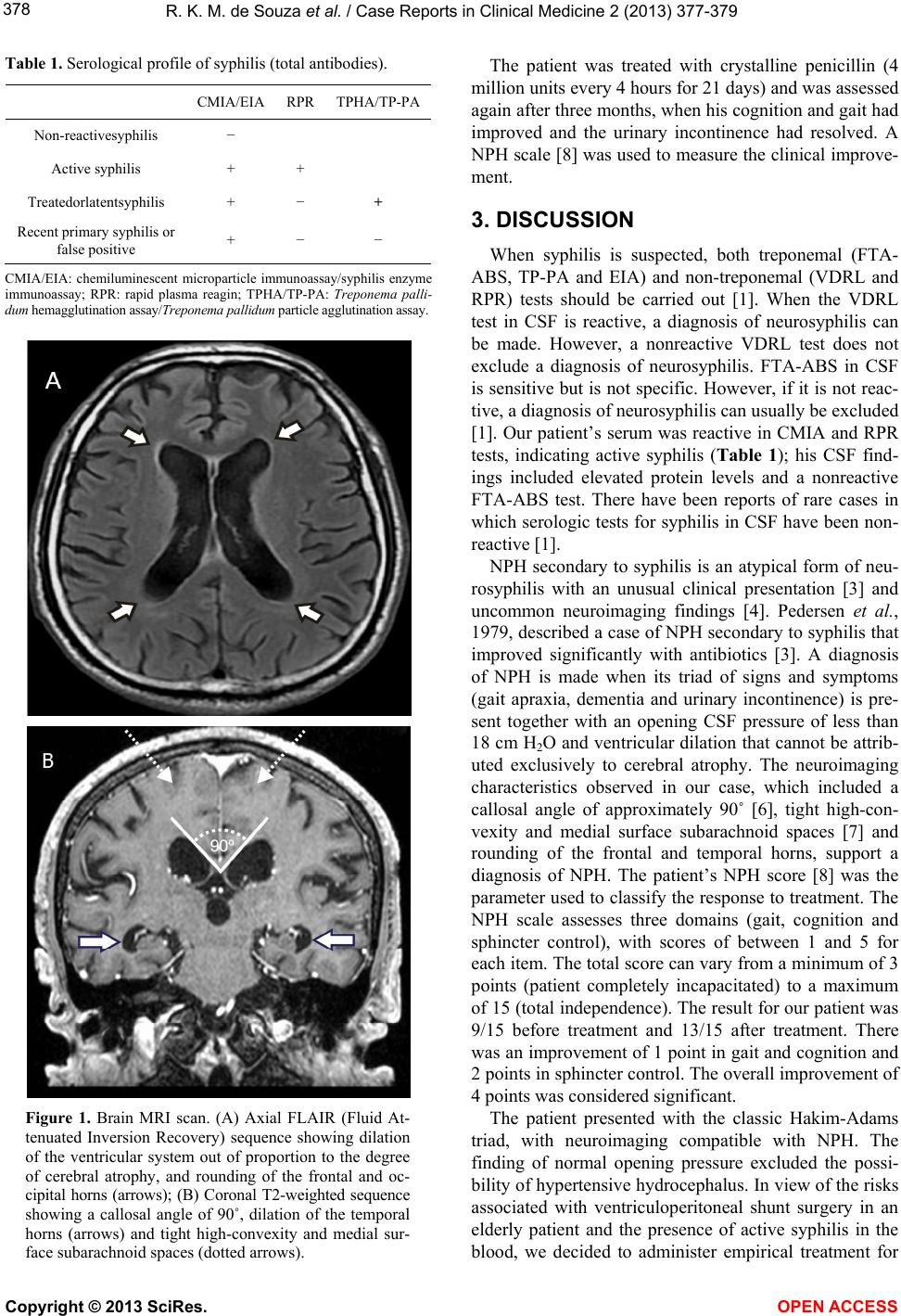 R. K. M. de Souza et al. / Case Reports in Clinical Medicine 2 (2013) 377-379 378 Table 1. Serological profile of syphilis (total antibodies). CMIA/EIA RPR TPHA/TP-PA Non-reactivesyphilis − Active syphilis + + Treatedorlatentsyphilis + − + Recent primary syphilis or false positive + − − CMIA/EIA: chemiluminescent microparticle immunoassay/syphilis enzyme immunoassay; RPR: rapid plasma reagin; TPHA/TP-PA: Treponema palli- dum hemagglutination assay/Tre ponema pallidum particle agglutination assay. Figure 1. Brain MRI scan. (A) Axial FLAIR (Fluid At- tenuated Inversion Recovery) sequence showing dilation of the ventricular system out of proportion to the degree of cerebral atrophy, and rounding of the frontal and oc- cipital horns (arrows); (B) Coronal T2-weighted sequence showing a callosal angle of 90˚, dilation of the temporal horns (arrows) and tight high-convexity and medial sur- face subarachnoid spaces (dotted arrows). The patient was treated with crystalline penicillin (4 million units every 4 hours for 21 days) and was assessed again after three months, when his cognition and gait had improved and the urinary incontinence had resolved. A NPH scale [8] was used to measure the clinical improve- ment. 3. DISCUSSION When syphilis is suspected, both treponemal (FTA- ABS, TP-PA and EIA) and non-treponemal (VDRL and RPR) tests should be carried out [1]. When the VDRL test in CSF is reactive, a diagnosis of neurosyphilis can be made. However, a nonreactive VDRL test does not exclude a diagnosis of neurosyphilis. FTA-ABS in CSF is sensitive but is not specific. However, if it is not reac- tive, a diagnosis of neurosyphilis can usually be excluded [1]. Our patient’s serum was reactive in CMIA and RPR tests, indicating active syphilis (Table 1); his CSF find- ings included elevated protein levels and a nonreactive FTA-ABS test. There have been reports of rare cases in which serologic tests for syphilis in CSF have been non- reactive [1]. NPH secondary to syphilis is an atypical form of neu- rosyphilis with an unusual clinical presentation [3] and uncommon neuroimaging findings [4]. Pedersen et al., 1979, described a case of NPH secondary to syphilis that improved significantly with antibiotics [3]. A diagnosis of NPH is made when its triad of signs and symptoms (gait apraxia, dementia and urinary incontinence) is pre- sent together with an opening CSF pressure of less than 18 cm H2O and ventricular dilation that cannot be attrib- uted exclusively to cerebral atrophy. The neuroimaging characteristics observed in our case, which included a callosal angle of approximately 90˚ [6], tight high-con- vexity and medial surface subarachnoid spaces [7] and rounding of the frontal and temporal horns, support a diagnosis of NPH. The patient’s NPH score [8] was the parameter used to classify the response to treatment. The NPH scale assesses three domains (gait, cognition and sphincter control), with scores of between 1 and 5 for each item. The total score can vary from a minimum of 3 points (patient completely incapacitated) to a maximum of 15 (total independence). The result for our patient was 9/15 before treatment and 13/15 after treatment. There was an improvement of 1 point in gait and cognition and 2 points in sphincter control. The overall improvement of 4 points was considered significant. The patient presented with the classic Hakim-Adams triad, with neuroimaging compatible with NPH. The finding of normal opening pressure excluded the possi- bility of hypertensive hydrocephalus. In view of the risks associated with ventriculoperitoneal shunt surgery in an elderly patient and the presence of active syphilis in the blood, we decided to administer empirical treatment for Copyright © 2013 SciRes. OPEN ACCESS  R. K. M. de Souza et al. / Case Reports in Clinical Medicine 2 (2013) 377-379 Copyright © 2013 SciRes. 379 neurosyphilis using penicillin. The improvement in the NPH score [8] observed after administration of the anti- biotic corroborated the diagnosis of atypical neurosyphi- lis. OPEN A CCESS 4. CONCLUSION Our case illustrates an atypical form of neurosyphilis (Hakim-Adams syndrome), which is considered in the literature to be a rare yet an important manifestation of this disease as it involves potentially reversible dementia. The absence of positive serology for syphilis in the CSF should not exclude a diagnosis of neurosyphilis in cases in which the clinical findings are suggestive of this in- fection. Physicians should bear in mind that tests can yield false-negative results and should trust their clinical impressions when these are relevant to the patient’s treatment. REFERENCES [1] Marra, C.M. (2009) Update on neurosyphilis. Current In- fectious Disease Reports, 11, 127-134. doi:10.1007/s11908-009-0019-1 [2] De Souza, R.K., Vosgerau, R.P., Sato, H.K. and Kowacs, P.A. (2013) A male patient with delirium, seizures and (limbic) encephalitis with bilateral mesial temporal lobe involvement. Arquivos de Neuro-Psiquiatria, 71, 270. doi:10.1590/0004-282X20130018 [3] Pedersen, K.K., Sorensen, P.S., Ankerhus, J. and Daniel- sen, U.T. (1979) Syphilitic normal pressure hydrocepha- lus. Acta Neurochirurgica (Wien), 48, 35-39. doi:10.1007/BF01406018 [4] Fadil, H., Gonzalez-Toledo, E., Kelley, B.J. and Kelley, R.E. (2006) Neuroimaging findings in neurosyphilis. Jour- nal of Neuroimaging: Official Journal of the American Society of Neuroimaging, 16, 286-289. [5] Relkin, N., Marmarou, A., Klinge, P., Bergsneider, M. and Black, P.M. (2005) Diagnosing idiopathic normal- pressure hydrocephalus. Neurosurgery, 57, S4-S16. [6] Ishii, K., Kanda, T., Harada, A., Miyamoto, N., Kawagu- chi, T., Shimada, K., et al. (2008) Clinical impact of the callosal angle in the diagnosis of idiopathic normal pres- sure hydrocephalus. European Radiology, 18, 2678-2683. doi:10.1007/s00330-008-1044-4 [7] Hashimoto, M., Ishikawa, M., Mori, E. and Kuwana, N. (2010) Diagnosis of idiopathic normal pressure hydro- cephalus is supported by MRI-based scheme: A prospec- tive cohort study. Cerebrospinal Fluid Research, 7, 18. [8] Sahuquillo, J., Rubio, E., Codina, A., Molins, A., Guitart, J.M., Poca, M.A., et al. (1991) Reappraisal of the intrac- ranial pressure and cerebrospinal fluid dynamics in pa- tients with the so-called “normal pressure hydrocephalus” syndrome. Acta Neurochirurg ica (Wi en), 112, 50-61. doi:10.1007/BF01402454 |