

Paper Menu >>
Journal Menu >>
 Vol.2, No.6, 375-376 (2013) Case Reports in Clinical Medicine http://dx.doi.org/10.4236/crcm.2013.26100 Laryngeal sarcoidosis—A case report* Hemanth Kowdley Subrahmanyam#, P. Gana, R. J. Lee Department of ENT-Head & Neck Surgery, Kettering General Hospital, Kettering, UK; #Corresponding Author: [email protected] Received 19 July 2013; revised 5 August 2013; accepted 12 August 2013 Copyright © 2013 Hemanth Kowdley Subrahmanyam et al. This is an open access article distributed under the Creative Commons Attribution License, which permits unrestricted use, distribution, and reproduction in any medium, provided the original work is properly cited. ABSTRACT Laryngeal sarcoidosis while involvement of the vocal cords in the disease process is excep- tionally rare. Involvement of the larynx is fre- quently limited to the supraglottis that is rich in lympho epithelial tissue and usually presents with difficulty in breathing of varying severity. We present a rare case of isolated sarcoidosis involving the vocal cord in a patient with the previous history of cutaneous sarcoidosis. Keywords: Laryngeal Sarcoidosis 1. INTRODUCTION Sarcoidosis is a chronic granulomatous disease involv- ing in multiple organs in the body. Common sites of in- volvement include lungs, hilar & mediastinal lymph nodes, liver, eyes, skin, bone and the nervous system. Diagnosis is based on a correlation between the clinical, radiological and histological findings [1]. Supraglottic involvement is a very common finding in the larynx. True vocal cord involvement is a rarity. We present an interesting case report who presented to us with chronic cough as the only primary laryngeal symptom. 2. CASE REPORT A 36-year-old female Caucasian smoker was referred by respiratory physicians with complaints of hoarseness for 8 months duration. She had received multiple courses of antibiotics for a presumed URTI with no effect on her hoarseness. There was no odynophagia or dysphagia. She had no loss of weight or appetite. No history of voice abuse was recorded. She was diagnosed with cutaneous sarcoidosis in 2002. Her co-morbidities included hay fever and Type II diabetes. Flexible nasolaryngoscopy revealed left vocal cord and ventricular band thickening. Her ACE level was elevated and CXR revealed bilateral hilar lymph node enlargement signifying an active period of her systemic sarcoidosis. Microlaryngoscopy and bi- opsy suggested a narrow glottic area. Biopsy of the left vocal cord revealed features consistent with Sarcoidosis showing florid granulomatous inflammation alongside well formed epitheloid granulomas and occasional mul- tinucleated giant cells (Figure 1). There was no evidence of caseous necrosis or malignancy. A diagnosis of laryn- geal sarcoidosis was made. Treatment with inhalational and systemic corticosteroids significantly improved her condition. She has symptomatically remained stable and on regular follow up. 3. DISCUSSION The first confirmed case of laryngeal sarcoidosis was by Poe in 1940 according to the literature [3]. Sarcoido- sis is an idiopathic phenomenom characterised by non caseating granulomas. Prevalence does vary in the ethnic groups and is found to be 50 per 100,000 in Scandina- vian countries and African Americans. It is a multi sys- tem disorder which typically affects population between 20 and 40 years of age. Laryngeal sarcoidosis prevalence is 0.5% to 8.3% in patients with a past history of sarcoi- dosis [1]. It affects the supraglottis typically with isolated evidence affecting the glottis. Interestingly it is theorized that sarcoidosis affects the reticuloendothelial system and hence vocal fold involvement is relatively uncommon due to lack of lymphoid tissue [1,4]. Common s ymp toms at pre senta tion ar e hoar senes s and stridor. Less commonly dysphagia, globus and cough could be presenting features. Disease does tend to fluctu- ate between active and latent periods [2] and therefore calls for prolonged per iod of follow up. In the supraglot- tis, epiglottis is the most common site of involvement though any part of larynx could be affected [4]. Hoarse- ness could be due to direct vocal fold involvement or as a result of peripheral neuropathy affecting the vocal folds and can usually be confirmed by laryngeal EMG [1]. Diagnosis is essentially established by histology demon- trating non caeseous granulomatous inflammation thus s *Conflict of interest: Nil. Copyright © 2013 SciRes. OPEN A CCESS 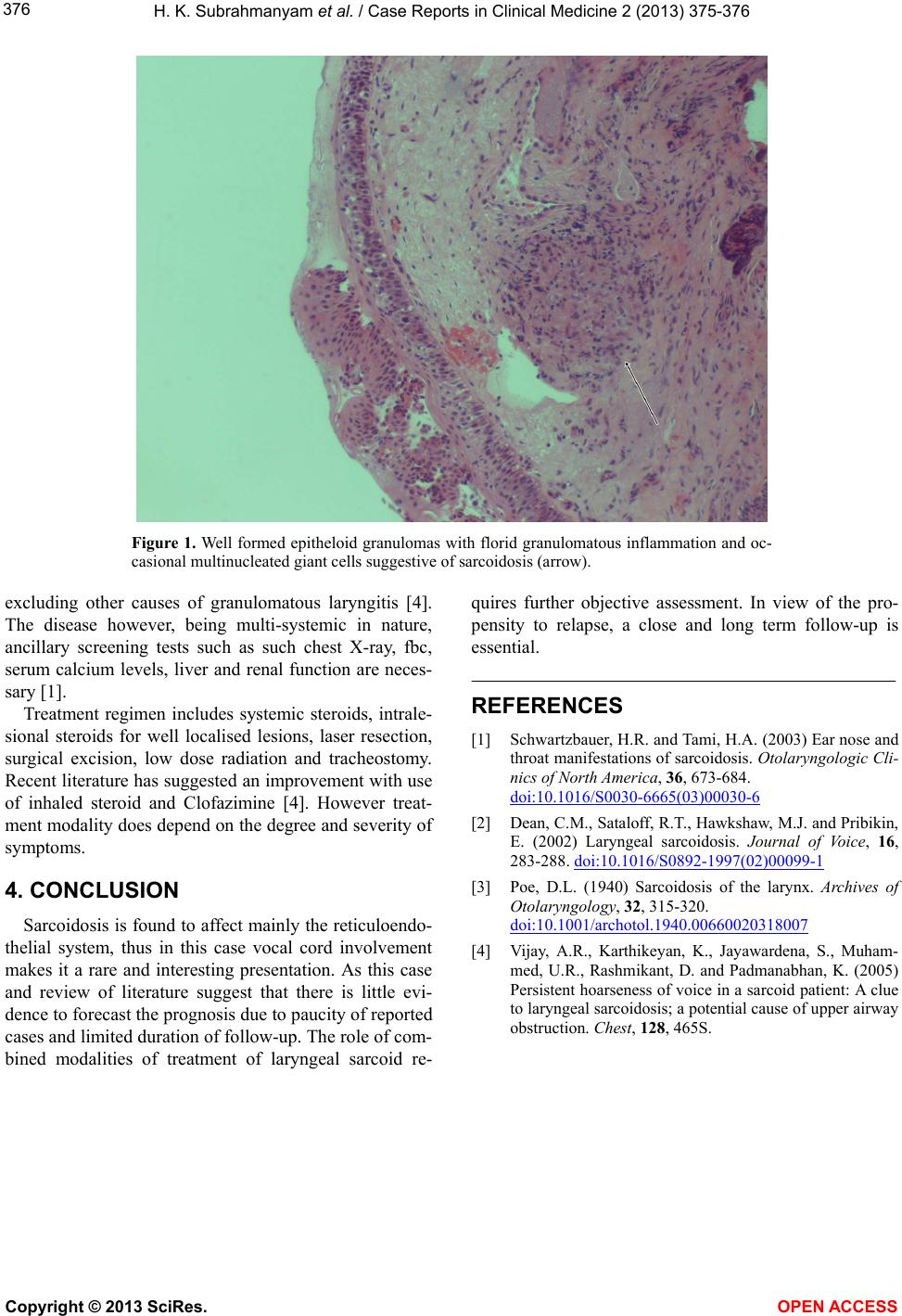 H. K. Subrahmanyam et al. / Case Reports in Clinical Medicine 2 (2 013) 375-376 376 Figure 1. Well formed epitheloid granulomas with florid granulomatous inflammation and oc- casional multinucleated giant cells suggestive of sarcoidosis (arrow). excluding other causes of granulomatous laryngitis [4]. The disease however, being multi-systemic in nature, ancillary screening tests such as such chest X-ray, fbc, serum calcium levels, liver and renal function are neces- sary [1]. Treatment regimen includes systemic steroids, intrale- sional steroids for well localised lesions, laser resection, surgical excision, low dose radiation and tracheostomy. Recent literature has suggested an improvement with use of inhaled steroid and Clofazimine [4]. However treat- ment modality does depend on the degree and sev erity of sy mptoms. 4. CONCLUSION Sarcoidosis is found to affect mainly the reticuloendo- thelial system, thus in this case vocal cord involvement makes it a rare and interesting presentation. As this case and review of literature suggest that there is little evi- dence to forecast the prognosis due to paucity of reported cases and limited duration of follow-up. The role of com- bined modalities of treatment of laryngeal sarcoid re- quires further objective assessment. In view of the pro- pensity to relapse, a close and long term follow-up is essential. REFERENCES [1] Schwartzbauer, H.R. and Tami, H.A. (2003) Ear nose and throat manifestations of sarcoidosis. Otolaryngologic Cli- nics of North America, 36, 673-684. doi:10.1016/S0030-6665(03)00030-6 [2] Dean, C.M., Sataloff, R.T., Hawkshaw, M. J. and Pribikin, E. (2002) Laryngeal sarcoidosis. Journal of Voice, 16, 283-288. doi:10.1016/S0892-1997(02)00099-1 [3] Poe, D.L. (1940) Sarcoidosis of the larynx. Archives of Otolaryngology, 32, 315-320. doi:10.1001/archotol.1940.00660020318007 [4] Vijay, A.R., Karthikeyan, K., Jayawardena, S., Muham- med, U.R., Rashmikant, D. and Padmanabhan, K. (2005) Persistent hoarseness of voice in a sarcoid patient: A clue to laryngeal sarcoidosis; a potential cause of upper airway obstruction. Chest, 128, 465S. Copyright © 2013 SciRes. OPEN A CCESS |