

Paper Menu >>
Journal Menu >>
 Open Journal of Medicinal Chemistry, 2013, 3, 87-92 http://dx.doi.org/10.4236/ojmc.2013.33011 Published Online September 2013 (http://www.scirp.org/journal/ojmc) Synthesis and Evaluation of Glyceride Prodrugs of Naproxen Vivekkumar K. Redasani1*, Sanjay B. Bari2 1R. C. Patel Institute of Pharmaceutical Education and Research, Shirpur, India 2H. R. Patel Institute of Pharmaceutical Education and Research, Shirpur, India Email: *[email protected] Received June 14, 2013; revised July 13, 2013; accepted July 28, 2013 Copyright © 2013 Vivekkumar K. Redasani, Sanjay B. Bari. This is an open access article distributed under the Creative Commons Attribution License, which permits unrestricted use, distribution, and reproduction in any medium, provided the original work is properly cited. ABSTRACT The glyceride ester derivatives 6a and 6b were prepared by reacting 1,2,3-trihydroxy propane 1,3-dipalmitate/stearate with (S)-naproxen as potential prodrugs. The synthesis was achieved successfully with the aid of N,N’-dicyclohexyl- carbodiimide. These prodrugs were evaluated for anti inflammatory, analgesic and gastroprotective activity. It was found that prodrugs 6a and 6b showed less irritation to gastric mucosa as indicated by ulcer index. The synthesized glyceride esters were found to possess good pharmacological profile as shown by results of anti inflammatory and an- algesic activity. The aqueous studies were performed in order to ensure the release of prodrugs. Both prodrugs were found to stable at acidic pH while underwent hydrolysis at pH 7.4. These findings suggest that the glyceride prodrugs 6a and 6b might be used as potential biolabile derivatives. Keywords: Naproxen; Glyceride Prodrugs; Anti-Inflammatory; Analgesic; Gastroprotective; Hydrolysis Kinetics 1. Introduction The clinical utility of the conventional acidic non-ste- roidal anti-inflammatory drugs (NSAIDs) continues to be principally limited by their undesired side effects, par- ticularly stomach ulceration, bleeding and perforation [1]. The gastric side effects related to the use of NSAIDs are generally attributed to local and/or systemic mechanisms [2]. This can be overcome to a considerable extent by derivatization of the carboxylic function of the NSAIDs to produce prodrug with adequate stability at the acidic pH, thus preventing local irritation of the stomach mu- cosa, and also capable of releasing the parent drug [3]. The utility of glyceride as a promoiety in the design of prodrugs of carboxylic acids relates to the absorption of natural triglycerides, thereby increasing stability in the stomach and thus overall absorption of the drug [4]. Naproxen, ((S)-6-methoxy-α-methyl-2-naphthalene acetic acid) is one of the most widely used NSAIDs for relieving arthritic pain. Free carboxylic group of na- proxen has severe gastrointestinal side effects on oral administration that restricts its use [5]. To overcome this, acidic group is temporarily masked by synthesizing glyceride ester prodrugs, which can pass through the sto- mach without releasing active drug in significant quantity and also increase the absorption pertaining to the natu- ral triglycerides. Earlier, the glyceride prodrugs of some NSAIDs like mefenamic acid [4], asprin [6], indomethacin [7], nif- lumic acid [8], diclofenac [9], ibuprofen [10] and also biphenyl acetic acid [11] were reported. In the present study, we have reported the synthesis of glyceride prod- rugs of (S)-naproxen, their evaluation for pharmacologi- cal activity and hydrolysis kinetics studies. 2. Materials and Methods 2.1. General Experimental Naproxen was obtained as gift sample form Cadila Health Care Ltd., Ahmedabad (India). All other chemi- cals and reagents were obtained from Loba Chemie Pvt. Ltd., Mumbai (India). Dihydroxyacetone was procured from Merck Specialities Pvt. Ltd., Mumbai (India). All the solvents used were distilled and dried before use as required. Infra red (FTIR) spectra were recorded using KBr on FTIR-8400S Shimadzu. 1H NMR spectra record- ed on Joel-FT-NMR-300MHZ in CDCl3 and mass spec- tra were recorded on HELWETT PACKARD G180017 *Corresponding author. C opyright © 2013 SciRes. OJMC  V. K. REDASANI, S. B. BARI 88 GCD system. The chromatographic system consisted of a Shimadzu LC-20 AD solvent delivery system, PDA de- tector with a Qualisil BDS C8 column (200 mm × 4.6 mm 5 µm) using acetonitrile: buffer (90:10 v/v) as mo- bile phase for determination and flow rate of 1.0 mL/min with UV detection at 232 nm. 2.2. Synthesis and Characterization of Title Compounds 1) Preparation of palmityl steryl chloride (1a and 1b) Palmitic/steric acid (10 gm) was dissolved in chloro- form and treated with thionyl chloride (10 mL). The re- action mixture was refluxed for 4 hrs at 85˚C - 90˚C, cooled and filtered to remove unreacted acid. Solvent was evaporated. The oily product was dissolved in abso- lute ether and evaporated to get corresponding acid chlo- ride (1a and 1b). 2) Preparation of 1,3-dipalmitoyl-1,3-dihydroxy-pro- pane-2-one (3a) and 1,3-distearyl-1,3-dihydroxy-propane- 2-one (3b) Palmitoyl chloride/steryl chloride (20 mmol) was ad- ded drop wise to reaction media, prepared under stirring at 5˚C - 10˚C, containing 1,3-hydroxypropane-2-one [DHA] (2) (90 mmol), pyridine (17 mL) and CHCl3. Re- actions were stirred at room temperature for 48 h. Water was added and organic layers were separated. Aqueous layers were extracted with CHCl3 (3*50 mL). Organic layers were joined, washed with water and treated with 0.1 N HCl (3*30 mL). The resulting organic layers were separated, dried over anhydrous sodium sulfate, filtered and the solvent was removed under reduced pressure. 3) Preparation of 1,3-dipalmitoyl-1,2,3-propanetriol (4a) and 1,3-distearyl-1,2,3-propanetriol (4b) Sodium borohydride (53 mmol) was added to reaction media containing 3a and 3b respectively (20 mmol) in tetrahydrofurane, benzene and distilled water. Reactions were kept under stirring at 0˚C - 5˚C, and when presence of reactants was no longer detected through TLC, ben- zene (25 mL) and water (100 mL) were added. Organic layers were separated and aqueous layers extracted with CHCl3 (25 mL). The combined extracts were washed with water and treated with 0.1 N HCl (15 mL). The re- sulting organic layer was separated, dried over anhydrous sodium sulfate and solvent evaporated under reduced pressure to get 4a and 4b. 4) Preparation of glyceride prodrug of naproxen (6a) Naproxen (5) (1 mmol) and 4a/4b (1.1 mmol) added to reaction media containing 4-DMAP (0.1 mmol) in CH2Cl2. After homogenization, DCC (0.0013 mol) in CH2Cl2 (100 mL) was added drop wise, and the mixture was kept under stirring at room temperature. After 24 h, the precipitate DCU was filtered and the solvent removed under reduced pressure to get solid mass (Scheme 1) (6a and 6b). This was further recrystallized by petroleum ether and characterized. 6a: [C49H80O7] mp 68˚C - 69˚C, IR (KBr) cm−1: 2915, 2854 (C-H), 1740 (C=O ester), 1232 (C-O ester). 1H NMR (300 MHz, CDCl3): δ (ppm): 0.96 (m, 6H, 2xCH3), 1.29 (m, 24xCH2), 1.58 (s, 3H, CH3), 1.68 (m, 4H, 2xCH2, β to CO), 2.25 (m, 4H, 2xCH2, α to CO), 3.73 (s, 3H, -OCH3), 3.78 (m, 1H, -CH), 4.73 (m, 1H, -CH), 4.32 (m, 4H, 2xCH2), 7.18 - 7.57 (6H, naphthalene). Mass: (70 eV) m/z 780. 6b: [C53H88O7] mp 104˚C - 105˚C, IR (KBr) cm−1: 2924, 2860 (C-H), 1744 (C = O ester), 1237 (C-O ester). 1H NMR (300 MHz, CDCl3): δ (ppm): δ 0.94 (m, 6H, 2xCH3), δ 1.31 (m, 28xCH2), δ 1.56 (s, 3H, CH3), δ 1.68 (m, 4H, 2xCH2, β to CO), δ 2.34 (m, 4H, 2xCH2, α to CO), δ 3.73 (s, 3H, -OCH3), δ 3.88 (m, 1H, -CH), δ 4.32 (m, 4H, 2xCH2), δ 4.84 (m, 1H, -CH), δ 7.18 - 7.56 (6H, naphthalene). Mass: (70 eV) m/z 836. 2.3. Pharmacological Screening Pharmacological activity was done by using Wistar rats of either sex weighing between 150 - 200 g and Swiss albino mice weighing between 25 - 35 gm; procured from animal house of the Institute (RCPIPER/IAEC/ 2009-10/14). The paw edema volume was measured with the help of Ugo Basile Plethysmometer (7140). All re- sults were expressed as mean ± SEM. Statistical evalua- tion was performed using analysis of variance followed by Dunnett test for sub group comparison. 2.3.1. Anti-Inflammatory Acti vi t y The anti-inflammatory activity was evaluated by carra- geenan-induced rat paw oedema model [12]. Wistar rats were divided into four groups of six animals each. Group I serve as control and received only vehicle (0.5% w/v CMC). Group II, III and IV received naproxen (10 mg/kg) and glyceride prodrugs 6a and 6b respectively in dose molecularly equivalent. All compounds were adminis- tered through oral gavage. After 30 min of compound administration, 0.1 mL of 1% carrageenan in normal sa- line was injected into the sub planter region of left hind paw and the edema volume was measured before injec- tion (V0) and at the interval of every hour up to 6 h. The percentages of swelling inhibition were calculated as: % Inhibition = {[(Vt − V0) control − (Vt − V0) treated]/ (Vt − V0) control} × 100. V0 and Vt are the average volume in the hind paw of the rats before and after treatment respectively. 2.3.2. An al gesic Acti vity Analgesic activity was carried out using acetic acid in- duced writhing method [13]. Group I served as a control and received vehicle 1% (v/v) Tween-80 in water at the dose of 10 mL/kg of body weight while group II, III and IV received naproxen (10 m/kg), glyceride prodrugs 6a g Copyright © 2013 SciRes. OJMC 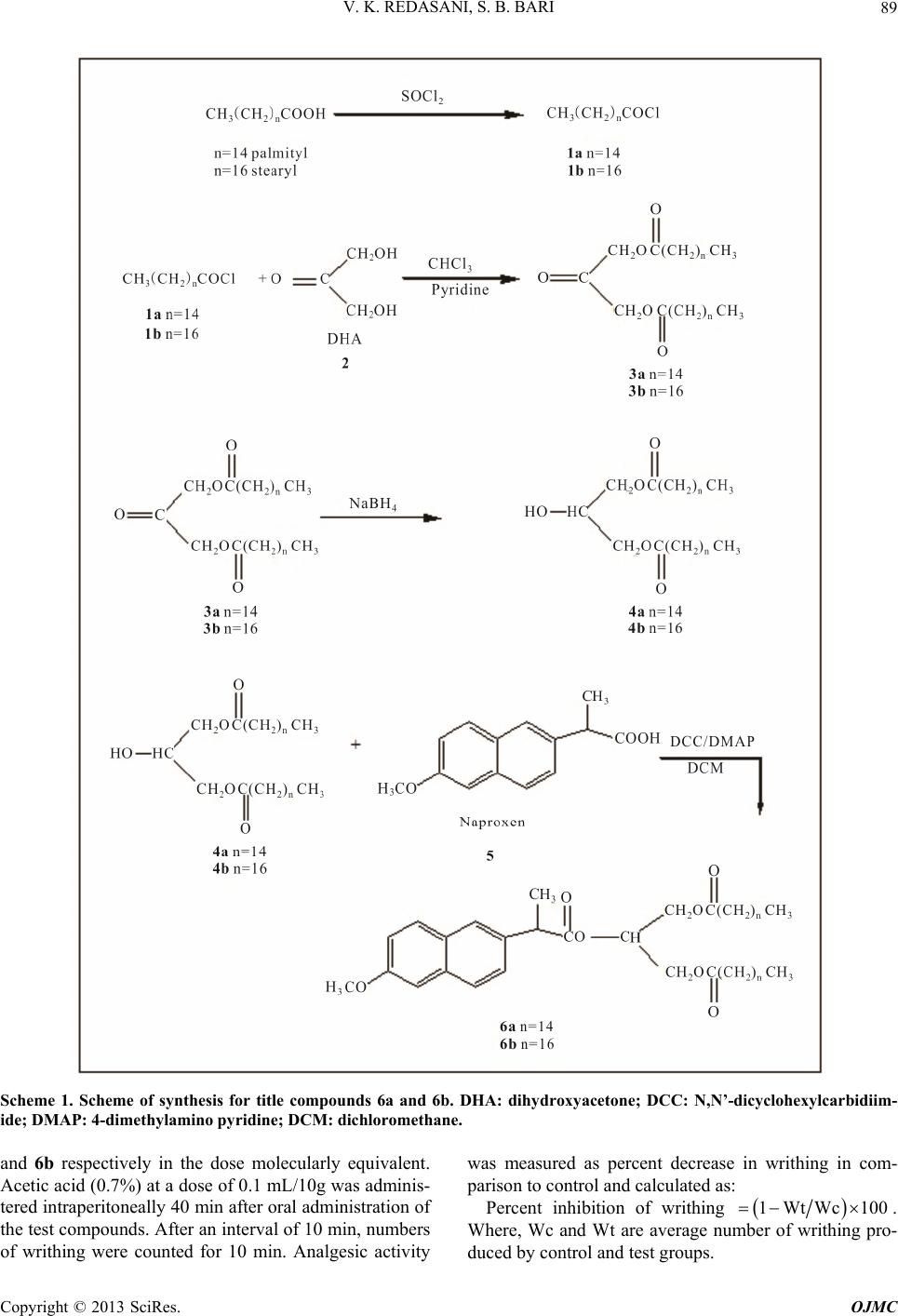 V. K. REDASANI, S. B. BARI Copyright © 2013 SciRes. OJMC 89 Scheme 1. Scheme of synthesis for title compounds 6a and 6b. DHA: dihydroxyacetone; DCC: N,N’-dicyclohexylcarbidiim- ide; DMAP: 4-dimethy l amino py ridine; DCM: dichloromethane . and 6b respectively in the dose molecularly equivalent. Acetic acid (0.7%) at a dose of 0.1 mL/10g was adminis- tered intraperitoneally 40 min after oral administration of the test compounds. After an interval of 10 min, numbers of writhing were counted for 10 min. Analgesic activity was measured as percent decrease in writhing in com- parison to control and calculated as: Percent inhibition of writhing 1Wt Wc100 . Where, Wc and Wt are average number of writhing pro- duced by control and test groups.  V. K. REDASANI, S. B. BARI 90 2.3.3. Evaluation of Gastroprotective Effect Gastro protective effect was determined by the reported method [14]. The animals were given orally 40 mg/kg body weight of naproxen or molecular equivalent of glyceride prodrugs 6a and 6b as suspension in 0.5% aca- cia. The animals were fasted 24 h prior to administration of each of control, standard and test compounds. The animals were sacrificed 6 h after administration of drug and food and water were available ad libitum. The gastric mucosa was opened, rinse with 5 mL saline and was ex- amined by means of 4× binocular magnifier. The stom- achs were carefully examined and ulcers were scored according to severity. The ulcer index was calculated as mean for all animals in the group. 2.4. In Vitro Hy d r o l y s i s St u d i e s The in-vitro aqueous hydrolysis kinetics studies of prod- rugs 6a and 6b were carried out at pH 7.4. The total buffer concentration was 20 mmol and constant ionic strength of 0.5 M for each sample was maintained by adding KCl. Hydrolysis of prodrugs was initiated by adding the samples to buffer solution. The mixtures were equilibrated at 37˚C for 1 h and 100 mg of each sample was added. The samples were withdrawn at appropriate time interval (0.5, 1, 2, 3, 4, 5, 6, 7, 8 h), 0.1 mL of solu- tion was removed and diluted with mobile phase up to 10 mL and 20 µl of this solution was injected for analysis by HPLC [15]. Pseudo first-order rate constants (Kobs) for the individual reactions were calculated with the help of equation, obs K2.303logtaa x , Where, “a” is initial concentration, “x” is the amount of drug hydro- lyzed and “t” is time in minutes. The corresponding half-life (t1/2) was then obtained from the equation: 1 2obs 0.693 Kt. 3. Results and Discussion 3.1. Chemistry Triglycerides being the major constituents of dietary fat and their absorption involve simple hydrolysis mainly by pancreatic lipases to monoglycerides and free fatty acids. These prodrugs, therefore, do not involve the risk of un- wanted effects after they are hydrolyzed and release pro- moiety [6]. The synthesis of targeted glyceride esters of naproxen 6a and 6b was achieved successfully using DCC as per the method reported [16]. DCC proves to be an effective catalyst for the conversion of carboxylic acid to esters and amides. It functions by activating the free carboxylic groups [17]. The purity and confirmation of structures of the synthesized compounds were confirmed by TLC, FTIR, 1HNMR and mass spectroscopy. Infrared spectra showed the characteristics band of C=O stretching around 1740 cm−1 and C-O stretching around 1232 cm−1 which confirms the formation of esters. The 1H NMR spectra of synthesized compounds showed characteristic chemical shifts, which anticipated their structures. Pres- ence of parent peak in mass spectra further confirms the molecular weight. 3.2. Pharmacological Screening Carrageenan-induced paw oedema is a useful model to assess the contribution of mediators involved in vascular changes associated with acute inflammation. The inhibi- tion of swelling in carrageenan-induced edema in rat paw is brought by oral administration of drugs. The develop- ment of edema in the rat hind paw following the injection of carrageenan has been described as a biphasic event in which various mediators operate in sequence to produce this inflammatory response. Prodrugs 6a and 6b demon- strate better anti-inflammatory activity with percentage inhibition of 58% and 55% in comparison to 51% for naproxen when studied up to 6 h. Increased anti-inflam- matory effect observed for glyceride derivatives might be the result of either better absorption of esters from the gastrointestinal tract or due to higher selectivity towards the COX-2 enzyme than the parent drug [18]. The decrease in number of writhing expressed as per- centage protection by test compounds with reference to the control for analgesic activity. Glyceride derivatives showed high value of percentage protection with 75% and 74% respectively as compared to naproxen with 70%. The abdominal constriction response induced by acetic acid is a sensitive procedure to establish peripherally acting analgesics. Results of analgesic activity of prod- rugs shows better as compared to parent drug indicated successful effects of derivatization [19]. The synthesized prodrugs showed less ulcer index value of 0.91 and 1.33 as compared to 2.83 for naproxen thus indicates minimized gastrointestinal side effects obtained by modification to prodrug. This might be due to inhibition of direct contact of carboxylic group of na- proxen to gastric mucosa; mainly responsible for gastric damage. This also supports to the successful masking of carboxylic group of naproxen when coupled with that of promoieties thus protect the gastric mucosa from injury evoked. 3.3. In Vitro Hy d r o l y s i s St u d i e s The hydrolysis kinetics studies were carried out in aque- ous buffer to determine the fate of prodrugs. Under the experimental conditions the targeted compounds hydro- lyzed to release the parent drug as evident by HPLC analysis. At constant pH and temperature the reaction displayed strict first order kinetics as the Kobs was fairly constant and a straight plot was obtained on plotting log concentration of residual prrug v/s time (Figure 1). od Copyright © 2013 SciRes. OJMC 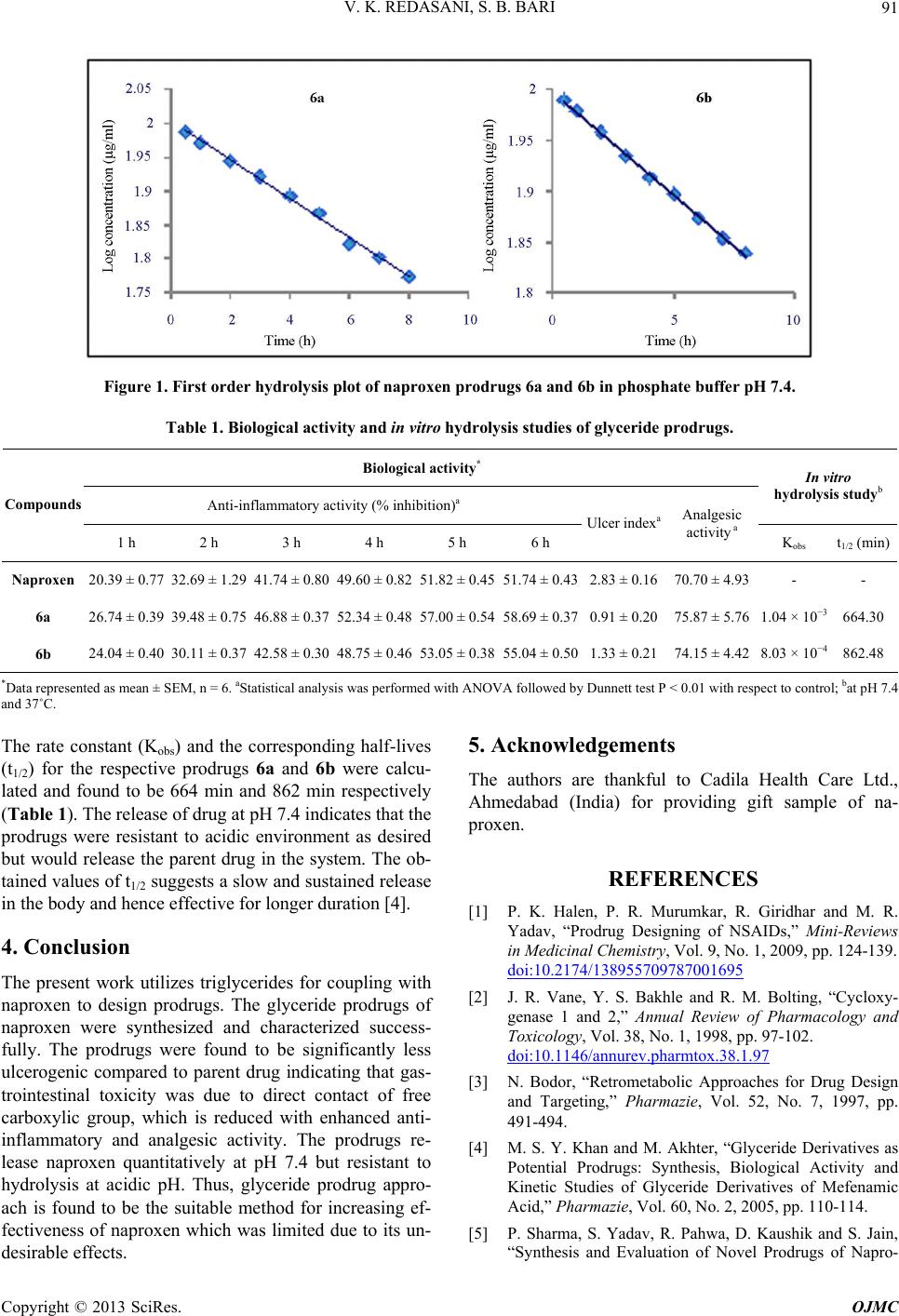 V. K. REDASANI, S. B. BARI Copyright © 2013 SciRes. OJMC 91 Figure 1. First order hydrolysis plot of naproxen prodrugs 6a and 6b in phosphate buffer pH 7.4. Table 1. Biological activity and in vitro hydrolysis studies of glyceride prodrugs. Biological activity* Anti-inflammatory activity (% inhibition)a In vitro hydrolysis studyb Compounds 1 h 2 h 3 h 4 h 5 h 6 h Ulcer indexaAnalgesic activity a Kobs t 1/2 (min) Naproxen 20.39 ± 0.77 32.69 ± 1.29 41.74 ± 0.80 49.60 ± 0.8251.82 ± 0.4551.74 ± 0.432.83 ± 0.1670.70 ± 4.93 - - 6a 26.74 ± 0.39 39.48 ± 0.75 46.88 ± 0.37 52.34 ± 0.4857.00 ± 0.5458.69 ± 0.370.91 ± 0.2075.87 ± 5.76 1.04 × 10−3664.30 6b 24.04 ± 0.40 30.11 ± 0.37 42.58 ± 0.30 48.75 ± 0.4653.05 ± 0.3855.04 ± 0.501.33 ± 0.2174.15 ± 4.42 8.03 × 10−4862.48 *Data represented as mean ± SEM, n = 6. aStatistical analysis was performed with ANOVA followed by Dunnett test P < 0.01 with respect to control; bat pH 7.4 and 37˚C. 5. Acknowledgements The rate constant (Kobs) and the corresponding half-lives (t1/2) for the respective prodrugs 6a and 6b were calcu- lated and found to be 664 min and 862 min respectively (Table 1). The release of drug at pH 7.4 indicates that the prodrugs were resistant to acidic environment as desired but would release the parent drug in the system. The ob- tained values of t1/2 suggests a slow and sustained release in the body and hence effective for longer duration [4]. The authors are thankful to Cadila Health Care Ltd., Ahmedabad (India) for providing gift sample of na- proxen. REFERENCES [1] P. K. Halen, P. R. Murumkar, R. Giridhar and M. R. Yadav, “Prodrug Designing of NSAIDs,” Mini-Reviews in Medicinal Chemistry, Vol. 9, No. 1, 2009, pp. 124-139. doi:10.2174/138955709787001695 4. Conclusion The present work utilizes triglycerides for coupling with naproxen to design prodrugs. The glyceride prodrugs of naproxen were synthesized and characterized success- fully. The prodrugs were found to be significantly less ulcerogenic compared to parent drug indicating that gas- trointestinal toxicity was due to direct contact of free carboxylic group, which is reduced with enhanced anti- inflammatory and analgesic activity. The prodrugs re- lease naproxen quantitatively at pH 7.4 but resistant to hydrolysis at acidic pH. Thus, glyceride prodrug appro- ach is found to be the suitable method for increasing ef- fectiveness of naproxen which was limited due to its un- desirable effects. [2] J. R. Vane, Y. S. Bakhle and R. M. Bolting, “Cycloxy- genase 1 and 2,” Annual Review of Pharmacology and Toxicology, Vol. 38, No. 1, 1998, pp. 97-102. doi:10.1146/annurev.pharmtox.38.1.97 [3] N. Bodor, “Retrometabolic Approaches for Drug Design and Targeting,” Pharmazie, Vol. 52, No. 7, 1997, pp. 491-494. [4] M. S. Y. Khan and M. Akhter, “Glyceride Derivatives as Potential Prodrugs: Synthesis, Biological Activity and Kinetic Studies of Glyceride Derivatives of Mefenamic Acid,” Pharmazie, Vol. 60, No. 2, 2005, pp. 110-114. [5] P. Sharma, S. Yadav, R. Pahwa, D. Kaushik and S. Jain, “Synthesis and Evaluation of Novel Prodrugs of Napro- 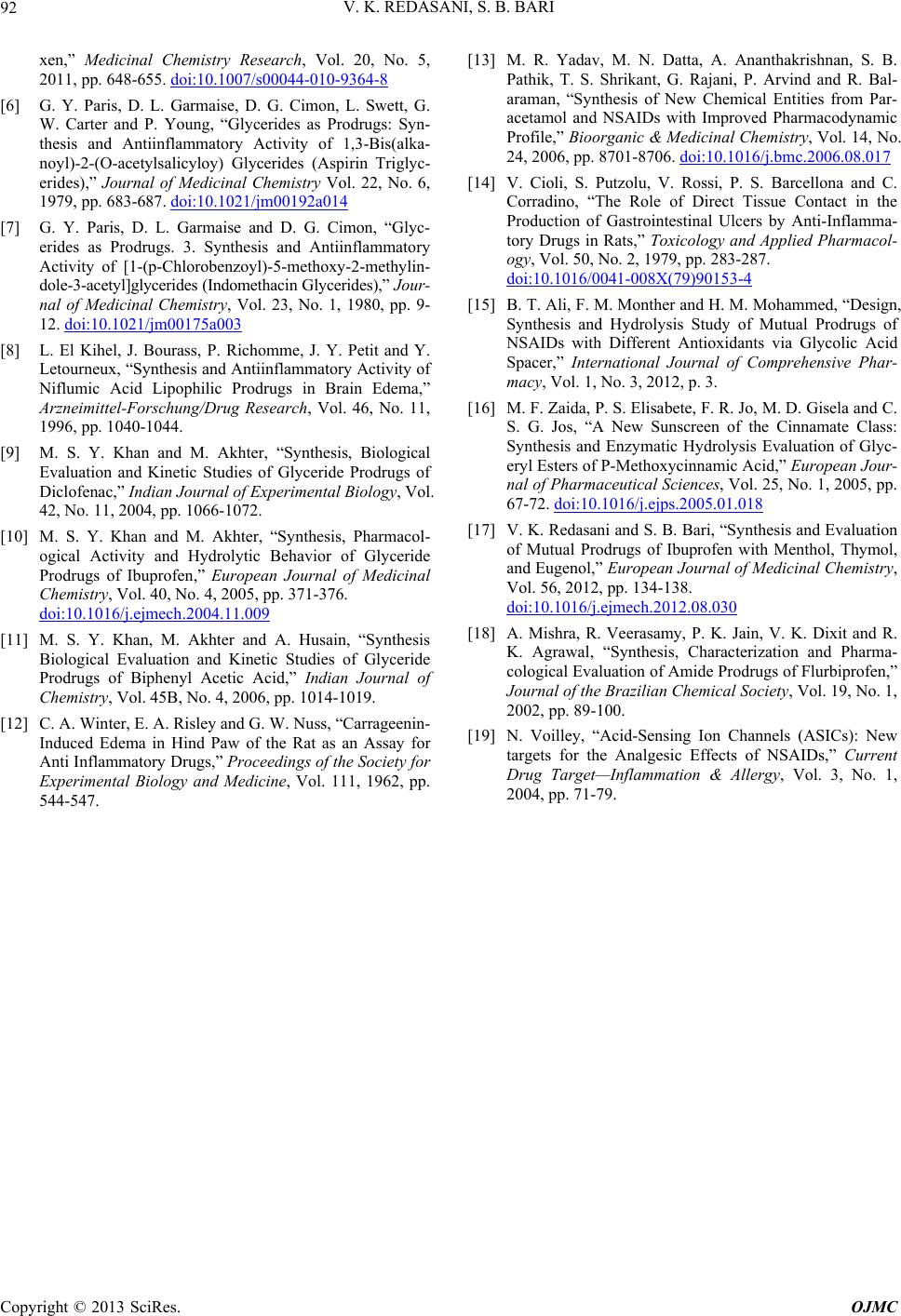 V. K. REDASANI, S. B. BARI 92 xen,” Medicinal Chemistry Research, Vol. 20, No. 5, 2011, pp. 648-655. doi:10.1007/s00044-010-9364-8 [6] G. Y. Paris, D. L. Garmaise, D. G. Cimon, L. Swett, G. W. Carter and P. Young, “Glycerides as Prodrugs: Syn- thesis and Antiinflammatory Activity of 1,3-Bis(alka- noyl)-2-(O-acetylsalicyloy) Glycerides (Aspirin Triglyc- erides),” Journal of Medicinal Chemistry Vol. 22, No. 6, 1979, pp. 683-687. doi:10.1021/jm00192a014 [7] G. Y. Paris, D. L. Garmaise and D. G. Cimon, “Glyc- erides as Prodrugs. 3. Synthesis and Antiinflammatory Activity of [1-(p-Chlorobenzoyl)-5-methoxy-2-methylin- dole-3-acetyl]glycerides (Indomethacin Glycerides),” Jour- nal of Medicinal Chemistry, Vol. 23, No. 1, 1980, pp. 9- 12. doi:10.1021/jm00175a003 [8] L. El Kihel, J. Bourass, P. Richomme, J. Y. Petit and Y. Letourneux, “Synthesis and Antiinflammatory Activity of Niflumic Acid Lipophilic Prodrugs in Brain Edema,” Arzneimittel-Forschung/Drug Research, Vol. 46, No. 11, 1996, pp. 1040-1044. [9] M. S. Y. Khan and M. Akhter, “Synthesis, Biological Evaluation and Kinetic Studies of Glyceride Prodrugs of Diclofenac,” Indian Journal of Experimental Biology, Vol. 42, No. 11, 2004, pp. 1066-1072. [10] M. S. Y. Khan and M. Akhter, “Synthesis, Pharmacol- ogical Activity and Hydrolytic Behavior of Glyceride Prodrugs of Ibuprofen,” European Journal of Medicinal Chemistry, Vol. 40, No. 4, 2005, pp. 371-376. doi:10.1016/j.ejmech.2004.11.009 [11] M. S. Y. Khan, M. Akhter and A. Husain, “Synthesis Biological Evaluation and Kinetic Studies of Glyceride Prodrugs of Biphenyl Acetic Acid,” Indian Journal of Chemistry, Vol. 45B, No. 4, 2006, pp. 1014-1019. [12] C. A. Winter, E. A. Risley and G. W. Nuss, “Carrageenin- Induced Edema in Hind Paw of the Rat as an Assay for Anti Inflammatory Drugs,” Proceedings of the Society for Experimental Biology and Medicine, Vol. 111, 1962, pp. 544-547. [13] M. R. Yadav, M. N. Datta, A. Ananthakrishnan, S. B. Pathik, T. S. Shrikant, G. Rajani, P. Arvind and R. Bal- araman, “Synthesis of New Chemical Entities from Par- acetamol and NSAIDs with Improved Pharmacodynamic Profile,” Bioorganic & Medicinal Chemistry, Vol. 14, No. 24, 2006, pp. 8701-8706. doi:10.1016/j.bmc.2006.08.017 [14] V. Cioli, S. Putzolu, V. Rossi, P. S. Barcellona and C. Corradino, “The Role of Direct Tissue Contact in the Production of Gastrointestinal Ulcers by Anti-Inflamma- tory Drugs in Rats,” Toxicology and Applied Pharmacol- ogy, Vol. 50, No. 2, 1979, pp. 283-287. doi:10.1016/0041-008X(79)90153-4 [15] B. T. Ali, F. M. Monther and H. M. Mohammed, “Design, Synthesis and Hydrolysis Study of Mutual Prodrugs of NSAIDs with Different Antioxidants via Glycolic Acid Spacer,” International Journal of Comprehensive Phar- macy, Vol. 1, No. 3, 2012, p. 3. [16] M. F. Zaida, P. S. Elisabete, F. R. Jo, M. D. Gisela and C. S. G. Jos, “A New Sunscreen of the Cinnamate Class: Synthesis and Enzymatic Hydrolysis Evaluation of Glyc- eryl Esters of P-Methoxycinnamic Acid,” European Jour- nal of Pharmaceutical Sciences, Vol. 25, No. 1, 2005, pp. 67-72. doi:10.1016/j.ejps.2005.01.018 [17] V. K. Redasani and S. B. Bari, “Synthesis and Evaluation of Mutual Prodrugs of Ibuprofen with Menthol, Thymol, and Eugenol,” European Journal of Medicinal Chemistry, Vol. 56, 2012, pp. 134-138. doi:10.1016/j.ejmech.2012.08.030 [18] A. Mishra, R. Veerasamy, P. K. Jain, V. K. Dixit and R. K. Agrawal, “Synthesis, Characterization and Pharma- cological Evaluation of Amide Prodrugs of Flurbiprofen,” Journal of the Brazilian Chemical Society, Vol. 19, No. 1, 2002, pp. 89-100. [19] N. Voilley, “Acid-Sensing Ion Channels (ASICs): New targets for the Analgesic Effects of NSAIDs,” Current Drug Target—Inflammation & Allergy, Vol. 3, No. 1, 2004, pp. 71-79. Copyright © 2013 SciRes. OJMC |