

Paper Menu >>
Journal Menu >>
 Journal of Sustainable Bioenergy Systems, 2013, 3, 179-185 http://dx.doi.org/10.4236/jsbs.2013.33025 Published Online September 2013 (http://www.scirp.org/journal/jsbs) Enhancement of Ethanol Production from Napiergrass (Pennisetum purpureum Schumach) by a Low-Moisture Anhydrous Ammonia Pretreatment Masahide Yasuda1*, Keisuke Takeo1, Hayato Nagai1, Takuya Uto1, Toshifumi Yui1, Tomoko Matsumoto2, Yasuyuki Ishii3, Kazuyoshi Ohta4 1Department of Applied Chemistry, Faculty of Engineering, University of Miyazaki, Miyazaki, Japan 2Center for Collaborative Research and Community Cooperation, University of Miyazaki, Miyazaki, Japan 3Department of Animal and Grassland Sciences, Faculty of Agriculture, University of Miyazaki, Miyazaki, Japan 4Department of Biochemistry and Applied Biosciences, Faculty of Agriculture, University of Miyazaki, Miyazaki, Japan Email: *[email protected] Received July 18, 2013; revised August 18, 2013; accepted August 25, 2013 Copyright © 2013 Masahide Yasuda et al. This is an open access article distributed under the Creative Commons Attribution License, which permits unrestricted use, distribution, and reproduction in any medium, provided the original work is properly cited. ABSTRACT Napiegrass (Pennisetum purpureum Schumach) was treated with a low-moisture anhydrous ammonia (LMAA) pre- treatment by adding an equal weight of water and keeping it under atmospheric ammonia gas at room temperature for four weeks. After the removal of ammonia and washing with water, a simultaneous saccharification and fermentation (SSF) was conducted for the LMAA-pretreated napiergrass (1.33 g) in a buffer solution (8 mL) using a mixture of a cellulase (80 mg) and a xylanase (53 mg) as well as the cell suspension (0.16 mL) of Saccharomyces cerevisiae. Etha- nol and xylose resulted in 91.2% and 62.9% yields, respectively. The SSF process was scaled up using LMAA-pre- treated napiergrass (100.0 g) to give ethanol (77.2%) and xylose (52.8%). After the removal of ethanol, the pentose fermentation of the SSF solution (40 mL), which contained 1.00 g of xylose, using cell suspension of Escherichia coli KO11 (70 mL) gave 86.3% yield of ethanol. Total ethanol yield reached 68.9% based on xylan (21.4 wt%) and glucan (39.7 wt%) of the LMAA-pretreated napiergrass. Keywords: LMAA; SSF; Cellulase; Xylanase; Saccharomyces cerevisiae; Escherichia coli KO11 1. Introduction Biomass has gained much attention as a new sustainable energy source alternative to petroleum-based fuels [1]. The second-generation bioethanol from lignocellulosic materials became a promising approach since the lingo- celluloses are not directly in competition with food sources. However, a variety of pretreatment methods to remove the lignin components and/or to promote an en- zymatic digestibility of the cellulosic components have been required for efficient bio-ethanol production from lignocellulose [2]. It has been known that cellulose chains are incorpo- rated into a number of distinct crystal phases each dif- fering in chemical reactivity and material characteristics. The naturally occurring crystal phases, cellulose I [3] can be transformed into cellulose IIII by treating them with liquid ammonia [4] or various amines [5-9]. Therefore, the ammonia fiber explosion (AFEX) pretreatment was performed by heating the biomass with ammonia gas at 90˚C under 21 atm [10,11]. This was interpreted as an increase in the cellulose IIII phase which has a high reac- tivity toward enzymatic degradation [12]. Also, soaking in aqueous ammonia (SAA) at 40˚C - 80˚C in a room atmosphere was used as the pretreatment of lignocellu- lose [13,14]. Recently, Kim et al. [15] developed a pre- treatment using gaseous ammonia, low-moisture anhy- drous ammonia (LMAA) pretreatment, where the lingo- cellulose was kept in a flask filled with ammonia gas at 80˚C for 84 h. *Corresponding author. C opyright © 2013 SciRes. JSBS 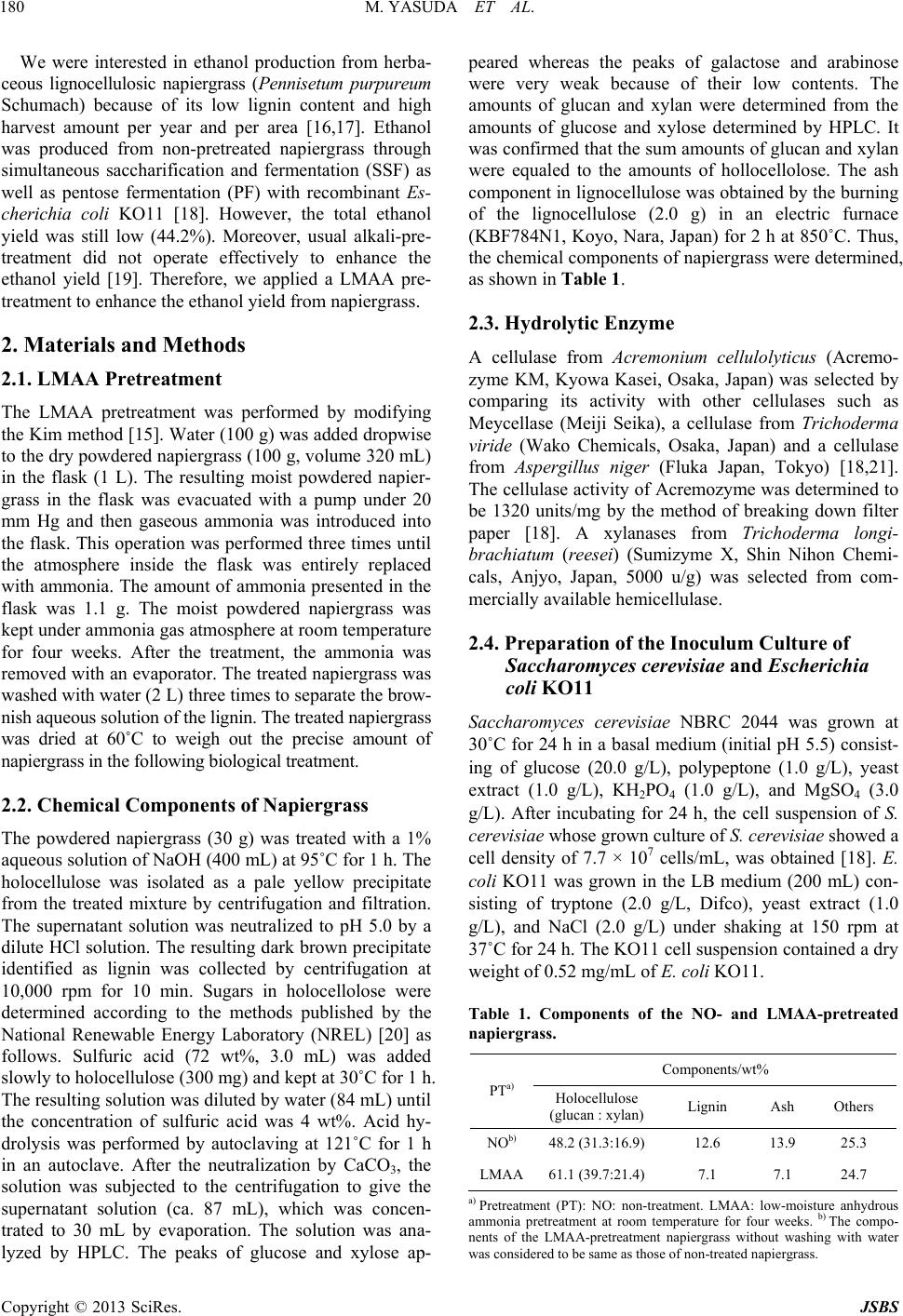 M. YASUDA ET AL. 180 We were interested in ethanol production from herba- ceous lignocellulosic napiergrass (Pennisetum purpureum Schumach) because of its low lignin content and high harvest amount per year and per area [16,17]. Ethanol was produced from non-pretreated napiergrass through simultaneous saccharification and fermentation (SSF) as well as pentose fermentation (PF) with recombinant Es- cherichia coli KO11 [18]. However, the total ethanol yield was still low (44.2%). Moreover, usual alkali-pre- treatment did not operate effectively to enhance the ethanol yield [19]. Therefore, we applied a LMAA pre- treatment to enhance the ethanol yield from napiergrass. 2. Materials and Methods 2.1. LMAA Pretreatment The LMAA pretreatment was performed by modifying the Kim method [15]. Water (100 g) was added dropwise to the dry powdered napiergrass (100 g, volume 320 mL) in the flask (1 L). The resulting moist powdered napier- grass in the flask was evacuated with a pump under 20 mm Hg and then gaseous ammonia was introduced into the flask. This operation was performed three times until the atmosphere inside the flask was entirely replaced with ammonia. The amount of ammonia presented in the flask was 1.1 g. The moist powdered napiergrass was kept under ammonia gas atmosphere at room temperature for four weeks. After the treatment, the ammonia was removed with an evaporator. The treated napiergrass was washed with water (2 L) three times to separate the brow- nish aqueous solution of the lignin. The treated napiergrass was dried at 60˚C to weigh out the precise amount of napiergrass in the following biological treatment. 2.2. Chemical Components of Napiergrass The powdered napiergrass (30 g) was treated with a 1% aqueous solution of NaOH (400 mL) at 95˚C for 1 h. The holocellulose was isolated as a pale yellow precipitate from the treated mixture by centrifugation and filtration. The supernatant solution was neutralized to pH 5.0 by a dilute HCl solution. The resulting dark brown precipitate identified as lignin was collected by centrifugation at 10,000 rpm for 10 min. Sugars in holocellolose were determined according to the methods published by the National Renewable Energy Laboratory (NREL) [20] as follows. Sulfuric acid (72 wt%, 3.0 mL) was added slowly to holocellulose (300 mg) and kept at 30˚C for 1 h. The resulting solution was diluted by water (84 mL) until the concentration of sulfuric acid was 4 wt%. Acid hy- drolysis was performed by autoclaving at 121˚C for 1 h in an autoclave. After the neutralization by CaCO3, the solution was subjected to the centrifugation to give the supernatant solution (ca. 87 mL), which was concen- trated to 30 mL by evaporation. The solution was ana- lyzed by HPLC. The peaks of glucose and xylose ap- peared whereas the peaks of galactose and arabinose were very weak because of their low contents. The amounts of glucan and xylan were determined from the amounts of glucose and xylose determined by HPLC. It was confirmed that the sum amounts of glucan and xylan were equaled to the amounts of hollocellolose. The ash component in lignocellulose was obtained by the burning of the lignocellulose (2.0 g) in an electric furnace (KBF784N1, Koyo, Nara, Japan) for 2 h at 850˚C. Thus, the chemical components of napiergrass were determined, as shown in Table 1. 2.3. Hydrolytic Enzyme A cellulase from Acremonium cellulolyticus (Acremo- zyme KM, Kyowa Kasei, Osaka, Japan) was selected by comparing its activity with other cellulases such as Meycellase (Meiji Seika), a cellulase from Trichoderma viride (Wako Chemicals, Osaka, Japan) and a cellulase from Aspergillus niger (Fluka Japan, Tokyo) [18,21]. The cellulase activity of Acremozyme was determined to be 1320 units/mg by the method of breaking down filter paper [18]. A xylanases from Trichoderma longi- brachiatum (reesei) (Sumizyme X, Shin Nihon Chemi- cals, Anjyo, Japan, 5000 u/g) was selected from com- mercially available hemicellulase. 2.4. Preparation of the Inoculum Culture of Saccharomyces cerevisiae and Escherichia coli KO11 Saccharomyces cerevisiae NBRC 2044 was grown at 30˚C for 24 h in a basal medium (initial pH 5.5) consist- ing of glucose (20.0 g/L), polypeptone (1.0 g/L), yeast extract (1.0 g/L), KH2PO4 (1.0 g/L), and MgSO4 (3.0 g/L). After incubating for 24 h, the cell suspension of S. cerevisiae whose grown culture of S. cerevisiae showed a cell density of 7.7 × 10⁷ cells/mL, was obtained [18]. E. coli KO11 was grown in the LB medium (200 mL) con- sisting of tryptone (2.0 g/L, Difco), yeast extract (1.0 g/L), and NaCl (2.0 g/L) under shaking at 150 rpm at 37˚C for 24 h. The KO11 cell suspension contained a dry weight of 0.52 mg/mL of E. coli KO11. Table 1. Components of the NO- and LMAA-pretreated napiergrass. Components/wt% PTa) Holocellulose (glucan : xylan) Lignin Ash Others NOb) 48.2 (31.3:16.9) 12.6 13.9 25.3 LMAA61.1 (39.7:21.4) 7.1 7.1 24.7 a) Pretreatment (PT): NO: non-treatment. LMAA: low-moisture anhydrous ammonia pretreatment at room temperature for four weeks. b) The compo- nents of the LMAA-pretreatment napiergrass without washing with water was considered to be same as those of non-treated napiergrass. Copyright © 2013 SciRes. JSBS 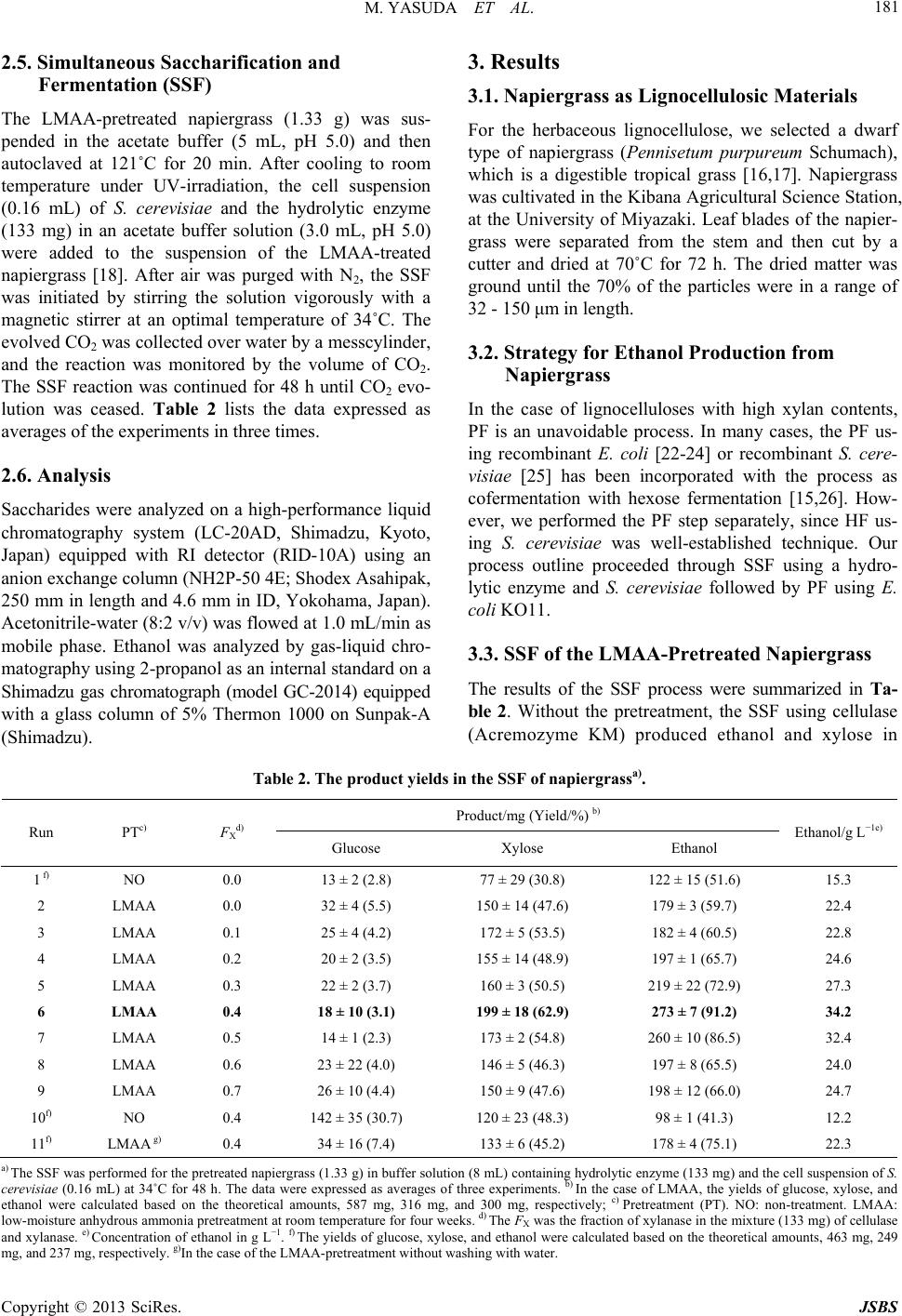 M. YASUDA ET AL. Copyright © 2013 SciRes. JSBS 181 2.5. Simultaneous Saccharification and Fermentation (SSF) The LMAA-pretreated napiergrass (1.33 g) was sus- pended in the acetate buffer (5 mL, pH 5.0) and then autoclaved at 121˚C for 20 min. After cooling to room temperature under UV-irradiation, the cell suspension (0.16 mL) of S. cerevisiae and the hydrolytic enzyme (133 mg) in an acetate buffer solution (3.0 mL, pH 5.0) were added to the suspension of the LMAA-treated napiergrass [18]. After air was purged with N2, the SSF was initiated by stirring the solution vigorously with a magnetic stirrer at an optimal temperature of 34˚C. The evolved CO2 was collected over water by a messcylinder, and the reaction was monitored by the volume of CO2. The SSF reaction was continued for 48 h until CO2 evo- lution was ceased. Table 2 lists the data expressed as averages of the experiments in three times. 2.6. Analysis Saccharides were analyzed on a high-performance liquid chromatography system (LC-20AD, Shimadzu, Kyoto, Japan) equipped with RI detector (RID-10A) using an anion exchange column (NH2P-50 4E; Shodex Asahipak, 250 mm in length and 4.6 mm in ID, Yokohama, Japan). Acetonitrile-water (8:2 v/v) was flowed at 1.0 mL/min as mobile phase. Ethanol was analyzed by gas-liquid chro- matography using 2-propanol as an internal standard on a Shimadzu gas chromatograph (model GC-2014) equipped with a glass column of 5% Thermon 1000 on Sunpak-A (Shimadzu). 3. Results 3.1. Napiergrass as Lignocellulosic Materials For the herbaceous lignocellulose, we selected a dwarf type of napiergrass (Pennisetum purpureum Schumach), which is a digestible tropical grass [16,17]. Napiergrass was cultivated in the Kibana Agricultural Science Station, at the University of Miyazaki. Leaf blades of the napier- grass were separated from the stem and then cut by a cutter and dried at 70˚C for 72 h. The dried matter was ground until the 70% of the particles were in a range of 32 - 150 μm in length. 3.2. Strategy for Ethanol Production from Napiergrass In the case of lignocelluloses with high xylan contents, PF is an unavoidable process. In many cases, the PF us- ing recombinant E. coli [22-24] or recombinant S. cere- visiae [25] has been incorporated with the process as cofermentation with hexose fermentation [15,26]. How- ever, we performed the PF step separately, since HF us- ing S. cerevisiae was well-established technique. Our process outline proceeded through SSF using a hydro- lytic enzyme and S. cerevisiae followed by PF using E. coli KO11. 3.3. SSF of the LMAA-Pretreated Napiergrass The results of the SSF process were summarized in Ta- ble 2. Without the pretreatment, the SSF using cellulase (Acremozyme KM) produced ethanol and xylose in Table 2. The product yields in the SSF of napier grassa). Product/mg (Yield/%) b) Run PTc) FXd) Glucose Xylose Ethanol Ethanol/g L−1e) 1 f) NO 0.0 13 ± 2 (2.8) 77 ± 29 (30.8) 122 ± 15 (51.6) 15.3 2 LMAA 0.0 32 ± 4 (5.5) 150 ± 14 (47.6) 179 ± 3 (59.7) 22.4 3 LMAA 0.1 25 ± 4 (4.2) 172 ± 5 (53.5) 182 ± 4 (60.5) 22.8 4 LMAA 0.2 20 ± 2 (3.5) 155 ± 14 (48.9) 197 ± 1 (65.7) 24.6 5 LMAA 0.3 22 ± 2 (3.7) 160 ± 3 (50.5) 219 ± 22 (72.9) 27.3 6 LMAA 0.4 18 ± 10 (3.1) 199 ± 18 (62.9) 273 ± 7 (91.2) 34.2 7 LMAA 0.5 14 ± 1 (2.3) 173 ± 2 (54.8) 260 ± 10 (86.5) 32.4 8 LMAA 0.6 23 ± 22 (4.0) 146 ± 5 (46.3) 197 ± 8 (65.5) 24.0 9 LMAA 0.7 26 ± 10 (4.4) 150 ± 9 (47.6) 198 ± 12 (66.0) 24.7 10f) NO 0.4 142 ± 35 (30.7) 120 ± 23 (48.3) 98 ± 1 (41.3) 12.2 11f) LMAA g) 0.4 34 ± 16 (7.4) 133 ± 6 (45.2) 178 ± 4 (75.1) 22.3 a) The SSF was performed for the pretreated napiergrass (1.33 g) in buffer solution (8 mL) containing hydrolytic enzyme (133 mg) and the cell suspension of S. cerevisiae (0.16 mL) at 34˚C for 48 h. The data were expressed as averages of three experiments. b) In the case of LMAA, the yields of glucose, xylose, and ethanol were calculated based on the theoretical amounts, 587 mg, 316 mg, and 300 mg, respectively; c) Pretreatment (PT). NO: non-treatment. LMAA: low-moisture anhydrous ammonia pretreatment at room temperature for four weeks. d) The FX was the fraction of xylanase in the mixture (133 mg) of cellulase and xylanase. e) Concentration of ethanol in g L−1. f) The yields of glucose, xylose, and ethanol were calculated based on the theoretical amounts, 463 mg, 249 g, and 237 mg, respectively. g)In the case of the LMAA-pretreatment without washing with water. m 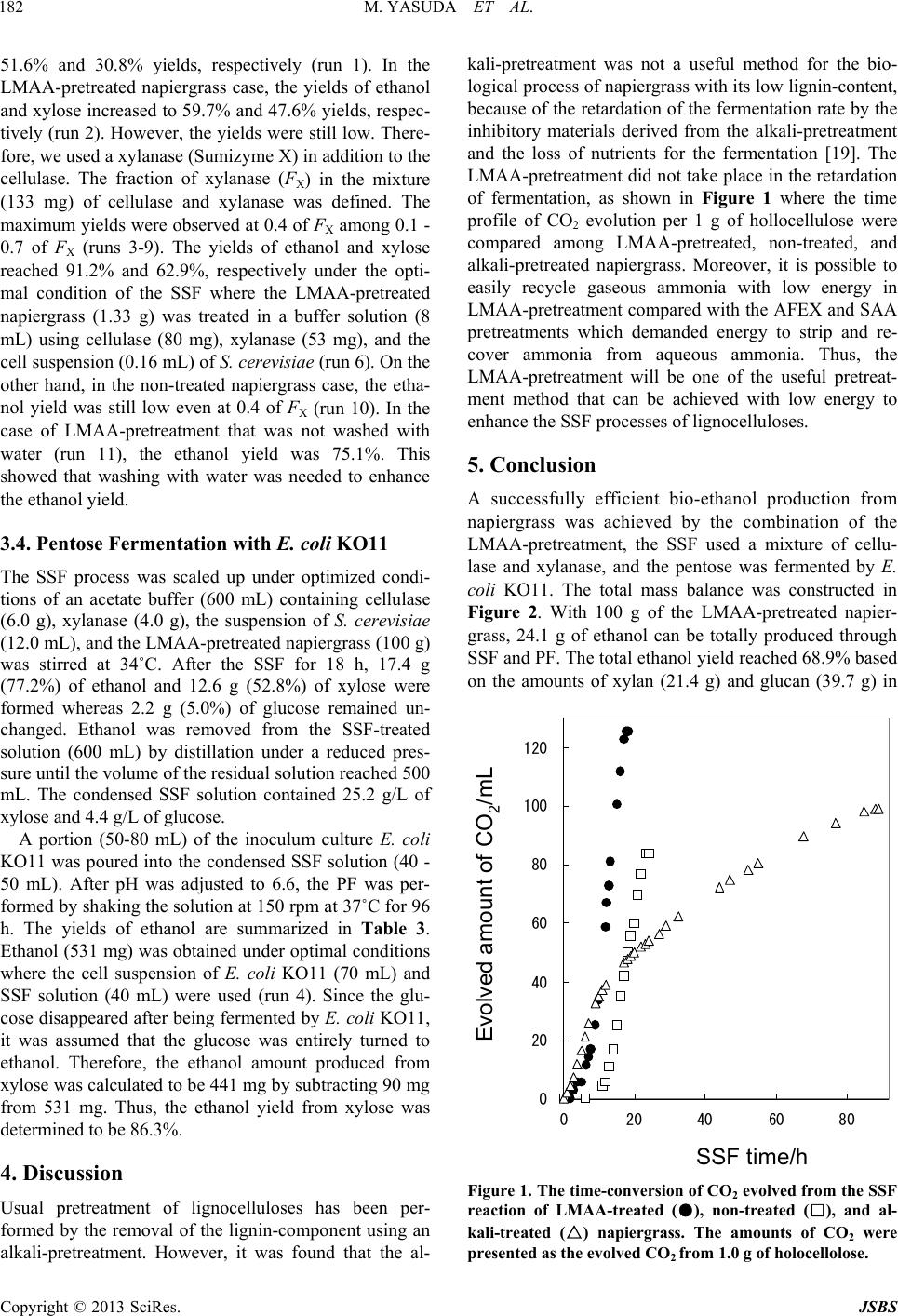 M. YASUDA ET AL. 182 51.6% and 30.8% yields, respectively (run 1). In the LMAA-pretreated napiergrass case, the yields of ethanol and xylose increased to 59.7% and 47.6% yields, respec- tively (run 2). However, the yields were still low. There- fore, we used a xylanase (Sumizyme X) in addition to the cellulase. The fraction of xylanase (FX) in the mixture (133 mg) of cellulase and xylanase was defined. The maximum yields were observed at 0.4 of FX among 0.1 - 0.7 of FX (runs 3-9). The yields of ethanol and xylose reached 91.2% and 62.9%, respectively under the opti- mal condition of the SSF where the LMAA-pretreated napiergrass (1.33 g) was treated in a buffer solution (8 mL) using cellulase (80 mg), xylanase (53 mg), and the cell suspension (0.16 mL) of S. cerevisiae (run 6). On the other hand, in the non-treated napiergrass case, the etha- nol yield was still low even at 0.4 of FX (run 10). In the case of LMAA-pretreatment that was not washed with water (run 11), the ethanol yield was 75.1%. This showed that washing with water was needed to enhance the ethanol yield. 3.4. Pentose Fermentation with E. coli KO11 The SSF process was scaled up under optimized condi- tions of an acetate buffer (600 mL) containing cellulase (6.0 g), xylanase (4.0 g), the suspension of S. cerevisiae (12.0 mL), and the LMAA-pretreated napiergrass (100 g) was stirred at 34˚C. After the SSF for 18 h, 17.4 g (77.2%) of ethanol and 12.6 g (52.8%) of xylose were formed whereas 2.2 g (5.0%) of glucose remained un- changed. Ethanol was removed from the SSF-treated solution (600 mL) by distillation under a reduced pres- sure until the volume of the residual solution reached 500 mL. The condensed SSF solution contained 25.2 g/L of xylose and 4.4 g/L of glucose. A portion (50-80 mL) of the inoculum culture E. coli KO11 was poured into the condensed SSF solution (40 - 50 mL). After pH was adjusted to 6.6, the PF was per- formed by shaking the solution at 150 rpm at 37˚C for 96 h. The yields of ethanol are summarized in Table 3. Ethanol (531 mg) was obtained under optimal conditions where the cell suspension of E. coli KO11 (70 mL) and SSF solution (40 mL) were used (run 4). Since the glu- cose disappeared after being fermented by E. coli KO11, it was assumed that the glucose was entirely turned to ethanol. Therefore, the ethanol amount produced from xylose was calculated to be 441 mg by subtracting 90 mg from 531 mg. Thus, the ethanol yield from xylose was determined to be 86.3%. 4. Discussion Usual pretreatment of lignocelluloses has been per- formed by the removal of the lignin-component using an alkali-pretreatment. However, it was found that the al- kali-pretreatment was not a useful method for the bio- logical process of napiergrass with its low lignin-content, because of the retardation of the fermentation rate by the inhibitory materials derived from the alkali-pretreatment and the loss of nutrients for the fermentation [19]. The LMAA-pretreatment did not take place in the retardation of fermentation, as shown in Figure 1 where the time profile of CO2 evolution per 1 g of hollocellulose were compared among LMAA-pretreated, non-treated, and alkali-pretreated napiergrass. Moreover, it is possible to easily recycle gaseous ammonia with low energy in LMAA-pretreatment compared with the AFEX and SAA pretreatments which demanded energy to strip and re- cover ammonia from aqueous ammonia. Thus, the LMAA-pretreatment will be one of the useful pretreat- ment method that can be achieved with low energy to enhance the SSF processes of lignocelluloses. 5. Conclusion A successfully efficient bio-ethanol production from napiergrass was achieved by the combination of the LMAA-pretreatment, the SSF used a mixture of cellu- lase and xylanase, and the pentose was fermented by E. coli KO11. The total mass balance was constructed in Figure 2. With 100 g of the LMAA-pretreated napier- grass, 24.1 g of ethanol can be totally produced through SSF and PF. The total ethanol yield reached 68.9% based on the amounts of xylan (21.4 g) and glucan (39.7 g) in SSF time/h Evolved amount of CO2/mL 0 20 40 60 80 100 120 02040 6080 Figure 1. The time-conversion of CO2 evolved from the SSF reaction of LMAA-treated (●), non-treated (□), and al- kali-treated (△) napiergrass. The amounts of CO2 were presented as the evolved CO2 from 1.0 g of holocellolose. Copyright © 2013 SciRes. JSBS  M. YASUDA ET AL. 183 Table 3. Pentose fermentation with E. coli KO11. Run KO11/mLa) SSF/mLb) Xylose/mg (Yield/%)c) Ethanol/mg (Yield/%)d) [Yield/%]e) Ethanol/g·L−1f) 1 50 50 807 ± 9 (64.0) 352 ± 28 (46.5) [37.2] 3.52 2 60 50 457 ± 122 (36.3) 440 ± 75 (58.1) [50.8] 4.00 3 70 30 0 (0.0) 309 ± 3 (72.0) [68.6] 3.09 4 70 40 0 (0.0) 531 ± 4 (88.4) [86.3] 4.82 5 70 50 60 ± 10 (4.7) 594 ± 77 (77.5) [73.6] 4.95 6 80 50 86 ± 38 (6.7) 540 ± 59 (70.4) [65.4] 4.15 a) The volume of the cell suspension of E. coli KO11 in ml. b)Pentose fermentation was performed for the SSF solution which contained 25.2 g·L−1 of xylose and 4.4 g·L−1 of glucose. c) Recovered xylose. d) The values in parenthesis are ethanol yields from both xylose and glucose. e) The values in blanket are the etha- nol yields from xylose. f) Concentration of ethanol in g·L−1. LMAA (ro o m temp , 4 w e e k s ) Water 127 mL NH31.4 g Buffer 588 mL Cellulase6.0 g Xylanase4.0 g Cell suspension of S. cere vi s ia e12 mL Cell suspension of E. c oli.KO11 882 mL Dry powdered napiergrass(127 g) Glucan 39.7 g, Xylan21.4 g, Lignin 16.1 g Glucose 2.2 g Xylose 12.6 g Ethanol 17.4 g Evaporation PF (37 ºC, 94 h) Glucose 2.2 g Xylose 12.6 g Water 500 mL SSF (34 ºC, 48 h) Et ha no l 6.7 g Glucan 7.1 g Xylan 10.1 g Lignin 7.1 g Water 1.38 L Et ha no l 17 .4 g Water 100 mL Remov al of NH 3 Was h in g with water Dr ynes s Glucan7.1 g Xylan 10.1 g Lignin 7.1 g Water 7.6 L NH31.4 g Lignin 9.0 g Water 7.7 L Glucan7.1 g Xylan 10.1 g Lignin 7.1 g LMAA-treated napiergrass (100 g) Glucan 39.7 g, Xylan21.4 g, Lignin 7.1 g Figure 2. Process outline and total mass balance from LMAA-pretreated napiergrass (100 g). 100 g of LMAA-pretreated napiergrass. If the PF process was combined with the SSF process run 6 of Table 2 which was run under optimal conditions of the small scale using 1.33 g of LMAA-pretreated napiergrass, the total yield will become 80.5%. 6. Acknowledgements We sincerely thank Lonnie O. Ingram from the Univer- sity of Florida for providing the E. coli KO11 strain. This study was done as a part of the project entitled “Research and Development of Catalytic Process for Efficient Con- version of Cellulosic Biomass into Biofuels and Chemi- cals (2009-2013)” through Special Funds for Education and Research from the Ministry of Education, Culture, Sports, Science, and Technology of Japan. REFERENCES [1] M. Galbe and G. Zacchi, “Pretreatment of Lignocellulosic Materials for Efficient Bioethanol proDuction,” Advances Biochemical Engineering/Biotechnology, Vol. 108, No. 3, 2007, pp. 41-65. doi:10.1007/10_2007_070 [2] P. Alvira, E. Tomás-Pejó, M. Ballesteros and M. J. Negro, “Pretreatment Technologies for an Efficient Bioethanol Production Process Based on Enzymatic Hydrolysis: A Review,” Bioresource Technology, Vol. 101, No. 13, 2010, pp. 4851-4861. doi:10.1016/j.biortech.2009.11.093 [3] R. H. Attala and D. L. VanderHart, “Native Cellulose: A Composite of Two Distinct Crystalline Forms,” Science, Vol. 223, No. 4633, 1984, pp. 283-285. doi:10.1126/science.223.4633.283 [4] M. A. Rousselle, M. L. Nelson, C. B. Hassenboehler Jr. and D. C. Legendre, “Liquid-Ammonia and Caustic Mer- Copyright © 2013 SciRes. JSBS  M. YASUDA ET AL. 184 cerization of Cotton Fibers: Changes in Fine Structure and Mechanical Propertied,” Textile Research Journal, Vol. 46, No. 4, 1976, pp. 304-310. [5] J. J. Creely and R. H. Wade, “Complexes of Diamines with Cellulose: Study of Symmetrical and Unsymmetrical Terminal Group Effects,” Textile Research Journal. Vol. 45, No. 5, 1975, pp. 240-246. doi:10.1177/004051757504500309 [6] J. J. Creely and R. H. Wade, “Complexes of Cellulose with Cyclic Amines and Diamines,” Journal of Polymer Science Part C Polymer Letters, Vol. 16, No. 6, 1978, pp. 291-295. doi:10.1002/pol.1978.130160608 [7] M. Wada, L. Heux, A. Isogai, Y. Nishiyama, H. Chanzy and J. Sugiyama, “Improved Structural Data of Cellulose IIII Prepared in Supercritical Ammonia,” Journal of Mac- romolecules, Vol. 34, No. 5, 2001, pp. 1237-1243. doi:10.1021/ma001406z [8] M. Wada, H. Chanzy, Y. Nishiyama and P. Langan, “Cel- lulose III I Crystal Structure and Hydrogen Bonding by Synchrotron X-Ray and Neutron Fiber Diffraction,” Macro- molecules, Vol. 37, No. 23, 2004, pp. 8548-8555. doi:10.1021/ma0485585 [9] H. Chanzy, B. Henrissat, M.Vincendon, S. Tanner and P. S. Belton, “Solid-State 13C-N.M.R. and Electron Micro- scopy Study on the Reversible Cellulose I→Cellulose IIII Transformation in Valonia,” Carbohyd rate. Research, Vol. 160, 1987, pp. 1-11. doi:10.1016/0008-6215(87)80299-9 [10] F. Teymouri, L.Lauerano-Perez, H. Alizadeh and B. E. Dale, “Optimization of the Ammonia Fiber Explosion (AFEX) Treatment Parameters for Enzymatic Hydrolysis of Corn Stover,” Bioresource Technology, Vol. 96, No. 18, 2005, pp. 2014-2018. doi:10.1016/j.biortech.2005.01.016 [11] M. W. Lau, B. E. Dale and V. Balan, “Ethanolic Fermen- tation of Hydrolysates from Ammonia Fiber Expansion (AFEX) Treated Corn Stover and Distillers Grain without Detoxification and External Nutrient Supplementation,” Biotechnology and Bioengineering, Vol. 99, No. 3, 2008, pp. 529-539. doi:10.1002/bit.21609 [12] K. Igarashi, M. Wada and M. Samejima, “Activation of Crystalline Cellulose to Cellulose IIII Results in Efficient Hydrolysis by Cellobiohydrolase,” FEBS Journal, Vol. 274, No. 7, 2007, pp. 1785-1792. doi:10.1111/j.1742-4658.2007.05727.x [13] T.-H. Kim and Y. Y. Lee, “Pretreatment of Corn Stover by Soaking in Aqueous Ammonia,” Applied Biochemistry and Biotechnology Part A Enzyme Engineering and Bio- technology, Vol. 124, No. 1-3, 2005, pp.1119-1132. doi:10.1385/ABAB:124:1-3:1119 [14] J.-K. Ko, J.-S. Bak, M.-W. Jung, H.-J. Lee, I.G. Choi and T.-H. Kim, “Ethanol Production from Rice Straw Suing Optimized Aqueous-Ammonia Soaking Pretreatment and Simultaneous Saccharification and Fermentation Proc- esses,” Bioresource Technology, Vol. 100, No. 19, 2009, pp. 4374-4380. doi:10.1016/j.biortech.2009.04.026 [15] C. G. Yoo, N. P. Nghiem, K. B. Hicks and T. H. Kim, “Pretreatment of Corn Stover by Low Moisture Anhy- drous Ammonia (LMAA) Process,” Bioresource Tech- nology, Vol. 102, No. 21, 2011, pp. 10028-10034. doi:10.1016/j.biortech.2011.08.057 [16] Y. Ishii, N. Yamaguchi and S. Idota, “Dry Matter Produc- tion and in Vitro Dry Matter Digestibility of Tillers among Napiergrass (Pennisetum purpureum Schumach) Varieties,” Grassland Science, Vol. 51, No. 2, 2005, pp. 153-163. doi:10.1111/j.1744-697X.2005.00021.x [17] K. Rengsirikul, Y. Ishii, K. Kangvansaichol, P. Pripan- apong, P. Sripichitt, V. Punsuvon, P. Vaithanomsat, G. Nakamanee and S. Tudsri, “Effects of Inter-Cutting In- terval on Biomass Yield, Growth Components and Chemical Composition of Napiergrass (Pennisetum pur- pureum Schumach) Cultivars as Bioenergy Crops in Thai- land,” Grassland Science, Vol. 57, No. 2, 2011, pp. 135- 141. doi:10.1111/j.1744-697X.2011.00220.x [18] M. Yasuda, A. Miura, T. Shiragami, J. Matsumoto, I. Kamei, Y. Ishii and K. Ohta, “Ethanol Production from Non-Pretreated Napiergrass through a Simultaneous Sac- charification and Fermentation Process Followed by a Pentose Fermentation with Escherichia coli KO11,” Jour- nal of Bioscience and Bioengineering, Vol. 114, No. 2, 2012, pp. 188-192. doi:10.1016/j.jbiosc.2012.03.011 [19] M. Yasuda, K. Takeo, T. Matsumoto, T. Shiragami, Y. Matsushita, K. Sugamoto and Y. Ishii, “Effectiveness of Lignin-Removal in Simultaneous Saccharification and Fermentation of Napiergrass, Rice Straw, Silbergrass and Bamboo with Different Lignin-Contents,” In: A. K. Chan- del and S. Silverio da Silva, Eds., Sustainable Degrada- tion of Lignocellulosic Biomass—Techniques, Applica- tions and Commercialization, InTech, Croatia, Chapter 4, 2013, pp. 91-104. [20] A. Sluiter, B. Hames, R. Ruiz, C. Scarlata, J. Sluiter, D. Templaton and D. Crocker, “Determination of Structural Carbohydrates and Lignin in Biomass,” Technical Report NREL/TP-510-42618, National Renewable Energy La- boratory, Golden, 2010. [21] M. Yasuda, A. Miura, R. Yuki, Y. Nakamura, T. Shi- ragami, Y. Ishii and H. Yokoi, “The Effect of TiO2- Photocatalytic Pretreatment on the Biological Production of Ethanol from Lignocelluloses,” Journal of Photo- chemistry and Photobiology A: Chemistry, Vol. 220, No. 2-3, 2011, pp. 195-199. doi:10.1016/j.jphotochem.2011.04.019 [22] S. A. Underwood, M. L. Buszko, K. T. Shanmugam and L. O. Ingram, “Flux through Citrate Synthase Limits the Growth of Ethanologenic Escherichia coli KO11 during Xylose Fermentation,” Applied and Environmental Mi- crobiology, Vol. 68, No. 3, 2002, pp. 1071-1081. doi:10.1128/AEM.68.3.1071-1081.2002 [23] K. Ohta, F. Alterthum and L. O. Ingram, “Effects of En- vironmental Conditions on Xylose Fermentation by Re- combinant Escherichia coli,” Applied and Environmental Microbiology, Vol. 56, No. 2, 1990, pp. 463-465. [24] K. Ohta, D. S. Beall, J. P. Mejia, K. T. Shanmugam and L. O. Ingram, “Genetic Improvement of Escherichia coli for Ethanol Production: Chromosomal Integration of Zymo- monas mobilis Genes Encoding Pyruvate Decarboxylase and Alcohol Dehydrogenase II,” Applied and Environ- mental Microbiology, Vol. 57, No. 4, 1991, pp. 893-900. [25] A. Matsushika, H. Inoue, T. Kodaki and S. Sawayama, Copyright © 2013 SciRes. JSBS  M. YASUDA ET AL. Copyright © 2013 SciRes. JSBS 185 “Ethanol Production from Xylose in Engineered Sac- charomyces cerevisiae Strains: Current State and Per- spectives,” Applied Microbiology and Biotechnology, Vol. 84, No. 1, 2009, pp. 37-53. doi:10.1007/s00253-009-2101-x [26] S. K. Brandon, L. N. Sharma, G. M. Hawkins, W. F. An- derson, C. K. Chambliss and J. Doran-Peterson, “Ethanol and Co-Product Generation from Pressurized Batch Hot Water Pretreated T85 Bermudagrass and Merkeron Napier- grass using Recombinant Escherichia coli as Biocata- lyst,” Biomass Bioengineering, Vol. 35, No. 8, 2011, pp. 3667-3673. doi:10.1016/j.biombioe.2011.05.021 |