

Paper Menu >>
Journal Menu >>
 Open Journal of Composite Materials, 2013, 3, 107-112 http://dx.doi.org/10.4236/ojcm.2013.34011 Published Online October 2013 (http://www.scirp.org/journal/ojcm) Copyright © 2013 SciRes. OJCM 107 Effect of Temperatures on Polymerization Stress and Microleakage of Class V Composite Restorations Pavinee Padipatvuthikul Didron1*, Wojciech Chrzanowski2, Ayman Ellakwa3,4 1Department of General Dentistry, Srinakharinwirot University, Bangkok, Thailand; 2Faculty of Pharmacy, University of Sydney, Sydney, Australia; 3Faculty of Dentistry, The University of Sydney, Sydney, Australia; 4Faculty of Dentistry, Tanta University, Tanta, Egypt. Email: *[email protected] Received July 22nd, 2013; revised August 22nd, 2013; accepted August 31st, 2013 Copyright © 201 3 Pavinee Padipa tvuthikul Didron et al. T his is an open access article distr i bu t e d under the Creative Commons Attribu- tion License, which permits unrestricted use, distribution, and reproduction in any me dium, prov ided the original work is properly cited. ABSTRACT The loss of interfacial integrity was identified as one of the major causes for replacement of resin com posite restorations. Preheating procedure has been prov en to enhance flowability and ad aptation of resin composites and increase their de- gree of conversion. The purpose of this study was to investigate polymerization contraction stress produced in resin composites after preheating to 37˚C and 60˚C, and measure microleakage of Class V restorations restored with pre- heated composites. Three resin composites (GC Kalore, Gradia Direct X, Filtek Supreme XT) at room te mpe rature, 3 7˚C, and 60˚C were investigated. Maximum contraction stress of the composites (n = 5) was evaluated in a modified low- compliance device. Samples were light-cured for 40 seconds and the maximum force was recorded during 15 minutes. Calculations were done to adjust for the system’s compliance and obtain linear shrinkage values of composites. Data were analyzed by Multivariated Analysis of Variance (MANOVA) and Tukey’s test for multiple comparisons (α = 0.05). Seventy-two Class V cavities were prepared on the buccal surfaces of extracted premolars and divided into 9 groups. The teeth were restored with composites at 3 temperatures and were thermo-cycled between 5˚C and 55˚C with a one-minute dwell-time for 1000 cycles. The teeth were sealed with wax and nail vanish before placed in 0.5% tolu- idine blue dye for 24 hours. The teeth were embedded in self-curing resin and sectioned bucco-lingually with a slow-speed diamond saw, providing 3 sections per restoration. Microleakage was rated by two evaluators using a 0 - 4 ordinal scale at the occlusal and cervical margins under light microscope. Microleakage data were analyzed with Kruskal-Wallis ANOVA and Mann-Whitney U test (α = 0.05). Results indicate that preheating co mposites to 37˚C and 60˚C significantly increased polymerization contraction stress of composites (p < 0.05). A significantly greater amount of leak age wa s found a t the cerv ical ma rgins (p < 0.05). For all tested materials, preh eating compos ites to 60˚C resulted in significantly less microleakage at the cervical margin. Keywords: Preheating; Dental Composite; Polymerization Shrinkage; Contraction Stress; Microleakage 1. Introduction Improvements in resin composites’ mechanical proper- ties and their reduced polymerization shrinkage during the past decade encouraged clinicians to use resin com- posites more frequently for posterior restorations. Ma- jorities of improvements aimed to improve microstruc- ture of the material including monomer composition, size, shape, and distribution of inorganic filler particles and targeted mainly at increasing the filler load of resin composites. However, increasing the filler load resulted in higher viscosity and led to concerns about handling, packing, and adaptation of the material. Many attempts were made to enhance composite adaptation and decrease microleakage between composites and dental cavity, ei- ther by using the flowable composite as a base material, chemical and laser treatments of dentin or by preheating the composites to lower their viscosity. The effect of lower viscosity in improvements of adap- tation has been proven important. Th is is the primary ba- sis for producing flowable resin composites in which the lower viscosity can be achieved by decreasing their filler contents and making changes in the matrix chemistry, which severely reduce their physical properties. Many polymers exhibit lower viscosity when they are heated because thermal vibrations force the composite monomer further apart and allow them to slide by each other more *Corresponding a uthor. 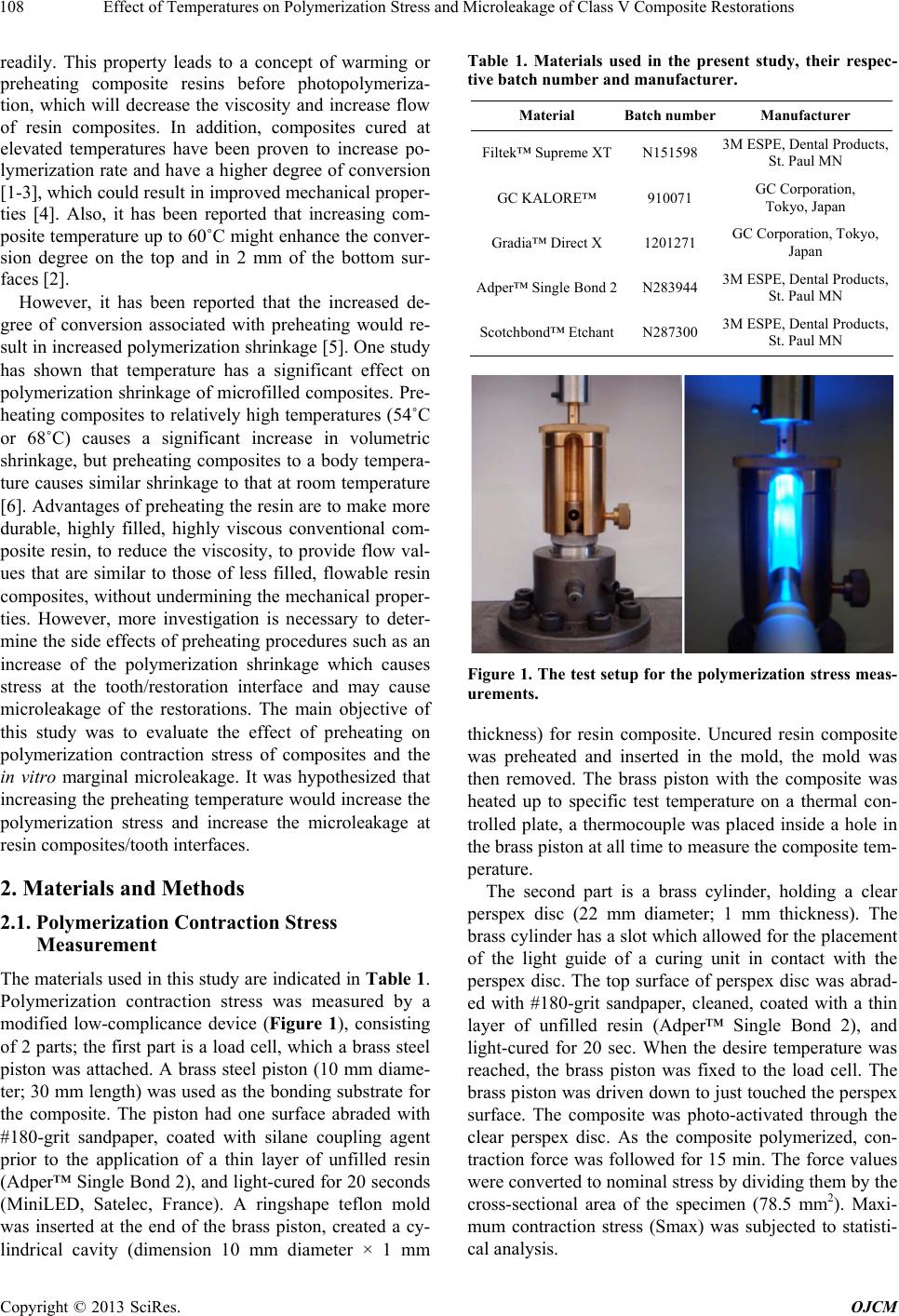 Effect of Temperatures on Polymerization Stress and Microleakage of Class V Composite Restorations Copyright © 2013 SciRes. OJCM 108 readily. This property leads to a concept of warming or preheating composite resins before photopolymeriza- tion, which will decrease the viscosity and increase flow of resin composites. In addition, composites cured at elevated temperatures have been proven to increase po- lymerization rate and have a higher degree of conversion [1-3], which could result in improved mechanical proper- ties [4]. Also, it has been reported that increasing com- posite temperature up to 60 ˚C might enhance the conver- sion degree on the top and in 2 mm of the bottom sur- faces [2]. However, it has been reported that the increased de- gree of conversion associated with preheating would re- sult in increased polymerization sh rinkage [5]. One study has shown that temperature has a significant effect on polymerization shrinkage of microf illed composites. Pre- heating composites to relatively high temperatures (54˚C or 68˚C) causes a significant increase in volumetric shrinkage, but preheating composites to a body tempera- ture causes similar shrinkage to that at room temperature [6]. Advantages of preheating the resin are to make more durable, highly filled, highly viscous conventional com- posite resin, to reduce the viscosity, to provide flow val- ues that are similar to those of less filled, flowable resin composites, without undermining the mechanical proper- ties. However, more investigation is necessary to deter- mine the si de effects of preh eating procedu res such as an increase of the polymerization shrinkage which causes stress at the tooth/restoration interface and may cause microleakage of the restorations. The main objective of this study was to evaluate the effect of preheating on polymerization contraction stress of composites and the in vitro marginal microleakage. It was hypothesized that increasing the preheating temp erature would in crease the polymerization stress and increase the microleakage at resin composites/tooth in terfaces. 2. Materials and Methods 2.1. Polymerization Contraction Stress Measurement The materials used in this study are indicated in Table 1. Polymerization contraction stress was measured by a modified low-complicance device (Figure 1), consisting of 2 parts; the first part is a load cell, which a brass steel piston was attached. A brass steel piston (10 mm diame- ter; 30 mm length) was used as the bonding substrate for the composite. The piston had one surface abraded with #180-grit sandpaper, coated with silane coupling agent prior to the application of a thin layer of unfilled resin (Adper™ Single Bond 2), and light-cured for 20 seconds (MiniLED, Satelec, France). A ringshape teflon mold was inserted at the end of the brass piston, created a cy- lindrical cavity (dimension 10 mm diameter × 1 mm Table 1. Materials used in the present study, their respec- tive batch number and manufacture r. Material Batch number Manufacturer Filtek™ Supreme XTN151598 3M ESPE, Dental Products, St. Paul MN GC KALORE™ 910071 GC Corporation, Tokyo, Japan Gradia™ Direct X 1201271 GC Corporation, Tok yo, Japan Adper™ Single Bond 2N283944 3M ESPE, Dental Products, St. Paul MN Scotchbond™ EtchantN287300 3M ESPE, Dental Products, St. Paul MN Figure 1. The test setup for the polymerization stress meas- urements. thickness) for resin composite. Uncured resin composite was preheated and inserted in the mold, the mold was then removed. The brass piston with the composite was heated up to specific test temperature on a thermal con- trolled plate, a thermocouple was placed inside a hole in the brass piston at all time to measure the composite tem- perature. The second part is a brass cylinder, holding a clear perspex disc (22 mm diameter; 1 mm thickness). The brass cylinder has a slot which allowed for the placement of the light guide of a curing unit in contact with the perspex disc. The top surface of perspex disc was abrad- ed with #180-grit sandpaper, cleaned, coated with a thin layer of unfilled resin (Adper™ Single Bond 2), and light-cured for 20 sec. When the desire temperature was reached, the brass piston was fixed to the load cell. The brass piston was driven down to just touched the perspex surface. The composite was photo-activated through the clear perspex disc. As the composite polymerized, con- traction force was followed for 15 min. The force values were converted to nominal stress by dividing them by the cross-sectional area of the specimen (78.5 mm2). Maxi- mum contraction stress (Smax) was subjected to statisti- cal analysis.  Effect of Temperatures on Polymerization Stress and Microleakage of Class V Composite Restorations Copyright © 2013 SciRes. OJCM 109 Data were analyzed by Multivariated Analysis of Va- riance (MANOVA), entering resin composite and tem- perature as main factors, and Tukey’s test for multiple comparisons (α = 0.05). 2.2. Microleakage Test 2.2.1. Tooth Selection Seventy-two extracted caries and restoration-free perma- nent human premolars were selected, remaining soft tis- sue removed, and stored in deionized water for a maxi- mum duration of 4 weeks. The teeth were cleaned with slurry of pumice and water, rinsed thoroughly with tap water, and then examined macroscopically with mag- nification for defects in the enamel and dentin. 2.2.2. Sample Prepa ration The teeth were randomly assigned into nine groups of eight. A Class V preparation was made in the buccal sur- face of each tooth. The occlusal margin of the cavities were in enamel and the gingival margins located 1.5 mm apical to the cemento-enamel junction. Preparations were made with a 329 carbide bur in a high-speed handpiece equipped with water spray. Cavity dimensions were stan- dardized (5.0 mm in width, 3.0 mm in height, and 2 mm in depth). For all groups, enamel and dentin are etched with 35% phosphoric acid gel (Scotchbond™ etchant, 3M Dental Products, MN, USA) for 20 s and 15 s re- spectively, rinsed for 20 s, and air-dried to obtain chalky- white appearance enamel and moist dentin. All cavities are treated with a resin-based adhesive system. The ad- hesive used in this study is Adper™ Single Bond 2 (3M ESPE, St. Paul, MN, USA). Wet-bonding technique is followed as recommended by the manufacturer, moist dentin was clinically evidenced by a uniform shiny sur- face on which water was not pooled. A fully saturated brush tip for each coat is used, applying two consecutive coats of Adper™ Single Bond 2 adhesive to prepared enamel and dentin. Later, the surface was dried gently for 5s and light cured for 20 s (miniLED, Satelec, France). The cavities were restored as follow: Group 1: restored with a room temperature Filtek Z350 XT; Group 2: restored with a preheated (37˚C) Filtek Z350 XT; Group 3: restored with a preheated (60˚C) Filtek Z350 XT; Group 4: re stored wi th a room temperature GC Kalore; Group 5: restor ed wi t h a prehe a te d (3 7˚C) GC Kalore; Group 6: restor ed wi t h a prehe a te d (6 0˚C) GC Kalore; Group 7: restored with a room temperature Gradia di- rect X; Group 8: restored with a preheated (37˚C) Gradia di- rect X; Group 9: restored with a preheated (60˚C) Gradia di- rect X. All restorations were done two increments with the first against the gingival wall, and light-cured for 20 s. Excess materials are removed with a No.170 bur, fol- lowed by finishing and polishing with the Softlex disk system (3M Dental Products Division, St. Paul, MN, USA). The restored teeth are stored in deionized water at 37˚C for 1 da y before f urther treat ment. All samples are thermocycled for 1000 cycles between 5 and 55˚C with a dwell time of 1 min, before immersion in dye. The apices of the teeth are sealed with blue wax and coated with a nail polish 1 mm short of the restora- tion margins in order to reduce other leakage elsewhere that could lead to false positive results. The teeth were immersed in 0.5% toluidine-blue solution for 24 hour at room temperature. The superficial dye is removed with a pumice slurry and rubber cup after removal of the speci- mens from the dye solution. Teeth are then mounted in a cold-cure epoxy resin (Leco®, Leco Corporation, MI, USA) to facilitate handling during sectioning. 2.2.3. Mi croleakag e Test To measure the extent of microleakage, the teeth were sectioned longitudinally through the restorations in a bucco-lingual direction with a low speed diamond saw (IsoMet™, Buehler Ltd., Lake Bluff, IL, USA), provid- ing 3 sections per restoration. The sectioned teeth were evaluated with a stereomicroscope (Leica MZ8, Leica Microscopy System Ltd., Heerbrugg, Switzerland) at 20 × magnification. The degree of microleakage determined through dye penetration was scored according to stan- d ardized criteria (0 to 4; Tab le 2, Figure 2). Double blind- ed evaluators measured the slices and then the Kappa test was performed. Differences in the frequency distribution of scores between groups were assessed using the Krus- kal-Wallis test and assessments within the groups were assessed using the Mann-Whitney U test. The results of testing were analyzed with statistical software (IBM® SPSS® Statistics Base 21, IBM, USA). Significance is considered at the 0.05 level. 3. Results Average polymerization contraction stress of composites at room temperature and when preheated to 37˚C and 60˚C are shown in Table 3 and Figure 3. Figure 4 shows trend lin es of the polymerization contraction force during 0 - 60 second. Results indicate that preheating composites to 37˚C and 60˚C significantly increased po- lymerization contraction stress and the developmental rate of polymerization contraction force (p < 0.05). Sta- tistically greater amount of leakage was found at the cer- vical margins compared to the occlusal margins (p < 0.05) for the group restored with composites at room tempera- ture and the group restored with composites at 37˚C. No  Effect of Temperatures on Polymerization Stress and Microleakage of Class V Composite Restorations Copyright © 2013 SciRes. OJCM 110 Table 2. Microleakage scoring criteria. 0 No dye penetration 1 Dye pe netration up to one-half of the cavity wall 2 Dye penetration up to total cavity wall 3 Dye penetration up to one-half of the axial wall 4 Dye penetration more than one-half of the axial wall Table 3. Average polymerization contraction stress of com- posites at room temperature and when preheated to 37˚C and 60˚C. Materials Room Temp37˚C 60˚C GC Kalore 4.18 ± 0.02 8.10 ± 0.07 9.85 ± 0.04 Gradia Direct X 5.61 ± 0.02 8.62 ± 0.03 10.72 ± 0.05 Filtek Supreme XT 11.83 ± 0.0114.21 ± 0.05 16.39 ± 0. 05 Figure 2. Diagram of Class V cavity and microleakage scor- ing. statistical significant differences were observed among materials and temperatures at the occlusal margin. In contrast, for all materials tested, the 60˚C preheated sam- ples showed statistically lower microleakage at the cer- vical margin. In fact, there was no microleakage ob- served at the cervical margin for the group restored with composite preheated to 60˚C. The polymerization contraction stress results were analyzed using General Linear Model, Multivariated Ana- lysis of Variance (MANOVA), Tukey’s and Scheffe’s Post Hoc test. Highly significant differences were found both between materials and between temperatures (p < 0.01). The frequency distribution of different degrees of mi- croleakage in the groups is shown in Table 4. There were significant differences between the microleakage scores for the enamel and dentin (p < 0.05). Less microleakage was observed at the occlusal margins than at the cerv ical margins. Only 2 restorations showed microleakage at the occlusal margins. There were no significant differences between materials and temperatures at the occlusal mar- gins (p > 0.05). However, at the cervical margins, there Figure 3. Polymerization contraction stress (MPa) of com- posites at different temperatures. Figure 4. Polymerization contraction force during 0 - 60 second. 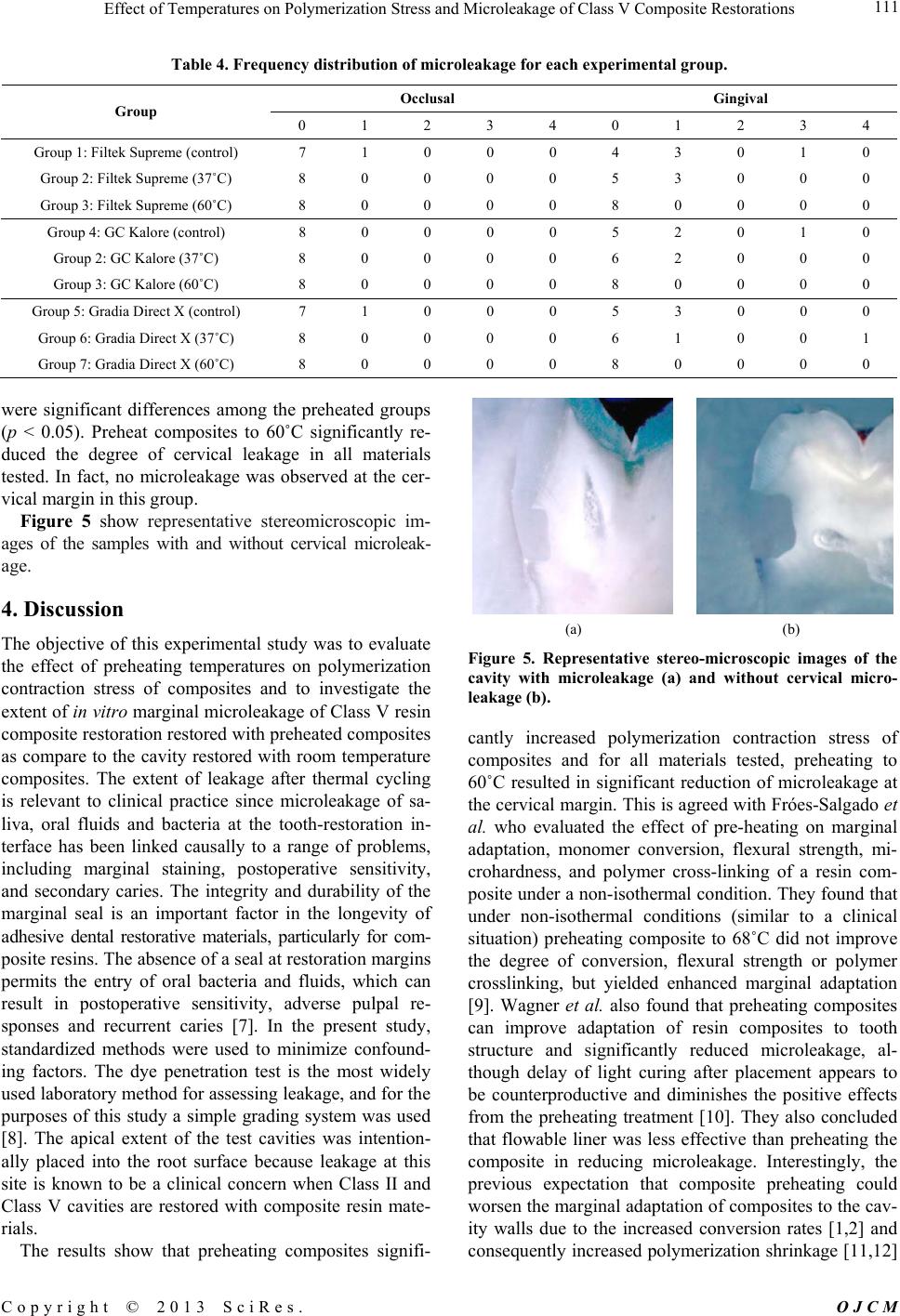 Effect of Temperatures on Polymerization Stress and Microleakage of Class V Composite Restorations Copyright © 2013 SciRes. OJCM 111 Table 4. Frequency distribution of micr oleakage for each experimental group. Occlusal Gingival Group 0 1 2 3 4 0 1 2 3 4 Group 1: Filtek Supreme (control) 7 1 0 0 0 4 3 0 1 0 Group 2: Filtek Supreme (37˚C) 8 0 0 0 0 5 3 0 0 0 Group 3: Filtek Supreme (60˚C) 8 0 0 0 0 8 0 0 0 0 Group 4: GC Kalore (control) 8 0 0 0 0 5 2 0 1 0 Group 2: GC Kalore (37˚C) 8 0 0 0 0 6 2 0 0 0 Group 3: GC Kalore (60˚C) 8 0 0 0 0 8 0 0 0 0 Group 5: Gradia Direct X (control) 7 1 0 0 0 5 3 0 0 0 Group 6: Gradia Direct X (37˚C) 8 0 0 0 0 6 1 0 0 1 Group 7: Gradia Direct X (60˚C) 8 0 0 0 0 8 0 0 0 0 were significant differences among the preheated groups (p < 0.05). Preheat composites to 60˚C significantly re- duced the degree of cervical leakage in all materials tested. In fact, no microleakage was observed at the cer- vical margin in this group. Figure 5 show representative stereomicroscopic im- ages of the samples with and without cervical microleak- age. 4. Discussion The objective of this experimental study was to evaluate the effect of preheating temperatures on polymerization contraction stress of composites and to investigate the extent of in vitro marginal microleakage of Class V resin composite restoration restored with preheated composites as compare to the cavity restored with room temperature composites. The extent of leakage after thermal cycling is relevant to clinical practice since microleakage of sa- liva, oral fluids and bacteria at the tooth-restoration in- terface has been linked causally to a range of problems, including marginal staining, postoperative sensitivity, and secondary caries. The integrity and durability of the marginal seal is an important factor in the longevity of adhesive dental restorative materials, particularly for com- posite resins. The absence of a seal at restoration margins permits the entry of oral bacteria and fluids, which can result in postoperative sensitivity, adverse pulpal re- sponses and recurrent caries [7]. In the present study, standardized methods were used to minimize confound- ing factors. The dye penetration test is the most widely used laboratory meth od for assessing leakage, and fo r the purposes of this study a simple grading system was used [8]. The apical extent of the test cavities was intention- ally placed into the root surface because leakage at this site is known to be a clinical concern when Class II and Class V cavities are restored with composite resin mate- rials. The results show that preheating composites signifi- (a) (b) Figure 5. Representative stereo-microscopic images of the cavity with microleakage (a) and without cervical micro- leakage (b). cantly increased polymerization contraction stress of composites and for all materials tested, preheating to 60˚C resulted in significant reduction of microleakage at the cervical margin. This is agreed with Fróes-Salgado et al. who evaluated the effect of pre-heating on marginal adaptation, monomer conversion, flexural strength, mi- crohardness, and polymer cross-linking of a resin com- posite under a non-isothermal condition. They found th at under non-isothermal conditions (similar to a clinical situation) preheating composite to 68˚C did not improve the degree of conversion, flexural strength or polymer crosslinking, but yielded enhanced marginal adaptation [9]. Wagner et al. also found that preheating composites can improve adaptation of resin composites to tooth structure and significantly reduced microleakage, al- though delay of light curing after placement appears to be counterproductive and diminishes the positive effects from the preheating treatment [10]. They also concluded that flowable liner was less effective than preheating the composite in reducing microleakage. Interestingly, the previous expectation that composite preheating could worsen the marginal adaptatio n of composites to th e cav- ity walls due to the increased conversion rates [1,2] and consequently increased polymerization shrinkage [11,12] 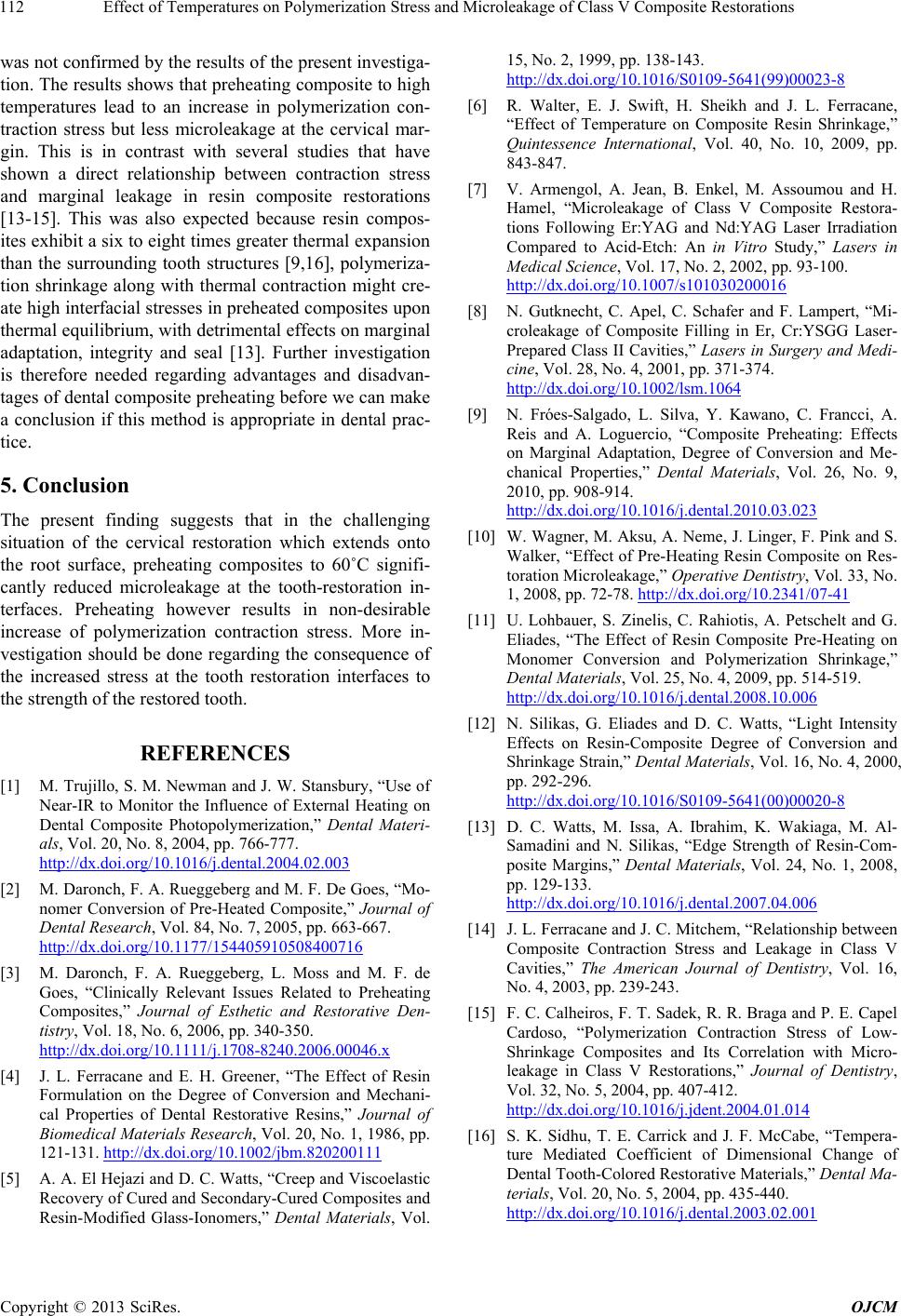 Effect of Temperatures on Polymerization Stress and Microleakage of Class V Composite Restorations Copyright © 2013 SciRes. OJCM 112 was not confirmed by the results o f the present inv estiga- tion. The results shows that preheating composite to high temperatures lead to an increase in polymerization con- traction stress but less microleakage at the cervical mar- gin. This is in contrast with several studies that have shown a direct relationship between contraction stress and marginal leakage in resin composite restorations [13-15]. This was also expected because resin compos- ites exhibit a six to eight ti mes greater thermal expansion than the surrounding tooth structures [9,16], polymeriza- tion shrinkage along with thermal contraction might cre- ate high interfacial stresses in preheated composites upon thermal equilibrium, with detrimental effects on marginal adaptation, integrity and seal [13]. Further investigation is therefore needed regarding advantages and disadvan- tages of dental composite preheating before we can make a conclusion if this method is appropriate in dental prac- tice. 5. Conclusion The present finding suggests that in the challenging situation of the cervical restoration which extends onto the root surface, preheating composites to 60˚C signifi- cantly reduced microleakage at the tooth-restoration in- terfaces. Preheating however results in non-desirable increase of polymerization contraction stress. More in- vestigation should be done regarding the consequence of the increased stress at the tooth restoration interfaces to the strength of the restored tooth. REFERENCES [1] M. Trujillo, S. M. Newman and J. W. Stansbury, “Use of Near-IR to Monitor the Influence of External Heating on Dental Composite Photopolymerization,” Dental Materi- als, Vol. 20, No. 8, 2004, pp. 766-777. http://dx.doi.org/10.1016/j.dental.2004.02.003 [2] M. Daronch, F. A. Rueggeberg and M. F. De Goes, “Mo- nomer Conversion of Pre-Heated Composite,” Journal of Dental Research, Vol. 84, No. 7, 2005, pp. 663-667. http://dx.doi.org/10.1177/154405910508400716 [3] M. Daronch, F. A. Rueggeberg, L. Moss and M. F. de Goes, “Clinically Relevant Issues Related to Preheating Composites,” Journal of Esthetic and Restorative Den- tistry, Vol. 18, No. 6, 2006, pp. 340-350. http://dx.doi.org/10.1111/j.1708-8240.2006.00046.x [4] J. L. Ferracane and E. H. Greener, “The Effect of Resin Formulation on the Degree of Conversion and Mechani- cal Properties of Dental Restorative Resins,” Journal of Biomedical Materials Research, Vol. 20, No. 1, 1986, pp. 121-131. http://dx.doi.org/10.1002/jbm.820200111 [5] A. A. El Hejazi and D. C. Watts, “Creep and Viscoelastic Recovery of Cured and Secondary-Cured Composites and Resin-Modified Glass-Ionomers,” Dental Materials, Vol. 15, No. 2, 1999, pp. 138-143. http://dx.doi.org/10.1016/S0109-5641(99)00023-8 [6] R. Walter, E. J. Swift, H. Sheikh and J. L. Ferracane, “Effect of Temperature on Composite Resin Shrinkage,” Quintessence International, Vol. 40, No. 10, 2009, pp. 843-847. [7] V. Armengol, A. Jean, B. Enkel, M. Assoumou and H. Hamel, “Microleakage of Class V Composite Restora- tions Following Er:YAG and Nd:YAG Laser Irradiation Compared to Acid-Etch: An in Vitro Study,” Lasers in Medical Science, Vol. 17, No. 2, 2002, pp. 93-100. http://dx.doi.org/10.1007/s101030200016 [8] N. Gutknecht, C. Apel, C. Schafer and F. Lampert, “Mi- croleakage of Composite Filling in Er, Cr:YSGG Laser- Prepared Class II Cavities,” Lasers in Surgery and Medi- cine, Vol. 28, No. 4, 2001, pp. 371-374. http://dx.doi.org/10.1002/lsm.1064 [9] N. Fróes-Salgado, L. Silva, Y. Kawano, C. Francci, A. Reis and A. Loguercio, “Composite Preheating: Effects on Marginal Adaptation, Degree of Conversion and Me- chanical Properties,” Dental Materials, Vol. 26, No. 9, 2010, pp. 908-914. http://dx.doi.org/10.1016/j.dental.2010.03.023 [10] W. Wagner, M. Aksu, A. Neme, J. Linger, F. Pink and S. Walker, “Effect of Pre-Heating Resin Composite on Res- toration Microleakage,” Operative Dentistry, Vol. 33, No. 1, 2008, pp. 72-78. http://dx.doi.org/10.2341/07-41 [11] U. Lohbauer, S. Zinelis, C. Rahiotis, A. Petschelt and G. Eliades, “The Effect of Resin Composite Pre-Heating on Monomer Conversion and Polymerization Shrinkage,” Dental Materials, Vol. 25, No. 4, 2009, pp. 514-519. http://dx.doi.org/10.1016/j.dental.2008.10.006 [12] N. Silikas, G. Eliades and D. C. Watts, “Light Intensity Effects on Resin-Composite Degree of Conversion and Shrinkage Strain,” Dental Materials, Vol. 16, No. 4, 2000, pp. 292-296. http://dx.doi.org/10.1016/S0109-5641(00)00020-8 [13] D. C. Watts, M. Issa, A. Ibrahim, K. Wakiaga, M. Al- Samadini and N. Silikas, “Edge Strength of Resin-Com- posite Margins,” Dental Materials, Vol. 24, No. 1, 2008, pp. 129-133. http://dx.doi.org/10.1016/j.dental.2007.04.006 [14] J. L. Ferracane and J. C. Mitchem, “Relationship between Composite Contraction Stress and Leakage in Class V Cavities,” The American Journal of Dentistry, Vol. 16, No. 4, 2003, pp. 239-243. [15] F. C. Calheiros, F. T. Sade k, R. R. Braga and P. E. Capel Cardoso, “Polymerization Contraction Stress of Low- Shrinkage Composites and Its Correlation with Micro- leakage in Class V Restorations,” Journal of Dentistry, Vol. 32, No. 5, 2004, pp. 407-412. http://dx.doi.org/10.1016/j.jdent.2004.01.014 [16] S. K. Sidhu, T. E. Carrick and J. F. McCabe, “Tempera- ture Mediated Coefficient of Dimensional Change of Dental Tooth-Colored Restorative Materials,” Dental Ma- terials, Vol. 20, No. 5, 2004, pp. 435-440. http://dx.doi.org/10.1016/j.dental.2003.02.001 |