

Paper Menu >>
Journal Menu >>
 Sociology Mind 2013. Vol.3, No.4, 284-289 Published Online October 2013 in SciRes (http://www.scirp.org/journal/sm) http://dx.doi.org/10.4236/sm.2013.34038 Copyright © 2013 SciRes. 284 Contextual Factors in the Open Approach-Based Mathematics Classroom Affecting Development of Students’ Metacognitive Strategies Ariya Suriyon1, Maitree Inprasitha2, Kiat Sangaroon3 1Department Doctoral Program in Mathematics Education, Khon Kaen Un iversity, Khon Kaen, Thailand 2Center for Research in Mathematics Education, Khon Kaen Univ ersity, Khon Kaen, Thailand 3Department of Mathematics, Faculty of Science, Khon Kaen Unive rsity, Khon Kaen, Thailand Email: [email protected] Received July 8th, 2013; revised August 16 th, 2013; accepted August 29th, 2013 Copyright © 2013 Ariya Suriyon et al. This is an open access article distributed under the Creative Commons Attribution License, which permits unrestricted use, distribution, and reproduction in any medium, provided the original work is properly cited. The objective of this research was to study the effect that contextual factors have on the development of students’ metacognitive strategies in the open approach-based mathematics classroom: the framework for learning and teaching activities in the class, the teacher’s role, and students’ role. The methodology was based on ethnographic research and Begle’s conceptual framework (1969), which focused on observation and study on the nature of occurrences. In the context, the researcher conducted participatory classroom obse rvatio n. The ta rget gr oups wer e a mathe matics teacher , who is a s tudent a s a math teaching practi- tioner, and four elementary school students at Grade 1 ranging from 6 to 7 years of age from Koo Kham Pittayasan School. Data were collected from 3 learning units totaling 6 study periods. Qualitative data analysis procedures were based on analyzing videos, protocols, students’ written work, and time units for dealing with activities and narrative description. The concept of 4 open approach-based teaching steps (Inprasitha, 2010) was considered for the analysis of the teacher’s teaching behavior and students’ prob- lem solving behavior. The study findings suggest that contextual factors in the open approach-based mathematics classroom affect the development of students’ metacognitive strategies in which the teacher has planned learning management related to learning unit structures and focused on instructional activities allowing students “to create knowledge from learning how to solve problems by themselves”. In addition, the study demonstrates that the teacher and students have different roles in each teaching step. Keywords: Contextual Factors; Metacognitive Strategies; Lesson Study; Open Approach Introduction A review of research papers on mathematical problem solv- ing with regard to metacognition yields findings that fall under the fundamental concept of Flavell (1976) regarding monitoring and regulation. The importance of research into the teaching of problem solving has been acknowledged since the 1980s (Les- ter, 1994), the researchers attempted to find explanations for various aspects due to the belief that metacognt ion is what makes a problem solver successful in solving problems, corresponding to Lesh (1982), Silver (1982) and Schoenfeld (1982) showing that metacognitive actions as “a driving force” in problem solving. Use of metacogntive strategies is considered a strategy that a problem solver applies to solving problems with various aims besides that of finding answers only. In other words, it is a strategy that a problem solver uses to monitor his or her goal in problem solving, or it can be said that he or she is a problem solver with characteristics of good thinking. Monitoring as men- tioned above can be seen from monitoring behavior and reflec- tion on a problem solver’s thinking process from work which he or she has alr eady done. As for arran ging learning and teach- ing activities in a class to stimulate or prompt students to apply metacognitive strategies, it is considered difficult and compli- cated. Allowing students to have a chance to participate in mathematical problem solving is vital for encouraging students to have a chance to create and develop metacognitive strategies; therefore, it requires conditions and contextual factors related to the classroom and learning and teaching activity design which is based on thorough and careful planning including considera- tion of the teacher’s and students’ roles with an emphasis on practice guidelines leading to students’ participation by “creat- ing knowledge from learning how to solve problems by them- selves”. The teacher and students should consider these issues and work together to find practice guidelines for creating good classroom contexts, leading to the development of students’ metacognitive strategies as an outcome. Another aspect of Silver’s research (1985) suggests that s tudy concerning metacognition is an important issue and should be considered for further research on mathematical problem solv- ing, especially the study on development of a person or a group of people in age ranges related to ones’ ability to solve prob- lems, which is a necessity. According to Silver’s belief, study- ing that aspect is fundamental for knowledge seeking, used by 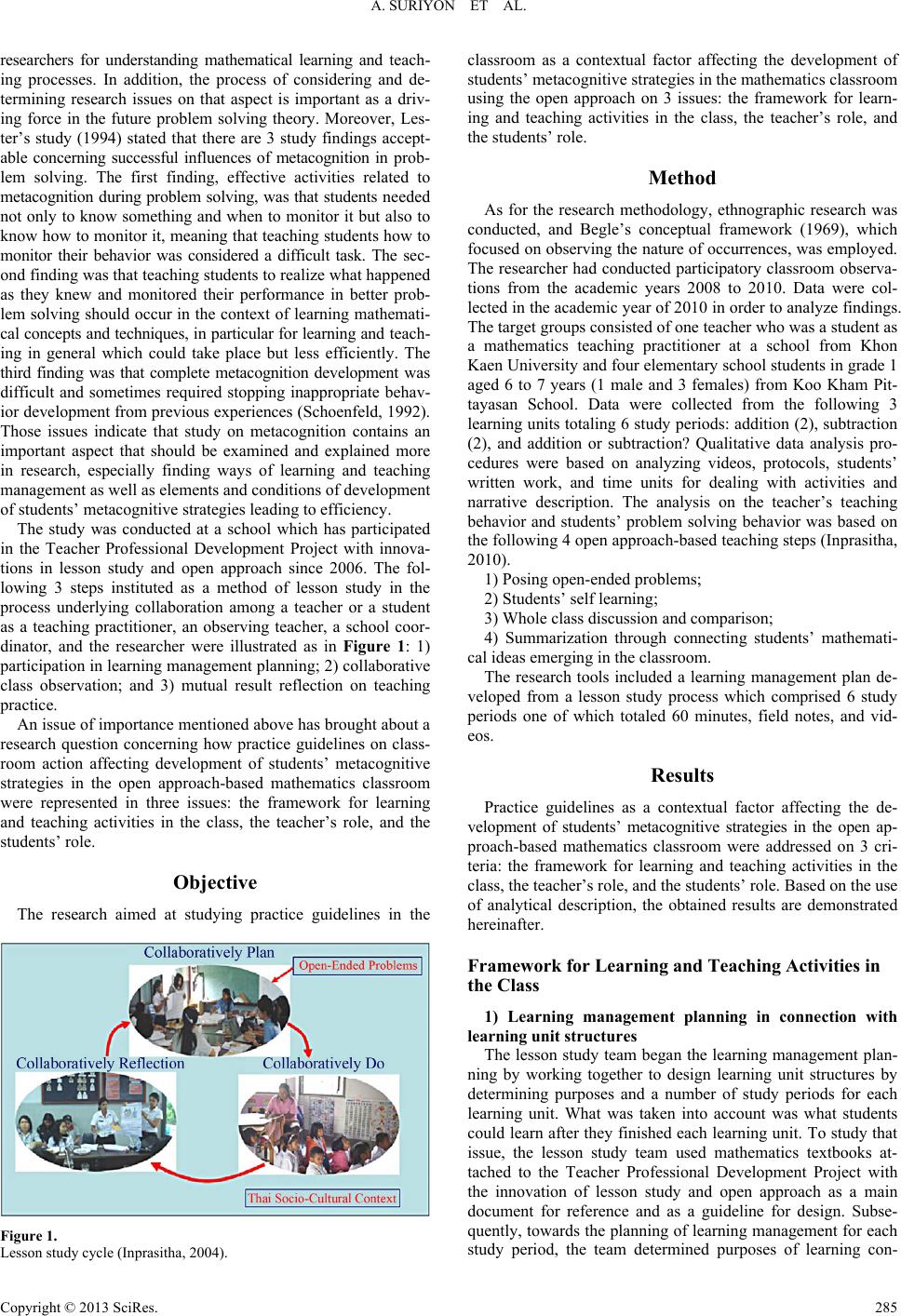 A. SURIYON ET AL. Copyright © 2013 SciRes. 285 researchers for understanding mathematical learning and teach- ing processes. In addition, the process of considering and de- termining research issues on that aspect is important as a driv- ing force in the future problem solving theory. Moreover, Les- ter’s study (1994) stated that there are 3 study findings accept- able concerning successful influences of metacognition in prob- lem solving. The first finding, effective activities related to metacognition during problem solving, was that students needed not only to know something and when to monitor it but also to know how to monitor it, meaning that teaching students how to monitor their behavior was considered a difficult task. The sec- ond finding was that teaching students to realize what happened as they knew and monitored their performance in better prob- lem solving should occur in the context of learning mathemati- cal concepts and techniques, in particular for learning and teach- ing in general which could take place but less efficiently. The third finding was that complete metacognition development was difficult and sometimes required stopping inappropriate behav- ior development from previous experiences (Schoenfeld, 1992). Those issues indicate that study on metacognition contains an important aspect that should be examined and explained more in research, especially finding ways of learning and teaching management as w e ll as elements and conditions of devel o pment of students’ metacognitive strategies leading to efficiency. The study was conducted at a school which has participated in the Teacher Professional Development Project with innova- tions in lesson study and open approach since 2006. The fol- lowing 3 steps instituted as a method of lesson study in the process underlying collaboration among a teacher or a student as a teaching practitioner, an observing teacher, a school coor- dinator, and the researcher were illustrated as in Figure 1: 1) participation in learning management planning; 2) collaborative class observation; and 3) mutual result reflection on teaching practice. An issue of importance mentioned above has brought about a research question concerning how practice guidelines on class- room action affecting development of students’ metacognitive strategies in the open approach-based mathematics classroom were represented in three issues: the framework for learning and teaching activities in the class, the teacher’s role, and the students’ role. Objective The research aimed at studying practice guidelines in the Figure 1. Lesson study cycle (Inprasitha, 2004). classroom as a contextual factor affecting the development of students’ metacognitive strategies in the mathematics classroom using the open approach on 3 issues: the framework for learn- ing and teaching activities in the class, the teacher’s role, and the students’ role. Method As for the research methodology, ethnographic research was conducted, and Begle’s conceptual framework (1969), which focused on observing the nature of occurrences, was employed. The researcher had conducted participatory classroom observa- tions from the academic years 2008 to 2010. Data were col- lected in the academic year of 2010 in order to analyze findings. The target groups consisted of one teacher who was a student as a mathematics teaching practitioner at a school from Khon Kaen University and four elementary school students in grade 1 aged 6 to 7 years (1 male and 3 females) from Koo Kham Pit- tayasan School. Data were collected from the following 3 learning units totaling 6 study periods: addition (2), subtraction (2), and addition or subtraction? Qualitative data analysis pro- cedures were based on analyzing videos, protocols, students’ written work, and time units for dealing with activities and narrative description. The analysis on the teacher’s teaching behavior and students’ problem solving behavior was based on the following 4 open approach-based teaching steps (Inprasitha, 2010). 1) Posing open-ended problems; 2) Students’ self learning; 3) Whole class discussion and comparison; 4) Summarization through connecting students’ mathemati- cal ideas emerging in the classroom. The research tools included a learning management plan de- veloped from a lesson study process which comprised 6 study periods one of which totaled 60 minutes, field notes, and vid- eos. Results Practice guidelines as a contextual factor affecting the de- velopment of students’ metacognitive strategies in the open ap- proach-based mathematics classroom were addressed on 3 cri- teria: the framework for learning and teaching activities in the class, the teacher’s role, and the students’ role. Based on the use of analytical description, the obtained results are demonstrated hereinafter. Framework for Learning and Teaching Activities in the Class 1) Learning management planning in connection with learning unit structures The lesson study team began the learning management plan- ning by working together to design learning unit structures by determining purposes and a number of study periods for each learning unit. What was taken into account was what students could learn after they finished each learning unit. To study that issue, the lesson study team used mathematics textbooks at- tached to the Teacher Professional Development Project with the innovation of lesson study and open approach as a main document for reference and as a guideline for design. Subse- quently, towards the planning of learning management for each study period, the team determined purposes of learning con- 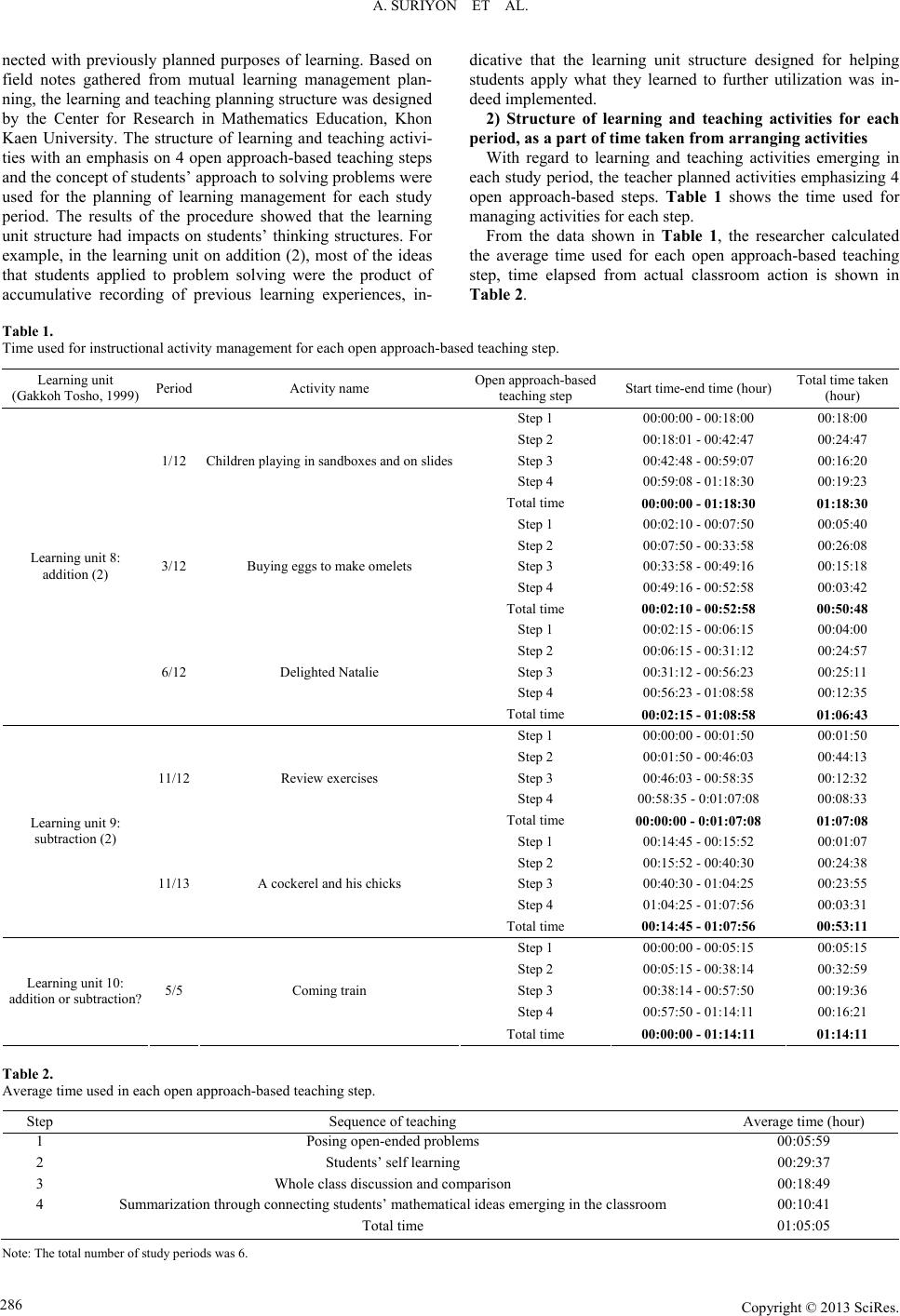 A. SURIYON ET AL. Copyright © 2013 SciRes. 286 nected with previously planned purposes of learning. Based on field notes gathered from mutual learning management plan- ning, the learning and teaching planning structure was designed by the Center for Research in Mathematics Education, Khon Kaen University. The structure of learning and teaching activi- ties with an emphasis on 4 open approach-based teaching steps and the concept of students’ approach to solving problems were used for the planning of learning management for each study period. The results of the procedure showed that the learning unit structure had impacts on students’ thinking structures. For example, in the learning unit on addition (2), most of the ideas that students applied to problem solving were the product of accumulative recording of previous learning experiences, in- dicative that the learning unit structure designed for helping students apply what they learned to further utilization was in- deed implemented. 2) Structure of learning and teaching activities for each period, as a part of time taken from arranging activities With regard to learning and teaching activities emerging in each study period, the teacher planned activities emphasizing 4 open approach-based steps. Table 1 shows the time used for managing activities for each step. From the data shown in Table 1, the researcher calculated the average time used for each open approach-based teaching step, time elapsed from actual classroom action is shown in Table 2. Table 1. Time used for instructional activity management for each open approach-based teaching step. Learning unit (Gakkoh Tosho, 1999) Period Activity name Open approach-based teaching step Start time-end time (hour) Total time taken (hour) Step 1 00:00:00 - 00:18:00 00:18:00 Step 2 00:18:01 - 00:42:47 00:24:47 Step 3 00:42:48 - 00:59:07 00:16:20 Step 4 00:59:08 - 01:18:30 00:19:23 1/12 Children pla ying in sa n dboxes and o n slides Total time 00:00:00 - 01:18:30 01:18:30 Step 1 00:02:10 - 00:07:50 00:05:40 Step 2 00:07:50 - 00:33:58 00:26:08 Step 3 00:33:58 - 00:49:16 00:15:18 Step 4 00:49:16 - 00:52:58 00:03:42 3/12 Buying eggs to make omele t s Total time 00:02:10 - 00:52:58 00:50:48 Step 1 00:02:15 - 00:06:15 00:04:00 Step 2 00:06:15 - 00:31:12 00:24:57 Step 3 00:31:12 - 00:56:23 00:25:11 Step 4 00:56:23 - 01:08:58 00:12:35 Learning unit 8: addition (2) 6/12 Delighted Natalie Total time 00:02:15 - 01:08:58 01:06:43 Step 1 00:00:00 - 00:01:50 00:01:50 Step 2 00:01:50 - 00:46:03 00:44:13 Step 3 00:46:03 - 00:58:35 00:12:32 Step 4 00:58:35 - 0:01:07:08 00:08:33 11/12 Review exercises Total time 00:00:00 - 0:01:07:08 01:07:08 Step 1 00:14:45 - 00:15:52 00:01:07 Step 2 00:15:52 - 00:40:30 00:24:38 Step 3 00:40:30 - 01:04:25 00:23:55 Step 4 01:04:25 - 01:07:56 00:03:31 Learning unit 9: subtraction (2) 11/13 A cockerel and his chicks Total time 00:14:45 - 01:07:56 00:53:11 Step 1 00:00:00 - 00:05:15 00:05:15 Step 2 00:05:15 - 00:38:14 00:32:59 Step 3 00:38:14 - 00:57:50 00:19:36 Step 4 00:57:50 - 01:14:11 00:16:21 Learning unit 10: addition or subt ra c tion ? 5/5 Coming train Total time 00:00:00 - 01:14:11 01:14:11 Table 2. Average time used in each open approach-based teaching st e p. Step Sequence of teaching Average time (hour) 1 Posing open-ended problems 00:05:59 2 Students’ self learning 00:29:37 3 Whole class discussion and comparison 00:18:49 4 Summarization through co n nect ing students’ mathematical ideas eme rging in the classroom 00:10:41 Total time 01:05:05 Note: The total number of study periods was 6. 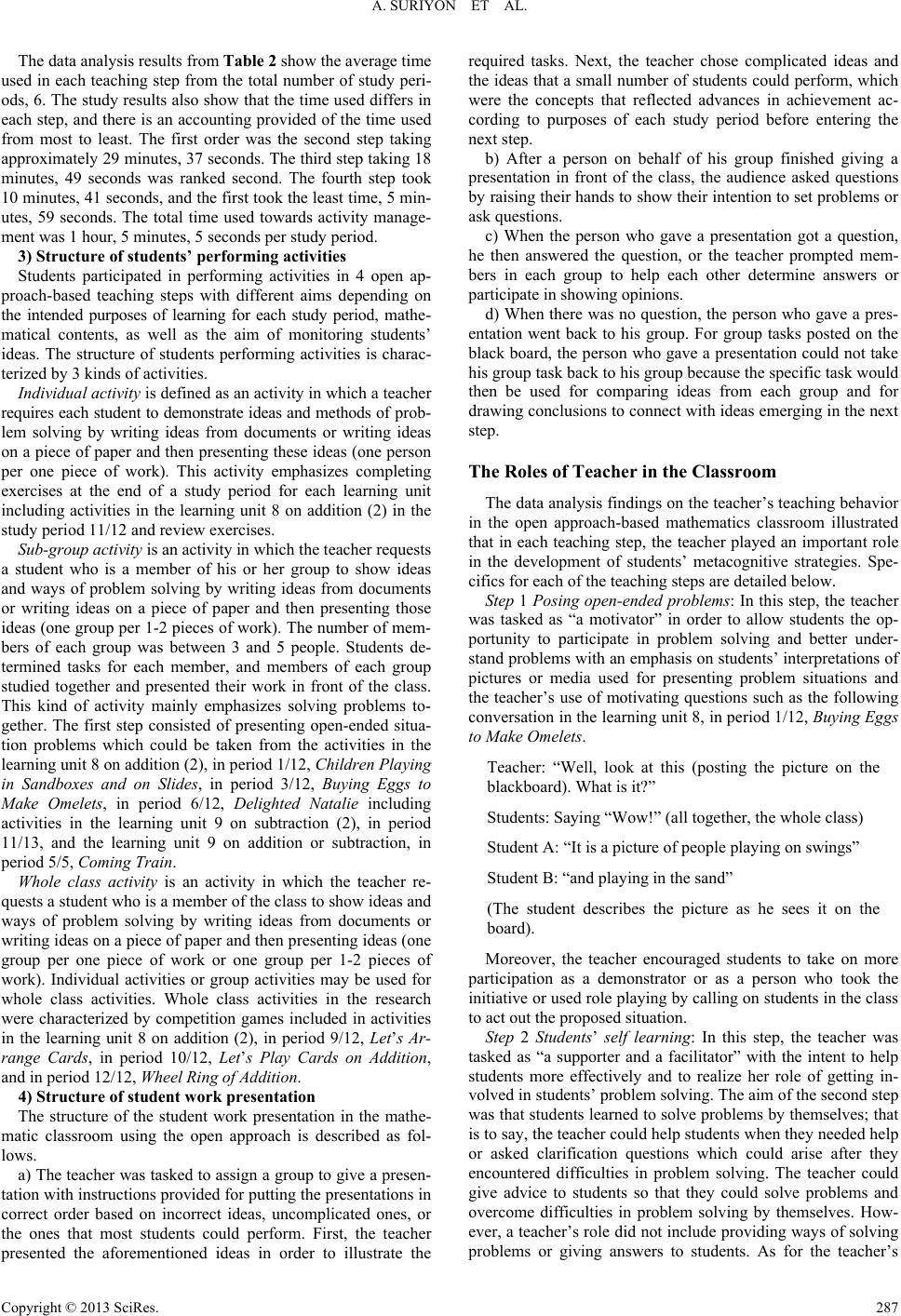 A. SURIYON ET AL. Copyright © 2013 SciRes. 287 The data analysis results from Table 2 show the average time used in each teaching step from the total number of study peri- ods, 6. The study results also show that the time used differs in each step, and there is an accounting provided of the time used from most to least. The first order was the second step taking approximately 29 minutes, 37 seconds. The third step taking 18 minutes, 49 seconds was ranked second. The fourth step took 10 minutes, 41 seconds, and the first took the least time, 5 min- utes, 59 seconds. The total time used towards activity manage- ment was 1 hour, 5 minutes, 5 seconds per study period. 3) Structure of students’ performing activities Students participated in performing activities in 4 open ap- proach-based teaching steps with different aims depending on the intended purposes of learning for each study period, mathe- matical contents, as well as the aim of monitoring students’ ideas. The structure of students performing activities is charac- terized by 3 kinds of activities. Individual activity is defined as an activity in which a teacher requires each student to demonstrate ideas and methods of p rob- lem solving by writing ideas from documents or writing ideas on a piece of paper and then presenting these ideas (one person per one piece of work). This activity emphasizes completing exercises at the end of a study period for each learning unit including activities in the learning unit 8 on addition (2) in the study period 11/12 and review exercises. Sub-group activity is an activity in which the teacher requests a student who is a member of his or her group to show ideas and ways of problem solving by writing ideas from documents or writing ideas on a piece of paper and then presenting those ideas (one group per 1-2 pieces of work). The number of mem- bers of each group was between 3 and 5 people. Students de- termined tasks for each member, and members of each group studied together and presented their work in front of the class. This kind of activity mainly emphasizes solving problems to- gether. The first step consisted of presenting open-ended situa- tion problems which could be taken from the activities in the learning unit 8 on addition (2), in period 1/12, Children Playing in Sandboxes and on Slides, in period 3/12, Buying Eggs to Make Omelets, in period 6/12, Delighted Natalie including activities in the learning unit 9 on subtraction (2), in period 11/13, and the learning unit 9 on addition or subtraction, in period 5/5, Coming Train. Whole class activity is an activity in which the teacher re- quests a student who is a member of the class to show ideas and ways of problem solving by writing ideas from documents or writing ideas on a piece of paper and then presenting ideas (one group per one piece of work or one group per 1-2 pieces of work). Individual activities or group activities may be used for whole class activities. Whole class activities in the research were characterized by competition games included in activities in the learning unit 8 on addition (2), in period 9/12, Let’s Ar- range Cards, in period 10/12, Let’s Play Cards on Addition, and in period 12/12, Wheel Ring of Addition. 4) Structure of student work presentation The structure of the student work presentation in the mathe- matic classroom using the open approach is described as fol- lows. a) The teacher was tasked to assign a group to give a presen- tation with instructions provided for putting the presentations in correct order based on incorrect ideas, uncomplicated ones, or the ones that most students could perform. First, the teacher presented the aforementioned ideas in order to illustrate the required tasks. Next, the teacher chose complicated ideas and the ideas that a small number of students could perform, which were the concepts that reflected advances in achievement ac- cording to purposes of each study period before entering the next step. b) After a person on behalf of his group finished giving a presentation in front of the class, the audience asked questions by raising their hands to show their intention to set problems or ask questions. c) When the person who gave a presentation got a question, he then answered the question, or the teacher prompted mem- bers in each group to help each other determine answers or participate in showing opinions. d) When there was no question, the person who gave a pres- entation went back to his group. For group tasks posted on the black board, the person who gave a presentation could not take his group task back to his group because the specific task would then be used for comparing ideas from each group and for drawing conclusions to connect with ideas emerging in the next step. The Roles of Teacher in the Classroom The data analysis findings on the teacher’s teaching behavior in the open approach-based mathematics classroom illustrated that in each teaching step, the teacher played an important role in the development of students’ metacognitive strategies. Spe- cifics for each of the teaching steps are detailed below. Step 1 Posing open-ended problems: In this step, the teacher was tasked as “a motivator” in order to allow students the op- portunity to participate in problem solving and better under- stand problems with an emphasis on students’ interpretations of pictures or media used for presenting problem situations and the teacher’s use of motivating questions such as the following conversation in the learning unit 8, in period 1/12, Buying Eggs to Make Omelets. Teacher: “Well, look at this (posting the picture on the blackboard). What is it?” Students: Saying “Wow!” (all together, the whole class) Student A: “It is a picture of people playing on swings” Student B: “and playing in the sand” (The student describes the picture as he sees it on the board). Moreover, the teacher encouraged students to take on more participation as a demonstrator or as a person who took the initiative or used role playing by calling on students in the class to act out the proposed situation. Step 2 Students’ self learning: In this step, the teacher was tasked as “a supporter and a facilitator” with the intent to help students more effectively and to realize her role of getting in- volved in students’ problem solving. The aim of the second step was that students learned to solve problems by themselves; that is to say, the teacher could help students when they needed help or asked clarification questions which could arise after they encountered difficulties in problem solving. The teacher could give advice to students so that they could solve problems and overcome difficulties in problem solving by themselves. How- ever, a teacher’s role did not include providing ways of solving problems or giving answers to students. As for the teacher’s  A. SURIYON ET AL. Copyright © 2013 SciRes. 288 role of motivating students to continually apply themselves and progress in problem solving, the teacher encouraged students to this end by prompting them during problem solving, which was evidenced by the teacher’s elicitations as provided below from unit 8, in period 1/12, Buying Eggs to Make Omelets, “Try to think in different ways”. Step 3 Whole class discussion and comparison: In this step, students monitored one another and reflected on problem solv- ing, and the teacher had an important role as an initiator of classroom discussion by proposing issues for whole class con- sideration. In other words, the teacher played the role of “a coordinator of understanding” by creating an atmosphere of discussion in order that students could consider the opinions and suggestions of their classmates. Step 4 Summarization through connecting students’ mathe- matical ideas emerging in the classroom: The teacher was t ask e d in this step as “a connector” to summarize students’ ideas by connecting students’ ideas in 2 ways. 1) Drawing conclusions through synthesizing student ideas: The teacher was tasked to propose a problem to students to in order to ascertain the spectrum of ideas and approaches to mee t- ing task objectives during the whole class discussion stage so that students could evaluate ideas and ways which helped them to solve problems effectively; that is, solving problems easily, quickly, and correctly. Based on the analysis results, students came to the conclusion that producing 10 was a factor that mo- tivated them solve problems effectively, and other concepts such as counting, adding, and counting one for each item also helped them solve problems but were quite slow ways some- times resulting in miscounting. 2) Drawing conclusions through synthesizing ideas that stu- dents applied to problem solving and initial situations or prob- lems: In this step, the teacher was tasked with preparing media and organizing media systems. Tools used in each study period from beginning of activities included pictures and instructions used for initial situations, work showing students’ ideas, and media. These tools were then used to check students’ under- standing of whether or not the ideas used in problem solving were consistent and rational with initial problems. The Roles of Student in the Classroom The analysis results on students’ problem solving behavior in the open approach-based mathematics classroom illustrated that in each teaching step, a student was tasked to know how to solve problems himself, which could lead to development of metacognitive strategies. Student tasks for each of the teaching steps are detailed below. Step 1 Posing open-ended problems: In this step, students were tasked as “participants trying to understand situation prob- lems” by making observations of what they saw from pictures or media used for presenting problem situations including the teacher’s answering of questions. Examples of students’ answe rs from observations and the teacher’s answering of questions are in the following conversation in the learning unit 8, in period 1/12, Buying Eggs to Make Omelets. Teacher: “Well, look at this (posting the picture on the blackboard). What is it?” Students: Saying “Wow!” (all together, the whole class) Student A: “It is a picture of people playing on swings” Student B: “and playing in the sand” (The student describes the picture as he sees it on the board). Moreover, students were tasked as “demonstrators” or “ex- perimenters” relevant to media that the teacher presented or that of a role of “an actor in role playing” in the situation problem presented by the te acher. Step 2 Students’ self learning: In this step, students were tasked as “problem solvers” with regard to learning how to solve problem themselves; that is, they had to encounter diffi- culties in self-problem solving, be cognizant of ideas or ways that they previously learned and used as problem solving tools. Students’ roles while problem solving in sub-groups were that of “idea recorders”, “observers of situation problems”, and “examiners”. For these roles, any student who was influential in his group often had the privilege to choose roles before other members in the group. Mostly, he was a student who demon- strated greater abilities than others. Furthermore, when the teacher prompted students during problem solving by saying, for example, “Try to think in different ways”, thereafter stu- dents usually tried to find various other ways to solve problems. Step 3 Whole class discussion and comparison: In this step, students were tasked as “persons who give presentations” and “an audience of a presentation of work concerning the collabo- ration of students in problem solving activities. Students in the whole class monitored one another and reflected on the prob- lem solving process including discussion with members in the class. Step 4 Summarization through connecting students’ mathe- matical ideas emerging in the classroom: In this step, students were tasked as “evaluators” as they were required to answer the teacher’s questions in order to compare the effectiveness of ideas and approaches to presentation creation during the whole class discussion stage, including examining whether or not and how ideas used for problem solving were consistent and ra- tional with initial expectations. Discussion and Conclusion Contextual factors related to classroom action affecting the development of students’ metacognitive strategies in the open approach-based mathematics classroom are detailed in the fol- lowing three issues. 1) Structure of learning and teaching activities in the class As for the structure of learning and teaching activities in the class, in the study, the research considered the following 4 is- sues: learning management planning related to the following structures: learning units, periodic instructional activities con- sidered from time used for arranging learning and teaching activities, students’ performing activities, and students’ work presentation. The study findings indicated the importance of each issue concerning emerging structures of instructional ac- tivities, especially activities underlining problem solving proc- esses which could prompt students to develop metacognitive strategies as well as results obtained from a time study used in arranging activities, showing that students spent the most time engaged in the second step of self-learning. These results con- firmed students’ ability to perform more tasks than simply find- ing answers only, which was considered evidence proving that students had indeed furthered the development of their meta- cognitive strategies.  A. SURIYON ET AL. Copyright © 2013 SciRes. 289 2) The roles of teacher in the classroom As for teacher’s roles with regard to helping students to de- velop metacognitive strategies, what teachers should be most cognizant of was their role in getting involved in problem solv- ing to help students at the right time so that students could then best help themselves. The teacher was tasked as the person responsible for determining the directions of activities emerg- ing in the class. In other words, students could be empowered toward self-learning in the future. The fundamental practice guideline was that the teacher had to understand and know when to get involved in students’ problem solving at the appro- priate time, corresponding to Polya (1957) in which the teacher had to rely on experiences in classroom observations until she could interpret students’ thinking processes in any activity as well as surrounding factors emerging in the classroom, for ex- ample, situation problems that the teacher presented to students, instructions, and instructional media used in activities. When students could solve problems by themselves, the outcome was that a variety of ideas in problem solving emerged. 3) The roles of students in the classroom For student’s roles in the mathematics classroom using the open approach, students were responsible for carrying out various important tasks in the class. Receiving emerging dif- ferent roles while performing instructional activities helped stu- dents to evolve their roles differently. The outcome was that students had a chance to develop learning skills and process extensively: problem solving, mathematical communication, expressions showing thinking, linking, and reasoning. In par- ticular, in the aspect of problem solving, students could learn from their actions, leading to accumulative recording of “re- sources” gained from experiences according to roles that stu- dents received as in Schoenfeld (1985) suggesting that these existent resources are fundamental elements related to success and failure in problem solving. Acknowledgements This research was supported by the Higher Education Re- search Promotion and National Research University Project of Thailand, Office of the Higher Education Commission, through the Cluster of Research to Enhance the Quality of Basic Educa- tion. This research was partially supported by the Center for Research in Mathematics Education, Thailand. REFERENCES Begle, E. G. (1969). The role of research in the improvement of ma- thematics education. Educational Studies in Mathematics, 2, 232-244. http://dx.doi.org/10.1007/BF00303460 Flavell, J. H. (1976). Metacognitive aspects of problem solving. In L. B. Resnick (Ed.), The nature of intelligence (pp. 231-236). Hillsdale, NJ: Erlbaum. Gakkoh Tosho Co., LTD (1999). Study with your friends MATHE- MATICS for elementary school 1st grade Gakkoh Tosho. Tokyo: Gakkotosho Co., LTD. Inprasitha, M. (2004). Teaching by open-approach method in Japanese Mathematics Classroom. KKU Journal of Mathematics Education, 1, 1-17. Inprasitha, M. (2010). One feature of adaptive lesson study in Thai- land—Designing learning unit. Proceeding of the 45th Korean Na- tional Meeting of Mathematics Education (pp. 193-206). Gyeongju: Dongkook University. Lesh, R. (1982). Metacognition in mathematical problem solving. Un- published manuscript. Lester, F. K. (1994). Musings about mathematical problem-solving research: 1970-1994. Journal for Research in Mathematics Educa- tion, 25, 660-675. http://dx.doi.org/10.2307/749578 Polya, G. (1957). How to solve it (2nd ed.). Princeton, NJ: Princeton University Press. Schoenfeld, A. H. (1982). Some thoughts on problem solving research and mathematics education (pp. 27-37). Mathematical problem solv- ing: Issue in research. Philadelphia: Franklin Institute Press. Schoenfeld, A. H. (1985). Mathematical problem solving. New York: Academic Press. Schoenfeld, A. H. (1992). Learning to think mathematically: Problem solving, metacognition, and sense making in mathematics. In D. A. Grows (Ed.), Handbook of research on mathematics teaching and learning (pp. 334-370). New York: Macmillan. Silver, E. A. (1982). Thinking about problem solving: Toward an un- derstanding of metacognitive aspects of mathematical problem solv- ing. Paper Prepared for the Conference on Thinking, Fiji. Silver, E. A. (1985). Research on teaching mathematical problem solv- ing: Some underrepresented themes and needed directions. Teaching and learning mathematical problem solving: Multiple research per- spectives. Hillsdale: Lawrence Erlbaum Associates. |