

Paper Menu >>
Journal Menu >>
 American Journal of Computational Mathematics, 2013, 3, 252-259 http://dx.doi.org/10.4236/ajcm.2013.33035 Published Online September 2013 (http://www.scirp.org/journal/ajcm) Conjugate Effect of Radiation and Thermal Conductivity Variation on MHD Free Convection Flow for a Vertical Plate Rowsanara Akhter1*, Mohammad Mokaddes Ali2, Babul Hossain2, M. Sharif Uddin1 1Department of Mathematics, Jahangirnagar University, Dhaka, Bangladesh 2Department of Mathematics, Mawlana Bhashani Science and Technology University, Tangail, Bangladesh Email: *[email protected], mmali309@gmail.com, babulhossain@yahoo.com, [email protected] Received August 20, 2013; revised September 5, 2013; accepted September 11, 2013 Copyright © 2013 Rowsanara Akhter et al. This is an open access article distributed under the Creative Commons Attribution Li- cense, which permits unrestricted use, distribution, and reproduction in any medium, provided the original work is properly cited. ABSTRACT A numerical investigation is performed to study the effect of thermal radiation on magnetohydrodynamic (MHD) free convection flow along a vertical flat plate in presence of variable thermal conductivity in this paper. The governing equations of the flow and the boundary conditions are transformed into dimensionless form using appropriate similar- ity transformations and th en solved employin g the implicit fi nite d ifference metho d with Keller-box scheme. Results for the details of the velocity profiles, temperature distributions as well as the skin friction, the rate of heat transfer and surface temperature distributions are shown graphically. Results reveal that the thermal radiation is more significant in MHD natural convection flow during thermal conductivity effect is considered. To illustrate the accuracy of the present results, the results for the local skin fraction and surface temperature distribution excluding the extension effects are compared with results of Merkin and Pop designed for the fixed value of Prandtl number and a good agreement were found. Keywords: Radiation; MHD; Thermal Conductivity; Finite Difference Method 1. Introduction The physical phenomenon of free convection flow is driven by temperature difference. Using these considera- tions, the temperature variation generates a density gra- dient which responsible for buoyancy forces. The buoy- ancy effects are important in free convection flow of v is- cous incompressible electrically conducting fluid. Many practical applications of free convection flow exist, for example in the heater and coolers of mechanical devices, in chemical industries, in nuclear power plants, in the formation of microstructures during the cooling of mol- ten metal’s, in fluid flows around heat-dissipation fins, and solar ponds etc. Moreover, MHD free convection flow is used frequently in the field of stellar and plane- tary magnetospheres, aeronautics, chemical engineering and electronics. Furthermore, most of the engineering processes are rela ted with a high temperature , accordingly , radiation heat transfer is significant to design the relevant equipment of heat transfer process. In addition, radiation effects on MHD free convection flow and heat transfer are important in the context of space technology. Con- sidering it’s important applications in engineering and industrial fields, a number of theoretical and experimen- tal work have been conducted extensively by many re- searchers. Among them, Soundalgekar and Takhar [1] studied the effect of radiation on MHD free convection flow of a gas past a sami-infinite vertical plate using the Cogley-vincenti-Giles equilibrium model (Cogley et al. [2]). Hossain and Takhar [3] employed implicit finite dif- ference methods to analyze the effect radiation on mixed convection flow along a heated vertical flat plate with a uniform free stream and a uniform surface temperature. The effects of radiation and transverse magnetic field near stretching sheet were investigated by Ghaly [4] in the p r esence of a uniform free stream of constant v e lo c i t y, temperature and concentration to show that radiation hav e significant influences on the velocity and temperature profiles. Abd El-Naby et al. [5] studied the radiation ef- fects on MHD un steady free convection flow over a ver- tical plate with variable surface temperature. Badruddin et al. [6] explored the effect of radiation and viscous dis- sipation on natural convection flow in a porous medium *Corresponding a uthor. C opyright © 2013 SciRes. AJCM 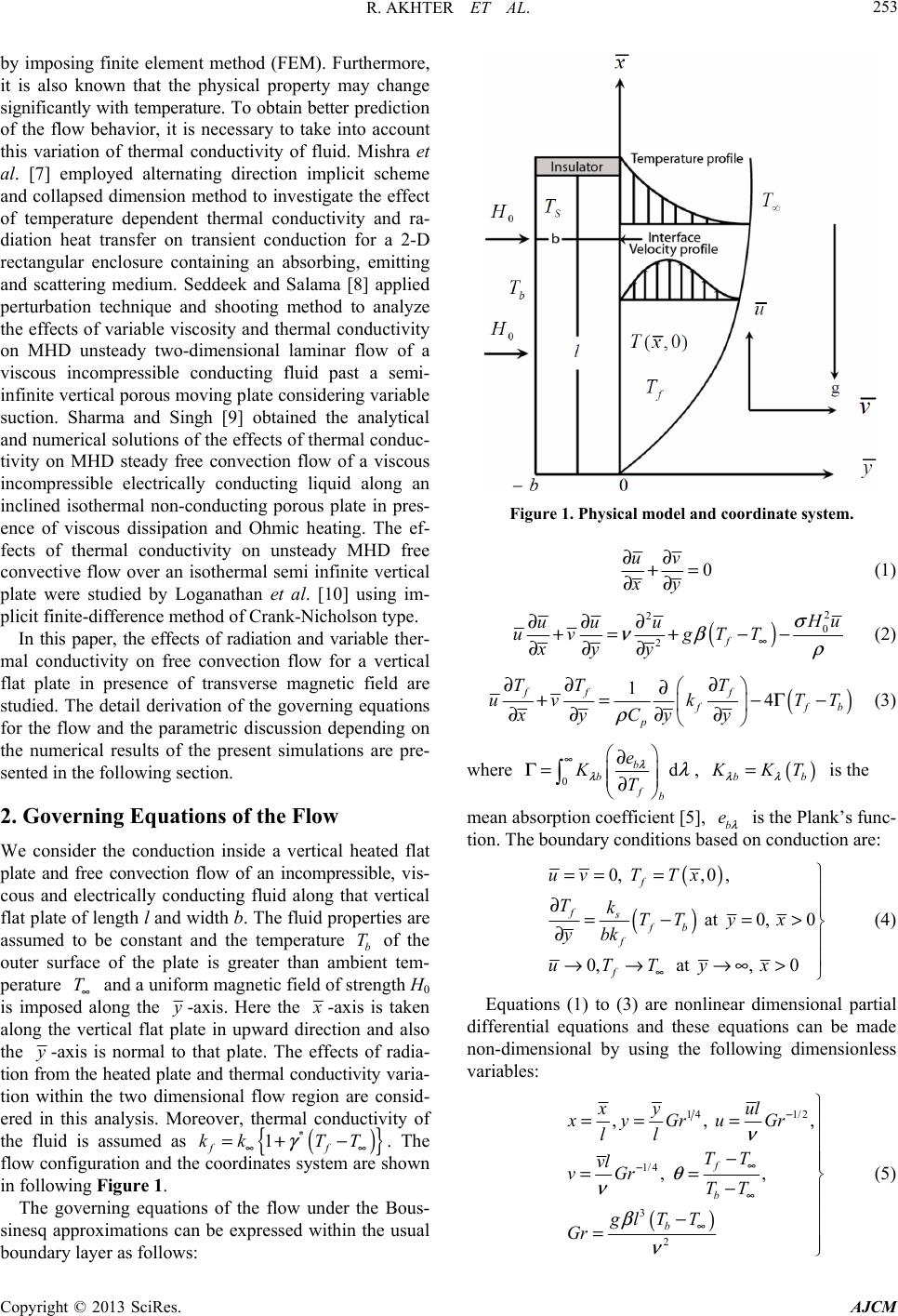 R. AKHTER ET AL. 253 by imposing finite element method (FEM). Furthermore, it is also known that the physical property may change significantly with temperature. To obtain better pred ictio n of the flow behavior, it is necessary to take into account this variation of thermal conductivity of fluid. Mishra et al. [7] employed alternating direction implicit scheme and collapsed dimension method to investigate the effect of temperature dependent thermal conductivity and ra- diation heat transfer on transient conduction for a 2-D rectangular enclosure containing an absorbing, emitting and scattering medium. Seddeek and Salama [8] applied perturbation technique and shooting method to analyze the effects of variable viscosity and thermal conductivity on MHD unsteady two-dimensional laminar flow of a viscous incompressible conducting fluid past a semi- infinite vertical porous moving plate considering variable suction. Sharma and Singh [9] obtained the analytical and numerical solutions of the effects of thermal conduc- tivity on MHD steady free convection flow of a viscous incompressible electrically conducting liquid along an inclined isothermal non-conducting porous plate in pres- ence of viscous dissipation and Ohmic heating. The ef- fects of thermal conductivity on unsteady MHD free convective flow over an isothermal semi infinite vertical plate were studied by Loganathan et al. [10] using im- plicit finite-difference method of Crank-Nicholson type. In this paper, the effects of radiation and variable ther- mal conductivity on free convection flow for a vertical flat plate in presence of transverse magnetic field are studied. The detail derivation of the governing equations for the flow and the parametric discussion depending on the numerical results of the present simulations are pre- sented in the following section. 2. Governing Equations of the Flow We consider the conduction inside a vertical heated flat plate and free convection flow of an incompressible, vis- cous and electrically conducting fluid along that vertical flat plate of length l and width b. The fluid properties are assumed to be constant and the temperature b of the outer surface of the plate is greater than ambient tem- perature and a uniform magnetic field of strength H0 is imposed along the T T∞ y -axis. Here the x -axis is taken along the vertical flat plate in upward direction and also the y -axis is normal to that plate. The effects of radia- tion from the heated plate and thermal conductivity var ia- tion within the two dimensional flow region are consid- ered in this analysis. Moreover, thermal conductivity of the fluid is assumed as () { } * 1 ff kk T γ =+ T ∞∞ −. The flow configuration and the coordinates system are shown in following Figure 1. The governing equations of the flow under the Bous- sinesq approximations can be expressed within the usual boundary layer as follows: Figure 1. Physical model and coordinate system. 0 uv xy ∂∂ += ∂∂ (1) () 2 20 2f H u uu u uv gTT xyy σ νβ ρ ∞ ∂∂∂ += +−− ∂∂∂ (2) ( 14 ff f ) f fb p TT T uvk TT xyCyy ρ ∂∂ ∂ ∂ += −Γ− ∂∂ ∂∂ (3) where 0d b b fb e KT λ λ λ ∞ ∂ Γ= ∂ , () bb K KT λλ = is the mean absorption coefficient [5], b is the Plank’s func- tion. The boundary conditions based on conduction are: e λ () () 0, ,0, at 0, 0 0, at , 0 f fs fb f f uvT Tx TkTTy x ybk uTTy x ∞ == = ∂ =− => ∂ →→ →∞> (4) Equations (1) to (3) are nonlinear dimensional partial differential equations and these equations can be made non-dimensional by using the following dimensionless variables: () 14 1/2 1/4 3 2 ,, , , , f b b xy ul xyGruGr ll TT vl vGr TT gl TT Gr ν θ ν β ν − ∞ − ∞ ∞ == = − == − − = (5) Copyright © 2013 SciRes. AJCM 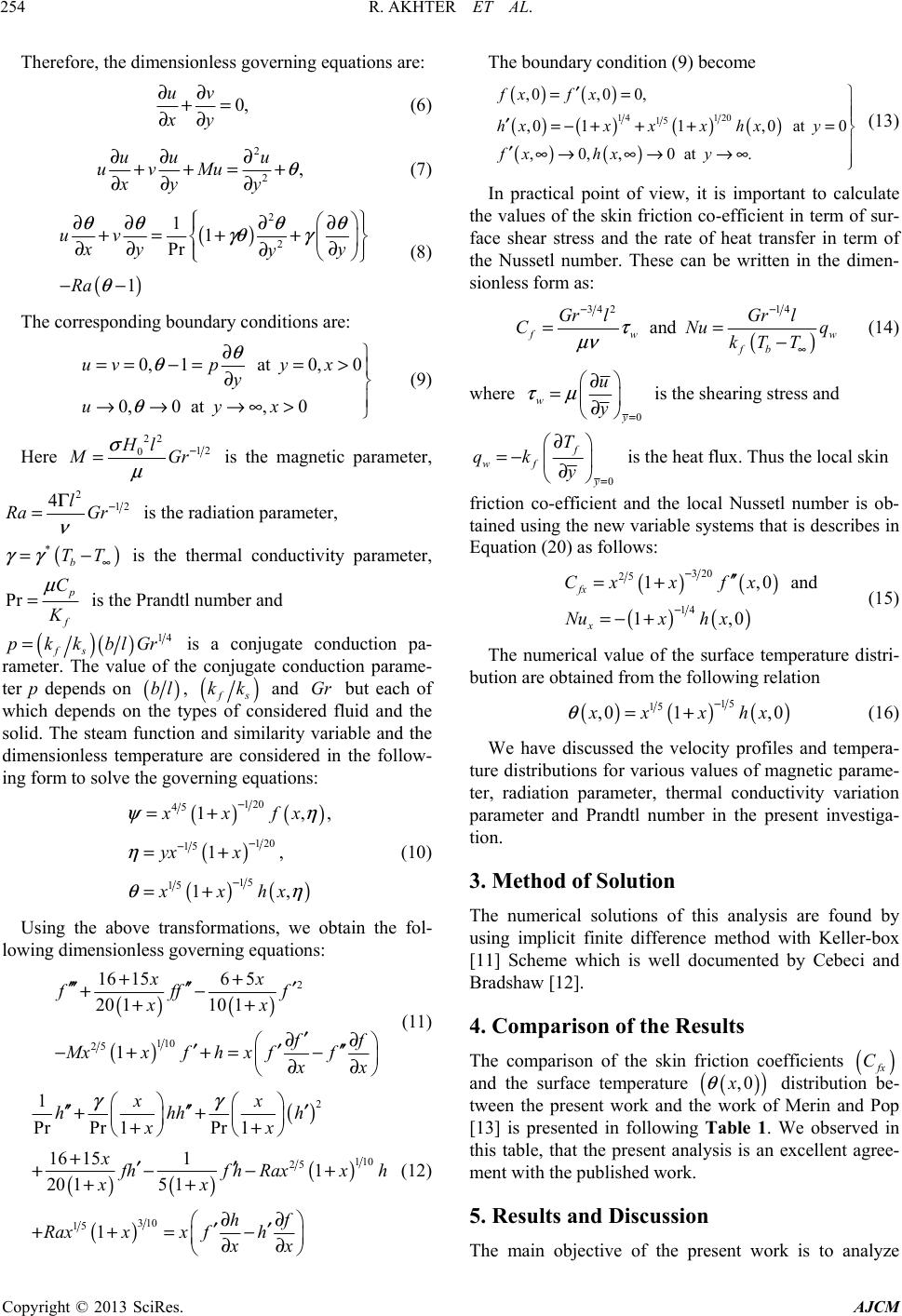 R. AKHTER ET AL. 254 Therefore, the dimensionless governing equations are: 0, uv xy ∂∂ += ∂∂ (6) 2 2, uu u uvMu xy y θ ∂∂ ∂ ++=+ ∂∂ ∂ (7) () () 2 2 11 Pr 1 uv x y y Ra θθθ θ γθ γ θ ∂∂∂ ∂ += ++ ∂∂ ∂ ∂ −− y (8) The corresponding boundary conditions are: 0,1 at 0,0 0,0 at ,0 uvpy x y uyx θ θ θ ∂ == −==> ∂ →→ →∞> (9) Here 2212 0 Hl M Gr σ μ − = is the magnetic parameter, 212 4l Ra Gr ν − Γ = is the radiation parameter, ( * b TT γγ ∞ =− ) is the thermal conductivity parameter, Pr p f C K μ = is the Prandtl number and () () 14 fs pkkblGr= is a conjugate conduction pa- rameter. The value of the conjugate conduction parame- ter p depends on () bl , () f s kk and but each of which depends on the types of considered fluid and the solid. The steam function and similarity variable and the dimensionless temperature are considered in the follow- ing form to solve the governing equations: Gr () () () ()() 120 45 120 15 15 15 1, 1, 1, xxfx yx x xxhx , ψ η η θη − − − − =+ =+ =+ (10) Using the above transformations, we obtain the fol- lowing dim e nsionl ess g overning equatio ns: () () () 2 110 25 16 1565 20 110 1 1 xx ffff xx f f Mxxfhxff x x ++ ′′′′′ ′ +− ++ ′ ∂∂ ′′′′ −+ +=− ∂∂ )11( () () () () () 2 110 25 310 15 1 PrPr1Pr 1 16 1511 20 151 1 xx hhh h xx x f hfhRaxx xx hf Raxxx fh xx γγ ′′′′ ′ ++ ++ +′′ +−−+ ++ ∂∂ ′′ ++= − ∂∂ The boundary condition (9) become () () () ()()() () () 14 120 15 ,0,0 0, ,011,0 at 0 ,0,,0 at . fxfx hxxxx hxy fx hxy ′ == ′=−+++= ′∞→ ∞→→∞ )13( In practical point of view, it is important to calculate the values of the skin friction co-efficient in term of sur- face shear stress and the rate of heat transfer in term of the Nussetl number. These can be written in the dimen- sionless form as: () 34 214 and f ww fb GrlGr l CNu kT T τ μν −− ∞ == −q (14) where 0 w y u y τμ = ∂ = ∂ is the shearing stress and 0 f wf y T qk y= ∂ =− ∂ is the heat flux. Thus the local skin friction co-efficient and the local Nussetl number is ob- tained using the new variable systems that is describes in Equation (20) as follows: () () ()() 320 25 14 1,0 1,0 fx x Cxx fx Nuxh x − − ′′ =+ =− + and (15) The numerical value of the surface temperature distri- bution are obtained from the following relation () ()( 15 15 ,0 1,0 ) x xxhx θ − =+ (16) We have discussed the velocity profiles and tempera- ture distributions for various values of magnetic parame- ter, radiation parameter, thermal conductivity variation parameter and Prandtl number in the present investiga- tion. 3. Method of Solution The numerical solutions of this analysis are found by using implicit finite difference method with Keller-box [11] Scheme which is well documented by Cebeci and Bradshaw [12]. 4. Comparison of the Results h The comparison of the skin friction coefficients () f x C and the surface temperature distribution be- tween the present work and the work of Merin and Pop [13] is presented in following Table 1. We observed in this table, that the present analysis is an excellent agree- ment with the published work. () ( ,0x θ ) )12( 5. Results and Discussion The main objective of the present work is to analyze Copyright © 2013 SciRes. AJCM 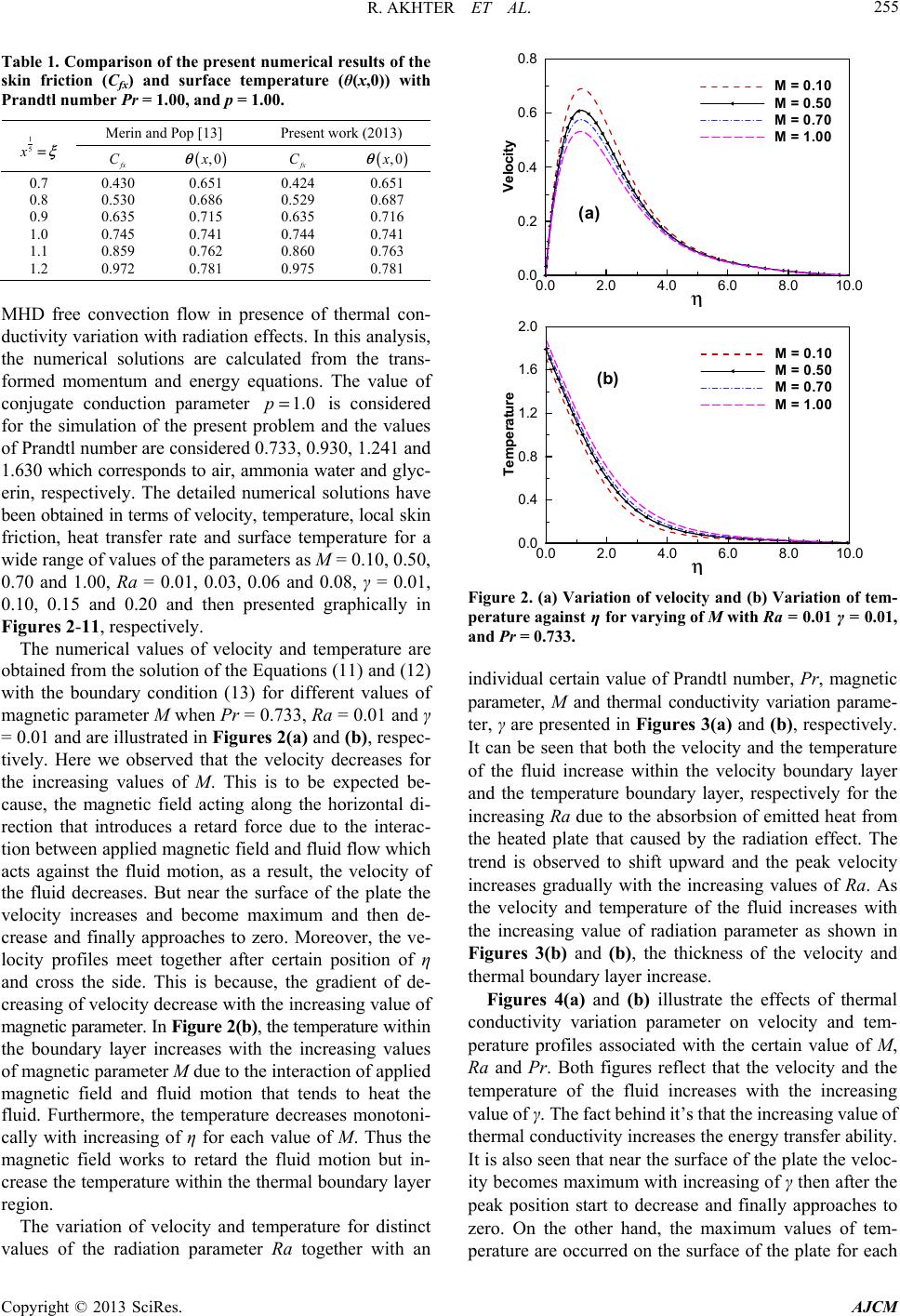 R. AKHTER ET AL. 255 Table 1. Comparison of the present numerical results of the skin friction (Cfx) and surface temperature (θ(x,0)) with Prandtl number Pr = 1.00, and p = 1.00. Merin and Pop [1 3] Present work (2013) 1 5 x ξ = fx C () ,0 x θ fx C () ,0 x θ 0.7 0.8 0.9 1.0 1.1 1.2 0.430 0.530 0.635 0.745 0.859 0.972 0.651 0.686 0.715 0.741 0.762 0.781 0.424 0.529 0.635 0.744 0.860 0.975 0.651 0.687 0.716 0.741 0.763 0.781 MHD free convection flow in presence of thermal con- ductivity variation with radiation effects. In this analysis, the numerical solutions are calculated from the trans- formed momentum and energy equations. The value of conjugate conduction parameter is considered for the simulation of the present problem and the values of Prandtl number are considered 0.733, 0.930, 1.241 and 1.630 which corresponds to air, ammonia water and glyc- erin, respectively. The detailed numerical solutions have been obtained in terms of velocity, temperature, local s kin friction, heat transfer rate and surface temperature for a wide range of values of the parameters as M = 0.10, 0.50, 0.70 and 1.00, Ra = 0.01, 0.03, 0.06 and 0.08, γ = 0.01, 0.10, 0.15 and 0.20 and then presented graphically in Figures 2-11, respectively. 1.0p= The numerical values of velocity and temperature are obtained from the solution of the Equations (11) and (12) with the boundary condition (13) for different values of magnetic parameter M when Pr = 0.733, Ra = 0.01 and γ = 0.01 and are illustrated in Figures 2(a) and (b), respec- tively. Here we observed that the velocity decreases for the increasing values of M. This is to be expected be- cause, the magnetic field acting along the horizontal di- rection that introduces a retard force due to the interac- tion between applied magnetic field and fluid flow which acts against the fluid motion, as a result, the velocity of the fluid decreases. But near the surface of the plate the velocity increases and become maximum and then de- crease and finally approaches to zero. Moreover, the ve- locity profiles meet together after certain position of η and cross the side. This is because, the gradient of de- creasing of velocity decrease with the increasing value of mag n e ti c pa r ame t e r . I n Figure 2(b), the temperature within the boundary layer increases with the increasing values of magnetic parameter M due to the interaction of applied magnetic field and fluid motion that tends to heat the fluid. Furthermore, the temperature decreases monotoni- cally with increasing of η for each value of M. Thus the magnetic field works to retard the fluid motion but in- crease the temperature within the thermal boundary layer region. The variation of velocity and temperature for distinct values of the radiation parameter Ra together with an 0.0 2.0 4.0 6.0 8.010.0 η 0.0 0.2 0.4 0.6 0.8 Velocity M = 0.10 M = 0.50 M = 0.70 M = 1.00 (a) 0.0 2.0 4.0 6.0 8.010.0 η 0.0 0.4 0.8 1.2 1.6 2.0 Temperature M = 0.10 M = 0.50 M = 0.70 M = 1.00 (b) Figure 2. (a) Variation of velocity and (b) Variation of tem- perature against η for varying of M wit h Ra = 0.01 γ = 0.01, and Pr = 0.733. individual certain value of Prandtl number, Pr, magnetic parameter, M and thermal conductivity variation parame- ter, γ are presented in Figures 3(a) and (b), respectively. It can be seen that both the velocity and the temperature of the fluid increase within the velocity boundary layer and the temperature boundary layer, respectively for the increasing Ra due to the absorbsion of emitted heat from the heated plate that caused by the radiation effect. The trend is observed to shift upward and the peak velocity increases gradually with the increasing values of Ra. As the velocity and temperature of the fluid increases with the increasing value of radiation parameter as shown in Figures 3(b) and (b), the thickness of the velocity and thermal boundary layer increase. Figures 4(a) and (b) illustrate the effects of thermal conductivity variation parameter on velocity and tem- perature profiles associated with the certain value of M, Ra and Pr. Both figures reflect that the velocity and the temperature of the fluid increases with the increasing value of γ. The fact behind it’s that the increasing value of thermal conductivity increases the energy transfer ability. It is also seen that near the surface of the plate the veloc- ity becomes maximum with increasing of γ then after the peak position start to decrease and finally approaches to zero. On the other hand, the maximum values of tem- perature are occurred on the surface of the plate for each Copyright © 2013 SciRes. AJCM 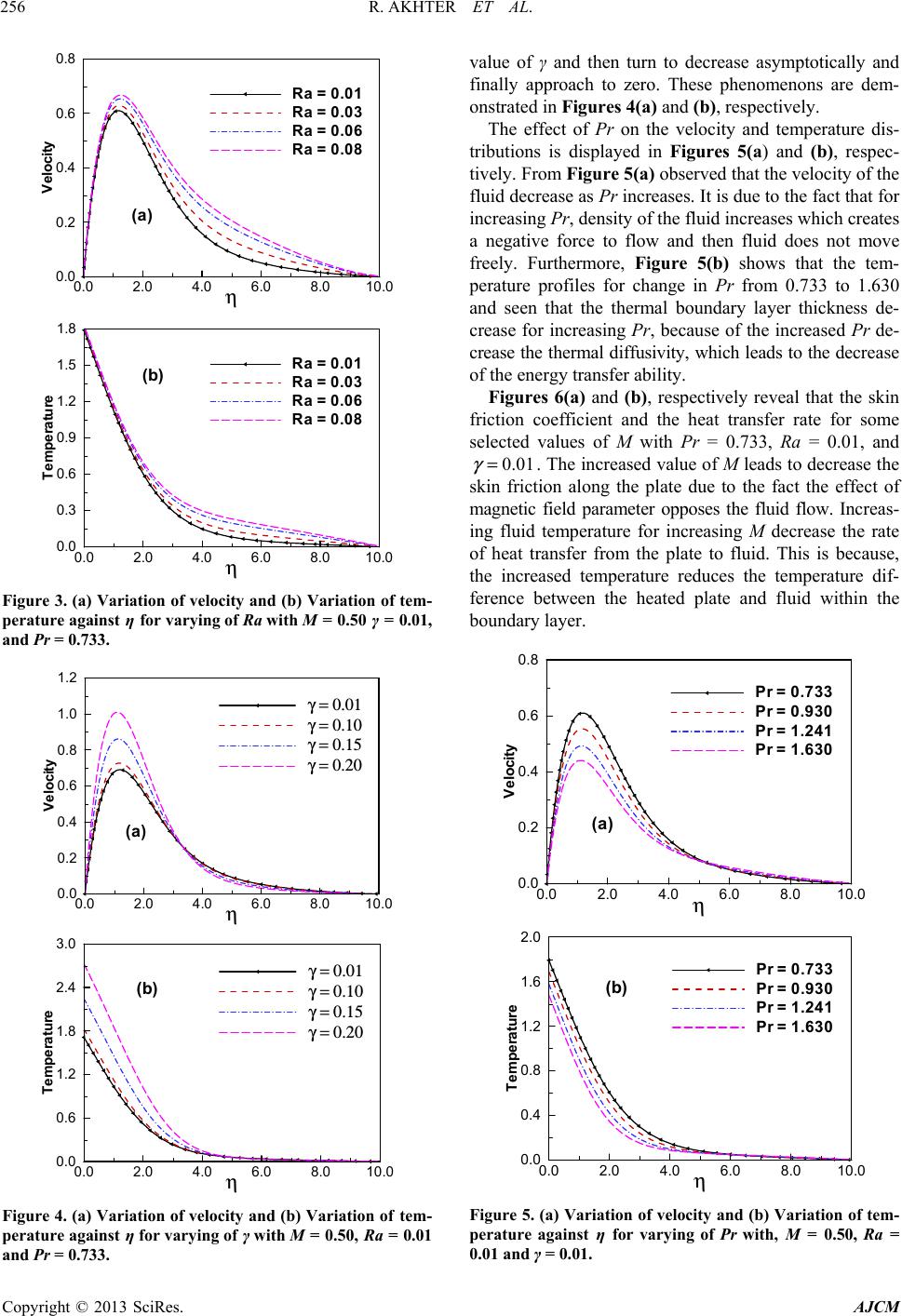 R. AKHTER ET AL. 256 0.0 2.0 4.0 6.0 8.010.0 η 0.0 0.2 0.4 0.6 0.8 Velocity Ra = 0.01 Ra = 0.03 Ra = 0.06 Ra = 0.08 (a) 0.0 2.0 4.0 6.0 8.010.0 η 0.0 0.3 0.6 0.9 1.2 1.5 1.8 Temperature Ra = 0.01 Ra = 0.03 Ra = 0.06 Ra = 0.08 (b) Figure 3. (a) Variation of velocity and (b) Variation of tem- perature against η for varying of Ra with M = 0.50 γ = 0.01, and Pr = 0.733. 0.02.0 4.06.08.010.0 η 0.0 0.2 0.4 0.6 0.8 1.0 1.2 Velocity γ = 0.01 γ = 0.10 γ = 0.15 γ = 0.20 (a) 0.0 2.0 4.0 6.0 8.010.0 η 0.0 0.6 1.2 1.8 2.4 3.0 Temperature γ = 0.01 γ = 0.10 γ = 0.15 γ = 0.20 (b) Figure 4. (a) Variation of velocity and (b) Variation of tem- perature against η for varying of γ with M = 0.50, Ra = 0.01 value of γ and and Pr = 0.733. then turn to decrease asymptotically and ature dis- tri ively reveal that the skin fr finally approach to zero. These phenomenons are dem- onstrated in Figures 4(a) and (b), respectively. The effect of Pr on the velocity and temper butions is displayed in Figures 5(a) and (b), respec- tively. From Figure 5(a) observed that the velocity of the fluid decrease as Pr increases. It is due to the fact that for increasing Pr, density of the fluid increases which creates a negative force to flow and then fluid does not move freely. Furthermore, Figure 5(b) shows that the tem- perature profiles for change in Pr from 0.733 to 1.630 and seen that the thermal boundary layer thickness de- crease for increasing Pr, because of the increased Pr de- crease the thermal d iffusivity, which leads to the decre ase of the energy transfer ability. Figures 6(a) and (b), respect iction coefficient and the heat transfer rate for some selected values of M with Pr = 0.733, Ra = 0.01, and 0.01 γ =. The increased value of M leads to decrease the tion along the plate due to the fact the effect of magnetic field parameter opposes the fluid flow. Increas- ing fluid temperature for increasing M decrease the rate of heat transfer from the plate to fluid. This is because, the increased temperature reduces the temperature dif- ference between the heated plate and fluid within the boundary layer. skin fric 0.02.04.06.08.010.0 η 0.0 0.2 0.4 0.6 0.8 Velocity Pr =0.733 Pr =0.930 Pr =1.241 Pr =1.630 (a) 0.02.0 4.0 6.0 8.010.0 η 0.0 0.4 0.8 1.2 1.6 2.0 Temperature Pr =0.733 Pr =0.930 Pr =1.241 Pr =1.630 (b) Figure 5. (a) Variation of velocity and (b) Variation ofm- te perature against η for varying of Pr with, M = 0.50, Ra = 0.01 and γ = 0.01. Copyright © 2013 SciRes. AJCM 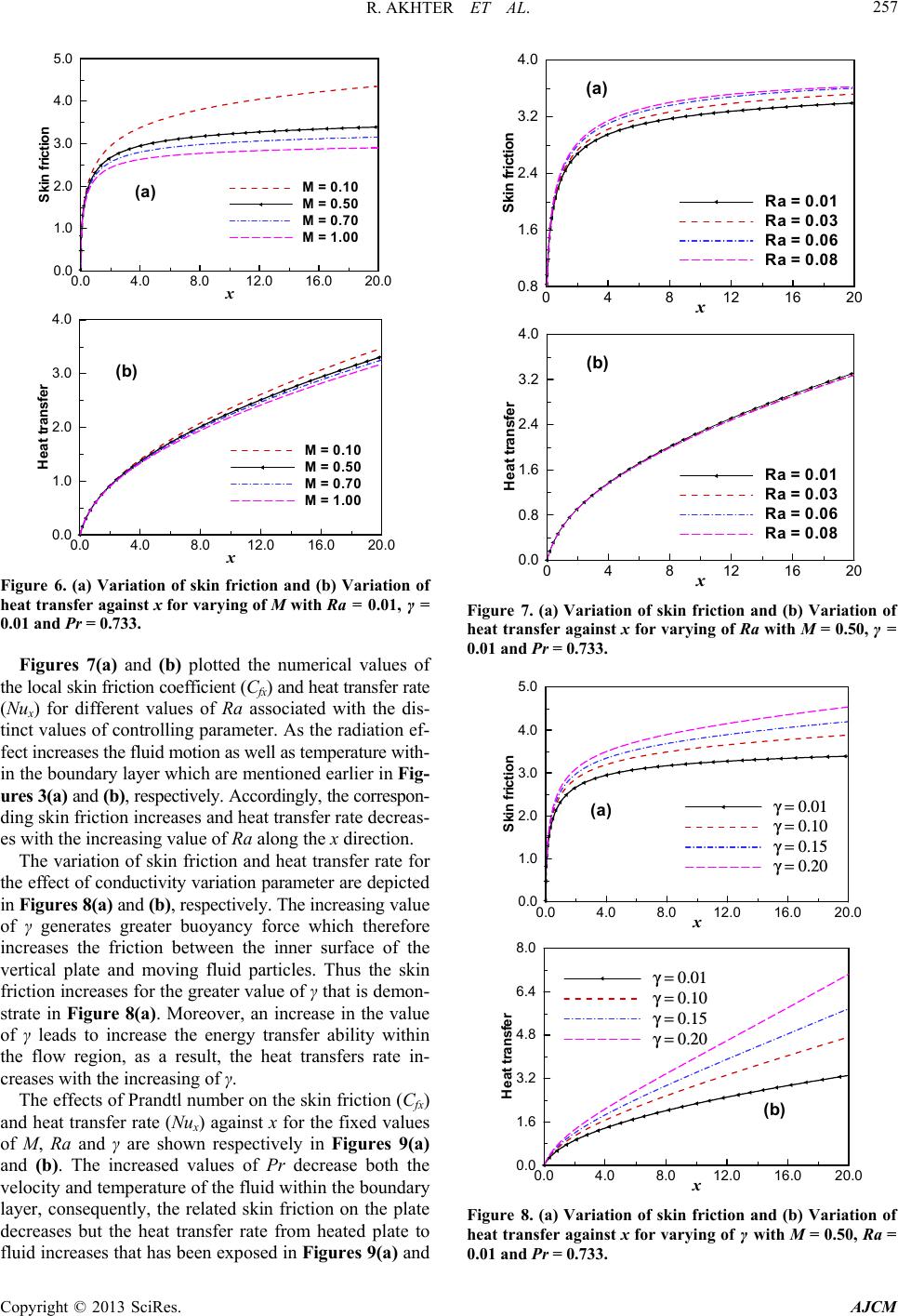 R. AKHTER ET AL. 257 0.04.08.012.0 16.020.0 x 0.0 1.0 2.0 3.0 4.0 5.0 Skin f ricti o n M = 0.10 M = 0.50 M = 0.70 M = 1.00 (a) 0.04.08.012.0 16.0 20.0 x 0.0 1.0 2.0 3.0 4.0 Heat transfer M=0.10 M=0.50 M=0.70 M=1.00 (b) Figure 6. (a) Variation of skin friction and (b) Variation of Figures 7(a) and (b) plotted the numerical values of th r th on the skin friction (Cfx) an heat transfer against x for varying of M with Ra = 0.01, γ = 0.01 and Pr = 0.733. e local sk in fr iction coefficie nt (Cfx) and heat transfer rate (Nux) for different values of Ra associated with the dis- tinct values of controlling parameter. As the radiation ef- fect increases the fluid motion as well as temperature with- in the boundary layer wh ich are mentioned earlier in Fig- ures 3(a) and (b), respectively. Accordingly, th e correspon- ding skin friction increases and heat transfer rate decreas- es with the increasing value of Ra along the x direction. The variation of skin friction and heat transfer rate fo e effect of conductivity variation parameter are depi cted in Figures 8(a) and (b), respectively. The incr easing value of γ generates greater buoyancy force which therefore increases the friction between the inner surface of the vertical plate and moving fluid particles. Thus the skin friction increases for the greater value of γ that is demon- strate in Figure 8(a). Moreover, an increase in the value of γ leads to increase the energy transfer ability within the flow region, as a result, the heat transfers rate in- creases with the increasing of γ. The effects of Prandtl number d heat transfer rate (Nux) against x for the fixed values of M, Ra and γ are shown respectively in Figures 9(a) and (b). The increased values of Pr decrease both the velocity and temperature of the fluid within the boundary layer, consequently, the related skin friction on the plate decreases but the heat transfer rate from heated plate to fluid increases that has been exposed in Figures 9(a) and 048 121620 x 0.8 1.6 2.4 3.2 4.0 Skin f r icti o n Ra = 0.01 Ra = 0.03 Ra = 0.06 Ra = 0.08 (a) 048 121620 x 0.0 0.8 1.6 2.4 3.2 4.0 Heat transfer Ra =0.01 Ra =0.03 Ra =0.06 Ra =0.08 (b) Figure 7. (a) Variation of skin friction and (b) Variation of heat transfer against x for varying of Ra with M = 0.50, γ = 0.01 and Pr = 0.733. 0.04.08.012.0 16.0 20.0 x 0.0 1.0 2.0 3.0 4.0 5.0 Skin f rictio n γ = 0.01 γ = 0.10 γ = 0.15 γ = 0.20 (a) 0.04.08.012.0 16.0 20.0 x 0.0 1.6 3.2 4.8 6.4 8.0 Heat trans f er γ=0.01 γ=0.10 γ=0.15 γ=0.20 (b) Figure 8. (a) Variation of skin friction and (b) Variation of 0.01 and Pr = 0.733. heat transfer against x for varying of γ with M = 0.50, Ra = Copyright © 2013 SciRes. AJCM 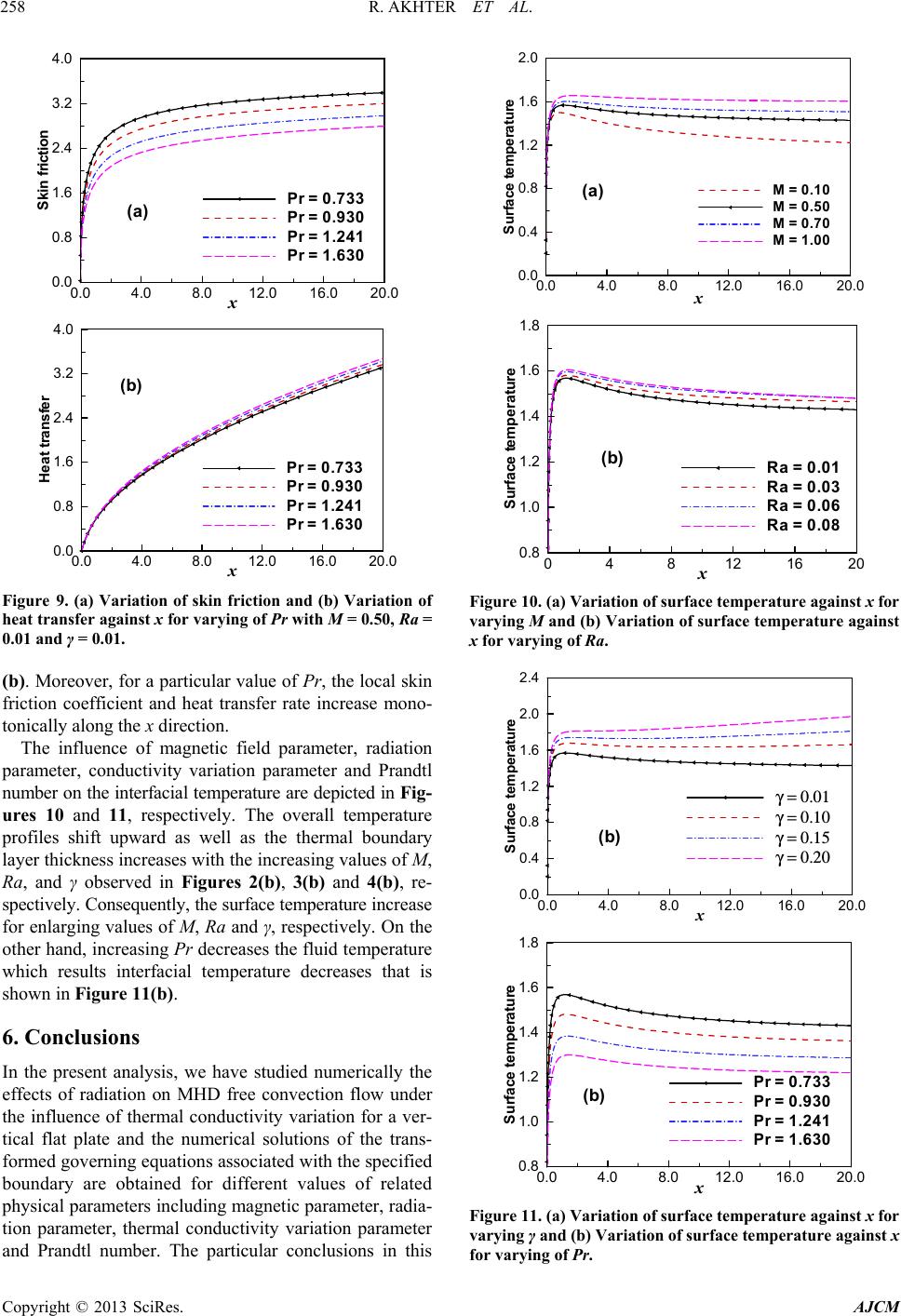 R. AKHTER ET AL. 258 0.04.08.012.016.020.0 x 0.0 0.8 1.6 2.4 3.2 4.0 Skin f rictio n Pr =0.733 Pr =0.930 Pr =1.241 Pr =1.630 (a) 0.04.08.012.0 16.0 20.0 x 0.0 0.8 1.6 2.4 3.2 4.0 Heat transfer Pr =0.733 Pr =0.930 Pr =1.241 Pr =1.630 (b) Figure 9. (a) Variation of skin friction and (b) Variation of heat transfer against x for varying of Pr with M = 0.50, a = r a particular value of Pr, the local skin friction coefficient and heatfer rate increase mono- n parameter and Prandtl nu sis, we have studied numerically the on MHD free convection flow under R 0.01 and γ = 0.01. (b). Moreover, fo trans tonically along the x direction. The influence of magnetic field parameter, radiation parameter, conductivity variatio mber on the interfacial temperature are depicted in Fig- ures 10 and 11, respectively. The overall temperature profiles shift upward as well as the thermal boundary layer thickness increases with the increasing values of M, Ra, and γ observed in Figures 2(b), 3( b) and 4(b), re- spectively. Consequently, the surface temperature inc r ea se for enlarging valu es of M, Ra and γ, respectively. On the other hand, increasing Pr decreases the fluid temperature which results interfacial temperature decreases that is shown in Figure 11(b). 6. Conclusions In the present analy effects of radiation the influence of thermal conductivity variation for a ver- tical flat plate and the numerical solutions of the trans- formed governing equations associated with the specified boundary are obtained for different values of related physical parameters including magnetic parameter, radia- tion parameter, thermal conductivity variation parameter and Prandtl number. The particular conclusions in this 0.04.08.012.0 16.0 20.0 x 0.0 0.4 0.8 1.2 1.6 2.0 Sur f ace temperature M=0.10 M=0.50 M=0.70 M=1.00 (a) 048 121620 x 0.8 1.0 1.2 1.4 1.6 1.8 Su r f acetempe r atu r e Ra = 0.01 Ra = 0.03 Ra = 0.06 Ra = 0.08 (b) Figure 10. (a) Variation of surface temperature against x for varying M and (b) Variation of surface temperature against x for varying of Ra. 0.0 4.0 8.012.016.020.0 x 0.0 0.4 0.8 1.2 1.6 2.0 2.4 Sur f ace temperature γ = 0.01 γ = 0.10 γ = 0.15 γ = 0.20 (b) 0.04.08.012.0 16.0 20.0 x 0.8 1.0 1.2 1.4 1.6 1.8 Sur f acetemperature Pr =0.733 Pr =0.930 Pr =1.241 Pr =1.630 (b) Figure 11. (a) Variation of surface temperature against x for varying γ and (b) Variation of surface t emperature against x for varying of Pr. Copyright © 2013 SciRes. AJCM 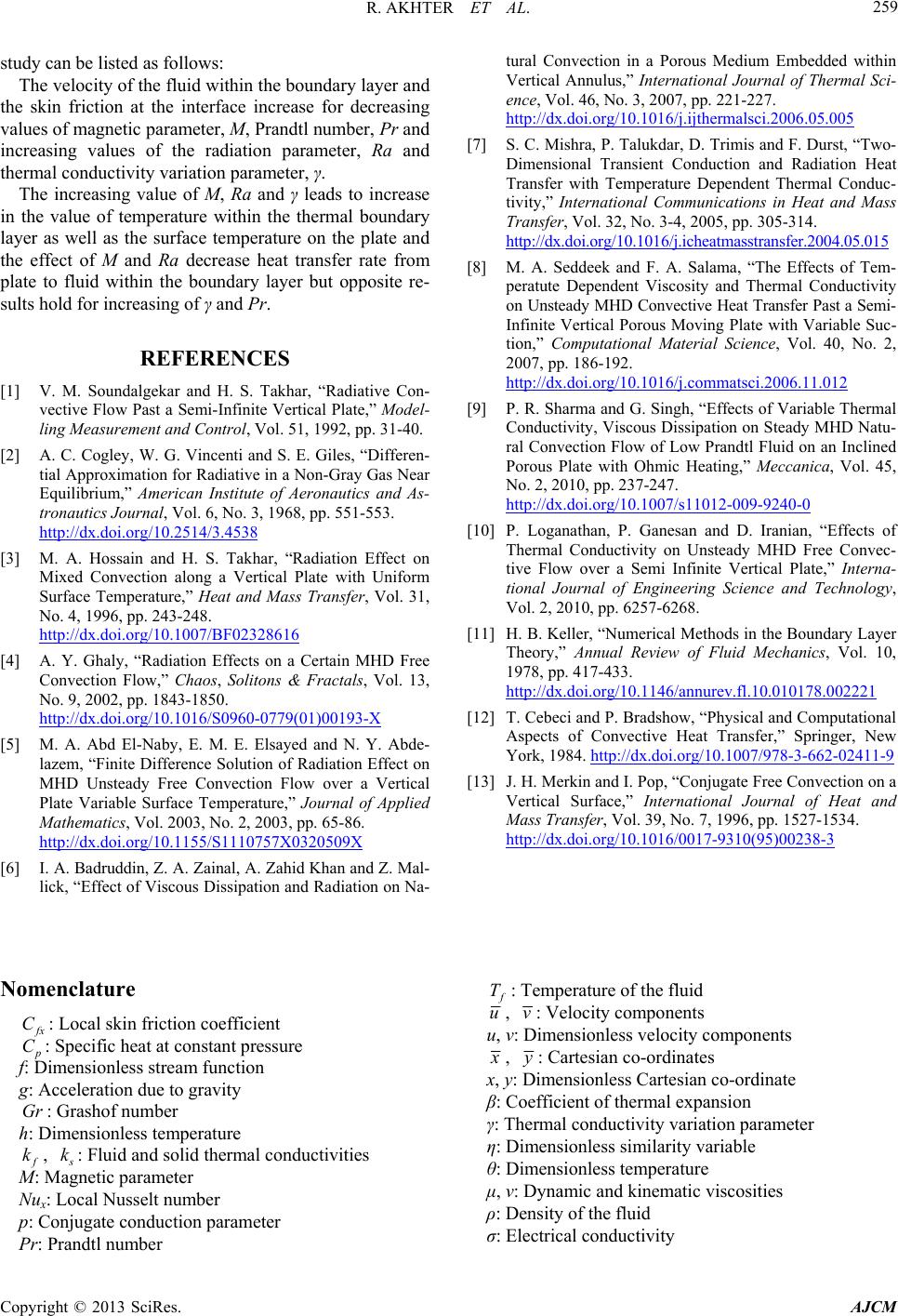 R. AKHTER ET AL. Copyright © 2013 SciRes. AJCM 259 e for decreasing [1] V. M. Soundalgekar and H. S. Takhar, “Radiative Con- vective Flow Pical Plate,” Model- ling Measurem, 1992, pp. 31-40. tural Convection in a Porous Medium Embedded within Vertical Annulus,” International Journal of Thermal Sci- ence, Vol. 46, No. 3, 2007, pp. 221-227. http://dx.doi.org/10.1016/j.ijthermalsci.2006.05.005 [7] S. C. Mishra, P. Talukdar, D. Trimis a nd F. Durst, “T Dimensional Transient Conduction and Radiation study can be listed as follows: The velocity of the fluid within the boundary layer and the skin friction at the interface increas values of magnetic parameter, M, Prandtl number, Pr and increasing values of the radiation parameter, Ra and thermal conductivity variation parameter, γ. The increasing value of M, Ra and γ leads to increase in the value of temperature within the thermal boundary layer as well as the surface temperature on the plate a wo- Heat Transfer with Temperature Dependent Thermal Conduc- tivity,” International Communications in Heat and Mass Transfer, Vol. 32, No. 3-4, 2005, pp. 305-314. http://dx.doi.org/10.1016/j.icheat ma sst ran sfer.200 4.05.01 5 [8] M. A. Seddeek and F. A. Salama, “The Effects of Tem- peratute Dependent Viscosity and Thermal Conductivity nd the effect of M and Ra decrease heat transfer rate from plate to fluid within the boundary layer but opposite re- sults hold for increasing of γ and Pr. REFERENCES on Unsteady MHD Convective Heat Transfer Past a Semi- Infinite Vertical Porous Moving Plate with Variable Suc- tion,” Computational Material Science, Vol. 40, No. 2, 2007, pp. 186-192. http://dx.doi.org/10.1016/j.commatsci.2006.11.012 [9] P. R. Sharma and G. Singh, “Effects of Variable Therm Conductivity, Viscous Dissipation on Steady MHD al Natu- ast a Semi-Infinite Vert ent and Control, Vol. 51ral Convection Flow of Low Prandtl Fluid on an Inclined Porous Plate with Ohmic Heating,” Meccanica, Vol. 45, No. 2, 2010, pp. 237-247. http://dx.doi.org/10.1007/s11012-009-9240-0 [10] P. Loganathan, P. Ganesan and D. Iranian, “ Thermal Conductivity on Unsteady MHD Fr [2] A. C. Cogley, W. G. Vincenti and S. E. Giles, “Differen- tial Approximation for Radiative in a Non-Gray Gas Near Equilibrium,” American Institute of Aeronautics and As- tronautics Journal, Vol. 6, No. 3, 1968, pp. 551-553. http://dx.doi.org/10.2514/3.4538 [3] M. A. Hossain and H. S. Takhar, “Radiation Effect on Mixed Convection along a Vertical Plate with Unifo Surface Temperature,” Heat and Mass Transfer Effects of ee Convec- Fluid Mechanics, Vol. 10, tive Flow over a Semi Infinite Vertical Plate,” Interna- tional Journal of Engineering Science and Technology, Vol. 2, 2010, pp. 6257-6268. [11] H. B. Keller, “Numerical Methods in the Boundary Layer Theory,” Annual Review of rm , Vol. 31, No. 4, 1996, pp. 243-248. http://dx.doi.org/10.1007/BF02328616 [4] A. Y. Ghaly, “Radiation Effects on a Certain MHD Free Convection Flow,” Chaos, Solitons & No. 9, 2002, pp. 1843-1850. 1978, pp. 417-433. http://dx.doi.org/10.1146/annurev.fl.10.010178.002221 [12] T. Cebeci and P. Bradshow, “Physical and Computation Aspects of Convective Heat Transfer,” Springer, Ne Fractals, Vol. 13, al w http://dx.doi.org/10.1016/S0960-0779(01)00193-X [5] M. A. Abd El-Naby, E. M. E. Elsayed and N. Y. Abde- lazem, “Finite Difference Solution of Radiation Eff MHD Unsteady Free Convection Flow over a V York, 1984. http://dx.doi.org/10.1007/978-3-662-02411-9 [13] J. H. Merkin and I. Pop, “Conjugate Free Convection on a Vertical Surface,” International Journal of Heat and ect on l ertica Plate Variable Surface Temperature,” Journal of Applied Mathematics, Vol. 2003, No. 2, 2003, pp. 65-86. http://dx.doi.org/10.1155/S1110757X0320509X [6] I. A. Badruddin, Z. A. Zainal, A. Zahid Khan and Z. Mal- lick, “Effect of Viscous Dissipation and Radiation Mass Transfer, Vol. 39, No. 7, 1996, pp. 1527-1534. http://dx.doi.org/10.1016/0017-9310(95)00238-3 on Na- Nomenclature f T: Temperature of the fluid f x C: Local skin friction coefficient p C: Specific heat at constant pressure imensionless stream function f: D g: Acceleration due to gravity Gr : Grashof number h: Derature imensionless temp f k, s k: Fluid and solid thermal conductivities M: Magnetic parameter Nux: Local Nusselt number p: Conjugate conduction parameter Pr: Prandtl number u, v: Velocity components v: Dimensionless velocity cou, mponents x y , : Cartesian co-ordinates x, y: Dimensionless Cartesian co-ordinate β:oeion γ: Thermal conductivity variation paramete Cfficient of thermal expansr es η: Dimensionless similarity variable θ: Dimensionless temperature μ, v: Dynamic and kinematic viscositi ρ: Density of the fluid σ: Electrical conductivity |