

Paper Menu >>
Journal Menu >>
 Neuroscience & Medicine, 2013, 4, 150-154 http://dx.doi.org/10.4236/nm.2013.43024 Published Online September 2013 (http://www.scirp.org/journal/nm) Stabilization of Circadian Rhythm, Its Augmentation by Bright Light Treatment and Its Importance for ADHD and Depression of Adole scents Helmut Niederhofer Department of Child and Adolescent Psychiatry and Psychotherapy, Saechsisches Krankenhaus für Psychiatrie und Neurologie Rodewisch Bahnhofstrasse, Rodewisch, Germany. Email: helmutnied[email protected] Received March 11th, 2013; revised April 14th, 2013; accepted May 8th, 2013 Copyright © 2013 Helmut Niederhofer. This is an open access article distributed under the Creative Commons Attribution License, which permits unrestricted use, distribution, and reproduction in any medium, provided the original work is properly cited. ABSTRACT Objective: ADHD is ch aracterized by the progressive development of, imp ulsiveness, attentional difficulties and some- times also excessive hyperactivity. Main biological reason is a quantitative reduction of the neurotransmitter dopamine in the forebrain. A lack of dopamine is also typical for depressive disorders. Methods: Bright light therapy is proven to be effective in treating depression. Purpose of our study is to verify the therapeutic effectiveness of Bright light therapy in subjects affected by ADHD. Results: Results show a significant improvement which lasts for at least 4 weeks, which is superposed by regulation of the circadian rhythm. Initial decrease of especially mornin g saliva melatonin levels, due to regular sleep under in-patient conditions, is followed by symptom improvement and a raising evening melatonin level, due to activation during the day. This level decreases as soon as activation is ceased. Conclusion: Bright light therapy seems to be effective as add-on therapy for ADHD, but in fact, stabilization of the circadian rhythm is the most impor- tant therapeutic in tervention, either for ADHD or for depres si on , as demonstrated in anot her study . Keywords: ADHD; Circadian Rhythm; Bright Light Therapy 1. Introduction ADHD is characterized by the progressive development, impulsiveness, attentional difficulties, which influences also interpersonal relationships, and sometimes also of excessive hyperactivity. Today, research has been of low specificity and used diagnostic criterions, absent from specific biological markers, and has been characterized by the scarce answer to the conventional pharmacologi- cal treatments. Recently, some researchers have under- lined the presence of a direct correlation of the severity of symptomatology and psychometric markers, such as a quantitative reduction of dopamine, especially in the right frontal lobe. Such parameters seem also to be modi- fied by the administration, e.g. Methylphenidate [1]. A lack of dopamine is also typical for depressive disorders. Additional biological therapies, which elevate cerebral dopamine levels, like repetitiv e transcranial magnetic sti- mulation (rTMS) have been proven to be effective treat- ing patients suffering from depression [2] and ADHD [3]. Bright light therapy also elevates cerebral dopamine lev- els and is proven to be effective treating depression [4]. One open trial, including adults suffering from ADHD [5] suggests that it might be also effective in wintertime and for ADHD, at least as additional therapy. Purpose of this placebo-controlled observation in 28 adolescents is to verify the therapeutic effectiveness of Bright l ig ht th era py in 28 adolescents affected by ADHD. 2. Methods 28 volunteers, aged 14 - 17 years, IQ 96 - 105, were re- cruitred in the Dep. of Child and Adolescent Psychiatry of the Hospital of Rodewisch from March 2011 to June 2012. Patients suffered from ADHD for more than two years. Informed consent was obtained from each partici- pant prior to the start of the study, in accordance with the guidelines set forth by the Declaration of Helsinki. Pa- tients were encouraged to continue ongoing treatment (both received 40 mg Methylphenidate daily and Psy- chotherapy) during the study, with the assumption that psychotherapy and medication effects over an interval of 4 weeks were likely to be small, since there was no change of medication/dosage and psychotherapy (2 ses- Copyright © 2013 SciRes. NM 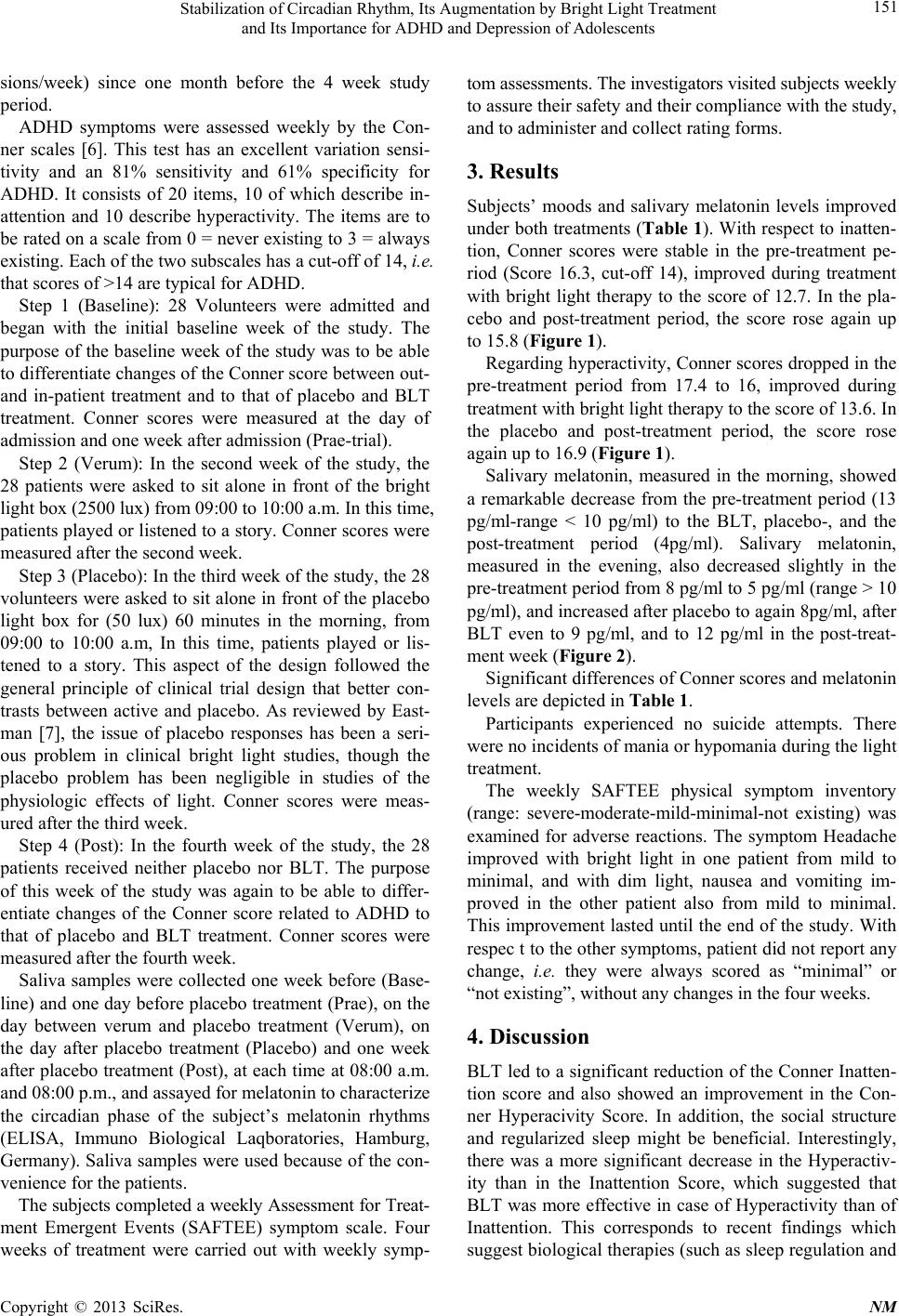 Stabilization of Circadian Rhythm, Its Augmentation by Bright Light Treatment and Its Importance for ADHD and Depression of Adolescents 151 sions/week) since one month before the 4 week study period. ADHD symptoms were assessed weekly by the Con- ner scales [6]. This test has an excellent variation sensi- tivity and an 81% sensitivity and 61% specificity for ADHD. It consists of 20 items, 10 of which describe in- attention and 10 describe hyperactivity. The items are to be rated on a scale from 0 = never existing to 3 = always existing. Each of the two subscales has a cut-off of 14, i.e. that scores of >14 are typical for ADHD. Step 1 (Baseline): 28 Volunteers were admitted and began with the initial baseline week of the study. The purpose of the baseline week of the study was to be able to differentiate change s of the Conner score between out- and in-patient treatment and to that of placebo and BLT treatment. Conner scores were measured at the day of admission and one week after admission (Prae-trial). Step 2 (Verum): In the second week of the study, the 28 patients were asked to sit alone in front of the bright light box (2500 lux) from 09:00 to 10:00 a.m. In this time, patients played or listened to a story. Conner scores were measured after the second week. Step 3 (Placebo): In the third week of the study, the 28 volunteers were asked to sit alone in front of the placebo light box for (50 lux) 60 minutes in the morning, from 09:00 to 10:00 a.m, In this time, patients played or lis- tened to a story. This aspect of the design followed the general principle of clinical trial design that better con- trasts between active and placebo. As reviewed by East- man [7], the issue of placebo responses has been a seri- ous problem in clinical bright light studies, though the placebo problem has been negligible in studies of the physiologic effects of light. Conner scores were meas- ured after the third week. Step 4 (Post): In the fourth week of the study, the 28 patients received neither placebo nor BLT. The purpose of this week of the study was again to be able to differ- entiate changes of the Conner score related to ADHD to that of placebo and BLT treatment. Conner scores were measured after the fourth week. Saliva samples were collected one week before (Base- line) and one day be fore placebo treatment (Prae), on the day between verum and placebo treatment (Verum), on the day after placebo treatment (Placebo) and one week after placebo treatment (Post), at each time at 08:00 a.m. and 08:00 p.m., and assayed for melatonin to characterize the circadian phase of the subject’s melatonin rhythms (ELISA, Immuno Biological Laqboratories, Hamburg, Germany). Saliva samples were used because of the con- venience for the patients. The subjects completed a weekly Assess ment for Treat- ment Emergent Events (SAFTEE) symptom scale. Four weeks of treatment were carried out with weekly symp- tom assessments. The investigators visited su bjects weekly to assure their safety and their compliance with the study, and to administer and collect rating forms. 3. Results Subjects’ moods and salivary melatonin levels improved under both treatments (Table 1). With respect to inatten- tion, Conner scores were stable in the pre-treatment pe- riod (Score 16.3, cut-off 14), improved during treatment with bright light therapy to the score of 12.7. In the pla- cebo and post-treatment period, the score rose again up to 15.8 (Figure 1). Regarding hyperactivity, Conner scores dropped in the pre-treatment period from 17.4 to 16, improved during treatment with bright light therapy to the score of 13.6. In the placebo and post-treatment period, the score rose again up to 16.9 (Figure 1). Salivary melatonin, measured in the morning, showed a remarkable decrease from the pre-treatment period (13 pg/ml-range < 10 pg/ml) to the BLT, placebo-, and the post-treatment period (4pg/ml). Salivary melatonin, measured in the evening, also decreased slightly in the pre-treatment period from 8 pg/ml to 5 pg/ml (range > 10 pg/ml), and increased after placebo to again 8pg/ml, after BLT even to 9 pg/ml, and to 12 pg/ml in the post-treat- ment week (Figure 2). Significant differences of Conner scores and melatonin levels are depicted in Table 1. Participants experienced no suicide attempts. There were no incidents of mania or hypomania during the light treatment. The weekly SAFTEE physical symptom inventory (range: severe-moderate-mild-minimal-not existing) was examined for adverse reactions. The symptom Headache improved with bright light in one patient from mild to minimal, and with dim light, nausea and vomiting im- proved in the other patient also from mild to minimal. This improvement lasted until th e end of the study. With respec t to the other symptoms, patient did not repo rt any change, i.e. they were always scored as “minimal” or “not existing”, without any changes in the four weeks. 4. Discussion BLT led to a significant reduction of the Con ner Inatten- tion score and also showed an improvement in the Con- ner Hyperacivity Score. In addition, the social structure and regularized sleep might be beneficial. Interestingly, there was a more significant decrease in the Hyperactiv- ity than in the Inattention Score, which suggested that BLT was more effective in case of Hyperactivity than of Inattention. This corresponds to recent findings which suggest biological therapies (such as sleep regulation and Copyright © 2013 SciRes. NM 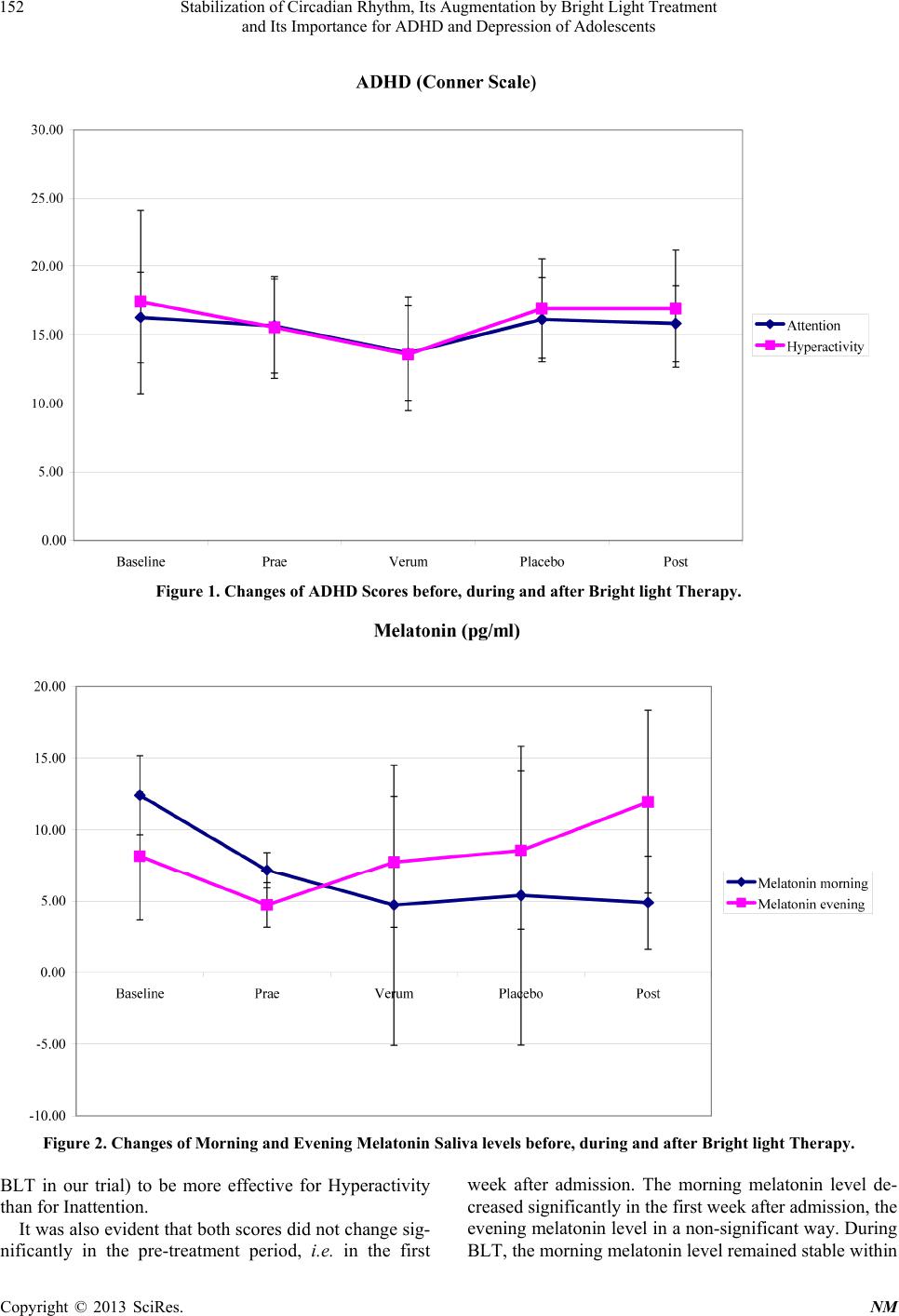 Stabilization of Circadian Rhythm, Its Augmentation by Bright Light Treatment and Its Importance for ADHD and Depression of Adolescents Copyright © 2013 SciRes. NM 152 Figure 1. Changes of ADHD Scores before, during and after Bright light Therapy. Figure 2. Changes of Morning and Evening Melatonin Saliva levels before, during and after Bright light Therapy. BLT in our trial) to be more effective for Hyperactivity than for Inattention. It was also evident that both scores did not change sig- nificantly in the pre-treatment period, i.e. in the first week after admission. The morning melatonin level de- creased significantly in the first week after admission, the evening melatonin level in a non-signif icant way. During BLT, the morning melatonin level remained stable within 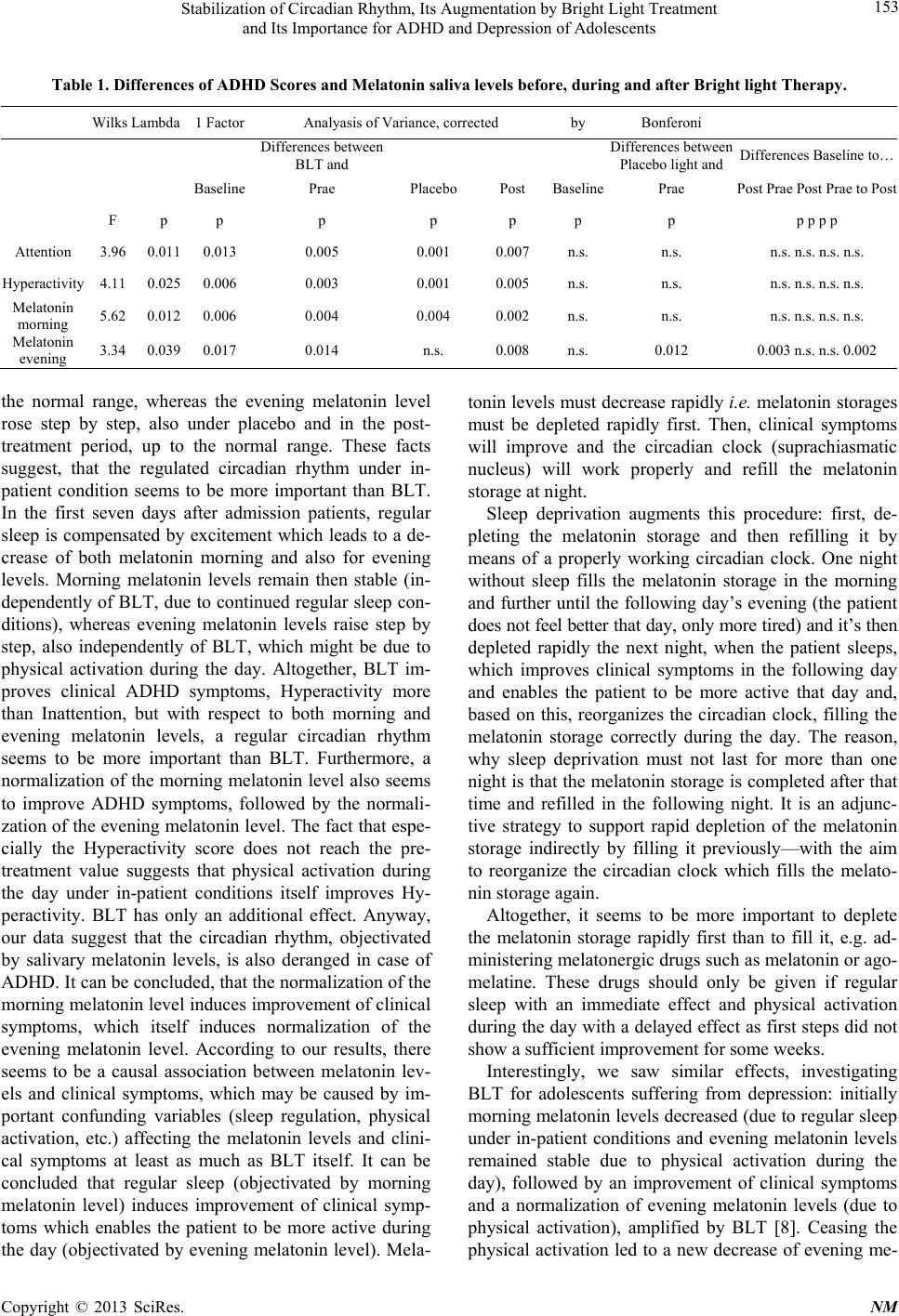 Stabilization of Circadian Rhythm, Its Augmentation by Bright Light Treatment and Its Importance for ADHD and Depression of Adolescents 153 Table 1. Differences of ADHD Scores and Melatonin saliva levels before, during and after Bright light Therapy. Wilks Lambda 1 Factor Analyasis of Variance, corrected by Bonferoni Differences between BLT and Differences between Placebo light and Differences Baseline to… Baseline Prae Placebo Post BaselinePrae Post Prae Post Prae to Post F p p p p p p p p p p p Attention 3.96 0.011 0.013 0.005 0.001 0.007 n.s. n.s. n.s. n.s. n.s. n.s. Hyperactivity 4.11 0.025 0.006 0.003 0.001 0.005 n.s. n.s. n.s. n.s. n.s. n.s. Melatonin morning 5.62 0.012 0.006 0.004 0.004 0.002 n.s. n.s. n.s. n.s. n.s. n.s. Melatonin evening 3.34 0.039 0.017 0.014 n.s. 0.008 n.s. 0.012 0.003 n.s. n.s. 0.002 the normal range, whereas the evening melatonin level rose step by step, also under placebo and in the post- treatment period, up to the normal range. These facts suggest, that the regulated circadian rhythm under in- patient condition seems to be more important than BLT. In the first seven days after admission patients, regular sleep is compensated by excitement which leads to a de- crease of both melatonin morning and also for evening levels. Morning melatonin levels remain then stable (in- dependently of BLT, due to continued regular sleep con- ditions), whereas evening melatonin levels raise step by step, also independently of BLT, which might be due to physical activation during the day. Altogether, BLT im- proves clinical ADHD symptoms, Hyperactivity more than Inattention, but with respect to both morning and evening melatonin levels, a regular circadian rhythm seems to be more important than BLT. Furthermore, a normalization of the morning melatonin level also seems to improve ADHD symptoms, followed by the normali- zation of the evening melatonin level. The fact that espe- cially the Hyperactivity score does not reach the pre- treatment value suggests that physical activation during the day under in-patient conditions itself improves Hy- peractivity. BLT has only an additional effect. Anyway, our data suggest that the circadian rhythm, objectivated by salivary melatonin levels, is also deranged in case of ADHD. It can be concluded, that the normalization of the morning melatonin level induces improvement of clinical symptoms, which itself induces normalization of the evening melatonin level. According to our results, there seems to be a causal association between melatonin lev- els and clinical symptoms, which may be caused by im- portant confunding variables (sleep regulation, physical activation, etc.) affecting the melatonin levels and clini- cal symptoms at least as much as BLT itself. It can be concluded that regular sleep (objectivated by morning melatonin level) induces improvement of clinical symp- toms which enables the patient to be more active during the day (objectivated by evening melatonin level). Mela- tonin levels must decrease rapidly i.e. melatonin storages must be depleted rapidly first. Then, clinical symptoms will improve and the circadian clock (suprachiasmatic nucleus) will work properly and refill the melatonin storage at night. Sleep deprivation augments this procedure: first, de- pleting the melatonin storage and then refilling it by means of a properly working circadian clock. One night without sleep fills the melatonin storage in the morning and further until the following day’s ev ening (the patient does not feel better that day, only more tired) and it’s then depleted rapidly the next night, when the patient sleeps, which improves clinical symptoms in the following day and enables the patient to be more active that day and, based on this, reorganizes the circadian clock, filling the melatonin storage correctly during the day. The reason, why sleep deprivation must not last for more than one night is that the melatonin stor age is completed after that time and refilled in the following night. It is an adjunc- tive strategy to support rapid depletion of the melatonin storage indirectly by filling it previously—with the aim to reorganize the circadian clock which fills the melato- nin storage agai n. Altogether, it seems to be more important to deplete the melatonin storage rapidly first than to fill it, e.g. ad- ministering melatonergic drugs such as melatonin or ago- melatine. These drugs should only be given if regular sleep with an immediate effect and physical activation during the day with a delayed effect as first steps did not show a sufficient improvement for some weeks. Interestingly, we saw similar effects, investigating BLT for adolescents suffering from depression: initially morning melatonin levels decreased (due to regular sleep under in-patient conditions and evening melatonin levels remained stable due to physical activation during the day), followed by an improvement of clinical symptoms and a normalization of evening melatonin levels (due to physical activation), amplified by BLT [8]. Ceasing the physical activation led to a new decrease of evening me- Copyright © 2013 SciRes. NM  Stabilization of Circadian Rhythm, Its Augmentation by Bright Light Treatment and Its Importance for ADHD and Depression of Adolescents 154 latonin levels. It can be assumed that a new dysregulation of sleep conditions might also lead to a new gain of morning melatonin levels. Altogether, regular sleep (morning melatonin levels react immediately) and physical activation during the day (evening melatonin levels react with a delay) seem to be more important than BLT itself, which amplifies this effect. This effect can be seen in patients suffering either from depression or from ADHD. Apart from an advantage on one scale (Head) of the SAFTEE side effects inventory, bright light treatment was superior to dim placebo light. The beneficial effects found in the study might be attributed to several factors that were common to the treatment and control groups. The “placebo” effect, chiefly positive expectations, and positive staff contacts may have contributed to positive responses. An hour a day engaging in a treatment, which is thought to be helpful, may have induced a reduction in ADHD symptoms. A longer period may be needed for this population with ADHD symptoms. Rhythms of melatonin, sleep, and activity all peak la- ter in ADHD patients as compared to healthy controls. However, since increased light exposure is generally as- sociated with more advanced rhythms (as was observed comparing the bright light and placebo period in this study), the results are consistent with the possibility that these patients are subsensitive to circadian effects of light. REFERENCES [1] G. H. Moll, H. Heinrich, G. Trott, S. Wirth and A. Roth- enberger, “Deficit Intracortical Inhibition in Drug-Naive Children with Attention Deficit Hyperactivity Disorder Is Enhanced by Methylphenidate,” Neuroscience Letters, Vol. 21, 2000, pp. 121-125. doi:10.1016/S0304-3940(00)00980-0 [2] J. Hoeppner, F. Padberg, G. Domes, A. Zinke, S. C. Her- pertz, N. Grossheinrich and U. Herwig, “Influence of Re- petitive Transcranial Magnetic Stimulation on Psycho- motor Symptoms in Major Depression,” European Ar- chives of Psychiatry and Clinical Neuroscience, Vol. 260, No. 3, 2010, pp. 197-202. doi:10.1007/s00406-009-0039-8 [3] H. Niederhofer, “Effectiveness of the Repetitive Tran- scranical Magnetic Stimulation (rTMS) of 1 Hz for Atten- tion-Deficit Hyperactivity Disorder (ADHD),” Psychia- tria Danubia, Vol. 20, No. 1, 2008, pp. 91-92. [4] C. Even, C. M. Schroeder, S. Friedman and F. Rouillon, “Efficacy of Light Therapy in Nonseasonal Depression: A Systematic Review,” Journal of Affective Disorders, Vol. 108, No. 1, 2008, pp. 11-23. doi:10.1016/j.jad.2007.09.008 [5] Y. E. Rybak, H. E. McNeely, B. E. Mackenzie, U. R. Jain and R. D. Levitan, “An Open Trial of Light Therapy in Adult Attention-Deficit/Hyperactivity Disorder,” Journal of Clinical Psychiatry, Vol. 67, 2006, pp. 1527-1535. doi:10.4088/JCP.v67n1006 [6] C. H. Goyette, C. K. Conners and R. F. Ulrich, “Norma- tive Data on Revised Conners Parent and Teacher Rating Scales,” Journal of Abnormal Child Psychology, Vol. 6, No. 2, 1978, pp. 221-236. doi:10.1007/BF00919127 [7] C. I. Eastman, “What the Placebo Literature Can Tell Us about Light Therapy for SAD,” Psychopharmacol Bul- letin, Vol. 26, No. 4, 1990, pp. 495-504. [8] H. Niederhofer and K. Klitzing, “Bright Light Treatment as Add-On Therapy for Depression in 28 Adolescents: A Randomized Trial,” Primary Care Companion CNS Dis- orders, Vol. 13, No. 6, 2011. Copyright © 2013 SciRes. NM |