

Paper Menu >>
Journal Menu >>
 International Journal of Clinical Medicine, 2013, 4, 384-387 http://dx.doi.org/10.4236/ijcm.2013.49069 Published Online September 2013 (http://www.scirp.org/journal/ijcm) Number of Daily Doses Does Not Affect Compliance with Flucloxacillin Prescriptions Elisabeth Rönnbäck1, Sofia Kälvemark Sporrong1,2*, Anders Österlund3 1Department of Pharmacy, Uppsala University, Uppsala, Sweden; 2Department of Pharmacy, University of Copenhagen, Copenhagen, Denmark; 3Department of Communicable Disease Control and Prevention, Norrbotten County Council, Luleå, Sweden. Email: *[email protected] Received July 5th, 2013; revised August 6th, 2013; accepted August 16th, 2013 Copyright © 2013 Elisabeth Rönnbäck et al. This is an open access article distributed under the Creative Commons Attribution Li- cense, which permits unrestricted use, distribution, and reproduction in any medium, provided the original work is properly cited. ABSTRACT Objective: To achieve optimal effect with beta-lactam antibiotics, regimens with frequent dosages have been found nec- essary. However, if compliance is negatively influenced by more frequent dosages, this might hamper the effect of the treatments. Therefore, we have studied whether the numbers of daily dosages influence the compliance with prescribed flucloxacillin regimens. Design: A prospective interview stud y of patients with different dos ing regimens of flucloxacil- lin. Setting: In the study, 200 patients with different dosing regimens of flucloxacillin underwent structured telephone interviews in order to reveal their compliance with the medication. Of these, 13 were prescribed twice-daily doses, 163 three times daily and 24 patients four times daily regimens. Results: There were no statistically significant differences between missed doses and prescribed numbers of daily doses. There was, however, a significant difference in the num- ber of daily doses and experiences associated with the medication. Conclusions: This study shows th at patients comply well with regimens of up to four daily do ses of flucloxacillin, d espite experiencing increasin g difficulties with reg imens of more frequent dosages. Keywords: Antibiotics; Compliance; Flucloxacillin; Treatment; Sweden 1. Introduction Compliance with antibiotic regimens is important, not only to get optimal effect from the drug, but also to pre- vent bacterial resistance [1]. Non-compliance can be in- tentional or unintentional; the latter can for example be due to forgetfulness or shortcomings in communication between patient and health care provider [2]. Lack of compliance has been identified as one contributor to un- successful antibiotics therapies, predominantly due to forgetfulness, adverse effects and patients determining themselves that they have been cured [3-5]. Earlier studies have shown compliance with antibiotics to be connected with dosing, with better adherence to regimens of fewer doses per day [6-8]. On the other hand, it is well known that for beta-lactam antibiotics, regimens with more frequent dosages have been found necessary to reach blood concentrations in sufficient time above MIC (minimum inhibitory concentration) to achieve op- timal effect [9,10]. Norrbotten County Council, responsible for healthcare in the northernmost part of Sweden, has since 2011 rec- ommended four daily doses of beta-lactam antibiotics in order to optimize efficacy. However, this could influence the compliance and thus the recommendation could be counteractive. Thus, this study was done to compare pa- tient experiences of different prescribed doses of flu- cloxacillin, and to reveal whether bad compliance with more frequent dosages could hamper the effect of the treatments. 2. Material and Methods All patients who obtained flucloxacillin during the study time, 1st of April - 15th of May and 1st of September - 15th of October in 2011, at five pharmacies in the county of Norrbotten, Sweden, were asked by pharmacy staff to participate in the study. The five largest pharmacies in the county, responsible for dispensing 64% of all flu- cloxacillin prescriptions in 2010, were enrolled in the study. Inclusion criteria for patients were: fluency in Swedish, collecting a prescription for oneself or one’s own children, and written consent to an interview about the treatment after the course had ended. Two patients *Corresponding a uthor. Copyright © 2013 SciRes. IJCM 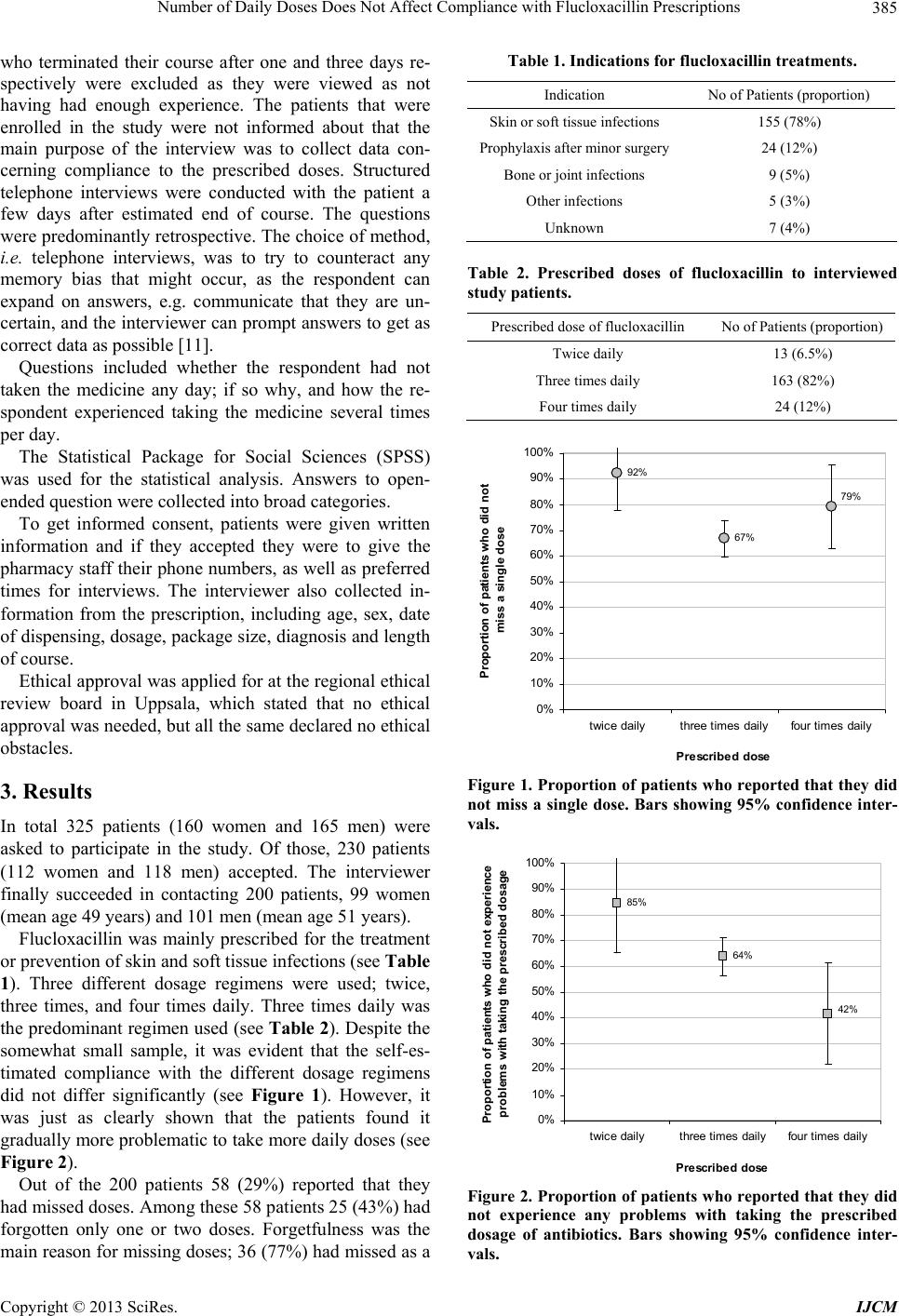 Number of Daily Doses Does Not Affect Compliance with Flucloxacillin Prescriptions 385 who terminated their course after one and three days re- spectively were excluded as they were viewed as not having had enough experience. The patients that were enrolled in the study were not informed about that the main purpose of the interview was to collect data con- cerning compliance to the prescribed doses. Structured telephone interviews were conducted with the patient a few days after estimated end of course. The questions were predominantly retrospective. The choice of method, i.e. telephone interviews, was to try to counteract any memory bias that might occur, as the respondent can expand on answers, e.g. communicate that they are un- certain, and the interviewer can prompt answers to get as correct data as possible [11]. Questions included whether the respondent had not taken the medicine any day; if so why, and how the re- spondent experienced taking the medicine several times per day. The Statistical Package for Social Sciences (SPSS) was used for the statistical analysis. Answers to open- ended question were collected into broad categories. To get informed consent, patients were given written information and if they accepted they were to give the pharmacy staff their phone numbers, as well as preferred times for interviews. The interviewer also collected in- formation from the prescription, including age, sex, date of dispensing, dosage, package size, diagnosis and length of course. Ethical approval was applied for at the regional ethical review board in Uppsala, which stated that no ethical approval was needed, but all the same declared no ethical obstacles. 3. Results In total 325 patients (160 women and 165 men) were asked to participate in the study. Of those, 230 patients (112 women and 118 men) accepted. The interviewer finally succeeded in contacting 200 patients, 99 women (mean age 49 years) and 101 men (mean age 51 years). Flucloxacillin was mainly prescribed for the treatment or prevention of skin and soft tissue infections (see Table 1). Three different dosage regimens were used; twice, three times, and four times daily. Three times daily was the predominant regimen used (see Table 2). Despite the somewhat small sample, it was evident that the self-es- timated compliance with the different dosage regimens did not differ significantly (see Figure 1). However, it was just as clearly shown that the patients found it gradually more prob lematic to take more daily d oses (see Figure 2). Out of the 200 patients 58 (29%) reported that they had missed doses. Among these 58 patients 25 (43%) had forgotten only one or two doses. Forgetfulness was the main reason for missing doses; 36 (77%) had missed as a Table 1. Indications for flucloxacillin treatments. Indication No of Patients (proportion) Skin or soft tissue infections 155 (78%) Prophylaxis after minor surgery24 (12%) Bone or joint infections 9 (5%) Other infections 5 (3%) Unknown 7 (4%) Table 2. Prescribed doses of flucloxacillin to interviewed study patients. Prescribed dose of flucloxacillin No of Patients (proportion) Twice daily 13 (6.5%) Three times dai ly 163 (82%) Four times dail y 24 (12%) 92% 67% 79% 0% 10% 20% 30% 40% 50% 60% 70% 80% 90% 100% t wice dail yt hree t i m es dail yfour tim es dail y Prescribed dose Proportion of patients who did not m iss a single d o se Figure 1. Proportion of patients who reported that they did not miss a single dose. Bars showing 95% confidence inter- vals. 85% 64% 42% 0% 10% 20% 30% 40% 50% 60% 70% 80% 90% 100% t wice dail yt hree t im es dai l yfour ti m es dail y Prescribed dose Proportion of patients who did not experience pro blems w i th taki n g th e prescribed d osag e Figure 2. Proportion of patients who reported that they did not experience any problems with taking the prescribed dosage of antibiotics. Bars showing 95% confidence inter- vals. Copyright © 2013 SciRes. IJCM  Number of Daily Doses Does Not Affect Compliance with Flucloxacillin Prescriptions 386 result of that. Missing doses was mainly due to changes in daily routines, such as going back to work. Adverse events were reported from three (6%) patients (see Table 3). 4. Discussion During the past decade, there has been an increasing awa reness of adhering to pharmacodynamic principles [9] in antibiotic treatments. Thus, the importance of doses being administered more frequently for the time-de- pendent antibiotics, such as the beta-lactams, has become evident [10]. The finding that more frequent daily dosing has led to poor compliance with the prescriptions [3,11] has thus been though t to be an obstacle to op timal antibi- otic dosing. However, recently Eide and co-workers pub- lished data from a study on antibiotic treatment in pri- mary health care in Norway which showed no significant differences in compliance between antibio tic regimens of three and four daily doses [12]. The results of our study further strengthen their findings that it is not evident that more doses lead to poorer compliance. Furthermore, our data show no differences in compliance to dosage regi- mens of twice, three times, or four times daily, despite reports from the patients that they find it increasingly difficult with more daily doses. However, our data show that patients seem to find it more problematic to take more doses per day. As flu- cloxacillin is often u sed under a short period of ti me, this might be an obstacle that is fairly easily overcome. Communication between prescriber and patient, and phar- macy staff and patient, in order to encourage patients to put up with these inconveniences should be highlighted. The results of this stud y are based on the answer s from patients during interviews. To reduce the risk of inter- viewer’s bias, all interviews are carried out in a system- atic way by the same interviewer. However, there is still a risk that missed doses are under-reported in the inter- views. Furthermore, only 200 out of the 325 patients (62%) that get flucloxacillin dispensed at the pharmacies participate in the study. Despite the risk of under-re- porting and a slight selection, there are no reasons to be- lieve that patients are more prone to be biased in respect to certain dosing regimens. As this is a real life study, differences in number of patients per regimen are inevita- ble. These results might reflect the intens ive focus on anti- biotic consumption an d resistant bacteria in Swedish me- dia during the past year. As a consequence, patients may have become more aware that unnecessary consumption of antibiotics might be harmful, an d that compliance with the prescribed dosages is impo rtant for maximal effect in those circumstances where antibiotics are needed. Also, prescribers and pharmacy staff might have been more pro n e to motivate patients with four doses, as this regimen Table 3. Answers to the question of “What was the reason for missing the dose/doses?” Reason No of Answers (proportion) I forgot 36 (77%) I ran out of medicine 2 (4%) Child with difficulties taking the medicine 2 (4%) Inconvenient due to activities 4 (9%) Adverse reaction 3 (6%) is fairly new to them as well. 5. Acknowledgements We thank the staff at the Apoteket AB pharmacies in Norrbotten, Sweden, includ ing Blåklo ckan in Sund erbyn, Manhem in Kalix, Lejonet in Luleå, Laxen in Boden, and Renen in Piteå. The project was performed with a grant from Norrbotten County Council, Sweden. REFERENCES [1] WHO, “The Evolving Threat of Antimicrobial Resistance: Options for Action,” WHO Library Cataloguing-in-Pub- lication Data, 2012. http://whqlibdoc.who.int/publications/2012/97892415031 81_eng.pdf [2] K. Krigsman, “Refill Adherence to Long-Ter m Drug Treat- ment with a Focus on Asthma/COPD Medication,” Ph.D. Thesis, Uppsala University, 2007. [3] J. Ho, D. M. Taylor, M. S. Cabalag, A. Ugoni and M. Yeoh, “Factors That Impact on Emergency Department Patient Compliance with Antibiotic Regimens,” Emer- gency Medicine Journal, Vol. 27, No. 11, 2010, pp. 815- 820. doi:10.1136/emj.2009.081984 [4] J. W. Cals, R. M. Hopstaken, P. H. Le Doux, G. A. Dries- sen, P. J. Nelemans and G. J. Dinant, “Dose Timing and Patient Compliance with Two Antibiotic Treatment Re- gimens for Lower Respiratory Tract Infections in Primary Care,” International Journal of Antimicrobial Agents, Vol. 31, No. 6, 2008, pp. 531-536. doi:10.1016/j.ijantimicag.2008.01.029 [5] B. S. Aronson, “Antibiotic-Taking Experiences of Under- graduate College Students,” Journal of the American Academy of Nurse Practitioners, Vol. 18, No. 12, 2006, pp. 591-508. doi:10.1111/j.1745-7599.2006.00184.x [6] K. Przemyslaw, “Comparison of Patients’ Compliance with Once-Daily and Twice-Daily Antibiotic Regimens in Respiratory Tract Infections: Results of a Randomized Trial,” Journal of Antimicrobial Chemotherapy, Vol. 59, No. 3, 2007, pp. 531-536.doi:10.1093/jac/dkl528 [7] S. Hernández, C. Bayona, M. Hernández, A. Moragas and O. Calvio, “Compliance Rate of Antibiotic Therapy in Pa- tients with Acute Pharyngitis Is Very Low, Mainly When Thrice-Daily Antibiotics Are Given,” Revista Espanola De Quimioterapia, Vol. 22, 2009, pp. 20-24. Copyright © 2013 SciRes. IJCM  Number of Daily Doses Does Not Affect Compliance with Flucloxacillin Prescriptions Copyright © 2013 SciRes. IJCM 387 [8] J. Claxton, J. Cramer and C. Pierce, “A Systematic Re- view of the Associations between Dose Regimens and Medication Compliance,” Clinical Therapeutics, Vol. 23, No. 8, 2001, pp. 1296-1310. doi:10.1016/S0149-2918(01)80109-0 [9] W. A. Craig, “Choosing an Antibiotic on the Basis of Pharmacodynamics,” Ear, Nose & Throat Journal, Vol. 77, No. 6, 1998, pp. 7-11. [10] C. A. DeRyke, S. Y. Lee, J. L. Kuti and D. P. Nicolau, “Optimising Dosing Strategies of Antibacterials Utilising Pharmacodynamic Principles: Impact on the Develop- ment of Resistance,” Drugs, Vol. 66, No. 1, 2006, pp. 1- 14. doi:10.2165/00003495-200666010-00001 [11] C. Llor, N. Sierra, S. Hernández, A. Moragas, M. He rnán- dez, C. Bayona and M. Miravitlles, “The Hi gher the Num- ber of Daily Doses of Antibiotic Treatment in Lower Res- piratory Tract Infection, the Worse the Compliance,” Journal of Antimicrobial Chemotherapy, Vol. 63, No. 2, 2009, pp. 396-399. doi:10.1093/jac/dkn472 [12] T. B. Eide, V. C. Hippe and M. Brekke, “The Feasibility of Antibiotic Dosing Four Times per Day: A Prospective Observational Study in Primary Health Care,” Scandina- vian Journal of Primary Health Care, Vol. 30, No. 1, 2012, pp. 16-20. doi:10.3109/02813432.2012.654196 |