

Paper Menu >>
Journal Menu >>
 Creative Education 2013. Vol.4, No.9, 611-613 Published Online September 2013 in SciRes (http://www.scirp.org/journal/ce) http://dx.doi.org/10.4236/ce.2013.49087 Copyright © 2013 SciRe s . 611 Critical Thinking as a Resilience Factor in an Engineering Program Benítez1, Canales2 1Master of Science Teaching, Polytechnic University of Pachuca, Pachuca, México 2Science Education, Autonomous University Hidalgo State, Pachuca, México Email: lybeco@upp. edu. mx, [email protected] Received July 25th, 2013 ; revised August 25th, 2013; accepted September 2nd, 2013 Copyright © 2013 Benítez, Canales. This is an open access article distributed under the Creative Commons At- tribution License, which permits unrestricted use, distribution, and reproduction in any medium, provided the original work is properly cited. In the current context of technical higher education in Mexico, there have been changes affecting the school community. The massification phenomenon and the implementation of a competence-based model are both challenges that college students must face. We present the preliminary results of the following research “Resilience skills development through protective and risk factors in engineering students”. In social sciences, resilience is presented as the individual’s ability to identify and solve problems, which impacts their own transformation and growth (Cyrulnik, 2004; Vanistendael, 2006; Melillo & Suarez, 2004). Developing resilience depends on certain resilience skills which through critical thinking streng- then students’ analysis and decision making. We used a mixed methodology because resilience emanates from the individual’s subjectivity. A quantitative study was applied to a sample of 105 students of which 23 were identified as having resilient characteristics. In the qualitative study the results show that 12 of these students had critical thinking as a protective factor. Keywords: Resilience; Critical Thinking; Engineering; Technical Higher Education Introduction This study is aimed at assessing the factors that generally af- fect the development of resilience skills in Mechatronics Engi- neering students from the Polytechnic University of Pachuca within the broader context of technical higher education in Me- xico. Thus it was necessary to reflect on the educational poli- cies implemented at the beginning of the 21st century, framed within the National Education Program 2001-2006 (PRONAE, acronym in Spanish), for which higher education is seen as the strategic means to increase human and social capital, science and technology, as well as important elements in contributing to increasing employment and competitiveness as dictated by the knowledge-based economy. These policies were also meant as a means to boost domestic production, social justice and cohesion, the consolidation of democracy and a national iden- tity based on cultural diversity and improving income distribu- tion among the population. Therefore a new educational subsystem was created: the Polytechnical Universities, which offer science and technology programs through a competence-based model. The different activities undertaken within this model become challenging as students are expected to become autonomous and active actors in their learning. In turn, this involves training teachers to as- sume their role as learning facilitators. Taking on these roles requires assertive communication directed at impacting student training. Another element to consider is that the cultural diver- sity found in university classrooms consists of a wide range of social, cultural, gender, economic and academic levels. Conse- quently, adaptation to the higher education context becomes a challenge. Even if you have implemented training programs for teachers teaching strategies aimed at developing thinking skills as con- tributions from Leming (1998) the goal of teaching students to thi n k c ri ti ca l ly is n ot y et secured. In this sense Nickerson (1994) notes that the development of the skills of higher order thinking in the university still sees little reason for increased research on the problem. Some evidence has shown that higher education students in a large percentage are struggling to make the kind of thinking that is required in college. Melillo (2004) in their research indicates that through protective factors such as critical thinking, mood, self-esteem, morale, creativity, independence, initiative and insight some people facing problematic situations and out adverse. Thus, different everyday life situations may become influ- encing factors on student permanence and the completion of studies (Cyrulnik, 2005). The results show critical thinking as a resilient factor. Com- petition is considered resilient to the ability of people to iden- tify, challenge, solve problems and emerge stronger to take on new challenges. Method The characteristics of resilience turn it into a complex issue that requires analysis. As Guba and Lincoln (1994) point out, resilience is framed by some dynamic realism within an inter- pretative epistemology and qualitative methodology, which could be defined as: “...one capable of incorporating the ques- tion of meaning and intentionality as inherent to the actions 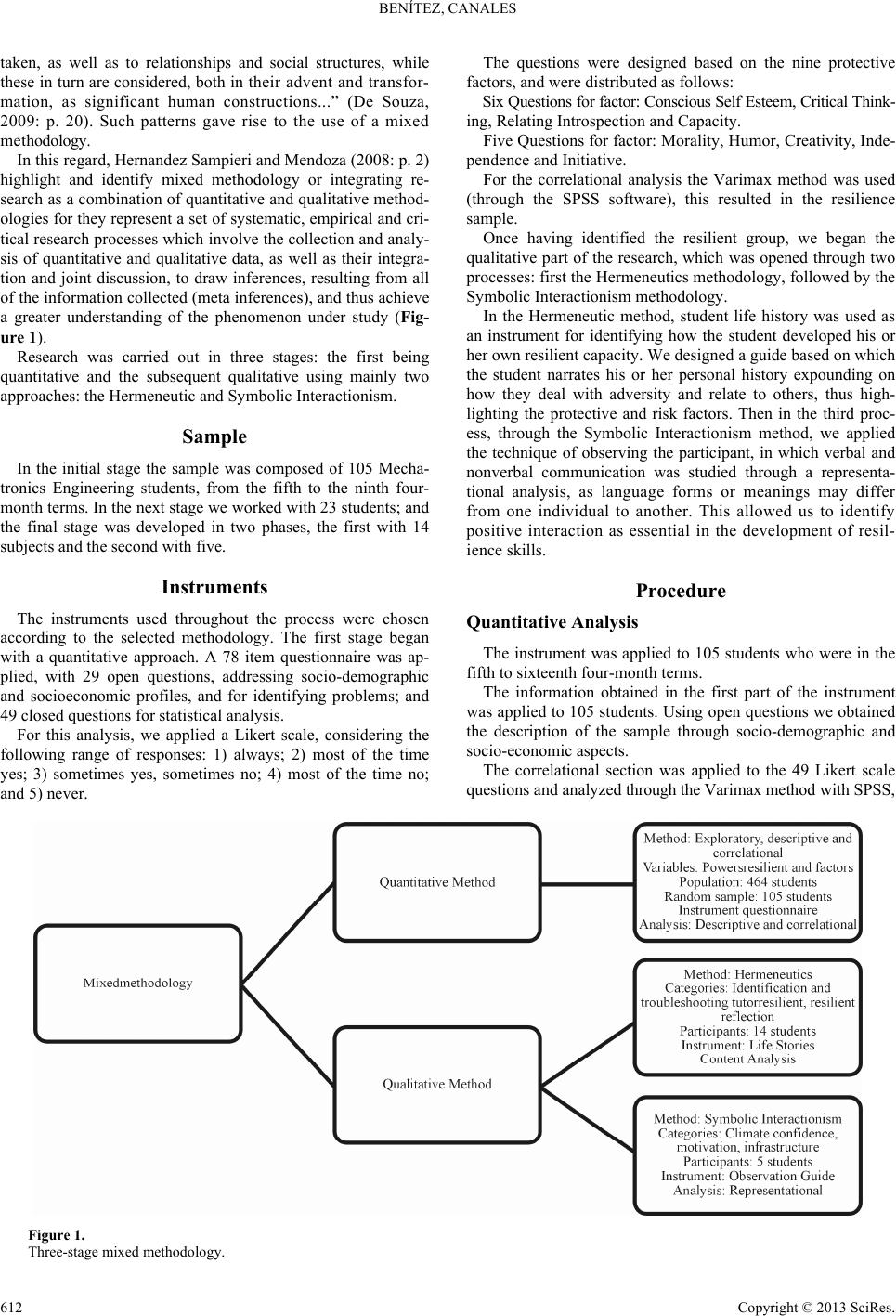 BENÍTEZ, CANALES Copyright © 2013 SciRe s . 612 taken, as well as to relationships and social structures, while these in turn are considered, both in t he ir ad ve nt a nd t ran sf or - mation, as significant human constructions...” (De Souza, 2009: p. 20). Such patterns gave rise to the use of a mixed methodology. In this regard, Hernandez Sampieri and Mendoza (2008: p. 2) highlight and identify mixed methodology or integrating re- search as a combination of quantitative and qualitative method- ologies for they represent a set of systematic, empirical and cri- tical research processes which involve the collection and analy- sis of quantitative and qualitative data, as well as their integra- tion and joint discussion, to draw inferences, resulting from all of the information collected (meta inferences), and thus achieve a greater understanding of the phenomenon under study (Fig- ure 1). Research was carried out in three stages: the first being quantitative and the subsequent qualitative using mainly two approaches: the Hermeneutic and Symbolic Interactionism. Sample In the initial stage the sample was composed of 105 Mecha- tronics Engineering students, from the fifth to the ninth four- month terms. In the next stage we worked with 23 students; and the final stage was developed in two phases, the first with 14 subjects and the s e c o n d with five. Instruments The instruments used throughout the process were chosen according to the selected methodology. The first stage began with a quantitative approach. A 78 item questionnaire was ap- plied, with 29 open questions, addressing socio-demographic and socioeconomic profiles, and for identifying problems; and 49 closed questions for statistical analysis. For this analysis, we applied a Likert scale, considering the following range of responses: 1) always; 2) most of the time yes; 3) sometimes yes, sometimes no; 4) most of the time no; and 5) never. The questions were designed based on the nine protective factors, and were distributed as follows: Six Questions for factor: Conscious Self Esteem, Critical Think- ing, Relating Introspection and Capacity. Five Questions for factor: Morality, Humor, Creativity, Inde- pendence and Ini t i ative. For the correlational analysis the Varimax method was used (through the SPSS software), this resulted in the resilience sample. Once having identified the resilient group, we began the qualitative part of the research, which was opened through two processes: first the Hermeneutics methodology, followed by the Symbolic Interactionism methodolog y. In the Hermeneutic method, student life history was used as an instrument for identifying how the student developed his or her own resilient capacity. We designed a guide based on which the student narrates his or her personal history expounding on how they deal with adversity and relate to others, thus high- lighting the protective and risk factors. Then in the third proc- ess, through the Symbolic Interactionism method, we applied the technique of observing the participant, in which verbal and nonverbal communication was studied through a representa- tional analysis, as language forms or meanings may differ from one individual to another. This allowed us to identify positive interaction as essential in the development of resil- ience skills. Procedure Quantita ti ve A n a l ysi s The instrument was applied to 105 students who were in the fifth to sixteenth four-month terms. The information obtained in the first part of the instrument was applied to 105 students. Using open questions we obtained the description of the sample through socio-demographic and socio-economic aspects. The correlational section was applied to the 49 Likert scale questions and analyzed through the Varimax method with SPSS, Figure 1. Three-stage mixed methodology.  BENÍTEZ, CANALES Copyright © 2013 SciRe s . 613 its validity was confirmed through a Cronbach Alpha test. Quantitative analysis resulted in the collection of the resilient sample comprised of 23 students who were also academically analyzed to reinforce the results obtained. Qualitative Analysi s Two different processes took place: the Hermeneutic Method and the Symbolic Interactionism Method. Hermeneutic Method: We worked with 14 students who agreed to continue collaborating with the research. A guide was used for working with the life history instrument. A matrix was de- signed for the analysis in order to identify the challenges ex- perienced by each student, it was found how students, in ad- dressing and overcoming childhood adversities, developed resilience in their lives, Vanistendael (2006). The second process employed the Symbolic Interactionism methodology. Through the interaction during a practice, we observed how a feeling of confidence is established which mo- tivates and fosters an assertive response to challenges on the part of the student. Finally, it was confirmed that a mixed methodology streng- thens subjective research as it provides greater validity by using two approaches. As well, we asserted that human beings de- velop their resilience during childhood, furthering it in different areas where they interact and coexist with others. Results The most relevant results in the quantitative stage were iden- tifying the behavior of the sample regarding the following risk factors: course failure, alcoholism, work and parents’ educa- tional level. Moreover the statistical analysis underlined critical thinking as one of the factors that foster resilient skills according to the Varimax analysis, which registered one of the highest values with .521 compared to other factors. Based on these results the sample was reduced to 23 students who presented resilient characteristics. As for the qualitative stage, content analysis of 14 life stories illustrated that through critical thinking students identified risk situations in their childhood that strengthened and helped them solve academic and social problems later in their lives. Finally, at the third stage, we identified factors through a re- presentational analysis, such as confidence, positive interac- tion and motivation focused on proactive thinking, which trig- gered the synergy to achieve the stated objective during a labo- ratory practice. Conclusion From the resilience approach critical thinking allows the in- dividual to analyze the causes and responsibilities associated with the adversity experienced, whenever it arises in different areas (family, school and/or social), while they seek ways to confront it and opt to change it (Melillo, 2004). Course failure as a risk factor becomes a protective factor when the student identifies and analyzes this problem through critical thinking, such a situation provides the student with self-confidence in decision-making. As results demonstrate there is a high rate of course failure, however, through an awareness of their academic situation resilient students take responsibility while facing and finding solutions to their learning problems through critical reflection, in turn, generating self-confidence, thus a risk factor becomes a protective one because instead of avoiding the problem, they face it and solve it. Alcoholism, an addiction also identified as a risk factor is confronted by the resilient student through focusing on their academic priorities, by deciding not to drink and instead nar- rowing in on their responsibilities as students. In this sense it is important to highlight that although some students come from families with college educated parents there are also some parents who are unable to read or write. It was found that resilient students’ origin does not define their destiny, because through their critical thinking, they are em- powered to change family patterns, preventing them from sink- ing into their problems, and facing them instead. They have sought out personal growth alternatives through the acquisition of new knowledge, skills and attitudes such as responsibility and commitment to their studies: Mechatronics Engineering. Finally it is shown that the protective factor of Critical Thinking is a resilience skill that strengthens college education. REFERENCES Cyrulnik, B. (2004). El encantamiento del mundo. Barcelona, España: Gedisa. Cyrulnik, B. (2005). The love that heals us. Barcelona, Spain: Gedisa. Hernández, R., & Mendoza, C. (2008). Quantitative and qualitative marriage: Mixed paradigm. In J. L. Alvarez G (Ed.), 6th Research Congress of Sexology. Congress Made by the Mexican Institute of Sexology, A. C. and Juarez Autonomous University of Tabasco, Vil- lahermosa, Tabasco, Mexico. Leming, J. S. (1998). Some critical thoughts about the teaching of critical thinking. The Social Studies, 89, 61-66. doi:10.1080/00377999809599826 Melillo, A. (2004). Resilience and subjectivity. Life cycles. Buenos Aires, Argentina: Paidós Press. Nickerson, R. S. (1994). The teaching of thinking and problem solving. In R. J. Sternberg (Ed.), Thinking and problem solving (pp. 409-449). San Diego, CA: Academic Press. Vanistendael, S., & Lecomte, J. (2006). La felicidad es posible. Des- pertar en los niños maltratados la confianza en sí mismos: Construir la resiliencia. España: Gedisa. |