

Paper Menu >>
Journal Menu >>
 Open Journal of Nephrology, 2013, 3, 135-138 http://dx.doi.org/10.4236/ojneph.2013.33025 Published Online September 2013 (http://www.scirp.org/journal/ojneph) A Case of Type I Hepatorenal Syndrome Treated with Vasopressin Laura Connor1, Geoffrey Teehan2,3 1Department of Internal Medicine, Lankenau Medical Center, Wynnewood, USA 2Department of Nephrol ogy, Lankenau Medical Center, Wynnewood, USA 3Lankenau Institute of Medical Research, Wynnewood, USA Email: [email protected] Received July 3, 2013; revised August 2, 2013; accepted August 13, 2013 Copyright © 2013 Laura Connor, Geoffrey Teehan. This is an open access article distributed under the Creative Commons Attribu- tion License, which permits unrestricted use, distribution, and reproduction in any medium, provided the original work is properly cited. ABSTRACT Hepatorenal syndrome (HRS) is a grave complication of end-stage liver disease and is associated with a very high mor- tality. This case report described a 42-year-old female with advanced alcohol-induced cirrhosis who developed HRS that was initially treated with Midodrine an d Octreotide bu t renal function co ntinu ed to deterior ate. Vasopressin therapy was added and HRS was successfully reversed. There are few data available on the use of vasopressin for HRS and this case supports its use in treatment of HRS, particularly in countries where the more widely studied Terlipressin is un- available. This case also demons trates that a patient failing one medical therapy for HRS may respond to an alternative or adjunctive therapy. Therefore, this should be attempted to increase the patie nt’s chance of survival. Keywords: Hepatorenal Syndrome; Vasopressin 1. Introduction Hepatorenal syndrome (HRS) is a grave complication of end-stage liver disease and is associated with a very high mortality. It is characterized by arterial vasodilation of the splanchnic vessels leading to pronounced renal vaso- constriction, marked reduction in renal blood flow and glomerular filtration rate [1]. HRS is classified into two types based on the rate of progression of the renal dys- function. Type 1 is characterized by an abrupt onset and a rapid progression of renal failure over a period of two weeks or less with a median survival of one to two weeks. Type 2 causes a more slowly progressive renal failure, typically over months with a median survival of about six months [2]. Management of HRS is challenging since the ideal treatment is liver transplantation, which is usually difficult to accomplish in a short timeframe. Therefore, patients with HRS are typically managed medically with the goal to improve renal function and survival as a bridge to transplantation. In Europe, the Vasopressin ana- logue Terlipressin, has been used successfully. Unfortu- nately, this medication is costly and not available in many countries, including North America [1]. Here, we present a case of Type 1 Hepatorenal Syndrome that is successfu l l y reverse d w i t h v asopress in. 2. Case Report A 43-year-old female with no significant past medical history presented to the emergency department complain- ing of bilateral lower extremity edema, abdominal pain, nausea, and vomiting that had progressively worsened over the past month. Review o f systems was positive for jaundice, increased abdominal girth, fevers, and occasio- nal hematochezia and hematemesis. She had been taking three to four grams of Acetaminophen daily for the past three months for rib pain, and been consuming two to three alcoholic drinks per day, three to four times a week. She was admitted to the hospital February 2011 for in- vestigation of her symptoms. The workup disclosed probable alcohol-induced cir- rhosis compounded by concomitant use of acetamino- phen. On hospital day 9, the patient’s urine output de- clined to 14 cc/hr an d urine sodium was low (<10 meq/l) suggesting Hepatorenal Syndrome despite a stable creati- nine. She was treated with Octreotide and Midodrine for 5 days while the serum creatinine remained stable. On hospital day 18, the patient developed acute kidney injury with creatinine increasing from 1.0 mg/dl to 1.3 mg/dl. The etiology was either pre-renal from increasing diuretics versus hepatorenal syndrome. Urine sodium C opyright © 2013 SciRes. OJNeph 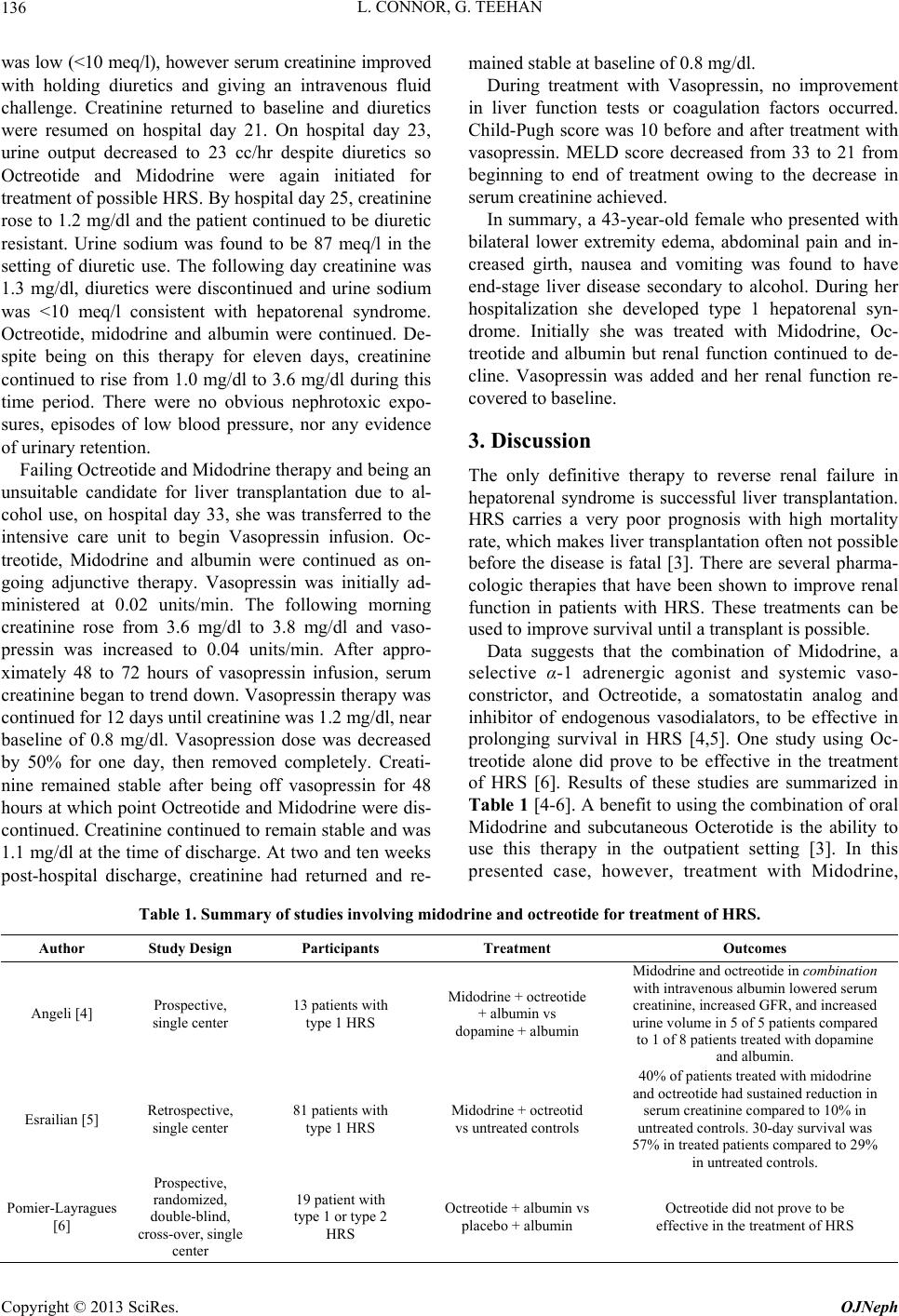 L. CONNOR, G. TEEHAN 136 was low (<10 meq/l), however serum creatinine improved with holding diuretics and giving an intravenous fluid challenge. Creatinine returned to baseline and diuretics were resumed on hospital day 21. On hospital day 23, urine output decreased to 23 cc/hr despite diuretics so Octreotide and Midodrine were again initiated for treatment of possible HRS. By hospital day 25, creatinine rose to 1.2 mg/dl and the patient continued to be diuretic resistant. Urine sodium was found to be 87 meq/l in the setting of diuretic use. The following day creatinine was 1.3 mg/dl, diuretics were discontinued and urine sodium was <10 meq/l consistent with hepatorenal syndrome. Octreotide, midodrine and albumin were continued. De- spite being on this therapy for eleven days, creatinine continued to rise from 1.0 mg/dl to 3.6 mg/d l during this time period. There were no obvious nephrotoxic expo- sures, episodes of low blood pressure, nor any evidence of urinary retention. Failing Octreotide and Midodrine therapy and being an unsuitable candidate for liver transplantation due to al- cohol use, on hospital day 33, she was transferred to the intensive care unit to begin Vasopressin infusion. Oc- treotide, Midodrine and albumin were continued as on- going adjunctive therapy. Vasopressin was initially ad- ministered at 0.02 units/min. The following morning creatinine rose from 3.6 mg/dl to 3.8 mg/dl and vaso- pressin was increased to 0.04 units/min. After appro- ximately 48 to 72 hours of vasopressin infusion, serum creatinine began to tren d down. Vasopressin therapy was continued for 12 days until creatinine was 1.2 mg/dl, n ear baseline of 0.8 mg/dl. Vasopression dose was decreased by 50% for one day, then removed completely. Creati- nine remained stable after being off vasopressin for 48 hours at which point Octreo tide and Midodrine were dis- continued. Creatinine co ntinued to remain stable and was 1.1 mg/dl at the time of discharge. At two an d ten weeks post-hospital discharge, creatinine had returned and re- mained stable at baseline of 0.8 mg/dl. During treatment with Vasopressin, no improvement in liver function tests or coagulation factors occurred. Child-Pugh score was 10 before and after treatment with vasopressin. MELD score decreased from 33 to 21 from beginning to end of treatment owing to the decrease in serum creatinine achieved. In summary, a 43-year-old female who presented with bilateral lower extremity edema, abdominal pain and in- creased girth, nausea and vomiting was found to have end-stage liver disease secondary to alcohol. During her hospitalization she developed type 1 hepatorenal syn- drome. Initially she was treated with Midodrine, Oc- treotide and albumin but renal function continued to de- cline. Vasopressin was added and her renal function re- covered to baseline. 3. Discussion The only definitive therapy to reverse renal failure in hepatorenal syndrome is successful liver transplantation. HRS carries a very poor prognosis with high mortality rate, which makes liver transplan tation often not possible before the disease is fatal [3]. There are several pharma- cologic therapies that have been shown to improve renal function in patients with HRS. These treatments can be used to improve survival until a transplant is possible. Data suggests that the combination of Midodrine, a selective α-1 adrenergic agonist and systemic vaso- constrictor, and Octreotide, a somatostatin analog and inhibitor of endogenous vasodialators, to be effective in prolonging survival in HRS [4,5]. One study using Oc- treotide alone did prove to be effective in the treatment of HRS [6]. Results of these studies are summarized in Table 1 [4-6]. A benefit to using the combination of oral Midodrine and subcutaneous Octerotide is the ability to use this therapy in the outpatient setting [3]. In this presented case, however, treatment with Midodrine, Table 1. Summary of studies involving midodrine and octreotide for treatment of HRS. Author Study Design Participants Treatment Outcomes Angeli [4] Prospective, single center 13 patients with type 1 HRS Midodrine + octreotide + albumin vs dopamine + albumin Midodrine and octreotide in combination with intravenous albumin lowered serum creatinine, increased GFR, and increased urine volume in 5 of 5 patients compared to 1 of 8 patients treated with dopam ine and albumin. Esrailian [5] Retrospective, single center 81 patients with type 1 HRS Midodrine + octreotid vs untreated controls 40% of patients treated with midodrine and octreotide had sustained reduction in serum creatinine compared to 10% in untreated controls. 30-day survival was 57% in treated patients compared to 29% in untreated controls. Pomier-Layragues [6] Prospective, randomized, double-blind, cross-over, single center 19 patient with type 1 or type 2 HRS Octreotide + albumin vs placebo + albumin Octreotide did not prove to be effective in the treatment of HRS Copyright © 2013 SciRes. OJNeph 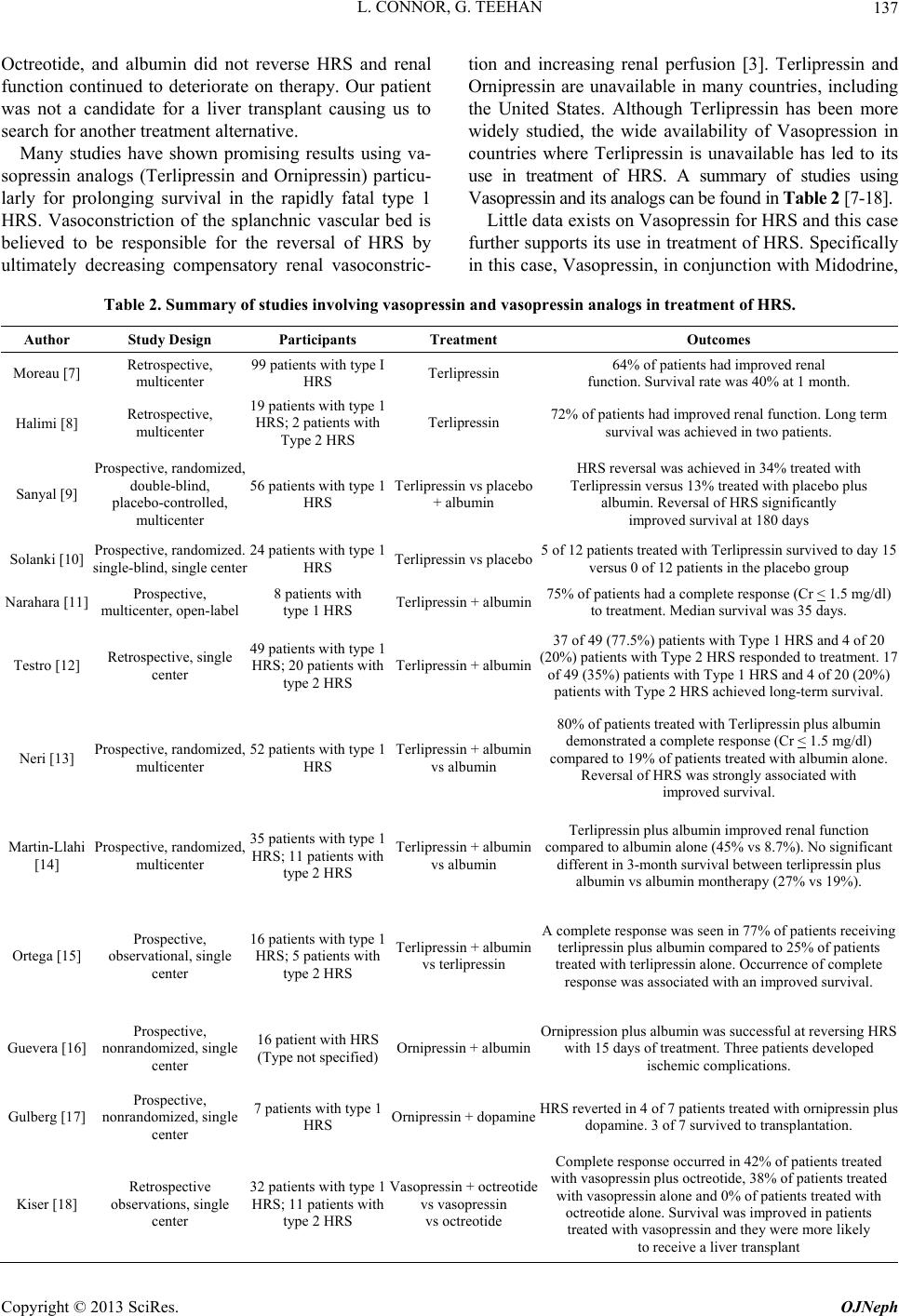 L. CONNOR, G. TEEHAN 137 Octreotide, and albumin did not reverse HRS and renal function continued to deteriorate on therapy. Our patient was not a candidate for a liver transplant causing us to search for another treatment alternative. Many studies have shown promising results using va- sopressin analogs (Terlipressin and Ornipressin) particu- larly for prolonging survival in the rapidly fatal type 1 HRS. Vasoconstriction of the splanchnic vascular bed is believed to be responsible for the reversal of HRS by ultimately decreasing compensatory renal vasoconstric- tion and increasing renal perfusion [3]. Terlipressin and Ornipressin are unavailable in many countries, including the United States. Although Terlipressin has been more widely studied, the wide availability of Vasopression in countries where Terlipressin is unavailable has led to its use in treatment of HRS. A summary of studies using Vasopressin and its analogs can be found in Table 2 [7-18]. Little data exists on Vasopressin for HRS and this case further supports its use in treatment of HRS. Specifically in this case, Vasopressin, in conjunction with Midodrine, Table 2. Summary of studies involving vasopressin and vasopressin analogs in treatment of HRS. Author Study Design Participants Treatment Outcomes Moreau [7] Retrospective, multicenter 99 patients with type I HRS Terlipressin 64% of patients had improved renal function. Survival rate was 40% at 1 month. Halimi [8] Retrospective, multicenter 19 patients with type 1 HRS; 2 patients with Type 2 HRS Terlipressin 72% of patients had improved renal function. Long term survival was achieved in two patients. Sanyal [9] Prospective, r andomized, double-blind, placebo-controlled, multicenter 56 patients with type 1 HRS Terlipressin v s p l a c e bo + albumin HRS reversal was achieved in 34% treated with Terlipressin versus 13% treated with placebo plus albumin. Reversal of HRS significantly improved surviva l a t 18 0 d ays Solanki [10] Prospective, r andomized. single-blind, single center 24 patients with type 1 HRS Terlipressi n vs placebo5 of 12 patien ts treated with Terlipressin survived to day 15 versus 0 of 12 patients in the placebo group Narahara [11] Prospective, multicenter, open-label 8 patients with type 1 HRS Terlipressin + album in75% of patients had a complete response (Cr < 1.5 m g/dl) to treatment. Median survival was 35 days. Testro [12] Retrospective, single center 49 patients with type 1 HRS; 20 patients with type 2 HRS Terlipressin + album in 37 of 49 (77.5%) pa ti en ts wi th T ype 1 HRS and 4 of 20 (20%) patients with Type 2 HRS responded to tre a t ment. 17 of 49 (35%) patients with Type 1 HRS and 4 of 20 (20%) patients with Type 2 HRS achieved long -term survival. Neri [13] Prospective, r andomized, multicenter 52 patients with type 1 HRS Terlipressin + a lb u min vs albumin 80% of patients treated with Terlipressin plus albumin demonstrated a complete response (Cr < 1.5 mg/dl) compared to 19% of patients treated wit h albumin alone. Reversal of HRS was strongly associated with improved survival. Martin-Llahi [14] Prospective, randomized, multicenter 35 patients with type 1 HRS; 11 patients with type 2 HRS Terlipressin + a lb u min vs albumin Terlipressin pl u s a lb umin improved renal function compared to alb umin alone (45% vs 8.7%). No significant different in 3-month survival between terlipressin plus albumin vs albumin montherapy (27% vs 19%) . Ortega [15] Prospective, observational, single center 16 patients with type 1 HRS; 5 patients with type 2 HRS Terlipressin + a lb u min vs terlipressin Acomplete response was seen in 77% of patients receiving terlipressin plus albumin compared t o 2 5 % o f p at i e nt s treated with terlipressin alone. Occurrence of complete response was associated with an improved survival. Guevera [16] Prospective, nonrandomize d, single center 16 patient with HRS (Type not specified)Ornipressin + albuminOrnipression plus albumin was successful at reversing HRS with 15 days of treatment. Three patients dev elo pe d ischemic complications. Gulberg [17] Prospective, nonrandomize d, single center 7 patients with type 1 HRS Ornipressin + do pamineHRS reverted in 4 of 7 patients treated wit h ornipressin plus dopamine. 3 of 7 survived to transplantat i o n. Kiser [18] Retrospective observations, si ngle center 32 patients with type 1 HRS; 11 patients with type 2 HRS Vasopressin + octreotide vs vasopressin vs octreotide Complete response occurred in 42% of patients treated with vasopressin plus octreotid e, 38% of patients treated with vasopressin alone and 0% of patients treated with octreotide alone. Survival was improved in patients treated with vasopressin and they were more likely to receive a liver transplant Copyright © 2013 SciRes. OJNeph  L. CONNOR, G. TEEHAN 138 Octreotide and albumin successfully reversed HRS. This case also demonstrates that a patient failing one medical therapy for H RS may respond to an altern ativ e or adjun c- tive therapy; therefore these methods should be attemp- ted to increase the patient’s chance of survival. 4. Conclusion In conclusion, we have reported a case of type 1 HRS that is successfully treated with vasopressin. There are studies in Europe using terlipressin that have shown some success, however, terlipressin is not available in many countries. Since terlipressin is not available in the United States, vasopressin is used as an alternative and is successful in this reported case. We would advocate the use of vasopressin where terlipressin is unavailable, par- ticularly when other available treatments are failing to reverse r e n a l failure. REFERENCES [1] C. Alessandria, A. Ottobrelli, W. Debernardi-Venon, L. Todros, M. T. Cerenzia, S. Martini, et al., “Noradrenalin vs Terlipressin in Patients with Hepatorenal Syndrome: A Prospective, Randomized, Unblinded, Pilot Study,” Jour- nal of Hepatology, Vol. 47, No. 4, 2007, pp. 499-505. doi:10.1016/j.jhep.2007.04.010 [2] S. J. Munozo, “The Hepatorenal Syndrome,” Medical Cli- nics of North America, Vol. 92, No. 4, 2008, pp. 813-837. doi:10.1016/j.mcna.2008.03.007 [3] T. H. Kiser, R. Maclaren and D. N. Fish, “Treatment of Hepatorenal Syndrome,” Pharmacotherapy, Vol. 29, No. 10, 2009, pp. 1196-1211. doi:10.1592/phco.29.10.1196 [4] P. Angeli, R. Volpin, G. Gerunda, R. Craighero, P. Roner, R. Merenda, et al., “Reversal of Type 1 Hepatorenal Syn- drome with the Administration of Midodrine and Octreo- tide,” Hepatology, Vol. 29, No. 6, 1999, pp. 1690-1697. doi:10.1002/hep.510290629 [5] E. Esrailian, E. R. Pantangco, N. L Kyulo, K. Q. Hu and B. A. Runyon, “Octreotide/Midodrine Therapy Signifi- cantly Improves Renal Function and 30-Day Survival in Patients with Type 1 Hepatorenal Syndrome,” Digestive Diseases and Sciences, Vol. 52, No. 3, 2007, pp. 742-748. doi:10.1007/s10620-006-9312-0 [6] G. Pomier-Layragues, S. C. Paquin, Z. Hassoun, M. La- fortune and A. Tran, “Octreotide in Hepatorenal Syn- drome: A Ransomized Double-Blind, Placebo-Controlled, Corssover Study,” Hepatology, Vol. 38, No. 1, 2003, pp. 238-243. doi:10.1053/jhep.2003.50276 [7] R. Moreau, F. Durand, T. Poy nard, C. Duhamel, J. P. Cer- voni, P. Ichai, et al., “Terlipressin in Patients with Cir- rhosis and Type 1 Hepatorenal Syndrome: A Retroepsc- tive Mulitcenter Study,” Gastroenterology, Vol. 122, No. 4, 2002, pp. 923-930. doi:10.1053/gast.2002.32364 [8] C. Halimi, P. Bonnard, D. Bernard, P. Mathurin, A. Mo- fredj, V. Martino, et al., “Effect of Terlipressin (Gly- pressin) on Hepatorenal Syndrome in Cirrhotic Patients: Results of a Multicentre Pilot Study,” European Journal of Gastroenterology & Hepatology, Vol. 14, No. 2, 2002, pp. 153-158. doi:10.1097/00042737-200202000-00009 [9] A. J. Sanyal, T. Boyer, G. Ga rcia-Tsao, F. Regenstein, L. Rossaro, B. Appenrodt, et al., “A Randomized, Pros- pective, Double-Blind, Placebo-Controlled, Trial of Terli- pressin for Type 1 Hepatorenal Syndrome,” Gastroente- rology, Vol. 143, No. 5, 2008, pp. 1360-1368. doi:10.1053/j.gastro.2008.02.014 [10] P. Solanki, A. Chawla, R. Garg, R. Gupta, M. Jain and S. K. Sarin, “Beneficial Effects of Terlipressin in Hepa- torenal Syndrome: A Prospective, Randomized Placebo- Controlled Clinical Trial,” Journal of Gastroenterology Hepatology, Vol. 18, No. 2, 2003, pp. 152-156. doi:10.1046/j.1440-1746.2003.02934.x [11] Y. Narahara, H. Kanazawa, C. Sakamoto, H. Maruyama, O. Yokosuka, S. Mochida, et al., “The Efficacy and Safe - ty of Terlipressin and Albumin in Patients with Type 1 Hepatorenal Syndrome: A Multicenter, Open-Label, Ex- plorative Study,” Journal of Gastroenterology, Vol. 47, No. 3, 2011, pp. 313-320. doi:10.1007/s00535-011-0485-8 [12] A. G. Testro, S. Wongseelashote, P. W. Angus and P. J. Gow, “Long-Term Outcome of Patients Treated with Ter- lipre ssi n fo r Ty pe s 1 a nd 2 He pa tor e na l Sy n dr ome , ” Jour- nal of Gastroenterology and Hepatology, Vol. 23, No. 10, 2008, pp. 1535-1540. doi:10.1111/j.1440-1746.2007.05176.x [13] S. Neri, D. Pulvirenti, M. Malaguarnera, B. M. Cosimo, G. Bertino, L. Ignaccolo, et al., “Terlipressin and Albu- min in Patients with Cirrhosis and Type I Hepatorenal Syndrome,” Digestive Diseases and Sciences, Vol. 53, No. 3, 2008, pp. 830-835. doi:10.1007/s10620-007-9919-9 [14] M. Martin-Llahi, M. N. Pepin, M. Guevara, F. Diaz, A. Torre, A. Monescillo, et al., “Terlipressin and Albumine vs. Albumin in Patients with Cirrhosis and Hepatorenal Syndrome: A Randomized Study,” Gastroenterology, Vol. 134, No. 5, 2008, pp. 1353-1359. doi:10.1053/j.gastro.2008.02.024 [15] R. Ortega, P. Gines, J. Uriz, A. Cardenas, B. Calahorra, D. De Las Heras, et al., “Terlipressin Therapy with and without Albumin for Patients with Hepatorenal Syndrome: Results of a Prospective, Nonrandomized Study,” Hepa- tology, Vol. 36, No. 4, 2002, pp. 941-941. doi:10.1053/jhep.2002.35819 [16] M. Guevera, P. Gines, G. Fernandez-Esparrach, P. Sort, J. M. Salmero, W. Jimenez, et al., “Reversibility of Hepa- torenal Syndrome by Prolonged Administration of Ornipressin and Plasma Volume Expansion,” Hepatology, Vol. 27, No. 1, 1998, pp. 35-41. doi:10.1002/hep.510270107 [17] V. Gulberg, M. Blizer and A. L. Gerbes, “Long-Term Therapy and Retreatment of Hepatorenal Syndrome Type 1 with Ornipressin and Dopamine,” Hepatology, Vol. 30, No. 4, 1999, pp. 870-875. doi:10.1002/hep.510300430 [18] T. H. Kiser, D. N. Fish, M. D. Obritsch, R. Jung, R. MacLaren and C. R. Rarikh, “Vasopressin, Not Octreo- tide, May Be Beneficial in the Treatment of Hepatorenal Syndrome: A Retrospective Study,” Nephrology Dialysis Transplantation, Vol. 20, No. 9, 2005, pp.1813-1820. doi:10.1093/ndt/gfh930 Copyright © 2013 SciRes. OJNeph |