

Paper Menu >>
Journal Menu >>
 Psychology 2013. Vol.4, No.9A2, 7-12 Published Online September 2013 in SciRes (http://www.scirp.org/journal/psych) http://dx.doi.org/10.4236/psych.2013.49A2002 Copyright © 2013 SciRes. 7 Team Play in Football: How Science Supports F. C. Barcelona’s Training Strategy Philippe Chassy Department of Psychology, Liverpool Hope University, Liverpool, UK Email: [email protected] Received June 30th, 2013; revised August 1st, 2013; accepted August 29th, 2013 Copyright © 2013 Philippe Chassy. This is an open access article distributed under the Creative Commons At- tribution License, which permits unrestricted use, distribution, and reproduction in any medium, provided the original work is properly cited. The paper applies the theory of self-organising systems to sport. The central hypothesis is that team play, implemented as passing in football, is the central factor generating performance. Data from the 2013 European Champions League were used to show that passing speed and precision predict domination (possession), shooting opportunities and performance. By using principal component analysis, the article offers a formula to estimate the team play of any team considering its passing speed, passing precision and ability to score. The compound measure accounts for about 42% of the variance in performance. The impact of this research on the training of football players is discussed. Keywords: Passing; Expertise; Football; Team Play; Self-Organisation Introduction The present paper proposes to examine team performance in sports through the lens of the theory of self-organised systems. Self-organisation is concerned with how dynamics at the local level determine coordination and cohesion at the system level. Primarily used in physics (Prigogine & Nicolis, 1977), the the- ory of self-organisation has developed ramifications in numer- ous disciplines such as biology (Camazine et al., 2003), artifi- cial intelligence (Fan & Yen, 2004), and sociology (Radzicki, 1990). Self-organisation in football has been used to analyse the dynamical characteristics of the actions leading to a goal (Gre- haigne, Bouthier, & David, 1997; McGarry, Anderson, Wallace, Hughes, & Franks, 2002). In spite of this interesting research, the theory of self-organising systems has received compara- tively little attention in sports. Recently, the ongoing research on the sources of performance has sparked a controversy on the role of possession in performance; some authors believe that mere possession ensures good performance while others believe that possession is not a sufficient factor (Collet, 2013; Jones, James, & Mellalieu, 2004; Lago-Ballesteros, Lago-Peñas, & Rey, 2012; Lago & Martin, 2007). The present paper will use the self organising theory to show that researchers have over- looked the central role of passing. We further show that the application of the theory of self-organising systems to sport has some implications on identifying the cognitive factors that un- derpin performance. The theoretical section introduces the con- cept of self-organisation and how it applies to sport psychology. In the second section, evidence from professional games is used to show how self-organisation reveals the factors underlying team play in world-class football. Finally, the contribution of the present approach in developing new training areas in foot- ball is discussed. Theory Self-organisation in biological systems (i.e., made of living organisms) emerges whenever the capabilities of an individual to comply with the task are not sufficient. In such case, the coordinated effort of many individuals is required. An illustra- tive case of self-organising systems is societies of insects (Bonabeau, Theraulaz, Deneubourg, Aron, & Camazine, 1997). By noticing the apparent synchrony at the system level, a naïve observer might conclude that the animals follow a general plan. For example, in spite of being mostly blind, ants can coordinate the efforts of hundreds of thousands to explore a region around the nest and organise the collection of food along well-defined paths (Deneubourg & Goss, 1989). Research has revealed that the perception of units being coordinated by a general working plan is an illusion; the animals actually respond to local patterns (Karsai & Theraulaz, 1995). At the system level, the illusion stems from the fact that each animal responds as promptly as possible to the incentives and stimulations that are relevant to its function. In several circumstances animals can cooperate in small groups and coordinate actions between groups. Yet, each animals carries out part of the work without knowledge of what the others are doing. What is referred to as collective intelli- gence is thus the efficiency that emerges at the group level from distributed organisation. The representation of the task is, also, distributed among agents; no one animal has a representation of the big picture. More than the actual knowledge of each animal, it is the speeded coordination of their work that generates effi- ciency. The behavioural pattern of the colony emerges as a result of rules applied at the local level. Self-organisation is thus concerned with how individual skills and abilities create a group behaviour which has characteristics of its own. The present paper will use football to apply self-organisation in sports. Previous studies have demonstrated that teams can be  P. CHASSY Copyright © 2013 SciRes. 8 conceptualised as dynamical systems (Grehaigne, Bouthier, & David, 1997; McGarry, Anderson, Wallace, Hughes, & Franks, 2002). In this perspective, the dynamics of opposing teams of similar strength usually generate a stable state. In football, a stable state indicates that the speed and coordination of the attackers is balanced by the speed and coordination of the de- fenders. Sporadically though, the equilibrium is altered by a perturbation of the system, consider for example a penetrating pass. Should the perturbation be sufficient to break out the equilibrium then the dynamics of the attacker dominates the one of the defender, potentially creating a shooting opportunity. The theory of self-organised systems has enabled researchers to integrate several variables at different levels into a mathemati- cal description. Since we consider living organisms, the dy- namics are ultimately underpinned by cognitive abilities. The present paper will complete the research in the field by speci- fying the nature of the cognitive factors operating at both the team and individual levels. The situation at the individual level is determined by the constraints that competitive, professional football imposes on cognitive processes. Carling (2010) recorded the behavioural performance of 28 professional players during 30 first-division league games taking place over two seasons. Averaged across possessions, a player covers about 4 meters at a speed of 12.9 km/h during which he touches the football 2.1 times. The dura- tion of the possession is 1.1 second in average. Such a time window limits drastically the options that a player can explore before making a decision. The 4 meters of progress when in possession of the ball seem negligible (4.4%) when compared to the length of a pitch (120 m). It is worth noting that 4 meters is also the average distance of the closest opponent when re- ceiving the ball. These huge constraints stem from the fact that opposed to the multitude, a single individual cannot win. The solution lies in an exact coordination of actions that will over- come the sum of the individual skills of the opponents. Coordination of action within the framework of self-organi- sation translates as team play in sports. Anecdotal evidence supports the view that team play can overcome the sum of the individual skills for having the best player in one’s team does not necessarily ensure victory. A perfect indicator of team play is passing for it entails all the skills that a player needs to re- spond appropriately to the proximal configuration of teammates and opponents. Furthermore, for a pass to be complete, the player should know where the teammate is, know how to tech- nically make the pass and properly execute motor program. Hence, the number of passes constitutes an elementary, yet very accurate, measure of the degree of coordination of the players. In line with the theory of self-organising systems, professional teams (i.e., experts) must demonstrate better dynamics (i.e., coordination) and thus better passing skills than non-profes- sional teams. Russell (2010) recorded the performance of 10 recreational players and 10 professional players in a wide range of physical and technical skills. They found that professional players were 14% faster and 17% more precise when passing than recreational players. The authors showed in parallel that the mean dribbling speed, that is the individual ability to pro- gress with the ball, did not differ between the two levels of expertise. That skills relating to team play are on average more developed than individual skills supports the self-organising systems as a valid theoretical framework. Possession of the ball has been considered to be a significant factor in generating performance (Jones et al., 2004; Lago- Ballesteros et al., 2012; Lago & Martin, 2007). Yet, by ana- lysing games played at the international level over a three-year period, Collet (2013) has showed that possession actually cor- relates negatively with performance when other factors influ- encing play are accounted for (i.e., home advantage). In line with Collet’s findings, it could be argued that to speed up the process of bringing the ball close to the opponents’ goal the minimum number of passes would be required. This view would also be consistent with the idea that minimizing the number of passes should reduce the opponent’s time to respond. Empirical data has demonstrated otherwise, Hughes (2005) has analysed the relationship between the number of passes per possession and the frequency of shots and found a positive correlation meaning that the more passes per possession the more shots a team gets. Another study informative of the rela- tionship between possession and performance was conducted by Redwood-Brown (2008). The author showed that the fre- quency of passes actually increases before the goal. Consider- ing self-organising systems as the framework these results sug- gest that it is not possession that matters as much as the ability of the team to self-organise when it is in possession of the ball; an ability that is reflected by the speed at which the players pass the ball to one another. Hence, possession is not the factor that is to be correlated with performance: It is the frequency and precision of the passes. The core principle underlying self-organised systems is that organisation at the group level emerges from local interactions. In football, the ability to move as a group is underpinned by the passing abilities of individual players. Should self-organisation be efficient, then the acquisition of the ball, by any player of the team, should lead to the ball being passed from one player to the next until the ball is passed to the player best positioned for shooting. From this logic, we distinguish two factors in the formalisation of a team’s performance. The first factor relates to the ability of the team to pass the ball while changing its spatial configuration to progress on the pitch. At the player level, the first factor refers to the ability of player to pass accu- rately when in possession and to occupy spaces when a team- mate is in possession. The more teammates create space at proximity of the possessor of the ball, the more options a player has to make a pass, the more likely the player will make a pass that makes the team progress as a group towards the goal. At the team level it is thus essential to keep changing the spatial configuration of the players so as to limit the capacity of the defender to adapt. Passing in an ever-changing spatial configu- ration of players requires perfect coordination. The ability to pass efficiently thus reflects how quickly a team can change its configuration, and how efficient it is at moving as a whole. If the defenders have less team play than the attackers their or- ganisation will collapse and spaces will be opened for the at- tackers. The second factor is the ability of the shooter to score a goal. Since it is rare that goals are scored by the sole action of one player, the ability of a team to score a goal also depends on passing abilities. It is commonly measured by the ability of the shooter to convert a try (shoot) into a goal. Within the framework of self organising systems, the ability of a team to make frequent and accurate passes reflects its level of self-organisation which should predict its ability to keep the ball and its ability to generate shooting opportunities. Then, by integrating the ability to convert a shoot into a goal, the vari- ables should predict performance (as indicated by the number of goals). In the framework presented in Figure 1, the speed 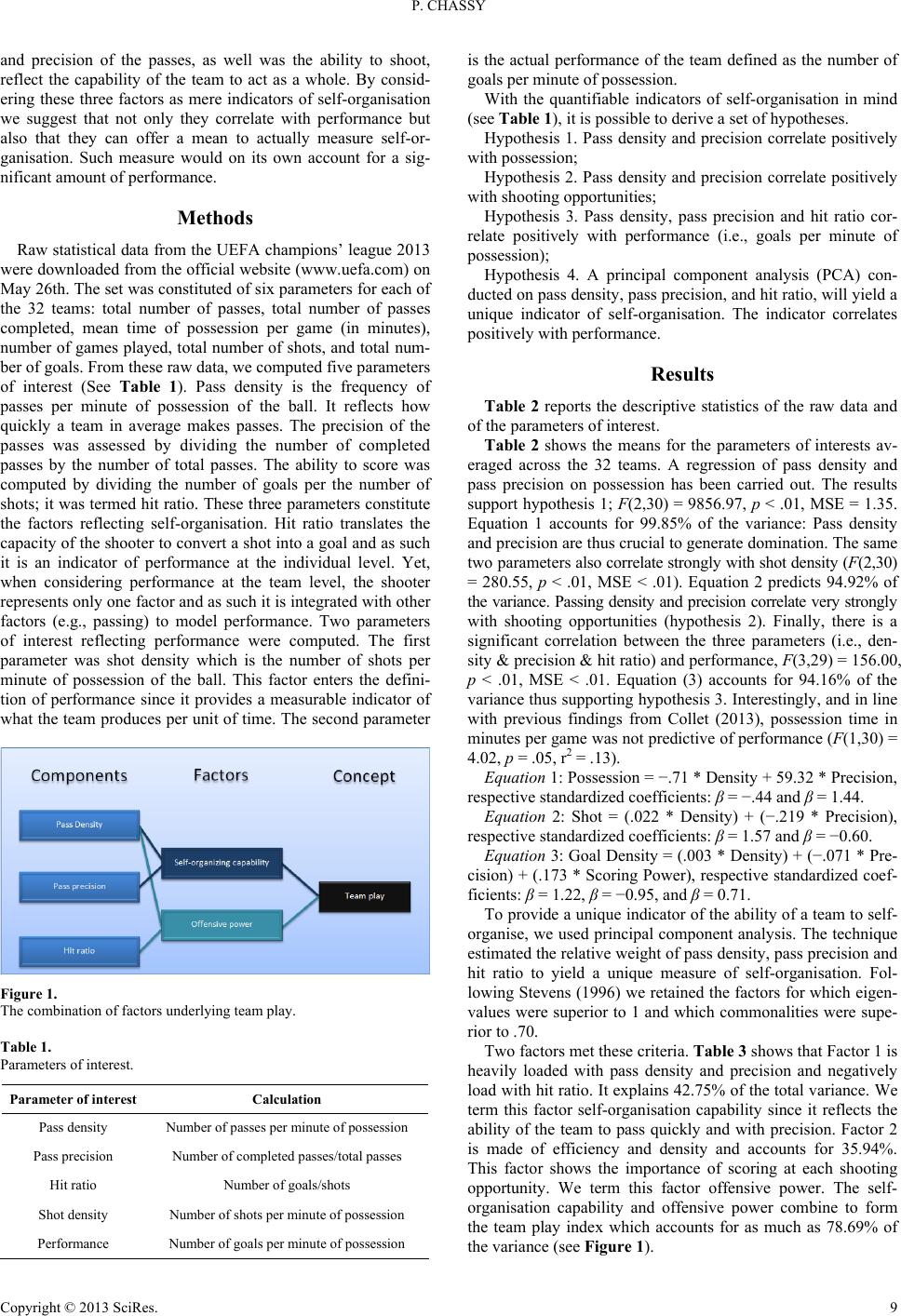 P. CHASSY Copyright © 2013 SciRes. 9 and precision of the passes, as well was the ability to shoot, reflect the capability of the team to act as a whole. By consid- ering these three factors as mere indicators of self-organisation we suggest that not only they correlate with performance but also that they can offer a mean to actually measure self-or- ganisation. Such measure would on its own account for a sig- nificant amount of performance. Methods Raw statistical data from the UEFA champions’ league 2013 were downloaded from the official website (www.uefa.com) on May 26th. The set was constituted of six parameters for each of the 32 teams: total number of passes, total number of passes completed, mean time of possession per game (in minutes), number of games played, total number of shots, and total num- ber of goals. From these raw data, we computed five parameters of interest (See Table 1). Pass density is the frequency of passes per minute of possession of the ball. It reflects how quickly a team in average makes passes. The precision of the passes was assessed by dividing the number of completed passes by the number of total passes. The ability to score was computed by dividing the number of goals per the number of shots; it was termed hit ratio. These three parameters constitute the factors reflecting self-organisation. Hit ratio translates the capacity of the shooter to convert a shot into a goal and as such it is an indicator of performance at the individual level. Yet, when considering performance at the team level, the shooter represents only one factor and as such it is integrated with other factors (e.g., passing) to model performance. Two parameters of interest reflecting performance were computed. The first parameter was shot density which is the number of shots per minute of possession of the ball. This factor enters the defini- tion of performance since it provides a measurable indicator of what the team produces per unit of time. The second parameter Figure 1. The combination of factors underlying team play. Table 1. Parameters of interest. Parameter of interest Calculation Pass density Number of passes per minute of possession Pass precision Number of completed passes/total passes Hit ratio Number of goals/shots Shot density Number of shots per minute of possession Performance Number of goals per minute of possession is the actual performance of the team defined as the number of goals per minute of possession. With the quantifiable indicators of self-organisation in mind (see Table 1), it is possible to derive a set of hypotheses. Hypothesis 1. Pass density and precision correlate positively with possession; Hypothesis 2. Pass density and precision correlate positively with shooting opportunities; Hypothesis 3. Pass density, pass precision and hit ratio cor- relate positively with performance (i.e., goals per minute of possession); Hypothesis 4. A principal component analysis (PCA) con- ducted on pass density, pass precision, and hit ratio, will yield a unique indicator of self-organisation. The indicator correlates positively with performance. Results Table 2 reports the descriptive statistics of the raw data and of the parameters of interest. Table 2 shows the means for the parameters of interests av- eraged across the 32 teams. A regression of pass density and pass precision on possession has been carried out. The results support hypothesis 1; F(2,30) = 9856.97, p < .01, MSE = 1.35. Equation 1 accounts for 99.85% of the variance: Pass density and precision are thus crucial to generate domination. The same two parameters also correlate strongly with shot density (F(2,30) = 280.55, p < .01, MSE < .01). Equation 2 predicts 94.92% of the variance. Passing density and precision correlate very strongly with shooting opportunities (hypothesis 2). Finally, there is a significant correlation between the three parameters (i.e., den- sity & precision & hit ratio) and performance, F(3,29) = 156.00, p < .01, MSE < .01. Equation (3) accounts for 94.16% of the variance thus supporting hypothesis 3. Interestingly, and in line with previous findings from Collet (2013), possession time in minutes per game was not predictive of performance (F(1,30) = 4.02, p = .05, r2 = .13). Equation 1: Possession = −.71 * Density + 59.32 * Precision, respective standardized coefficients: β = −.44 and β = 1.44. Equation 2: Shot = (.022 * Density) + (−.219 * Precision), respective standardized coefficients: β = 1.57 and β = −0.60. Equation 3: Goal Density = (.003 * Density) + (−.071 * Pre- cision) + (.173 * Scoring Power), respective standardized coef- ficients: β = 1.22, β = −0.95, and β = 0.71. To provide a unique indicator of the ability of a team to self- organise, we used principal component analysis. The technique estimated the relative weight of pass density, pass precision and hit ratio to yield a unique measure of self-organisation. Fol- lowing Stevens (1996) we retained the factors for which eigen- values were superior to 1 and which commonalities were supe- rior to .70. Two factors met these criteria. Table 3 shows that Factor 1 is heavily loaded with pass density and precision and negatively load with hit ratio. It explains 42.75% of the total variance. We term this factor self-organisation capability since it reflects the ability of the team to pass quickly and with precision. Factor 2 is made of efficiency and density and accounts for 35.94%. This factor shows the importance of scoring at each shooting opportunity. We term this factor offensive power. The self- organisation capability and offensive power combine to form the team play index which accounts for as much as 78.69% of the variance (see Figure 1). 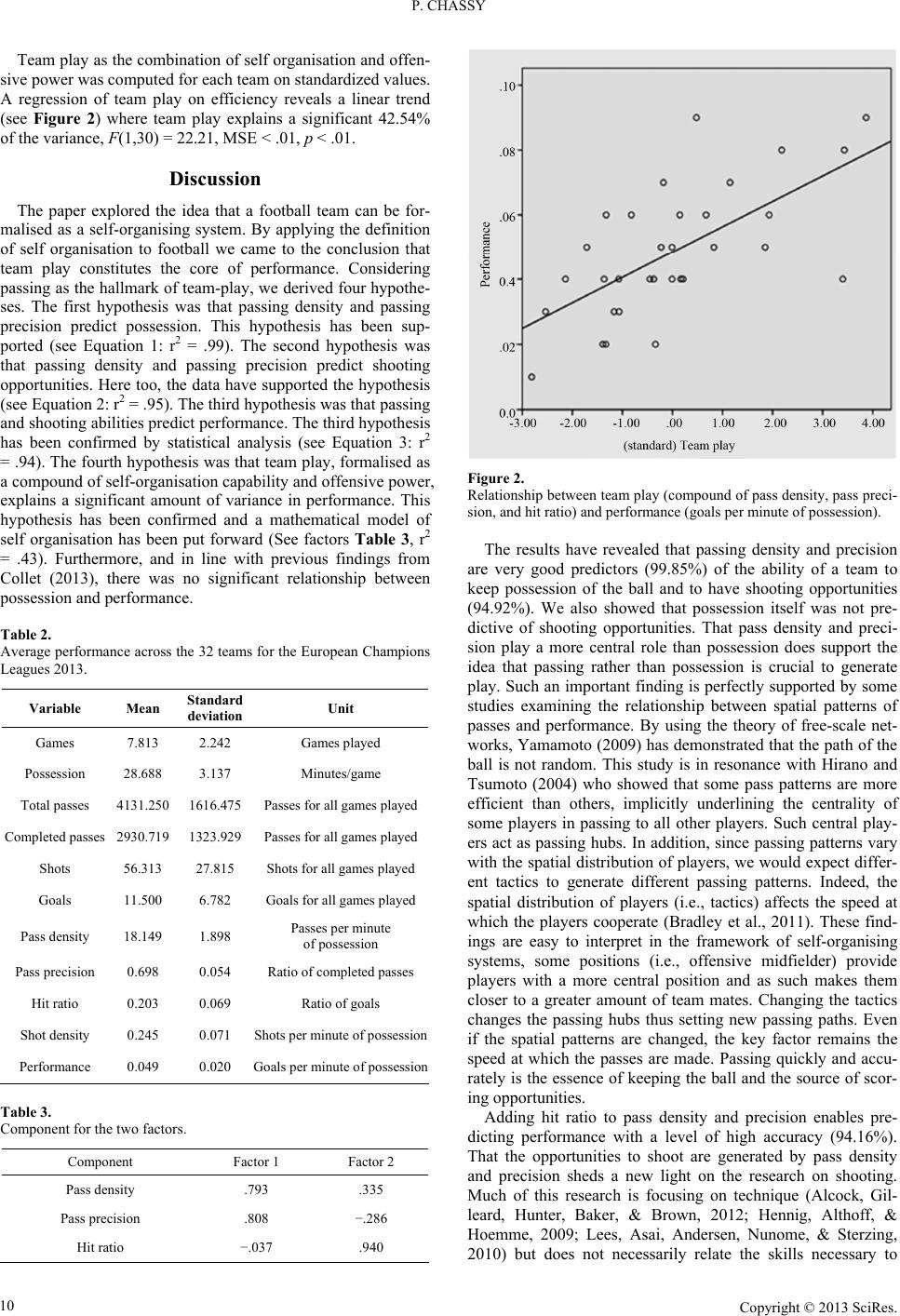 P. CHASSY Copyright © 2013 SciRes. 10 Team play as the combination of self organisation and offen- sive power was computed for each team on standardized values. A regression of team play on efficiency reveals a linear trend (see Figure 2) where team play explains a significant 42.54% of the variance, F(1,30) = 22.21, MSE < .01, p < .01. Discussion The paper explored the idea that a football team can be for- malised as a self-organising system. By applying the definition of self organisation to football we came to the conclusion that team play constitutes the core of performance. Considering passing as the hallmark of team-play, we derived four hypothe- ses. The first hypothesis was that passing density and passing precision predict possession. This hypothesis has been sup- ported (see Equation 1: r2 = .99). The second hypothesis was that passing density and passing precision predict shooting opportunities. Here too, the data have supported the hypothesis (see Equation 2: r2 = .95). The third hypothesis was that passing and shooting abilities predict performance. The third hypothesis has been confirmed by statistical analysis (see Equation 3: r2 = .94). The fourth hypothesis was that team play, formalised as a compound of self-organisation capability and offensive power, explains a significant amount of variance in performance. This hypothesis has been confirmed and a mathematical model of self organisation has been put forward (See factors Table 3, r2 = .43). Furthermore, and in line with previous findings from Collet (2013), there was no significant relationship between possession and performance. Table 2. Average performance across the 32 teams for the European Champions Leagues 2013. Variable Mean Standard deviation Unit Games 7.813 2.242 Games played Possession 28.688 3.137 Minutes/game Total passes 4131.250 1616.475 Passes for all games played Completed passes 2930.719 1323.929 Passes for all games played Shots 56.313 27.815 Shots for all games played Goals 11.500 6.782 Goals for all games played Pass density 18.149 1.898 Passes per minute of possession Pass precision 0.698 0.054 Ratio of completed passes Hit ratio 0.203 0.069 Ratio of goals Shot density 0.245 0.071 Shots per minute of possession Performance 0.049 0.020 Goals per minute of possession Table 3. Component for the two factors. Component Factor 1 Factor 2 Pass density .793 .335 Pass precision .808 −.286 Hit ratio −.037 .940 Figure 2. Relationship between team play (compound of pass density, pass preci- sion, and hit ratio) and performance (goals per minute of possession). The results have revealed that passing density and precision are very good predictors (99.85%) of the ability of a team to keep possession of the ball and to have shooting opportunities (94.92%). We also showed that possession itself was not pre- dictive of shooting opportunities. That pass density and preci- sion play a more central role than possession does support the idea that passing rather than possession is crucial to generate play. Such an important finding is perfectly supported by some studies examining the relationship between spatial patterns of passes and performance. By using the theory of free-scale net- works, Yamamoto (2009) has demonstrated that the path of the ball is not random. This study is in resonance with Hirano and Tsumoto (2004) who showed that some pass patterns are more efficient than others, implicitly underlining the centrality of some players in passing to all other players. Such central play- ers act as passing hubs. In addition, since passing patterns vary with the spatial distribution of players, we would expect differ- ent tactics to generate different passing patterns. Indeed, the spatial distribution of players (i.e., tactics) affects the speed at which the players cooperate (Bradley et al., 2011). These find- ings are easy to interpret in the framework of self-organising systems, some positions (i.e., offensive midfielder) provide players with a more central position and as such makes them closer to a greater amount of team mates. Changing the tactics changes the passing hubs thus setting new passing paths. Even if the spatial patterns are changed, the key factor remains the speed at which the passes are made. Passing quickly and accu- rately is the essence of keeping the ball and the source of scor- ing opportunities. Adding hit ratio to pass density and precision enables pre- dicting performance with a level of high accuracy (94.16%). That the opportunities to shoot are generated by pass density and precision sheds a new light on the research on shooting. Much of this research is focusing on technique (Alcock, Gil- leard, Hunter, Baker, & Brown, 2012; Hennig, Althoff, & Hoemme, 2009; Lees, Asai, Andersen, Nunome, & Sterzing, 2010) but does not necessarily relate the skills necessary to 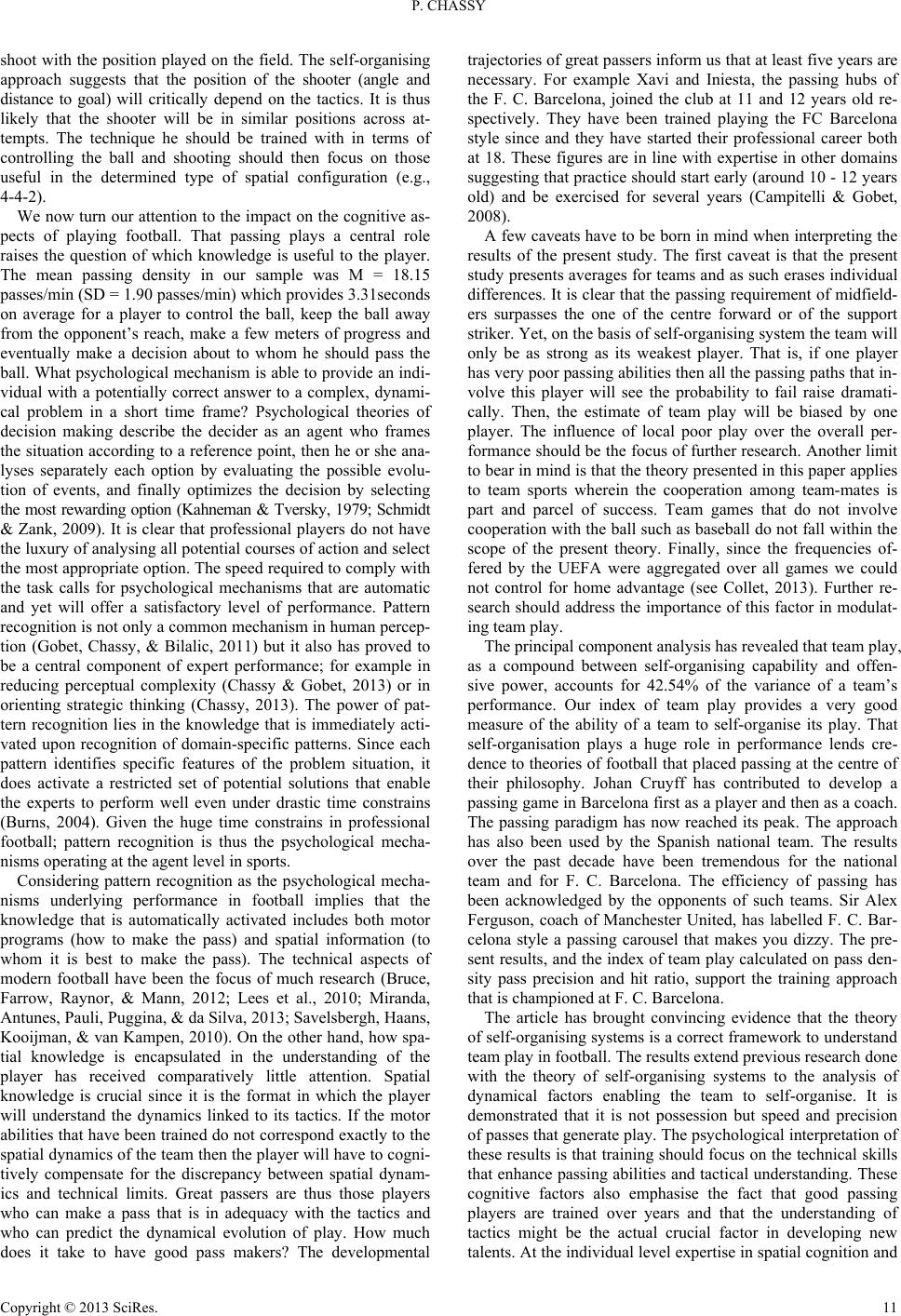 P. CHASSY Copyright © 2013 SciRes. 11 shoot with the position played on the field. The self-organising approach suggests that the position of the shooter (angle and distance to goal) will critically depend on the tactics. It is thus likely that the shooter will be in similar positions across at- tempts. The technique he should be trained with in terms of controlling the ball and shooting should then focus on those useful in the determined type of spatial configuration (e.g., 4-4-2). We now turn our attention to the impact on the cognitive as- pects of playing football. That passing plays a central role raises the question of which knowledge is useful to the player. The mean passing density in our sample was M = 18.15 passes/min (SD = 1.90 passes/min) which provides 3.31seconds on average for a player to control the ball, keep the ball away from the opponent’s reach, make a few meters of progress and eventually make a decision about to whom he should pass the ball. What psychological mechanism is able to provide an indi- vidual with a potentially correct answer to a complex, dynami- cal problem in a short time frame? Psychological theories of decision making describe the decider as an agent who frames the situation according to a reference point, then he or she ana- lyses separately each option by evaluating the possible evolu- tion of events, and finally optimizes the decision by selecting the most rewarding option (Kahneman & Tversky, 1979; Schmidt & Zank, 2009). It is clear that professional players do not have the luxury of analysing all potential courses of action and select the most appropriate option. The speed required to comply with the task calls for psychological mechanisms that are automatic and yet will offer a satisfactory level of performance. Pattern recognition is not only a common mechanism in human percep- tion (Gobet, Chassy, & Bilalic, 2011) but it also has proved to be a central component of expert performance; for example in reducing perceptual complexity (Chassy & Gobet, 2013) or in orienting strategic thinking (Chassy, 2013). The power of pat- tern recognition lies in the knowledge that is immediately acti- vated upon recognition of domain-specific patterns. Since each pattern identifies specific features of the problem situation, it does activate a restricted set of potential solutions that enable the experts to perform well even under drastic time constrains (Burns, 2004). Given the huge time constrains in professional football; pattern recognition is thus the psychological mecha- nisms operating at the agent level in sports. Considering pattern recognition as the psychological mecha- nisms underlying performance in football implies that the knowledge that is automatically activated includes both motor programs (how to make the pass) and spatial information (to whom it is best to make the pass). The technical aspects of modern football have been the focus of much research (Bruce, Farrow, Raynor, & Mann, 2012; Lees et al., 2010; Miranda, Antunes, Pauli, Puggina, & da Silva, 2013; Savelsbergh, Haans, Kooijman, & van Kampen, 2010). On the other hand, how spa- tial knowledge is encapsulated in the understanding of the player has received comparatively little attention. Spatial knowledge is crucial since it is the format in which the player will understand the dynamics linked to its tactics. If the motor abilities that have been trained do not correspond exactly to the spatial dynamics of the team then the player will have to cogni- tively compensate for the discrepancy between spatial dynam- ics and technical limits. Great passers are thus those players who can make a pass that is in adequacy with the tactics and who can predict the dynamical evolution of play. How much does it take to have good pass makers? The developmental trajectories of great passers inform us that at least five years are necessary. For example Xavi and Iniesta, the passing hubs of the F. C. Barcelona, joined the club at 11 and 12 years old re- spectively. They have been trained playing the FC Barcelona style since and they have started their professional career both at 18. These figures are in line with expertise in other domains suggesting that practice should start early (around 10 - 12 years old) and be exercised for several years (Campitelli & Gobet, 2008). A few caveats have to be born in mind when interpreting the results of the present study. The first caveat is that the present study presents averages for teams and as such erases individual differences. It is clear that the passing requirement of midfield- ers surpasses the one of the centre forward or of the support striker. Yet, on the basis of self-organising system the team will only be as strong as its weakest player. That is, if one player has very poor passing abilities then all the passing paths that in- volve this player will see the probability to fail raise dramati- cally. Then, the estimate of team play will be biased by one player. The influence of local poor play over the overall per- formance should be the focus of further research. Another limit to bear in mind is that the theory presented in this paper applies to team sports wherein the cooperation among team-mates is part and parcel of success. Team games that do not involve cooperation with the ball such as baseball do not fall within the scope of the present theory. Finally, since the frequencies of- fered by the UEFA were aggregated over all games we could not control for home advantage (see Collet, 2013). Further re- search should address the importance of this factor in modulat- ing team play. The principal component analysis has revealed that team play, as a compound between self-organising capability and offen- sive power, accounts for 42.54% of the variance of a team’s performance. Our index of team play provides a very good measure of the ability of a team to self-organise its play. That self-organisation plays a huge role in performance lends cre- dence to theories of football that placed passing at the centre of their philosophy. Johan Cruyff has contributed to develop a passing game in Barcelona first as a player and then as a coach. The passing paradigm has now reached its peak. The approach has also been used by the Spanish national team. The results over the past decade have been tremendous for the national team and for F. C. Barcelona. The efficiency of passing has been acknowledged by the opponents of such teams. Sir Alex Ferguson, coach of Manchester United, has labelled F. C. Bar- celona style a passing carousel that makes you dizzy. The pre- sent results, and the index of team play calculated on pass den- sity pass precision and hit ratio, support the training approach that is championed at F. C. Barcelona. The article has brought convincing evidence that the theory of self-organising systems is a correct framework to understand team play in football. The results extend previous research done with the theory of self-organising systems to the analysis of dynamical factors enabling the team to self-organise. It is demonstrated that it is not possession but speed and precision of passes that generate play. The psychological interpretation of these results is that training should focus on the technical skills that enhance passing abilities and tactical understanding. These cognitive factors also emphasise the fact that good passing players are trained over years and that the understanding of tactics might be the actual crucial factor in developing new talents. At the individual level expertise in spatial cognition and 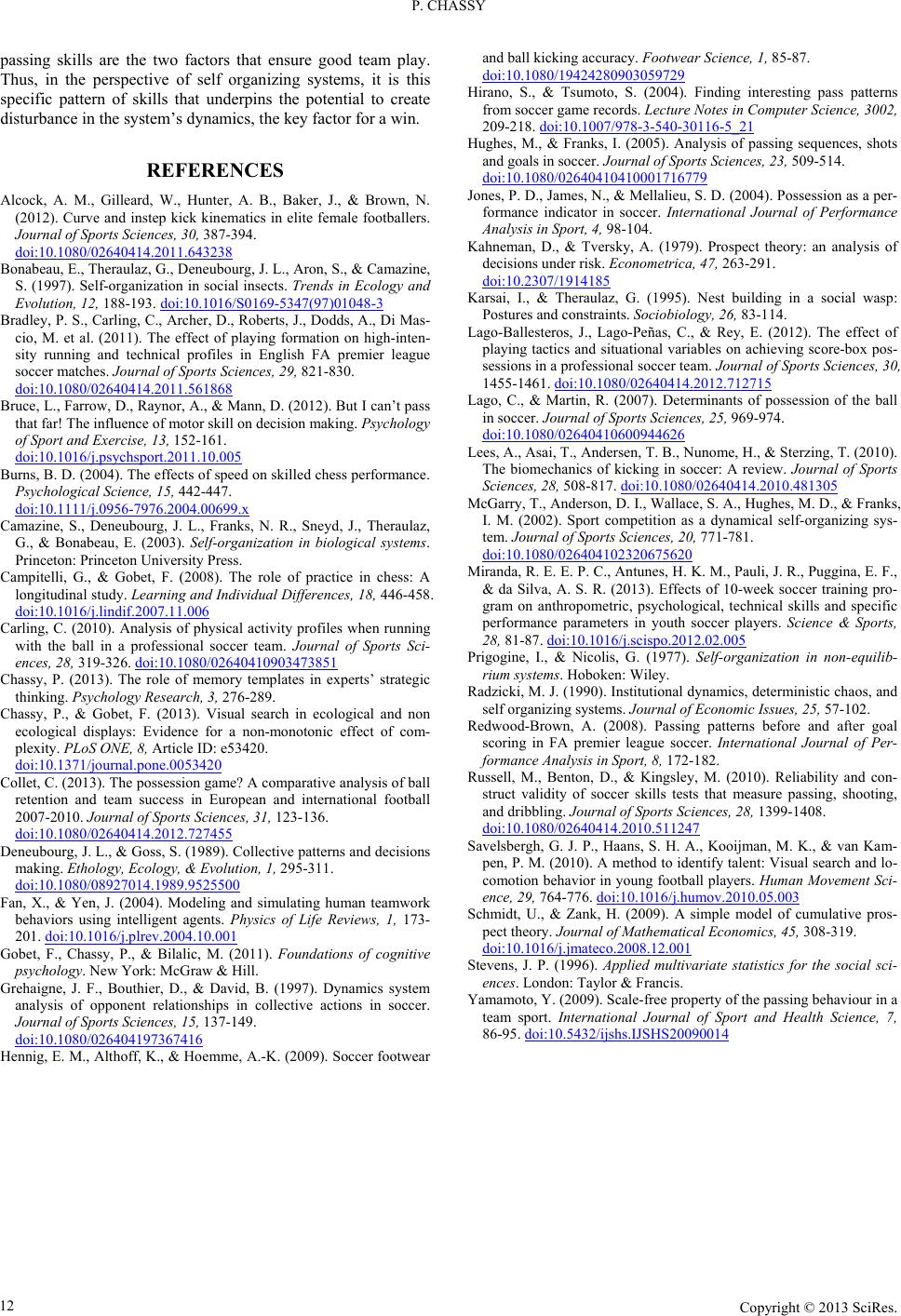 P. CHASSY Copyright © 2013 SciRes. 12 passing skills are the two factors that ensure good team play. Thus, in the perspective of self organizing systems, it is this specific pattern of skills that underpins the potential to create disturbance in the system’s dynamics, the key factor for a win. REFERENCES Alcock, A. M., Gilleard, W., Hunter, A. B., Baker, J., & Brown, N. (2012). Curve and instep kick kinematics in elite female footballers. Journal of Sports Sciences, 30, 387-394. doi:10.1080/02640414.2011.643238 Bonabeau, E., Theraulaz, G., Deneubourg, J. L., Aron, S., & Camazine, S. (1997). Self-organization in social insects. Trends in Ecology and Evolution, 12, 188-193. doi:10.1016/S0169-5347(97)01048-3 Bradley, P. S., Carling, C., Archer, D., Roberts, J., Dodds, A., Di Mas- cio, M. et al. (2011). The effect of playing formation on high-inten- sity running and technical profiles in English FA premier league soccer matches. Journal of Sports Sciences, 29, 821-830. doi:10.1080/02640414.2011.561868 Bruce, L., Farrow, D., Raynor, A., & Mann, D. (2012). But I can’t pass that far! The influence of motor skill on decision making. Psychology of Sport and Exercise, 13, 152-161. doi:10.1016/j.psychsport.2011.10.005 Burns, B. D. (2004). The effects of speed on skilled chess performance. Psychological Science, 15, 442-447. doi:10.1111/j.0956-7976.2004.00699.x Camazine, S., Deneubourg, J. L., Franks, N. R., Sneyd, J., Theraulaz, G., & Bonabeau, E. (2003). Self-organization in biological systems. Princeton: Princeton University Press. Campitelli, G., & Gobet, F. (2008). The role of practice in chess: A longitudinal study. Learning and Individual Differences, 18, 446-458. doi:10.1016/j.lindif.2007.11.006 Carling, C. (2010). Analysis of physical activity profiles when running with the ball in a professional soccer team. Journal of Sports Sci- ences, 28, 319-326. doi:10.1080/02640410903473851 Chassy, P. (2013). The role of memory templates in experts’ strategic thinking. Psychology Research, 3, 276-289. Chassy, P., & Gobet, F. (2013). Visual search in ecological and non ecological displays: Evidence for a non-monotonic effect of com- plexity. PLoS ONE, 8, Article ID: e53420. doi:10.1371/journal.pone.0053420 Collet, C. (2013). The possession game? A comparative analysis of ball retention and team success in European and international football 2007-2010. Journal of Sports Sciences, 31, 123-136. doi:10.1080/02640414.2012.727455 Deneubourg, J. L., & Goss, S. (1989). Collective patterns and decisions making. Ethology, Ecology, & Evolution, 1, 295-311. doi:10.1080/08927014.1989.9525500 Fan, X., & Yen, J. (2004). Modeling and simulating human teamwork behaviors using intelligent agents. Physics of Life Reviews, 1, 173- 201. doi:10.1016/j.plrev.2004.10.001 Gobet, F., Chassy, P., & Bilalic, M. (2011). Foundations of cognitive psychology. New York: McGraw & Hill. Grehaigne, J. F., Bouthier, D., & David, B. (1997). Dynamics system analysis of opponent relationships in collective actions in soccer. Journal of Sports Sciences, 15, 137-149. doi:10.1080/026404197367416 Hennig, E. M., Althoff, K., & Hoemme, A.-K. (2009). Soccer footwear and ball kicking accuracy. Footwear Science, 1, 85-87. doi:10.1080/19424280903059729 Hirano, S., & Tsumoto, S. (2004). Finding interesting pass patterns from soccer game records. Lecture Notes in Computer Science, 3002, 209-218. doi:10.1007/978-3-540-30116-5_21 Hughes, M., & Franks, I. (2005). Analysis of passing sequences, shots and goals in soccer. Journal of Sports Sciences, 23, 509-514. doi:10.1080/02640410410001716779 Jones, P. D., James, N., & Mellalieu, S. D. (2004). Possession as a per- formance indicator in soccer. International Journal of Performance Analysis in Sport, 4, 98-104. Kahneman, D., & Tversky, A. (1979). Prospect theory: an analysis of decisions under risk. Econometrica, 47, 263-291. doi:10.2307/1914185 Karsai, I., & Theraulaz, G. (1995). Nest building in a social wasp: Postures and constraints. Sociobiology, 26, 83-114. Lago-Ballesteros, J., Lago-Peñas, C., & Rey, E. (2012). The effect of playing tactics and situational variables on achieving score-box pos- sessions in a professional soccer team. Journal of Sports Sciences, 30, 1455-1461. doi:10.1080/02640414.2012.712715 Lago, C., & Martin, R. (2007). Determinants of possession of the ball in soccer. Journal of Sports Sciences, 25, 969-974. doi:10.1080/02640410600944626 Lees, A., Asai, T., Andersen, T. B., Nunome, H., & Sterzing, T. (2010). The biomechanics of kicking in soccer: A review. Journal of Sports Sciences, 28, 508-817. doi:10.1080/02640414.2010.481305 McGarry, T., Anderson, D. I., Wallace, S. A., Hughes, M. D., & Franks, I. M. (2002). Sport competition as a dynamical self-organizing sys- tem. Journal of Sports Sciences, 20, 771-781. doi:10.1080/026404102320675620 Miranda, R. E. E. P. C., Antunes, H. K. M., Pauli, J. R., Puggina, E. F., & da Silva, A. S. R. (2013). Effects of 10-week soccer training pro- gram on anthropometric, psychological, technical skills and specific performance parameters in youth soccer players. Science & Sports, 28, 81-87. doi:10.1016/j.scispo.2012.02.005 Prigogine, I., & Nicolis, G. (1977). Self-organization in non-equilib- rium systems. Hoboken: Wiley. Radzicki, M. J. (1990). Institutional dynamics, deterministic chaos, and self organizing systems. Journal of Economic Issues, 25, 57-102. Redwood-Brown, A. (2008). Passing patterns before and after goal scoring in FA premier league soccer. International Journal of Per- formance Analysis in Sport, 8, 172-182. Russell, M., Benton, D., & Kingsley, M. (2010). Reliability and con- struct validity of soccer skills tests that measure passing, shooting, and dribbling. Journal of Sports Sciences, 28, 1399-1408. doi:10.1080/02640414.2010.511247 Savelsbergh, G. J. P., Haans, S. H. A., Kooijman, M. K., & van Kam- pen, P. M. (2010). A method to identify talent: Visual search and lo- comotion behavior in young football players. Human Movement Sci- ence, 29, 764-776. doi:10.1016/j.humov.2010.05.003 Schmidt, U., & Zank, H. (2009). A simple model of cumulative pros- pect theory. Journal of Mathematical Economics, 45, 308-319. doi:10.1016/j.jmateco.2008.12.001 Stevens, J. P. (1996). Applied multivariate statistics for the social sci- ences. London: Taylor & Francis. Yamamoto, Y. (2009). Scale-free property of the passing behaviour in a team sport. International Journal of Sport and Health Science, 7, 86-95. doi:10.5432/ijshs.IJSHS20090014 |