

Paper Menu >>
Journal Menu >>
 Open Journal of Gastroenterology, 2013, 3, 272-275 OJGas http://dx.doi.org/10.4236/ojgas.2013.35046 Published Online September 2013 (http://www.scirp.org/journal/ojgas/) Diphenyl methane laxatives do not induce electrolyte imbalance Stefan Müller-Lissner Department of Internal Medicine, Park-Klinik Weissensee, Schönstrasse, Berlin Email: [email protected] Received 2 July 2013; revised 5 August 2013; accepted 18 August 2013 Copyright © 2013 Stefan Müller-Lissner. This is an open access article distributed under the Creative Commons Attribution License, which permits unrestricted use, distribution, and reproduction in any medium, provided the original work is properly cited. ABSTRACT Aim: To analyse whether there are changes in sodium and potassium serum levels during chronic treatment with the diphenyl methanes bisacodyl and sodium picosulfate. Methods: A literature search was done using PubMed, and the reference lists of pertinent papers were screened for additional studies. Only studies of at least 4 weeks duration were considered for further analysis. Results: Four relevant studies were identified. In three randomised controlled trials with 5 to 10 mg daily of bisacodyl or sodium picosul- fate, respectively, over four weeks no electrolyte losses were found. Hypokalemia was also not a problem in a group of patients with paraplegia using bisacodyl suppositories for 2 to 34 years. Conclusions: Electro- lyte losses, particularly hypokalemia, are not a prob- lem when bisacodyl or sodium picosulfate are used long-term. Keywords: Laxative; Bisacodyl; Sodium Picosulfate; Hyponatremia; H ypokalemia 1. INTRODUCTION Consumer reports, whether printed or in the internet, often contain warnings of side effects of laxatives, par- ticularly of the so-called stimulan t laxatives. These com- prise the anthraquinones (e.g. sennosides) and the di- phenyl methane derivatives (bisacodyl and sodium pico- sulfate) and exert a dual, namely a secretory and a pro- kinetic action [1,2]. These warnings read e.g. “confusion, irregular heartbeat, muscle cramps, and unusual tiredness or weakness” [3-6 ]. Similar concerns have, to my knowledge, not been ex- pressed regarding water binding laxatives (salinic laxa- tives, sugars such as lactulose, and macrogol). Nor have they been expressed for pure prokinetics such as pruca- lopride and the new secretory stimulants lubiprostone and linaclotide, potentially because the manufacturers were hitherto successful in avoiding the term “laxative” for these products. If these side effects would occur they would occur with almost certainty be due to electrolyte losses, particularly of potassium. It is well known that induction of diarrhea by these laxatives may lead to hypokalemia [7-9], but this does not allow the conclusion that such losses may also occur when the laxatives are used in the proper dose. The purpose of the present paper is to present the available data of sodium and potassium serum levels dur- ing chronic treatment of chronic constipation with di- phenyl methanes. 2. METHODS A literature search was done using PubMed with the terms (diphenyl methanes OR bisacodyl OR sodium pi- cosulfate) AND (electrolytes OR sodium OR potassium) and the available respective MeSH terms (“picosulfate sodium” [Supplementary Concept]) AND (“Hypokale- mia” [Mesh] OR “Water-Electrolyte Imbalance” [Mesh]). In addition the reference lists of the papers were screened for additional studies. Only studies of at least 4 weeks duration were considered for further analysis. The manu- facturer of bisacodyl and sodium picosulfate was then asked to provide the original data on electrolytes from the respective trials. 3. RESULTS The oldest paper on the subject reports long-term data from 101 patients with spinal cord injury using bisacodyl over a period of 2 to 34 years. Patients used bisacodyl suppositories, predominantly one to two suppositories two or three times weekly [10]. Only two patients had potassium levels slightly below the lower limit of nor- mality and without clinical relevance (Figure 1). How- ever, no information is available regarding intake of other drugs affecting serum electrolytes such as diuretics. There are three randomised controlled trials with OPEN ACCESS 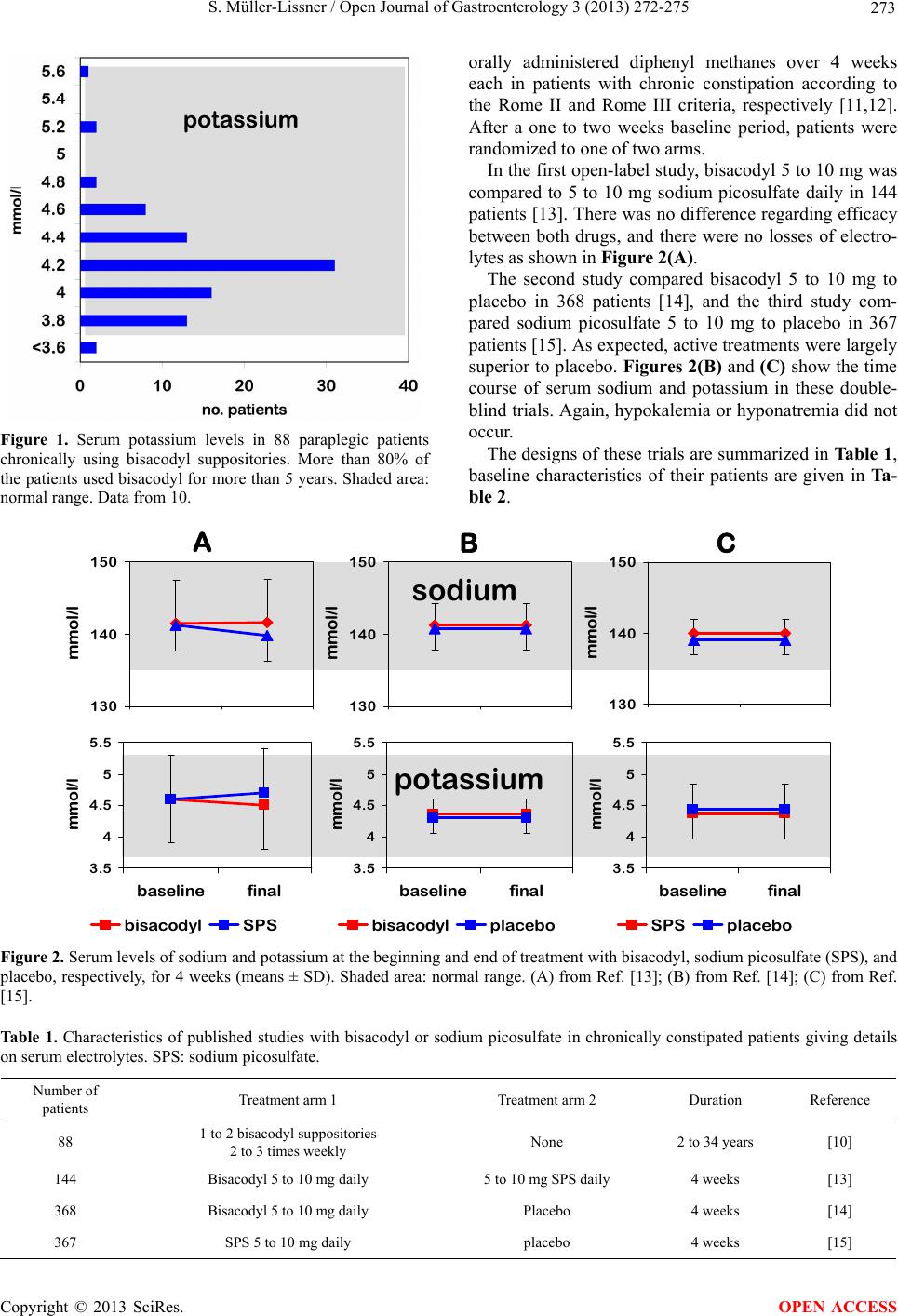 S. Müller-Lissner / Open Journal of Gastroenterology 3 (2013) 272-275 273 Figure 1. Serum potassium levels in 88 paraplegic patients chronically using bisacodyl suppositories. More than 80% of the patients used bisacodyl for more than 5 years. Shaded area: normal range. Data from 10. orally administered diphenyl methanes over 4 weeks each in patients with chronic constipation according to the Rome II and Rome III criteria, respectively [11,12]. After a one to two weeks baseline period, patients were randomized to one of two arms. In the first open-label study, bisacodyl 5 to 10 mg was compared to 5 to 10 mg sodium picosulfate daily in 144 patients [13]. There was no difference regarding efficacy between both drugs, and there were no losses of electro- lytes as shown in Figure 2(A). The second study compared bisacodyl 5 to 10 mg to placebo in 368 patients [14], and the third study com- pared sodium picosulfate 5 to 10 mg to placebo in 367 patients [15]. As expected, active treatments were largely superior to placebo. Figures 2(B) and (C) show the time course of serum sodium and potassium in these double- blind trials. Again, hypokalemia or hyponatremia did not occur. The designs of these trials are summarized in Table 1, baseline characteristics of their patients are given in Ta- ble 2. 130 140 150 mmo l/l 3.5 4 4.5 5 5.5 baseline final mmol/l bisacodyl SPS 130 140 150 mmo l/l 3.5 4 4.5 5 5.5 baselinefinal mmo l/l bisacodyl placebo 130 140 150 mmo l/l 3.5 4 4.5 5 5.5 baseline final mmol/l SPS placebo sodium potassiu m ABC Figure 2. Serum levels of sodium and potassium at the beginning and end of tre atme nt with bisacodyl, sodium picosulfate (SPS), and placebo, respectively, for 4 weeks (means ± SD). Shaded area: normal range. (A) from Ref. [13]; (B) from Ref. [14]; (C) from Ref. [15]. Table 1. Characteristics of published studies with bisacodyl or sodium picosulfate in chronically constipated patients giving details on serum electrolyte s. SPS: sodium pic osulfa te . Number of patients Treatment arm 1 Treatment arm 2 Duration Reference 88 1 to 2 bisacodyl suppositories 2 to 3 times weekly None 2 to 34 years [10] 144 Bisacodyl 5 to 10 mg daily 5 to 10 mg SPS daily 4 weeks [13] 368 Bisacodyl 5 to 10 mg daily Placebo 4 weeks [14] 367 SPS 5 to 10 mg daily placebo 4 weeks [15] Copyright © 2013 SciRes. OPEN ACCESS 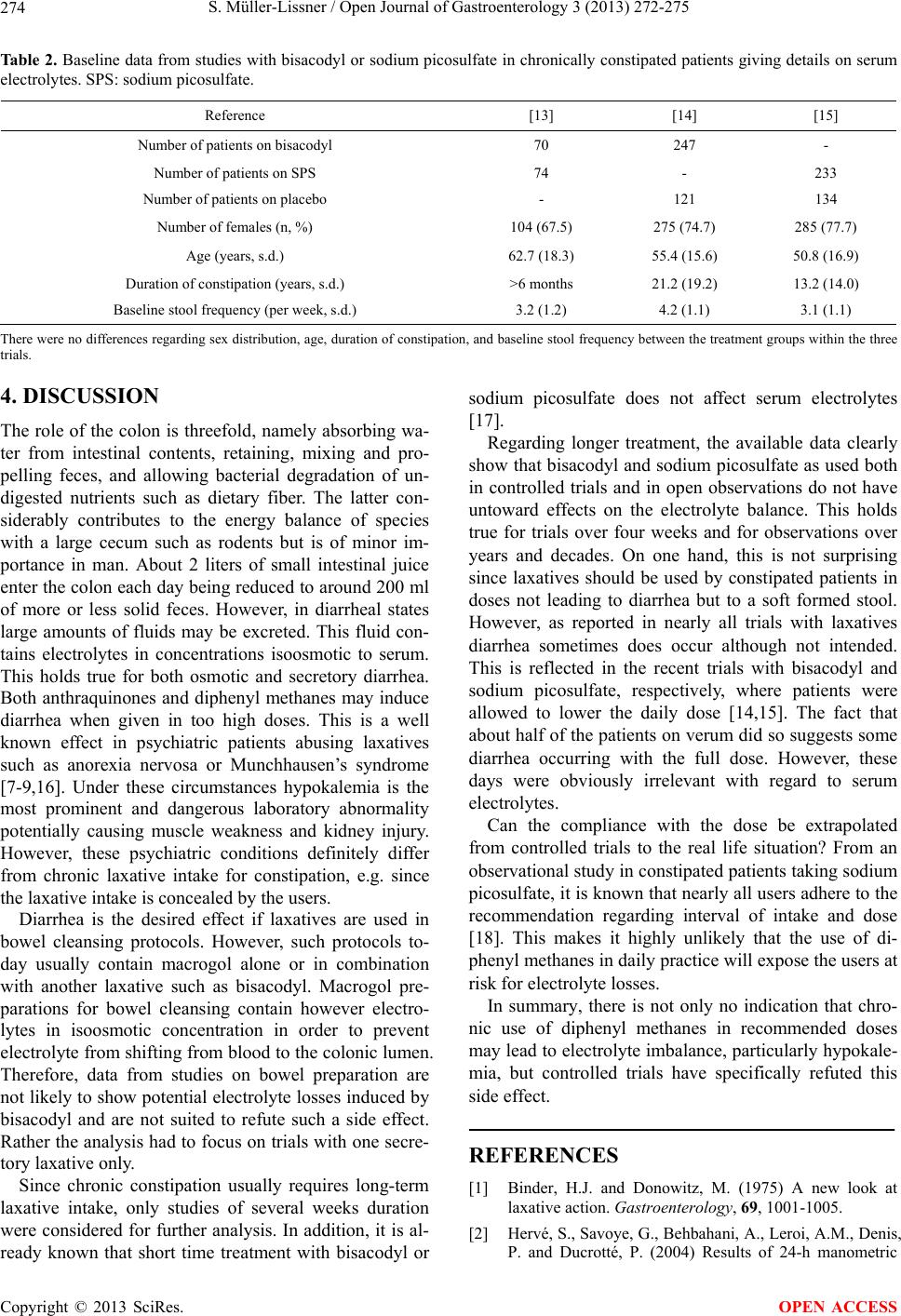 S. Müller-Lissner / Open Journal of Gastroenterology 3 (2013) 272-275 274 Table 2. Baseline data from studies with bisacodyl or sodium picosulfate in chronically constipated patients giving details on serum electrolytes. SPS: sodium picosulfate. Reference [13] [14] [15] Number of patients on bisacodyl 70 247 - Number of patients on SPS 74 - 233 Number of patients on placebo - 121 134 Number of females (n, %) 104 (67.5) 275 (74.7) 285 (77.7) Age (years, s.d.) 62.7 (18.3) 55.4 (15.6) 50.8 (16.9) Duration of constipation (years, s.d.) >6 months 21.2 (19.2) 13.2 (14.0) Baseline stool frequency (per week, s.d.) 3.2 (1.2) 4.2 (1.1) 3.1 (1.1) There were no differences regarding sex distribution, age, duration of constipation, and baseline stool frequency between the treatment groups within the three trials. 4. DISCUSSION The role of the colon is threefold, namely absorbing wa- ter from intestinal contents, retaining, mixing and pro- pelling feces, and allowing bacterial degradation of un- digested nutrients such as dietary fiber. The latter con- siderably contributes to the energy balance of species with a large cecum such as rodents but is of minor im- portance in man. About 2 liters of small intestinal juice enter the colon each day being reduced to around 200 ml of more or less solid feces. However, in diarrheal states large amounts of fluids may be excreted. This fluid con- tains electrolytes in concentrations isoosmotic to serum. This holds true for both osmotic and secretory diarrhea. Both anthraquinones and diphenyl methanes may induce diarrhea when given in too high doses. This is a well known effect in psychiatric patients abusing laxatives such as anorexia nervosa or Munchhausen’s syndrome [7-9,16]. Under these circumstances hypokalemia is the most prominent and dangerous laboratory abnormality potentially causing muscle weakness and kidney injury. However, these psychiatric conditions definitely differ from chronic laxative intake for constipation, e.g. since the laxative intake is concealed by the users. Diarrhea is the desired effect if laxatives are used in bowel cleansing protocols. However, such protocols to- day usually contain macrogol alone or in combination with another laxative such as bisacodyl. Macrogol pre- parations for bowel cleansing contain however electro- lytes in isoosmotic concentration in order to prevent electrolyte from shifting from blood to the colonic lumen. Therefore, data from studies on bowel preparation are not likely to show potential electro lyte losses induced by bisacodyl and are not suited to refute such a side effect. Rather the analysis had to focus on trials with one secre- tory laxative only. Since chronic constipation usually requires long-term laxative intake, only studies of several weeks duration were considered for further analysis. In addition, it is al- ready known that short time treatment with bisacodyl or sodium picosulfate does not affect serum electrolytes [17]. Regarding longer treatment, the available data clearly show that bisacodyl and sodium picosulfate as used both in controlled trials and in open observations do not have untoward effects on the electrolyte balance. This holds true for trials over four weeks and for observations over years and decades. On one hand, this is not surprising since laxatives should be used by constipated patients in doses not leading to diarrhea but to a soft formed stool. However, as reported in nearly all trials with laxatives diarrhea sometimes does occur although not intended. This is reflected in the recent trials with bisacodyl and sodium picosulfate, respectively, where patients were allowed to lower the daily dose [14,15]. The fact that about half of the patients on verum did so suggests some diarrhea occurring with the full dose. However, these days were obviously irrelevant with regard to serum electrolytes. Can the compliance with the dose be extrapolated from controlled trials to the real life situation? From an observational study in constipated patients taking sodium picosulfate, it is known that nearly all users adhere to the recommendation regarding interval of intake and dose [18]. This makes it highly unlikely that the use of di- phenyl methanes in daily practice will expose the users at risk for electrolyte losses. In summary, there is not only no indication that chro- nic use of diphenyl methanes in recommended doses may lead to electrolyte imbalance, particularly hypo kale- mia, but controlled trials have specifically refuted this side effect. REFERENCES [1] Binder, H.J. and Donowitz, M. (1975) A new look at laxative action. Gastroenterology, 69, 1001-1005. [2] Hervé, S., Savoye, G., Behbahani, A., Leroi, A.M., Denis, P. and Ducrotté, P. (2004) Results of 24-h manometric Copyright © 2013 SciRes. OPEN ACCESS  S. Müller-Lissner / Open Journal of Gastroenterology 3 (2013) 272-275 275 recording of colonic motor activity with endoluminal in- stillation of bisacodyl in patients with severe chronic slow transit constipation. Neurogastroenterology and Motility, 16, 397-402. doi:10 .1111/j.1365-2982.2004.00535.x [3] Bundesvereinigung Deutscher Apothekerverbände, 2011. http://www.abda.de/52+B6JmNIYXNoPTMy MjllYmNh MTQmdHhfdHRuZXdzW2JhY2tQaWRdPTI0JnR4X3R 0bmV3c1twb2ludGVyXT01JnR4X3R0bmV3c1t0dF9uZ XdzXT0xMzU4.html [4] ADRAC (2002) Electrolyte disturbances with sodium picosulfate bowel cleansing products. Australian Adverse Drug Reactions Bulletin, 21, 1-4. [5] (1997) Consumer reports complete drug reference, 981- 988. [6] Fruit-Eze, Inc. Laxative Warnings, Side Effects & Con- traindications Reported in Medical Literature. http://web.pdx.edu/~sujata/FruitEze/education/laxative/m edical_warnings.html#1 [7] Bytzer, P., Stokholm, M., Andersen, I., Klitgaard, N.A. and Schaffalitzky de Muckadell, O.B. (1989) Prevalence of surreptitious laxative abuse in patients with diarrhoea of uncertain origin: A cost benefit analysis of a screening procedure. Gut, 30, 1379-1384. doi:10.1136/gut.30.10.1379 [8] Cummings, J.H., Sl ade n, G.E. , James, O.F. W. , Sarner, M. and Misiewicz, J.J. (1974) Laxative-induced diarrhoea: A continuing clinical problem. British Medical Journal, 1, 537. doi:10.1136/bmj.1.5907.537 [9] Read, N.W., Krejs, G.J. and Read, M.G. (1980) Chronic diarrhea of unknown origin. Gastroenterology, 78, 264- 271. [10] Ruidisch, M.H., Hutt, H.-J. and König, E. (1994) Laxan- zien-langzeittherapie mit bisacodyl. Wirksamkeit und ver- träglichkeit bei patienten mit rückenmarkverletzungen. Ärztliche Forschung, 41, 3-8. [11] Longstreth, G.F., Thompson, W.G., Chey, W.D., Hough- ton, L.A., Mearin, F. and Spiller, R.C. (2006) Functional bowel disorders. Gastroenterology, 130, 1480-1491. doi:10.1053/j.gastro.2005.11.061 [12] Thompson, W.G., Longstreth, G.F., Drossman, D.A., Heaton, K.W., Irvine, E.J. and Müller-Lissner, S.A. (1999) Functional bowel disorders and functional abdominal pain. Gut, 45, II43-II47. doi:10.1136/gut.45.2008.ii43 [13] Kienzle-Horn, S., Vix, J.M., Schuijt, C., Peil, H., Jordan, C.C. and Kamm, M.A. (2007) Comparison of bisacodyl and sodium picosulfate in the treatment of chronic con- stipation. Current Medical Research and Opinion, 23, 891-899. doi:10.1185/030079907X178865 [14] Kamm, M.A., Mueller-Lissner, S., Wald, A., Richter, E., Swallow, R. and Gessner, U. (2011) Oral bisacodyl is ef- fective and well-tolerated in patients with chronic consti- pation. Clinical Gastroenterology and Hepatology, 9, 577-583. doi:10.1016/j.cgh.2011.03.026 [15] Müller-Lissner, S.A., Kamm, M.A., Scarpignato, C. and Wald, A. (2005) Myths and misconceptions about chronic constipation. American Journal of Gastroenterology, 100, 232-242. doi:10.1111/j.1572-0241.2005.40885.x [16] Müller-Lissner, S.A. (1996) What has happened to the cathartic colon? Gut, 39, 486-488. doi:10.1136/gut.39.3.486 [17] Kienzle-Horn, S., Vix, J.M., Schuijt, C., Peil, H., Jordan, C.C. and Kamm, M.A. (2006) Efficacy and safety of bis- acodyl in the acute treatment of constipation: A double- blind, randomized, placebo-controlled study. Alimentary Pharmacology & Therapeutics, 23, 1479-1488. doi:10 .1111/j.1365-2036.2006.02903.x [18] Hinkel, U., Schuijt, C. and Erckenbrecht, J. (2008) OTC laxative use of sodium picosulfate—Results of a phar- macy-based patient survey (cohort study). International Journal of Clinical Pharmacology and Therapeutics, 46, 89-95. Copyright © 2013 SciRes. OPEN ACCESS |