

Paper Menu >>
Journal Menu >>
 Journal of Sensor Technology, 2013, 3, 31-35 http://dx.doi.org/10.4236/jst.2013.33006 Published Online September 2013 (http://www.scirp.org/journal/jst) Zinc Oxide Nanostructure Thick Films as H2S Gas Sensors at Room Temperature Vinod S. Kalyamwar1*, Fulsingh C. Raghuwanshi2, Narayan L. Jadhao1, Anil J. Gadewar1 1Bharatiya Mahavidyalaya, Amravati, India 2Vidyabharati Mahavidyalaya, Amravati, India Email: *[email protected] Received August 29, 2012; revised September 29, 2012; accepted October 6, 2012 Copyright © 2013 Vinod S. Kalyamwar et al. This is an open access article distributed under the Creative Commons Attribution License, which permits unrestricted use, distribution, and reproduction in any medium, provided the original work is properly cited. ABSTRACT The ZnO nanostructures have been synthesized and studied as the sensing element for the detection of H2S. The ZnO nanostructures were synthesized by hydrothermal method followed by sonication for different interval of time i.e. 30, 60, 90 and 120 min. By using screen printing method, thick films of synthesized ZnO nanostructure were deposited on glass substrate. Gas sensing properties of ZnO nanostructure thick films were studied for low concentratio n H2S gas at room temperature. The effects of morphology of synthesized ZnO nanostructure on gas sensing properties were studied and discussed. ZnO nanostructure synthesized by this method can be used as a promising material for semiconductor gas sensor to detect poisonous gas like H2S at room temperature with high sensitivity and selectivity. Keywords: ZnO Nanostructure; Room Temperature Gas Sensor for H2S 1. Introduction Nanostructured materials such as WO3, ZnO, SnO2, and V2O5 have shown good sensing properties [1-7]. Among these nanostructure-semiconducting materials, ZnO has been studied extensively for gas sensing application. It has been proved that Zn O is a good gas sen s itive material for detection of both reducing and oxidizing gases [8-16]. Various gases have been tested for ZnO nanostructure sensor studied including ethanol, acetone, NO2, NH3, H2 and CO2 and hydrogen [17-22]. H2S is a toxic gas produced from the coal, oil and natural gas industries. In order to enhance the sensitivity and selectivity o f H2S, many attempts were made to sys- temize nanostructure ZnO with different morphologies [23-27]. However, there are very few reports on ZnO nanostructure based room temperature H2S sensors. In the present work, efforts were made to synthesize ZnO nanostructure with innovative morphology by hy- drothermal route. The synthesized ZnO shows high sen- sitivity with fast response and recovery for low concen- tration of H2S ga s . 2. Experimental 2.1. Synthesis of ZnO Nanostructure All chemicals were of analytical grade and used as pur- chased with out further purification. In present work, 5.2 g of Zinc acetate dehydrate was dissolved in 480 ml of distilled water. Subsequently, 20 ml of 2 M NaoH aqueous solution was introduced into the above aqueous solution drop by drop with constant stir- ring. The obtained mixture was kept at room temperature for 5 min. and transferred into 700 ml Teflon-lined stainless steel reactor (autoclave), maintained at tem- perature 120˚C. After 6 hr, allow it to cool to room tem- perature naturally and the resultant white solution were collected in a beaker. The obtained white solution were sonicated (Ultrasonic wave treatment) for different in- terval of time say 30, 60, 90 and 120 min with pulse rate 4 s and power 0.7 A. The resultant products were col- lected by centrifugation, washed several times with dis- tilled water and ethanol, dried at temperature 70˚C for 3 hr. The obtained powder which was sonicated for 30, 60, 90 and 120 min were termed as 30 min ZnO, 60 min ZnO, 90 min ZnO and 120 min ZnO respectively. 2.2. Preparation of Thick Films Thick films of synthesized nanostructure ZnO were pre- pared by using screen printing technique. In present process, thixotropic paste was formulated by mixing the synthesized ZnO powder with ethyl cellulose (a tempo- rary binder) in a mixture of organic solvents such as butyl *Corresponding autho r . C opyright © 2013 SciRes. JST 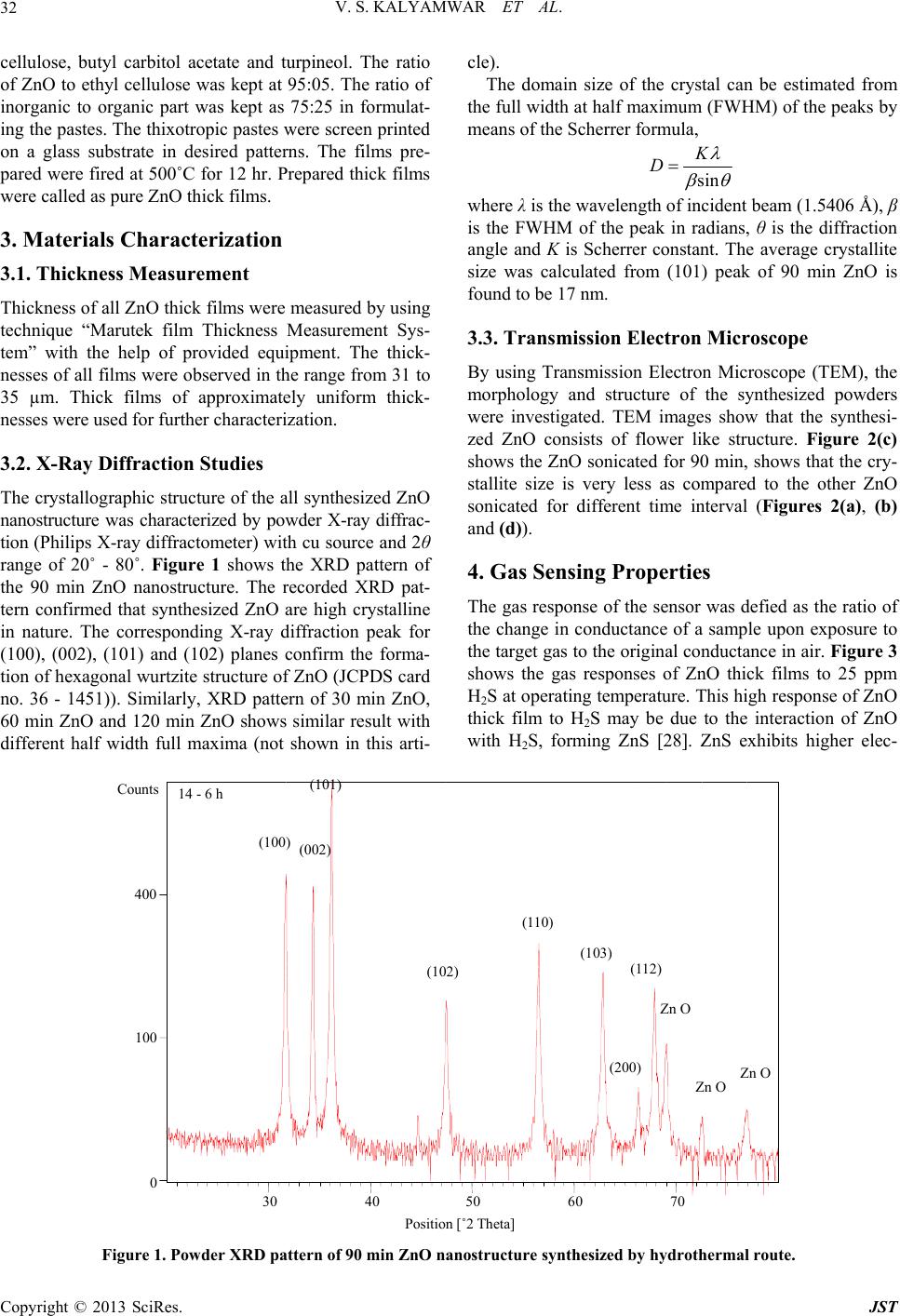 V. S. KALYAMWAR ET AL. 32 cellulose, butyl carbitol acetate and turpineol. The ratio of ZnO to ethyl cellulose was kept at 95:05. The ratio of inorganic to organic part was kept as 75:25 in formulat- ing the pastes. The thixotropic pastes were screen printed on a glass substrate in desired patterns. The films pre- pared were fired at 500˚C for 12 hr. Prepared thick films were called as pure ZnO thick films. 3. Materials Characterization 3.1. Thickness Measurement Thickness of all ZnO thick films were measured by using technique “Marutek film Thickness Measurement Sys- tem” with the help of provided equipment. The thick- nesses of all films were observed in the range from 31 to 35 µm. Thick films of approximately uniform thick- nesses we re used for f urther c ha r a ct e ri z a ti on. 3.2. X-Ray Diffraction Studies The crystallographic structure of the all synthesized ZnO nanostructure was characterized by powder X-ray diffrac- tion (Philips X-ray diffractometer) with cu source and 2θ range of 20˚ - 80˚. Figure 1 shows the XRD pattern of the 90 min ZnO nanostructure. The recorded XRD pat- tern confirmed that synthesized ZnO are high crystalline in nature. The corresponding X-ray diffraction peak for (100), (002), (101) and (102) planes confirm the forma- tion of hexagonal wurtzite structure of ZnO (JCPDS card no. 36 - 1451)). Similarly, XRD pattern of 30 min ZnO, 60 min ZnO and 120 min ZnO shows similar result with different half width full maxima (not shown in this arti- cle). The domain size of the crystal can be estimated from the full width at half maximum (FWHM) of the peaks by means of the Scherrer formula, sin K D where λ is the wavelength of incident beam (1.5406 Å), β is the FWHM of the peak in radians, θ is the diffraction angle and K is Scherrer constant. The average crystallite size was calculated from (101) peak of 90 min ZnO is found to be 17 nm. 3.3. Transmission Electron Microscope By using Transmission Electron Microscope (TEM), the morphology and structure of the synthesized powders were investigated. TEM images show that the synthesi- zed ZnO consists of flower like structure. Figure 2(c) shows the ZnO sonicated for 90 min, shows that the cry- stallite size is very less as compared to the other ZnO sonicated for different time interval (Figures 2(a), (b) and (d)). 4. Gas Sensing Properties The gas response of the sensor was defied as the ratio of the change in conductance of a sample upon exposure to the target gas to the original conductance in air. Figure 3 shows the gas responses of ZnO thick films to 25 ppm H2S at operating temperature. Th is high response of ZnO thick film to H2S may be due to the interaction of ZnO with H2S, forming ZnS [28]. ZnS exhibits higher elec- Position [˚2 Theta] 30 40506070 Count s 0 100 400 (100) (002) (101) (102) (110) (103) (200) (112) Zn O Zn O Zn O 14 - 6 h Figure 1. Powder XRD pattern of 90 min ZnO nanostructure synthesized by hydrothermal route. Copyright © 2013 SciRes. JST 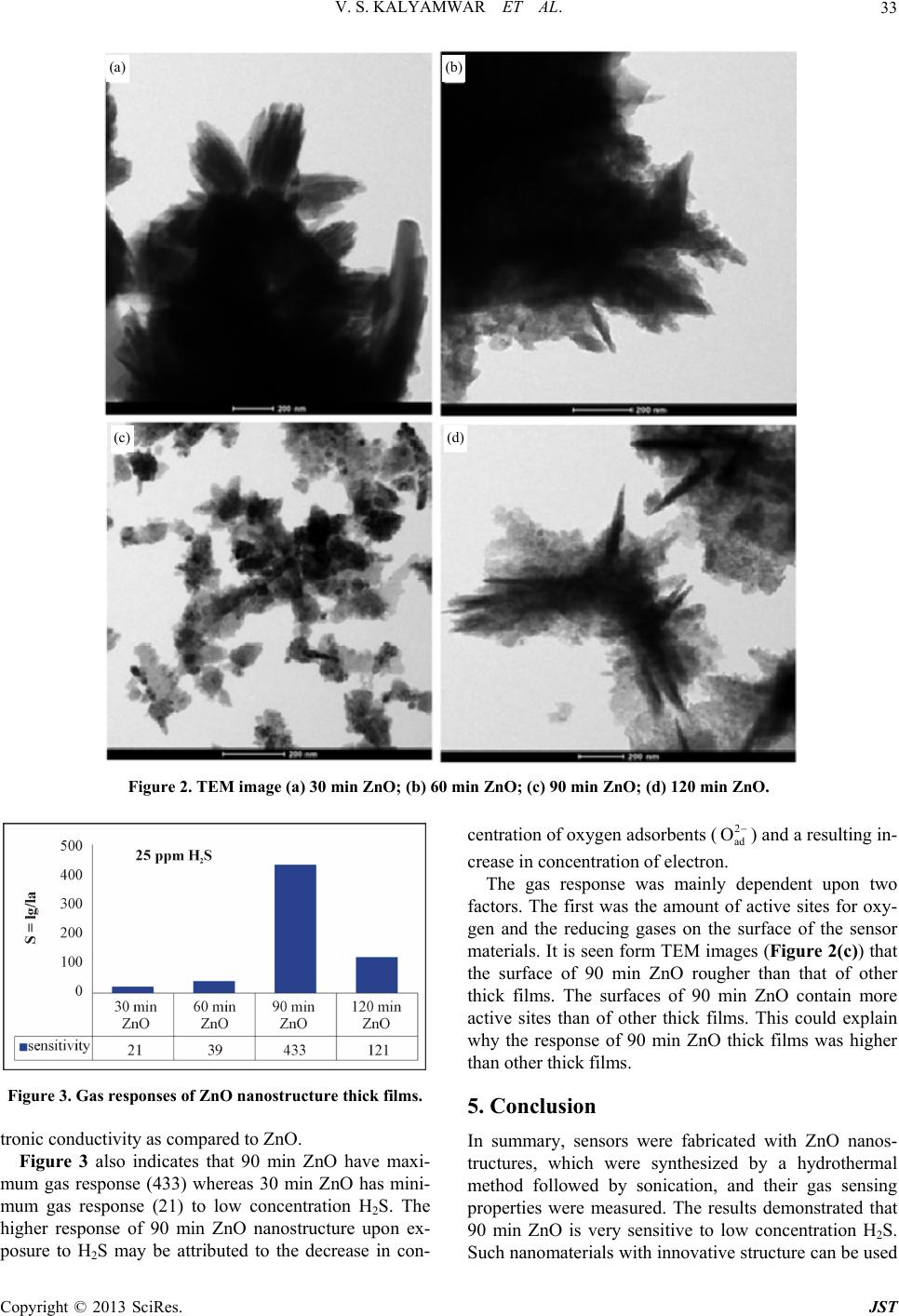 V. S. KALYAMWAR ET AL. 33 (a) (d)(c) (b) Figure 2. TEM image (a) 30 min ZnO; (b) 60 min ZnO; (c) 90 min ZnO; (d) 120 min ZnO. Figure 3. Gas responses of ZnO nanostructure thic k films. tronic conductivity as compared to ZnO. Figure 3 also indicates that 90 min ZnO have maxi- mum gas response (433) whereas 30 min ZnO has mini- mum gas response (21) to low concentration H2S. The higher response of 90 min ZnO nanostructure upon ex- posure to H2S may be attributed to the decrease in con- centration of oxygen ad so rben ts () and a resulting in- 2 ad O crease in concentration of electron. The gas response was mainly dependent upon two factors. The first was the amount of active sites for oxy- gen and the reducing gases on the surface of the sensor materials. It is seen form TEM images (Figure 2(c)) that the surface of 90 min ZnO rougher than that of other thick films. The surfaces of 90 min ZnO contain more active sites than of other thick films. This could explain why the response of 90 min ZnO thick films was higher than other t hi c k fi lms. 5. Conclusion In summary, sensors were fabricated with ZnO nanos- tructures, which were synthesized by a hydrothermal method followed by sonication, and their gas sensing properties were measured. The results demonstrated that 90 min ZnO is very sensitive to low concentration H2S. Such nanomaterials with innovative structure can be used Copyright © 2013 SciRes. JST 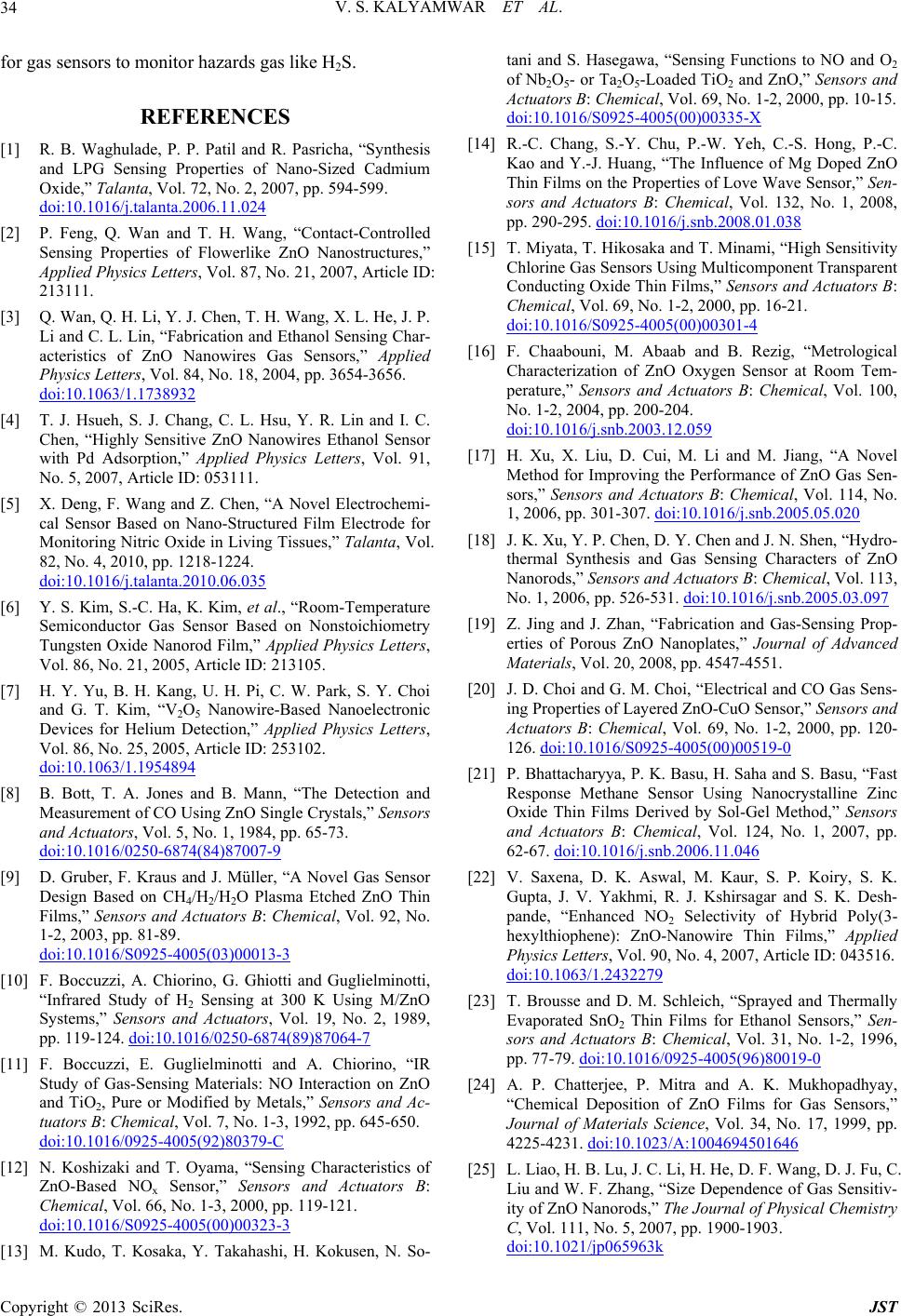 V. S. KALYAMWAR ET AL. 34 for gas sensors to monitor hazards gas like H2S. REFERENCES [1] R. B. Waghulade, P. P. Patil and R. Pasricha, “Synthesis and LPG Sensing Properties of Nano-Sized Cadmium Oxide,” Talanta, Vol. 72, No. 2, 2007, pp. 594-599. doi:10.1016/j.talanta.2006.11.024 [2] P. Feng, Q. Wan and T. H. Wang, “Contact-Controlled Sensing Properties of Flowerlike ZnO Nanostructures,” Applied Physics Letters, Vol. 87, No. 21, 2007, Article ID: 213111. [3] Q. Wan, Q. H. Li, Y. J. Chen, T. H. Wang, X. L. He, J. P. Li and C. L. Lin, “Fabrication and Ethanol Sensing Char- acteristics of ZnO Nanowires Gas Sensors,” Applied Physics Letters, Vol. 84, No. 18, 2004, pp. 3654-3656. doi:10.1063/1.1738932 [4] T. J. Hsueh, S. J. Chang, C. L. Hsu, Y. R. Lin and I. C. Chen, “Highly Sensitive ZnO Nanowires Ethanol Sensor with Pd Adsorption,” Applied Physics Letters, Vol. 91, No. 5, 2007, Article ID: 053111. [5] X. Deng, F. Wang and Z. Chen, “A Novel Electrochemi- cal Sensor Based on Nano-Structured Film Electrode for Monitoring Nitric Oxide in Living Tissues,” Talanta, Vol. 82, No. 4, 2010, pp. 1218-1224. doi:10.1016/j.talanta.2010.06.035 [6] Y. S. Kim, S.-C. Ha, K. Kim, et al., “Room-Temperature Semiconductor Gas Sensor Based on Nonstoichiometry Tungsten Oxide Nanorod Film,” Applied Physics Letters, Vol. 86, No. 21, 2005, Article ID: 213105. [7] H. Y. Yu, B. H. Kang, U. H. Pi, C. W. Park, S. Y. Choi and G. T. Kim, “V2O5 Nanowire-Based Nanoelectronic Devices for Helium Detection,” Applied Physics Letters, Vol. 86, No. 25, 2005, Article ID: 253102. doi:10.1063/1.1954894 [8] B. Bott, T. A. Jones and B. Mann, “The Detection and Measurement of CO Using ZnO Single Crystals,” Sensors and Actuators, Vol. 5, No. 1, 1984, pp. 65-73. doi:10.1016/0250-6874(84)87007-9 [9] D. Gruber, F. Kraus and J. Müller, “A Novel Gas Sensor Design Based on CH4/H2/H2O Plasma Etched ZnO Thin Films,” Sensors and Actuators B: Chemical, Vol. 92, No. 1-2, 2003, pp. 81-89. doi:10.1016/S0925-4005(03)00013-3 [10] F. Boccuzzi, A. Chiorino, G. Ghiotti and Guglielminotti, “Infrared Study of H2 Sensing at 300 K Using M/ZnO Systems,” Sensors and Actuators, Vol. 19, No. 2, 1989, pp. 119-124. doi:10.1016/0250-6874(89)87064-7 [11] F. Boccuzzi, E. Guglielminotti and A. Chiorino, “IR Study of Gas-Sensing Materials: NO Interaction on ZnO and TiO2, Pure or Modified by Metals,” Sensors and Ac- tuators B: Chemical, Vol. 7, No. 1-3, 1992, pp. 645-650. doi:10.1016/0925-4005(92)80379-C [12] N. Koshizaki and T. Oyama, “Sensing Characteristics of ZnO-Based NOx Sensor,” Sensors and Actuators B: Chemical, Vol. 66, No. 1-3, 2000, pp. 119-121. doi:10.1016/S0925-4005(00)00323-3 [13] M. Kudo, T. Kosaka, Y. Takahashi, H. Kokusen, N. So- tani and S. Hasegawa, “Sensing Functions to NO and O2 of Nb2O5- or Ta2O5-Loaded TiO2 and ZnO,” Sensors and Actuators B: Chemical, Vol. 69, No. 1-2, 2000, pp. 10-15. doi:10.1016/S0925-4005(00)00335-X [14] R.-C. Chang, S.-Y. Chu, P.-W. Yeh, C.-S. Hong, P.-C. Kao and Y.-J. Huang, “The Influence of Mg Doped ZnO Thin Films on the Properties of Love Wave Sensor,” Sen- sors and Actuators B: Chemical, Vol. 132, No. 1, 2008, pp. 290-295. doi:10.1016/j.snb.2008.01.038 [15] T. Miyata, T. Hikosaka and T. Minami, “High Sensitivity Chlorine Gas Sensors Using Multicomponent Transparent Conducting Oxide Thin Films,” Sensors and Actuators B: Chemical, Vol. 69, No. 1-2, 2000, pp. 16-21. doi:10.1016/S0925-4005(00)00301-4 [16] F. Chaabouni, M. Abaab and B. Rezig, “Metrological Characterization of ZnO Oxygen Sensor at Room Tem- perature,” Sensors and Actuators B: Chemical, Vol. 100, No. 1-2, 2004, pp. 200-204. doi:10.1016/j.snb.2003.12.059 [17] H. Xu, X. Liu, D. Cui, M. Li and M. Jiang, “A Novel Method for Improving the Performance of ZnO Gas Sen- sors,” Sensors and Actuators B: Chemical, Vol. 114, No. 1, 2006, pp. 301-307. doi:10.1016/j.snb.2005.05.020 [18] J. K. Xu, Y. P. Chen, D. Y. Chen and J. N. Shen, “Hydro- thermal Synthesis and Gas Sensing Characters of ZnO Nanorods,” Sensors and Actuators B: Chemical, Vol. 113, No. 1, 2006, pp. 526-531. doi:10.1016/j.snb.2005.03.097 [19] Z. Jing and J. Zhan, “Fabrication and Gas-Sensing Prop- erties of Porous ZnO Nanoplates,” Journal of Advanced Materials, Vol. 20, 2008, pp. 4547-4551. [20] J. D. Choi and G. M. Choi, “Electrical and CO Gas Sens- ing Properties of Layered ZnO-CuO Sensor,” Sensors and Actuators B: Chemical, Vol. 69, No. 1-2, 2000, pp. 120- 126. doi:10.1016/S0925-4005(00)00519-0 [21] P. Bhattacharyya, P. K. Basu, H. Saha and S. Basu, “Fast Response Methane Sensor Using Nanocrystalline Zinc Oxide Thin Films Derived by Sol-Gel Method,” Sensors and Actuators B: Chemical, Vol. 124, No. 1, 2007, pp. 62-67. doi:10.1016/j.snb.2006.11.046 [22] V. Saxena, D. K. Aswal, M. Kaur, S. P. Koiry, S. K. Gupta, J. V. Yakhmi, R. J. Kshirsagar and S. K. Desh- pande, “Enhanced NO2 Selectivity of Hybrid Poly(3- hexylthiophene): ZnO-Nanowire Thin Films,” Applied Physics Letters, Vol. 90, No. 4, 2007, Article ID: 043516. doi:10.1063/1.2432279 [23] T. Brousse and D. M. Schleich, “Sprayed and Thermally Evaporated SnO2 Thin Films for Ethanol Sensors,” Sen- sors and Actuators B: Chemical, Vol. 31, No. 1-2, 1996, pp. 77-79. doi:10.1016/0925-4005(96)80019-0 [24] A. P. Chatterjee, P. Mitra and A. K. Mukhopadhyay, “Chemical Deposition of ZnO Films for Gas Sensors,” Journal of Materials Science, Vol. 34, No. 17, 1999, pp. 4225-4231. doi:10.1023/A:1004694501646 [25] L. Liao, H. B. Lu, J. C. Li, H. He, D. F. Wang, D. J. Fu, C. Liu and W. F. Zhang, “Size Dependence of Gas Sensitiv- ity of ZnO Nanorods,” The Journal of Physical Chemistry C, Vol. 111, No. 5, 2007, pp. 1900-1903. doi:10.1021/jp065963k Copyright © 2013 SciRes. JST  V. S. KALYAMWAR ET AL. Copyright © 2013 SciRes. JST 35 [26] S. S. Badadhe and I. S. Mulla, “H2S Gas Sensitive In- dium-Doped ZnO Thin Films: Preparation and Charac- terization,” Sensors and Actuators B: Chemical, Vol. 143, No. 1, 2009, pp. 164-170. doi:10.1016/j.snb.2009.08.056 [27] Z. T. Liu, T. X. Fan, D. Zhang, X. L. Gong and J. Q. Xu, “Hierarchically Porous ZnO with High Sensitivity and Selectivity to H2S Derived from Biotemplates,” Sensors and Actuators B: Chemical, Vol. 136, No. 2, 2009, pp. 499-509. doi:10.1016/j.snb.2008.10.043 [28] D. Wang, X. F. Chu and M. L. Gong, “Hydrothermal Growth of ZnO Nanoscrewdrivers and Their Gas Sensing Properties,” Nanotechnology, Vol. 18, No. 18, 2007, Ar- ticle ID: 185601. doi:10.1088/0957-4484/18/18/185601 |