

Paper Menu >>
Journal Menu >>
 Advances in Infectious Diseases, 2013, 3, 210-218 http://dx.doi.org/10.4236/aid.2013.33031 Published Online September 2013 (http://www.scirp.org/journal/aid) Marital Status and HIV Prevalence in Nigeria: Implications for Effective Prevention Programmes for Women* Samson B. Adebayo1,2#, Richard I. Olukolade3#, Omokhudu Idogho1, Jennifer Anyanti1, Augustine Ankomah1,4 1The Society for Family Health, Abuja, Nigeria; 2National Agency for Food and Drug Administration and Control, Abuja, Nigeria; 3Association for Reproductive and Family Health, Abuja, Nigeria; 4Department of Population, Family and Reproductive Health, School of Public Health, College of Health Sciences, University of Ghana, Accra, Ghana. Email: #[email protected] Received May 31st, 2013; revised June 31st, 2013; accepted July 31st, 2013 Copyright © 2013 Samson B. Adebayo et al. This is an open access article distributed under the Creative Commons Attribution Li- cense, which permits unrestricted use, distribution, and reproduction in any medium, provided the original work is properly cited. ABSTRACT Objective: Until recently, HIV prevalence has been based on estimates from antenatal sentinel surveys which have been found to overestimate HIV prevalence among the general population. Multiple studies have shown women to be disproportionately affected by HIV and AIDS epidemic. Design: Data for this study were based on the first Nigerian population household-based HIV biomarker survey of 2007, which used a multi-stage probability sampling technique. Methods: Respondents were selected through probability sampling (male age 15 - 64 years and female 15 - 49 years). This paper, therefore, examined the correlates of marital status and HIV prevalence among women in Nigeria. Results: A descriptive analysis of the data showed that HIV prevalence of women that were formerly married: divorced, sepa- rated or widowed were more than double that of those who were currently married/cohabiting with a sexual partner; and more than three times those that were never married. Bivariate and multivariate levels of analysis were explored in this paper. At bivariate level, findings showed a significant difference in HIV prevalence among women according to their marital status (p < 0.0001), educational attainment (p = 0.004) and geo-political zones (p = 0.003). Respondents that were formerly married were 5.6 times as likely to be infected with HIV compared with those who had never married (OR = 5.6, p < 0.0001) while HIV prevalence increased with higher educational attainment. Conclusion: In view of these findings, HIV programmers should design interventions that will improv e economic empowerment as well as so- cial security for women that were formerly married. In addition, gender mainstreaming in the ongoing HIV and AIDS preventive efforts should be strengthened and scaled-up. Keywords: Early Marriage; Sexual Initiation; HIV Prevalence; Marital Status; Formerly Married 1. Introduction The Human Immunodeficiency Virus (HIV) and Ac- quired Immunodeficiency Syndrome (AIDS) have been a major problem in many parts of the world. AIDS was first recognized as a distinct syndrome in 1981 [1]. In Nigeria, about 3.3 million people are infected with HIV with an estimated 220,000 AIDS related deaths [2]. The 2010 National HIV Sero-prevalence sentinel survey conducted among pregnant women attending antenatal clinics in Nigeria put HIV prevalence at 4.1% [3]. The pervading knowledge that women are burden-bearers cannot be said to be untrue, as from the natural and bio- logical point of view, women bear the weight of child birth and the survival of the child greatly depends on the care of the mother. In the same manner, the impact of HIV and AIDS on a global level, but especially in sub Saharan Africa, does not exclude women. This is because HIV is the leading cause of death and disease among women of reproductive age (15 - 49 years) worldwide [4]. Women have constituted approximately half of all adults living with HIV globally and are more likely to *Conflict of Interest: The authors have no conflicts of interest to de- clare. #Corresponding author. become infected than men. It is estimated that for every Copyright © 2013 SciRes. AID  Marital Status and HIV Prevalence in Nigeria: Implications for Effective Prevention Programmes for Women 211 10 men infected, 13 women will be infected. Of the sev- eral factors implicated in the unequal prevalence of the disease among women in Africa are economic depend- ence, feminisation of poverty, unequal distribution of sexual power (sexual violence and coercion), including limited educational opportunities [5]. Sub-Saharan Africa remains the region hardest hit by the HIV epidemic [2]. As is the case in most of sub-Saharan Africa, women greatly surpass men in the number of people living with HIV and AIDS, and in many areas, women double the number of men with the virus [6]. While some long standing socio-cultural practices are reasons for this higher prevalence of HIV among women, other reasons are evolving with changing patterns of be- haviour and lifestyle. These reasons include biological and social risk factors [7]. The social factors consist of cultural roles and norms, and harmful traditional prac- tices [8]. Such customs include female genital mutilation, forced marriage, low female child education, and dis- crimination against the female gender. Protection of girls and women from HIV infection should include protecting them against gender-based violence and promoting eco- nomic independence from older men [2]. Social norms that accept extra-marital and pre-marital sexual relation- ships among men, combined with women’s inability to negotiate safe sex pr actices with th eir partners make HIV infection a risk even in women who have only had one partner in their entire lives [9]. Men tend to dominate women’s sexuality in Africa’s dramatic context of pov- erty [10]. Similarly, in many countries and societies, women and girls are treated as socially inferior [11]. In all these situations, the inability of women to insist on condom use is a “trade off” of their inalienable right for economic advantage. Biologically, women are two to eight times more likely than men to contract HIV during vaginal inter- course [12] and this may be attributed to difference in anatomical structures of genito-urinary tract which makes females more susceptible to STIs [13]. Since the majority of sexually transmitted infections do not give rise to any symptoms in women, these are less likely to be recog- nized or treated early enough [9 ]. During unprotected sex, the virus can also be directly absorbed through the vagi- nal and cervical mucous membranes. Also, the vaginal lining in women can sometimes tear and possibly allow HIV to enter the body during sex [14]. Marital status is reported to be a factor responsible for the higher HIV prevalence observed among women. In- dividuals, who are divorced, separated or widowed, tend to have significantly higher HIV prevalence than their counterparts who are single, married, or cohabitating; with divorced or widowed women experiencing espe- cially higher prevalence [8]. For instance, some studies have shown that divorced or separated women in Guinea are more than three times more likely to be infected with HIV than single women, while widowed women are al- most seven times more likely to be living with HIV than their counterparts who are single [15]. Meanwhile in Tanzania, studies have shown that more than one in four of widowed women are living with HIV compared with 6% of those who are married or cohabiting and 2% of those who have never been married [16]. Furthermore, studies in Uganda showed that the risk of HIV among widowed individuals is almost 5 times higher than that seen in married individuals, while the risk of HIV among separated is twice that of married respondents. This may be because their partners died of AIDS. Most infections are almost three times higher among the divorced and separated than the married [15, 17]. Higher prevalence of HIV in many African countries has been associated with a high rate of marital separation and widowhood [18]. Although a number of HIV and AIDS prevention and intervention efforts are ongoing, and literature on pro- gress made in Nigeria in addressing HIV prevalence is available, yet more needs to be done. In Nigeria, studies are yet to fully examine the relationship between for- merly married women within the general population and HIV prevalence especially at national level. This may basically be due to the fact that data to make such infer- ences are not available until lately. This paper therefore examines possible correlates of HIV prevalence among women in the general population controlling for their marital status. Findings from this paper will provide HIV programmers and policymakers with the basis for improving and repositioning strategies to combat the disease among women especially in view of higher HIV prevalence among formerly married women compared with their counterparts who were cur- rently in a stable relationship or never married. This pa- per will also review what target groups would need to be addressed as key populations at risk of HIV. 2. Data and Methods 2.1. Survey Method The data us ed for this stud y were obtain ed from the 2007 National HIV & AIDS and Reproductive Health Survey (NARHS) in Nigeria. The primary objective of the NARHS survey is to provide quantitative data for moni- toring current levels of sexual and reproductive health indicators in Nigeria, as well as the impact of reproduc- tive health interventions. The 2007 wave was the third round of the survey in the country with earlier rounds conducted in 2003 and 2005. The 2007 wave was the only one that included a serological component to deter- mine the national HIV prevalence level among the gen- eral population. In essence, the 2007 wave was the first Copyright © 2013 SciRes. AID  Marital Status and HIV Prevalence in Nigeria: Implications for Effective Prevention Programmes for Women 212 survey in Nigeria that provided population-based esti- mates of HIV prevalence in Nigeria. Survey participants were selected across the 36 states and the Federal Capital Territory (FCT) of Nigeria through a multi-stage prob- ability cluster sampling techn iqu e at three levels. Eligible respondents were female aged 15 - 49 years and male aged 15 - 64 years. Selection was based on the sampling frame of enumeration areas which is main- tained by the Nigerian National Population Commission (NPC). List of localities was provided by NPC and strati- fied into major or big towns, medium towns and rural according to the 2006 Population Census. Localities where the surveys were conducted were selected from this list comprising of a mixture of the three main cate- gories with more of rural localities according to the 2006 Nigeria population distribution. A structured questionnaire which was pre-tested was administered to the respondents. Research personnel were trained with the aim of acquainting them with the survey instruments. Questions were adapted from UN- AIDS general population HIV & AIDS indicator and the Demographic and Health Survey questionnaires. Due to the language complexity in Nigeria (with over 250 lan- guages), questionnaire was designed primarily in English Language. Translations of keywords into local languages were done at a central level training to enhance uniform- ity and standardisation of questionnaire administration. Enumerators, including HIV & AIDS counsellors/testers were versed both in English and the local languages of the communities where they worked. For ethical appro- priateness, the survey instruments and materials received the approval of the Federal and State Ministries of Health in Nigeria before implementation through the Nigerian Institute of Medical Research. Consent of the respon- dents was obtained individually and they were ade- quately informed of the survey objectives upon which an individual has the right to participate or otherwise with- out any fear of intimidation. A total of 11,822 respon- dents were selected for the survey but only 11,521 re- sponded to the questionnaire. An HIV pre-test (to all selected eligible respondents) and post-test (only for those that obliged HIV testing) counselling was offered, while results of the test was provided orally but referrals to facilities for further con- firmation and possible placement on treatment for those that were positive. At the end of data co llection exercise, the HIV test results were further confirmed on the dried blood samples collected from respondents, in a well-eq- uipped laboratory by an external consultant. 2.2. Data Overall, 5360 women were interviewed in the 2007 NARHS. Of these, only 4195 agreed to be tested after the HIV pre-test counselling. Therefore, all analyses in this paper were based on the 4195 female respondents that answered the behavioural questionnaire and accepted HIV testing. Marital status was grouped into “Never mar- ried, Currently married/cohabiting, and formerly mar- ried (i.e. separated, divorced and widowed)”. In general, the mean age of the respondents was 27.8 years with a standard deviation (SD) of 9.34. Mean ages according to the marital status are 19.8 years (SD = 4.90) for never married, 30.5 years (SD = 8.61) for currently mar- ried/cohabiting, and 35.9 years (SD = 9.33) for formerly married. Table 1 presents the distribution of the respon- dents according to marital status and selected character- istics. 2.2.1. Depend ent Variable The outcome variable of interest in this study is the result of the HIV test conducted among respondents who were interviewed and volunteered to be tested. For the purp ose of this analysis, response indicating positive HIV test was scored “1” and “0” otherwise. 2.2.2. Independent Variables The key independent variables in this paper are: “marital status”, “location of residence”, “geo-political zones”, “age”, “tribe”, “age at first sex”, “experience of sexually transmitted infections (STIs)”, “multiple partnering”, “transactional sex i.e. sex in exchange for gifts/favour”, religion, “k nowledge of HIV p revention ”, “knowledge of HIV transmission”, and “education”. Marital status with never married as reference category. Place of residence: urban and rural (reference category). Others include educational attainment: Qur’anic/primary, secondary, higher, and no formal education (reference category). Nigeria is divided into six geo-political zones: North West, North East, South West, South East, South South and North Central (the North Central zone was used as the reference). Respondents’ age was grouped into four categories; 15 - 19 years, 20 - 24 years, 25 - 34 years, and 35 - 49 years (reference). Tribe was put into: Hau sa, Igbo, Yoruba, and others (reference). Religion was clas- sified into three; Christianity, Islam and others (refer- ence). Background characteristics (demographic variables) and other correlates of HIV prevalence which are impor- tant predictors were adjusted for in multiple logistic re- gression models. These include location, marital status, education, geo-political zones, respondents’ age, tribe, religion, knowledge about modes of transmission and prevention of HIV and AIDS, and sexual behavioural indicators such as age at sexual debut, multiple sexual partnering; sex in exchange for gifts, favour or money, and self-report of sexually transmitted infections in the las 12 months. t Copyright © 2013 SciRes. AID  Marital Status and HIV Prevalence in Nigeria: Implications for Effective Prevention Programmes for Women Copyright © 2013 SciRes. AID 213 Table 1. Descriptive information about the respondents according to demographic characteristics. Variables Never marriedCurrently married/cohabiting Formerly married Total frequency HIV Status Positive Negative 2.9 97.1 4.0 96.0 10.6 89.4 170 4025 Place of residence Rural Urban 56.7 43.3 69.3 30.7 70.3 29.7 2761 1434 Educational attainment None Qur’anic Primary Secondary Higher 5.7 1.9 10.9 68.6 12.9 36.5 8.8 24.3 24.1 6.3 42.4 8.1 28.4 18.2 3.0 1182 285 870 1524 334 Geo-political zones North West North East North Central South West South East South South 9.5 11.1 16.5 23.0 20.0 19.9 26.1 15.9 18.4 17.4 8.2 14.0 17.4 14.0 17.9 17.0 15.7 17.9 876 605 745 792 501 665 Ethnicity Hausa Igbo Yoruba Others 16.1 23.9 22.9 37.1 37.0 10.7 17.4 34.9 21.6 17.4 19.5 41.5 1269 621 799 1506 Religion Islam Christian (Catholic and Protestants) Traditional/No religion/Others 30.4 69.4 0.3 54.5 44.9 0.7 41.1 57.6 1.3 1966 2201 24 Knowledge of mode of HIV transmission Correct knowledge of all (i.e. all five) Otherwise 27.2 72.8 18.6 81.4 15.7 84.3 875 3320 Knowledge of m ode of prevention Correct knowledge Otherwise 48.2 51.8 36.4 63.6 33.1 66.9 1658 2537 Exchange sex for a gift Yes No 12.7 87.3 96.5 3.5 6.0 94.0 170 3269 Experienced STI symptoms Had STI Did not have STI 12.6 87.4 89.9 10.1 90.7 9.3 452 3743 Age at first sex First sex below 15 years 15 years and above Never Can’t remember 5.1 33.7 59.5 1.7 21.0 71.7 0.3 6.9 22.0 64.8 N/A 13.1 694 2543 715 243 3. Data Analyses and Results 3.1. Descriptive Analysis Table 1 presents the descriptive information about the respondents considered in this paper. HIV prevalence was highest among those who were formerly married compared with those currently married/cohabitating, and those who were never married. Among the formerly married, 6.0% had exchanged sex for gifts, favour or money, compared with 96.5% of cur- rently married and 12.7% of never married who had ex- changed sex for g ift, favour or mone y. In general, 90.7% of those who were formerly married, 89.9% among cur- rently married/cohabiting respondents, and 12.6% among never married reported to have experienced STIs. 3.2. Bivariate Analysis Bivariate analyses were performed to establish any sig- nificant relationship between HIV status and its corre- lates i.e. demographic characteristics and other factors that are suspected to be associated with HIV status con- sidered in this paper. In order to assess the degree of as- sociation between HIV prevalence (status) and the se- lected variables, Pearson Chi-square (X2) test of associa- tion between the dependent and independent variables was used. Results of the bivariate analyses are shown in Table 2. HIV status was foun d to be significantly associ- ated with marital status. Findings revealed a significant and higher HIV prevalence among women who were formerly married (10.6%), compared with those currently married (4.0%) and never married (2.9% ) ( p < 0.0 001 ). 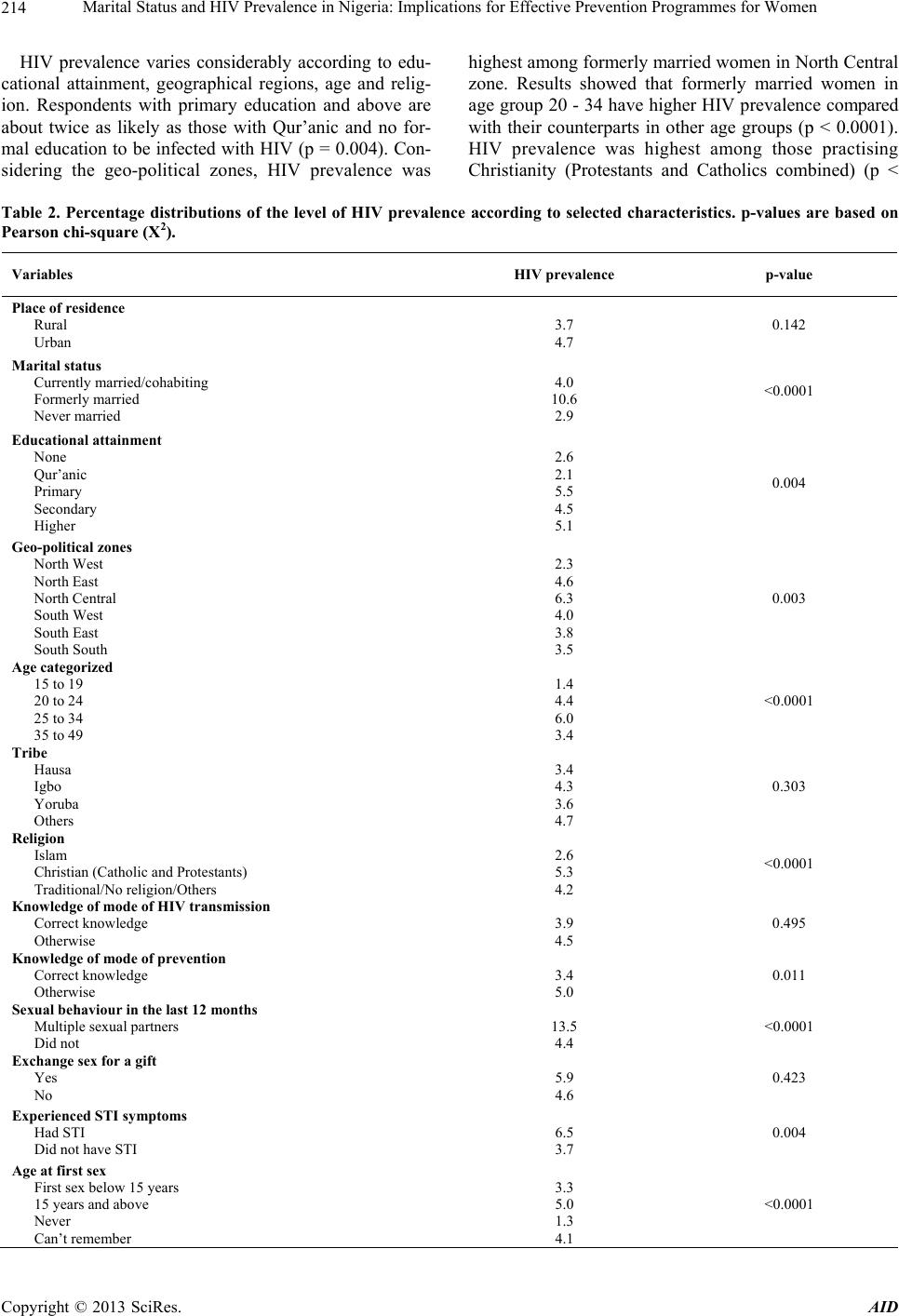 Marital Status and HIV Prevalence in Nigeria: Implications for Effective Prevention Programmes for Women 214 HIV prevalence varies considerably according to edu- cational attainment, geographical regions, age and relig- ion. Respondents with primary education and above are about twice as likely as those with Qur’anic and no for- mal education to be infected with HIV (p = 0.004). Con- sidering the geo-political zones, HIV prevalence was highest among formerly married women in North Central zone. Results showed that formerly married women in age group 20 - 34 have higher HIV prevalence compared with their counterparts in other age groups (p < 0.0001). HIV prevalence was highest among those practising Christianity (Protestants and Catholics combined) (p < Table 2. Percentage distributions of the level of HIV prevalence according to selected characteristics. p-values are based on Pearson chi-square (X2). Variables HIV prevalence p-value Place of residence Rural Urban 3.7 4.7 0.142 Marital status Currently married/cohabiting Formerly married Never married 4.0 10.6 2.9 <0.0001 Educational attainment None Qur’anic Primary Secondary Higher 2.6 2.1 5.5 4.5 5.1 0.004 Geo-political zones North West North East North Central South West South East South South 2.3 4.6 6.3 4.0 3.8 3.5 0.003 Age categorized 15 to 19 20 to 24 25 to 34 35 to 49 1.4 4.4 6.0 3.4 <0.0001 Tribe Hausa Igbo Yoruba Others 3.4 4.3 3.6 4.7 0.303 Religion Islam Christian (Catholic and Protestants) Traditional/No religion/Others 2.6 5.3 4.2 <0.0001 Knowledge of mode of HIV transmission Correct knowledge Otherwise 3.9 4.5 0.495 Knowledge of mode of prevention Correct knowledge Otherwise 3.4 5.0 0.011 Sexual behaviour in the last 12 months Multiple sexual partners Did not 13.5 4.4 <0.0001 Exchange sex for a gift Yes No 5.9 4.6 0.423 Experienced STI symptoms Had STI Did not have STI 6.5 3.7 0.004 Age at first sex First sex below 15 years 15 years and above Never Can’t remember 3.3 5.0 1.3 4.1 <0.0001 Copyright © 2013 SciRes. AID 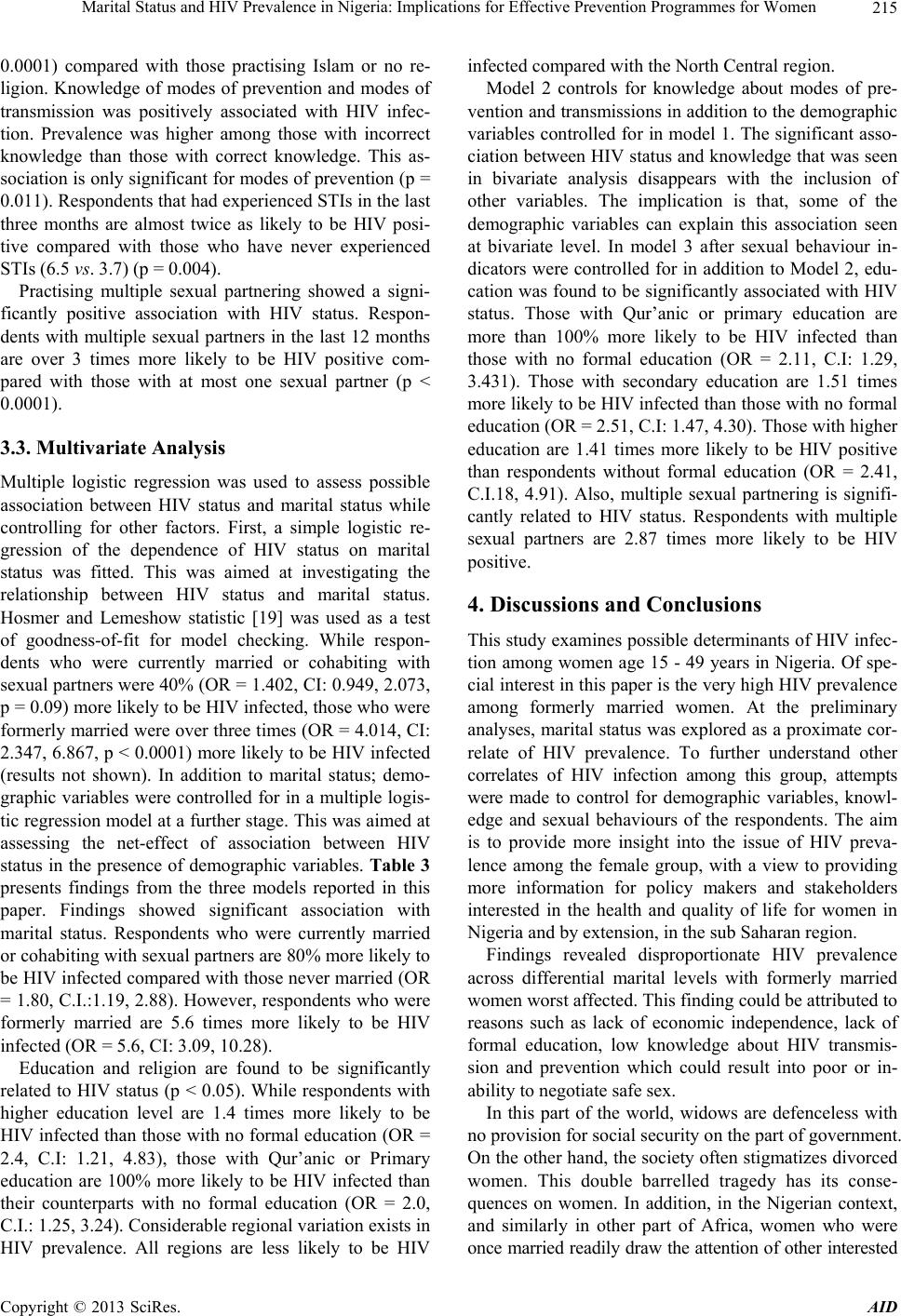 Marital Status and HIV Prevalence in Nigeria: Implications for Effective Prevention Programmes for Women 215 0.0001) compared with those practising Islam or no re- ligion. Knowledge of modes of prevention and modes of transmission was positively associated with HIV infec- tion. Prevalence was higher among those with incorrect knowledge than those with correct knowledge. This as- sociation is only significant for modes of prevention (p = 0.011). Respondents that had experienced STIs in the last three months are almost twice as likely to be HIV posi- tive compared with those who have never experienced STIs (6.5 vs. 3.7) (p = 0.004). Practising multiple sexual partnering showed a signi- ficantly positive association with HIV status. Respon- dents with multiple sexual partners in the last 12 months are over 3 times more likely to be HIV positive com- pared with those with at most one sexual partner (p < 0.0001). 3.3. Multivariate Analysis Multiple logistic regression was used to assess possible association between HIV status and marital status while controlling for other factors. First, a simple logistic re- gression of the dependence of HIV status on marital status was fitted. This was aimed at investigating the relationship between HIV status and marital status. Hosmer and Lemeshow statistic [19] was used as a test of goodness-of-fit for model checking. While respon- dents who were currently married or cohabiting with sexual partners were 40% (OR = 1.402, CI: 0.949, 2.073, p = 0.09) more likely to be HIV infected, those who were formerly married were over three times (OR = 4.014, CI: 2.347, 6.867, p < 0.0001) more likely to be HIV infected (results not shown). In addition to marital status; demo- graphic variables were controlled for in a multiple logis- tic regression model at a further stage. This was aimed at assessing the net-effect of association between HIV status in the presence of demographic variables. Table 3 presents findings from the three models reported in this paper. Findings showed significant association with marital status. Respondents who were currently married or cohabiting with sexu al partn ers are 80% more likely to be HIV infected compared with those never married (OR = 1.80, C.I.:1.19, 2.88). However, respondents who were formerly married are 5.6 times more likely to be HIV infected (OR = 5.6, CI: 3.09, 10.28). Education and religion are found to be significantly related to HIV status (p < 0.05). While respondents with higher education level are 1.4 times more likely to be HIV infected than those with no formal education (OR = 2.4, C.I: 1.21, 4.83), those with Qur’anic or Primary education are 100% more likely to be HIV infected than their counterparts with no formal education (OR = 2.0, C.I.: 1.25, 3.24). Considerable regional variation exists in HIV prevalence. All regions are less likely to be HIV infected compared with the North Central region. Model 2 controls for knowledge about modes of pre- vention and transmissions in addition to the demographic variables controlled for in model 1. The significant asso- ciation between HIV status and knowledge that was seen in bivariate analysis disappears with the inclusion of other variables. The implication is that, some of the demographic variables can explain this association seen at bivariate level. In model 3 after sexual behaviour in- dicators were controlled for in addition to Model 2, edu- cation was found to be significantly asso ciated with HIV status. Those with Qur’anic or primary education are more than 100% more likely to be HIV infected than those with no formal education (OR = 2.11, C.I: 1.29, 3.431). Those with secondary education are 1.51 times more likely to be HIV infected th an those with no formal education (OR = 2.51, C.I: 1.47, 4.30) . Thos e with high er education are 1.41 times more likely to be HIV positive than respondents without formal education (OR = 2.41, C.I.18, 4.91). Also, multiple sexual partnering is signifi- cantly related to HIV status. Respondents with multiple sexual partners are 2.87 times more likely to be HIV positive. 4. Discussions and Conclusions This study examines possible determinants o f HIV infec- tion among women age 15 - 49 years in Nigeria. Of spe- cial interest in this paper is the very high HIV prevalence among formerly married women. At the preliminary analyses, marital status was explored as a proximate cor- relate of HIV prevalence. To further understand other correlates of HIV infection among this group, attempts were made to control for demographic variables, knowl- edge and sexual behaviours of the respondents. The aim is to provide more insight into the issue of HIV preva- lence among the female group, with a view to providing more information for policy makers and stakeholders interested in the health and quality of life for women in Nigeria and by extension, in the sub Saharan region. Findings revealed disproportionate HIV prevalence across differential marital levels with formerly married women worst affected. This finding could be attributed to reasons such as lack of economic independence, lack of formal education, low knowledge about HIV transmis- sion and prevention which could result into poor or in- ability to negotiate safe sex. In this part of the world, widows are defenceless with no provision for social security on the part of government. On the other hand, the society often stigmatizes divorced women. This double barrelled tragedy has its conse- quences on women. In addition, in the Nigerian context, and similarly in other part of Africa, women who were once married readily draw the attention of other interested Copyright © 2013 SciRes. AID 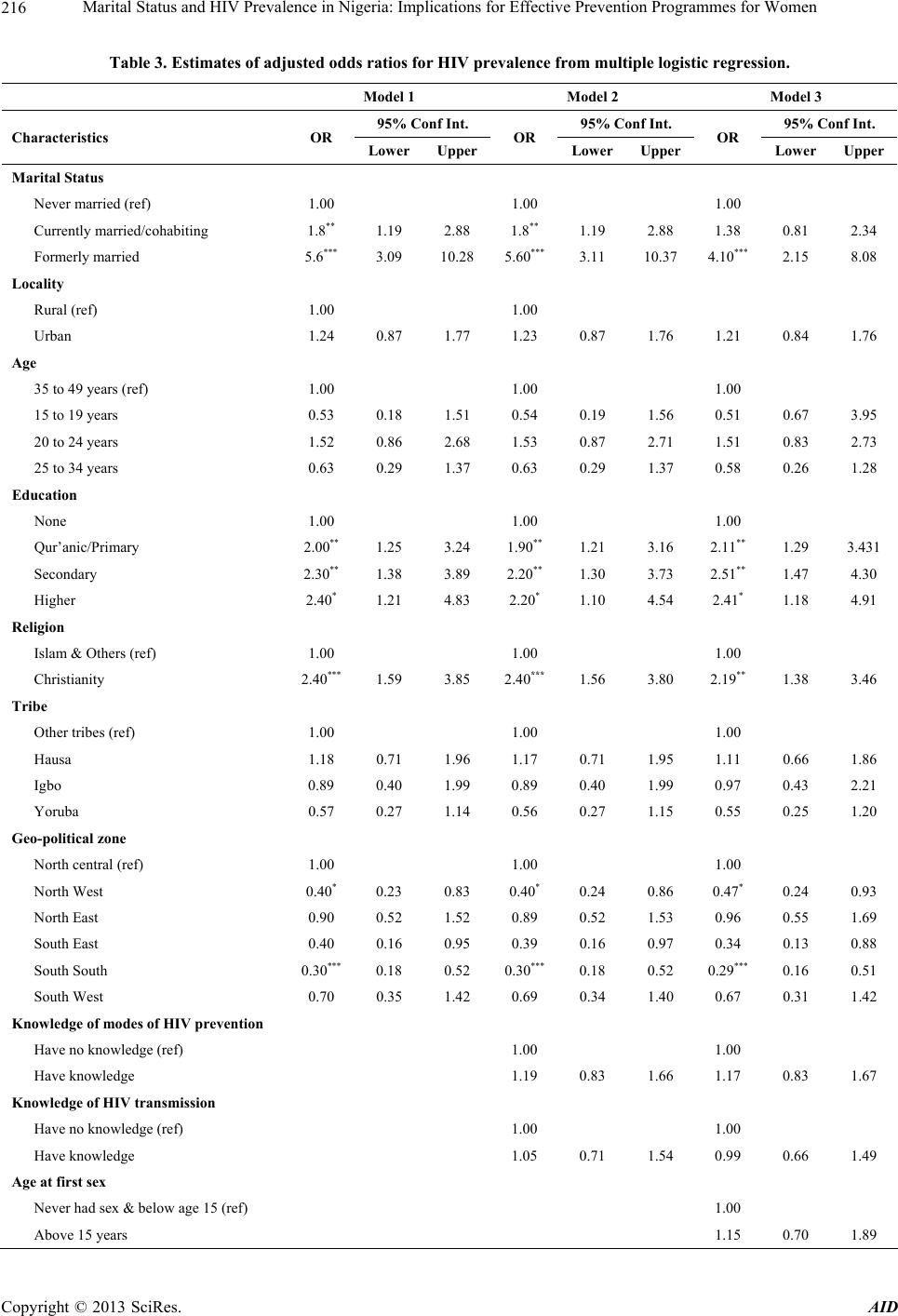 Marital Status and HIV Prevalence in Nigeria: Implications for Effective Prevention Programmes for Women 216 Table 3. Estimates of adjusted odds ratios for HIV prevalence from multiple logistic regression. Model 1 Model 2 Model 3 95% Conf Int. 95% Conf Int. 95% Conf Int. Characteristics OR Lower UpperOR LowerUpper OR Lower Upper Marital Status Never married (ref) 1.00 1.00 1.00 Currently married/cohabiting 1.8** 1.19 2.88 1.8** 1.19 2.88 1.38 0.81 2.34 Formerly married 5.6*** 3.09 10.28 5.60*** 3.11 10.37 4.10*** 2.15 8.08 Locality Rural (ref) 1.00 1.00 Urban 1.24 0.87 1.77 1.23 0.87 1.76 1.21 0.84 1.76 Age 35 to 49 years (ref) 1.00 1 .00 1. 00 15 to 19 years 0.53 0.18 1.51 0.54 0.19 1.56 0.51 0.67 3.95 20 to 24 years 1.52 0.86 2.68 1.53 0.87 2.71 1.51 0.83 2.73 25 to 34 years 0.63 0.29 1.37 0.63 0.29 1.37 0.58 0.26 1.28 Education None 1.00 1.00 1.00 Qur’anic/Primary 2.00** 1.25 3.24 1.90** 1.21 3.16 2.11** 1.29 3.431 Secondary 2.30** 1.38 3.89 2.20** 1.30 3.73 2.51** 1.47 4.30 Higher 2.40* 1.21 4.83 2.20* 1.10 4.54 2.41* 1.18 4.91 Religion Islam & Others (ref) 1.00 1.00 1.00 Christianity 2.40*** 1.59 3.85 2.40*** 1.56 3.80 2.19** 1.38 3.46 Tribe Other tribes (ref) 1.00 1.00 1.00 Hausa 1.18 0.71 1.96 1.17 0.71 1.95 1.11 0.66 1.86 Igbo 0.89 0.40 1.99 0.89 0.40 1.99 0.97 0.43 2.21 Yoruba 0.57 0.27 1.14 0.56 0.27 1.15 0.55 0.25 1.20 Geo-political zone North central (ref) 1.00 1.00 1.00 North West 0.40* 0.23 0.83 0.40* 0.24 0.86 0.47* 0.24 0.93 North East 0.90 0.52 1.52 0.89 0.52 1.53 0.96 0.55 1.69 South East 0.40 0.16 0.95 0.39 0.16 0.97 0.34 0.13 0.88 South South 0.30*** 0.18 0.52 0.30*** 0.18 0.52 0.29*** 0.16 0.51 South West 0.70 0.35 1.42 0.69 0.34 1.40 0.67 0.31 1.42 Knowledge of modes of HIV prevention Have no knowledge (ref) 1.00 1.00 Have knowledge 1.19 0.83 1.66 1.17 0.83 1.67 Knowledge of HIV transmission Have no knowledge (ref) 1.00 1.00 Have knowledge 1.05 0.71 1.54 0.99 0.66 1.49 Age at first sex Never had sex & below age 15 (ref) 1.00 Above 15 years 1.15 0.70 1.89 Copyright © 2013 SciRes. AID 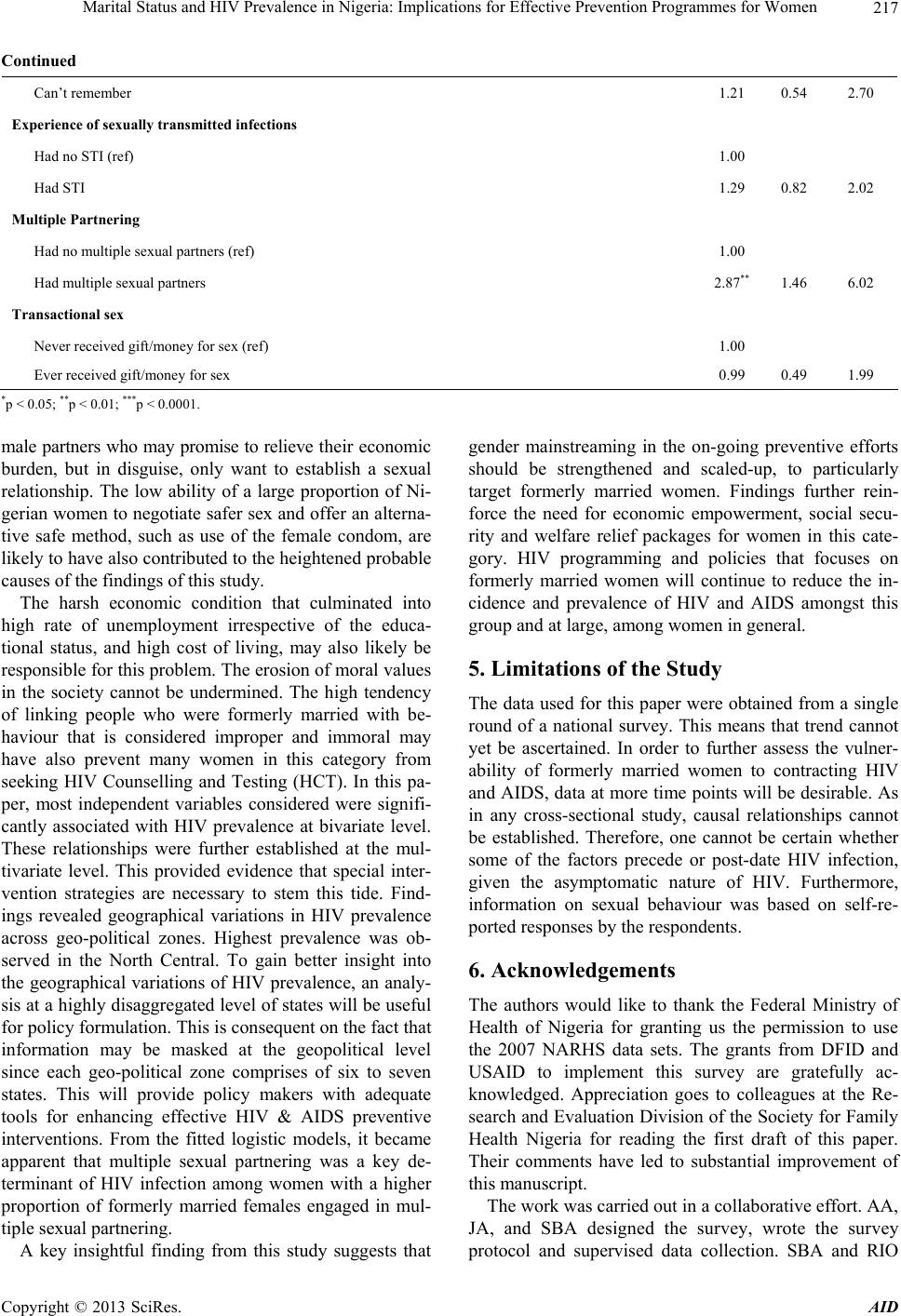 Marital Status and HIV Prevalence in Nigeria: Implications for Effective Prevention Programmes for Women 217 Continued Can’t remember 1.21 0.54 2.70 Experience of sexually transmitted infections Had no STI (ref) 1.00 Had STI 1.29 0.82 2.02 Multiple Partnering Had no multiple sexual partners (ref) 1.00 Had multiple sexual partners 2.87** 1.46 6.02 Transactional sex Never received gift/money for sex (ref) 1.00 Ever received gift/money for sex 0.99 0.49 1.99 *p < 0.05; **p < 0.01; ***p < 0.0001. male partners who may promise to relieve the ir e cono mic burden, but in disguise, only want to establish a sexual relationship. The low ability of a large proportion of Ni- gerian women to negotiate safer sex and offer an alterna- tive safe method, such as use of the female condom, are likely to have also contributed to the heightened probable causes of the findings of this study. The harsh economic condition that culminated into high rate of unemployment irrespective of the educa- tional status, and high cost of living, may also likely be responsible fo r this problem. Th e erosion of moral v alues in the society cannot be undermined. The high tendency of linking people who were formerly married with be- haviour that is considered improper and immoral may have also prevent many women in this category from seeking HIV Counselling and Testing (HCT). In this pa- per, most independent variables considered were signifi- cantly associated with HIV prevalence at bivariate level. These relationships were further established at the mul- tivariate level. This provided evidence that special inter- vention strategies are necessary to stem this tide. Find- ings revealed geographical variations in HIV prevalence across geo-political zones. Highest prevalence was ob- served in the North Central. To gain better insight into the geographical variations of HIV prevalence, an analy- sis at a highly disaggregated level of states will be u seful for policy formulation. This is consequent on the fact that information may be masked at the geopolitical level since each geo-political zone comprises of six to seven states. This will provide policy makers with adequate tools for enhancing effective HIV & AIDS preventive interventions. From the fitted logistic models, it became apparent that multiple sexual partnering was a key de- terminant of HIV infection among women with a higher proportion of formerly married females engaged in mul- tiple sexual partnering. A key insightful finding from this study suggests that gender mainstreaming in the on-going preventive efforts should be strengthened and scaled-up, to particularly target formerly married women. Findings further rein- force the need for economic empowerment, social secu- rity and welfare relief packages for women in this cate- gory. HIV programming and policies that focuses on formerly married women will continue to reduce the in- cidence and prevalence of HIV and AIDS amongst this group and at large, among women in general. 5. Limitations of the Study The data used for this paper were obtained from a single round of a national survey. This means that trend cannot yet be ascertained. In order to further assess the vulner- ability of formerly married women to contracting HIV and AIDS, data at more time points will be desirable. As in any cross-sectional study, causal relationships cannot be established. Therefore, one cannot be certain whether some of the factors precede or post-date HIV infection, given the asymptomatic nature of HIV. Furthermore, information on sexual behaviour was based on self-re- ported responses by the respondents. 6. Acknowledgements The authors would like to thank the Federal Ministry of Health of Nigeria for granting us the permission to use the 2007 NARHS data sets. The grants from DFID and USAID to implement this survey are gratefully ac- knowledged. Appreciation goes to colleagues at the Re- search and Evaluation Division of the Society for Family Health Nigeria for reading the first draft of this paper. Their comments have led to substantial improvement of this manuscript. The work was carried out in a collaborative effort. AA, JA, and SBA designed the survey, wrote the survey protocol and supervised data collection. SBA and RIO Copyright © 2013 SciRes. AID  Marital Status and HIV Prevalence in Nigeria: Implications for Effective Prevention Programmes for Women 218 carried out the data analyses. All authors read and ap- proved the final manuscriptt. 7. Conflicts of Inte rest and Sources of Funding None of the authors declared any conflict of interest. The 2007 National HIV & AIDS and Reproductive Health Survey Plus from where data for this paper was gener- ated, was funded by the United States Agency for Inter- national Development (USAID) and the British Depart- ment for International Development with the support of the Federal Government of Nigeria. REFERENCES [1] J. Mann, “AIDS,” World He alth Forum, Vol. 8, 1997, pp. 361-370. [2] UNAIDS, “Report on the Global AIDS Epidemic,” 2010. http://www.unaids.org/globalreport/documents/20101123 _GlobalReport_full_en.pdf [3] Federal Ministry of Health, “Technical Report of National HIV Sero-Prevalence Sentinel Survey among Pregnant Women Attending Antenatal Clinics in Nigeria,” De- partment of Public Health, National AIDS/STI Control Programme, 2011. [4] UNAIDS Fact Sheet, “Women, Girls, and HIV Over- view,” 2010. http://www.unaids.org [5] B. E. Wodi, “Gender Issues in HIV/AIDS Epidemiology in Sub-Saharan Africa,” 2005. http://appweb.cortland.edu/ojs/index.php/Wagagu/article/ viewArticle/245/ 454. [6] World Health Organization, “AIDS Epidemic Update: Special Report on HIV/AIDS,” 2006. http://www.who.int/hiv/mediacentre/2006_EpiUpdate_en. pdf [7] S. Maman, J. Campbell, M. D. Sweat and A. C. Gleen, “The Intersections of HIV and Violence: Directions for Future Research and Interventions,” Social Science and Medicine, Vol. 50, No. 4, 2000, pp. 459-478. doi:10.1016/S0277-9536(99)00270-1 [8] UNAIDS and WHO, “AIDS Epidemic Update 2009,” 2009. http://data.unaids.org/pub/Report/2009/jc1700_epi_updat e_2009_en.pdf [9] World Health Organization, “Gender and HIV/AIDS,” 2003. http://www.who.org [10] L. Finley, “The AIDS Pandemic,” (2006). Retrieved from: http://the-aids-pandemic.blogspot.com/2006/11/women-a nd-hivaids-in-africa.html [11] World Health Organization, “Women and Health: To- day’s Evidence, Tomorrow’s Agenda,” World Health Organization, Geneva, 2009. [12] UNAIDS and WHO, “AIDS Epidemic Update 2007,” 2007. http://data.unaids.org/pub/epislides/2007/2007_epiupdate _en.pdf [13] A. Abdulazeez, E. Alo and R. Naphthali, “Concurrent Infection of HIV-1 and HIV-2 Serotypes in Adamawa State Nigeria, ” World Journal of Medical Sciences, Vol. 3, No. 1, 2008, pp. 15-18. [14] Center for Disease Control and Prevention, “HIV Trans- mission,” 2010. http://www.cdc.gov/hiv/resources/qa/transmission.htm [15] H. Neondo, “HIV Falling but High among Divorced, Widowed,” Africa Science News Service, 2009. http://africasciencenews.org/asns/index2.php?option=com _content&do_pdf=1&id=1811 [16] National Bureau of Statistics [Tanzania] and ORC Macro, “Tanzania Demographic Health and Survey 2004-2005,” 2005. http://www.measuredhs.com/pubs/pdf/FR173/FR173-TZ 04-05.pdf [17] I. Kasamba, D. Maher, S. Biraro, H. Grosskurth and J. Todd, “How HIV Prevalence, Number of Sexual Partners and Marital Status Are Related in Rural Uganda,” XXVI IUSSP International Population Conference, Marrakech, 2009. http://iussp2009.princeton.edu/download.aspx?submissio nId=92459 [18] J. T. Boerma, M. Urassa, S. Nnko, J. Ng’weshemi, R. Isingo, B. Zaba and G. Mwaluko, “Sociodemographic Context of the AIDS Epidemic in a Rural Area of Tanza- nia with a Focus on People’s Mobility and Marriage,” Sexually Transmitted Infections, Vol. 78, No. S1, 2002, pp. S97-S105. doi:10.1136/sti.78.suppl_1.i97 [19] D. W. Hosmer and S. Lemeshow, “Applied Logistic Re- gression,” John Wiley, New York, 1989. Copyright © 2013 SciRes. AID |