

Paper Menu >>
Journal Menu >>
 Journal of Cancer Therapy, 2013, 4, 1242-1243 http://dx.doi.org/10.4236/jct.2013.47145 Published Online September 2013 (http://www.scirp.org/journal/jct) Maintenance Chemotherapy in Ovarian Cancer: A Trial-Sequential Analysis Andrea Messori*, Valeria Fadda, Dario Maratea, Sabrina Trippoli HTA Unit, ESTAV Toscana Centro, Regional Health Service, Firenze, Italy. Email: *[email protected] Received July 26th, 2013; revised August 21st, 2013; accepted August 26th, 2013 Copyright © 2013 Andrea Messori et al. This is an open access article distributed under the Creative Commons Attribution License, which permits unrestricted use, distribution, and reproduction in any medium, provided the original work is properly cited. ABSTRACT In patients with epithelian ovarian cancer who have achieved remission after initial surgery and induction chemotherapy, the role of maintenance chemotherapy is controversial. We carried out a trial-sequential analysis that included 4 ran- domised controlled trials. The end-point was progression at 3 years while the boundary for non-inferiority was set at ±20% in risk ratio. The results of our trial-sequential analysis indicated the futility of maintenance chemotherapy, i.e. proof of no effectiveness. Consequently, no further trials of this type should be performed to assess the effectiveness of this intervention in this clinical condition. Keywords: Chemotherapy; Ovarian Cancer; Trial-Sequential Analysis; Futility 1. Introduction In patients with epithelian ovarian cancer who have achi- eved remission after initial surgery and induction che- motherapy, the role of maintenance chemotherapy is con- troversial. This pharmacological intervention is aimed at prolonging the duration of remission and improving overall survival; however, conflicting results have been reported on its effectiveness in comparison with observa- tion alone. 2. Results and Discussion Mei and coworkers [1] have recently published a meta- analysis on this issue based on 4 randomised controlled trials (RCTs) that used different types of conventional cytotoxic chemotherapy (e.g. platinum agents, doxorubi- cin, topotecan or paclitaxel). No proof of effectiveness was found; the pooled probability of progression-free survival (PFS) for maintenance chemotherapy vs obser- vation alone was 1.07 (95% confidence interval [CI]: 0.91 to 1.25), which corresponds to a relative risk of pro- gression of 0.93 (95% CI: 0.80 to 1.10). Hence, this meta-analysis concluded that maintenance chemotherapy was not superior to observation alone, i.e. no proof of effectiveness. To better interpret the implications of this negative finding, we applied trial-sequential analysis (TSA) [2-5] to this data-set of survival information in order to deter- mine whether the data available on this treatment simply indicate no proof of effectiveness or conclusive futility (i.e. proof of no effectiveness). Our TSA employed the following assumptions: type 1 error, 5% (two-sided); power, 80%; event frequency for controls, 48% (i.e. the overall event rate found in the 4 control groups). The boundaries for concluding superior- ity or inferiority or futility were calculated according to the O’Brien-Fleming alpha-spending function. A specific statistical software was used (User Manual for TSA, Co- penhagen Trial Unit 2011, see www.ctu.dk/tsa). As usual, the main result of TSA was expressed through the graph of cumulative z-curve. The distinction between inconclu- siveness and futility is not assumption-free, but depends on the choice of a specific threshold for incremental cli- nical effectiveness. In our TSA, this threshold was set at a relative risk reduction (RRR) of 20%; this value was derived from the outcomes reported in the “most posi- tive” trials evaluating remission rates and/or progression [1]. Figure 1 shows the results of our TSA in which “events” were cases of progression at 3 years. The raw data from the 4 trials are presented in the supplementary web material. According to our pre-determined assump- tions, the TSA of these data indicated the futility of maintenance chemotherapy, i.e. proof of no effectiveness. Interestingly enough, although the optimal information *Corresponding author. Copyright © 2013 SciRes. JCT 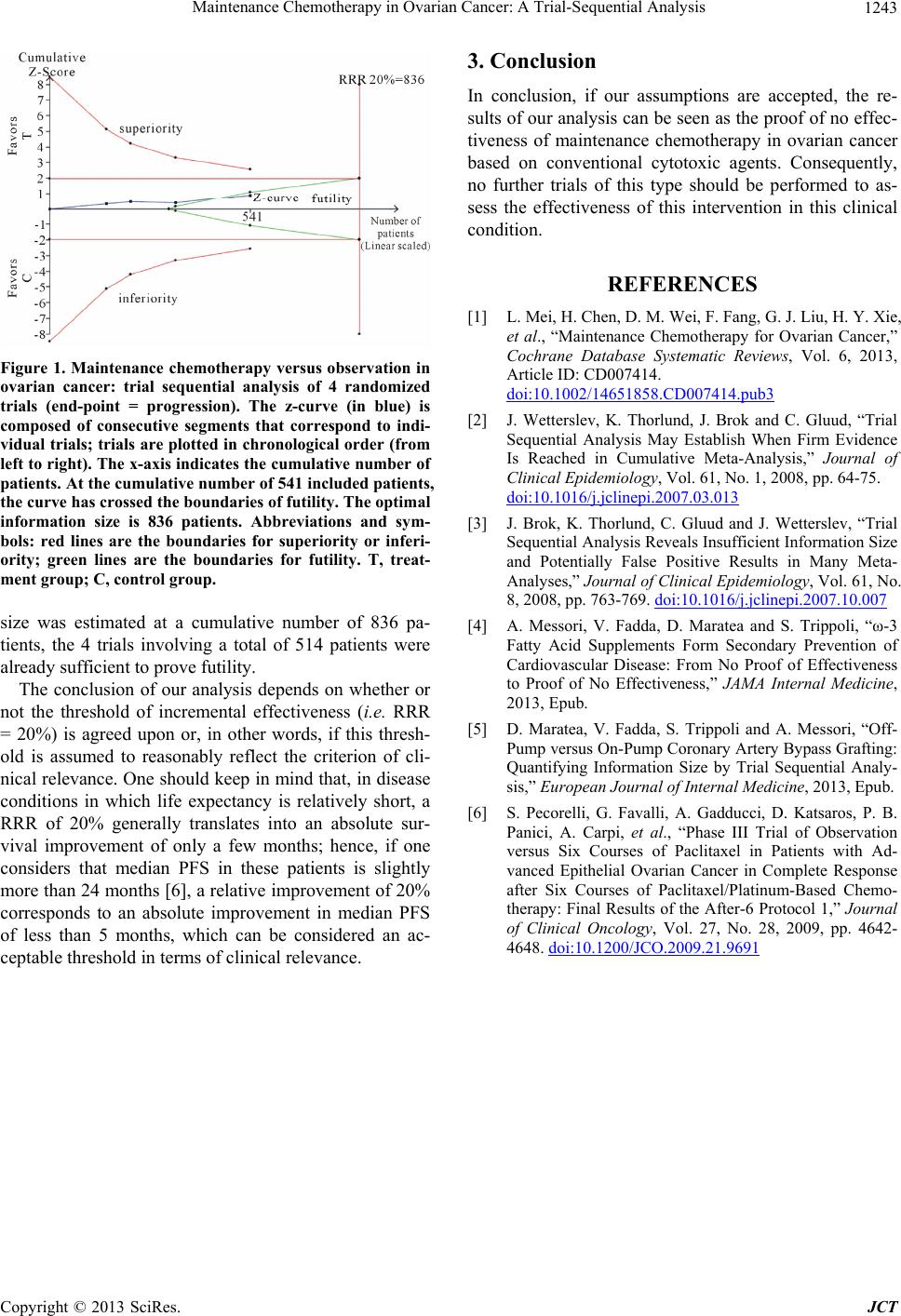 Maintenance Chemotherapy in Ovarian Cancer: A Trial-Sequential Analysis 1243 Figure 1. Maintenance chemotherapy versus observation in ovarian cancer: trial sequential analysis of 4 randomized trials (end-point = progression). The z-curve (in blue) is composed of consecutive segments that correspond to indi- vidual trials; trials are plotted in chronological order (from left to right). The x-axis indicates the cumulative number of patients. At the cumulative number of 541 included patients, the curve has crossed the boundaries of futility. The optimal information size is 836 patients. Abbreviations and sym- bols: red lines are the boundaries for superiority or inferi- ority; green lines are the boundaries for futility. T, treat- ment group; C, control group. size was estimated at a cumulative number of 836 pa- tients, the 4 trials involving a total of 514 patients were already sufficient to prove futility. The conclusion of our analysis depends on whether or not the threshold of incremental effectiveness (i.e. RRR = 20%) is agreed upon or, in other words, if this thresh- old is assumed to reasonably reflect the criterion of cli- nical relevance. One should keep in mind that, in disease conditions in which life expectancy is relatively short, a RRR of 20% generally translates into an absolute sur- vival improvement of only a few months; hence, if one considers that median PFS in these patients is slightly more than 24 months [6], a relative improvement of 20% corresponds to an absolute improvement in median PFS of less than 5 months, which can be considered an ac- ceptable threshold in terms of clinical relevance. 3. Conclusion In conclusion, if our assumptions are accepted, the re- sults of our analysis can be seen as the proof of no effec- tiveness of maintenance chemotherapy in ovarian cancer based on conventional cytotoxic agents. Consequently, no further trials of this type should be performed to as- sess the effectiveness of this intervention in this clinical condition. REFERENCES [1] L. Mei, H. Chen, D. M. Wei, F. Fang, G. J. Liu, H. Y. Xie, et al., “Maintenance Chemotherapy for Ovarian Cancer,” Cochrane Database Systematic Reviews, Vol. 6, 2013, Article ID: CD007414. doi:10.1002/14651858.CD007414.pub3 [2] J. Wetterslev, K. Thorlund, J. Brok and C. Gluud, “Trial Sequential Analysis May Establish When Firm Evidence Is Reached in Cumulative Meta-Analysis,” Journal of Clinical Epidemiolo gy, Vol. 61, No. 1, 2008, pp. 64-75. doi:10.1016/j.jclinepi.2007.03.013 [3] J. Brok, K. Thorlund, C. Gluud and J. Wetterslev, “Trial Sequential Analysis Reveals Insufficient Information Size and Potentially False Positive Results in Many Meta- Analyses,” Journal of Clinical Epidemiology, Vol. 61, No. 8, 2008, pp. 763-769. doi:10.1016/j.jclinepi.2007.10.007 [4] A. Messori, V. Fadda, D. Maratea and S. Trippoli, “ω-3 Fatty Acid Supplements Form Secondary Prevention of Cardiovascular Disease: From No Proof of Effectiveness to Proof of No Effectiveness,” JAMA Internal Medicine, 2013, Epub. [5] D. Maratea, V. Fadda, S. Trippoli and A. Messori, “Off- Pump versus On-Pump Coronary Artery Bypass Grafting: Quantifying Information Size by Trial Sequential Analy- sis,” European Journal of Internal Medicine, 2013, Epub. [6] S. Pecorelli, G. Favalli, A. Gadducci, D. Katsaros, P. B. Panici, A. Carpi, et al., “Phase III Trial of Observation versus Six Courses of Paclitaxel in Patients with Ad- vanced Epithelial Ovarian Cancer in Complete Response after Six Courses of Paclitaxel/Platinum-Based Chemo- therapy: Final Results of the After-6 Protocol 1,” Journal of Clinical Oncology, Vol. 27, No. 28, 2009, pp. 4642- 4648. doi:10.1200/JCO.2009.21.9691 Copyright © 2013 SciRes. JCT |