

Paper Menu >>
Journal Menu >>
 Journal of Cancer Therapy, 2013, 4, 1224-1227 http://dx.doi.org/10.4236/jct.2013.47142 Published Online September 2013 (http://www.scirp.org/journal/jct) Work Productivity and Activity Impairment in Breast Cancer Patients Treated with Capecitabine Marco Vacante1, Giulia Malaguarnera2*, Manuela Pennisi3, Giuseppe Grosso2, Salvatore Salomone2, Filippo Drago2, Erdogan Ozyalcin1, Vito Catania4, Alfredo Consoli4, Mariano Malaguarnera1 1Research Center “The Great Senescence”, Cannizzaro Hospital, University of Catania, Catania, Italy; 2International PhD Programme in Neuropharmacology, University of Catania, Catania, Italy; 3Department of Neurosciences, University of Catania, Catania, Italy; 4Department of General Surgery, University of Catania, Catania, Italy. Email: *[email protected] Received June 11th, 2013; revised July 10th, 2013; accepted July 17th, 2013 Copyright © 2013 Marco Vacante et al. This is an open access article distributed under the Creative Commons Attribution License, which permits unrestricted use, distribution, and reproduction in any medium, provided the original work is properly cited. ABSTRACT Background: Although the majority of breast cancer patients are able to work, lower work ability and reduced job retention have been reported. The aim of the present study was to evaluate the effect of chemotherapy with capecitabine in patients with breast cancer on work productivity and daily activity. Methods: 34 patients with metastatic breast cancer were enrolled for our study. Capecitabine was given twice daily at a cumulative dose of 2500 mg/m2 on days 1 - 14 and repeated on day 22. Work productivity was determined using the WPAI questionnaire. Results: We observed an increase in absenteeism, presenteeism, work productivity loss and daily activity impairment after 1 cycle and 6 cycles of therapy, but we could not find statistically different significances. Conclusions: This study provides some data indicat- ing an association between problems in breast cancer and work. Our results confirm that capecitabine may improve quality of life of patients with metastatic breast cancer. Keywords: Breast Cancer; Capecitabine; Work Productivity; Absenteeism; Presenteeism 1. Introduction Breast cancer is one of the most frequently diagnosed cancer as well as a leading cause of cancer mortality in women. A growing proportion of women diagnosed with breast cancer, present with earlier disease stages. Appro- ximately 50% of all women diagnosed with breast cancer develop metastatic disease, and for these patients the av- erage survival time from the time of diagnosis of metas- tatic disease ranges from 20 to 36 months. After surgery, the next question always is the need for adjuvant treat- ment and also the choice of chemoterapeutic agent. The goal of systemic therapy in early breast cancer is to era- dicate micrometastases and reduce the risk of recurrence and death. Capecitabine is an innovative fluoropyrimidine carba- mate, developed as an orally administered precursor of 5’-deoxy-5 fluorouridine [1]. Capecitabine is an effective, well tolerated, and convenient treatment for patients with breast cancer. Along a pathway with three enzymatic steps, capecitabine is finally converted into the active compound 5-FU at the site of tumor tissue, by the tumor- associated angiogenic factor thymidine phosphorilase, which is overexpressed in tumor cells [2]. The oral for- mulation and the rarity of alopecia make capecitabine a very acceptable and suitable drug, particularly for metas- tatic disease, because it is associated with a better quality of life than intravenous therapies [3]. Although the ma- jority of breast cancer patients are able to work, lower work ability and reduced job retention have been re- ported [4,5]. The aim of the present study was to evaluate the effect of chemotherapy with capecitabine in patients with breast cancer on work productivity and daily activ- ity. 2. Methods Between January 2011 and February 2013, female pa- tients with metastatic breast cancer that desired to con- tinue their job were recruited for postoperative adjuvant oral chemotherapy with capecitabine. The study protocol was approved by the Institutional Review Board. Written informed consents were obtained from all partecipants. *Corresponding author. Copyright © 2013 SciRes. JCT  Work Productivity and Activity Impairment in Breast Cancer Patients Treated with Capecitabine 1225 Further eligibility criteria included the following: 1) Age 30 to 50 years; 2) Eastern Cooperative Oncology Group performance status of 0 or 1; 3) Adequate hematological function (absolute leukocyte count 4000 to 12,000 leu- kocytes/mm3; neutrophil count 2000 neutophils/mm3 or more, and platelets 100,000/mm3 or more) hepatic func- tion (transaminases 2.5 times or less the upper limit of normal and serum bilirubin 2.0 mg/dl or less) and renal function (serum creatinine below the upper limit of nor- mal); 4) Ability to take oral medication. Patients were excluded if they had any of following: history of severe drug allergies, interstitial pneumonitis or pulmonary fi- brosis, several pleural effusion or ascites, active infection, diarrhea or serious uncontrolled comorbilities or medical conditions. Patients were also excluded if they were par- ticipating in another trial, unwilling to use effective con- traception or had a medical condition or concomitant ill- ness that might impair protocol compliance. Patients had received no prior chemotherapy. Capecitabine was given twice daily at a cumulative dose of 2500 mg/m2 on days 1 - 14 and repeated on day 22. The total daily dose was divided into two equal amounts and given roughly 12 h apart and within 30 min after a meal, usually breakfast and dinner. Baseline assessment were medical history, clinical examination, complete haematology with differ- ential leucocyte count, clinical chemistry including co- agulation parameters, tumour markers CA 125 and CA 19-9, chest radiography and computed tomographic scans of the abdomen, pelvis and chest before starting treat- ment at baseline. 2.1. Laboratory Exams A complete routine chemistry including red cell count, hemoglobin, white cell count, platelets, prothrombin time, fasting plasma glucose, insulin, C-reactive protein, blood urea nitrogen, serum creatinine, bilirubin, ALT, aspartate aminotransferase, alkaline phosphatase, γ-glutamil trans- peptidase, and creatin phosphokinase levels was per- formed at every medical visit. All patients were included in the safety and efficacy analyses. The severity of the adverse effects was evaluated according to the National Cancer Institute Common Toxicity Criteria (NCI-CTC) version 2.0 [6]. 2.2. WPAI (Work Productivity and Activity Impairment) Work productivity was determined using the WPAI ques- tionnaire. Patients reported the number of actual hours worked, hours missed due to chemotherapy, as well as the effect on productivity while working and doing re- gular activities during the past 7 days. The WPAI was self-administered and consisted of four questions that eli- cited employment status. Scores for abseteeism, presen- teeism, overall work productivity loss and impairment in regular (non work) daily activities, such as work around the house, shopping, child care, exercising, studying, were derived as follows: Absenteeism = hours missed/ hours missed + hours worked; Presenteeism = scale score/10; Work productivity loss = absenteeism + (hours worked × presenteeism); Daily activity impairment = scale score/10. Score were transformed into percentage with higher percentages indicating greater work impair- ment, lower productivity and daily activity impairment [7]. 2.3. Statistical Analysis Results are expressed as means +/− standard deviations. Comparisons of quantitative data were made using the Student’s t-test or Mann-Whitney test. Qualitative data were analyzed using the chi-square test. A P value of < 0.05 was considered as indicating a statistically signifi- cant difference. All data management and statistical cal- culations were performed using SPSS 15.0 statistical package (Chicago, IL). 3. Results Patients’ characteristics at baseline are reported in Table 1. Blue collars (manual labourers) were 64% and white collars (non manual/office labourers) were 35%. The oe- strogen receptor status was positive in 25% of patients, negative in 41%, unknown in 23%. 58% of patients had one metastatic site, while 41% had two metastatic sites. With regard to WPAI score, we observed an increase in absenteeism, presenteeism, work productivity loss and daily activity impairment after 1 cycle and 6 cycles of therapy, but we could not find statistically different sig- nificances (Table 2 ). Adverse events after 24 weeks che- motherapy included gastrointestinal toxicity: 5 (14%) pa- tients had nausea, 4 (11%) vomiting, 7 (20%) diarrhoea, 4 (11%) mucositis, 6 (17%) stomatitis, 2 (5%) abdominal pain and 1 (2%) proctitis and higher rates of hand-foot skin reactions (12 patients, 35%). 20 (58%) patients showed fatigue (Table 3). 4. Discussion Extensive clinical investigation has established that the standard 3-week cycle of capecitabine prolongs the time to disease progression, with similar or prolonged overall survival in patients with metastatic breast cancer. The possibility of staying at home instead of receiving treat- ment in hospital represents an important role on decision for many patients impacting less on quality of life and offering greater freedom [8]. This preference has influ- enced the adoption of oral capecitabine into the treatment of breast cancer [9]. The goal of this study was to evalu- ate the possible effects of chemotherapy stress on work Copyright © 2013 SciRes. JCT 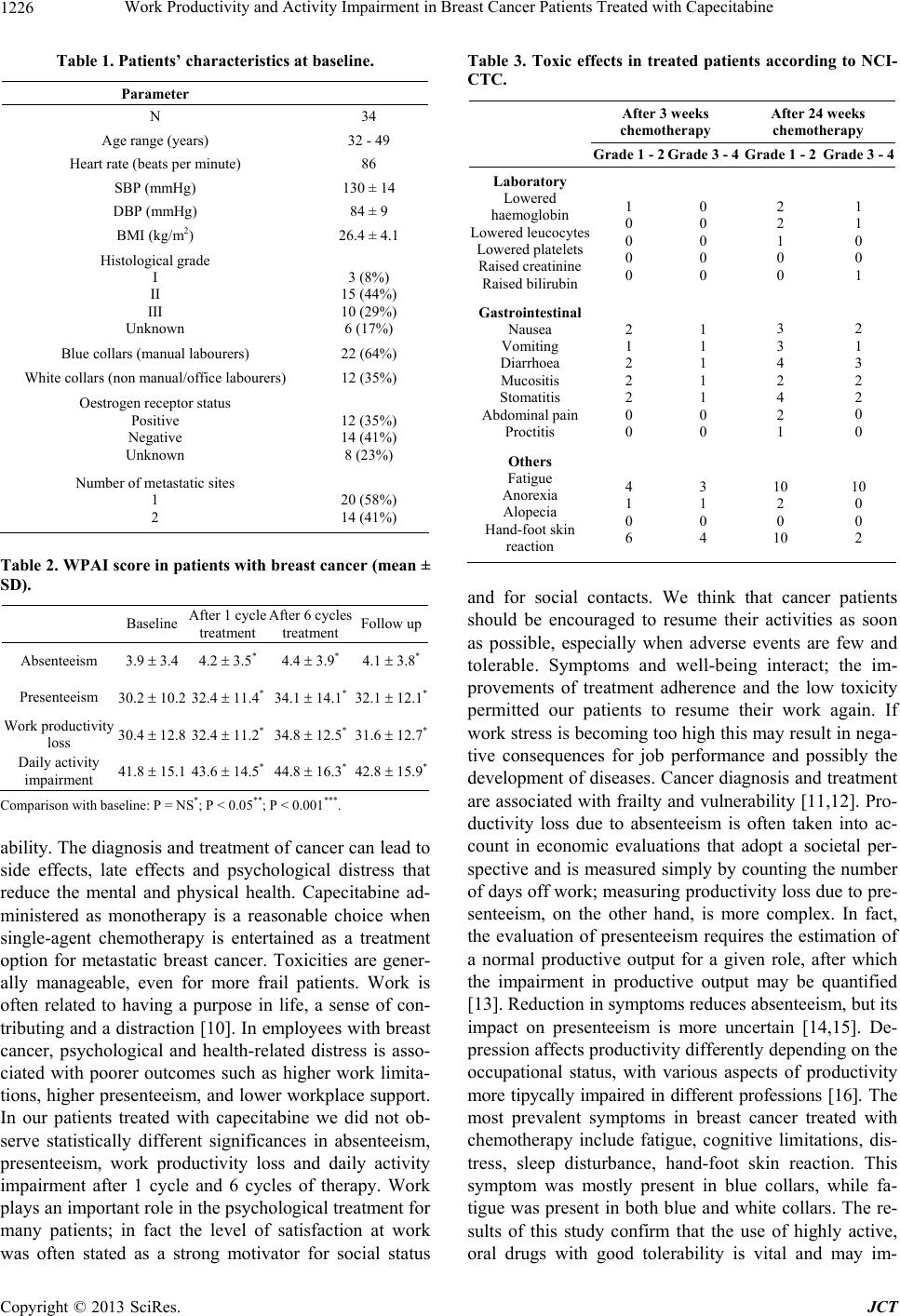 Work Productivity and Activity Impairment in Breast Cancer Patients Treated with Capecitabine 1226 Table 1. Patients’ characteristics at baseline. Parameter N 34 Age range (years) 32 - 49 Heart rate (beats per minute) 86 SBP (mmHg) 130 ± 14 DBP (mmHg) 84 ± 9 BMI (kg/m2) 26.4 ± 4.1 Histological grade I II III Unknown 3 (8%) 15 (44%) 10 (29%) 6 (17%) Blue collars (manual labourers) 22 (64%) White collars (non manual/office labourers) 12 (35%) Oestrogen receptor status Positive Negative Unknown 12 (35%) 14 (41%) 8 (23%) Number of metastatic sites 1 2 20 (58%) 14 (41%) Table 2. WPAI score in patients with breast cancer (mean ± SD). Baseline After 1 cycle treatment After 6 cycles treatment Follow up Absenteeism 3.9 3.4 4.2 3.5* 4.4 3.9* 4.1 3.8* Presenteeism 30.2 10.2 32.4 11.4* 34.1 14.1* 32.1 12.1* Work productivity loss 30.4 12.8 32.4 11.2* 34.8 12.5* 31.6 12.7* Daily activity impairment 41.8 15.1 43.6 14.5* 44.8 16.3* 42.8 15.9* Comparison with baseline: P = NS*; P < 0.05**; P < 0.001***. ability. The diagnosis and treatment of cancer can lead to side effects, late effects and psychological distress that reduce the mental and physical health. Capecitabine ad- ministered as monotherapy is a reasonable choice when single-agent chemotherapy is entertained as a treatment option for metastatic breast cancer. Toxicities are gener- ally manageable, even for more frail patients. Work is often related to having a purpose in life, a sense of con- tributing and a distraction [10]. In employees with breast cancer, psychological and health-related distress is asso- ciated with poorer outcomes such as higher work limita- tions, higher presenteeism, and lower workplace support. In our patients treated with capecitabine we did not ob- serve statistically different significances in absenteeism, presenteeism, work productivity loss and daily activity impairment after 1 cycle and 6 cycles of therapy. Work plays an important role in the psychological treatment for many patients; in fact the level of satisfaction at work was often stated as a strong motivator for social status Table 3. Toxic effects in treated patients according to NCI- CTC. After 3 weeks chemotherapy After 24 weeks chemotherapy Grade 1 - 2Grade 3 - 4 Grade 1 - 2Grade 3 - 4 Laboratory Lowered haemoglobin Lowered leucocytes Lowered platelets Raised creatinine Raised bilirubin 1 0 0 0 0 0 0 0 0 0 2 2 1 0 0 1 1 0 0 1 Gastrointestinal Nausea Vomiting Diarrhoea Mucositis Stomatitis Abdominal pain Proctitis 2 1 2 2 2 0 0 1 1 1 1 1 0 0 3 3 4 2 4 2 1 2 1 3 2 2 0 0 Others Fatigue Anorexia Alopecia Hand-foot skin reaction 4 1 0 6 3 1 0 4 10 2 0 10 10 0 0 2 and for social contacts. We think that cancer patients should be encouraged to resume their activities as soon as possible, especially when adverse events are few and tolerable. Symptoms and well-being interact; the im- provements of treatment adherence and the low toxicity permitted our patients to resume their work again. If work stress is becoming too high this may result in nega- tive consequences for job performance and possibly the development of diseases. Cancer diagnosis and treatment are associated with frailty and vulnerability [11,12]. Pro- ductivity loss due to absenteeism is often taken into ac- count in economic evaluations that adopt a societal per- spective and is measured simply by counting the number of days off work; measuring productivity loss due to pre- senteeism, on the other hand, is more complex. In fact, the evaluation of presenteeism requires the estimation of a normal productive output for a given role, after which the impairment in productive output may be quantified [13]. Reduction in symptoms reduces absenteeism, but its impact on presenteeism is more uncertain [14,15]. De- pression affects productivity differently depending on the occupational status, with various aspects of productivity more tipycally impaired in different professions [16]. The most prevalent symptoms in breast cancer treated with chemotherapy include fatigue, cognitive limitations, dis- tress, sleep disturbance, hand-foot skin reaction. This symptom was mostly present in blue collars, while fa- tigue was present in both blue and white collars. The re- sults of this study confirm that the use of highly active, oral drugs with good tolerability is vital and may im- Copyright © 2013 SciRes. JCT  Work Productivity and Activity Impairment in Breast Cancer Patients Treated with Capecitabine Copyright © 2013 SciRes. JCT 1227 prove quality of life. This study provides some data in- dicating an association between problems in breast can- cer and work. It is unclear whether those who left the workplace would have remained at work if the problems related to cancer and its treatment were effectively ad- dressed. 5. Acknowledgements GM, GG, MiM were supported by the International PhD programme in Neuropharmacology, University of Cata- nia. The authors declare that they have no competing int- erests. REFERENCES [1] P. M. Hoff and R. Pazdur, “Dihydropyrimidine Dehy- drogenase Inhibitory Fluoropyrimidines: A Novel Class of Oral Antineoplastic Agents,” Seminars in Oncology, Vol. 26, No. 6, 1999, pp. 52-56. [2] J. Schüller, J. Cassidy, E. Dumont, B. Roos, S. Durston, L. Banken, M. Utoh, K. Mori, E. Weidekamm and B. Reig- ner, “Preferential Activation of Capecitabine in Tumor Following Oral Administration to Colorectal Cancer Pa- tients,” Cancer Chemotherapy and Pharmacology, Vol. 45, No. 4, 2000, pp. 291-297. doi:10.1007/s002800050043 [3] G. Malaguarnera, M. Pennisi, G. Grosso, M. Vacante, S. Salomone, F. Drago, M. Malaguarnera, E. Ozyalcin, M. Motta, V. Raciti and M. Malaguarnera, “Work Productiv- ity and Activity Impairment in Colorectal Cancer Patients Treated with Capecitabine,” Journal of Cancer Therapy, Vol. 4, No. 7, 2013. [4] J. E. Lavigne, J. J. Griggs, X. M. Tu and D. J. Lerner, “Hot Flashes, Fatigue, Treatment Exposures and Work Productivity in Breast Cancer Survivors,” Journal of Can- cer Survivorship, Vol. 2, No. 4, 2008, pp. 296-302. doi:10.1007/s11764-008-0072-z [5] P. Maguire, M. Brooke, A. Tait, C. Thomas and R. Sell- wood, “The Effect of Counselling on Physical Disability and Social Recovery after Mastectomy,” Clinical Oncol- ogy, Vol. 9, 1983, pp. 319-324. [6] National Cancer Institute Common Toxicity Criteria (NCI-CTC), Version 2.0, DCTD, NCI, NIH, DHHS, March 1998. [7] M. C. Reilly, K. L. Gooch, R. L. Wong, H. Kupper and D. van der Heijde, “Validity, Reliability and Responsiveness of the Work Productivity and Activity Impairment Ques- tionnaire in Ankylosing Spondylitis,” Rheumatology (Ox- ford), Vol. 49, No. 4, 2010, pp. 812-819. [8] S. A. Payne, “A Study of Quality of Life in Cancer Pa- tients Receiving Palliative Chemotherapy,” Social Sci- ence and Medicine, Vol. 35, No. 12, 1992, pp. 1505-1509. doi:10.1016/0277-9536(92)90053-S [9] P. Frazzetto, M. Vacante, M. Malaguarnera, E. Vinci, F. Catalano, E. Cataudella, F. Drago, G. Malaguarnera, F. Basile and A. Biondi, “Depression in Older Breast Cancer Survivors,” BMC Surgery, Vol. 12, Suppl 1, 2012, p. S14. doi:10.1186/1471-2482-12-S1-S14 [10] L. Freeman, “Peer Assistance. Focus on New Return-to- Work Opportunities for Nurses in Recovery,” Texas Nursing, Vol. 70, 1996, pp. 2-3. [11] M. Malaguarnera, M. Vacante, P. M. Frazzetto and M. Motta, “What Is the Frailty in Elderly? Value and Signifi- cance of the Multidimensional Assessments,” Archives of Gerontology and Geriatrics, Vol. 56, No. 1, 2013, pp. 23- 26. doi:10.1016/j.archger.2011.09.017 [12] M. Vacante, V. D’Agata, M. Motta, G. Malaguarnera, A. Biondi, F. Basile, M. Malaguarnera, C. Gagliano, F. Drago and S. Salamone, “Centenarians and Supercenten- arians: A Black Swan. Emerging Social, Medical and Sur- gical Problems,” BMC Surgery, Vol. 12, Suppl 1, 2012, p. S36. doi:10.1186/1471-2482-12-S1-S36 [13] A. B. Schultz, C. Y. Chen and D. W. Edington, “The Cost and Impact of Health Conditions on Presenteeism to Em- ployers: A Review of the Literature,” Pharmacoeconom- ics, Vol. 27, No. 5, 2009, pp. 365-378. doi:10.2165/00019053-200927050-00002 [14] D. A. Adler, T. J. McLaughlin, W. H. Rogers, H. Chang, L. Lapitsky and D. Lerner, “Job Performance Deficits Due to Depression,” American Journal of Psychiatry, Vol. 163, No. 9, 2006, pp. 1569-1576. doi:10.1176/appi.ajp.163.9.1569 [15] P. S. Wang, A. Beck, P. Berglund, J. A. Leutzinger, N. Pronk, D. Richling, T. W. Schenk, G. Simon, P. Stang, T. B. Ustun and R. C. Kessler, “Chronic Medical Conditions and Work Performance in the Health and Work Perform- ance Questionnaire Calibration Surveys,” Journal of Oc- cupational and Environmental Medicine, Vol. 45, No. 12, 2003, pp. 1303-1311. doi:10.1097/01.jom.0000100200.90573.df [16] D. Lerner, D. A. Adler, H. Chang, L. Lapitsky, M. Y. Hood, C. Perissinotto, J. Reed, T. J. McLaughlin, E. R. Berndt and W. H. Rogers, “Unemployment, Job Reten- tion and Productivity Loss among Employees with De- pression,” Psychiatric Services, Vol. 55, No. 12, 2004, pp. 1371-1378. doi:10.1176/appi.ps.55.12.1371 |