

Paper Menu >>
Journal Menu >>
 Journal of Materials Science and Chemical Engineering, 2013, 1, 1-7 http://dx.doi.org/10.4236/msce.2013.14001 Published Online September 2013 (http://www.scirp.org/journal/msce) Behaviors of Polypyrrole Soft Actuators in LiTFSI or NaCl Electrolyte Solutions Containing Methanol Tetsuya Kadoyama, Jun Yamasaki, Futo Tsumuji, Satoshi Takamiya, Shou Ogihara, Daiki Hoshino, Yasushiro Nishioka* Department of Precision Machinery, College of Science & Technology, Nihon University, Chiba, Japan Email: *[email protected] Received June 18, 2013; revised July 18, 2013; accepted August 18, 2013 Copyright © 2013 Tetsuya Kadoyama et al. This is an open access article distributed under the Creative Commons Attribution Li- cense, which permits unrestricted use, distribution, and reproduction in any medium, provided the original work is properly cited. ABSTRACT Organic soft linear actuators were fabricated using galvanostatic electropolymerization of the polypyrrole (PPy) thin film using a methyl benzoate electrolyte solution of N,N-Diethyl-N-methyl-N-(2-methoxyethyl) ammonium bis (trifluoromethanesulfonyl) imide. The electrochemical deformation behaviors of the PPy actuators were investigated in aqueous solutions of an electrolyte, lithium bis (trifluoromethanesulphonyl) imide (LiTFSI) or sodium chloride (NaCl), containing different concentrations of methanol. The actuating strain of approximately 9% was achieved when the ac- tuator was driven by a potential between –1 and 1 V with the potential sweep rate of 10 mV/s corresponding to 0.0025 Hz in the LiTFSI electrolyte containing 40% to 50% of methanol under a load stress of 0.3 MPa. However, the PPy actuator could not catch up with the higher frequency. On the other hand, the PPy actuator caught up with the potential sweep up to 0.1 Hz in the NaCl solutions with a methanol concentration between 40% and 60% with the expense of the actuating strain to approximately 1%. Keywords: Soft Actuator; Polypyrrole; LiTFSI; NaCl 1. Introduction Organic soft linear actuators made of conducting poly- mers such as polypyrrole (PPy) films are of special in- terest for application in microelectromechanical systems (MEMS) because they generate large electrochemical stress between 3 and 5 MPa and large strain [1-8]. Their electrochemical strains (actuating strain) were between 1% and 3%. Recently, it has been reported that some PPy actuators exhibited actuating strains of more than 10% [9-14], and that some of those even achieved actuating strains of up to 40% [14]. The improved actuating strain has been mostly achieved using an electrolyte of tetra-n- butylammonium bis (trifluoromethansulfonyl) imide (TBATFSI) during PPy electropolymerization. These actuators generally function under a low potential voltage range less than 1 V. In the research of PPy actuators, not only larger elec- trochemical strain and stress but their operation speed is another important issue, and a PPy bending actuator was reported to operate at the frequency up to 90 Hz [15]. However, the force generated by the bending actuator was much smaller compared to the PPy linear actuators [16,17]. Similar PPy linear actuators were also reported to operate with at the frequency of 30 Hz [18,19]. On the other hand, the performance of PPy actuators were re- ported to strongly dependent on the different kind of cations in the electrolyte solutions during actuation [20,21]. Kaneto et al. made systematic researches using different kinds of electrolytes such LiCl, NaCl, etc. for [22-24]. Hara et al. also reported that their TFSI-doped porous PPy films exhibited increased actuating strains when their aqueous lithium bis (trifluoromethansulfonyl)- imide (LiTFSI) electrolyte solutions contained propylene carbonate [25]. They attributed those effects to the swelling of the PPy film caused by the penetration of propylene carbonate. The swelled PPy film could more easily pass TFSI anions. Hoshino et al. also found that the PPy films showed notable increase of actuating strains when they were functioned in LiTFSI solutions containing 2-propanol [26] or methanol [27]. However, the PPy actuators in the electrolyte solutions showed notable electrochemical creep after repeated actuation processes. In this paper, we report on increased actuating strain of PPy actuators but with minimal increase of electro- chemical creep in a LiTFSI electrolyte solution contain- *Corresponding author. C opyright © 2013 SciRes. MSCE 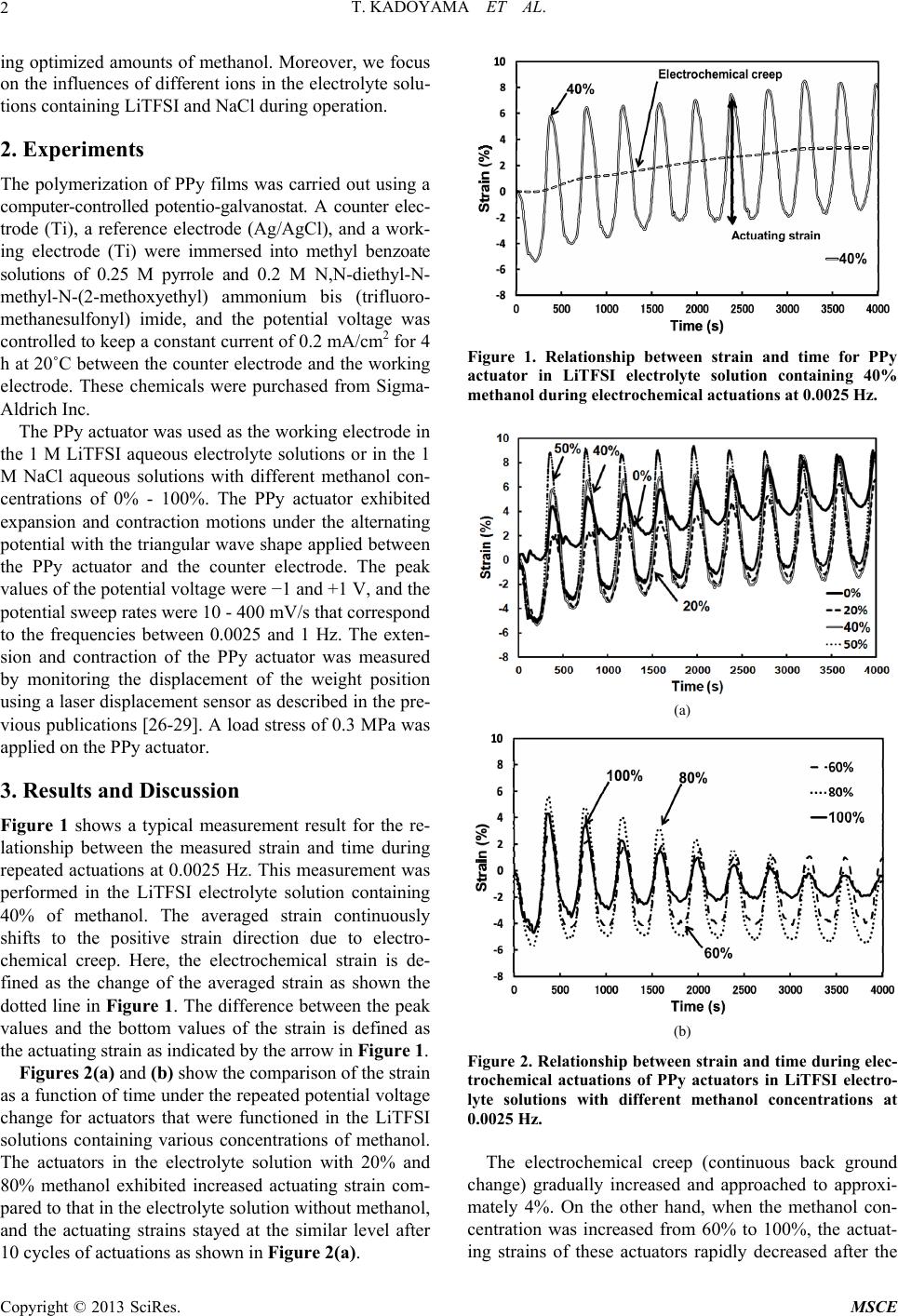 T. KADOYAMA ET AL. 2 ing optimized amounts of methanol. Moreover, we focus on the influences of different ions in the electrolyte solu- tions containing LiTFSI and NaCl during operation. 2. Experiments The polymerization of PPy films was carried out using a computer-controlled potentio-galvanostat. A counter elec- trode (Ti), a reference electrode (Ag/AgCl), and a work- ing electrode (Ti) were immersed into methyl benzoate solutions of 0.25 M pyrrole and 0.2 M N,N-diethyl-N- methyl-N-(2-methoxyethyl) ammonium bis (trifluoro- methanesulfonyl) imide, and the potential voltage was controlled to keep a constant current of 0.2 mA/cm2 for 4 h at 20˚C between the counter electrode and the working electrode. These chemicals were purchased from Sigma- Aldrich Inc. The PPy actuator was used as the working electrode in the 1 M LiTFSI aqueous electrolyte solutions or in the 1 M NaCl aqueous solutions with different methanol con- centrations of 0% - 100%. The PPy actuator exhibited expansion and contraction motions under the alternating potential with the triangular wave shape applied between the PPy actuator and the counter electrode. The peak values of the potential voltage were −1 and +1 V, and the potential sweep rates were 10 - 400 mV/s that correspond to the frequencies between 0.0025 and 1 Hz. The exten- sion and contraction of the PPy actuator was measured by monitoring the displacement of the weight position using a laser displacement sensor as described in the pre- vious publications [26-29]. A load stress of 0.3 MPa was applied on the PPy actuator. 3. Results and Discussion Figure 1 shows a typical measurement result for the re- lationship between the measured strain and time during repeated actuations at 0.0025 Hz. This measurement was performed in the LiTFSI electrolyte solution containing 40% of methanol. The averaged strain continuously shifts to the positive strain direction due to electro- chemical creep. Here, the electrochemical strain is de- fined as the change of the averaged strain as shown the dotted line in Figure 1. The difference between the peak values and the bottom values of the strain is defined as the actuating strain as indicated by the arrow in Figure 1. Figures 2(a) and (b) show the comparison of the strain as a function of time under the repeated potential voltage change for actuators that were functioned in the LiTFSI solutions containing various concentrations of methanol. The actuators in the electrolyte solution with 20% and 80% methanol exhibited increased actuating strain com- pared to that in the electrolyte solution without methanol, and the actuating strains stayed at the similar level after 10 cycles of actuations as shown in Figure 2(a). Figure 1. Relationship between strain and time for PPy actuator in LiTFSI electrolyte solution containing 40% methanol during electrochemical actuations at 0.0025 Hz. (a) (b) Figure 2. Relationship between strain and time during elec- trochemical actuations of PPy actuators in LiTFSI electro- lyte solutions with different methanol concentrations at 0.0025 Hz. The electrochemical creep (continuous back ground change) gradually increased and approached to approxi- mately 4%. On the other hand, when the methanol con- centration was increased from 60% to 100%, the actuat- ing strains of these actuators rapidly decreased after the Copyright © 2013 SciRes. MSCE 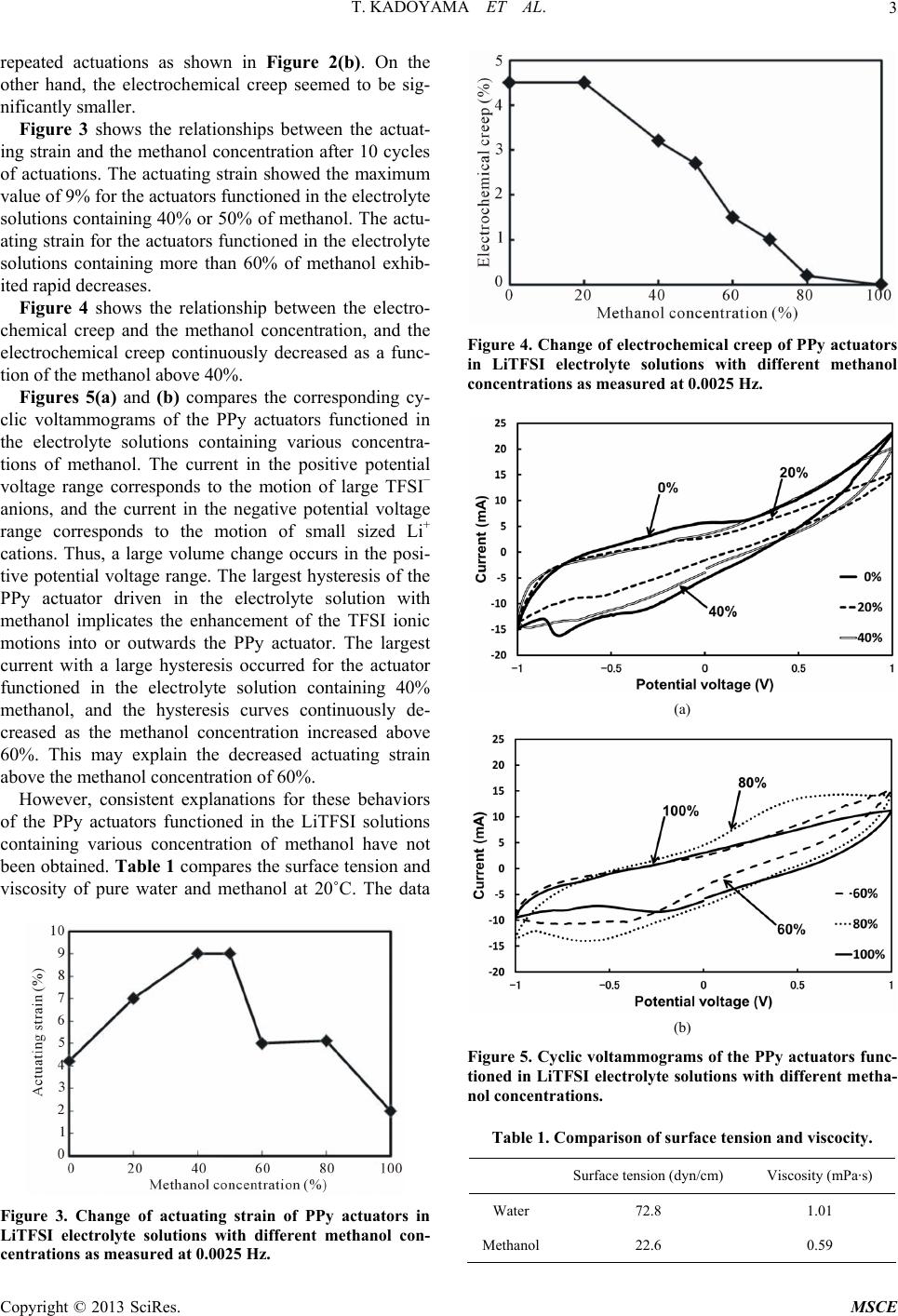 T. KADOYAMA ET AL. 3 repeated actuations as shown in Figure 2(b). On the other hand, the electrochemical creep seemed to be sig- nificantly smaller. Figure 3 shows the relationships between the actuat- ing strain and the methanol concentration after 10 cycles of actuations. The actuating strain showed the maximum value of 9% for the actuators functioned in the electrolyte solutions containing 40% or 50% of methanol. The actu- ating strain for the actuators functioned in the electrolyte solutions containing more than 60% of methanol exhib- ited rapid decreases. Figure 4 shows the relationship between the electro- chemical creep and the methanol concentration, and the electrochemical creep continuously decreased as a func- tion of the methanol above 40%. Figures 5(a) and (b) compares the corresponding cy- clic voltammograms of the PPy actuators functioned in the electrolyte solutions containing various concentra- tions of methanol. The current in the positive potential voltage range corresponds to the motion of large TFSI− anions, and the current in the negative potential voltage range corresponds to the motion of small sized Li+ cations. Thus, a large volume change occurs in the posi- tive potential voltage range. The largest hysteresis of the PPy actuator driven in the electrolyte solution with methanol implicates the enhancement of the TFSI ionic motions into or outwards the PPy actuator. The largest current with a large hysteresis occurred for the actuator functioned in the electrolyte solution containing 40% methanol, and the hysteresis curves continuously de- creased as the methanol concentration increased above 60%. This may explain the decreased actuating strain above the methanol concentration of 60%. However, consistent explanations for these behaviors of the PPy actuators functioned in the LiTFSI solutions containing various concentration of methanol have not been obtained. Table 1 compares the surface tension and viscosity of pure water and methanol at 20˚C. The data Figure 3. Change of actuating strain of PPy actuators in LiTFSI electrolyte solutions with different methanol con- centrations as measured at 0.0025 Hz. Figure 4. Change of electrochemical creep of PPy actuators in LiTFSI electrolyte solutions with different methanol concentrations as measured at 0.0025 Hz. (a) (b) Figure 5. Cyclic voltammograms of the PPy actuators func- tioned in LiTFSI electrolyte solutions with different metha- nol concentrations. Table 1. Comparison of surface tension and viscocity. Surface tension (dyn/cm) Viscosity (mPa·s) Water 72.8 1.01 Methanol22.6 0.59 Copyright © 2013 SciRes. MSCE 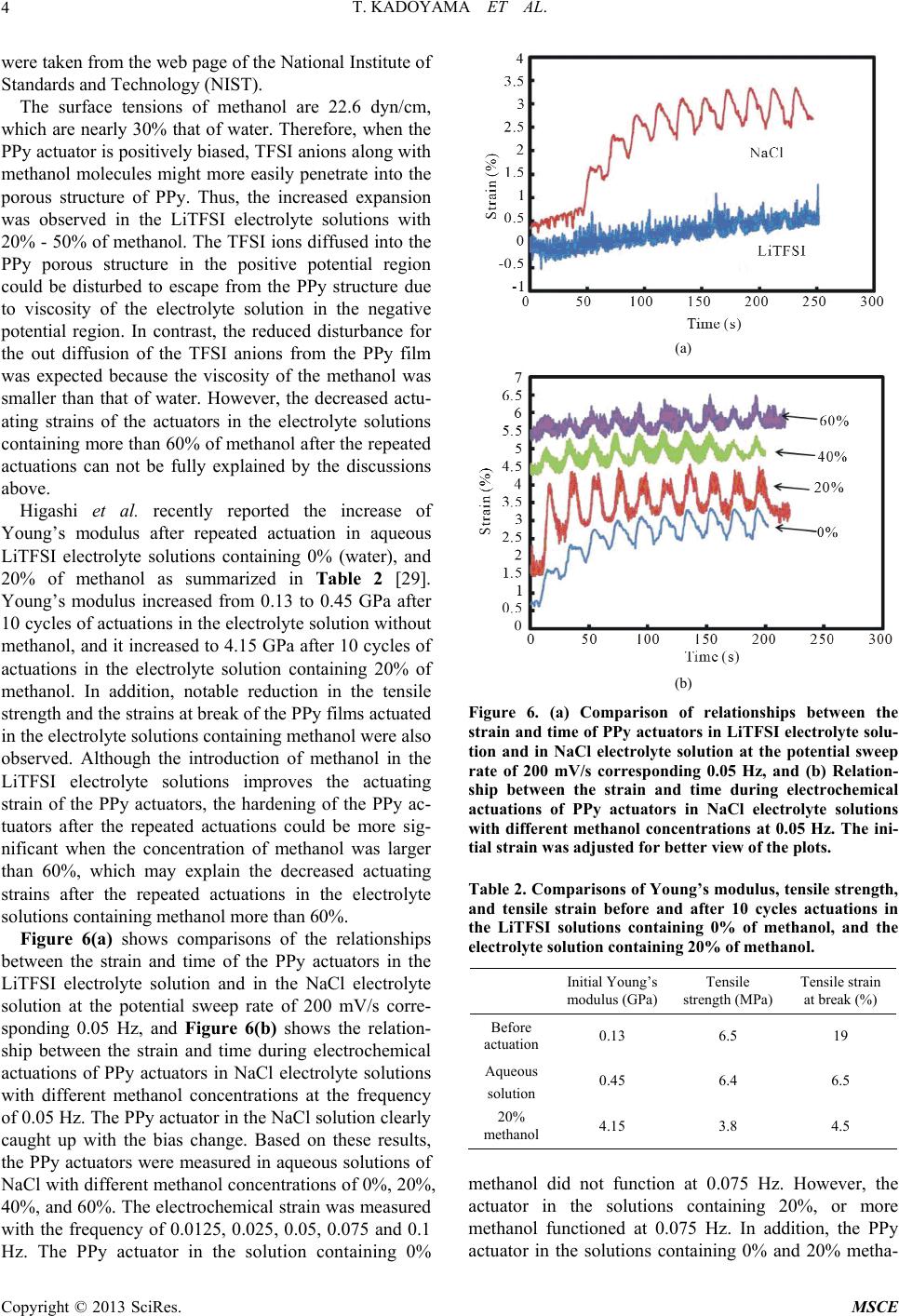 T. KADOYAMA ET AL. 4 were taken from the web page of the National Institute of Standards and Technology (NIST). The surface tensions of methanol are 22.6 dyn/cm, which are nearly 30% that of water. Therefore, when the PPy actuator is positively biased, TFSI anions along with methanol molecules might more easily penetrate into the porous structure of PPy. Thus, the increased expansion was observed in the LiTFSI electrolyte solutions with 20% - 50% of methanol. The TFSI ions diffused into the PPy porous structure in the positive potential region could be disturbed to escape from the PPy structure due to viscosity of the electrolyte solution in the negative potential region. In contrast, the reduced disturbance for the out diffusion of the TFSI anions from the PPy film was expected because the viscosity of the methanol was smaller than that of water. However, the decreased actu- ating strains of the actuators in the electrolyte solutions containing more than 60% of methanol after the repeated actuations can not be fully explained by the discussions above. Higashi et al. recently reported the increase of Young’s modulus after repeated actuation in aqueous LiTFSI electrolyte solutions containing 0% (water), and 20% of methanol as summarized in Table 2 [29]. Young’s modulus increased from 0.13 to 0.45 GPa after 10 cycles of actuations in the electrolyte solution without methanol, and it increased to 4.15 GPa after 10 cycles of actuations in the electrolyte solution containing 20% of methanol. In addition, notable reduction in the tensile strength and the strains at break of the PPy films actuated in the electrolyte solutions containing methanol were also observed. Although the introduction of methanol in the LiTFSI electrolyte solutions improves the actuating strain of the PPy actuators, the hardening of the PPy ac- tuators after the repeated actuations could be more sig- nificant when the concentration of methanol was larger than 60%, which may explain the decreased actuating strains after the repeated actuations in the electrolyte solutions containing methanol more than 60%. Figure 6(a) shows comparisons of the relationships between the strain and time of the PPy actuators in the LiTFSI electrolyte solution and in the NaCl electrolyte solution at the potential sweep rate of 200 mV/s corre- sponding 0.05 Hz, and Figure 6(b) shows the relation- ship between the strain and time during electrochemical actuations of PPy actuators in NaCl electrolyte solutions with different methanol concentrations at the frequency of 0.05 Hz. The PPy actuator in the NaCl solution clearly caught up with the bias change. Based on these results, the PPy actuators were measured in aqueous solutions of NaCl with different methanol concentrations of 0%, 20%, 40%, and 60%. The electrochemical strain was measured with the frequency of 0.0125, 0.025, 0.05, 0.075 and 0.1 Hz. The PPy actuator in the solution containing 0% (a) (b) Figure 6. (a) Comparison of relationships between the strain and time of PPy actuators in LiTFSI electrolyte solu- tion and in NaCl electrolyte solution at the potential sweep rate of 200 mV/s corresponding 0.05 Hz, and (b) Relation- ship between the strain and time during electrochemical actuations of PPy actuators in NaCl electrolyte solutions with different methanol concentrations at 0.05 Hz. The ini- tial strain was adjusted for better view of the plots. Table 2. Comparisons of Young’s modulus, tensile strength, and tensile strain before and after 10 cycles actuations in the LiTFSI solutions containing 0% of methanol, and the electrolyte solution containing 20% of methanol. Initial Young’s modulus (GPa) Tensile strength (MPa) Tensile strain at break (%) Before actuation 0.13 6.5 19 Aqueous solution 0.45 6.4 6.5 20% methanol 4.15 3.8 4.5 methanol did not function at 0.075 Hz. However, the actuator in the solutions containing 20%, or more methanol functioned at 0.075 Hz. In addition, the PPy actuator in the solutions containing 0% and 20% metha- Copyright © 2013 SciRes. MSCE 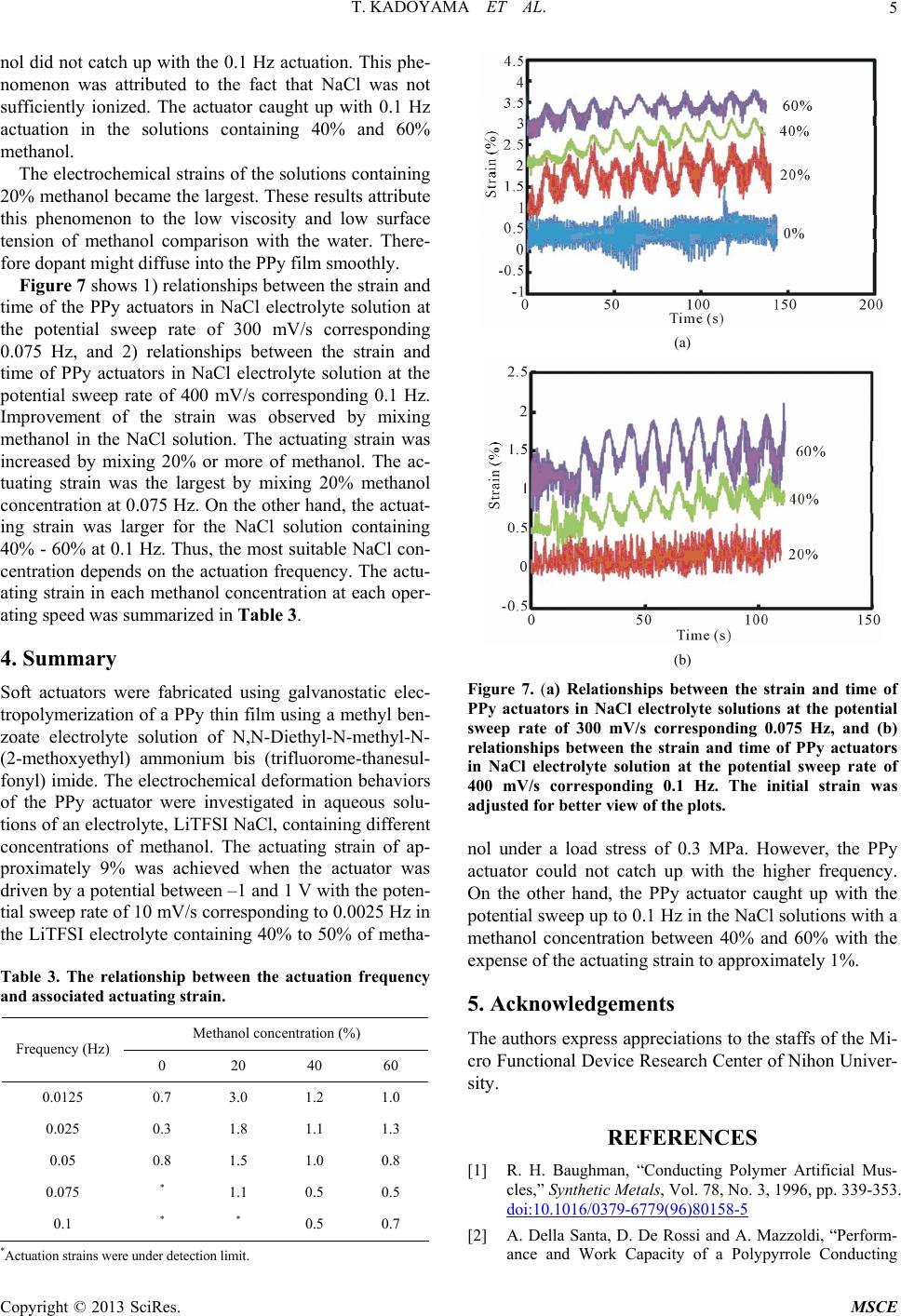 T. KADOYAMA ET AL. 5 nol did not catch up with the 0.1 Hz actuation. This phe- nomenon was attributed to the fact that NaCl was not sufficiently ionized. The actuator caught up with 0.1 Hz actuation in the solutions containing 40% and 60% methanol. The electrochemical strains of the solutions containing 20% methanol became the largest. These results attribute this phenomenon to the low viscosity and low surface tension of methanol comparison with the water. There- fore dopant might diffuse into the PPy film smoothly. Figure 7 shows 1) relationships between the strain and time of the PPy actuators in NaCl electrolyte solution at the potential sweep rate of 300 mV/s corresponding 0.075 Hz, and 2) relationships between the strain and time of PPy actuators in NaCl electrolyte solution at the potential sweep rate of 400 mV/s corresponding 0.1 Hz. Improvement of the strain was observed by mixing methanol in the NaCl solution. The actuating strain was increased by mixing 20% or more of methanol. The ac- tuating strain was the largest by mixing 20% methanol concentration at 0.075 Hz. On the other hand, the actuat- ing strain was larger for the NaCl solution containing 40% - 60% at 0.1 Hz. Thus, the most suitable NaCl con- centration depends on the actuation frequency. The actu- ating strain in each methanol concentration at each oper- ating speed was summarized in Table 3. 4. Summary Soft actuators were fabricated using galvanostatic elec- tropolymerization of a PPy thin film using a methyl ben- zoate electrolyte solution of N,N-Diethyl-N-methyl-N- (2-methoxyethyl) ammonium bis (trifluorome-thanesul- fonyl) imide. The electrochemical deformation behaviors of the PPy actuator were investigated in aqueous solu- tions of an electrolyte, LiTFSI NaCl, containing different concentrations of methanol. The actuating strain of ap- proximately 9% was achieved when the actuator was driven by a potential between –1 and 1 V with the poten- tial sweep rate of 10 mV/s corresponding to 0.0025 Hz in the LiTFSI electrolyte containing 40% to 50% of metha- Table 3. The relationship between the actuation frequency and associated actuating strain. Methanol concentration (%) Frequency (Hz) 0 20 40 60 0.0125 0.7 3.0 1.2 1.0 0.025 0.3 1.8 1.1 1.3 0.05 0.8 1.5 1.0 0.8 0.075 * 1.1 0.5 0.5 0.1 * * 0.5 0.7 *Actuation strains were under detection limit. (a) (b) Figure 7. (a) Relationships between the strain and time of PPy actuators in NaCl electrolyte solutions at the potential sweep rate of 300 mV/s corresponding 0.075 Hz, and (b) relationships between the strain and time of PPy actuators in NaCl electrolyte solution at the potential sweep rate of 400 mV/s corresponding 0.1 Hz. The initial strain was adjusted for better view of the plots. nol under a load stress of 0.3 MPa. However, the PPy actuator could not catch up with the higher frequency. On the other hand, the PPy actuator caught up with the potential sweep up to 0.1 Hz in the NaCl solutions with a methanol concentration between 40% and 60% with the expense of the actuating strain to approximately 1%. 5. Acknowledgements The authors express appreciations to the staffs of the Mi- cro Functional Device Research Center of Nihon Univer- sity. REFERENCES [1] R. H. Baughman, “Conducting Polymer Artificial Mus- cles,” Synthetic Metals, Vol. 78, No. 3, 1996, pp. 339-353. doi:10.1016/0379-6779(96)80158-5 [2] A. Della Santa, D. De Rossi and A. Mazzoldi, “Perform- ance and Work Capacity of a Polypyrrole Conducting Copyright © 2013 SciRes. MSCE 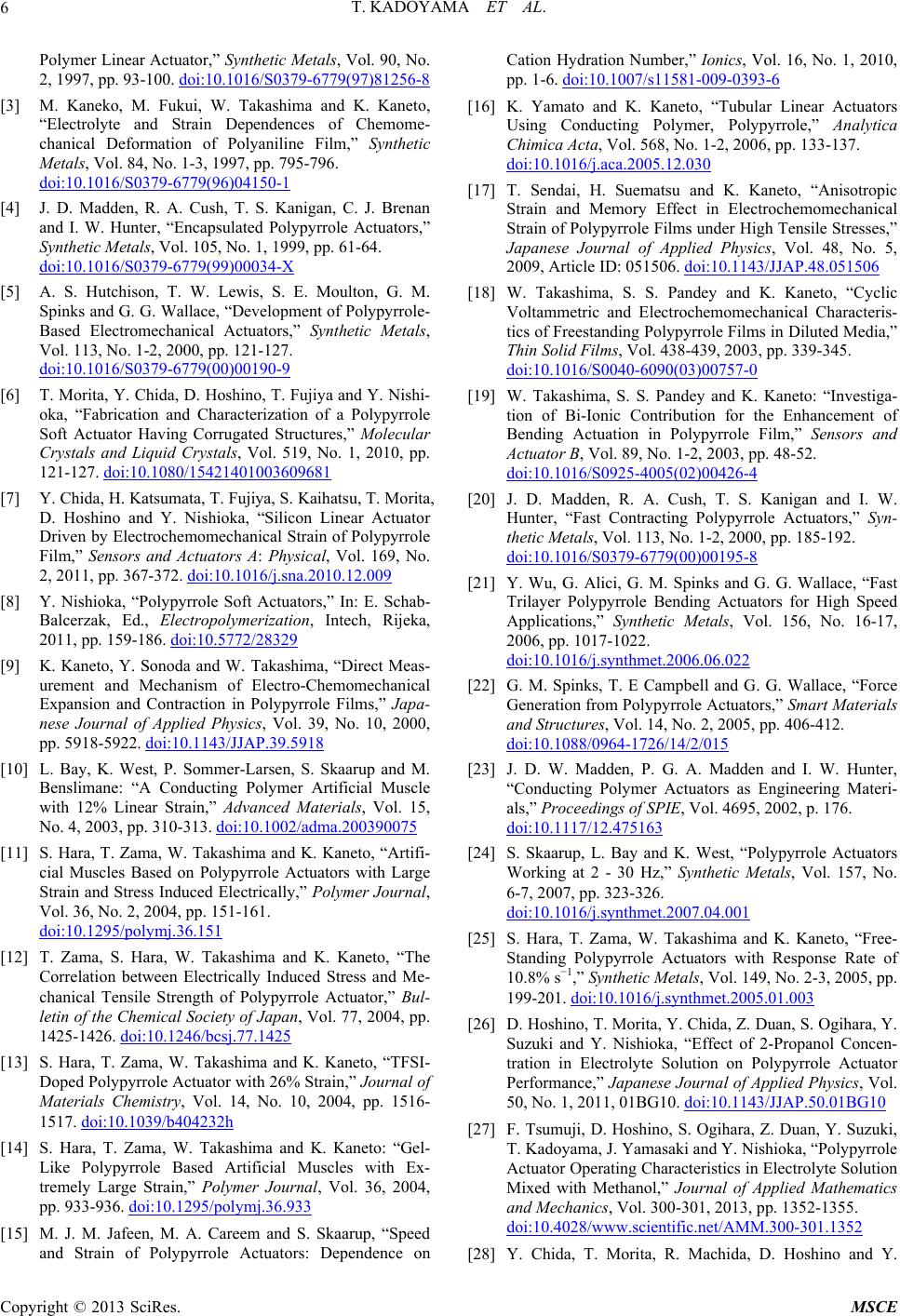 T. KADOYAMA ET AL. 6 Polymer Linear Actuator,” Synthetic Metals, Vol. 90, No. 2, 1997, pp. 93-100. doi:10.1016/S0379-6779(97)81256-8 [3] M. Kaneko, M. Fukui, W. Takashima and K. Kaneto, “Electrolyte and Strain Dependences of Chemome- chanical Deformation of Polyaniline Film,” Synthetic Metals, Vol. 84, No. 1-3, 1997, pp. 795-796. doi:10.1016/S0379-6779(96)04150-1 [4] J. D. Madden, R. A. Cush, T. S. Kanigan, C. J. Brenan and I. W. Hunter, “Encapsulated Polypyrrole Actuators,” Synthetic Metals, Vol. 105, No. 1, 1999, pp. 61-64. doi:10.1016/S0379-6779(99)00034-X [5] A. S. Hutchison, T. W. Lewis, S. E. Moulton, G. M. Spinks and G. G. Wallace, “Development of Polypyrrole- Based Electromechanical Actuators,” Synthetic Metals, Vol. 113, No. 1-2, 2000, pp. 121-127. doi:10.1016/S0379-6779(00)00190-9 [6] T. Morita, Y. Chida, D. Hoshino, T. Fujiya and Y. Nishi- oka, “Fabrication and Characterization of a Polypyrrole Soft Actuator Having Corrugated Structures,” Molecular Crystals and Liquid Crystals, Vol. 519, No. 1, 2010, pp. 121-127. doi:10.1080/15421401003609681 [7] Y. Chida, H. Katsumata, T. Fujiya, S. Kaihatsu, T. Morita, D. Hoshino and Y. Nishioka, “Silicon Linear Actuator Driven by Electrochemomechanical Strain of Polypyrrole Film,” Sensors and Actuators A: Physical, Vol. 169, No. 2, 2011, pp. 367-372. doi:10.1016/j.sna.2010.12.009 [8] Y. Nishioka, “Polypyrrole Soft Actuators,” In: E. Schab- Balcerzak, Ed., Electropolymerization, Intech, Rijeka, 2011, pp. 159-186. doi:10.5772/28329 [9] K. Kaneto, Y. Sonoda and W. Takashima, “Direct Meas- urement and Mechanism of Electro-Chemomechanical Expansion and Contraction in Polypyrrole Films,” Japa- nese Journal of Applied Physics, Vol. 39, No. 10, 2000, pp. 5918-5922. doi:10.1143/JJAP.39.5918 [10] L. Bay, K. West, P. Sommer-Larsen, S. Skaarup and M. Benslimane: “A Conducting Polymer Artificial Muscle with 12% Linear Strain,” Advanced Materials, Vol. 15, No. 4, 2003, pp. 310-313. doi:10.1002/adma.200390075 [11] S. Hara, T. Zama, W. Takashima and K. Kaneto, “Artifi- cial Muscles Based on Polypyrrole Actuators with Large Strain and Stress Induced Electrically,” Polymer Journal, Vol. 36, No. 2, 2004, pp. 151-161. doi:10.1295/polymj.36.151 [12] T. Zama, S. Hara, W. Takashima and K. Kaneto, “The Correlation between Electrically Induced Stress and Me- chanical Tensile Strength of Polypyrrole Actuator,” Bul- letin of the Chemical Society of Japan, Vol. 77, 2004, pp. 1425-1426. doi:10.1246/bcsj.77.1425 [13] S. Hara, T. Zama, W. Takashima and K. Kaneto, “TFSI- Doped Polypyrrole Actuator with 26% Strain,” Journal of Materials Chemistry, Vol. 14, No. 10, 2004, pp. 1516- 1517. doi:10.1039/b404232h [14] S. Hara, T. Zama, W. Takashima and K. Kaneto: “Gel- Like Polypyrrole Based Artificial Muscles with Ex- tremely Large Strain,” Polymer Journal, Vol. 36, 2004, pp. 933-936. doi:10.1295/polymj.36.933 [15] M. J. M. Jafeen, M. A. Careem and S. Skaarup, “Speed and Strain of Polypyrrole Actuators: Dependence on Cation Hydration Number,” Ionics, Vol. 16, No. 1, 2010, pp. 1-6. doi:10.1007/s11581-009-0393-6 [16] K. Yamato and K. Kaneto, “Tubular Linear Actuators Using Conducting Polymer, Polypyrrole,” Analytica Chimica Acta, Vol. 568, No. 1-2, 2006, pp. 133-137. doi:10.1016/j.aca.2005.12.030 [17] T. Sendai, H. Suematsu and K. Kaneto, “Anisotropic Strain and Memory Effect in Electrochemomechanical Strain of Polypyrrole Films under High Tensile Stresses,” Japanese Journal of Applied Physics, Vol. 48, No. 5, 2009, Article ID: 051506. doi:10.1143/JJAP.48.051506 [18] W. Takashima, S. S. Pandey and K. Kaneto, “Cyclic Voltammetric and Electrochemomechanical Characteris- tics of Freestanding Polypyrrole Films in Diluted Media,” Thin Solid Films, Vol. 438-439, 2003, pp. 339-345. doi:10.1016/S0040-6090(03)00757-0 [19] W. Takashima, S. S. Pandey and K. Kaneto: “Investiga- tion of Bi-Ionic Contribution for the Enhancement of Bending Actuation in Polypyrrole Film,” Sensors and Actuator B, Vol. 89, No. 1-2, 2003, pp. 48-52. doi:10.1016/S0925-4005(02)00426-4 [20] J. D. Madden, R. A. Cush, T. S. Kanigan and I. W. Hunter, “Fast Contracting Polypyrrole Actuators,” Syn- thetic Metals, Vol. 113, No. 1-2, 2000, pp. 185-192. doi:10.1016/S0379-6779(00)00195-8 [21] Y. Wu, G. Alici, G. M. Spinks and G. G. Wallace, “Fast Trilayer Polypyrrole Bending Actuators for High Speed Applications,” Synthetic Metals, Vol. 156, No. 16-17, 2006, pp. 1017-1022. doi:10.1016/j.synthmet.2006.06.022 [22] G. M. Spinks, T. E Campbell and G. G. Wallace, “Force Generation from Polypyrrole Actuators,” Smart Materials and Structures, Vol. 14, No. 2, 2005, pp. 406-412. doi:10.1088/0964-1726/14/2/015 [23] J. D. W. Madden, P. G. A. Madden and I. W. Hunter, “Conducting Polymer Actuators as Engineering Materi- als,” Proceedings of SPIE, Vol. 4695, 2002, p. 176. doi:10.1117/12.475163 [24] S. Skaarup, L. Bay and K. West, “Polypyrrole Actuators Working at 2 - 30 Hz,” Synthetic Metals, Vol. 157, No. 6-7, 2007, pp. 323-326. doi:10.1016/j.synthmet.2007.04.001 [25] S. Hara, T. Zama, W. Takashima and K. Kaneto, “Free- Standing Polypyrrole Actuators with Response Rate of 10.8% s−1,” Synthetic Metals, Vol. 149, No. 2-3, 2005, pp. 199-201. doi:10.1016/j.synthmet.2005.01.003 [26] D. Hoshino, T. Morita, Y. Chida, Z. Duan, S. Ogihara, Y. Suzuki and Y. Nishioka, “Effect of 2-Propanol Concen- tration in Electrolyte Solution on Polypyrrole Actuator Performance,” Japanese Journal of Applied Physics, Vol. 50, No. 1, 2011, 01BG10. doi:10.1143/JJAP.50.01BG10 [27] F. Tsumuji, D. Hoshino, S. Ogihara, Z. Duan, Y. Suzuki, T. Kadoyama, J. Yamasaki and Y. Nishioka, “Polypyrrole Actuator Operating Characteristics in Electrolyte Solution Mixed with Methanol,” Journal of Applied Mathematics and Mechanics, Vol. 300-301, 2013, pp. 1352-1355. doi:10.4028/www.scientific.net/AMM.300-301.1352 [28] Y. Chida, T. Morita, R. Machida, D. Hoshino and Y. Copyright © 2013 SciRes. MSCE  T. KADOYAMA ET AL. Copyright © 2013 SciRes. MSCE 7 Nishioka, “Fabrication of Bi-Directional Bending Organic Actuators Consisting of Stacked Polypyrrole Films with Different Expansion and Contraction Ratios,” Molecular Crystals and Liquid Crystals, Vol. 519, No. 1, 2010, pp. 115-120. doi:10.1080/15421401003609475 [29] M. Higashi, D. Hoshino, Z. Duan, S. Ogihara, Y. Suzuki, F. Tsumuji, H. Obayashi and Y. Nishioka, “Influence of Electrochemical Actuations on Mechanical Properties of PPy Actuators in Electrolyte Solutions Mixed with 2-Propanol or Methanol,” Molecular Crystals and Liquid Crystals, Vol. 566, No. 1, 2012, pp. 1-5. doi:10.1080/15421406.2012.701886 |