

Paper Menu >>
Journal Menu >>
 Vol.4, No.9, 516-520 (2013) Agricultural Sciences http://dx.doi.org/10.4236/as.2013.49069 Fungi associated with wheat seed discolouration and abnormalities in in-vitro study Neha Pathak*, Razia. K. Zaidi Section of Plant Pathology and Nematology, Department of Botany, Aligarh Muslim University , Aliga r h, India ; *Corresponding Author: [email protected] Received 31 January 2013; revised 1 March 2013; accepted 15 April 2013 Copyright © 2013 Neha Pathak, Razia. K. Zaidi. This is an open access article distributed under the Creative Commons Attribution License, which permits unrestricted use, distribution, and reproduction in any medium, provided the original work is properly cited. ABSTRACT The main aim of present study is to ascert ain the fungal species and their effect on germination associated with wheat seeds. Seeds of three varieties WH896, PBW-373 and HD264 of wheat (Triticum aestivum) were collected from Quarsi Agriculture Farm Aligarh. These three seed samples of wheat showing different forms of discouloration and abnormalities were screened for associated fungi. Microscopic examination of wheat seeds reveals that seeds of all the va- rieties of wheat possess injuries to varying ex- tent. Detailed examination of the seeds has shown that the seeds can be classified on the basis of extent of injury in the three categories viz., seeds having minor cracks, cracks without exposed embryo and cracks with exposed em- bryo. Seed soaking and washing techniques were also employed. Fusarium moniliforme and Alternaria alternata were isolated from all the categories of seed tested. Floating mycelial bits and conidia of Alternaria, Fusarium, Drechslera, Curvularia lunata, Mucor were found in all the three varieties of wheat. The seeds were sub- jected to visual observation and examination under stereoscopic microscope. These findings are to study and detect the phytopathogenic mycoflora which causes damage and loss to our seeds and crops. Keywords: Wheat; Seed-Borne Fungi; Incidence; Discolouration; Wrinkled Seeds 1. INTRODUCTION Wheat (Triticum aestivum L) is an important cereal crop belonging to Gramineae family .The production rates of these crops have failed to keep pace with re- quirements of the growing population [1]. During recent studies, it has been reported that 100 g of edible portion of wheat grains contain 11.50% proteins, 59.40% carbo- hydrates, 9.70% fats, 10.60% crude fibers, and 1.80% ash [2]. Along with some abiotic limitations, this protein and starch rich cereal crop is also highly susceptible to various pests and diseases and a number of storage grain molds cause considerable losses [3]. Quality characters of wheat seeds, such as seed germination, moisture con- tent, seed discolouration and seed-borne fungal preva- lence have long been known to be influenced by various factors. The major mycotoxigenic fungi in rice are As- pergillus spp. [4], Fusarium sp p. [5], an d Pen icilliu m spp [6] in cereal. The type and severity of seed abnormality may be dependent on the type and pathogenic potential of the associated fungi as well as the prevailing weather conditions [7]. The harmful effects of such fungal inva- sion are glume or grain discolouration. Other abnormali- ties such as deformation and damage in seeds are a major constraint in crop production in most of the developing countries. Seed abnormality due to the influence of seed- borne fungi is very common and often accounts for a large percentage of crop losses [8]. Seeds that showed distinct symptoms were selected for study and catego- rized in to three groups viz discoloured seeds, wrinkled seeds, and seeds with discoloured embryo. Seed abnor- mality could be in the form of shrunken seeds, seed ne- crosis, seed rot, reduction in seed size or total seed dis- colouration [9]. Discoloured seeds were further sub- grouped, to isolate, identify and obtain information about the incidence of various seed-borne fungi associated with different types of discolouration and abnormalities of seeds related to crop wheat in Aligarh district. 2. MATERIAL AND METHODS 2.1. Dry Inspection of Seeds Seeds of three varieties of wheat viz WH896, PBW- Copyright © 2013 SciRes. OPEN ACCESS 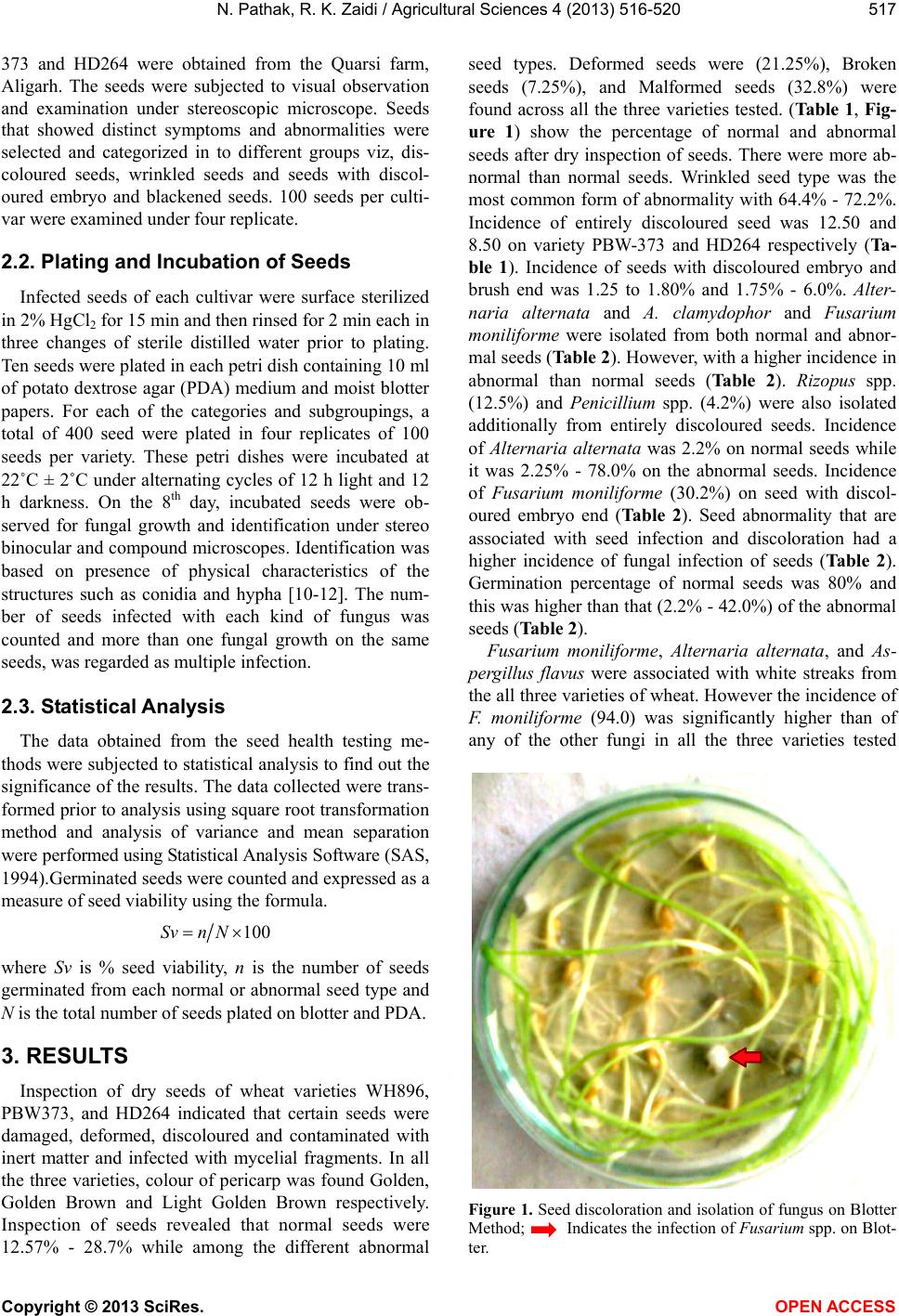 N. Pathak, R. K. Zaidi / Agricultural Sciences 4 (2013) 516-520 517 373 and HD264 were obtained from the Quarsi farm, Aligarh. The seeds were subjected to visual observation and examination under stereoscopic microscope. Seeds that showed distinct symptoms and abnormalities were selected and categorized in to different groups viz, dis- coloured seeds, wrinkled seeds and seeds with discol- oured embryo and blackened seeds. 100 seeds per culti- var were examined under four replicate. 2.2. Plating and Incubation of Seeds Infected seeds of each cultivar were surface sterilized in 2% HgCl2 for 15 min and then rinsed for 2 min each in three changes of sterile distilled water prior to plating. Ten seeds were plated in each petri dish containing 10 ml of potato dextrose agar (PDA) medium and moist blotter papers. For each of the categories and subgroupings, a total of 400 seed were plated in four replicates of 100 seeds per variety. These petri dishes were incubated at 22˚C ± 2˚C under alternating cycles of 12 h light and 12 h darkness. On the 8th day, incubated seeds were ob- served for fungal growth and identification under stereo binocular and compound microscopes. Identification was based on presence of physical characteristics of the structures such as conidia and hypha [10-12]. The num- ber of seeds infected with each kind of fungus was counted and more than one fungal growth on the same seeds, was regarded as multiple infection. 2.3. Statistical Analysis The data obtained from the seed health testing me- thods were subjected to statistical analysis to find out the significance of the results. The data collected were trans- formed prior to analysis using square root transformation method and analysis of variance and mean separation were performed using Statistical Analysis Software (SAS, 1994).Germinated seeds were counted and expressed as a measure of seed viability using the formula. 100Svn N where Sv is % seed viability, n is the number of seeds germinated from each normal or abnormal seed type and N is the total number of seeds plated on blotter and PDA. 3. RESULTS Inspection of dry seeds of wheat varieties WH896, PBW373, and HD264 indicated that certain seeds were damaged, deformed, discoloured and contaminated with inert matter and infected with mycelial fragments. In all the three varieties, colour of pericarp was found Golden, Golden Brown and Light Golden Brown respectively. Inspection of seeds revealed that normal seeds were 12.57% - 28.7% while among the different abnormal seed types. Deformed seeds were (21.25%), Broken seeds (7.25%), and Malformed seeds (32.8%) were found across all the three varieties tested. (Tab l e 1 , Fig- ure 1) show the percentage of normal and abnormal seeds after dry inspection of seeds. There were more ab- normal than normal seeds. Wrinkled seed type was the most common form of abnormality with 64.4% - 72.2%. Incidence of entirely discoloured seed was 12.50 and 8.50 on variety PBW-373 and HD264 respectively (Ta- ble 1). Incidence of seeds with discoloured embryo and brush end was 1.25 to 1.80% and 1.75% - 6.0%. Alter - naria alternata and A. clamydophor and Fusarium moniliforme were isolated from both normal and abnor- mal seeds (Table 2). However, with a higher incidence in abnormal than normal seeds (Table 2). Rizopus spp. (12.5%) and Penicillium spp. (4.2%) were also isolated additionally from entirely discoloured seeds. Incidence of Alternaria alternata was 2.2% on normal seeds while it was 2.25% - 78.0% on the abnormal seeds. Incidence of Fusarium moniliforme (30.2%) on seed with discol- oured embryo end (Tab le 2). Seed abnormality that are associated with seed infection and discoloration had a higher incidence of fungal infection of seeds (Ta b le 2 ). Germination percentage of normal seeds was 80% and this was higher than that (2.2% - 42.0%) of the abnormal seeds (Table 2). Fusarium moniliforme, Alternaria alternata, and As- pergillus flavus were associated with white streaks from the all three varieties of wheat. However th e incidence of F. moniliforme (94.0) was significantly higher than of any of the other fungi in all the three varieties tested Figure 1. Seed discoloration and isolation of fungus on Blotter Method; Indicates the infection of Fusarium spp. on Blot- ter. Copyright © 2013 SciRes. OPEN ACCESS 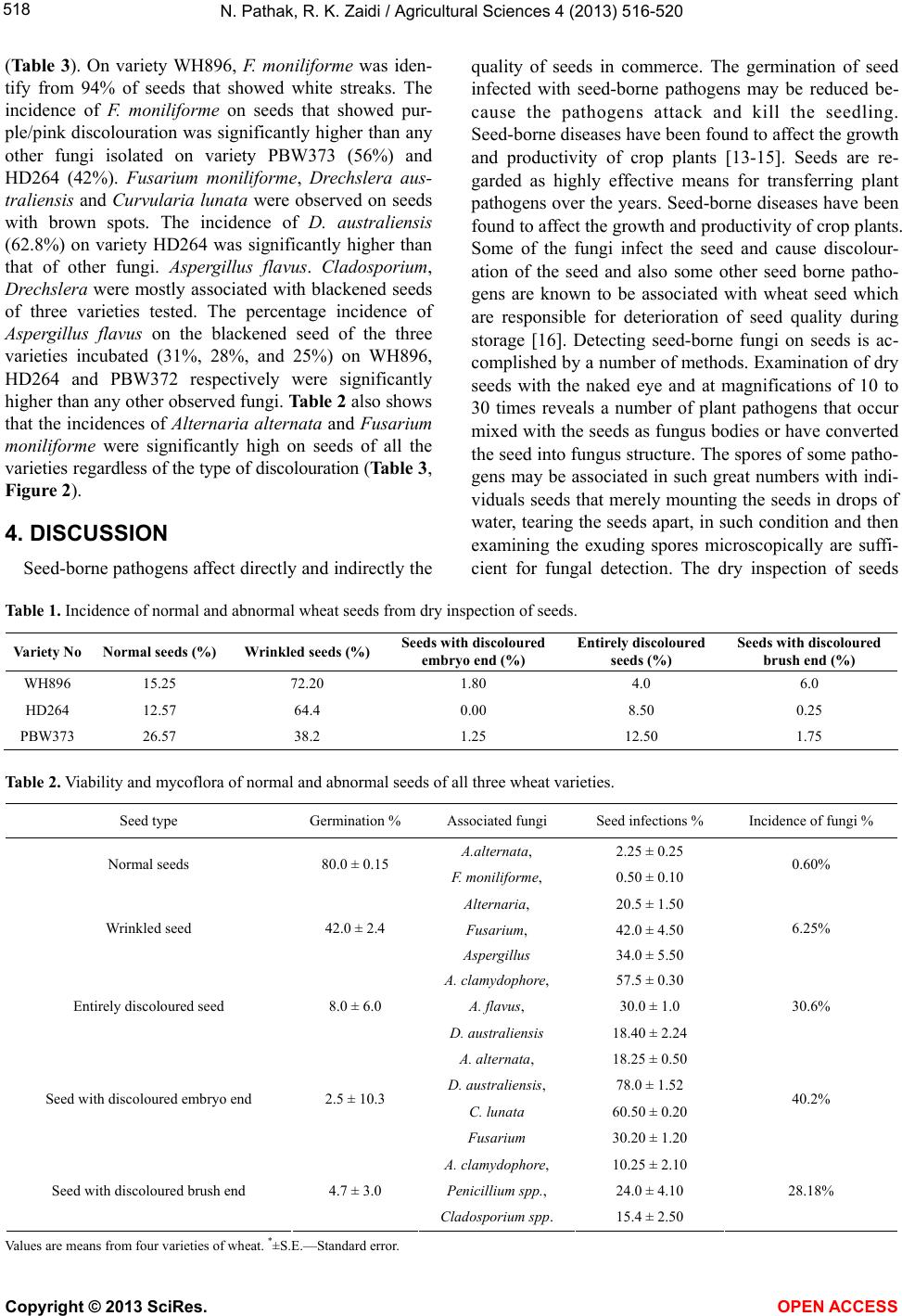 N. Pathak, R. K. Zaidi / Agricultural Sciences 4 (2013) 516-520 Copyright © 2013 SciRes. OPEN ACCESS 518 (Ta b le 3 ). On variety WH896, F. moniliforme was iden- tify from 94% of seeds that showed white streaks. The incidence of F. moniliforme on seeds that showed pur- ple/pink discolouration was significantly higher than any other fungi isolated on variety PBW373 (56%) and HD264 (42%). Fusarium moniliforme, Drechslera aus- traliensis and Curvularia lunata were observed on seeds with brown spots. The incidence of D. australiensis (62.8%) on variety HD264 was significantly higher than that of other fungi. Aspergillus flavus. Cladosporium, Drechslera were mostly associated with blackened seeds of three varieties tested. The percentage incidence of Aspergillus flavus on the blackened seed of the three varieties incubated (31%, 28%, and 25%) on WH896, HD264 and PBW372 respectively were significantly higher than any o ther observed fungi. Table 2 also show s that the incidences of Alternaria alternata and Fusarium moniliforme were significantly high on seeds of all the var ie ti es r eg ar dless of the type of discolouration (Table 3, Figure 2). 4. DISCUSSION Seed-borne pathogens affect directly and indirectly the quality of seeds in commerce. The germination of seed infected with seed-borne pathogens may be reduced be- cause the pathogens attack and kill the seedling. Seed-borne diseases have been found to affect the growth and productivity of crop plants [13-15]. Seeds are re- garded as highly effective means for transferring plant pathogens over the years. Seed-borne diseases have been found to affect the growth and productivity of cr op plan ts. Some of the fungi infect the seed and cause discolour- ation of the seed and also some other seed borne patho- gens are known to be associated with wheat seed which are responsible for deterioration of seed quality during storage [16]. Detecting seed-borne fungi on seeds is ac- complished by a number of methods. Examination of dry seeds with the naked eye and at magnifications of 10 to 30 times reveals a number of plant pathogens that occur mixed with the seeds as fungus bodies or have converted the seed into fungus structure. The spores of some path o- gens may be associated in such great numbers with indi- viduals seeds that merely mo unting the seeds in drops of water, tearing the seeds apart, in such conditio n and then examining the exuding spores microscopically are suffi- cient for fungal detection. The dry inspection of seeds Table 1. Incidence of normal and abnormal wheat seeds from dry inspection of seeds. Variety No Normal seeds (%) Wrinkled seeds (%)Seeds with discoloured embryo end (%) Entirely discoloured seeds (%) Seeds with discoloured brush end (%) WH896 15.25 72.20 1.80 4.0 6.0 HD264 12.57 64.4 0.00 8.50 0.25 PBW373 26.57 38.2 1.25 12.50 1.75 Table 2. Viability and mycoflora of normal and abnormal seeds of all three wheat varieties. Seed type Germination % Associated fungi Seed infections % Incidence of fungi % A.alternata, 2.25 ± 0.25 Normal seeds 80.0 ± 0.15 F. moniliforme, 0.50 ± 0.10 0.60% Alternaria, 20.5 ± 1.50 Fusarium, 42.0 ± 4. 5 0 Wrinkled seed 42.0 ± 2.4 Aspergillus 34.0 ± 5.50 6.25% A. clamydophore, 57.5 ± 0.30 A. flavus, 30.0 ± 1.0 Entirely discoloured seed 8.0 ± 6.0 D. australiensis 18.40 ± 2.24 30.6% A. alternata, 18.25 ± 0.50 D. australiensis, 78.0 ± 1.52 C. lunata 60.50 ± 0.20 Seed with discoloured embryo end 2.5 ± 10.3 Fusarium 30.20 ± 1.20 40.2% A. clamydophore, 10.25 ± 2.10 Penicillium spp., 24.0 ± 4.10 Seed with discoloured brush end 4.7 ± 3.0 Cladosporium spp. 15.4 ± 2.50 28.18% Values are means from four varieties of wheat. *±S.E.—Standard error. 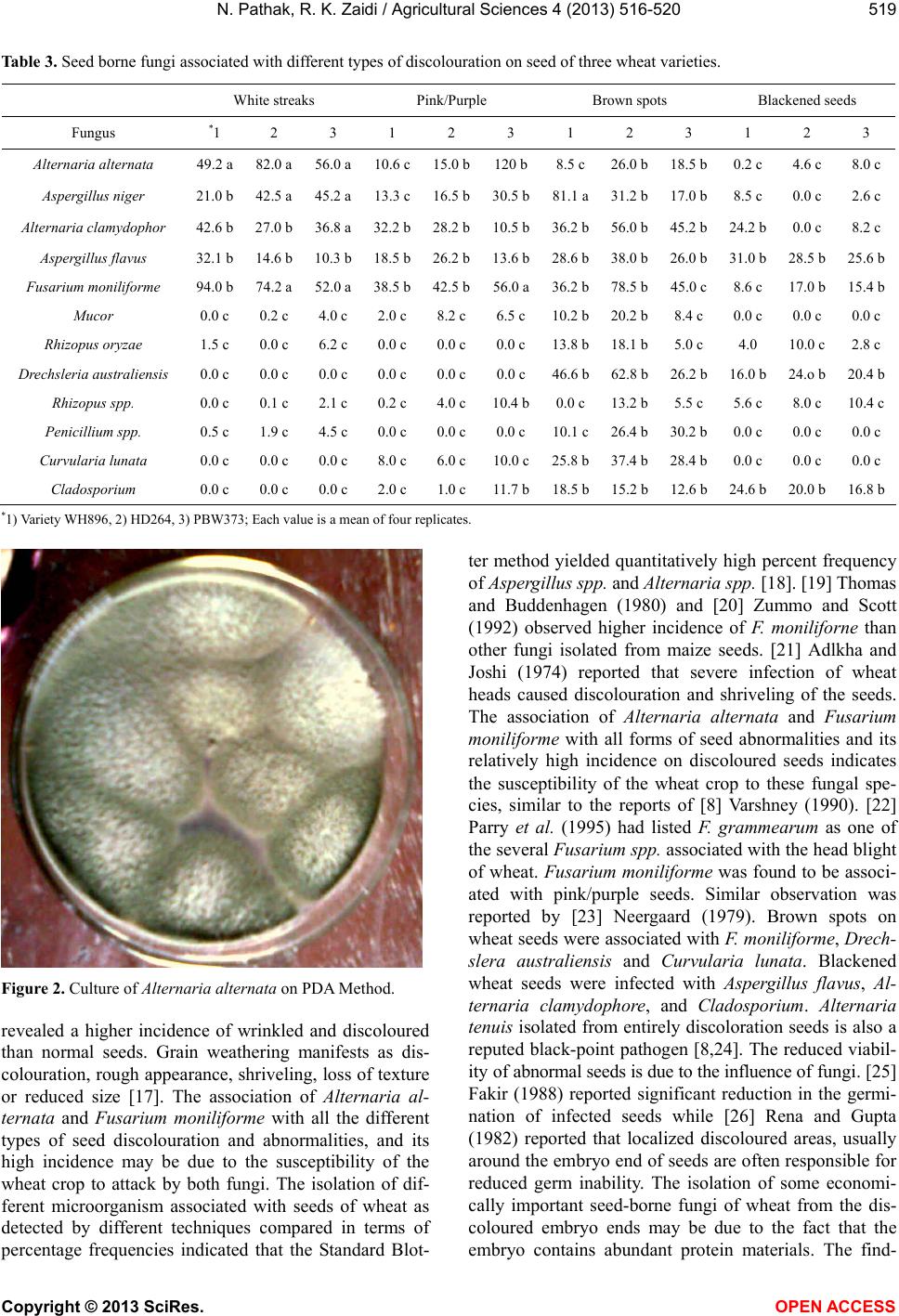 N. Pathak, R. K. Zaidi / Agricultural Sciences 4 (2013) 516-520 519 Table 3. Seed borne fungi associated with different types of discolouration on seed of three wheat varieties. White streaks Pink/Purple Brown spots Blackened seeds Fungus *1 2 3 1 2 3 1 2 3 1 2 3 Alternaria alternata 49.2 a82.0 a 56.0 a 10.6 c15.0 b120 b8.5 c 2 6 .0 b18.5 b 0.2 c 4.6 c 8.0 c Aspergillus niger 21.0 b42.5 a 45.2 a 13.3 c16.5 b30. 5 b81.1 a3 1 .2 b17.0 b 8.5 c 0.0 c 2.6 c Alternaria clamydophor 42.6 b27.0 b 36.8 a 32.2 b28.2 b10.5 b36.2 b56.0 b45.2 b 24.2 b 0.0 c 8.2 c Aspergillus flavus 32.1 b14.6 b 10.3 b 18.5 b26.2 b13.6 b28.6 b38.0 b26.0 b 31.0 b 28.5 b25.6 b Fusarium moniliforme 94.0 b74.2 a 52.0 a 38.5 b42.5 b56.0 a36.2 b78.5 b45.0 c 8.6 c 17.0 b15.4 b Mucor 0.0 c 0.2 c 4.0 c 2.0 c 8.2 c 6.5 c 10.2 b20.2 b8.4 c 0.0 c 0.0 c 0.0 c Rhizopus oryzae 1.5 c 0.0 c 6.2 c 0.0 c 0.0 c 0.0 c 13.8 b18.1 b5.0 c 4.0 10 .0 c2.8 c Drechsleria australiensis 0.0 c 0.0 c 0.0 c 0.0 c 0.0 c 0.0 c 46.6 b62.8 b26.2 b 16.0 b 24.o b20.4 b Rhizopus spp. 0.0 c 0.1 c 2.1 c 0.2 c 4.0 c 10.4 b0.0 c 13.2 b5.5 c 5.6 c 8.0 c 10.4 c Penicillium spp. 0.5 c 1.9 c 4.5 c 0.0 c 0.0 c 0.0 c 10.1 c26.4 b30.2 b 0.0 c 0.0 c 0.0 c Curvularia lunata 0.0 c 0.0 c 0.0 c 8.0 c 6.0 c 10.0 c25.8 b37.4 b28.4 b 0.0 c 0.0 c 0.0 c Cladosporium 0.0 c 0.0 c 0.0 c 2.0 c 1.0 c 11.7 b1 8.5 b15.2 b12.6 b 24.6 b 20.0 b16.8 b *1) Variety WH896, 2) HD264, 3) PBW373; Each value is a mean of four rep li cates. Figure 2. Culture of Alternaria alternata on PDA Method. revealed a higher incidence of wrinkled and discoloured than normal seeds. Grain weathering manifests as dis- colouration, rough appearance, shriveling, loss of texture or reduced size [17]. The association of Alternaria al- ternata and Fusarium moniliforme with all the different types of seed discolouration and abnormalities, and its high incidence may be due to the susceptibility of the wheat crop to attack by both fungi. The isolation of dif- ferent microorganism associated with seeds of wheat as detected by different techniques compared in terms of percentage frequencies indicated that the Standard Blot- ter method yielded quantitatively high percent frequency of Aspergillus spp. and Alternaria spp. [18]. [19] Thomas and Buddenhagen (1980) and [20] Zummo and Scott (1992) observed higher incidence of F. moniliforne than other fungi isolated from maize seeds. [21] Adlkha and Joshi (1974) reported that severe infection of wheat heads caused discolouration and shriveling of the seeds. The association of Alternaria alternata and Fusarium moniliforme with all forms of seed abnormalities and its relatively high incidence on discoloured seeds indicates the susceptibility of the wheat crop to these fungal spe- cies, similar to the reports of [8] Varshney (1990). [22] Parry et al. (1995) had listed F. grammearum as one of the several Fusarium spp. associated with the head blight of wheat. Fusarium mon iliforme was found to be associ- ated with pink/purple seeds. Similar observation was reported by [23] Neergaard (1979). Brown spots on wheat seeds were associated with F. moniliforme, Drech- slera australiensis and Curvularia lunata. Blackened wheat seeds were infected with Aspergillus flavus, Al- ternaria clamydophore, and Cladosporium. Alternaria tenuis isolated from entirely discoloration seeds is also a reputed black-point pathogen [8,24]. The reduced viabil- ity of abnormal seeds is due to the influence of f u ngi . [ 2 5] Fakir (1988) reported significant reduction in the germi- nation of infected seeds while [26] Rena and Gupta (1982) reported that localized discoloured areas, usually around the embr yo end of seeds are often responsible for reduced germ inability. The isolation of some economi- cally important seed-borne fungi of wheat from the dis- coloured embryo ends may be due to the fact that the embryo contains abundant protein materials. The find- Copyright © 2013 SciRes. OPEN ACCESS  N. Pathak, R. K. Zaidi / Agricultural Sciences 4 (2013) 516-520 520 ings in this investigation suggest that wheat seeds with various types of discolouration and abnormalities have the potential to cause seed deterior ation in storage and in the field too. REFERENCES [1] Ali, M. and Kumar, S. (2000) Problems and prospects of pulses research in India. Indian Farming, 50, 4-13. [2] Akhtar, L. H. and Siddiqui, S.Z. (2003) Current status of re se ar ch and development on pulses in Paki st ha n. Science, Tecnology and Development, 22, 16-28. [3] Subramanian, M. (2000) Pulses production strategies in Tamil Nadu. Centre for Plant Breeding and Genetics Tamil Nadu Agricultural University, Coimbatore. [4] Reddy, C.S., Reddy, K.R.N., Kumar, R.N., Laha, G.S. and Muralidharan, K. (2004) Exploration of aflatoxia con- tamination and its management in rice. Journal of My- cology and Plant Pathology, 34, 816-820. [5] Abbas, H.K., Cartwright, R.D., Xie, W., Mirocha, C.J., Richard, J.L., Dvorak, J.J., Sciumbato, G.L. and Shier, W.T. (1999) Mycotoxin production by Fusariumprolif- eratum isolates from rice with Fusarium sheath rot dis- ease. Mycopathologia, 147, 97-104. doi:10.1023/A:1007147813326 [6] Makun, H.A., Gbodi, T.A., Akanya, H.O., Sakalo, A.E. and Ogbadu, H.G. (2007) Fungi and some mycotoxins contamination rice (Oryza sativa) in Niger State, Nigeria. African Journal of Biotechnology, 6, 99-108. [7] Owolade, B.F., Fawole, B. and Osinkanlu, Y.O.K. (2001) Fungi associated with maize seed discolouration and ab- normalities in South Western Nigeria. African Crop Sci- ence Journal, 9, 693-697. [8] Varshney, J.L. (1990) Seed-borne diseases of wheat— Their impact in relation to production and productivity. International Journal Of Tropical Plant Diseases, 8, 173- 192. [9] Shetty, H.S. (1993) Different types of damages in seeds caused by seedborne fungi. In: Mathur, S.B. and Jorgen- sen, J., Eds., Seed Pathology: Proceedings of CTA Semi- nar, Copenhagen, 20-25 June 1988, p. 53. [10] Benoit, H.C. and Mathur, S.B. (1970) Identification of species of Curvularia on rice seed. Proceedings Interna- tional Seed Testing Association , 35, 99-119. [11] Chidambaran, P., Mathur, S.B. and Neergaard, P. (1973) Identification of seed-borne Drechslera species. Friersia, 10, 165-207. [12] Barnett, H.C. and Hunter, B.B. (1972) Illustrated genera of imperfect fungi. 3rd Edition, Burgress Publishing Co., Minneapolis, 20 p. [13] Kubiak, K. and Korbas, M. (1999) Occurrence of fungal diseases on selected winter wheat cultivars. Postepy w Ochronie Roslin, 39, 801-804. [14] Weber, R., Hrynczuk, B., Runowska-Hrynczuk, B. and Kita, W. (2001) Influence of the mode of tillage on dis- eases of culm base in some winter wheat varieties, oats and spring wheat. Journal of Phytopathology, 149, 185- 188. doi:10.1046/j.1439-0434.2001.00592.x [15] Dawson, W.A.J.M. and Bateman, G.L. (2001) Fungal communities on roots of wheat and barley and effects of seed treatments containing fluquinconazole applied to control take-all. Plant Pathology, 50, 75-82. doi:10.1046/j.1365-3059.2001.00538.x [16] Pathak, N. and Zaidi, R.K. (2013) Comparative study of seed dressing fungicides and Calotropis Procera latex for the control of seed-borne mycoflora of wheat. Annals of Biological Research, 4, 1-6. [17] Tyagi, P.D. and Olugbemi, L.B. (1980) Rain-fed wheat in Nigeria as influenced by fungal pathogens and adverse weather conditions. Samaru Miscellaneous Paper, 91, 1- 15. [18] Pathak, N. and Zaidi, R.K. (2013) Studies on seed-borne fungi of wheat in seed health testing programme. Ar- chives of Phytopathology and Plant Protection, 46, 389- 401. doi:10.1080/03235408.2012.741978 [19] Thomas, M.D. and Buddenhagen, I.W. (1980) Incidence and persistence of Fusarium moniliforme in symptomless maize kernels and seedlings in Nigeria. Mycologia, 72, 882-887. doi:10.2307/3759731 [20] Zummon, N. and Scott, G.E. (1992) Interaction of Fusa- riummoniliforme and Aspergillusflavus on kernel infec- tion and aflatoxin contamination in maize ears. Plant Disease, 76, 771-773. doi:10.1094/PD-76-0771 [21] Adlakha, K.L. and Joshi, L.M. (1974) Black point of wheat. Indian Phytopath, 27, 41- 44. [22] Parry, D.W., Jenkinson, P. and McLeod, L. (1995) Fusa- rium ear blight (scab) in small grain cereals. Review of Plant Pathology, 44, 207-238. doi:10.1111/j.1365-3059.1995.tb02773.x [23] Neergaard, P. (1981) Introduction to methods of seed- health testing. Seed Science and Technology, 7, 601-635. [24] Parashar, R.D. and Chohan, J.S. (1967) Effect of black point, both Alternania sp. and Helminthosporium sativum on seed germination under laboratory and field conditions and on yield. Journal of Research in Ludhiana, 4, 73-75. [25] Fakir, G.L. (1988) Report on investigation into black point disease of wheat in Bangladesh. Bangladesh Agri- cultural University, Mymensingh. [26] Rena, J.P. and Gupta, P.K.S. (1982) Occurrence of black point disease of wheat in West Bengal. Phytopathology, 35, 700-702. Copyright © 2013 SciRes. OPEN ACCESS |