

Paper Menu >>
Journal Menu >>
 Journal of Cancer Therapy, 2013, 4, 54-58 http://dx.doi.org/10.4236/jct.2013.48A009 Published Online September 2013 (http://www.scirp.org/journal/jct) Better Selection Model for EML4-ALK Fusion Gene Test in Patients with Non-Small-Cell Lung Cancer* Dekel Shlomi1, Amir Onn1, Maya Gottfried2, Jair Bar1, Haim Biran1, Maya Ilouze1, Addie Dvir3, Hovav Nechushtan4, Lior Soussan-Gutman3, Nir Peled1# 1Pulmonary-Oncology Unit, Chaim Sheba Medical Center, Tel Hashomer, Israel; 2Oncology Department, Meir Medical Center, Kfar Saba, Israel; 3Oncotest-TEVA, Teva Pharmaceutical Industries LTD., Shoham, Israel; 4Sharett Institute of Oncology, Hadassah He- brew University Medical Center, Jerusalem, Israel. Email: #[email protected] Received July 5th, 2013; revised August 6th, 2013; accepted August 14th, 2013 Copyright © 2013 Dekel Shlomi et al. This is an open access article distributed under the Creative Commons Attribution License, which permits unrestricted use, distribution, and reproduction in any medium, provided the original work is properly cited. ABSTRACT Background: In the last decade, the search for gene mutations in lung cancer has been constantly growing. EGFR, KRAS mutations and, recently, the EML4-ALK fusion can guide the selection of treatment for patients who carry a specific mutation. Methods: During 2010-2011, EML4-ALK fusion test has been performed in Israel, mostly for wild type EGFR non-squamous NSCLC patients based on fluorescent in-situ hybridization (FISH) technique to detect EML4-ALK rearrangements. Results: Between January 2010 and December 2011, 3341 patients were diagnosed with lung cancer in Israel. Of the 2997 patients with NSCLC 687 had squamous cell carcinoma and 2310 had non-squamous NSCLC. This study focused on available 125 non-squamous NSCLC cases in which analysis for EML4-ALK rear- rangement was available. All were negative for EGFR mutation. Nineteen (15.2%) were found positive for the fusion, a figure 2 - 10 times higher compared with previously reported findings. The EML4-ALK fusion was significantly more prevalent in younger male patients (52.1 vs. 61.3 years, p = 0.049), in whom every additional year reduced the chance to find the fusion by 7% [CI = 0.93 (0.88 - 0.99), p = 0.03]. Conclusions: A stepwise approach based on histology and prior EGFR analysis to detect EML4-ALK fusion is highly efficient with a related increased yield of detection. We recommend testing patients with non-squamous cell lung carcinoma after ruling out an EGFR mutation. The chance to find the ALK fusion is significantly greater in young er men. Keywords: Lung Cancer; EML4-ALK; Gene Mutation; EGFR; Histology 1. Introduction In the past few years, a novel therapeutic approach to lung cancer treatment has been integrated into clinical practice. The epid ermal growth factor receptor 1 (HER1/ EGFR) inhibitors, such as Erlotinib (Tarceva, Genentech, USA) and Gefitinib (Iressa, AstraZeneca, UK), were the first two oral drugs to demonstrate efficacy in patients who harbored an activating mutation in the EGFR gene [1,2]. Searching for other gene mutations as possible therapeutic targets, Soda et al. identified, in 2007, a unique rearrangement of the anaplastic lymphoma kinase (ALK) gene in 6.7% (5/75) Japanese patients with non- small-cell lung cancer (NSCLC) who were negative for the EGFR mutation [3]. In this study, the ALK rear- rangement was described as a small inversion within chromosome 2p, resulting in the formation of a fusion gene comprising portions of the echinoderm microtubule- associated protein-like 4 (EML4) gene and the ALK gene. The ALK gene is a target for research and has been tar- geted in anaplastic large cell lymphoma [4] and inflam- matory myofibroblastic tumor (IMT) [4,5]. In lung can- cer, the EML4-ALK fusion gene was found almost ex- clusively in wild-type EGFR and KRAS adenocarcino- mas [6-10]. Similar results were reported by Wong et al., although two out of the 13 ALK positive tumors were described as comprised of mixed squamous and glandu- lar components [8]. The discovery of EML4-ALK fusion as a therapeutic target in lung cancer led to the develop- *Jair Bar received honoraria and reimbursement for the attendance of a scientific conference from Pfizer. Hovav Nechushtan participated in p hase IV Sutent study by Pfizer. Lior Soussan-Gutman is an employee of “Teva Pharmaceutical Industries” LTD. All other authors declared no conflict of interests. #Corresponding author. Copyright © 2013 SciRes. JCT 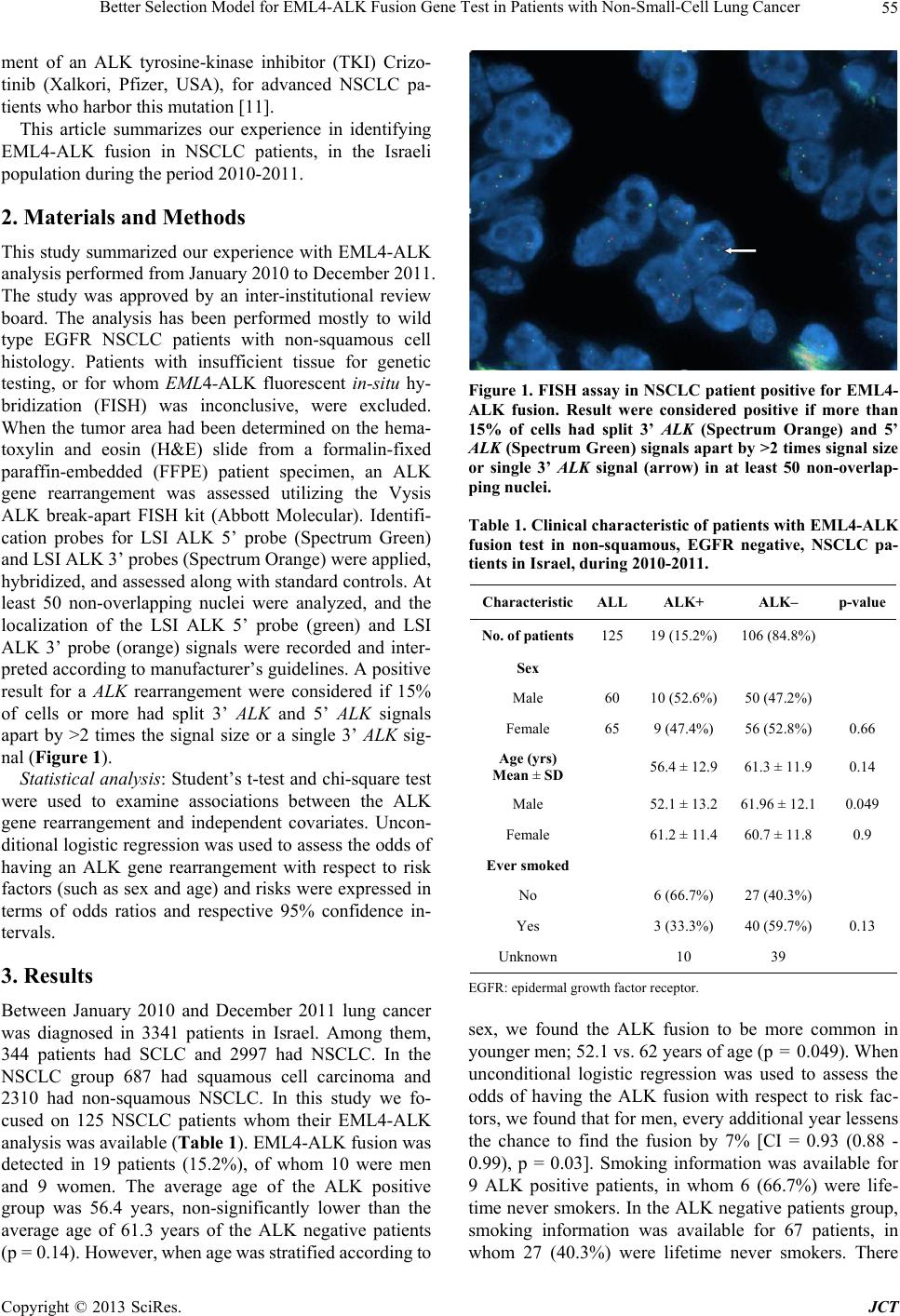 Better Selection Model for EML4-ALK Fusion Gene Test in Patients with Non-Small-Cell Lung Cancer 55 ment of an ALK tyrosine-kinase inhibitor (TKI) Crizo- tinib (Xalkori, Pfizer, USA), for advanced NSCLC pa- tients who harbor this mutation [11]. This article summarizes our experience in identifying EML4-ALK fusion in NSCLC patients, in the Israeli population during the period 2010-2011. 2. Materials and Methods This study summarized our experience with EML4-ALK analysis performed from Januar y 2010 to December 2011. The study was approved by an inter-institutional review board. The analysis has been performed mostly to wild type EGFR NSCLC patients with non-squamous cell histology. Patients with insufficient tissue for genetic testing, or for whom EML4-ALK fluorescent in-situ hy- bridization (FISH) was inconclusive, were excluded. When the tumor area had been determined on the hema- toxylin and eosin (H&E) slide from a formalin-fixed paraffin-embedded (FFPE) patient specimen, an ALK gene rearrangement was assessed utilizing the Vysis ALK break-apart FISH kit (Abbott Molecular). Identifi- cation probes for LSI ALK 5’ probe (Spectrum Green) and LSI ALK 3’ p robes (Spectrum Orange) we re a pplied, hybridized, and assessed along with standard controls. At least 50 non-overlapping nuclei were analyzed, and the localization of the LSI ALK 5’ probe (green) and LSI ALK 3’ probe (orange) signals were recorded and inter- preted accordin g to manuf acturer’s guid elines. A positive result for a ALK rearrangement were considered if 15% of cells or more had split 3’ ALK and 5’ ALK signals apart by >2 times the signal size or a single 3’ ALK sig- nal (Figure 1). Statistical analysis: Student’s t-test and chi-square test were used to examine associations between the ALK gene rearrangement and independent covariates. Uncon- ditional logistic regression was used to assess the odd s of having an ALK gene rearrangement with respect to risk factors (such as sex and age) and risks were expressed in terms of odds ratios and respective 95% confidence in- tervals. 3. Results Between January 2010 and December 2011 lung cancer was diagnosed in 3341 patients in Israel. Among them, 344 patients had SCLC and 2997 had NSCLC. In the NSCLC group 687 had squamous cell carcinoma and 2310 had non-squamous NSCLC. In this study we fo- cused on 125 NSCLC patients whom their EML4-ALK analysis was available (Table 1 ). EML4 -ALK fu sion was detected in 19 patients (15.2%), of whom 10 were men and 9 women. The average age of the ALK positive group was 56.4 years, non-significantly lower than the average age of 61.3 years of the ALK negative patients (p = 0.14). However, whe n age was strati fied accordin g to Figure 1. FISH assay in NSCLC patient positive for EML4- ALK fusion. Result were considered positive if more than 15% of cells had split 3’ ALK (Spectrum Orange) and 5’ ALK (Spectrum Green) signals apart by >2 times signal size or single 3’ ALK signal (arrow) in at least 50 non-overlap- ping nuclei. Table 1. Clinical characteristic of patients with EML4-ALK fusion test in non-squamous, EGFR negative, NSCLC pa- tients in Israel, during 2010-2011. p-valueALK– ALK+ ALLCharacteristic 106 (84.8%)19 (15.2%) 125 No. of patients Sex 50 (47.2%) 10 (52.6%) 60 Male 0.66 56 (52.8%) 9 (47.4%) 65 Female 0.14 61.3 ± 11.9 56.4 ± 12.9 Age (yrs) Mean ± SD 0.049 61.96 ± 12.152.1 ± 13.2 Male 0.9 60.7 ± 11.8 61.2 ± 11.4 Female Ever smoked 27 (40.3%) 6 (66.7%) No 0.13 40 (59.7%) 3 (33.3%) Yes 39 10 Unknown EGFR: epidermal growth factor receptor. sex, we found the ALK fusion to be more common in younger men; 52.1 vs. 62 years of age (p = 0.049). When unconditional logistic regression was used to assess the odds of having the ALK fusion with respect to risk fac- tors, we found that for men, every additional year lessens the chance to find the fusion by 7% [CI = 0.93 (0.88 - 0.99), p = 0.03]. Smoking information was available for 9 ALK positive patients, in whom 6 (66.7%) were life- time never smok ers. In the ALK negative patients group, smoking information was available for 67 patients, in whom 27 (40.3%) were lifetime never smokers. There Copyright © 2013 SciRes. JCT  Better Selection Model for EML4-ALK Fusion Gene Test in Patients with Non-Small-Cell Lung Cancer 56 were no statistical significant differences regarding smoking habits between the ALK positive and the ALK negative patients (p = 0.13). When the origin of the bi- opsy was tested for ALK fusion, we found no correlation between biopsies that were taken from the lung origin or the metastasis. 4. Discussion While EGFR mutation is prevalent in 15% - 20% of NSCLC patients, being more common in Asian ethnicity, women and non-smokers [1,12-14], the EML4-ALK fu- sion is less prevalent, more common in Asian population, younger and non-smokers or light smokers. To date, no conclusive data was published regarding sex-depended differences. Ethnic variation of the EML4-ALK fusion gene shows a frequency as high as 7.5% (9 of 120) of NSCLC specimens from Italy and Spain [15],while in US, Koi- vunen et al. found a frequency of 1.5% (2 of 138 ) in US Caucasian populatio n [16]. In this study, Korean patients had a non-significant 3.6% (total population 3%) more prevalence of the EML4-ALK fusion. In Japan, Soda et al. [3] detected the EML4-ALK fusion in 6.7% of the NSCLC patients while Inamura et al. [6] detected ALK rearrangement in 2.26% (5 of 221) patients with primary lung cancer. In Chinese population, 4.9% (13/266) were positive for EML4-ALK fusion, in the study of Wong et al. of NSCLC pat ie nt s [8]. Histology: In this study, patients were selected to the EML4-ALK fusion test if they had non-squamous lung carcinoma and wild type EGFR gene analysis. To the best of our knowledge, all studies excep t one found ALK fusion in non-squamous lung carcinomas. Inamura et al. found EML4-ALK fusion in 11 of 363 in primary lung cancer, all adenocarcinomas of papillary or acinar type [7]. Similarly, all of the EML4-ALK fusion-containing tumors in both Koivunen et al. [16] and Takahashi [10] studies were adenocarcinomas. In Shaw et al., 18 of 19 EML4-ALK fusion tumors were adenocarcinoma, pre- dominantly of the signet ring cell subtype, and one was of the adenosquamous type, however this result could be due to selection bias [9]. In Chinese population, 11 of the EML4-ALK fusion were adenocarcinomas, and 2 were unusual carcinomas with mixed squamous and glandular components [8]. The most outstanding results were found in the Martelli et al. study in Italy, in which, of the 9 NCSLC patients with EML4-ALK fusion, 3 were found to be adenocarcinoma, 2 adenosquamous carcinoma and 4 squamous cell carcinomas [15]. EGFR and KRAS mutations: Several studies found the EML4-ALK fusion exclusively in wild-type EGFR and KRAS tumors in NSCLC patients [6-10,17]. Only one of 8 patients with EML4-ALK fusion adenocarcinoma of the lung, in the Koivunen et al. study, was positive for EGFR mutation, while all of them were negative for KRAS mutation [16]. In the Martelli et al. study, all of the 9 patients with EML4-ALK fusion lung cancer were negative for EGFR mutation, but KRAS mutation was detected in one patient with lung adenocarcinoma [15]. Based on this data, ALK fusion testing in Israel is fo- cused on patients with non-squamous lung carcinoma who were negative for the EGFR mutation. By selecting NSCLC patients with non-squamous lung carcinoma and negative EGFR mutation, we could expect a higher prevalence of the EML4-ALK fusion and were thus hop- ing to cut on unnecessary high cost tests. Accordingly, out of the tested population in our study a frequency of 15.2% of EML4-ALK fusion was found, which is 2 - 10 times higher than previously reported [6,8,15,16]. Age: We found a non-significant lower age for patients in the EML4-ALK fusion group (56.4 vs. 61.3 years, p = 0.14). However, mean age of males with positive results was 9.86 years younger than males with negative result (52.1 vs. 61.96 years, p = 0.049). We also found that among men, every additional year reduced the chance to find the fusion by 7%, which was statistically sig nificant [CI = 0.93 (0.88 - 0.99), p = 0.03]. These findings were a further support to previous studies that indicated a statis- tically significant prevalence of ALK fusion in younger patients [7-9,17]. In the Wong et al. study, the ALK positive group had median age of 59 years, compared with the ALK negativ e patients, in whom the median age was 64 (p = 0.018) [8 ]. Inamura et al. found that patients with EML4-ALK lung cancers were younger (mean age 56 vs. 64 years, p = 0.0062) [7]. Four of 11 pa t ients (36%) with EML4-ALK-positive lung cancers were below 50 years of age, as compared with 12 of 242 patients ( 5.0%) with EML4-ALK-negativ e lung cancers (p = 0.00038). In the Shaw study, patients with EML4-ALK fusion tumors were of a significantly younger median age of 52 com- pared with 66 years of age in patients with EGFR muta- tion and 64 years of age in patients with WT/WT status [9]. However, in the Martelli et al. study, no age correla- tion was not e d [15]. Sex: Previous studies found mixed results in regard to sex differences. However, this study showed no sex preferences for the EML4-ALK fusion (10 males vs. 9 females, p = 0.66). In Japan, 4 of the 5 patients who were positive for the EML4-ALK fusion genes were females [10]. In a combined US and Korean population study, the frequency of EML4-ALK fusion was non-significantly higher in females (4%) versus males (2%) [16]. The study of Shaw et al. in US, mostly of non-Asian popula- tion, identified a significantly greater prevalence of EML4-ALK fusion in men (23%) than in women (9%) [9], while Martelli et al. did not find any correlation with Copyright © 2013 SciRes. JCT  Better Selection Model for EML4-ALK Fusion Gene Test in Patients with Non-Small-Cell Lung Cancer 57 sex [15]. Smoking: Our data collection was not comprehensive enough to determine smoking habits differences among groups. Smoking exposure data was collected from 76 of 125 patients (60.8%), but no statistically significant dif- ferences were found among the groups. Several studies showed that the EML4-ALK fusion was more frequent in never smokers or light smokers [8-10,16-17]. In the Koivunen et al. study, the EML4-ALK fusion was de- tected significantly more frequently in patients with lim- ited smoking history (<10 pack-years) compared with tumors from smokers [16]. In the Shaw et al. study [9], patients who were positive for EML4-ALK fusion were more likely to be never smokers or light smokers, com- pared with patients in the wild-type cohort (p < 0.001). Also in the Wong et al. study, the EML4-ALK fusion was significantly higher in non-smokers [8]. In the Ta- kahashi et al. study, the EML4-ALK fusion was pre- dominantly found in non-smokers or light smokers [10]. Other studies found no association between EML4-ALK fusion and smoking hab i ts [7,15] . 5. Conclusion EML4-ALK fusion in selected patients in Israel with non-squamous cell lung carcinoma, in whom the EGFR mutation test was negative, was found to be more fre- quent (15.2%) than expected when no selection was in- troduced. In this group, the ALK fusion was significantly more prevalent in younger men. Based on this study and on published literature, in order to avoid unnecessary ALK fusion tests, we recommend selecting patients with non-squamous cell lung carcinoma in whom both the EGFR and the KRAS mutations are negative. 6. Acknowledgements The authors thank Oncotest-TEVA Pharmaceutical in- dustries LTD. for their assistance in data management. REFERENCES [1] T. J. Lynch, D. W. Bell, R. Sordella, et al., “Activating Mutations in the Epidermal Growth Factor Receptor Un- derlying Responsiveness of Non-Small-Cell Lung Cancer to Gefitinib,” New England Journal of Medicine, Vol. 350, No. 21, 2004, pp. 2129-2139. [2] F. A. Shepherd, J. R. Pereira, T. Ciuleanu, E. H. Tan, V. Hirsh, S. Thongprasert, et al., “Erlotinib in Previously Treated Non-Small-Cell Lung Cancer,” New England Journal of Medicine, Vol. 353, 2005, pp. 123-132. doi:10.1056/NEJMoa050753 [3] M. Soda, Y. L. Choi, M. Enomoto, et al., “Identification of the Transforming EML4-ALK Fusion Gene in Non- Small-Cell Lung Cancer,” Nature, Vol. 448, No. 7153, 2007, pp. 561-566. [4] M. Shiota, S. Nakamura, R. Ichinohasama, et al., “Ana- plastic Large Cell Lymphomas Expressing the Novel Chi- meric Protein p80NPM/ALK: A Distinct Clinicopatholo- gic Entity,” Blood, Vol. 86, No. 5, 1995, pp. 1954-1960. [5] J. Cools, I. Wlodarska, R. Somers, et al., “Identification of Novel Fusion Partners of ALK, the Anaplastic Lym- phoma Kinase, in Anaplastic Large-Cell Lymphoma and Inflammatory Myofibroblastic Tumour,” Genes Chromo- somes Cancer, Vol. 34, No. 4, 2002, pp. 354-362. [6] K. Inamura, K. Takeuchi, Y. Togashi, et al., “EML4- ALK Fusion Is Linked to Histological Characteristics in a Subset of Lung Cancers,” Journal of Thoracic Oncology, Vol. 3, No. 1, 2008, pp. 13-17. [7] K. Inamura, K. Takeuchi, Y. Togashi, et al., “EML4- ALK Lung Cancers Are Characterized by Rare Other Mutations, a TTF-1 Cell Lineage, an Acinar Histology, and Young Onset,” Modern Pathology, Vol. 22, No. 4, 2009, pp. 508-515. doi:10.1038/modpathol.2009.2 [8] D. W. Wong, E. L. Leung, K. K. So, et al., “The EML4- ALK Fusion Gene Is Involved in Various Histologic Types of Lung Cancers from Non-Smokers with Wild- Type E GFR and KRAS,” Cancer, Vol. 115, No. 8, 2009, pp. 1723-1733. doi:10.1002/cncr.24181 [9] A. T. Shaw, B. Y. Yeap, M. Mino-Kenudson, et al., “Clinical Features and Outcome of Patients with Non- Small-Cell Lung Cancer Who Harbor EML4-ALK,” Journal of Clinical Oncology, Vol. 27, No. 26, 2009, pp. 4247-4253. doi:10.1200/JCO.2009.22.6993 [10] T. Takahashi, M. Sonobe, M. Kobayashi, et al., “Clini- copathologic Features of Non-Small-Cell Lung Cancer with EML4-ALK Fusion Gene,” Annals of Surgical On- cology, Vol. 17, No. 3, 2010, pp. 889-897. [11] A. T. Shaw, B. Y. Yeap, B. J. Solomon, et al., “Effect of Crizotinib on Overall Survival in Patients with Advanced Non-Small-Cell Lung Cancer Harbouring ALK Gene Re- arrangement: A Retrospective Analysis,” Lancet Oncol- ogy, Vol. 12, No. 11, 2011, pp. 1004-1012. [12] R Development Core Team, “R: A Language and Envi- ronment for Statistical Computing,” R Foundation for Statistical Computing, Vienna, 2006. http://www.R-project.org [13] H. Shigematsu, L. Lin, T. Takahashi, et al., “Clinical and Biological Features Associated with Epidermal Growth Factor Receptor Gene Mutations in Lung Cancers,” Journal of the National Cancer Institute, Vol. 97, No. 5, 2005, pp. 339-346. doi:10.1093/jnci/dji055 [14] R. Rosell, T. Moran, C. Queralt, et al., “Screening for Epidermal Growth Factor Receptor Mutations in Lung Cancer,” New England Journal of Medicine, Vol. 361, 2009, pp. 958-967. doi:10.1056/NEJMoa0904554 [15] M. P. Martelli, G. Sozzi, L. Hernandez, et al., “EML4- ALK Rearrangement in Non-Small-Cell Lung Cancer and Non-Tumor Lung Tissues,” American Journal of Pathol- ogy, Vol. 174, No. 2, 2009, pp. 661-670. [16] J. P. Koivunen, C. Mermel, C. Murphy, et al., “EML4- ALK Fusion Gene and Efficacy of an ALK Kinase In- hibitor in Lung Cancer,” Clinical Cancer Research, Vol. 14, No. 13, 2008, pp. 4275-4283. Copyright © 2013 SciRes. JCT  Better Selection Model for EML4-ALK Fusion Gene Test in Patients with Non-Small-Cell Lung Cancer Copyright © 2013 SciRes. JCT 58 [17] S. J. Rodig, M. Mino-Kenudson, S. Dacic, et al., “Unique Clinicopathologic Features Characterize ALK-Rearranged Lung Adenocarcinoma in the Western Population,” Cli- nical Cancer Research, Vol. 15, No. 16, 2009, pp. 5216- 5223. |