

Paper Menu >>
Journal Menu >>
 Pharmacology & Pharmacy, 2013, 4, 473-477 http://dx.doi.org/10.4236/pp.2013.46068 Published Online September 2013 (http://www.scirp.org/journal/pp) 473 Evaluation of Some Biological Activities of Albizia lebbeck Flowers Mohamed Farag1*, Ali El Gamal1,2, Ashraf Kalil1,2, Adnan Al-Rehaily1, Omar El Mirghany3, Kamal El Tahir3 1Pharmacognosy Department, Faculty of Pharmacy, King Saud University, Riyadh, KSA; 2Pharmacognosy Department, Faculty of Pharmacy, Mansoura University, Mansoura, Egypt; 3Pharmacology Department, Faculty of Pharmacy, King Saud University, Riyadh, KSA. Email: *[email protected] Received May 17th, 2013; revised June 21st, 2013; accepted July 5th, 2013 Copyright © 2013 Mohamed Farag et al. This is an open access article distributed under the Creative Commons Attribution License, which permits unrestricted use, distribution, and reproduction in any medium, provided the original work is properly cited. ABSTRACT Reviewing the current literature for the importance of the plant Albizia lebbeck L. growing worldwide revealed many biological interests. However, the species growing in Saudi Arabia has not received due attention. The pre- sent study was undertaken to study antipyretic, analgesic, estrogenic and anti-inflammatory activities of five different fractions from successive extraction of Albizia lebbeck flowers: n hexane, dichloromethane, ethyl acetate, n-butanol as well as the 70% total alcohol. The flowers showed reasonable antipyretic, analgesic, estrogenic and anti-inflammatory activities. Keywords: Herbal Medicine; Albizia lebbeck; Anti-Inflammatory Effect; Antipyretic Effect; Analgesic Effect; Estrogenic Effect 1. Introduction The genus Albizia (Fabaceae) comprises approximately 150 species, mostly trees and shrubs native to tropical and subtropical regions of Asia and Africa [1]. Albizia lebbeck was imported many years ago from India and well adapted to the harsh environmental conditions of the central part of Saudi Arabia. The current literature re- vealed that some plants of the genus Albizia have great medicinal values. A. lebbeck is a tree well known in the Indian subcontinent for its range of uses. A. lebbeck is used in Indian folk medicine to treat several inflamma- tory pathologies such as asthma, arthritis and burns [2]. A. lebbeck inhibited the passive cutaneous anaphylaxis and mast cell degranulation in rat. In addition, it could protect the sensitized guinea pig from antigen induced anoxic convulsion [3]. Recently, it was found that the alcoholic extract of A. lebbeck has antihistaminic property, by neu- tralizing the histamine directly or due to corticotrophic action as evidenced by raising cortisol levels in plasma [4]. Moreover, Saponins of A. lebbeck have been claimed to be useful in treatment of Alzheimer’s and Parkinson’s diseases [5]. Leaves have been claimed to have anticon- vulsant activity [6] and nootropic effect [7] which may be due to the presence of certain important compounds like alkaloids and flavanoids. Moreover, the aqueous extract of A. lebbeck leaves showed antioxidant activity in diabetic rats [8]. The saponins of the seeds of A. leb- beck exhibited antiovulatory properties. The seeds had anti-fertility effect on male rats [9] and antidiarhoeal activity studied on conventional rodents models of diar- rhea [10]. In addition, the flowers are being commonly used to treat anxiety, depression and insomnia in tradi- tional Chinese medicine [11]. In this study, we report evaluation of antipyretic, analgesic, estrogenic and anti- inflammatory activities of different extracts of A. Leb- beck flowers. 2. Materials and Methods 2.1. Plant Material The air-dried flowers of A. lebbeck were collected from Riyadh district, Saudi Arabia in Spring 2008. The plant was identified and kindly authenticated by Professor Dr. Ahmad Alfarhan, Department of Botany, College of Science, King Saud University. A voucher specimen was deposited at the Pharmacognosy Department, College of *Corresponding author. Copyright © 2013 SciRes. PP  Evaluation of Some Biological Activities of Albizia lebbeck Flowers 474 pharmacy, King Saud University. 2.2. Extraction and Isolation The air-dried flowers were ground to a coarse powder. A sample of 700 gm was soaked in 70% ethanol for 3 days with occasional shaking. This process was repeated four times until complete exhaustion. The alcoholic extract was then concentrated to dryness under reduced pressure at 40˚C using a rotary vacuum evaporator. The crude dried alcoholic extract (95 gm) was then liquefied in wa- ter-alcohol mixture (20:80) and successive extracts were prepared using shaking in separating funnel with n-hex- ane, dichloromethane, ethyl acetate and n-butanol, re- spectively. 2.3. Animals Healthy male adult Swiss albino mice, weighing between 20 - 25 g and albino Wistar rats were obtained from the Experimental Animal Care Centre, College of Pharmacy, King Saud University, Riyadh. The conduct of experi- ments and the procedure of sacrifice (using ether) were approved by the Ethics Committee of the Experimental Animal Care Society, College of Pharmacy, King Saud University, Riyadh, Saudi Arabia. 2.4. Screening for Antipyretic Activity Six male albino mice, weighing 20 - 25 g, were fasted overnight before the experiments. Pyrexia was induced by a subcutaneous injection of 20% w/v brewer’s yeast suspension (10 ml/kg) into the animal’s dorsum region. Seventeen hours after the injection, the rectal tempera- ture of each mouse was measured using a digital ther- mometer. Only mice that showed an increase in tem- perature of at least 0.7˚C were used for experiments. A dose of 1 g/kg of each extract, except n-butanol extract which was administered in dose of 0.25 g/kg, was ad- ministered intraperitoneally, and the temperature meas- ured at 15, 30, 60, 120 and 180 minutes after injection. Water ad libitum was used as a negative control and as- pirin (200 mg/kg) was used as a positive control [12]. 2.5. Screening for Analgesic Activity—Hot Plate Method Male albino white mice, weighing 20 - 25 g, were used. They were gently placed on a hot plate thermostatically maintained at 55˚C [13]. The time in sec at which the animals displayed nociceptive responses exhibited as licking of the front paws or fanning (blowing) the hind paws was recorded and the animals were removed from the plate. A cut-off time of 40 sec was used to avoid damage of the paws. Crude extracts (500 mg/kg) and a reference analgesic drug, aspirin (200 mg/kg) were ad- ministered (i.p) [14]. 2.6. Screening for Estrogenic Activity Two groups each of three immature female albino rats, weighing 100 g, were housed under a temperature and light controlled room. They were maintained in a well ventilated animal quarter. They had free access to water and commercially available food. To determine estro- genic activity, a dose of 500 mg of each crude extract/ kg/day was administered intraperitoneally in 1 ml saline for 3 consecutive days and on the 4th day animals were sacrificed and uteri were removed and weighed. Normal saline was used as a negative control and 17-ß-estradiol (0.32 μg/animal/day) was used as a positive control [15]. 2.7. Screening for Anti-Inflammatory Activity—Carrageenan-Induced Inflammation Carrageenan-induced rat hind paw oedema was induced following the method of [16]. Initially the volumes of the hind paws of male Wistar rats, weighing 150 - 200 g, were measurd using hydroplethysmometer (Model 7150, Ugo Basile, Caemerio, Italy). For this purpose each paw was marked at the level of the lateral malleoulus and then dipped gently into the 0.45% NaCl fluid in the chamber of plethysmometer. This instrument measures the volume of the paw in ml. Then 0.1 ml of carregeenin (2% w/v in sterile saline) was injected in one paw under the planter aponeurosis. The paw volume was then measured hourly for 4 - 5 hours. Inflammation (or oedema) was expressed as volume (in ml) increase above the original volume of the paw or as a percentage increase in the paw volume. Animals were then injected (i.p) with various doses of the crude extracts 60 min. before injection of carrageenan. Then carrageenan was injected as described above and the paw volume determined hourly for 4 - 5 hours there- after. Diclofenac sodium was used as standard drug at concentration of 20 mg/kg of body weight. The influence of the treatment on the induced inflammation was evalu- ated [14]. 2.8. Statistical Analysis Values are given as arithmetic means ± standard devia- tion of the mean (S. D. M.). Data was statistically ana- lyzed by using the Student’s t-test or ANOVA as appro- priate. Significance with respect to control group. 3. Results 3.1. Antipyretic Activity The effects of the different extracts administered at doses of 1 g/kg except the n-butanol extract which was admin- istered at a dose 0.25 g/kg (i.p) are shown in Table 1. All of the treatments decreased the body temperature sig- nificantly. The maximum decrease of 8˚C was shown by the dichloromethane extract. Copyright © 2013 SciRes. PP 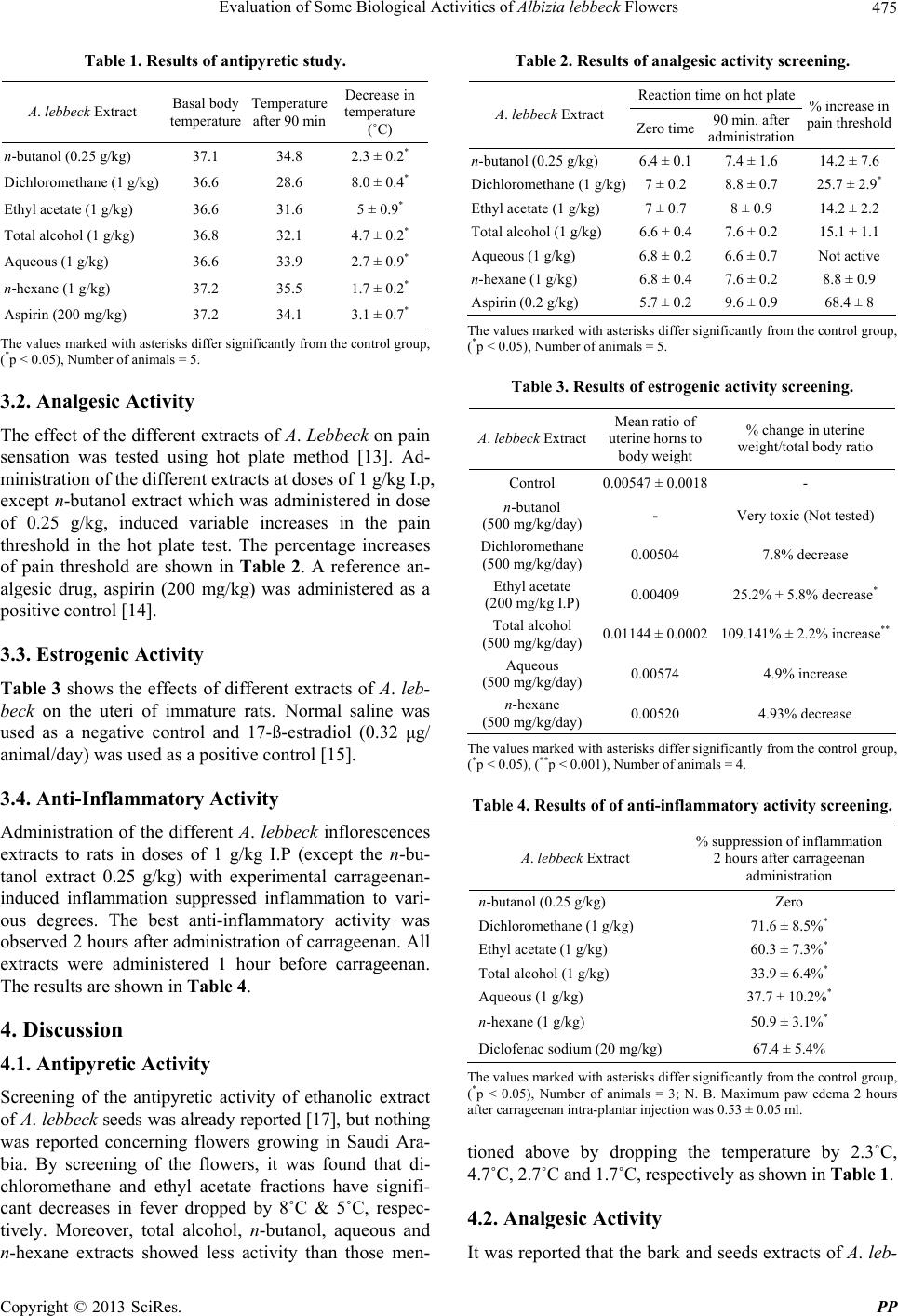 Evaluation of Some Biological Activities of Albizia lebbeck Flowers 475 Table 1. Results of antipyretic study. A. lebbeck Extract Basal body temperature Temperature after 90 min Decrease in temperature (˚C) n-butanol (0.25 g/kg) 37.1 34.8 2.3 ± 0.2* Dichloromethane (1 g/kg) 36.6 28.6 8.0 ± 0.4* Ethyl acetate (1 g/kg) 36.6 31.6 5 ± 0.9* Total alcohol (1 g/kg) 36.8 32.1 4.7 ± 0.2* Aqueous (1 g/kg) 36.6 33.9 2.7 ± 0.9* n-hexane (1 g/kg) 37.2 35.5 1.7 ± 0.2* Aspirin (200 mg/kg) 37.2 34.1 3.1 ± 0.7* The values marked with asterisks differ significantly from the control group, (*p < 0.05), Number of animals = 5. 3.2. Analgesic Activity The effect of the different extracts of A. Lebbeck on pain sensation was tested using hot plate method [13]. Ad- ministration of the different extracts at doses of 1 g/kg I.p, except n-butanol extract which was administered in dose of 0.25 g/kg, induced variable increases in the pain threshold in the hot plate test. The percentage increases of pain threshold are shown in Table 2. A reference an- algesic drug, aspirin (200 mg/kg) was administered as a positive control [14]. 3.3. Estrogenic Activity Table 3 shows the effects of different extracts of A. leb- beck on the uteri of immature rats. Normal saline was used as a negative control and 17-ß-estradiol (0.32 μg/ animal/day) was used as a positive control [15]. 3.4. Anti-Inflammatory Activity Administration of the different A. lebbeck inflorescences extracts to rats in doses of 1 g/kg I.P (except the n-bu- tanol extract 0.25 g/kg) with experimental carrageenan- induced inflammation suppressed inflammation to vari- ous degrees. The best anti-inflammatory activity was observed 2 hours after administration of carrageenan. All extracts were administered 1 hour before carrageenan. The results are shown in Table 4. 4. Discussion 4.1. Antipyretic Activity Screening of the antipyretic activity of ethanolic extract of A. lebbeck seeds was already reported [17], but nothing was reported concerning flowers growing in Saudi Ara- bia. By screening of the flowers, it was found that di- chloromethane and ethyl acetate fractions have signifi- cant decreases in fever dropped by 8˚C & 5˚C, respec- tively. Moreover, total alcohol, n-butanol, aqueous and n-hexane extracts showed less activity than those men- Table 2. Results of analgesic activity screening. Reaction time on hot plate A. lebbeck Extract Zero time 90 min. after administration % increase in pain threshold n-butanol (0.25 g/kg) 6.4 ± 0.1 7.4 ± 1.6 14.2 ± 7.6 Dichloromethane (1 g/kg)7 ± 0.2 8.8 ± 0.7 25.7 ± 2.9* Ethyl acetate (1 g/kg) 7 ± 0.7 8 ± 0.9 14.2 ± 2.2 Total alcohol (1 g/kg) 6.6 ± 0.4 7.6 ± 0.2 15.1 ± 1.1 Aqueous (1 g/kg) 6.8 ± 0.2 6.6 ± 0.7 Not active n-hexane (1 g/kg) 6.8 ± 0.4 7.6 ± 0.2 8.8 ± 0.9 Aspirin (0.2 g/kg) 5.7 ± 0.2 9.6 ± 0.9 68.4 ± 8 The values marked with asterisks differ significantly from the control group, (*p < 0.05), Number of animals = 5. Table 3. Results of estrogenic activity screening. A. lebbeck Extract Mean ratio of uterine horns to body weight % change in uterine weight/total body ratio Control 0.00547 ± 0.0018 - n-butanol (500 mg/kg/day)- Very toxic (Not tested) Dichloromethane (500 mg/kg/day)0.00504 7.8% decrease Ethyl acetate (200 mg/kg I.P) 0.00409 25.2% ± 5.8% decrease* Total alcohol (500 mg/kg/day)0.01144 ± 0.0002 109.141% ± 2.2% increase** Aqueous (500 mg/kg/day)0.00574 4.9% increase n-hexane (500 mg/kg/day)0.00520 4.93% decrease The values marked with asterisks differ significantly from the control group, (*p < 0.05), (**p < 0.001), Number of animals = 4. Table 4. Results of of anti-inflammatory activity screening. A. lebbeck Extract % suppression of inflammation 2 hours after carrageenan administration n-butanol (0.25 g/kg) Zero Dichloromethane (1 g/kg) 71.6 ± 8.5%* Ethyl acetate (1 g/kg) 60.3 ± 7.3%* Total alcohol (1 g/kg) 33.9 ± 6.4%* Aqueous (1 g/kg) 37.7 ± 10.2%* n-hexane (1 g/kg) 50.9 ± 3.1%* Diclofenac sodium (20 mg/kg) 67.4 ± 5.4% The values marked with asterisks differ significantly from the control group, (*p < 0.05), Number of animals = 3; N. B. Maximum paw edema 2 hours after carrageenan intra-plantar injection was 0.53 ± 0.05 ml. tioned above by dropping the temperature by 2.3˚C, 4.7˚C, 2.7˚C and 1.7˚C, respectively as shown in Table 1. 4.2. Analgesic Activity It was reported that the bark and seeds extracts of A. leb- Copyright © 2013 SciRes. PP  Evaluation of Some Biological Activities of Albizia lebbeck Flowers 476 beck have analgesic activity but flowers extracts didn’t take due attention [18]. For flowers extracts as shown in the Table 2, a maximum of 25.7% increase in the reac- tion time was shown by the dichloromethane extract. The aqueous extract was inactive. Maximum increases in the pain threshold were observed 90 minutes after admini- stration of each extract. 4.3. Estrogenic Activity Estrogens are steroid hormones with important functions in the regulation of specific sexual processes in the fe- male. It was reported that methanolic pod extract of A. lebbeck has antifertility effect but nothing was reported about estrogenic effect [19]. At a dose of 500 mg/kg I.P. to immature rats, only total alcohol extract caused sig- nificant increase in the ratio of weight of the two uterine horns to the total body weight by 109.14%. This is a very high percentage and indicates the potent estrogenic ac- tivity of the total alcohol extract that can point to further researches. Whereas, the ethyl acetate extract exerted significant depression of uterine weight/body weight ratio. 4.4. Anti-Inflammatory Activity Screening of the anti-inflammatory activity of seeds and bark of A. lebbeck was reported but nothing about flow- ers of species growing in Saudi Arabia was reported [17,18]. The best extract which showed anti-inflamma- tory activity was the dichloromethane extract with 71.6% followed by the ethyl acetate extract with 60.3% inhibi- tors. In conclusion, these findings clearly suggest that flow- ers of Albizia lebbeck growing in Saudi Arabia have in- teresting biological activities and we recommend further research for isolation of the components responsible for the estrogenic and anti-inflammatory activities. 5. Acknowledgements This research project was supported by a grant from the research Center of the Center for Male Scientific and Medical Colleges in the King Saud University. REFERENCES [1] A. M. Migahid, “Flora of Saudi Arabia: ALBIZIA; Al- bizia L.,” 3rd Edition, Riyadh University Publication, Riyadh, 1989, p. 8. [2] Government of India, The Ministry of Health & Family Welfare, “Ayurvedic Pharmacopoeia of India,” The Con- troller of Publication, Delhi, 2001, pp. 201-202. [3] C. C. Baruach, P. P. Gupta, G. K. Patnaik, D. K. Kul- shreshtha and B. N. Dhawan, “Anti Anaphylactic and Mast Cell Stabilizing Activity of Albizzia lebbeck,” In- dian Journal of Veterinary Medicine, Vol. 21, No. 2, 1997, pp. 127-132. [4] N. P. Babu, P. Pandikumar and S. Ignacimuthu, “Anti- Inflammatory Activity of Albizia lebbeck Benth., an Eth- nomedicinal Plant, in Acute and Chronic Animal Models of Inflammation,” Journal of Ethnopharmacology, Vol. 125, No. 2, 2009, pp. 356-360. doi:10.1016/j.jep.2009.02.041 [5] K. Sanjay, “Saponins of Albizia lebbek in Alzheimer’s and Parkinson’s Disease,” Indian Journal of Natural Products, Vol. 19, No. 1, 2003, pp. 42-48. [6] V. S. Kasture, S. B. Kasture and S. C. Pal, “Anticonvul- sant Activity of Albizzia lebbeck Leaves,” Indian Journal of Experimental Biology, Vol. 34, No. 1, 1996, pp. 78-80. [7] S. D. Chintawar, R. S. Somani, V. S. Kasture and S. B. Kasture, “Nootropic activity of Albizzia lebbeck in Mice,” Journal of Ethnopharmacology, Vol. 81, No. 3, 2002, pp. 299-305. doi:10.1016/S0378-8741(02)00140-X [8] C. R. Resmi, M. R. Venukumar and M. S. Latha, “Anti- oxidant Activity of Albizzia lebbeck (Linn.) Benth. in Al- loxan Diabetic Rats,” Indian Journal of Physiology and Pharmacology, Vol. 50, No. 3, 2006, pp. 297-302. [9] Y. N. Singh, H. Bisht and D. Panday, “Effect of Dry Seed Extract of a Medicinal Plant Albizzia lebbeck on Testicu- lar and Epididymal Protein Profiles of Rat,” Himalayan Journal of Environment and Zoology, Vo. 5, No. 1, 1991, pp. 94-108. [10] S. E. Besra, A. Gomes, L. Chaudhary, J. R. Vedasiromoni and D. K. Ganguly, “Antidiarrhoeal Activity of Seed Ex- tract of Albizzia lebbeck Studied on Conventional Rodent Models of Diarrhe,” Phytotherapy Research, Vol. 16, No. 6, 2002, pp. 529-530. doi:10.1002/ptr.961 [11] J. Kang, C. H. Huo, Z. Li and Z. P. Li, “New Ceramides from the Flower of Albizia julibrissin,” Chinese Chemical Letters, Vol. 18, No. 2, 2007, pp. 181-184. doi:10.1016/j.cclet.2006.12.042 [12] Z. Yongna, R. Wantana, B. Pisit, L. Zhongkun and Z. Rongping, “Analgesic and Antipyretic Activities of the Aqueous Extract of Urtica macrorrhiza in Experimental Animals,” Fitoterapia, Vol. 76, No. 1, 2005, pp. 91-95. doi:10.1016/j.fitote.2004.10.018 [13] G. E. Leighton, M. A. Johnson, K. G. Meecham, R. G. Hill and J. Hughes, “Pharmacological Profile of PD 117302, a Selective K-Opioid Agonist,” British Journal of Pharmacology, Vol. 92, No. 4, 1987, pp. 915-922. doi:10.1111/j.1476-5381.1987.tb11398.x [14] K. El Tahir, “A Guide to Drug Discovery: Directions for Pharmacological Screening for New Synthetic and Natural Compounds Leading to Discovery of New Medicines,” El Tahir Publication, Riyadh, 2007, pp. 100-105. [15] A. Kumar and P. Pakrasi, “Estrogenic and Antiestrogenic Properties of Clomiphene Citrate in Laboratory Mice,” Journal of Bioscience, Vol. 20, No. 5, 1995, pp. 665-673. doi:10.1007/BF02703306 [16] G. S. Duncan, S. H. Peers, F. Carey, R. Forder and R. J. Flower, “Calcium Antagonistic and Antiarrhythmic Ac- tions of CPU-23, a Substituted Tetrahydroisoquinoline,” British Journal of Pharmacology, Vol. 109, No. 1, 1993, pp. 113-119. doi:10.1111/j.1476-5381.1993.tb13539.x Copyright © 2013 SciRes. PP  Evaluation of Some Biological Activities of Albizia lebbeck Flowers Copyright © 2013 SciRes. PP 477 [17] N. Verma and R. K. Srivastav, “Analgesic, Antipyretic and Anti-Inflammatory Activities of Albizia lebbeck Seeds,” Pharmacology Online, Vol. 3, 2011, pp. 1209- 1216. [18] A. Saha and M. Ahmed, “The Analgesic and Anti-In- flammatory Activities of the Extract of Albizia lebbeck in Animal Model,” Pakistanian Journal of Pharmaceutical Science, Vol. 22, No. 1, 2009, pp.74-77. [19] R. S. Gupta, J. S. Kachhawa and R. Chaudhary, “Antifer- tility Effects of Methanolic Pod Extract of Albizzia leb- beck (L.) Benth in Male Rats,” Asian Journal of Androl- ogy, Vol. 6, No. 2, 2004, pp. 155-159. |