

Paper Menu >>
Journal Menu >>
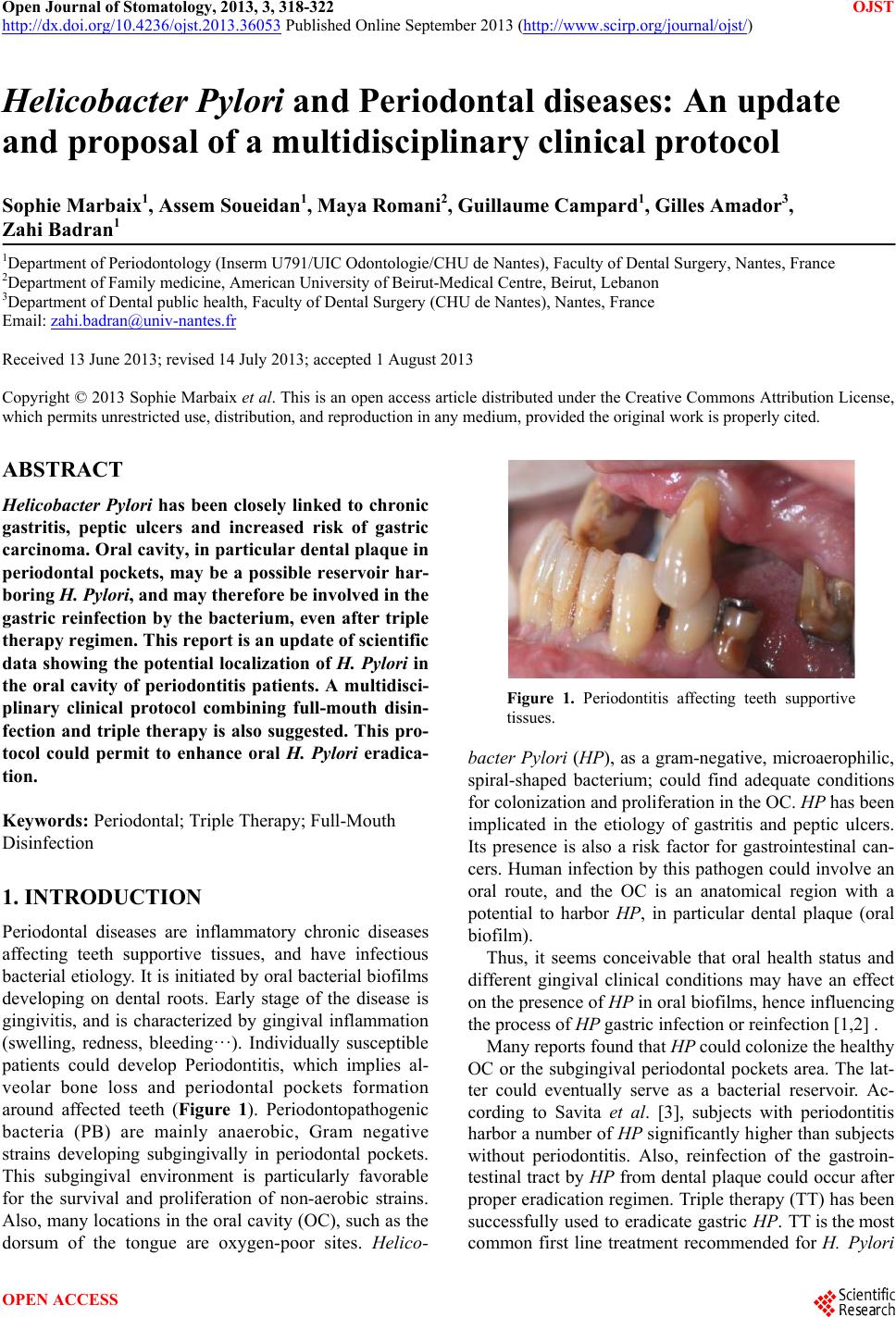 Open Journal of Stomatology, 2013, 3, 318-322 OJST http://dx.doi.org/10.4236/ojst.2013.36053 Published Online September 2013 (http://www.scirp.org/journal/ojst/) Helicobacter Pylori and Periodontal diseases: An update and proposal of a multidisciplinary clinical protocol Sophie Marbaix1, Assem Soueidan1, Maya Romani2, Guillaume Campard1, Gilles Amador3, Zahi Badran1 1Department of Periodontology (Inserm U791/UIC Odontologie/CHU de Nantes), Faculty of Dental Surgery, Nantes, France 2Department of Family medicine, American University of Beirut-Medical Centre, Beirut, Lebanon 3Department of Dental public health, Faculty of Dental Surgery (CHU de Nantes), Nantes, France Email: [email protected] Received 13 June 2013; revised 14 July 2013; accepted 1 August 2013 Copyright © 2013 Sophie Marbaix et al. This is an open access article distributed under the Creative Commons Attribution License, which permits unrestricted use, distribution, and reproduction in any medium, provided the original work is properly cited. ABSTRACT Helicobacter Pylori has been closely linked to chronic gastritis, peptic ulcers and increased risk of gastric carcinoma. Oral cavity, in particular dental plaque in periodontal pockets, may be a possible reservoir har- boring H. Pylori, and may therefore be involved in the gastric reinfection by the bacterium, even after triple therapy regimen. This report is an update of scientific data showing the potential localization of H. Pylori in the oral cavity of periodontitis patients. A multidisci- plinary clinical protocol combining full-mouth disin- fection and triple therapy is also suggested. This pro- tocol could permit to enhance oral H. Pylori eradica- tion. Keywords: Periodontal; Triple Therapy; Full-Mouth Disinfection 1. INTRODUCTION Periodontal diseases are inflammatory chronic diseases affecting teeth supportive tissues, and have infectious bacterial etiology. It is initiated by oral bacterial biofilms developing on dental roots. Early stage of the disease is gingivitis, and is characterized by gingival inflammation (swelling, redness, bleeding···). Individually susceptible patients could develop Periodontitis, which implies al- veolar bone loss and periodontal pockets formation around affected teeth (Figure 1). Periodontopathogenic bacteria (PB) are mainly anaerobic, Gram negative strains developing subgingivally in periodontal pockets. This subgingival environment is particularly favorable for the survival and proliferation of non-aerobic strains. Also, many locations in the oral cavity (OC), such as the dorsum of the tongue are oxygen-poor sites. Helico- Figure 1. Periodontitis affecting teeth supportive tissues. bacter Pylori (HP), as a gram-negative, microaerophilic, spiral-shaped bacterium; could find adequate conditions for colonization and proliferation in the OC. HP has been implicated in the etiology of gastritis and peptic ulcers. Its presence is also a risk factor for gastrointestinal can- cers. Human infection by this pathogen could involve an oral route, and the OC is an anatomical region with a potential to harbor HP, in particular dental plaque (oral biofilm). Thus, it seems conceivable that oral health status and different gingival clinical conditions may have an effect on the presence of HP in oral biofilms, hence influencing the process of HP gastric infection or reinfection [1,2] . Many reports found that HP could colonize the healthy OC or the subgingival periodontal pockets area. The lat- ter could eventually serve as a bacterial reservoir. Ac- cording to Savita et al. [3], subjects with periodontitis harbor a number of HP significantly higher than subjects without periodontitis. Also, reinfection of the gastroin- testinal tract by HP from dental plaque could occur after proper eradication regimen. Triple therapy (TT) has been successfully used to eradicate gastric HP. TT is the most common first line treatment recommended for H. Pylori OPEN ACCESS  S. Marbaix et al. / Open Journal of Stomatology 3 (2013) 318-322 319 eradication, it consists of a proton pump inhibitor (PPI) (lansoprazole 30 mg twice daily, omeprazole 20 mg twice daily, pantoprazole 40 mg twice daily, rabeprazole 20 mg twice daily) plus amoxicillin 1 gram twice daily and clarithromycin 500mg twice daily for 7 to 14 days. Met- ronidazole (500 mg twice daily) can be substituted for amoxicillin in penicillin-allergic patients. A longer dura- tion of treatment (14 versus 7 days) may be more effective in curing infection, but this remains controversial. TT is currently considered the gold standard reaching an eradi- cation rate up to 80% [1,4]. However, in many cases, HP is not completely eliminated after a single treatment, and the recurrence of the HP infection has been well-docu- mented [5]. Therefore, the OC has been suspected to be a common source for reinfection of the stomach [2,6]. In fact, bacteria developing in biofilm configuration (such as in dental plaque) are much more resistant to antibiot- ics than freely circulating bacteria [7]. Full mouth disinfection (FMD) is a periodontal clini- cal protocol, combining mechanical antibacterial therapy (scaling/root planning of dental roots) and antiseptic re- gimen (chlorhexidine) to obtain PB eradication [8,9]. The mechanical debridement of all teeth is performed within 24 h, in order to eradicate rapidly PB present in dental biofilms, and thus preventing reinfection of treated sites. Also, the adjunction of a systemic antibiotic pre- scription to FMD (amoxicillin/metronidazole or azithro- mycin) has been found to successfully enhance clinical outcomes [10-12]. This article focuses on the specific association of periodontal status and oral HP in the published scientific literature. The rationale of considering periodontitis as a risk factor for HP infections/reinfection will also be dis- cussed, with an emphasis on the eventual clinical impli- cations of this assumption. Finally, we suggest the merg- ing of both FMD and TT regimen, in order to enhance periodontal therapy outcome as well as eradication of HP. 2. HELICOBACTER PYLORI AND PERIODONTAL DISEASES 2.1. Helicobacter Pylori in Periodontally Ill and Healthy Patients Several studies have evaluated the correlation between the prevalence of HP and periodontal diseases. Conflict- ing results could be observed in the literature, this could be attributed to the diversity of the studied populations, sample collection methods, and the specificity of the methods used for HP detection [2,13]. Although it may affect the presence of HP in dental plaque, few studies have separately investigated supra and subgingival plaque, which corresponds to different microenvironments when availability of nutrients, oxygen and host mechanisms are considered [14]. Souto et al. [2] performed a full-mouth clinical ex- amination (six sites per tooth) to determine periodontal health status and examined subjects with no history of gastric symptoms, their results showed a higher preva- lence of HP in subgingival biofilm of subjects with pe- riodontitis compared to individuals with periodontal health (50% versus 11% respectively), suggesting that periodontal pockets and inflammation may favor HP colonization. Another study by Riggio and Lennon [15] examined the presence of H. Pylori in subgingival plaque (sites with periodontal pocket depth ≥5 mm) of perio- dontitis patients with no symptoms of gastritis or peptic ulcer disease. This study found that 38% of subjects with deep periodontal pockets were positive for HP. Conse- quently, the authors concluded that subgingival plaque in individuals presenting periodontitis may function as a reservoir for HP. Gebara et al. [14], found that more than 26% of HP was detected in the OC of periodontitis patients (all posi- tive for gastric HP), periodontitis and gingivitis showed a high prevalence; however, no control group with healthy patients were included. Al Asqah et al. [13] found that periodontitis patients had a significantly higher percent- age of HP in subgingival plaque samples in comparison to periodontally healthy controls (79% versus 43% re- spectively). Other studies failed to detect HP in the sub- gingival plaque [16,17] or found no association between periodontal status and the prevalence of the bacterium in OC [18]. 2.2. Relation between Gastric Infection and Periodondal Disease Umeda et al. [19] showed that more than 40 % of pa- tients with history of gastritis or peptic ulcers had perio- dontal pockets (>4 mm). Bruce et al. (54) found that periodontal pockets ≥5 mm are associated with increased odds of HP seropositivity. Also, a large epidemiological investigation performed over 10,000 subjects [20], found a positive link between HP associated gastric infection and periodontal diseases. The latter may facilitate the HP oro-gastric transmission and colonization of the bacteria in the digestive tract. Also, periodontitis microenviron- ment conditions could be favorable for HP multiplication, thus increasing sufficiently to cause gastric infection [21,22]. On the other hand, many studies [23-25] failed to es- tablish a positive correlation between periodontal disease and gastric infection. 3. TRIPLE THERAPY AND ORAL HELICOBACTER PYLORI 3.1. Effect of Triple Therapy on Oral HP It is still unclear whether TT affects HP in dental plaque. Song et al. [26] found plaque samples negative for HP Copyright © 2013 SciRes. OPEN ACCESS 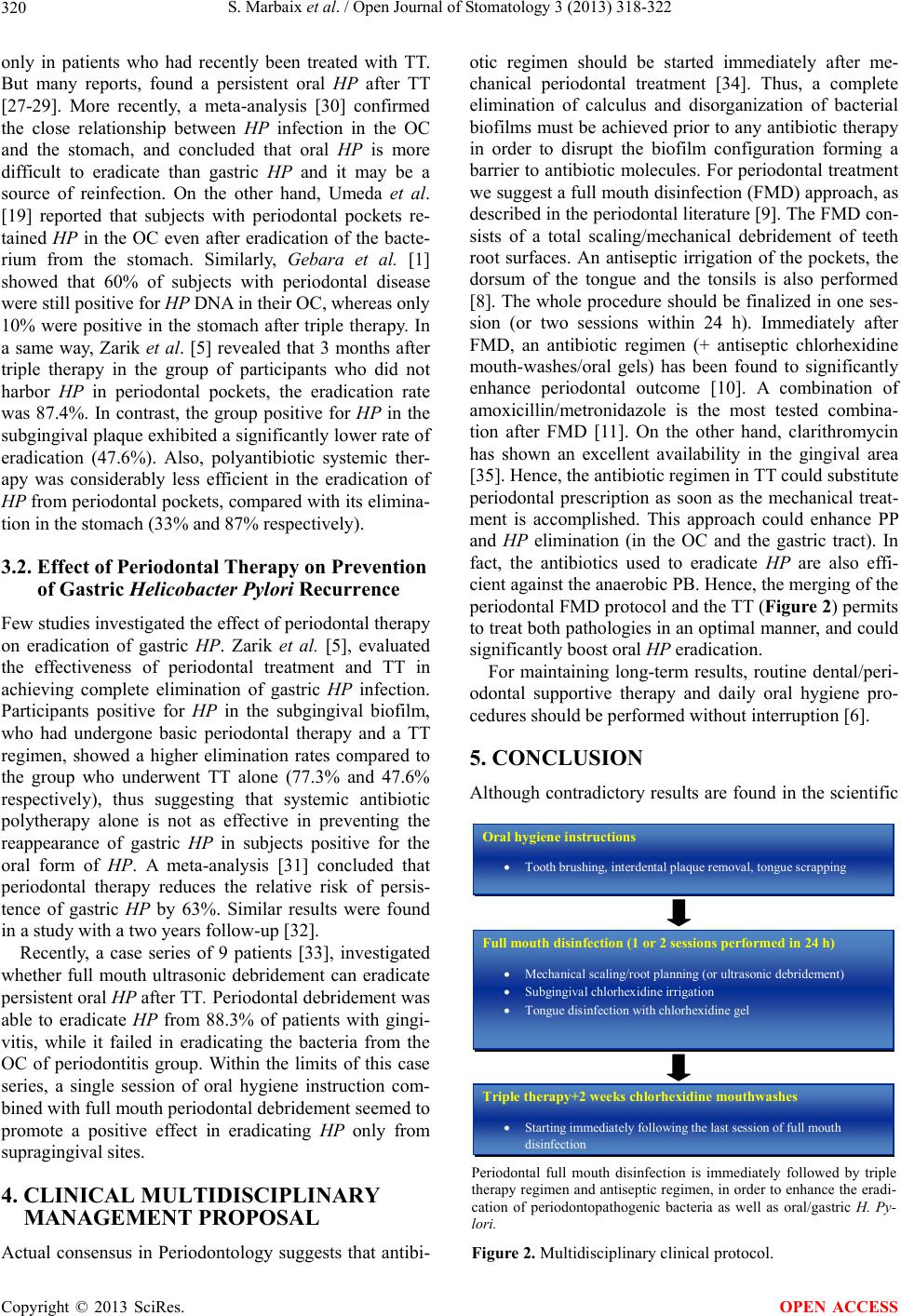 S. Marbaix et al. / Open Journal of Stomatology 3 (2013) 318-322 320 only in patients who had recently been treated with TT. But many reports, found a persistent oral HP after TT [27-29]. More recently, a meta-analysis [30] confirmed the close relationship between HP infection in the OC and the stomach, and concluded that oral HP is more difficult to eradicate than gastric HP and it may be a source of reinfection. On the other hand, Umeda et al. [19] reported that subjects with periodontal pockets re- tained HP in the OC even after eradication of the bacte- rium from the stomach. Similarly, Gebara et al. [1] showed that 60% of subjects with periodontal disease were still positive for HP DNA in their OC, whereas only 10% were positive in the stomach after triple therapy. In a same way, Zarik et al. [5] revealed that 3 months after triple therapy in the group of participants who did not harbor HP in periodontal pockets, the eradication rate was 87.4%. In contrast, the group positive for HP in the subgingival plaque exhibited a significantly lower rate of eradication (47.6%). Also, polyantibiotic systemic ther- apy was considerably less efficient in the eradication of HP from periodontal pockets, compared with its elimina- tion in the stomach (33% and 87% respectively). 3.2. Effect of Periodontal Therapy on Prevention of Gastric Helicobacter Pylori Recurrence Few studies investigated the effect of periodontal therapy on eradication of gastric HP. Zarik et al. [5], evaluated the effectiveness of periodontal treatment and TT in achieving complete elimination of gastric HP infection. Participants positive for HP in the subgingival biofilm, who had undergone basic periodontal therapy and a TT regimen, showed a higher elimination rates compared to the group who underwent TT alone (77.3% and 47.6% respectively), thus suggesting that systemic antibiotic polytherapy alone is not as effective in preventing the reappearance of gastric HP in subjects positive for the oral form of HP. A meta-analysis [31] concluded that periodontal therapy reduces the relative risk of persis- tence of gastric HP by 63%. Similar results were found in a study with a two years follow-up [32]. Recently, a case series of 9 patients [33], investigated whether full mouth ultrasonic debridement can eradicate persistent oral HP after TT. Periodontal debridement was able to eradicate HP from 88.3% of patients with gingi- vitis, while it failed in eradicating the bacteria from the OC of periodontitis group. Within the limits of this case series, a single session of oral hygiene instruction com- bined with full mouth periodontal debridement seemed to promote a positive effect in eradicating HP only from supragingival sites. 4. CLINICAL MULTIDISCIPLINARY MANAGEMENT PROPOSAL Actual consensus in Periodontology suggests that antibi- otic regimen should be started immediately after me- chanical periodontal treatment [34]. Thus, a complete elimination of calculus and disorganization of bacterial biofilms must be achieved prior to any antibiotic therapy in order to disrupt the biofilm configuration forming a barrier to antibiotic molecules. For periodontal treatment we suggest a full mouth disinfection (FMD) approach, as described in the periodontal literature [9]. The FMD con- sists of a total scaling/mechanical debridement of teeth root surfaces. An antiseptic irrigation of the pockets, the dorsum of the tongue and the tonsils is also performed [8]. The whole procedure should be finalized in one ses- sion (or two sessions within 24 h). Immediately after FMD, an antibiotic regimen (+ antiseptic chlorhexidine mouth-washes/oral gels) has been found to significantly enhance periodontal outcome [10]. A combination of amoxicillin/metronidazole is the most tested combina- tion after FMD [11]. On the other hand, clarithromycin has shown an excellent availability in the gingival area [35]. Hence, the antibiotic regimen in TT could substitute periodontal prescription as soon as the mechanical treat- ment is accomplished. This approach could enhance PP and HP elimination (in the OC and the gastric tract). In fact, the antibiotics used to eradicate HP are also effi- cient against the anaerobic PB. Hence, the merging of the periodontal FMD protocol and the TT (Figure 2) permits to treat both pathologies in an optimal manner, and could significantly boost oral HP eradication. For maintaining long-term results, routine dental/peri- odontal supportive therapy and daily oral hygiene pro- cedures should be performed without interruption [6]. 5. CONCLUSION Although contradictory results are found in the scientific Oral h yg iene instructions Tooth brushing, interdental plaque removal, tongue scrapping Full mouth disinfection(1 or 2 sessions p erformed in 24 h) Mechanical scaling/root planning (or ultrasonic debridement) Subgingival chlorhexidine irrigation Tongue disinfection with chlorhexidine gel Tri p le the ra py +2 weeks chlorhexidine mouthwashes Starting immediately following the last session of full mouth disinfection Periodontal full mouth disinfection is immediately followed by triple therapy regimen and antiseptic regimen, in order to enhance the eradi- cation of periodontopathogenic bacteria as well as oral/gastric H. Py- lori. Figure 2. Multidisciplinary clinical protocol. Copyright © 2013 SciRes. OPEN ACCESS  S. Marbaix et al. / Open Journal of Stomatology 3 (2013) 318-322 321 literature, many reports have associated periodontal dis- ease (periodontal pockets formation) to an increased prevalence of oral HP. Its bacterial load is increased by periodontal disease and periodontal pockets formation. The assumption that subgingival oral biofilm could act as a suitable reservoir for HP is plausible and supported by consistent evidence from preliminary clinical trials. The presence of oral HP in patients with periodontal disease (Periodontitis and gingivitis) may cause refractoriness of gastric infection to triple therapy alone [5,31]. The mechanisms that confer the ability of HP to es- cape systemic treatment are not well understood, but there is evidence indicating that biofilms provide de- fense from the host immunological response and the ac- tion of antimicrobials agents [36]. Hence, antimicrobials cannot be efficient if the biofilm is not mechanically disrupted [37] shortly prior to prescription. The subgin- gival dental biofilm is particularly suspected, due to the favorable micro-ecological conditions provided by the periodontal pockets. The biofilm is known to provide protection from the host’s immunological response, and bacteria growing in biofilms exhibit high resistance to antimicrobial agents [5]. We therefore suggest a simple multidisciplinary clinical management protocol, merging the triple therapy to periodontal mechanical treatment and chemical antiseptic disinfection. A joint coordination between the periodontist and the gastroenterologist is a perquisite for the success of this treatment regimen. Adopting this protocol has two objectives; treating pe- riodontal disease and enhancing the efficacy of the anti HP therapy. On the other hand, it should be considered that the ef- ficacy of non-surgical treatment modalities is related to the pocket depth. Hence, surgical periodontal procedures like open flap debridement could be needed in some cases to eliminate deep bacterial biofilms potentially har- boring HP [33]. To our knowledge, no research has been conducted in this field. In conclusion, the efficacy of the combined proposed protocol should be investigated in future controlled, ran- domized clinical trials. If confirmed, it could be inte- grated in the standard clinical management of HP infec- tions. REFERENCES [1] Gebara, E.C., Faria, C.M., Pannuti, C., Chehter, L., Mayer, M.P. and Lima, L.A. (2006) Persistence of Helicobacter pylori in the oral cavity after systemic eradication therapy. Journal of Clinical Periodontology, 33, 329-333. doi:10.1111/j.1600-051X.2006.00915.x [2] Souto, R. and Colombo, A.P. (2008) Detection of Helico- bacter pylori by polymerase chain reaction in the subgin- gival biofilm and saliva of non-dyspeptic periodontal pa- tients. Journal of Periodontology, 79, 97-103. doi:10.1902/jop.2008.070241 [3] Sambashivaiah, S., Bilichodmath, S., Nanjaiah, N. and Kulal, R. (2011) Helicobacter pylori in periodontal pock- ets of chronic periodontitis patients with and without type II diabetes mellitus: A randomized controlled trial. [4] Bago, I., Plecko, V., Aurer, A., Majstorovic, K. and Budimir, A. (2011) The effectiveness of systemic eradi- cation therapy against oral Helicobacter pylori. Journal of Oral Pathology & Medicine, 40, 428-432. doi:10.1111/j.1600-0714.2010.00989.x [5] Zaric, S., Bojic, B., Jankovic, L., Dapcevic, B., Popovic B., Cakic, S. and Milasin, J. (2009) Periodontal therapy improves gastric Helicobacter pylori eradication. Journal of Dental Research, 88, 946-950. doi:10.1177/0022034509344559 [6] Jia, C.L., Jiang, G.S., Li, C.H. and Li, C.R. (2009) Effect of dental plaque control on infection of Helicobacter py- lori in gastric mucosa. Journal of Periodontology, 80, 1606-1609. doi:10.1902/jop.2009.090029 [7] Dye, B.A., Kruszon-Moran, D. and McQuillan, G. (2002) The relationship between periodontal disease attributes and Helicobacter pylori infection among adults in the United States. The American Journal of Public Health, 92, 1809-1815. doi:10.2105/AJPH.92.11.1809 [8] Quirynen, M., Mongardini, C., de Soete, M., Pauwels, M., Coucke, W., van Eldere, J. and van Steenberghe, D. (2000) The role of chlorhexidine in the one-stage full-mouth disinfection treatment of patients with advanced adult pe- riodontitis. Long-term clinical and microbiological ob- servations. Journal of Clinical Periodontology, 27, 578- 589. doi:10.1034/j.1600-051x.2000.027008578.x [9] Quirynen, M., Mongardini, C., Pauwels, M., Bollen, C.M., Van Eldere, J. and van Steenberghe, D.(1999) One stage full-versus partial-mouth disinfection in the treatment of chronic adult or generalized early-onset periodontitis. II. Long-term impact on microbial load. Journal of Perio- dontology, 70, 646-656. doi:10.1902/jop.1999.70.6.646 [10] Aimetti, M., Romano, F., Guzzi, N. and Carnevale, G. (2012) Full-mouth disinfection and systemic antimicro- bial therapy in generalized aggressive periodontitis: A randomized, placebo-controlled trial. Journal of Clinical Periodontology, 39, 284-294. doi:10.1111/j.1600-051X.2011.01795.x [11] Cionca, N., Giannopoulou, C., Ugolotti, G. and Mombelli, A. (2009) Amoxicillin and metronidazole as an adjunct to full-mouth scaling and root planing of chronic periodon- titis. Journal of Periodontology, 80, 364-371. doi:10.1902/jop.2009.080540 [12] Gomi, K., Yashima, A., Nagano, T., Kanazashi, M., Mae- da, N. and Arai, T. (2007) Effects of full-mouth scaling and root planing in conjunction with systemically admin- istered azithromycin. Journal of Periodontology, 78, 422- 429. doi:10.1902/jop.2007.060247 [13] Al Asqah, M., Al Hamoudi, N., Anil, S., Al Jebreen, A. and Al-Hamoudi, W.K. (2009) Is the presence of Helico- bacter pylori in dental plaque of patients with chronic pe- riodontitis a risk factor for gastric infection? Canadian Journal of Gastroenterology, 23, 177-179. [14] Gebara, E.C., Pannuti, C., Faria, C.M., Chehter, L., May- er, M.P. and Lima, L.A. (2004) Prevalence of Helico- Copyright © 2013 SciRes. OPEN ACCESS  S. Marbaix et al. / Open Journal of Stomatology 3 (2013) 318-322 Copyright © 2013 SciRes. 322 OPEN ACCESS bacter pylori detected by polymerase chain reaction in the oral cavity of periodontitis patients. Oral Microbiology and Immunology, 19, 277-280. doi:10.1111/j.1399-302X.2004.00153.x [15] Riggio, M.P. and Lennon, A. (1999) Identification by PCR of Helicobacter pylori in subgingival plaque of adult periodontitis patients. Journal of Medical Microbiology, 48, 317-322. doi:10.1099/00222615-48-3-317 [16] Asikainen, S., Chen, C. and Slots, J. (1994) Absence of Helicobacter pylori in subgingival samples determined by polymerase chain reaction. Oral Microbiology and Im- munology, 9, 318-320. doi:10.1111/j.1399-302X.1994.tb00079.x [17] Silva, D.G., Stevens, R.H., Macedo, J.M., Albano, R.M., Falabella, M.E., Fischer, R.G., Veerman, E.C. and Tinoco, E.M. (2010) Presence of Helicobacter pylori in supragin- gival dental plaque of individuals with periodontal dis- ease and upper gastric diseases. Archives of Oral Biology, 55, 896-901. doi:10.1016/j.archoralbio.2010.06.018 [18] Burgers, R., Schneider-Brachert, W., Reischl, U., Behr, A., Hiller, K.A., Lehn, N., Schmalz, G. and Ruhl, S. (2008) Helicobacter pylori in human oral cavity and stomach. European Journal of Oral Sciences, 116, 297-304. doi:10.1111/j.1600-0722.2008.00543.x [19] Umeda, M., Kobayashi, H., Takeuchi, Y., Hayashi, J., Morotome-Hayashi, Y., Yano, K., Aoki, A., Ohkusa, T. and Ishikawa, I. (2003) High prevalence of Helicobacter pylori detected by PCR in the oral cavities of periodonti- tis patients. Journal of Periodontology, 74, 129-134. doi:10.1902/jop.2003.74.1.129 [20] Bielanski, W. (1999) Epidemiological study on Helico- bacter pylori infection and extra gastroduodenal disorders in Polish population. Journal of Physiology and Phar- macology, 50, 723-733. [21] Czesnikiewicz-Guzik, M., Bielanski, W., Guzik, T.J., Los- ter, B. and Konturek, S.J. (2005) Helicobacter pylori in the oral cavity and its implications for gastric infection, periodontal health, immunology and dyspepsia. Journal of Physiology and Pharmacology, 56, 77-89. [22] Czesnikiewicz-Guzik, M., Karczewska, E., Bielanski, W., Guzik, T.J., Kapera, P., Targosz, A., Konturek, S.J. and Loster, B. (2004) Association of the presence of Helico- bacter pylori in the oral cavity and in the stomach. Jour- nal of Physiology and Pharmacology, 55, 105-115. [23] Anand, P.S., Nandakumar, K. and Shenoy, K.T. (2006) Are dental plaque, poor oral hygiene, and periodontal di- sease associated with Helicobacter pylori infection? Journal of Periodontology, 77, 692-698. doi:10.1902/jop.2006.050163 [24] Berroteran, A., Perrone, M., Correnti, M., Cavazza, M.E., Tombazzi, C., Goncalvez, R. and Lecuna, V. (2002) De- tection of Helicobacter pylori DNA in the oral cavity and gastroduodenal system of a Venezuelan population. Jour- nal of Medical Microbiology, 51, 764-770. [25] Hardo, P.G., Tugnait, A., Hassan, F., Lynch, D.A., West, A.P., Mapstone, N.P., Quirke, P., Chalmers, D.M., Ko- wolik, M.J. and Axon, A.T. (1995) Helicobacter pylori infection and dental care. Gut, 37, 44-46. doi:10.1136/gut.37.1.44 [26] Song, Q., Lange, T., Spahr, A., Adler, G. and Bode, G. (2000) Characteristic distribution pattern of Helicobacter pylori in dental plaque and saliva detected with nested PCR. Journal of Medical Microbiology, 49, 349-353. [27] Czesnikiewicz-Guzik, M., Loster, B., Bielanski, W., Gu- zik, T.J., Konturek, P.C., Zapala, J. and Konturek, S.J. (2007) Implications of oral Helicobacter pylori for the outcome of its gastric eradication therapy. Journal of Clinical Gastroenterology, 41, 145-151. doi:10.1097/01.mcg.0000225654.85060.3d [28] Gurbuz, A.K., Ozel, A.M., Yazgan, Y., Celik, M. and Yildirim, S. (2003) Oral colonization of Helicobacter py- lori: Risk factors and response to eradication therapy. South African Medical Journal, 96, 244-247. doi:10.1097/01.SMJ.0000051069.50950.2B [29] Pytko-Polonczyk, J., Konturek, S.J., Karczewska, E., Bie- lanski, W. and Kaczmarczyk-Stachowska, A. (1996) Oral cavity as permanent reservoir of Helicobacter pylori and potential source of reinfection. Journal of Physiology and Pharmacology, 47, 121-129. [30] Zou, Q.H. and Li, R.Q. (2011) Helicobacter pylori in the oral cavity and gastric mucosa: a meta-analysis. Journal of Oral Pathology & Medicine, 40, 317-324. doi:10.1111/j.1600-0714.2011.01006.x [31] Bouziane, A., Ahid, S., Abouqal, R. and Ennibi, O. (2012) Effect of periodontal therapy on prevention of gastric He- licobacter pylori recurrence: A systematic review and meta-analysis. Journal of Clinical Periodontology, 39, 1166-1173. doi:10.1111/jcpe.12015 [32] Tarullo, A., Tattoli, M. and Cagiano, R. (2001) Persistent eradication of Helicobacter pylori after systemic poli- therapy associated with periodontal pockets treatment with metronidazole and calcium sulphate. European Re- view for Medical and Pharmacological Sciences, 5, 127- 129. [33] Escobar, E.C., Chambrone, L., Pannut, C.M., Mayer, M.P.A. and Lima, l.A. (2013) Full mouth ultrasonic de- bridement in Helicobacter Pylori eradication from the oral cavity: A case series. Canadian Journal of Dental Hygiene, 47, 39. [34] Sanz, M. and Teughels, W. (2008) Innovations in non- surgical periodontal therapy: Consensus Report of the Sixth European Workshop on Periodontology. Journal of Clinical Periodontology, 35, 3-7. doi:10.1111/j.1600-051X.2008.01256.x [35] Burrell, R.C. and Walters, J.D. (2008) Distribution of systemic clarithromycin to gingiva. Journal of Periodon- tology, 79, 1712-1718. doi:10.1902/jop.2008.080013 [36] Socransky, S.S. and Haffajee, A.D. (2002) Dental bio- films: Difficult therapeutic targets. Periodontology, 28, 12-55. doi:10.1034/j.1600-0757.2002.280102.x [37] Herrera, D., Alonso, B., Leon, R., Roldan, S. and Sanz, M. (2008) Antimicrobial therapy in periodontitis: The use of systemic antimicrobials against the subgingival biofilm. Journal of Clinical Periodontology, 35, 45-66. doi:10.1111/j.1600-051X.2008.01260.x |