

Paper Menu >>
Journal Menu >>
 iBusiness, 2013, 5, 107-112 http://dx.doi.org/10.4236/ib.2013.53013 Published Online September 2013 (http://www.scirp.org/journal/ib) 107 The Research on the Key Success Factors of Mobile Internet with Interpretative Structural Modelling* Jiangping Wan1,2, Yahui Zhu1, Lianyu Liang1 1School of Business Administration, South China University of Technology, Guangzhou, China; 2Institute of Emerging Industrializa- tion Development South China University of Technology, Guangzhou, China. Email: [email protected], zhu yahui0819@q q.com, ja [email protected] Received August 3rd, 2013; revised August 25th, 2013; accepted Aug ust 31st, 2013 Copyright © 2013 Jiangping Wan et al. This is an open access article distributed under the Creative Commons Attribution License, which permits unrestricted use, distribution, and reproduction in any medium, provided the original work is properly cited. ABSTRACT Today mobile Internet is a rapidly rising area. How to deal with the disruptive transition? This paper is intended to study the success factors of mobile Internet with grounded theory and it is the result that 17 success factors are iden- tified. Then the following top 10 key success factors are found out through the questionnaire: the user traffic and scale, product and service innovation, keen market environmental sense, the user experience and business model in- novation, core technology, the development of mobile terminals, e-commerce and online payment services, custom- ized services and applications of cloud computing and big data. Finally, interpretative structural modeling (ISM) is applied to analyze the relationship among the key success factors and the root key success factors of mobile Internet were figured out, as they are product and service innovation, keen grasp of market environment, the user experience and core technology. The results will be enlightened for the ente rprises of mobile Internet, mobile phone manuf acturers and operators. Keywords: Mobile Internet; Key Success Factors; Grounded Theo ry; Interpretative Structural Modeling (ISM) 1. Introduction As an emerging market, there is no stable development model of mobile Internet. However, it is necessary for the mobile Internet to find out its key success factors to continue the healthy development, which relates to its success or failure. The characteristics of the mobile In- ternet include: quickly technological change, short prod- uct life-cycle, fast improvement of product performance and technology etc., which make the analysis and eval- uation of the mobile Internet difficult to be quantified. In order to solve this problem, interpretative structural modeling (ISM) is used in this paper. This paper is organized as follows: introduction and literature review are in the first, and then the research design followed. After identifying the influence factors of mobile Internet with Grounded Theory, the hierarchi- cal structural relationship among the key success factors (KSF) is analyzed with ISM, to find out the root success factors and their influence relation. 2. Literature Review Mary Meeker, titled the “queen of the Internet”, the ex- ecutives of Kleiner Perkins venture-capital firm, said in a speech at Stanford University recently that the global mobile Internet traffic was growing so fast that it even exceeded the Internet traffic of desktop system in some areas. Besides, the mobile industry was still in the early development stage with great potential [1]. The huge market prospect of mobile Internet attracts the telecom operators, terminal manufacturers, Internet companies, systems integrators etc., leading to the flourish [2]. Kate Matsudaira said: You want to make sure that APIs return quickly and do not block while waiting for results, since mobile clients have a limited number of connections, and design your APIs to allow clients to request just the information they need [3]. Nafaa Jabeur, Sherali Zeadaly, Biju Sayed argued that 1) Along with PC functions, TV, games, and business services are available through mobile devices, wherever and when- ever a user might want them. 2) Mobile devices are read- ily discoverable by nearby people and social services. 3) Even more services are expected soon, along with nu- *This research was supported by Key Project of Guangdong Province Education Office (06JDXM63002), NSF of China (70471091), and QualiPSo (IST-FP6-IP-034763). Copyright © 2013 SciRes. IB 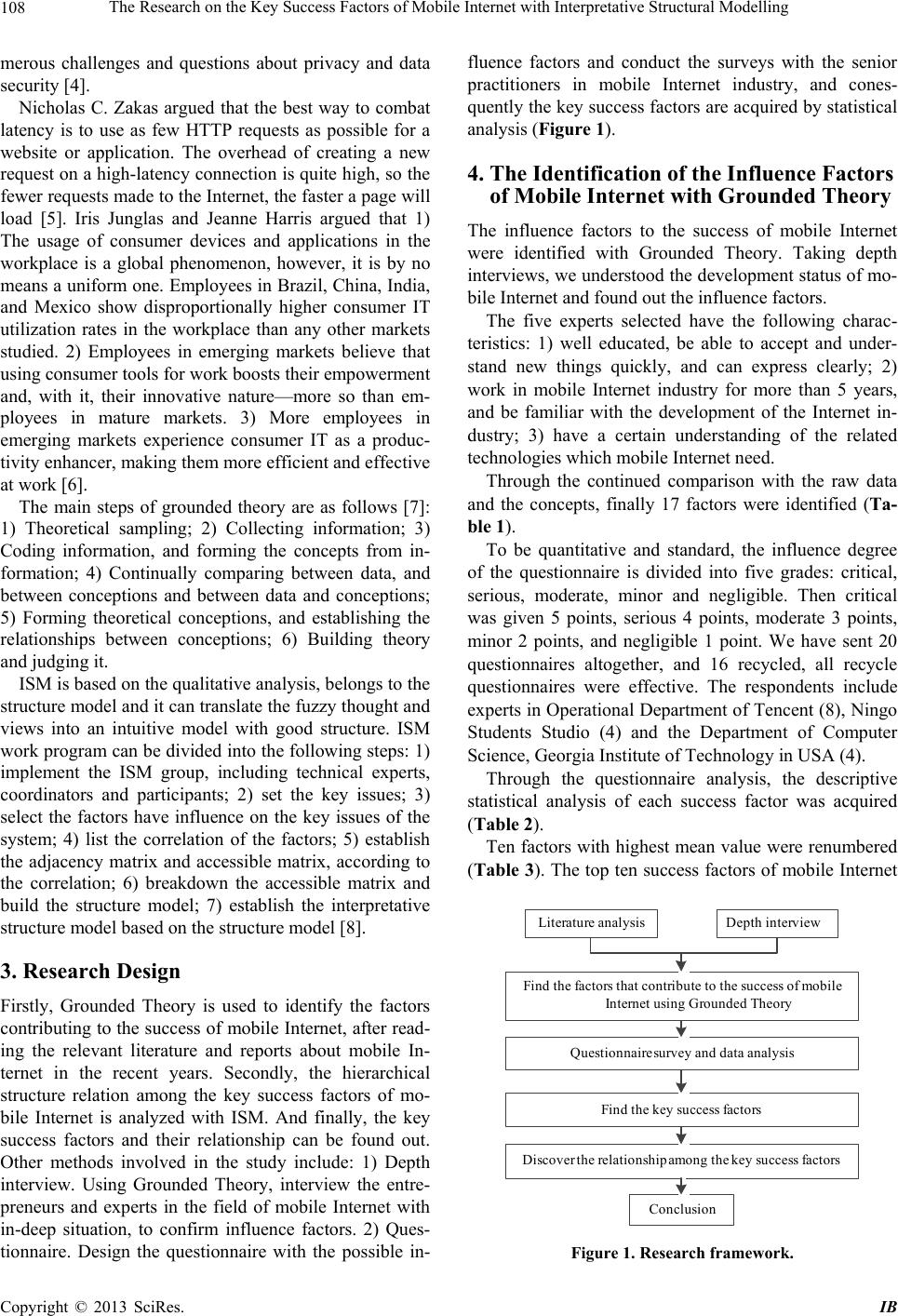 The Research on the Key Success Factors of Mobile Internet with Interpretative Structural Modelling 108 merous challenges and questions about privacy and data security [4]. Nicholas C. Zakas argued that the best way to combat latency is to use as few HTTP requests as possible for a website or application. The overhead of creating a new request on a high-latency connection is quite high , so the fewer requests made to the Internet, the faster a page will load [5]. Iris Junglas and Jeanne Harris argued that 1) The usage of consumer devices and applications in the workplace is a global phenomenon, however, it is by no means a uniform one. Employees in Brazil, China, India, and Mexico show disproportionally higher consumer IT utilization rates in the workplace than any other markets studied. 2) Employees in emerging markets believe that using consumer tools for work boosts their empowerment and, with it, their innovative nature—more so than em- ployees in mature markets. 3) More employees in emerging markets experience consumer IT as a produc- tivity enhancer, making them more efficient and effective at work [6]. The main steps of grounded theory are as follows [7]: 1) Theoretical sampling; 2) Collecting information; 3) Coding information, and forming the concepts from in- formation; 4) Continually comparing between data, and between conceptions and between data and conceptions; 5) Forming theoretical conceptions, and establishing the relationships between conceptions; 6) Building theory and judging it. ISM is based on the qualitative analysis, belongs to the structure model and it can translate the fuzzy thought and views into an intuitive model with good structure. ISM work program can be div ided into the following steps: 1) implement the ISM group, including technical experts, coordinators and participants; 2) set the key issues; 3) select the factors have influence on the key issues of the system; 4) list the correlation of the factors; 5) establish the adjacency matrix and accessible matrix, according to the correlation; 6) breakdown the accessible matrix and build the structure model; 7) establish the interpretative structure model based on the structure model [8]. 3. Research Design Firstly, Grounded Theory is used to identify the factors contributing to the success of mobile Internet, after read- ing the relevant literature and reports about mobile In- ternet in the recent years. Secondly, the hierarchical structure relation among the key success factors of mo- bile Internet is analyzed with ISM. And finally, the key success factors and their relationship can be found out. Other methods involved in the study include: 1) Depth interview. Using Grounded Theory, interview the entre- preneurs and experts in the field of mobile Internet with in-deep situation, to confirm influence factors. 2) Ques- tionnaire. Design the questionnaire with the possible in- fluence factors and conduct the surveys with the senior practitioners in mobile Internet industry, and cones- quently the key success factors are acquired by statistical analysis (Figure 1). 4. The Identification of the Influence Factors of Mobile Internet with Grounded Theory The influence factors to the success of mobile Internet were identified with Grounded Theory. Taking depth interviews, we understood the development status of mo- bile Internet and found out the influence factors. The five experts selected have the following charac- teristics: 1) well educated, be able to accept and under- stand new things quickly, and can express clearly; 2) work in mobile Internet industry for more than 5 years, and be familiar with the development of the Internet in- dustry; 3) have a certain understanding of the related technologies which mobile Internet need. Through the continued comparison with the raw data and the concepts, finally 17 factors were identified (Ta- ble 1). To be quantitative and standard, the influence degree of the questionnaire is divided into five grades: critical, serious, moderate, minor and negligible. Then critical was given 5 points, serious 4 points, moderate 3 points, minor 2 points, and negligible 1 point. We have sent 20 questionnaires altogether, and 16 recycled, all recycle questionnaires were effective. The respondents include experts in Op erational Department o f Tencent (8), Ningo Students Studio (4) and the Department of Computer Science, Georgia Institute of Technology in USA (4). Through the questionnaire analysis, the descriptive statistical analysis of each success factor was acquired (Table 2). Ten factors with highest mean value were renumbered (Table 3). The top ten success factors of mobile Internet L iterature a nalys i s L itera ture a nalys isDepth inter view Depth inter view F in d the fa c tors th at c ontri bute to the s uc ce ss of mobi le In terne t u si ng G roun ded Theory Fin d the fac t ors th at c ontribute t o the suc ce ss of mobile I nte rne t us ing Gr ounded T heory Que st i on na i resurvey a n d d a ta a n a l ysi s Questi onna ires urvey and da ta a na lysi s F ind the key succes s fac tor s Find the key success factors Disc over the re la tionshipamo ng the keysuc ce ss factor s Discover the re lationshipam ong the keysuccess fa ctor s Conclusion Conclusion Figure 1. Research framework. Copyright © 2013 SciRes. IB 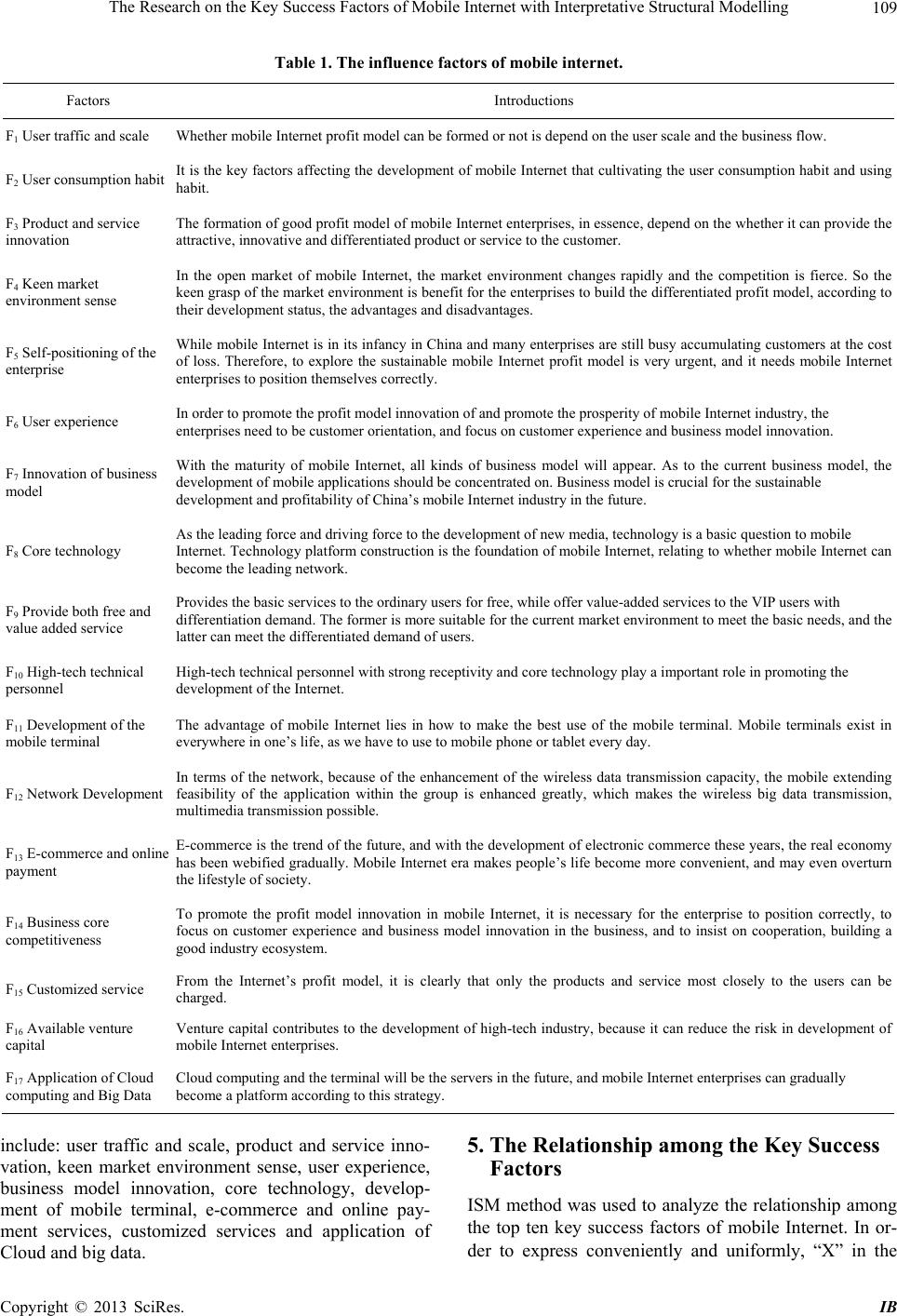 The Research on the Key Success Factors of Mobile Internet with Interpretative Structural Modelling Copyright © 2013 SciRes. IB 109 Table 1. The influence factors of mobile internet. Factors Introductions F1 User traffic and scale Whether mobile Internet profit model can be formed or not is depend on the user scale and the business flow. F2 User consumption habit It is the key factors affecting the development of mobile Internet that cultivating the user consumption ha b it and using habit. F3 Product and service innovation The formation of good profit model of mobile Internet enterprises, in essence, depend on the whether it can provide the attractive, innovative and differentiated product or service to the customer. F4 Keen market environment sense In the open market of mobile Internet, the market environment changes rapidly and the competition is fierce. So the keen grasp of the market environment is benefit for the enterprises to build the differentiated profit model, according to their development status, the ad v a n t ag e s a n d d i s a d va n t ages. F5 Self-positioning of the enterprise While mobile Internet is in its infancy in China and many enterprises are still busy accumulating customers at the cost of loss. Therefore, to explore the sustainable mobile Internet profit model is very urgent, and it needs mobile Internet enterprises to position t hemselves correctly. F6 User experience In order to promote the profit model innovation of and promote the prosperity of mobile Internet industry , the enterprises need to be customer orientation, and f ocus on customer experi ence a n d b u s i n e s s model innovati o n . F7 Innovation of business model With the maturity of mobile Internet, all kinds of business model will appear. As to the current business model, the development of mobile applications shou ld be c on cen trated on. Business model is crucial for the sustainable development and profit a b i l i t y of China’s mobile Internet industry in the future. F8 Core technology As the leading force and driving force to the development of new med ia, te ch nol ogy is a basic question to mobile Internet. Technology platform construction is the foundation of mobile Internet, relating to whether mobile Internet can become the leading network. F9 Provide both free and value added service Provides the basic services to the or din ary users for free, while offer value-added services to the VIP users with differentiation demand. The former is more suitable for the current market env iro nment to meet the basic needs, and the latter can meet the differentiated demand of users. F10 High-tech technical personnel High-tech technical personnel with strong recepti vity and core technology play a imp o rtant role in promoting the development of the Internet. F11 Development of the mobile terminal The advantage of mobile Internet lies in how to make the best use of the mobile terminal. Mobile terminals exist in everywhere in one’s life, as we have to use to mobile phone or tablet every day. F12 Network Development In termsof the network, because of the enhancement of the wireless data transmission capacity, the mobile extending feasibility of the application within the group is enhanced greatly, which makes the wireless big data transmission, multimedia transmission possible. F13 E-commerce and online payment E-commerce is the trend of the future, and with the development of electronic commerce these years, the real econo my has been webified gradually. Mobile Internet era makes people’s life become more convenient, and may even overturn the lifestyle of society. F14 Business core competitiveness To promote the profit model innovation in mobile Internet, it is necessary for the enterprise to position correctly, to focus on customer experience and business model innovation in the business, and to insist on cooperation, building a good industry e c o s ystem. F15 Customized service From the Internet’s profit model, it is clearly that only the products and service most closely to the users can be charged. F16 Available venture capital Venture capital contributes to the development of high-tech industry, because it can reduce the risk in development of mobile Internet enterprises. F17 Application of Cloud computing and Big Data Cloud computing and the term i nal will be the ser vers in the future, and mobile Internet enterprises can gradually become a platform according to this strategy. include: user traffic and scale, product and service inno- vation, keen market environment sense, user experience, business model innovation, core technology, develop- ment of mobile terminal, e-commerce and online pay- ment services, customized services and application of Cloud and big data. 5. The Relationship among the Key Success Factors ISM method was used to analyze the relationship among the top ten key success factors of mobile Internet. In or- der to express conveniently and uniformly, “X” in the 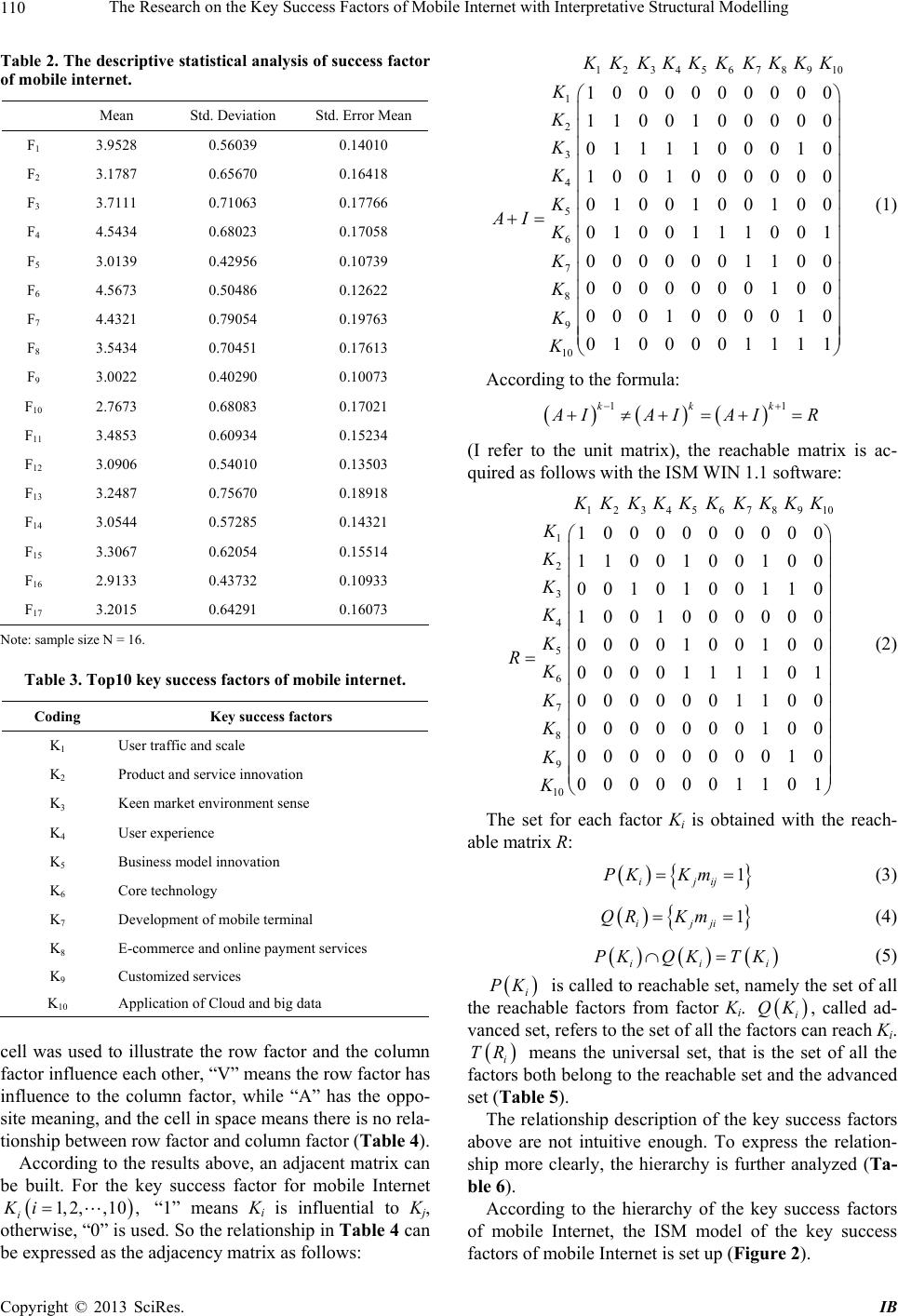 The Research on the Key Success Factors of Mobile Internet with Interpretative Structural Modelling 110 Table 2. The descriptive statistical analysis of success factor of mobile internet. Mean Std. Deviation Std. Error Mean F1 3.9528 0.56039 0.14010 F2 3.1787 0.65670 0.16418 F3 3.7111 0.71063 0.17766 F4 4.5434 0.68023 0.17058 F5 3.0139 0.42956 0.10739 F6 4.5673 0.50486 0.12622 F7 4.4321 0.79054 0.19763 F8 3.5434 0.70451 0.17613 F9 3.0022 0.40290 0.10073 F10 2.7673 0.68083 0.17021 F11 3.4853 0.60934 0.15234 F12 3.0906 0.54010 0.13503 F13 3.2487 0.75670 0.18918 F14 3.0544 0.57285 0.14321 F15 3.3067 0.62054 0.15514 F16 2.9133 0.43732 0.10933 F17 3.2015 0.64291 0.16073 Note: sample siz e N = 16. Table 3. Top10 key success factors of mobile internet. Coding Key success factors K1 User traffic and scale K2 Product and service innovation K3 Keen market environment sense K4 User experience K5 Business model innovation K6 Core technology K7 Development of mobile terminal K8 E-commerce and online payment services K9 Customized services K10 Application of Cloud and big data cell was used to illustrate the row factor and the column factor influence each other, “V” means the row factor has influence to the column factor, while “A” has the oppo- site meaning, and the cell in space means there is no rela- tionship between row factor and column factor (Table 4). According to the re sults above, an adjacent matrix can be built. For the key success factor for mobile Internet 1, 2,,10, iiK “1” means Ki is influential to Kj, otherwise, “0” is used. So the relationship in Table 4 can be expressed as the adjacency matrix as follows: 1245 6 78910 1 2 3 4 5 6 3 7 8 9 10 1000000000 1100100000 0111100010 1001000000 0100100100 0100111001 0000001100 0000000100 0001000010 0100001111 K KKKKKKKKK K K K K K AI K K K K K (1) According to the formula: 11kkk A IAIAI R (I refer to the unit matrix), the reachable matrix is ac- quired as follows with the ISM WIN 1.1 software: 1245 6 78910 1 2 3 4 5 6 7 8 9 10 3 1000000000 1100100100 0010100110 1001000000 0000100100 0000111101 0000001100 0000000100 0000000010 0000001101 K KKKKKKKKK K K K K K RK K K K K (2) The set for each factor Ki is obtained with the reach- able matrix R: 1 ijij PK Km (3) 1 ijji QR Km (4) ii PKQK TK i (5) i PK is called to reachable set, namely the set o f all the reachable factors from factor Ki. i QK , called ad- vanced set, refers to the set of all the factors can reach Ki. i TR means the universal set, that is the set of all the factors both belong to the reachable set and the advanced set (Table 5). The relationship description of the key success factors above are not intuitive enough. To express the relation- ship more clearly, the hierarchy is further analyzed (Ta- ble 6). According to the hierarchy of the key success factors of mobile Internet, the ISM model of the key success factors of mobile Internet is set up (Figure 2). Copyright © 2013 SciRes. IB 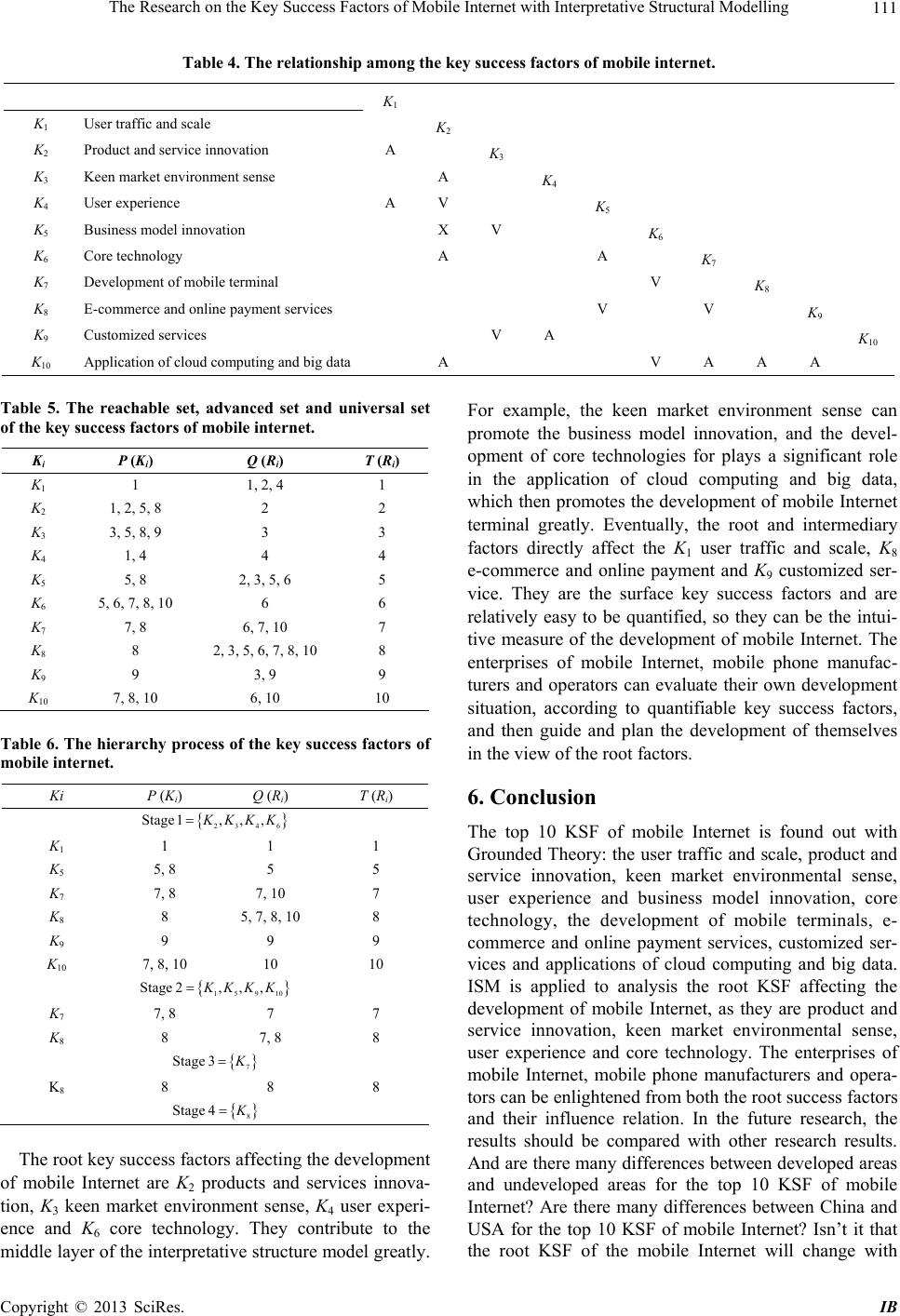 The Research on the Key Success Factors of Mobile Internet with Interpretative Structural Modelling Copyright © 2013 SciRes. IB 111 Table 4. The relationship among the key success factors of mobile internet. K1 K1 User traffic and scale K2 K2 Product and service innovation A K3 K3 Keen market environment sense A K4 K4 User experience A V K5 K5 Business model innovation X V K6 K6 Core technology A A K7 K7 Development of mobile terminal V K8 K8 E-commerce and online payment services V V K9 K9 Customized services V A K10 K10 Application of cloud computing and big data A V A A A Table 5. The reachable set, advanced set and universal set of the key success factors of mobile internet. Ki P (Ki) Q (Ri) T (Ri) K1 1 1, 2, 4 1 K2 1, 2, 5, 8 2 2 K3 3, 5, 8, 9 3 3 K4 1, 4 4 4 K5 5, 8 2, 3, 5, 6 5 K6 5, 6, 7, 8, 10 6 6 K7 7, 8 6, 7, 10 7 K8 8 2, 3, 5, 6, 7, 8, 10 8 K9 9 3, 9 9 K10 7, 8, 10 6, 10 10 Table 6. The hierarchy process of the key success factors of mobile internet. Ki P (Ki) Q (Ri) T (Ri) 2346 Stage1, ,, K KKK K1 1 1 1 K5 5, 8 5 5 K7 7, 8 7, 10 7 K8 8 5, 7, 8, 10 8 K9 9 9 9 K10 7, 8, 10 10 10 15910 Stage2,,, K KKK K7 7, 8 7 7 K8 8 7, 8 8 7 Stage3 K K8 8 8 8 8 Stage4 K The root key success factors affecting the development of mobile Internet are K2 products and services innova- tion, K3 keen market environment sense, K4 user experi- ence and K6 core technology. They contribute to the middle layer of the interpretative structure model gr eatly. For example, the keen market environment sense can promote the business model innovation, and the devel- opment of core technologies for plays a significant role in the application of cloud computing and big data, which then promotes the development of mobile Internet terminal greatly. Eventually, the root and intermediary factors directly affect the K1 user traffic and scale, K 8 e-commerce and online payment and K9 customized ser- vice. They are the surface key success factors and are relatively easy to be quantified, so they can be the intui- tive measure of the development of mobile Internet. The enterprises of mobile Internet, mobile phone manufac- turers and operators can evaluate their own development situation, according to quantifiable key success factors, and then guide and plan the development of themselves in the view of the root factors. 6. Conclusion The top 10 KSF of mobile Internet is found out with Grounded Theory: the user traffic and scale, product and service innovation, keen market environmental sense, user experience and business model innovation, core technology, the development of mobile terminals, e- commerce and online payment services, customized ser- vices and applications of cloud computing and big data. ISM is applied to analysis the root KSF affecting the development of mobile Internet, as they are product and service innovation, keen market environmental sense, user experience and core technology. The enterprises of mobile Internet, mobile phone manufacturers and opera- tors can be enlightened from both the root success factors and their influence relation. In the future research, the results should be compared with other research results. And are there many differences between developed areas and undeveloped areas for the top 10 KSF of mobile Internet? Are there many differences between China and USA for the top 10 KSF of mobile Internet? Isn’t it that he root KSF of the mobile Internet will change with t 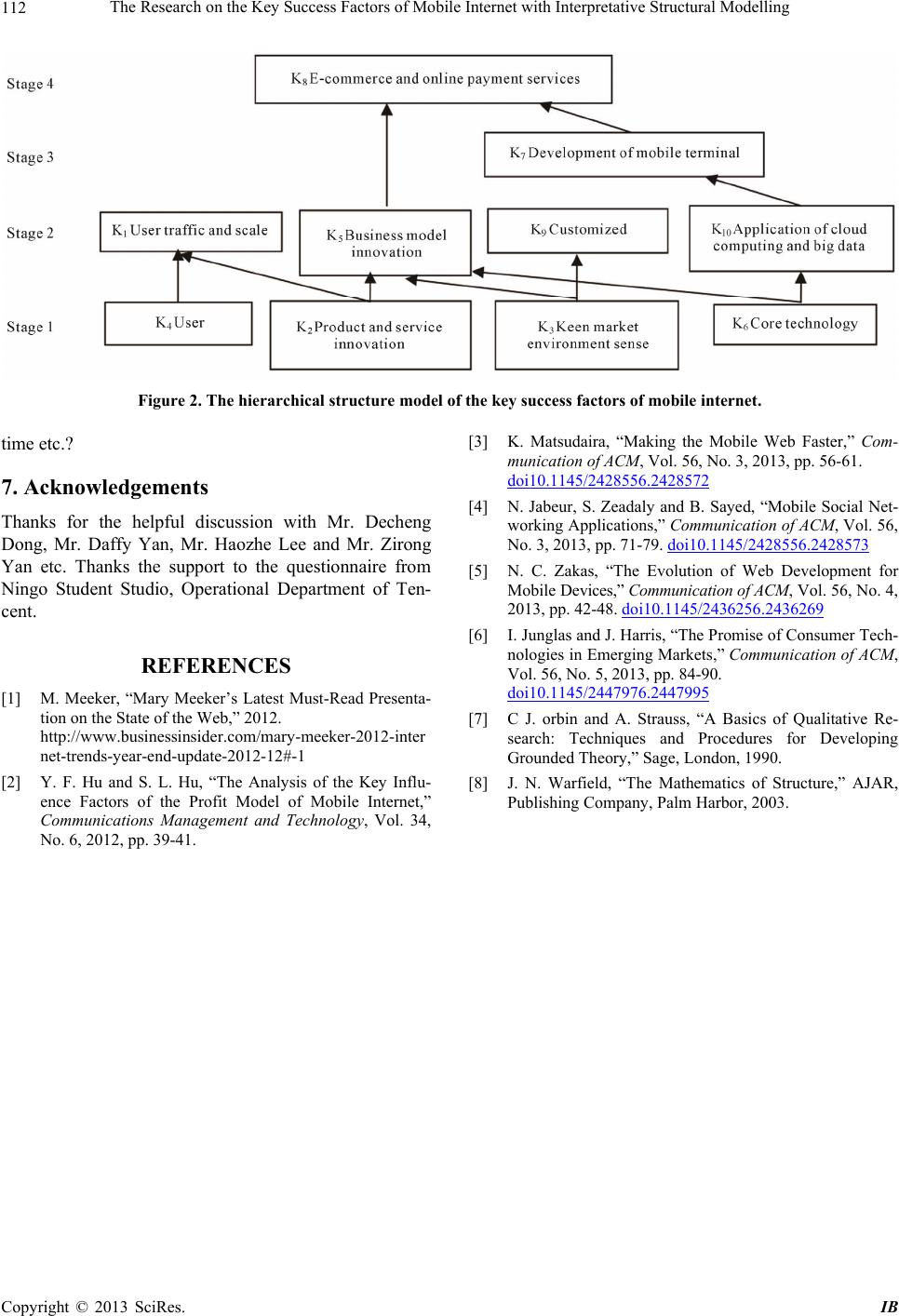 The Research on the Key Success Factors of Mobile Internet with Interpretative Structural Modelling 112 Figure 2. The hierarchical structure model of the key success factors of mobile internet. time etc.? 7. Acknowledgements Thanks for the helpful discussion with Mr. Decheng Dong, Mr. Daffy Yan, Mr. Haozhe Lee and Mr. Zirong Yan etc. Thanks the support to the questionnaire from Ningo Student Studio, Operational Department of Ten- cent. REFERENCES [1] M. Meeker, “Mary Meeker’s Latest Must-Read Presenta- tion on the State of the Web,” 2012. http://www.businessinsider.com/mary-meeker-2012-inter net-trends-year-end-update-2012-12#-1 [2] Y. F. Hu and S. L. Hu, “The Analysis of the Key Influ- ence Factors of the Profit Model of Mobile Internet,” Communications Management and Technology, Vol. 34, No. 6, 2012, pp. 39-41. [3] K. Matsudaira, “Making the Mobile Web Faster,” Com- munication of ACM, Vol. 56, No. 3, 2013, pp. 56-61. doi10.1145/2428556.2428572 [4] N. Jabeur, S. Zeadaly and B. Sayed, “Mobile Social Net- working Applications,” Communication of ACM, Vol. 56, No. 3, 2013, pp. 71-79. doi10.1145/2428556.2428573 [5] N. C. Zakas, “The Evolution of Web Development for Mobile Devices,” Communication of ACM, Vol. 56, No. 4, 2013, pp. 42-48. doi10.1145/2436256.2436269 [6] I. Junglas and J. Harris, “The Promise of Consumer Tech- nologies in Emerging Markets,” Communication of ACM, Vol. 56, No. 5, 2013, pp. 84-90. doi10.1145/2447976.2447995 [7] C J. orbin and A. Strauss, “A Basics of Qualitative Re- search: Techniques and Procedures for Developing Grounded Theory,” Sage, London, 1990. [8] J. N. Warfield, “The Mathematics of Structure,” AJAR, Publishing Company, Palm Harbor, 2003. Copyright © 2013 SciRes. IB |