

Paper Menu >>
Journal Menu >>
 Creative Education 2013. Vol.4, No.9, 533-539 Published Online September 2013 in SciRes (http://www.scirp.org/journal/ce) http://dx.doi.org/10.4236/ce.2013.49078 Copyright © 2013 SciRe s . 533 Global Collaboration in Teacher Education: A Case Study Greg Neal1, Terry Mullins2, A ni t a Rey nolds2, Mark Angle2 1Victoria University, Melbourne, A u stralia 2Concord University, Athens, USA Email: [email protected] Received July 17th, 2013; revised August 17th, 2013; accepted August 24th, 2013 Copyright © 2013 Greg Neal et al. This is an open access article distributed under the Creative Commons Attri- bution License, which permits unrestricted use, distribution, and reproduction in any medium, provided the original work is properly cited. Effective online collaboration is a valuable instructional approach appropriate for 21st century teaching and learning. This paper describes a case that involves two higher education student cohorts from the United States and Australia engaged in a global collaboration to promote an authentic teaching and learn- ing experience. The collaboration aims to involve students in sharing, reflecting and synthesizing new knowledge to make a comparative analysis between education systems from the two countries. The global collaboration is matched against an Assessment and Teaching of 21st Century Skills framework to com- prehend and justify this approach as part of a teacher education course. This case advocates the value of having future teachers using online resources in a global context as a way to effectively integrate new content with various technology resources to develop new learning and new relationships beyond their own culture. Keywords: Teacher Education; Global Collaboration; 21st Century Teaching and Learning Introduction “Teacher preparation programs should prepare teachers with the values, skills, and knowledge to not just keep abreast with the times but also be ahead of their time.” (Asia Society, 2013) The biggest influence on student learners is the effective teacher with effective teaching strategies (Rice, 2003; Hattie, 2009). The “knowledge transmission” model of education that predominantly existed in the 20th century is no longer adequate. With appropriate pedagogical approaches including the strate- gic use of 21st century learning tools, there is now a recognised need for new teachers to be properly prepared for today’s learn- ers. This paper reports on an initiative happening between two universities from the United States and Australia who have developed a global collaborative partnership for their pre-ser- vice teachers. It involves the pre-service teachers from the re- spective universities globally connecting and exchanging in- formation and therefore gaining new knowledge about each other’s education systems. The collaboration aims to have stu- dents from teacher education courses examine the similarities and differences from each nation’s education systems including school cultures, teaching methods, inclusion and diversity prac- tices, assessment strategies and current educational issues. The global exchange requires the integrated use of different online applications that are recognised as relevant resources to their own future teaching practices. Now in its second year of operation, the global collaboration has already expanded into additional semesters for both univer- sities and the initial findings reported in this paper highlight the early positiveness of this initiative. It has already demonstrated improvement in digital literacies for the pre-service teachers who have also recognised the approach as a teaching method- ology appropriate for today’s learners. Collaborating with stu- dents from around the world in meaningful, real-life projects is a necessary approach for developing 21st century literacies (ATC21S Consortium, 2013; Partnership for 21st Century Skills, 2013). This project has challenged higher education students beyond the conventional university-based practices. Preparing Pre-Service Teachers for New Learning An unconscious challenge for pre-service teachers is the im- pact of bringing personal practical knowledge and prior ex- perience from their own schooling and therefore the learning situation. These prior opportunities are highly likely to influ- ence their learning in teacher education programs and according to Edwards (2000) personal knowledge and prior experience can be very resistant to change. “One of the important goals for teacher education is to help pre-service teachers view teaching as more than simply applying routine practices. In certain cases, this means that pre-service teachers need to reconstruct their established perceptions of teaching and learning in order to learn and adopt new ideas.” (Hyeonjin et al., 2012). Now in the 21st century a major goal of schooling, including university schooling, “is to prepare students for flexible adapta- tion to new problems and settings. Students’ abilities to transfer what they have learned to new situations provides an important index of adaptive, flexible learning” (National Research Coun- cil, 2000: p. 235). According to Niess et al. (2007) this may require pre-service teachers to “unlearn how and what you have learned and relearn your subject with the technologies as tools in order to support you as you learn with and about the tech-  G. NEAL ET AL. Copyright © 2013 SciRes. 534 nologies as learning tools.” (p. 75) Teaching practices that include problem-based learning and cooperative learning promoting shared knowledge-building encourage students to be active participants in the learning pro- cess and are important aspects of effective teaching and learn- ing. The shared knowledge building is an integral part of 21st century learning and brings together ways of thinking, ways of working, tools for working and a global connection (ATC21S consortium, 2013). Teacher educators from Concord University, West Virginia and Victoria University, Melbourne, Australia have established an international online collaboration project where pre-service teachers are expected to share and exchange information by engaging in weekly professional dialogue. As part of the 5 week collaboration, pre-service teachers are expected to inves- tigate educational similarities and differences of real world teaching foci including school systems, teaching methods, in- clusion and diversity practices, assessment strategies and cur- rent educational issues. The inclusion of various information and communication technologies (ICT) resources is an integral part of the exercise and a mix of synchronous and asynchronous tools are supported and encouraged in order for students from their respective institutions to report and present their compara- tive understanding as part of their assessment requirements. The global collaboration was organised in university teams of pre-service teachers (3 - 4 per group) and the teacher educa- tors coordinated the matching of teams from each university. The pre-service teachers were then assigned a weekly topic to explore with their global partners and used predetermined ICT online applications. Students were required to discuss the given topic and share and reflect on similarities and differences be- tween the school systems in the United States and Australia. They were to gather their shared knowledge via online sources while accounting for time differences when using synchronous communication. Their gathered information and shared knowl- edge was required as evidence that they engaged with the dif- ferent online collaboration tools over the 5 week journey. The pre-service teachers were also required to present a final prod- uct for their course assessment requirements and to highlight what they synthesised from the collaborative exercise. Online Collaboration With the increase in the integration of ICT into teaching and learning, two main forms of peer-learning are often used inter- changeably: cooperative and collaborative learning (Thompson, 2004). Teasley and Roscelle (1993) argue that cooperative work “is accompanied by the division of labor among partici- pants, as an activity where each person is responsible for a por- tion of the problem solving” whereas collaboration requires the “mutual engagement of participants in a coordinated effort to solve the problem together” (p. 235). Underwood and Under- wood (1999) further argue that the focus on whether coopera- tion or collaboration takes place depends on issues such as re- sponsibility for the tasks, the decision-making process, and the characteristics of the social group. Where collaborative knowledge-building happens, students become the constructors of collective knowledge (Scardamalia & Bereiter, 1999). However, the effects of learning on achieve- ment for the individual will be mediated by the cohesiveness of the group members. Even as far back as the eighties, Cohen (1986) stated, “if the task is challenging and interesting, and if students are sufficiently prepared of skills in group processing, students will experience the process of group work as highly rewarding” (pp. 69-70). Individual students participating within collaborative learning situations contribute to collective re- sponsibility and motivation for learning. Effective collaboration requires “roughly equal participation, genuine interaction among the participants, and the synthesis of work into a unified whole” (Ingram & Hathorn, 2004: p. 215). Such shared learning ap- proaches will encourage decentralisation of decision-making from the lecturer to pre-service teachers and empower them to play a key role in self-directed learning, and: “... the ability to work productively in teams, in both so- cial and work settings, especially in situations where the various team members may have diverse backgrounds, experiences, and opinions. Indeed, it is in just such an en- vironment that collaborative work can bring the greatest benefits.” (Roberts, 2005a: p. vi) Theoretical Framework and 21st Century Learning It is widely recognised that teaching and learning in the 21st century requires the effective use of technology resources. The focus on 21st century is to move beyond the instructional teacher delivering subject matter (years ago referred to as the 3Rs-reading, writing and arithmetic) that students attempt to retain and then show their understanding through examinations. Ministerial Council on Education, Employment, Training & Youth Affairs (2008) stated that using technology effectively enables students to become capable ICT users, problem solvers, creative, communicators, collaborators and informed citizens. This was later modified by Trilling and Fadel (2009) who put forward the notion that learning involves the 3Rs (content) multiplied by today’s necessary life skills, the 7Cs (critical think- ing, creativity, collaboration, cross-culturalism, communication, computing and career). The Assessment and Teaching of 21st Century Skills (ATC21S) (2013) consortium (which includes Australia and the United States) provides a further framework that outlines 21st century skills, knowledge, and attitudes into four categories: Ways of thinking: creativity/innovation, critical thinking, problem-solving, decision-making, and learning to learn; Ways of working: communication and collaboration/team- work; Tools for working: including information and communica- tions technologies; Living in the world: citizenship, life and career and per- sonal, and social responsibilities, including cultural aware- ness and competence. The attributes from the different research supports commonly shared language that portray the need for 21st century teachers to go beyond the delivery of content to move students into new ways of thinking, working and communicating in a global con- text. It is now an imperative that teacher education ensures new teachers develop and utilize these common attributes as part of their practice for the benefit of teaching and learning today’s students. This paper highlights a case that uses the ATC21S framework to report on a shared learning experience where pre- service teac hers are e ngage d in new learning appropriate for the 21st century. A Case Study The use of a case study approach was used to examine the  G. NEAL ET AL. Copyright © 2013 SciRe s . 535 global collaboration from the cross-institutional exercise. Mer- riam (1998) suggests special features of qualitative case studies are particularistic, descriptive and heuristic. This case study is particularistic because there is a focus on a particular teaching and learning situation. The process reveals what is occurring with students in a global collaboration experience as part of their university studies. It is descriptive because recounts from staff and students’ perceptions are gathered from teaching and learning practices. Importantly, it’s heuristic because the tea- cher educators discover and confirm new understandings in re- gard to student use of ICT resources in the global share-ex- change collaboration. Data was captured from the experiences of the preservice teachers as they described, explained and reflected on the in- formation exchange between the two universities. The qualita- tive data assisted the researchers to understand the collaborative approach from the voice of the participants. Data captured throughout the initial stages of the work included narratives and work samples as evidence of dialogue. One university also used a pre-post survey with the same cohort of students as a way to measure changes in particular attitudes and skills with technol- ogy applications. The limitations in this research have been identified as hav- ing only focused on two relatively small cohorts of preservice teachers, approximately 40 from each of the two universities. Both universities are located in low socio-economic regions; a broader socio-economic background may reveal different re- sults. An Initial Perspective For this paper, the ATC21S framework is the selected way to examine how the global collaboration assists pre-service teach- ers in their development to become 21st century teachers and learners. The framework provides identified categories that define important characteristics of skills appropriate for today’s learners and are important indicators of pre-service teachers readiness to teach. It is relevant for this investigation because according to ATC21S (2013), “Collaborative problem-solving sp a n s all four categories.” Ways of Thinking A key organising principle of the Teacher Education program at Victoria University is called Praxis Inquiry. The notion of “praxis” means the integration of practice and theory in cycles of investigation so that a particular situation is understood and improved. Praxis Inquiry involves “reflection on action” for social and educational change to benefit all participants (Che- rednichenko and Kruger, 2002). The process involves cycles of describing, e xplaining, theorising and ch a n ging practice. The emphasis for this global collaboration project was also on supporting students to think in a process of inquiry learning with ICT applications. Each week a teaching and learning topic was provided to the students as well as a designated ICT appli- cation as the required resource to be used to exchange informa- tion online. Each pair of pre-service teachers were required to gather information from an online exchange of inquiry, come to a deeper understanding of each issue and how it is relevant to their own teaching in Australia. The weekly topics included: The sch ool systems School culture Teaching methods Assessment practices Issues in Education The collaboration began within the context of an overseas exchange of information relevant to education. Using the Praxis Inquiry process thus entails all paired members to take respon- sibility for initiating and guiding their own learning. As each issue is encountered and investigated, the process needs to be documented as the basis of discussion and reflection. In Victoria University’s situation, the documented exchange of information was presented to the lecturer as a weekly report of what was learned from the exchange. In the initial weeks preservice teachers tended to describe and present the informa- tion from their local context and simply relayed it to their over- seas partners. For example, one group emailed their week 1 response (small part of response shown below) and included relevant web links to enable ease of further exploration of the topic: Schooling in Australia starts with a kindergarten or pre- paratory year followed by 12 years of primary and secon- dary school. In the final year of secondary school, Year 12, you can study for a government-endorsed certificate that is recognized by all Australian universities and vocational education and training institutions. Australia has a na- tional curriculum framework to ensure high academic standards across the country. All schools provide subjects in the eight key learning areas… Following this initial exchange of information the response from their US partners was to also describe their school sys- tems. At times, some preservice teachers started to draw some conclusions from the shared information (and used emoticons as part of the developing relationship): Concord pst1—The school system is Australia is very much like the one here in the US. The only difference is some elementary schools only go K-4 and the middle school goes 5 - 8. The education here is also mandatory and free. Some students use to have to pay for breakfast and lunch but in some counties, this year, they started free breakfast and lunch for all students. It seems to me that education and teachers are quite well respecte d in Austra- lia. The collaboration between high schools and universi- ties are alike here in the US as well. Some courses are of- fered for college credit while you are in high school. The higher education in Australia seems to be just like the higher education in the US!) Toward the end of the 5 week program there was a notice- able shift to presenting the exchanged information beyond the descriptive stage and more aligned to asking and responding to ontological and epistemology questions allowing the opportu- nity to engage in conversations. One example below was taken from a shared Voice thread (conversations in the cloud) ex- change: PST 1: Is standardized testing a fair way to judge compe- tence? What are the benefits of NAPLAN2? How much homework should a student have? Is creativity as impor- 1PST—acronym for preservice teacher. 2NAPLAN—The National Assessment Program for Literacy and Numeracy is the measure through which education authorities can determine whether Australians schools are meeting important set standards.  G. NEAL ET AL. Copyright © 2013 SciRes. 536 tant as literacy? Should teachers be subject to perform- ance related pay? Should Principles be given more power? Should government schools receive more funding than non-government or private schools? What are the issues surrounding indigenous people and education? PST2: [Name] you have made some good points. Per- formance pay is a very significant issue and one that I am not in favour of. I believe teachers should all be working together and openly sharing resources, information and anything else that is relevant. This will help to create and design better lessons for all students which will further develop students’ knowledge and education. PST1: A big challenge as a future teacher is to encourage students to take risks and be creative. This is increasingly challenging because of curriculum restrictions, what is in the curriculum and needs to be taught, and also the con- sideration of standardised testing such as NAPLAN. Other groups used Web Links to provide extra possibilities to extend the learning, for example, one group’s response in- cluded: Teachers in Australia are put under pressure and there are very high expectations of them to produce the results. There is talk of putting in place a pay-by-results system that would work with the teachers whose students perform well in national tests being paid a higher wage. http:// www.dailytelegraph.com.au/news/wage-bonus-for-top-tea- chers-planned-under-nsw-education-shake-up-by-minister- adrian-piccoli/story-e6freuy9-1226295941933 Other groups also reacted and responded to the information provided by their overseas partners. One example is shown below where the preservice teachers from the two universities are engaged in a th e ory-practice dialogue: VU pst—The most commonly used instructional approach in an Australian primary classroom is the together-apart- together3 approach. This is used for literacy and numeracy, as well as integrated studies. The class will begin each lesson together to discuss the topic of the lesson. Concord pst—Elementary school uses much the same format although they do not call it together-apart-together, it does not have an official name. The teacher will give a mini-lesson to the class, and then split them into groups or send them off by themselves to complete work. At the end they will come together and share, and she/he will give out the homework for that lesson (each lesson of the day has different homework). Some schools are trialing a new concept called “project based learning”, where discovery is the key for students. This involves students working in small groups or on their own to do “projects” on topics they have chosen for an assigned list. They may use class as well as home time to complete their projects, and when one is finished they begin another. VU pst—It sounds like it’s similar to the Cathy Walker Approach some schools use here, where the students choose something to learn about in an “investigation”. Then to promote higher order thinking skills, teachers in Australian primary schools are able to use a variety of strategies in their teaching. There are no set rules on the way in which the curriculum must be delivered, so long as the outcomes are being met in each year level. As a group, we have witnessed various methods in our teaching prac- ticums. Bloom’s Taxonomy is a common theory, where the remembering, understanding and applying of content is supplemented by analysing, evaluating and creating. By extending lessons in this way, students are able to expand their thinking on a topic. Concord pst—For most US schools, Blooms Taxonomy is required to be used in the elementary classroom. All of our Concord contacts have laminated Bloom’s posters on their classroo m walls, and it is referred to constantly while classes are running. Ways of Worki ng In this collaborative project the use of online communication occurred through synchronous and asynchronous communica- tion forms. The synchcronous communication included email and Skype and is a “potentially powerful medium for support- ing collaboration and social negotiation” (Jonassen, 2000: p. 244). The synchronous communication used included Voice- thread, Google Docs and a wiki allows time for the respondents to reflect before replying. The term progressive discourse is used to describe both forms of online conversations as a process in which members of learning teams can negotiate and synthe- sise viewpoints. Progressive discourse is associated with a form of inquiry learning (Sherry, 2000) and is a an important inten- tion of this project as expressed by one of the VU pre-service teachers: I thought it was odd at times that people were trying to write facts when I felt the answers should have instigated more discussion/debate, not always a right or wrong an- swer. As part of this project each group requires specific content and technology responsibilities to effectively communicate and work with other members of their immediate group and with groups from afar—a dual challenge that was generally well handled by the various groups. However, it was noticeable that the local groups needed to be reasonably well established in order to work effectively as a local team before they were able to engage effectively with another group from overseas. One preservice teacher from Australia made comment from her observations: The challenge was twofold. One was the difficulty in communicating via groups on both sides. It actually would have been easier just to communicate one to one. That would potentially also increase the chances of en- gaging in a long term post course relationship with your Concord collaborator. From our end each group found it difficult to liaise with its members. From their end they did not really seem to know each other. The other chal- lenge was using a potentially new and different commu- nication form every week. However I do understand this was one of the aims of the exercise. I guess it depends whether the outcome is to use new and different forms of communication or develop a solid relationship with the 3In Australia, together-apart-together is more commonly referred to as whole-small-whole which refers to lessons that have whole classroom teaching focus, then group work, followed by whole classroom conclusion.  G. NEAL ET AL. Copyright © 2013 SciRe s . 537 potential learning that comes from it. It remains integral not to take social interaction in groups for granted nor forget the lack of attention to the social dimension of teamwork outside of the task context. There is research that shows that some computer based environments do not com- pletely fulfill expectations on supporting interactive group learning, shared understanding, social construction of knowl- edge, and acquisition of competencies (Kreijns et al., 2002). While it is recognized that group learning situations encourage students to collaborate, enforced online learning contexts are not necessarily conducive for all students. Online group activi- ties can be quite different from traditional interactions that re- quire new skills and behaviours for the participants (Brindley et al., 2009). Shared online learning situations for example, can create friction or frustration between students who are relying on others to fulfill their work obligations. The interactiveness and the working relationships of the different groups varied be- tween the preservice teachers: I was disappointed to hear some groups just divided up the questions and addressed them individually. I enjoyed our work as a team. (VU pst) Generally the preservice teachers in this global project were willing to participate in the online environment and a typical response below highlights the positiveness of social connect- edness of a well-formed group working on this global collabo- ration: I found university class group work was split up by the most bossy person and people would really work indi- vidually. But in this project we actually did group work. There was no bossy person that decided what our roles would be so our process unfolded much more fluidly and smoothly. We shared the load. I learnt from everyone’s responses and I was glad to see such a positive/fluid means of group work... I liked this model of working. The selected ICT tools used in the project remain important to the success of the global exercise. For example, the use of Skype as a synchronous experience created real time commu- nication challenges and made communication hard for some of the activities (VU pst). This is further elaborated by another preservice teacher: I found that the communication via email or wiki was the easiest due to each group responding in their own time in- stead of finding a mutually suitable time to chat via Skype for example when the time difference was a difficult chal- lenge to overcome. This lead to us often rescheduling Skype chats and eventually rushing through the chat in order to either get to bed late at night or get ready for uni- versity in the morning. Establishing communication protocols and making joint ar- rangements for real time communication remained a challenge for the different groups. The preplanning organization to enable the synchronous communication was highlighted by one team member from Concord expressing her concern to her lec- turer: About this Skype call—I have given the Australia team my Skype contact information and have not heard any- thing back from them about the call. We were trying to do it this morning but still heard nothing back. I will try again at 7 am but they have not added my account or any- thing like that and I do not have their username to add their account. We sent them all the answers to our ques- tions and they sent them back but other than that I don’t know what to do about it. They said that it is hard for them to meet up and Skype because of their labs and placements. (Concord pst) Tools for Worki ng The role of teachers/lecturers incorporating ICT effectively is an important part of 21st century learning. Teachers/lecturers are expected to be more than just information givers. With the introduction of ICT into their bank of resources, pre-service teachers need to learn how to scaffold learning: teachers at all levels will have to change what they teach, “they will have to shift from teaching content (a body of knowledge) to facilitat- ing process (supporting learning)” for individual clients (Spen- der, 1998: p. 11). Effective practice requires teachers to suc- cessfully guide and direct students through an immense amount of data, teach the students skills for locating useful information, and to then use higher order thinking strategies to deal with the information. Pre-service teachers need a sound understanding of the role ICT can play in mediating more effective learning through the development of higher-order thinking skills and to “rethink the learning experiences that they offer students and further, to explore how the technology might be used to support those learning experiences” (Owen, Calnin, & Lambert, 2002: pp. 158-159). The ease of it means that a potential flow on to school stu- dents is a natural extension given many schools are in- volved in blogging etc. (VU graduate now teaching) Different applications were integrated into the global col- laboration to allow students who lack specific computer Inter- net skills to acquire them while working with the content as- pects of such exercises. Developing a familiarity with the col- laborative computer applications hopefully transcend the prac- tice into their teaching and learning situations as part of being 21st century teachers. I learned how to use a few things I was not familiar with beforehand. (VU pst) Subjects like New Learning [which included the global collaboration project] gave good practice and knowledge about new ICT resources that I could use as a teacher as well as providing valuable experiences to learning exactly how to use unfamiliar ICT resources or Web 2.0 programs. (VU pst) The VU pre-service teachers completed surveys during the year to ascertain changes in their technology skills before and after their involvement in this collaboration. For two questions specifically about collaboration and communication, a statisti- cal analysis was undertaken to determine any shift in the results over the time of the project. The two questions are shown in Table 1 with the results from each of the surveys before and after the collaboration.  G. NEAL ET AL. Copyright © 2013 SciRes. 538 Table 1. Global collaboration pre and post survey questions. Not confidentModerately confident Very confident mean4 Collaborate for professional purposes, such as online professional communities Survey 1 before collaboration exe r cise 10 21 2 1.76 Survey 2 after collaboration exercise 0 16 17 2.52 Select and use a variety of digital formats to communicate information Survey 1 before collaboration exercise 7 25 1 1.82 Survey 2 after collaboration exercise 0 15 18 2.55 Significant differences5 were substantiated for both questions. At the start of the year 30 percent of the respondents indicated they were “not confident” collaborating for professional pur- poses, however by the end of the year all students indicated that they felt some degree of confidence in this area, with 51.5 per- cent indicating that they were “very confident”. At the start of the year 21 percent of the respondents indi- cated they were “not confident” selecting and using a variety of digital formats, however by the end of the year all students indicated that they felt some degree of confidence in this area, with 54.5 percent indicating that they were “very confident”. The mean score for both questions also showed a general im- provement in confidence over the time of the collaboration. Whilst the value of the collaboration has been shown to sta- tistically improve pre-service teachers confidence, the integra- tion of the new technology applications with given topics does remain an extra burden for the novice technology user. The combination of new ICT applications with a new topic can be quite overwhelming as described by one such pre-service tea- cher: I just wanted more time to get my head around the tech- nology as I am slow with some new forms of media... This would have given me more confidence and interest in the collaboration. But having to learn the new technol- ogy as well as do the topic areas sometimes felt too over- whelming. (VU pst) Living in the World A global collaboration provides a new context for pre-service teachers to engage with others over an extended period of time. It aims to provide another perspective from which to formulate and confirm thinking around particular global issues. In this case it enables the opportunity to contrast and compare differ- ent school systems, ways of teaching etc. through an authentic learning experience. The online collaboration attempts to make individual pre-service teachers think beyond their immediate environment and their localized knowledge about curriculum, assessment requirements and teaching and learning practices as part of a team of developing new teachers. The questions provoked a lot of thought around my values and why I wanted to be a teacher. This was useful in that point in time in the course. I was glad of the way our group approached the communication. One of us would have a go at all the questions. That would stir up the rest of us to respond to their position on each question. (VU pst) The collaboration was an extension into the social and/or working lives of the participants to further promote and en- courage ongoing global communication. This would be such a valuable outcome and enhance the participants 21st century skills as evidenced by one of the pre-service teachers now em- ployed in a full-time teaching position: I developed a good solid relationship with one Concord student. I can definitely imagine that I would communi- cate and potentially developed a collaborative project as we become embedded in our schools as teachers (newly employed VU graduate). To extend the global collaboration into their own classroom practice highlights the value such a project can do to promote 21st century teaching and learning: As a future teacher I would you try something similar, per- haps in a classroom, a new age pen pal. (VU pst) Discussion and Findings There are many individual teachers and lecturers who are endeavouring to transform the 21st century teaching and learn- ing process by encouraging individuals, and collective groups, to perform functions, solve problems, and apply different thinking strategies to achieve social and academic objectives. In an effort to integrate technology applications with knowl- edge-building, that is to provide authentic learning, the global collaboration between the two universities described in this paper has challenged the conventional teaching practice often experienced in university teaching. The collaborative online learning promotes opportunities for students to use shared strategies to support their knowledge building. Evidence from the pre-service teachers indicated how they perceived the online learning tasks and were able to (re)evaluate, modify and reflect throughout the process. The pre-service teachers that proactively engaged in exchanging information were able to respond and reflect that enabled them to co-construct relevant knowledge in a purposeful way. As well, the global exchange focused on understanding more about international issues and content and provided some first-hand 4The mean is determined by the arithmetic average of the 3 responses and expresses the measure of central tendency. In the 4 questions in the ta b le, the higher the mean the m ore positive the response. 5“How conf id ent are you that you have the knowledge, skills and abilities to: collabo rate for profes sional p urposes, su ch as online p rofession al communi- ties?” A repeated measures t-test showed a significant difference beyond the 0.5 level: t (32) = 7.76; p = .000 (two-tailed). “How confident are you that you have the knowledge, skills and abilities to use ICT to ... select and use a variety of digital media and formats to com- municate information?” A repeated measures t-test showed a significant difference be y ond the 0.5 level: t ( 32 ) = 7.28; p = .000 ( two-tailed ) . 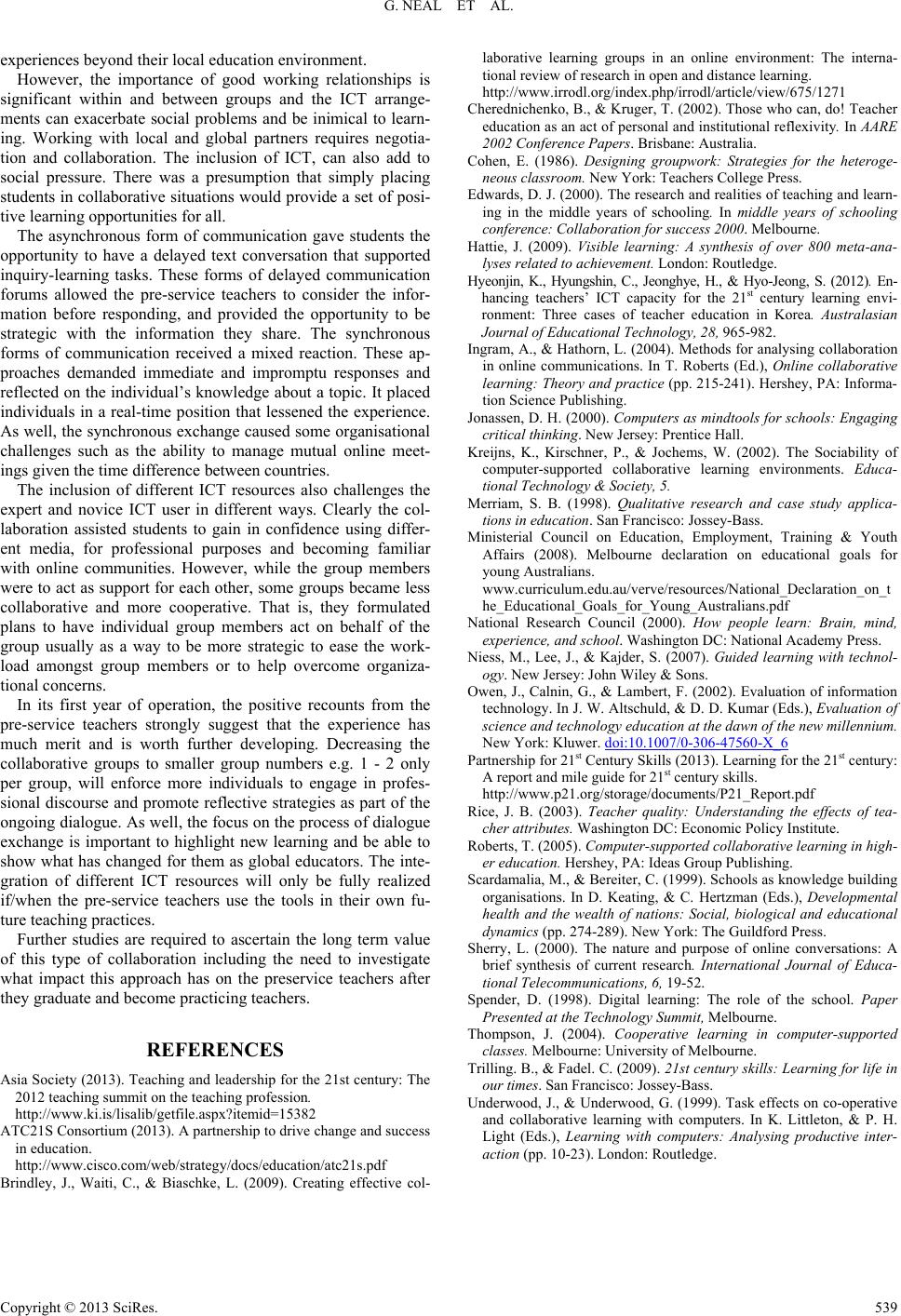 G. NEAL ET AL. Copyright © 2013 SciRe s . 539 experiences beyond their local education environment. However, the importance of good working relationships is significant within and between groups and the ICT arrange- ments can exacerbate social problems and be inimical to learn- ing. Working with local and global partners requires negotia- tion and collaboration. The inclusion of ICT, can also add to social pressure. There was a presumption that simply placing students in collaborative situations would provide a set of posi- tive learning opportunities for all. The asynchronous form of communication gave students the opportunity to have a delayed text conversation that supported inquiry-learning tasks. These forms of delayed communication forums allowed the pre-service teachers to consider the infor- mation before responding, and provided the opportunity to be strategic with the information they share. The synchronous forms of communication received a mixed reaction. These ap- proaches demanded immediate and impromptu responses and reflected on the individual’s knowledge about a topic. It placed individuals in a real-time position that lessened the experience. As well, the synchronous exchange caused some organisational challenges such as the ability to manage mutual online meet- ings given the time difference betwee n countries. The inclusion of different ICT resources also challenges the expert and novice ICT user in different ways. Clearly the col- laboration assisted students to gain in confidence using differ- ent media, for professional purposes and becoming familiar with online communities. However, while the group members were to act as support for each other, some groups became less collaborative and more cooperative. That is, they formulated plans to have individual group members act on behalf of the group usually as a way to be more strategic to ease the work- load amongst group members or to help overcome organiza- tional concerns. In its first year of operation, the positive recounts from the pre-service teachers strongly suggest that the experience has much merit and is worth further developing. Decreasing the collaborative groups to smaller group numbers e.g. 1 - 2 only per group, will enforce more individuals to engage in profes- sional discourse and promote reflective strategies as part of the ongoing dialogue. As well, the focus on the process of dialogue exchange is important to highlight new learning and be able to show what has changed for them as global educators. The inte- gration of different ICT resources will only be fully realized if/when the pre-service teachers use the tools in their own fu- ture teaching practices. Further studies are required to ascertain the long term value of this type of collaboration including the need to investigate what impact this approach has on the preservice teachers after they graduate and become practicing teachers. REFERENCES Asia Society (2013). Teaching and leadership for the 21st century: The 2012 teaching summit on the teaching professi on. http://www.ki.is/lisalib/getfile.aspx?itemid=15382 ATC21S Consortium (2013). A partnership to drive change and success in education. http://www.cisco.com/web/strategy/docs/education/atc21s.pdf Brindley, J., Waiti, C., & Biaschke, L. (2009). Creating effective col- laborative learning groups in an online environment: The interna- tional review of research in open and distance learning. http://www.irrodl.org/index.php/irrodl/article/view/675/1271 Cherednichenko, B., & Kruger, T. (2002). Those who can, do! Teacher education as an act of personal and institutional reflexivity. In AARE 2002 Conference Papers. Brisbane: Australia. Cohen, E. (1986). Designing groupwork: Strategies for the heteroge- neous classroom. New York: Teachers College Press. Edwards, D. J. (2000). The research and realities of teaching and learn- ing in the middle years of schooling. In middle years of schooling conference: Collaboration for success 2000. Melbourne. Hattie, J. (2009). Visible learning: A synthesis of over 800 meta-ana- lyses related to achievement. London: Routledge. Hyeonjin, K., Hyungshin, C., Jeonghye, H., & Hyo-Jeong, S. (2012). En- hancing teachers’ ICT capacity for the 21st century learning envi- ronment: Three cases of teacher education in Korea. Australasian Journal of Educationa l T e c hn o l ogy, 28, 965-98 2. Ingram, A., & Hathorn, L. (2004). Methods for analysing collaboration in online communications. In T. Roberts (Ed.), Online collaborative learning: Theory and practice (pp. 215-241). Hershey, PA: Informa- tion Science Publishing. Jonassen, D. H. (2000). Computers as mindtools for schools: Engaging critical thinking. New Jersey: Prentice Hall. Kreijns, K., Kirschner, P., & Jochems, W. (2002). The Sociability of computer-supported collaborative learning environments. Educa- tional Technology & Society, 5. Merriam, S. B. (1998). Qualitative research and case study applica- tions in education. San Francisco: Jossey-Bass. Ministerial Council on Education, Employment, Training & Youth Affairs (2008). Melbourne declaration on educational goals for young Australians. www.curriculum.edu.au/verve/resources/National_Declaration_on_t he_Educational_Goals_for_Young_Australians.pdf National Research Council (2000). How people learn: Brain, mind, experience, and school. Washington DC: National Academy Press. Niess, M., Lee, J., & Kajder, S. (2007). Guided learning with technol- ogy. New Jersey: John Wiley & Sons. Owen, J., Calnin, G., & Lambert, F. (2002). Evaluation of information technology. In J. W. Altschuld, & D. D. Kumar (Eds.), Evaluation of science and technology education at the dawn of the new millennium. New York: Kluwer. doi:10.1007/0-306-47560-X_6 Partnership for 21st Century Skills (2013). Learning for the 21st century: A report and mile guide for 21 st century skills. http://www.p21.org/storage/documents/P21_Report.pdf Rice, J. B. (2003). Teacher quality: Understanding the effects of tea- cher attributes. Washington DC: Economic Policy Institute. Roberts, T. (2005). Computer-supported collaborative learning in high- er education. Hershey, PA: Ideas Group Publishing. Scardamalia, M., & Bereiter, C. (1999). Schools as knowledge building organisations. In D. Keating, & C. Hertzman (Eds.), Developmental health and the wealth of nations: Social, biological and educational dynamics (pp. 274-289). New York: The Guildford Press. Sherry, L. (2000). The nature and purpose of online conversations: A brief synthesis of current research. International Journal of Educa- tional Telecommunications, 6, 19-52. Spender, D. (1998). Digital learning: The role of the school. Paper Presented at the Technology Summit, Melbourne. Thompson, J. (2004). Cooperative learning in computer-supported classes. Melbourne: University of Melbour n e . Trilling. B., & Fadel. C. (2009). 21st century skills: Learning for life in our times. San Francisco: Jossey-Bass. Underwood, J., & Underwood, G. (1999). Task effects on co-operative and collaborative learning with computers. In K. Littleton, & P. H. Light (Eds.), Learning with computers: Analysing productive inter- action (pp. 10-23). London: Routledge. |