

Paper Menu >>
Journal Menu >>
 Vol.1, No.1, 1-3 (2013) Open Journal of Therapy and Rehabilitation http://dx.doi.org/10.4236/ojtr.2013.11001 Sitting position improves consciousness level in patients with cerebral disorders Takashi Moriki1, Takeshi Nakamura 1*, Daisuke Kojima1, Hiroy oshi Fujiwara2, Fumihiro Ta jima 1 1Department of Rehabilitation Medicine, Wakayama Medical University, Wakayama, Japan; *Corresponding Author: [email protected] 2Department of Orthopedics, Graduate School of Medical Science, Kyoto Prefectural University of Medicine, Kyoto, Japan Received 2 May 2013; revised 3 June 2013; accepted 12 June 2013 Copyright © 2013 Takashi Moriki et al. This is an open access article distributed under the Creative Commons Attribution License, which permits unrestricted use, distribution, and reproduction in any medium, provided the original work is properly cited. ABSTRACT Cerebral disorders are of ten associated with dis- turbance of consciousness. Since the latter could alter the prognosis of physical function, early improvement of consciousness level is impor- tant. The present study tested the hypothesis that sitting position improves disturbances of consciousness in patients with cerebral disor- ders. The subject s were 17 p atient s with cerebra l disorders and disturbances of consciousness. The consciousness level was evaluated in su- pine position and following a change to sitting position. The consciousness level was evalu- ated by the Glasgow Coma Scale (GCS). The tot al, eye opening, and motor GCS scores were sig- nificantly higher in the sitting position compared with the supine position. In conclusions, chang- ing from supine to sitting position impro ves con- sciousness level in patients with cerebral dis- orders. Keywords: Consciousness Disturban ce ; Glasgow Coma Scale; Sitting Position 1. INTRODUCTION The major clinical features of cerebral disorders (e.g., cerebrovascular accident, brain injury, brain tumor and hypoxic encephalopathy) are disturbance of conscious- ness, hemiplegia, sensory disturbance and higher cere- bral dysfunction [1]. Disturbance of consciousness can in- directly affect prognosis of physical dysfunction. There- fore, it is important to improve as soon as possible the consciousness level of patients with cerebral disorders. The reticular activating system (RAS) is primarily in- volved in the state of arousal and wakefulness and nor- mally responds to all sensory stimuli, including pain, pressure, touch, temperature, proprioception, vision, and hearing [2]. Intense multisensory stimulation in patients with disturbances of consciousness should stimulate the RAS and improve arousabilit y. For example, clinical evi- dence indicates that sensory stimulation (e.g., intermit- tent bright lights directed into the patient’s eyes), sound (clapping two blocks of wood together periodically next to the patient’s ear), and sensory stimulation (touching extremities with ice cubes) improve the consciousness level [3]. A change in posture from supine to sitting position adds gravitation stress to the body. Thus, the sitting p osi- tion might stimulate RAS and improve consciousness level in patients with cerebral disorders. To our knowl- edge, however, there is no information on the effect of sitting position on disturbance of consciousness. We tested in this study the hypo thesis that sitting pos ition improves disturbances of consci o us ness. 2. METHODS 2.1. Participants The study subjects were 17 patients with disturbances of consciousness (mean age, 71.3 ± 14.0 years; ± SD, range, 35 - 90, including 7 with cerebral infarction, 4 with cerebral hemorrhage, and 6 with traumatic brain injury). They consisted of 9 men (70.3 ± 10.1 years; range, 49 - 81) and 8 women (72.4 ± 18.1 years; range, 35 - 90). Table 1 summarizes the characteristics of the participating subjects. The study was approved by the ethics review committee of Wakayama Medical Univer- sity, School of Medicine, and was performed between October 2007 and September 2008. Families of all sub- jects were informed about the study procedure before signing the consent form in accordance to the guidelines of the Wakayama Medical University. Copyright © 2013 SciRes. OPEN ACCESS 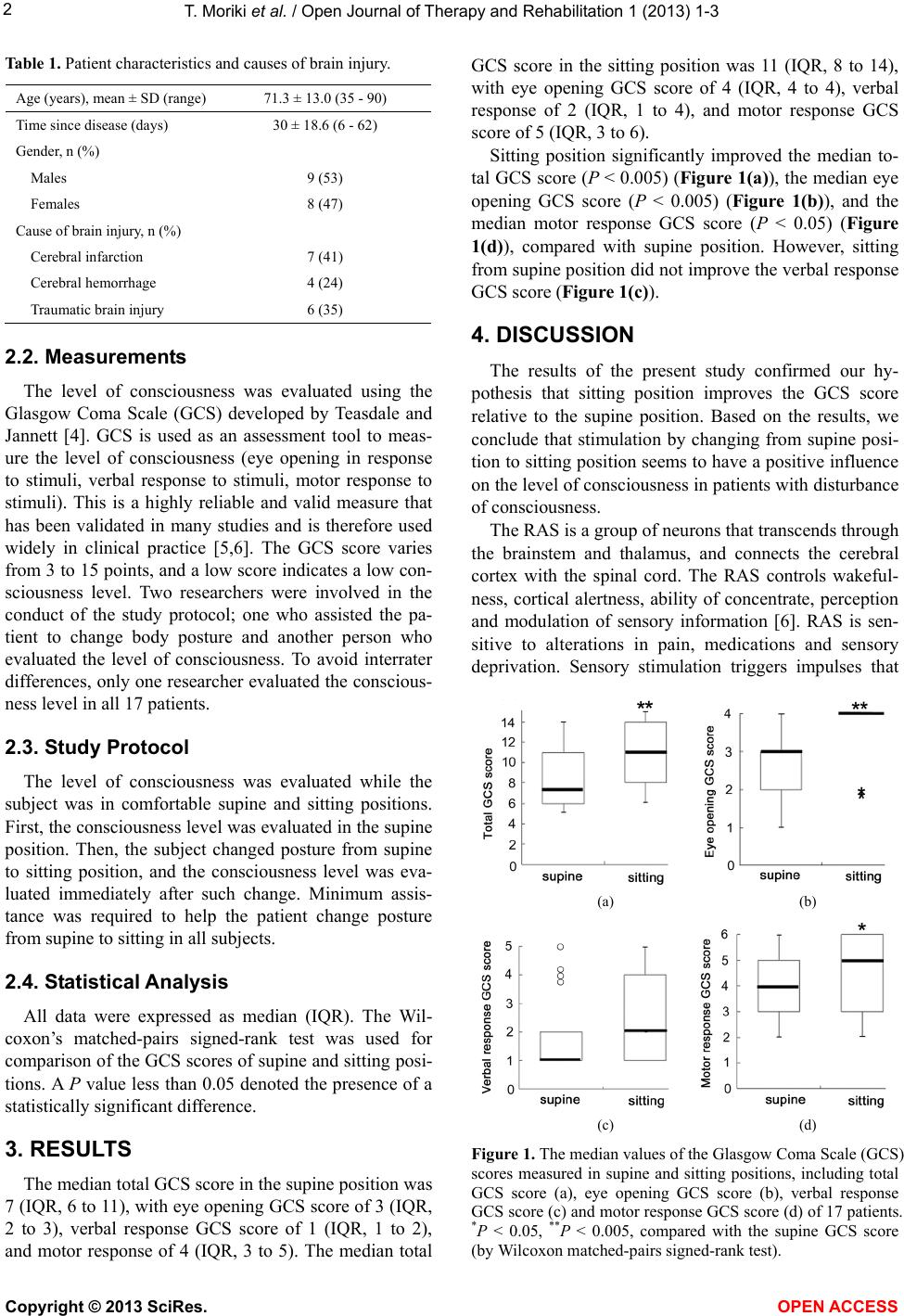 T. Moriki et al. / Open Journal of Therapy and Rehabilitation 1 (2013) 1-3 2 Table 1. Patient characteristics and causes of brain injury. Age (years), mean ± SD (range) 71.3 ± 13.0 (35 - 90) Time since disease (days) 30 ± 18.6 (6 - 62) Gender, n (%) Males 9 (53) Females 8 (47) Cause of brain injury, n (%) Cerebral infarction 7 (41) Cerebral hemorrhage 4 (24) Traumatic brain injury 6 (35) 2.2. Measurements The level of consciousness was evaluated using the Glasgow Coma Scale (GCS) developed by Teasdale and Jannett [4]. GCS is used as an assessment tool to meas- ure the level of consciousness (eye opening in response to stimuli, verbal response to stimuli, motor response to stimuli). This is a highly reliable and valid measure that has been validated in many studies and is therefore used widely in clinical practice [5,6]. The GCS score varies from 3 to 15 points, and a low score ind icates a low con- sciousness level. Two researchers were involved in the conduct of the study protocol; one who assisted the pa- tient to change body posture and another person who evaluated the level of consciousness. To avoid interrater differences, only one researcher evaluated the conscious- ness level in all 17 patien ts. 2.3. Study Protocol The level of consciousness was evaluated while the subject was in comfortable supine and sitting positions. First, the consciousness level was evaluated in the supine position. Then, the subject changed posture from supine to sitting position, and the consciousness level was eva- luated immediately after such change. Minimum assis- tance was required to help the patient change posture from supine to sitting in all subjects. 2.4. Statistical Analysis All data were expressed as median (IQR). The Wil- coxon’s matched-pairs signed-rank test was used for comparison of the GCS scores o f supine and sitting p osi- tions. A P value less than 0.05 denoted the presence of a statistically significant difference. 3. RESULTS The median total GCS score in the supine position was 7 (IQR, 6 to 11), with eye opening GCS score of 3 (IQR, 2 to 3), verbal response GCS score of 1 (IQR, 1 to 2), and motor response of 4 (IQR, 3 to 5). The median total GCS score in the sitting position was 11 (IQR, 8 to 14), with eye opening GCS score of 4 (IQR, 4 to 4), verbal response of 2 (IQR, 1 to 4), and motor response GCS score of 5 (IQR, 3 to 6). Sitting position significantly improved the median to- tal GCS score (P < 0.005) (Figure 1(a)), the median eye opening GCS score (P < 0.005) (Figure 1(b)), and the median motor response GCS score (P < 0.05) (Figure 1(d)), compared with supine position. However, sitting from supine position did not improve the verbal response GCS score (Figure 1(c)). 4. DISCUSSION The results of the present study confirmed our hy- pothesis that sitting position improves the GCS score relative to the supine position. Based on the results, we conclude that stimulation by changing from supine posi- tion to sitting position seems to have a positive influ ence on the level of consciousness in patients with disturbance of consciousness. The RAS is a group of neurons that tr anscends through the brainstem and thalamus, and connects the cerebral cortex with the spinal cord. The RAS controls wakeful- ness, cortical alertness, ability of concentrate, perception and modulation of sensory information [6]. RAS is sen- sitive to alterations in pain, medications and sensory deprivation. Sensory stimulation triggers impulses that (a) (b) (c) (d) Figure 1. The median values of the Glasgow Coma Scale (GCS) scores measured in supine and sitting positions, including total GCS score (a), eye opening GCS score (b), verbal response GCS score (c) and motor response GCS score (d) of 17 patients. *P < 0.05, **P < 0.005, compared with the supine GCS score (by Wilcoxon matched-pairs signed-rank test). Copyright © 2013 SciRes. OPEN ACCESS  T. Moriki et al. / Open Journal of Therapy and Rehabilitation 1 (2013) 1-3 Copyright © 2013 SciRes. 3 5. CONCLUSION are transmitted to the RAS, which ultimately lead to ac- tivation of the cerebral cortex. The results of the present study suggest that gravitation stress induced by sitting position stimulated th e RAS, resulting in imp rovement of the GCS score. The present study demonstrated that sitting position improved the GCS score in patients with cerebral disor- ders and disturbances of consciousness, suggesting the effectiveness of the sitting position in improving con- sciousness level. In present study, the eye opening and motor response GCS scores significantly improved at sitting compared with supine position. However, the change in body pos- ture did not affect the verbal response GCS score. Six- teen of the 17 patients who particip ated in this study had of bilateral cerebral cortical damage. Damage of the cerebral cortex influences cognitive function. Therefore, most patients of our study could have verbal cognitive dysfunction. We speculate that cognitive dysfunction could have a negative influence on the verbal response GCS score. 6. ACKNOWLEDGEMENTS We thank Takeshi Harada, Takamasa Hashizaki and Tokio Kinoshita for the clinical assistance. We also thank Dr. Faiq G Issa for the careful reading and editing of the manuscript. REFERENCES [1] Scherer, P. (1986) Assessment the logic of coma. Ameri- can Journal of Nursing, 86, 542-549. The present study has certain limitations. The study did not evaluate the effect of repetition of the sitting po- sition on the improvement of disturbances of conscious- ness. Further studies are needed to evaluate the level of consciousness in the sitting position on several days to determine the effect of repetitive change in body posture. [2] Spielman, G. (1981) Coma: A clinical review. Heart and Lung, 10, 700-707. [3] DeYoung, S. and Grass, R.B. (1987) Coma recovery pro- gram. Rehabilitation Nursing, 12, 121-124. doi:10.1002/j.2048-7940.1987.tb00573.x We have demonstrated in the present study that the sit- ting position effectively improve consciousness level in patients with cerebral disorders. The results suggest that further improvement in consciousness level could proba- bly be achieved on standing position since the latter po- sition is more stressful posture than sitting positio n. Phy- sical therapists do not need special techniques to change body posture of patients with cerebral disorders, since this can be achieved at bedside. The present results sug- gest that a posture change is easy and beneficial reha- bilitation program for patients with disturbances of con- sciousness. [4] Teasdale, G. and Jennett, B. (1974) Assessment of coma and impaired consciousness. A practical scale. Lancet, 13, 81-84. doi:10.1016/S0140-6736(74)91639-0 [5] Oh, H. and Seo, W. (2003) Sensory stimulation program- me to improve recovery in comatose patients. Journal of Clinical Nursing, 12, 394-404. doi:10.1046/j.1365-2702.2003.00750.x [6] Sosnowski, C. and Ustik, M. (1994) Early intervention: Coma stimulation in the intensive care unit. Journal of Neuroscience Nursing, 26, 336-341. doi:10.1097/01376517-199412000-00005 OPEN ACCESS |