

Paper Menu >>
Journal Menu >>
 Materials Sciences and Applicatio ns, 2011, 2, 42-48 doi:10.4236/msa.2011.21006 Published Online January 2011 (http://www.SciRP.org/journal/msa) Copyright © 2011 SciRes. MSA Electrochemical and Microstructural Study of Ni-Cr-Mo Alloys Used in Dental Prostheses José W. J. Silva*, Lucíola L. Sousa, Roberto Z. Nakazato, Eduardo N. Codaro, Hamilton de Felipe Departamento de Física e Química, Universidade Estadual Paulista, Campus de Guaratinguetá, Guaratinguetá, Brazil. Email: [email protected] Received September 24th, 2010; revised December 7th, 2010; accepted December 28th, 2010. ABSTRACT Ni-Cr-Mo alloys have been widely used as fixed dental prostheses. Recast process influence on corrosion behavior of Ni-Cr-Mo dental alloy in simulated physiological serum has been investigated using chemical and electrochemical techniques. Ni-Cr-Mo alloy recast by induction (induction) or by blowtorch (torch) has exhibited similar dendritic structures with wide and precipitate grains in their boundaries. The torch alloy has presented good corrosion resis- tance in physiological serum. Passivation process provides th is corrosion resistance. Passivation of Ni-Cr-Mo alloy is often attributed to the formation of a thin and compact layer of chromium oxide (Cr2O3). This film is self-limiting be- cause it acts as a barrier to the oxygen transport and metal ions. This film stability will depend on its solubility to the working temperature. Different recast procedures change electrochemical parameters as stabilizing potential in open circuit, current density and passivation interva l. Keywords: Corrosion, Metal and Alloys, Microstructure, Nickel-Chrome-Molybdenum 1. Introduction In dental restorations, the most decisive property of a cast alloy in biocompatibility is corrosion [1]. Co and Ni based alloys were widely used in dental skeletal struc- tures and orthopedic implants such as screws, pins and plates. And recently they have been applied for making stents [1,2]. The advantages of these alloys include low cost of casting, matching thermal expansion coefficient with the ceramics of metal-ceramic restorations, and ac- ceptable mechanical and tribological properties in vivo [3,4]. However, the possible release of toxic metal ions due to corrosion remains a major concern [3-5]. Casting is one of the main methods of producing shaped metals and alloys. Electrochemical corrosion behavior of Co-Cr and Ni-Cr dental cast alloys depends primarily on the Cr and Mo levels in an alloy [6]. In commercial alloys, the compositions of Cr and Mo usually range from 11% to 25% and from 0 to 10% (mass fraction), respectively [7]. Both microstructure and casting defect have pronounced effect on the ion release in actual practice. The defects of dental cast alloys include mainly shrinkage porosity, in- clusion, micro-crack and dendritic structure [8]. Only few reported works were available on the influence of casting procedures on the corrosion resistance of dental alloys [9,10]. In Ni-Cr alloys, resistance to corrosion is relatively high because of passivation effect of the oxide layer cov- ering a surface [11]. During production of dental alloy, trace elements are used due to playing an important role in their properties. They improve the use and casting qualities, and increase the porcelain-metal fusion as well as corrosion resistance [12,13]. An early study high- lighted that a variety of different microstructures could be formed depending on such an alloy added [12]. For example, Be has been added to improve both the alloy castability and the adherence of veneering porcelain. However, it decreases significantly the alloy corrosion resistance owing to formation of a Cr-depleted Ni-Be eutectic phase [12,14]. Phase structures (microstructure) of dental alloys af- fect their clinical performance, especially biocompatibil- ity [15,16]. Alloys can either be single-phase (homoge- nous) or multiple-phase (heterogeneous). If all elements are completely mutually soluble in solid state (gold, pal- ladium and copper), then alloy will be single-phase; if not (gold and platinum), then alloy may be multiple- phase [17,18]. The relationship between microstructure and corrosion behavior of Ni based dental casting alloys has been studied. It has been reported that in regions 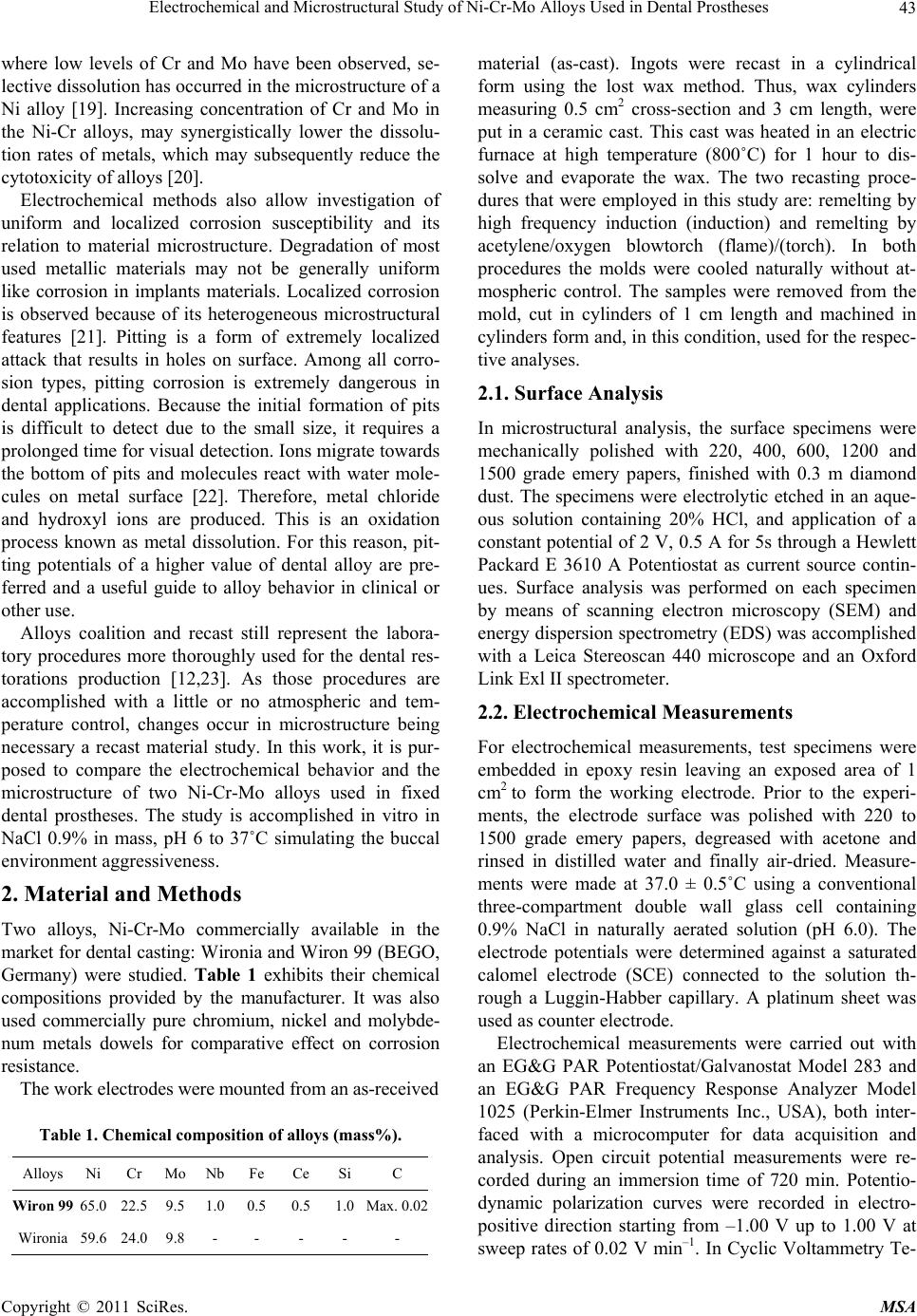 Electrochemical and Microstructural Study of Ni-Cr-Mo Alloys Used in Dental Prostheses43 where low levels of Cr and Mo have been observed, se- lective dissolution has occurred in the microstructure of a Ni alloy [19]. Increasing concentration of Cr and Mo in the Ni-Cr alloys, may synergistically lower the dissolu- tion rates of metals, which may subsequently reduce the cytotoxicity of alloys [20]. Electrochemical methods also allow investigation of uniform and localized corrosion susceptibility and its relation to material microstructure. Degradation of most used metallic materials may not be generally uniform like corrosion in implants materials. Localized corrosion is observed because of its heterogeneous microstructural features [21]. Pitting is a form of extremely localized attack that results in holes on surface. Among all corro- sion types, pitting corrosion is extremely dangerous in dental applications. Because the initial formation of pits is difficult to detect due to the small size, it requires a prolonged time for visual detection. Ions migrate towards the bottom of pits and molecules react with water mole- cules on metal surface [22]. Therefore, metal chloride and hydroxyl ions are produced. This is an oxidation process known as metal dissolution. For this reason, pit- ting potentials of a higher value of dental alloy are pre- ferred and a useful guide to alloy behavior in clinical or other use. Alloys coalition and recast still represent the labora- tory procedures more thoroughly used for the dental res- torations production [12,23]. As those procedures are accomplished with a little or no atmospheric and tem- perature control, changes occur in microstructure being necessary a recast material study. In this work, it is pur- posed to compare the electrochemical behavior and the microstructure of two Ni-Cr-Mo alloys used in fixed dental prostheses. The study is accomplished in vitro in NaCl 0.9% in mass, pH 6 to 37˚C simulating the buccal environment aggressiveness. 2. Material and Methods Two alloys, Ni-Cr-Mo commercially available in the market for dental casting: Wironia and Wiron 99 (BEGO, Germany) were studied. Table 1 exhibits their chemical compositions provided by the manufacturer. It was also used commercially pure chromium, nickel and molybde- num metals dowels for comparative effect on corrosion resistance. The work electrodes were mounted from an as-received Table 1. Chemical composition of alloys (mass%). Alloys Ni Cr Mo Nb Fe Ce Si C Wiron 9965.0 22.5 9.5 1.0 0.5 0.5 1.0 Max. 0.02 Wironia 59.6 24.0 9.8 - - - - - material (as-cast). Ingots were recast in a cylindrical form using the lost wax method. Thus, wax cylinders measuring 0.5 cm2 cross-section and 3 cm length, were put in a ceramic cast. This cast was heated in an electric furnace at high temperature (800˚C) for 1 hour to dis- solve and evaporate the wax. The two recasting proce- dures that were employed in this study are: remelting by high frequency induction (induction) and remelting by acetylene/oxygen blowtorch (flame)/(torch). In both procedures the molds were cooled naturally without at- mospheric control. The samples were removed from the mold, cut in cylinders of 1 cm length and machined in cylinders form and, in this condition, used for the respec- tive analyses. 2.1. Surface Analysis In microstructural analysis, the surface specimens were mechanically polished with 220, 400, 600, 1200 and 1500 grade emery papers, finished with 0.3 m diamond dust. The specimens were electrolytic etched in an aque- ous solution containing 20% HCl, and application of a constant potential of 2 V, 0.5 A for 5s through a Hewlett Packard E 3610 A Potentiostat as current source contin- ues. Surface analysis was performed on each specimen by means of scanning electron microscopy (SEM) and energy dispersion spectrometry (EDS) was accomplished with a Leica Stereoscan 440 microscope and an Oxford Link Exl II spectrometer. 2. 2. Electrochemical Measurements For electrochemical measurements, test specimens were embedded in epoxy resin leaving an exposed area of 1 cm2 to form the working electrode. Prior to the experi- ments, the electrode surface was polished with 220 to 1500 grade emery papers, degreased with acetone and rinsed in distilled water and finally air-dried. Measure- ments were made at 37.0 ± 0.5˚C using a conventional three-compartment double wall glass cell containing 0.9% NaCl in naturally aerated solution (pH 6.0). The electrode potentials were determined against a saturated calomel electrode (SCE) connected to the solution th- rough a Luggin-Habber capillary. A platinum sheet was used as counter electrode. Electrochemical measurements were carried out with an EG&G PAR Potentiostat/Galvanostat Model 283 and an EG&G PAR Frequency Response Analyzer Model 1025 (Perkin-Elmer Instruments Inc., USA), both inter- faced with a microcomputer for data acquisition and analysis. Open circuit potential measurements were re- corded during an immersion time of 720 min. Potentio- dynamic polarization curves were recorded in electro- positive direction starting from –1.00 V up to 1.00 V at sweep rates of 0.02 V min–1. In Cyclic Voltammetry Te- Copyright © 2011 SciRes. MSA 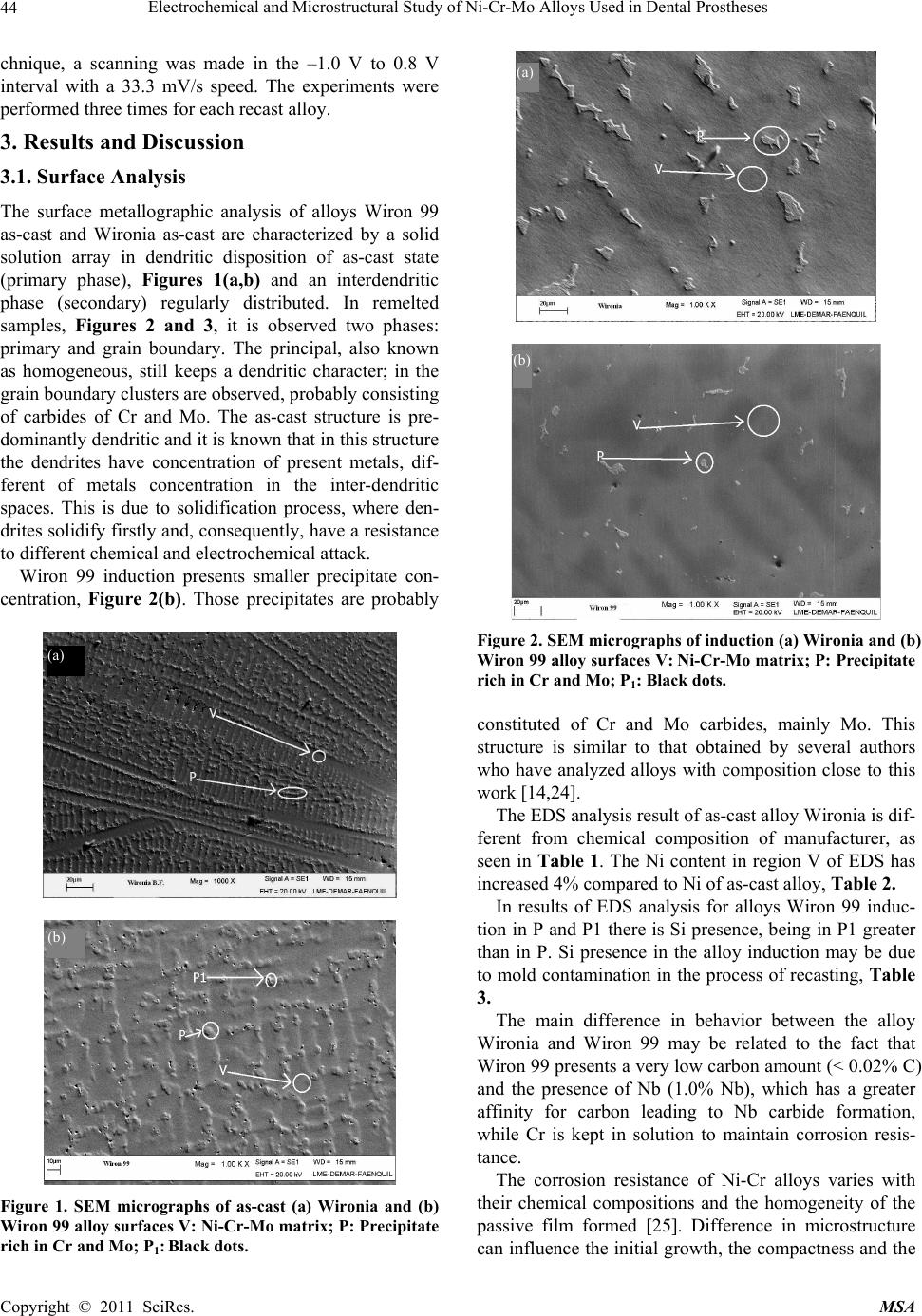 Electrochemical and Microstructural Study of Ni-Cr-Mo Alloys Used in Dental Prostheses 44 chnique, a scanning was made in the –1.0 V to 0.8 V interval with a 33.3 mV/s speed. The experiments were performed three times for each recast alloy. 3. Results and Discussion 3.1. Surface Analysis The surface metallographic analysis of alloys Wiron 99 as-cast and Wironia as-cast are characterized by a solid solution array in dendritic disposition of as-cast state (primary phase), Figures 1(a,b) and an interdendritic phase (secondary) regularly distributed. In remelted samples, Figures 2 and 3, it is observed two phases: primary and grain boundary. The principal, also known as homogeneous, still keeps a dendritic character; in the grain boundary clusters are observed, probably consisting of carbides of Cr and Mo. The as-cast structure is pre- dominantly dendritic and it is known that in this structure the dendrites have concentration of present metals, dif- ferent of metals concentration in the inter-dendritic spaces. This is due to solidification process, where den- drites solidify firstly and, consequently, have a resistance to different chemical and electrochemical attack. Wiron 99 induction presents smaller precipitate con- centration, Figure 2(b). Those precipitates are probably Figure 1. SEM micrographs of as-cast (a) Wironia and (b) Wiron 99 alloy surfaces V: Ni-Cr-Mo matrix; P: Precipitate rich in Cr and Mo; P1: Black dots. (a) (b) Figure 2. SEM micrographs of induction (a) Wir onia and (b) Wiron 99 alloy surfaces V: Ni-Cr-Mo matrix; P: Precipitate rich in Cr and Mo; P1: Black dots. (a) constituted of Cr and Mo carbides, mainly Mo. This structure is similar to that obtained by several authors who have analyzed alloys with composition close to this work [14,24]. The EDS analysis result of as-cast alloy Wironia is dif- ferent from chemical composition of manufacturer, as seen in Table 1. The Ni content in region V of EDS has increased 4% compared to Ni of as-cast alloy, Table 2. In results of EDS analysis for alloys Wiron 99 induc- tion in P and P1 there is Si presence, being in P1 greater than in P. Si presence in the alloy induction may be due to mold contamination in the process of recasting, Table 3. (b) The main difference in behavior between the alloy Wironia and Wiron 99 may be related to the fact that Wiron 99 presents a very low carbon amount (< 0.02% C) and the presence of Nb (1.0% Nb), which has a greater affinity for carbon leading to Nb carbide formation, while Cr is kept in solution to maintain corrosion resis- tance. The corrosion resistance of Ni-Cr alloys varies with their chemical compositions and the homogeneity of the passive film formed [25]. Difference in microstructure can influence the initial growth, the compactness and the Copyright © 2011 SciRes. MSA 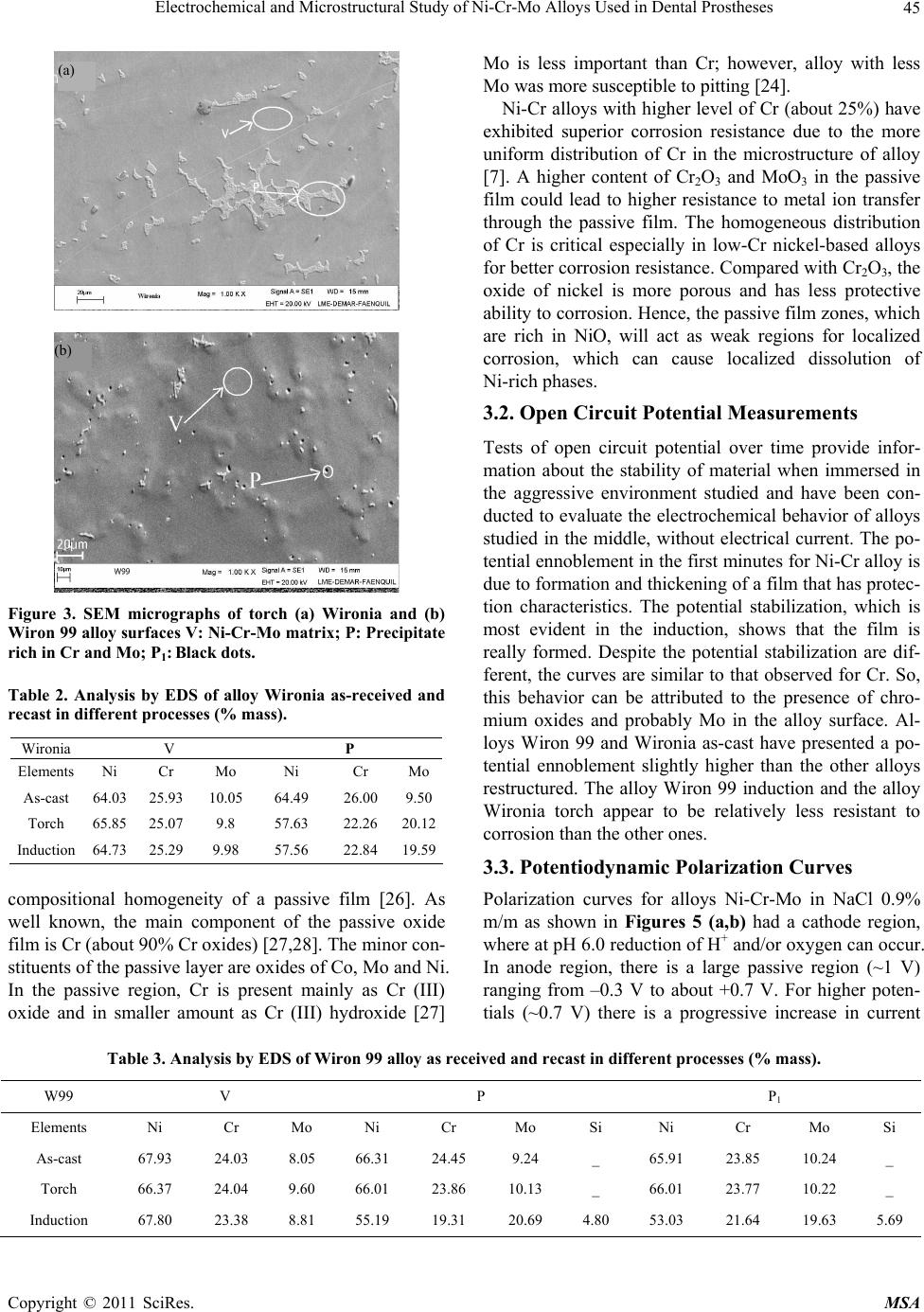 Electrochemical and Microstructural Study of Ni-Cr-Mo Alloys Used in Dental Prostheses Copyright © 2011 SciRes. MSA 45 Mo is less important than Cr; however, alloy with less Mo was more susceptible to pitting [24]. Ni-Cr alloys with higher level of Cr (about 25%) have exhibited superior corrosion resistance due to the more uniform distribution of Cr in the microstructure of alloy [7]. A higher content of Cr2O3 and MoO3 in the passive film could lead to higher resistance to metal ion transfer through the passive film. The homogeneous distribution of Cr is critical especially in low-Cr nickel-based alloys for better corrosion resistance. Compared with Cr2O3, the oxide of nickel is more porous and has less protective ability to corrosion. Hence, the passive film zones, which are rich in NiO, will act as weak regions for localized corrosion, which can cause localized dissolution of Ni-rich phases. 3.2. Open Circuit Potential Measurements Tests of open circuit potential over time provide infor- mation about the stability of material when immersed in the aggressive environment studied and have been con- ducted to evaluate the electrochemical behavior of alloys studied in the middle, without electrical current. The po- tential ennoblement in the first minutes for Ni-Cr alloy is due to formation and thickening of a film that has protec- tion characteristics. The potential stabilization, which is most evident in the induction, shows that the film is really formed. Despite the potential stabilization are dif- ferent, the curves are similar to that observed for Cr. So, this behavior can be attributed to the presence of chro- mium oxides and probably Mo in the alloy surface. Al- loys Wiron 99 and Wironia as-cast have presented a po- tential ennoblement slightly higher than the other alloys restructured. The alloy Wiron 99 induction and the alloy Wironia torch appear to be relatively less resistant to corrosion than the other ones. Figure 3. SEM micrographs of torch (a) Wironia and (b) Wiron 99 alloy surfaces V: Ni-Cr-Mo matrix; P: Precipitate rich in Cr and Mo; P1: Black dots. Table 2. Analysis by EDS of alloy Wironia as-received and recast in different processes (% mass). Wironia V P Elements Ni Cr Mo Ni Cr Mo As-cast 64.03 25.93 10.0564.49 26.00 9.50 Torch 65.85 25.07 9.8 57.63 22.26 20.12 Induction 64.73 25.29 9.98 57.56 22.84 19.593.3. Potentiodynamic Polarization Curves compositional homogeneity of a passive film [26]. As well known, the main component of the passive oxide film is Cr (about 90% Cr oxides) [27,28]. The minor con- stituents of the passive layer are oxides of Co, Mo and Ni. In the passive region, Cr is present mainly as Cr (III) oxide and in smaller amount as Cr (III) hydroxide [27] Polarization curves for alloys Ni-Cr-Mo in NaCl 0.9% m/m as shown in Figures 5 (a,b) had a cathode region, where at pH 6.0 reduction of H+ and/or oxygen can occur. In anode region, there is a large passive region (~1 V) ranging from –0.3 V to about +0.7 V. For higher poten- tials (~0.7 V) there is a progressive increase in current Table 3. Analysis by EDS of Wiron 99 alloy as received and recast in different processes (% mass). W99 V P P1 Elements Ni Cr Mo Ni Cr Mo Si Ni Cr Mo Si As-cast 67.93 24.03 8.05 66.31 24.45 9.24 _ 65.91 23.85 10.24 _ Torch 66.37 24.04 9.60 66.01 23.86 10.13 _ 66.01 23.77 10.22 _ Induction 67.80 23.38 8.81 55.19 19.31 20.69 4.80 53.03 21.64 19.63 5.69 (b) (a) 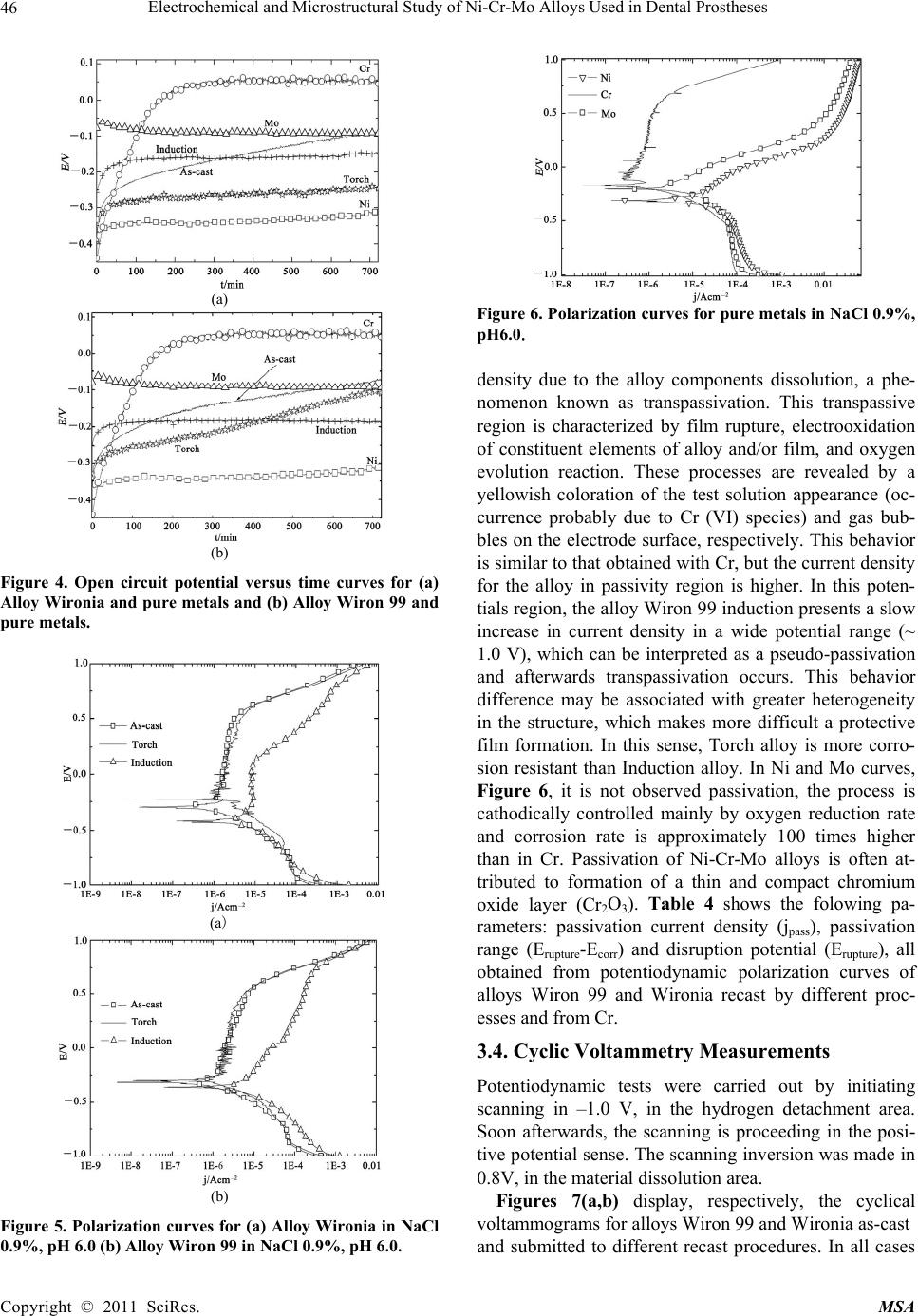 Electrochemical and Microstructural Study of Ni-Cr-Mo Alloys Used in Dental Prostheses 46 (a) (b) Figure 4. Open circuit potential versus time curves for (a) Alloy Wironia and pure metals and (b) Alloy Wiron 99 and pure metals. (a) (b) Figure 5. Polarization curves for (a) Alloy Wironia in NaCl 0.9%, pH 6.0 (b) Alloy Wiron 99 in NaCl 0.9%, pH 6.0. Figure 6. Polarization curves for pure metals in NaCl 0.9%, pH6.0. density due to the alloy components dissolution, a phe- nomenon known as transpassivation. This transpassive region is characterized by film rupture, electrooxidation of constituent elements of alloy and/or film, and oxygen evolution reaction. These processes are revealed by a yellowish coloration of the test solution appearance (oc- currence probably due to Cr (VI) species) and gas bub- bles on the electrode surface, respectively. This behavior is similar to that obtained with Cr, but the current density for the alloy in passivity region is higher. In this poten- tials region, the alloy Wiron 99 induction presents a slow increase in current density in a wide potential range (~ 1.0 V), which can be interpreted as a pseudo-passivation and afterwards transpassivation occurs. This behavior difference may be associated with greater heterogeneity in the structure, which makes more difficult a protective film formation. In this sense, Torch alloy is more corro- sion resistant than Induction alloy. In Ni and Mo curves, Figure 6, it is not observed passivation, the process is cathodically controlled mainly by oxygen reduction rate and corrosion rate is approximately 100 times higher than in Cr. Passivation of Ni-Cr-Mo alloys is often at- tributed to formation of a thin and compact chromium oxide layer (Cr2O3). Table 4 shows the folowing pa- rameters: passivation current density (jpass), passivation range (Erupture-Ecorr) and disruption potential (Erupture), all obtained from potentiodynamic polarization curves of alloys Wiron 99 and Wironia recast by different proc- esses and from Cr. 3.4. Cyclic Voltammetry Measurements Potentiodynamic tests were carried out by initiating scanning in –1.0 V, in the hydrogen detachment area. Soon afterwards, the scanning is proceeding in the posi- tive potential sense. The scanning inversion was made in 0.8V, in the material dissolution area. Figures 7(a,b) display, respectively, the cyclical voltammograms for alloys Wiron 99 and Wironia as-cast and submitted to different recast procedures. In all cases Copyright © 2011 SciRes. MSA 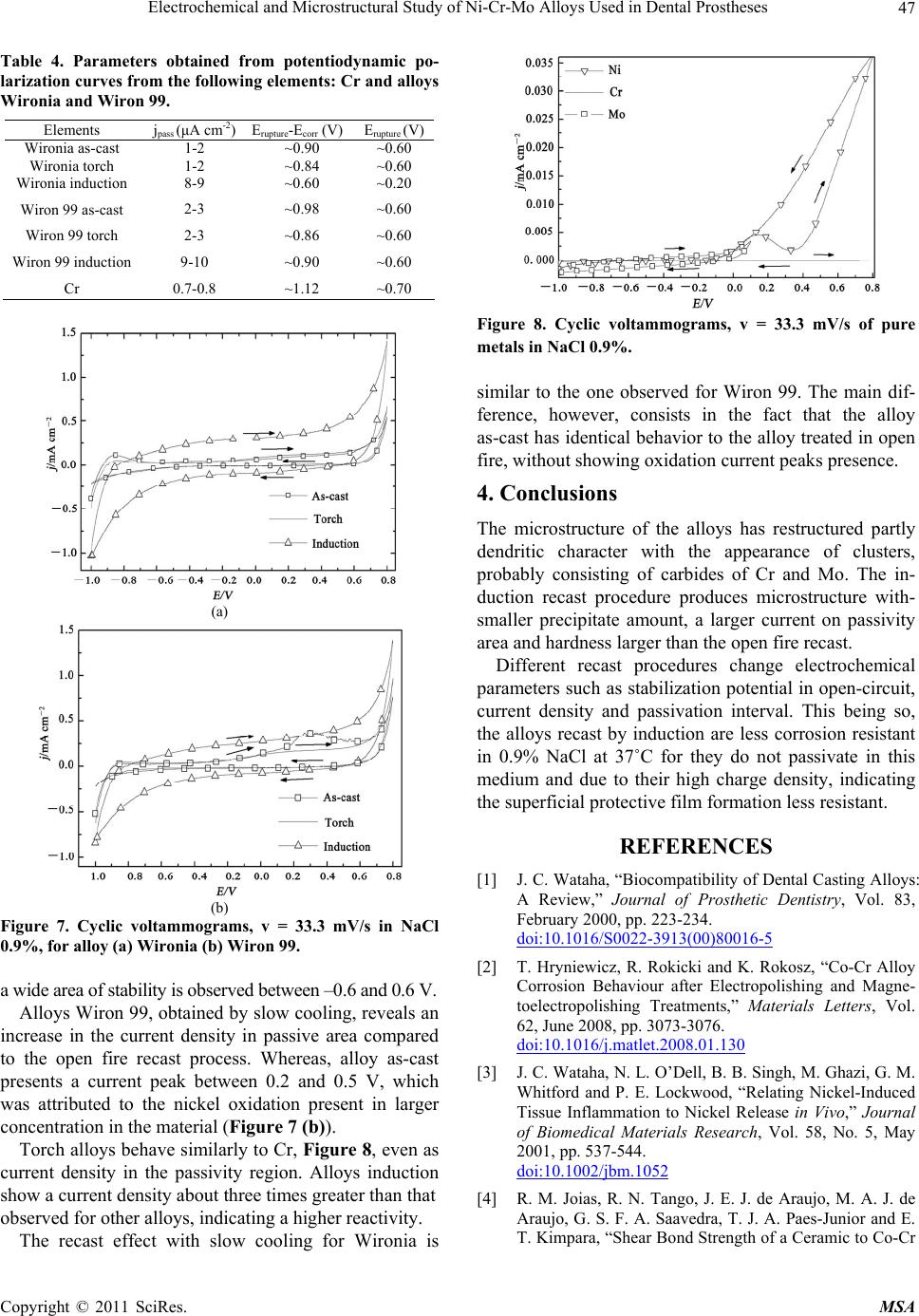 Electrochemical and Microstructural Study of Ni-Cr-Mo Alloys Used in Dental Prostheses47 Table 4. Parameters obtained from potentiodynamic po- larization curves from the following elements: Cr and alloys Wironia and Wiron 99. Elements jpass (μA cm-2)E rupture-Ecorr (V) Erupture (V) Wironia as-cast 1-2 ~0.90 ~0.60 Wironia torch 1-2 ~0.84 ~0.60 Wironia induction Wiron 99 as-cast Wiron 99 torch Wiron 99 induction 8-9 2-3 2-3 9-10 ~0.60 ~0.98 ~0.86 ~0.90 ~0.20 ~0.60 ~0.60 ~0.60 Cr 0.7-0.8 ~1.12 ~0.70 (a) (b) Figure 7. Cyclic voltammograms, v = 33.3 mV/s in NaCl 0.9%, for alloy (a) Wironia (b) Wiron 99. a wide area of stability is observed between –0.6 and 0.6 V. Alloys Wiron 99, obtained by slow cooling, reveals an increase in the current density in passive area compared to the open fire recast process. Whereas, alloy as-cast presents a current peak between 0.2 and 0.5 V, which was attributed to the nickel oxidation present in larger concentration in the material (Figure 7 (b)). Torch alloys behave similarly to Cr, Figure 8, even as current density in the passivity region. Alloys induction show a current density about three times greater than that observed for other alloys, indicating a higher reactivity. The recast effect with slow cooling for Wironia is Figure 8. Cyclic voltammograms, v = 33.3 mV/s of pure metals in NaCl 0.9%. similar to the one observed for Wiron 99. The main dif- ference, however, consists in the fact that the alloy as-cast has identical behavior to the alloy treated in open fire, without showing oxidation current peaks presence. 4. Conclusions The microstructure of the alloys has restructured partly dendritic character with the appearance of clusters, probably consisting of carbides of Cr and Mo. The in- duction recast procedure produces microstructure with- smaller precipitate amount, a larger current on passivity area and hardness larger than the open fire recast. Different recast procedures change electrochemical parameters such as stabilization potential in open-circuit, current density and passivation interval. This being so, the alloys recast by induction are less corrosion resistant in 0.9% NaCl at 37˚C for they do not passivate in this medium and due to their high charge density, indicating the superficial protective film formation less resistant. REFERENCES [1] J. C. Wataha, “Biocompatibility of Dental Casting Alloys: A Review,” Journal of Prosthetic Dentistry, Vol. 83, February 2000, pp. 223-234. doi:10.1016/S0022-3913(00)80016-5 [2] T. Hryniewicz, R. Rokicki and K. Rokosz, “Co-Cr Alloy Corrosion Behaviour after Electropolishing and Magne- toelectropolishing Treatments,” Materials Letters, Vol. 62, June 2008, pp. 3073-3076. doi:10.1016/j.matlet.2008.01.130 [3] J. C. Wataha, N. L. O’Dell, B. B. Singh, M. Ghazi, G. M. Whitford and P. E. Lockwood, “Relating Nickel-Induced Tissue Inflammation to Nickel Release in Vivo,” Journal of Biomedical Materials Research, Vol. 58, No. 5, May 2001, pp. 537-544. doi:10.1002/jbm.1052 [4] R. M. Joias, R. N. Tango, J. E. J. de Araujo, M. A. J. de Araujo, G. S. F. A. Saavedra, T. J. A. Paes-Junior and E. T. Kimpara, “Shear Bond Strength of a Ceramic to Co-Cr Copyright © 2011 SciRes. MSA  Electrochemical and Microstructural Study of Ni-Cr-Mo Alloys Used in Dental Prostheses Copyright © 2011 SciRes. MSA 48 Alloys,” Journal of Prosthetic Dentistry, Vol. 99, January 2008, pp. 55-59. [5] G. Schmalz and P. Garhammer, “Biological Interactions of Dental Cast Alloys with Oral Tissues,” Dental Materi- als, Vol. 18, No. 5, July 2002, pp. 396-406. doi:10.1016/S0109-5641(01)00063-X [6] M. D. Roach, J. T. Wolan, D. E. Parsell and J. D. Bumgardner, “Use of XPS and Cyclic Polarization to Evaluate the Corrosion Behaviour of Six Ni-Cr Alloys before and after PFM Firing,” Journal of Prosthetic Den- tistry, Vol. 84, December 2000, pp. 623-634. [7] C. M. Wylie, R. M. Shelton, G. J. Fleming and A. Dav- enport, “Corrosion of Nickel-Based Dental Casting Al- loys,” Dental Materials, Vol. 23, June 2007, pp. 714-723. doi:10.1016/j.dental.2006.06.011 [8] A. Fossati, F. Borgiolo, E. Galvanetto and T. Bacci, “Cor- rosion Resistance Properties of Plasma Nitrided Ti-6Al-4V Alloy in Nitric Acid Solutions,” Corrosion Science, Vol. 46, April 2004, pp. 917-927. doi:10.1016/S0010-938X(03)00188-4 [9] C. Mulders, M. Darwish and R. Holze, “The Influence of Alloy Composition and Casting Procedure upon the Cor- rosion Behaviour of Dental Alloys: An in Vitro Study,” Journal of Oral Rehabilitation, Vol. 23, December 1996, pp. 825-831. doi:10.1046/j.1365-2842.1996.d01-201.x [10] S.-J. Kim, Y.-M. Ko and H.-C. Choe, “Pitting Corrosion of TiN Coated Dental Cast Alloy with Casting Methods,” Advanced Materials Research, Vol. 15-17, February 2007, pp. 164-168. doi:10.4028/www.scientific.net/AMR.15-17.164 [11] J. F. McCabe and W. G. Walls, “Applied Dental Mate- rial,” Blackwell Science Ltd., Cambridge, 2008. [12] G. R. Baran, “The Metallurgy of Ni-Cr Alloys for Fixed Prosthodontics,” Journal of Prosthetic Dentistry, Vol. 50, No. 5, November 1983, pp. 639-650. doi:10.1016/0022-3913(83)90201-9 [13] J. R. Kelly and T. C. Rose, “Non-Precious Alloys for Use in Fixed Prosthodontics: A Literature Review,” Journal of Prosthetic Dentistry, Vol. 49, No. 3, March 1983, pp. 363-370. doi:10.1016/0022-3913(83)90279-2 [14] F. J. Gil, L. A. Sánchez, A. Espías and J. A. Planell, “In Vitro Corrosion Behavior and Metallic Ion Release of Different Prothodontic Alloys,” International Dental Journal, Vol. 49, No. 6, December 1999, pp. 361-367. [15] R. G. Craig and C. T. Hanks, “Cytotoxicity of Experi- mental Casting Alloys Evaluated by Cell Culture Tests,” Journal of Dental Research, Vol. 69, No. 8, August 1990, pp. 1539-1542. doi:10.1177/00220345900690081801 [16] K. J. Anusavice, “Phillip’s Science of Dental Materials,” 11th Edition, W. B. Saunders Co., Philadelphia, 2003. [17] J. C. Wataha, “Alloys for Prosthodontic Restorations,” Journal of Prosthetic Dentistry, Vol. 87, No. 4, April 2002, pp. 351-363. doi:10.1067/mpr.2002.123817 [18] D. Brune, “Metal Release from Dental Biomaterials,” Biomaterials, Vol. 7, No. 3, May 1986, pp. 163-175. doi:10.1016/0142-9612(86)90097-9 [19] J. F. Lopez-Alias, J. Martinez-Gomis and J. M. Anglada, M. Peraire, “Ion Release from Dental Casting Alloys as Assessed by a Continuous Flow System: Nutritional and Toxicological Implications,” Dental Materials, Vol. 22, No. 9, May 2006, pp. 832-837. doi:10.1016/j.dental.2005.11.011 [20] A. S. Al-Hiyasat, H. Darmani, “The Effects of Recasting on the Cytotoxicity of Base Metal Alloys,” Journal of Prosthetic Dentistry, Vol. 93, No. 2, February 2005, pp. 158-163. doi:10.1016/j.prosdent.2004.11.009 [21] P. Schmutz, N. C. Quach-Vu and I. Gerber, “Metallic Medical Implants: Electrochemical Characterization of Corrosion Processes,” The Journal Electrochemical Soci- ety Interface, Vol. 17, 2008, pp. 35-40. [22] N. Perez, “Electrochemistry and Corrosion Science, Bos- ton,” Kluwer Academic Publishers, 2004, pp. 16-22. doi:10.1007/b118420 [23] K. F. Leinfelder, “New Developments in Resin Restora- tive Systems,” The Journal of the American Dental Asso- ciation, Vol. 128, July 1997, pp. 573-581. [24] J. Geis-Gerstorfer and H. Weber, “In Vitro Corrosion Behaviour of Four Ni-Cr Dental Alloys in Lactic Acid and Sodium Chloride Solutions,” Dental Materials, Vol. 3, No. 6, 1987, pp. 289-295. doi:10.1016/S0109-5641(87)80064-7 [25] A. H. L. Goff, S. Joiret and D. Abourazzouk, “Raman Investigation of Crevice Corrosion in Ni-Cr Dental Al- loys Containing Be,” Electrochimica Acta, Vol. 43, No. 1-2, April 1998, pp. 53-62. doi:10.1016/S0013-4686(97)00234-X [26] L. Liu, Y. Li and F. Wang, “Influence of Microstructure on Corrosion Behaviour of a Ni-Based Superalloy in 3.5 wt.% NaCl,” Electrochimica Acta, Vol. 52, No. 25, Sep- tember 2007, pp. 7193-7202. doi:10.1016/j.electacta.2007.05.043 [27] H. Awe, S. Kurz, S. Virtanen, V. Fervel, C. O. A. Olsson and S. Mischler, “Passive and Transpassive Behavior of CoCrMo in Simulated Biological Solutions,” Electro- chimica Acta, Vol. 49, No. 13, May 2004, pp. 2167-2178. [28] J. R. Kelly and T. C. Rose, “Non-Precious Alloys for Use in Fixed Prosthodontics,” Journal of Prosthetic Dentistry, Vol. 49, No. 3, March 1983, pp. 363-367. doi:10.1016/0022-3913(83)90279-2 |