

Paper Menu >>
Journal Menu >>
 American Journal of Plant Sciences, 2013, 4, 1872-1878 http://dx.doi.org/10.4236/ajps.2013.49230 Published Online September 2013 (http://www.scirp.org/journal/ajps) Residual Effects of Sucrose and Hormonal Treatments of the Tuberization Medium on in Vitro Germination of Potato (Solanum tuberosum L.) Microtubers Abraham Diémé1, Mame Abdou Nahr Sambe1, Emile Codjo Agbangba2, Mame Ourèye Sy1 1Laboratoire Campus de Biotechnologies Végétales, Département de Biologie Végétale, Faculté des Sciences & Techniques, Université Cheikh Anta Diop, Dakar, Sénégal; 2Laboratoire d’Ecologie Végétale et d’Ecohydrologie, Département de Biologie Végétale, Faculté des Sciences & Techniques, Université Cheikh Anta Diop, Dakar, Sénégal. Email: [email protected], [email protected] Received July 9th, 2013; revised August 9th, 2013; accepted August 27th, 2013 Copyright © 2013 Abraham Diémé et al. This is an open access article distributed under the Creative Commons Attribution License, which permits unrestricted use, distribution, and reproduction in any medium, provided the original work is properly cited. ABSTRACT The residual effects of sucrose concentrations (80 or 100 g·L−1) and hormonal treatments (BAP + Kinetin or Coumarin) of tuberization medium on in vitro microtubers germination of three potato varieties (Solanum tuberosum L.) so called Aida, Atlas and Odessa, are described. After 3 weeks of incubation at 28˚C ± 1˚C, 70% of Aida microtubers variety, previously formed in the MT2 medium [MS/2 + 80 g·L−1 Sucrose], germinated. The best germination rate for varieties Atlas (100%) and Odessa (66.66%) was obtained on microtubers previously formed in the medium MT2 [MS/2 + 100 g·L−1 Sucrose]. The addition of hormones in the tuberization medium allowed optimizing the microtubers germination of the Aida variety unlike the other varieties. Indeed, for the Aida variety, the combination M5 [Kin 2.5 mg·L−1 + Coum 0.025 mg·L−1 + Sucrose 80 g·L−1] increased the germination rate from 70% up to 93.33%. The best germination rate (90%), noticed with microtubers of Atlas variety, initially formed in M2 medium [Kin 1 mg·L−1 + BAP 1 mg·L−1 + Su- crose 100 g·L−1], was lower than that one (100%) obtained on medium without hormones. For Odessa variety, the maximum germination rate (53.33%) of microtubers, from the medium M4 [Kin 2.5 mg·L−1 + BAP 1 mg·L−1 + Sucrose 100 g·L−1], was also lower than that one (66.66%) observed in the medium without hormones. Aida and Atlas varieties thus offer a better germination rate than Odessa after their cold storage. Keywords: Solanum tuberosum; Microcuttings; Microtubers; In Vitro Germination; Sucrose; Cytokinins; Coumarin 1. Introduction The potato is the fourth largest food crop production in the world, after the three major cereals such as wheat, rice and maize. Potato culture is a strategic sector in Se- negal. This production occurs from November to March in the Niayes zone, during which the North Atlantic fringe of the country benefits from winds relenting tem- peratures and thus allow the tuberization of this specula- tion. The potato culture represents 10% of the national production of vegetables and roughly 50% of trade im- portation. Analysis of the national potato production cost illustrates that potato seeds represent one third of impor- tation, which heavily influences the trade balance in Se- negal. Indeed, conventional seed production systems are currently completely disorganized so that the needs of quality seeds are important. Local certified pest-free seeds (5170 tons in 2010) do not cover all the national requirements, consequently, a massive import of seeds is practiced (24,000 tons per year). Most varieties of potatoes grown in the world are va- rieties with tetraploid true-seeds giving heterogeneous progeny. Thus, the use of the potato tuber as basic seed is a current practice and can easily meet the requirement of genetic conformity [1,2]. But the conventional produc- tion of potato plants is a speculation that requires signifi- cant technical expertise as produced tubers must include a minimum rate of plant pathogenic infections and any viral amount respecting the original genetic traits of the variety. The techniques developed have always strived to bring in cropping systems plant material with a mini- mum of infective load. For this, the traditional culture techniques obey a clonal selection model that includes a number of measures favorable to the preservation of good health status over multiplication and thus the intrin- Copyright © 2013 SciRes. AJPS 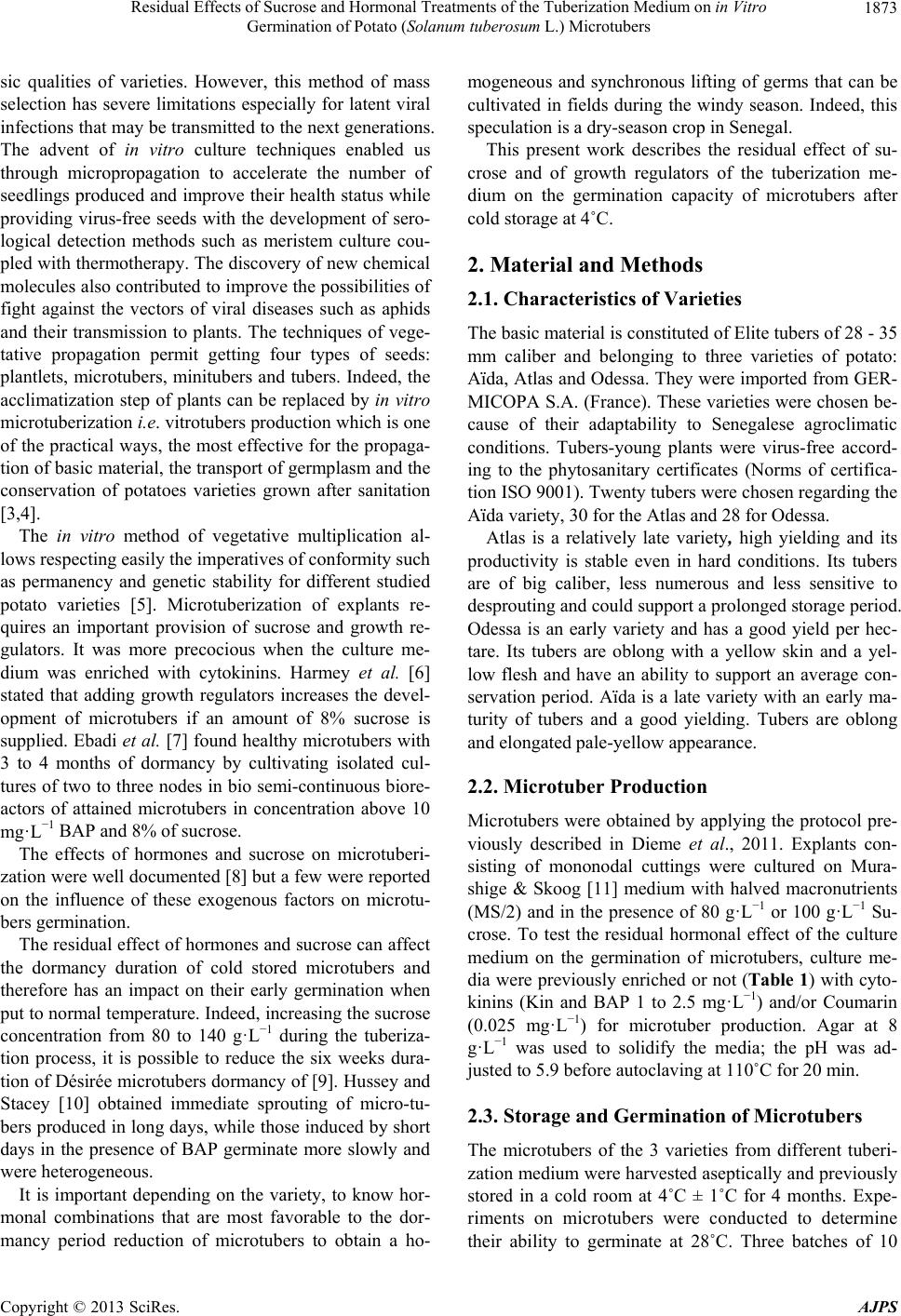 Residual Effects of Sucrose and Hormonal Treatments of the Tuberization Medium on in Vitro Germination of Potato (Solanum tuberosum L.) Microtubers 1873 sic qualities of varieties. However, this method of mass selection has severe limitations especially for latent viral infections that may be transmitted to the next generations. The advent of in vitro culture techniques enabled us through micropropagation to accelerate the number of seedlings produced and improve their health status while providing virus-free seeds with the development of sero- logical detection methods such as meristem culture cou- pled with thermotherapy. The discovery of new chemical molecules also contributed to improve the possibilities of fight against the vectors of viral diseases such as aphids and their transmission to plants. The techniques of vege- tative propagation permit getting four types of seeds: plantlets, microtubers, minitubers and tubers. Indeed, the acclimatization step of plants can be replaced by in vitro microtuberization i.e. vitrotubers production which is one of the practical ways, the most effective for the propaga- tion of basic material, the transport of germplasm and the conservation of potatoes varieties grown after sanitation [3,4]. The in vitro method of vegetative multiplication al- lows respecting easily the imperatives of conformity such as permanency and genetic stability for different studied potato varieties [5]. Microtuberization of explants re- quires an important provision of sucrose and growth re- gulators. It was more precocious when the culture me- dium was enriched with cytokinins. Harmey et al. [6] stated that adding growth regulators increases the devel- opment of microtubers if an amount of 8% sucrose is supplied. Ebadi et al. [7] found healthy microtubers with 3 to 4 months of dormancy by cultivating isolated cul- tures of two to three nodes in bio semi-continuous biore- actors of attained microtubers in concentration above 10 mg· L −1 BAP and 8% of sucrose. The effects of hormones and sucrose on microtuberi- zation were well documented [8] but a few were reported on the influence of these exogenous factors on microtu- bers germination. The residual effect of hormones and sucrose can affect the dormancy duration of cold stored microtubers and therefore has an impact on their early germination when put to normal temperature. Indeed, increasing the sucrose concentration from 80 to 140 g·L−1 during the tuberiza- tion process, it is possible to reduce the six weeks dura- tion of Désirée microtubers dormancy of [9]. Hussey and Stacey [10] obtained immediate sprouting of micro-tu- bers produced in long days, while those induced by short days in the presence of BAP germinate more slowly and were heterogeneous. It is important depending on the variety, to know hor- monal combinations that are most favorable to the dor- mancy period reduction of microtubers to obtain a ho- mogeneous and synchronous lifting of germs that can be cultivated in fields during the windy season. Indeed, this speculation is a dry-season crop in Senegal. This present work describes the residual effect of su- crose and of growth regulators of the tuberization me- dium on the germination capacity of microtubers after cold storage at 4˚C. 2. Material and Methods 2.1. Characteristics of Varieties The basic material is constituted of Elite tubers of 28 - 35 mm caliber and belonging to three varieties of potato: Aïda, Atlas and Odessa. They were imported from GER- MICOPA S.A. (France). These varieties were chosen be- cause of their adaptability to Senegalese agroclimatic conditions. Tubers-young plants were virus-free accord- ing to the phytosanitary certificates (Norms of certifica- tion ISO 9001). Twenty tubers were chosen regarding the Aïda variety, 30 for the Atlas and 28 for Odessa. Atlas is a relatively late variety, high yielding and its productivity is stable even in hard conditions. Its tubers are of big caliber, less numerous and less sensitive to desprouting and could support a prolonged storage period. Odessa is an early variety and has a good yield per hec- tare. Its tubers are oblong with a yellow skin and a yel- low flesh and have an ability to support an average con- servation period. Aïda is a late variety with an early ma- turity of tubers and a good yielding. Tubers are oblong and elongated pale-yellow appearance. 2.2. Microtuber Production Microtubers were obtained by applying the protocol pre- viously described in Dieme et al., 2011. Explants con- sisting of mononodal cuttings were cultured on Mura- shige & Skoog [11] medium with halved macronutrients (MS/2) and in the presence of 80 g·L−1 or 100 g·L−1 Su- crose. To test the residual hormonal effect of the culture medium on the germination of microtubers, culture me- dia were previously enriched or not (Table 1) with cyto- kinins (Kin and BAP 1 to 2.5 mg·L−1) and/or Coumarin (0.025 mg·L−1) for microtuber production. Agar at 8 g·L−1 was used to solidify the media; the pH was ad- justed to 5.9 before autoclaving at 110˚C for 20 min. 2.3. Storage and Germination of Microtubers The microtubers of the 3 varieties from different tuberi- zation medium were harvested aseptically and previously stored in a cold room at 4˚C ± 1˚C for 4 months. Expe- riments on microtubers were conducted to determine their ability to germinate at 28˚C. Three batches of 10 Copyright © 2013 SciRes. AJPS 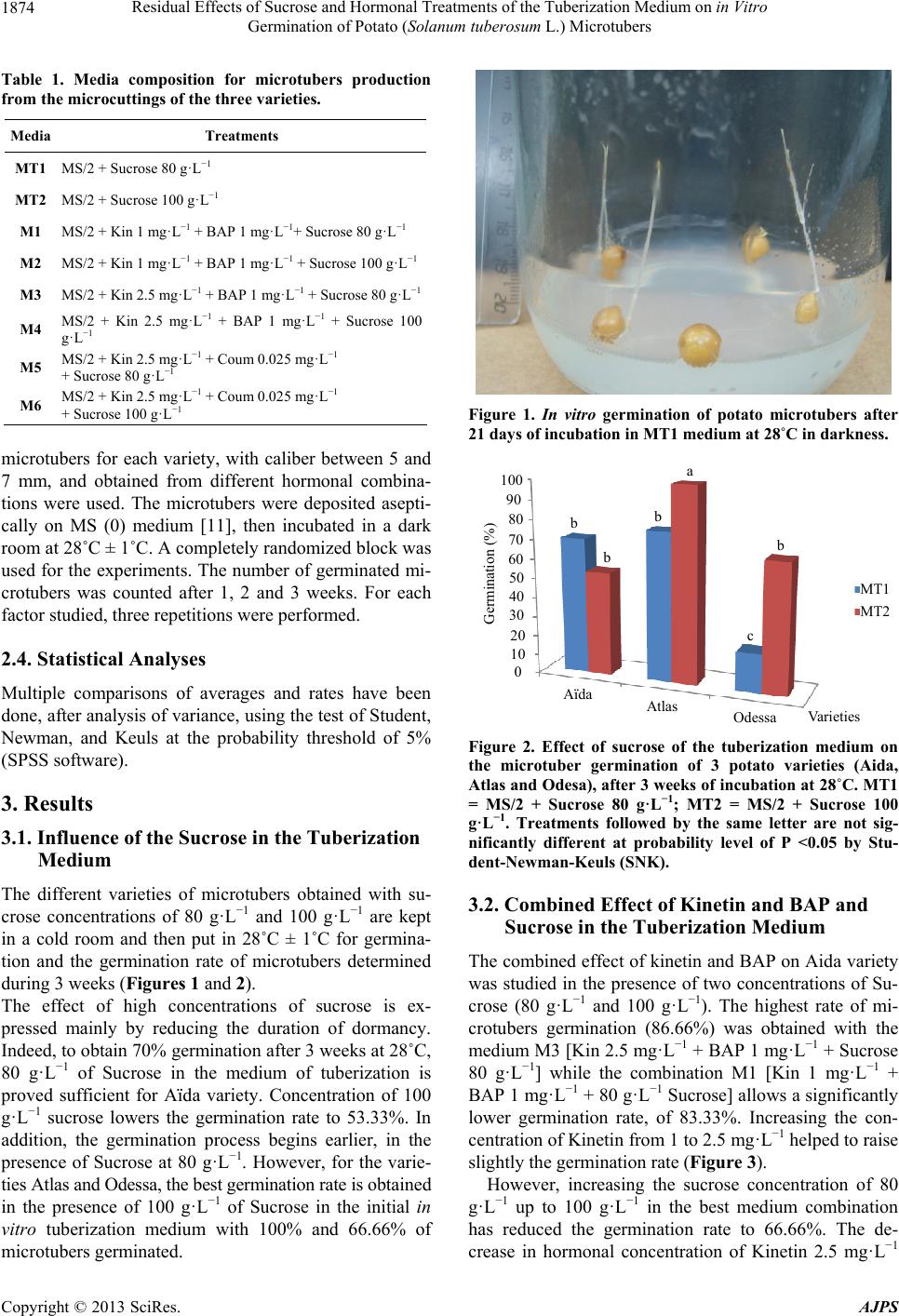 Residual Effects of Sucrose and Hormonal Treatments of the Tuberization Medium on in Vitro Germination of Potato (Solanum tuberosum L.) Microtubers 1874 Table 1. Media composition for microtubers production from the microcuttings of the three varieties. Media Treatments MT1 MS/2 + Sucrose 80 g·L−1 MT2 MS/2 + Sucrose 100 g·L−1 M1 MS/2 + Kin 1 mg·L−1 + BAP 1 mg·L−1+ Sucrose 80 g·L−1 M2 MS/2 + Kin 1 mg·L−1 + BAP 1 mg·L−1 + Sucrose 100 g·L−1 M3 MS/2 + Kin 2.5 mg·L−1 + BAP 1 mg·L−1 + Sucrose 80 g·L−1 M4 MS/2 + Kin 2.5 mg·L−1 + BAP 1 mg·L−1 + Sucrose 100 g·L−1 M5 MS/2 + Kin 2.5 mg·L−1 + Coum 0.025 mg·L−1 + Sucrose 80 g·L−1 M6 MS/2 + Kin 2.5 mg·L−1 + Coum 0.025 mg·L−1 + Sucrose 100 g·L−1 microtubers for each variety, with caliber between 5 and 7 mm, and obtained from different hormonal combina- tions were used. The microtubers were deposited asepti- cally on MS (0) medium [11], then incubated in a dark room at 28˚C ± 1˚C. A completely randomized block was used for the experiments. The number of germinated mi- crotubers was counted after 1, 2 and 3 weeks. For each factor studied, three repetitions were performed. 2.4. Statistical Analyses Multiple comparisons of averages and rates have been done, after analysis of variance, using the test of Student, Newman, and Keuls at the probability threshold of 5% (SPSS software). 3. Results 3.1. Influence of the Sucrose in the Tuberization Medium The different varieties of microtubers obtained with su- crose concentrations of 80 g·L−1 and 100 g·L−1 are kept in a cold room and then put in 28˚C ± 1˚C for germina- tion and the germination rate of microtubers determined during 3 weeks (Figures 1 and 2). The effect of high concentrations of sucrose is ex- pressed mainly by reducing the duration of dormancy. Indeed, to obtain 70% germination after 3 weeks at 28˚C, 80 g·L−1 of Sucrose in the medium of tuberization is proved sufficient for Aïda variety. Concentration of 100 g·L−1 sucrose lowers the germination rate to 53.33%. In addition, the germination process begins earlier, in the presence of Sucrose at 80 g·L−1. However, for the varie- ties Atlas and Odessa, the best germination rate is obtained in the presence of 100 g·L−1 of Sucrose in the initial in vitro tuberization medium with 100% and 66.66% of microtubers germinated. Figure 1. In vitro germination of potato microtubers after 21 days of incubation in MT1 medium at 28˚C in darkness. MT1 Germination ( % ) MT2 0 10 20 30 40 50 60 70 80 90 100 b b b b a c A ïda Atlas Odessa Varieties Figure 2. Effect of sucrose of the tuberization medium on the microtuber germination of 3 potato varieties (Aida, Atlas and Odesa), after 3 weeks of incubation at 28˚C. MT1 = MS/2 + Sucrose 80 g·L−1; MT2 = MS/2 + Sucrose 100 g·L−1. Treatments followed by the same letter are not sig- nificantly different at probability level of P <0.05 by Stu- dent-Newman-Keuls (SNK). 3.2. Combined Effect of Kinetin and BAP and Sucrose in the Tuberization Medium The combined effect of kinetin and BAP on Aida variety was studied in the presence of two concentrations of Su- crose (80 g·L−1 and 100 g·L−1). The highest rate of mi- crotubers germination (86.66%) was obtained with the medium M3 [Kin 2.5 mg·L−1 + BAP 1 mg·L−1 + Sucrose 80 g·L−1] while the combination M1 [Kin 1 mg·L−1 + BAP 1 mg·L−1 + 80 g·L−1 Sucrose] allows a significantly lower germination rate, of 83.33%. Increasing the con- centration of Kinetin from 1 to 2.5 mg·L−1 helped to raise slightly the germination rate (Figure 3). However, increasing the sucrose concentration of 80 g·L−1 up to 100 g·L−1 in the best medium combination has reduced the germination rate to 66.66%. The de- crease in hormonal concentration of Kinetin 2.5 mg·L−1 Copyright © 2013 SciRes. AJPS 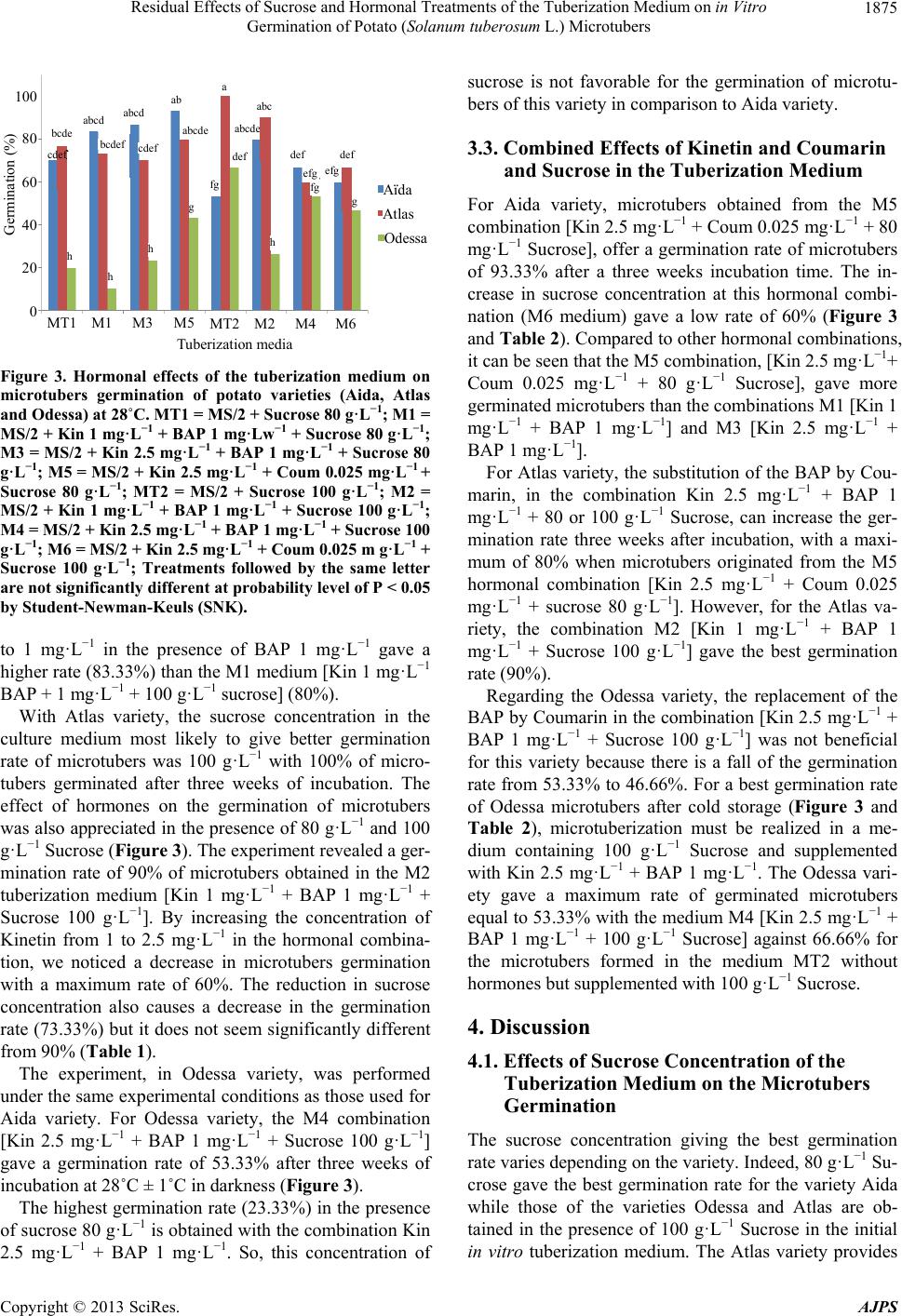 Residual Effects of Sucrose and Hormonal Treatments of the Tuberization Medium on in Vitro Germination of Potato (Solanum tuberosum L.) Microtubers 1875 MT1 Germination ( % ) MT2 0 Aïda Atlas Odessa M1 M3 M5 M2 M4 M6 Tuberization media 20 40 60 80 100 bcde abcd abcd abcde abcde abc def def def ab a h h h h g g fg efg fg efg b cdef cdef cdef Figure 3. Hormonal effects of the tuberization medium on microtubers germination of potato varieties (Aida, Atlas and Odessa) at 28˚C. MT1 = MS/2 + Sucrose 80 g·L−1; M1 = MS/2 + Kin 1 mg·L−1 + BAP 1 mg·Lw−1 + Sucrose 80 g·L−1; M3 = MS/2 + Kin 2.5 mg·L−1 + BAP 1 mg·L−1 + Sucrose 80 g·L−1; M5 = MS/2 + Kin 2.5 mg·L−1 + Coum 0.025 mg·L−1 + Sucrose 80 g·L−1; MT2 = MS/2 + Sucrose 100 g·L−1; M2 = MS/2 + Kin 1 mg·L−1 + BAP 1 mg·L−1 + Sucrose 100 g·L−1; M4 = MS/2 + Kin 2.5 mg·L−1 + BAP 1 mg·L−1 + Sucrose 100 g·L−1; M6 = MS/2 + Kin 2.5 mg·L−1 + Coum 0.025 m g·L−1 + Sucrose 100 g·L−1; Treatments followed by the same letter are not significantly different at probability level of P < 0.05 by Student-Newman-Keuls (SNK). to 1 mg·L−1 in the presence of BAP 1 mg·L−1 gave a higher rate (83.33%) than the M1 medium [Kin 1 mg·L−1 BAP + 1 mg·L−1 + 100 g·L−1 sucrose] (80%). With Atlas variety, the sucrose concentration in the culture medium most likely to give better germination rate of microtubers was 100 g·L−1 with 100% of micro- tubers germinated after three weeks of incubation. The effect of hormones on the germination of microtubers was also appreciated in the presence of 80 g·L−1 and 100 g·L−1 Sucrose (Figure 3). The experiment revealed a ger- mination rate of 90% of microtubers obtained in the M2 tuberization medium [Kin 1 mg·L−1 + BAP 1 mg·L−1 + Sucrose 100 g·L−1]. By increasing the concentration of Kinetin from 1 to 2.5 mg·L−1 in the hormonal combina- tion, we noticed a decrease in microtubers germination with a maximum rate of 60%. The reduction in sucrose concentration also causes a decrease in the germination rate (73.33%) but it does not seem significantly different from 90% (Table 1). The experiment, in Odessa variety, was performed under the same experimental conditions as those used for Aida variety. For Odessa variety, the M4 combination [Kin 2.5 mg·L−1 + BAP 1 mg·L−1 + Sucrose 100 g·L−1] gave a germination rate of 53.33% after three weeks of incubation at 28˚C ± 1˚C in darkness (Figure 3). The highest germination rate (23.33%) in the presence of sucrose 80 g·L−1 is obtained with the combination Kin 2.5 mg·L−1 + BAP 1 mg·L−1. So, this concentration of sucrose is not favorable for the germination of microtu- bers of this variety in comparison to Aida variety. 3.3. Combined Effects of Kinetin and Coumarin and Sucrose in the Tuberization Medium For Aida variety, microtubers obtained from the M5 combination [Kin 2.5 mg·L−1 + Coum 0.025 mg·L−1 + 80 mg· L −1 Sucrose], offer a germination rate of microtubers of 93.33% after a three weeks incubation time. The in- crease in sucrose concentration at this hormonal combi- nation (M6 medium) gave a low rate of 60% (Figure 3 and Table 2). Compared to other hormonal combinations, it can be seen that the M5 combination, [Kin 2.5 mg·L−1+ Coum 0.025 mg·L−1 + 80 g·L−1 Sucrose], gave more germinated microtubers than the combinations M1 [Kin 1 mg· L −1 + BAP 1 mg·L−1] and M3 [Kin 2.5 mg·L−1 + BAP 1 mg·L−1]. For Atlas variety, the substitution of the BAP by Cou- marin, in the combination Kin 2.5 mg·L−1 + BAP 1 mg· L −1 + 80 or 100 g·L−1 Sucrose, can increase the ger- mination rate three weeks after incubation, with a maxi- mum of 80% when microtubers originated from the M5 hormonal combination [Kin 2.5 mg·L−1 + Coum 0.025 mg· L −1 + sucrose 80 g·L−1]. However, for the Atlas va- riety, the combination M2 [Kin 1 mg·L−1 + BAP 1 mg· L −1 + Sucrose 100 g·L−1] gave the best germination rate (90%). Regarding the Odessa variety, the replacement of the BAP by Coumarin in the combination [Kin 2.5 mg·L−1 + BAP 1 mg·L−1 + Sucrose 100 g·L−1] was not beneficial for this variety because there is a fall of the germination rate from 53.33% to 46.66%. For a best germination rate of Odessa microtubers after cold storage (Figure 3 and Table 2), microtuberization must be realized in a me- dium containing 100 g·L−1 Sucrose and supplemented with Kin 2.5 mg·L−1 + BAP 1 mg·L−1. The Odessa vari- ety gave a maximum rate of germinated microtubers equal to 53.33% with the medium M4 [Kin 2.5 mg·L−1 + BAP 1 mg·L−1 + 100 g·L−1 Sucrose] against 66.66% for the microtubers formed in the medium MT2 without hormones but supplemented with 100 g·L−1 Sucrose. 4. Discussion 4.1. Effects of Sucrose Concentration of the Tuberization Medium on the Microtubers Germination The sucrose concentration giving the best germination rate varies depending on the variety. Indeed, 80 g·L−1 Su- crose gave the best germination rate for the variety Aida while those of the varieties Odessa and Atlas are ob- tained in the presence of 100 g·L−1 Sucrose in the initial in vitro tuberization mediumhe Atlas variety provides . T Copyright © 2013 SciRes. AJPS 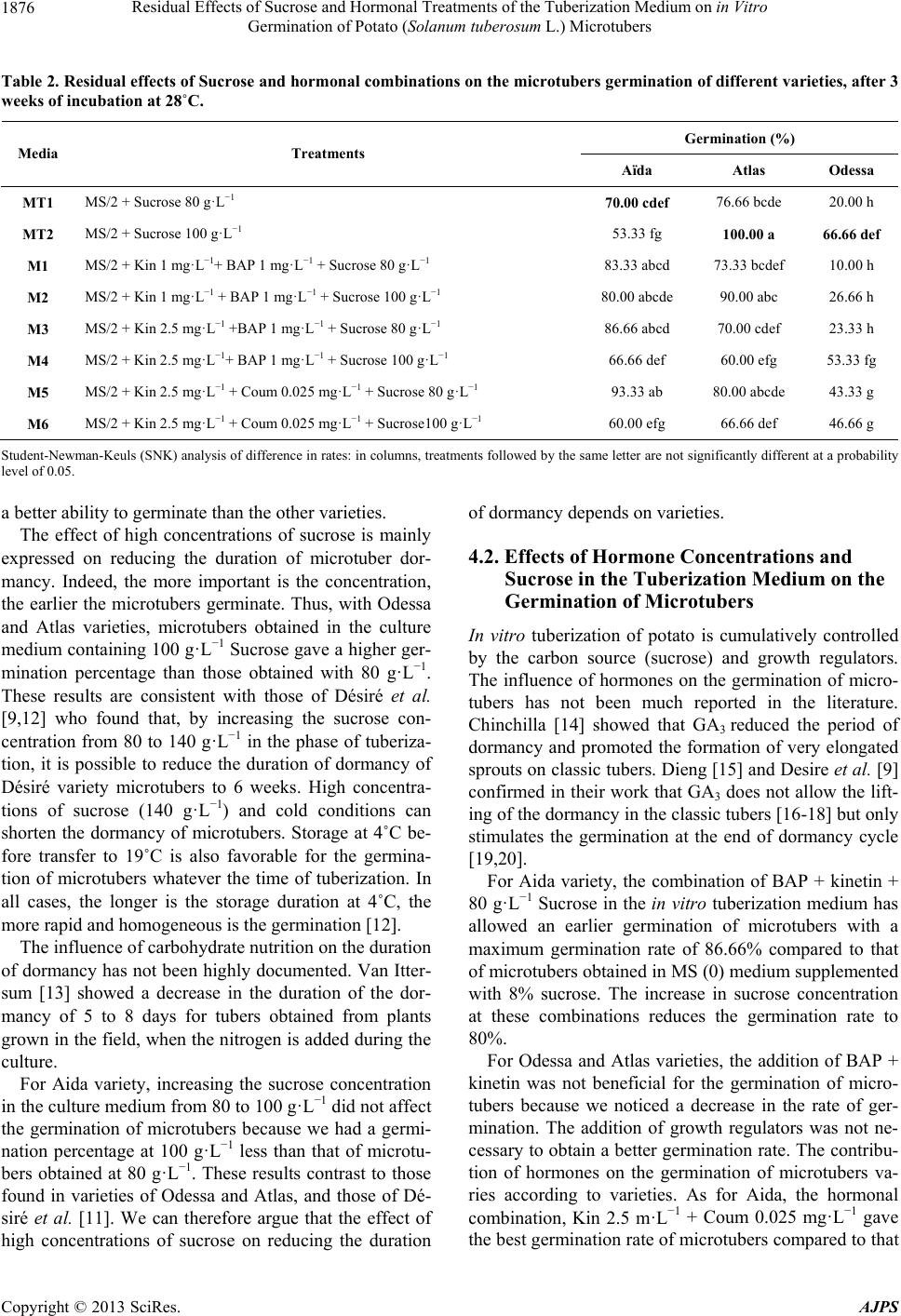 Residual Effects of Sucrose and Hormonal Treatments of the Tuberization Medium on in Vitro Germination of Potato (Solanum tuberosum L.) Microtubers Copyright © 2013 SciRes. AJPS 1876 Table 2. Residual effects of Sucrose and hormonal combinations on the microtubers germination of different varieties, after 3 weeks of incubation at 28˚C. Germination (%) Media Treatments Aïda Atlas Odessa MT1 MS/2 + Sucrose 80 g·L−1 70.00 cdef 76.66 bcde 20.00 h MT2 MS/2 + Sucrose 100 g·L−1 53.33 fg 100.00 a 66.66 def M1 MS/2 + Kin 1 mg·L−1+ BAP 1 mg·L−1 + Sucrose 80 g·L−1 83.33 abcd 73.33 bcdef 10.00 h M2 MS/2 + Kin 1 mg·L−1 + BAP 1 mg·L−1 + Sucrose 100 g·L−1 80.00 abcde 90.00 abc 26.66 h M3 MS/2 + Kin 2.5 mg·L−1 +BAP 1 mg·L−1 + Sucrose 80 g·L−1 86.66 abcd 70.00 cdef 23.33 h M4 MS/2 + Kin 2.5 mg·L−1+ BAP 1 mg·L−1 + Sucrose 100 g·L−1 66.66 def 60.00 efg 53.33 fg M5 MS/2 + Kin 2.5 mg·L−1 + Coum 0.025 mg·L−1 + Sucrose 80 g·L−1 93.33 ab 80.00 abcde 43.33 g M6 MS/2 + Kin 2.5 mg·L−1 + Coum 0.025 mg·L−1 + Sucrose100 g·L−1 60.00 efg 66.66 def 46.66 g Student-Newman-Keuls (SNK) analysis of difference in rates: in columns, treatments followed by the same letter are not significantly different at a probability level of 0.05. a better ability to germinate than the other varieties. The effect of high concentrations of sucrose is mainly expressed on reducing the duration of microtuber dor- mancy. Indeed, the more important is the concentration, the earlier the microtubers germinate. Thus, with Odessa and Atlas varieties, microtubers obtained in the culture medium containing 100 g·L−1 Sucrose gave a higher ger- mination percentage than those obtained with 80 g·L−1. These results are consistent with those of Désiré et al. [9,12] who found that, by increasing the sucrose con- centration from 80 to 140 g·L−1 in the phase of tuberiza- tion, it is possible to reduce the duration of dormancy of Désiré variety microtubers to 6 weeks. High concentra- tions of sucrose (140 g·L−1) and cold conditions can shorten the dormancy of microtubers. Storage at 4˚C be- fore transfer to 19˚C is also favorable for the germina- tion of microtubers whatever the time of tuberization. In all cases, the longer is the storage duration at 4˚C, the more rapid and homogeneous is the germination [12]. The influence of carbohydrate nutrition on the duration of dormancy has not been highly documented. Van Itter- sum [13] showed a decrease in the duration of the dor- mancy of 5 to 8 days for tubers obtained from plants grown in the field, when the nitrogen is added during the culture. For Aida variety, increasing the sucrose concentration in the culture medium from 80 to 100 g·L−1 did not affect the germination of microtubers because we had a germi- nation percentage at 100 g·L−1 less than that of microtu- bers obtained at 80 g·L−1. These results contrast to those found in varieties of Odessa and Atlas, and those of Dé- siré et al. [11]. We can therefore argue that the effect of high concentrations of sucrose on reducing the duration of dormancy depends on varieties. 4.2. Effects of Hormone Concentrations and Sucrose in the Tuberization Medium on the Germination of Microtubers In vitro tuberization of potato is cumulatively controlled by the carbon source (sucrose) and growth regulators. The influence of hormones on the germination of micro- tubers has not been much reported in the literature. Chinchilla [14] showed that GA3 reduced the period of dormancy and promoted the formation of very elongated sprouts on classic tubers. Dieng [15] and Desire et al. [9] confirmed in their work that GA3 does not allow the lift- ing of the dormancy in the classic tubers [16-18] but only stimulates the germination at the end of dormancy cycle [19,20]. For Aida variety, the combination of BAP + kinetin + 80 g·L−1 Sucrose in the in vitro tuberization medium has allowed an earlier germination of microtubers with a maximum germination rate of 86.66% compared to that of microtubers obtained in MS (0) medium supplemented with 8% sucrose. The increase in sucrose concentration at these combinations reduces the germination rate to 80%. For Odessa and Atlas varieties, the addition of BAP + kinetin was not beneficial for the germination of micro- tubers because we noticed a decrease in the rate of ger- mination. The addition of growth regulators was not ne- cessary to obtain a better germination rate. The contribu- tion of hormones on the germination of microtubers va- ries according to varieties. As for Aida, the hormonal combination, Kin 2.5 m·L−1 + Coum 0.025 mg·L−1 gave the best germination rate of microtubers compared to that 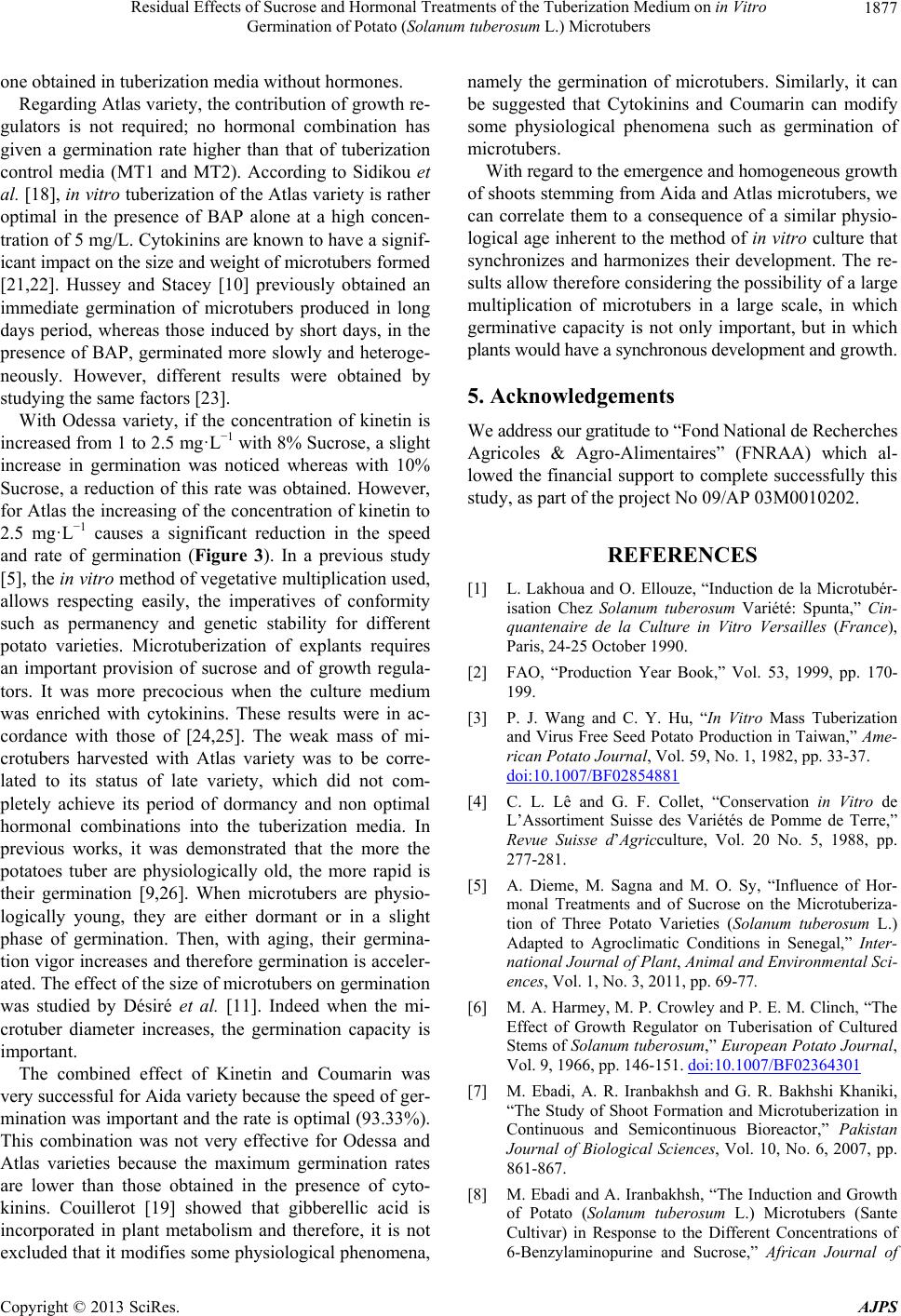 Residual Effects of Sucrose and Hormonal Treatments of the Tuberization Medium on in Vitro Germination of Potato (Solanum tuberosum L.) Microtubers 1877 one obtained in tuberization media without hormones. Regarding Atlas variety, the contribution of growth re- gulators is not required; no hormonal combination has given a germination rate higher than that of tuberization control media (MT1 and MT2). According to Sidikou et al. [18], in vitro tuberization of the Atlas variety is rather optimal in the presence of BAP alone at a high concen- tration of 5 mg/L. Cytokinins are known to have a signif- icant impact on the size and weight of microtubers formed [21,22]. Hussey and Stacey [10] previously obtained an immediate germination of microtubers produced in long days period, whereas those induced by short days, in the presence of BAP, germinated more slowly and heteroge- neously. However, different results were obtained by studying the same factors [23]. With Odessa variety, if the concentration of kinetin is increased from 1 to 2.5 mg·L−1 with 8% Sucrose, a slight increase in germination was noticed whereas with 10% Sucrose, a reduction of this rate was obtained. However, for Atlas the increasing of the concentration of kinetin to 2.5 mg·L−1 causes a significant reduction in the speed and rate of germination (Figure 3). In a previous study [5], the in vitro method of vegetative multiplication used, allows respecting easily, the imperatives of conformity such as permanency and genetic stability for different potato varieties. Microtuberization of explants requires an important provision of sucrose and of growth regula- tors. It was more precocious when the culture medium was enriched with cytokinins. These results were in ac- cordance with those of [24,25]. The weak mass of mi- crotubers harvested with Atlas variety was to be corre- lated to its status of late variety, which did not com- pletely achieve its period of dormancy and non optimal hormonal combinations into the tuberization media. In previous works, it was demonstrated that the more the potatoes tuber are physiologically old, the more rapid is their germination [9,26]. When microtubers are physio- logically young, they are either dormant or in a slight phase of germination. Then, with aging, their germina- tion vigor increases and therefore germination is acceler- ated. The effect of the size of microtubers on germination was studied by Désiré et al. [11]. Indeed when the mi- crotuber diameter increases, the germination capacity is important. The combined effect of Kinetin and Coumarin was very successful for Aida variety because the speed of ger- mination was important and the rate is optimal (93.33%). This combination was not very effective for Odessa and Atlas varieties because the maximum germination rates are lower than those obtained in the presence of cyto- kinins. Couillerot [19] showed that gibberellic acid is incorporated in plant metabolism and therefore, it is not excluded that it modifies some physiological phenomena, namely the germination of microtubers. Similarly, it can be suggested that Cytokinins and Coumarin can modify some physiological phenomena such as germination of microtubers. With regard to the emergence and homogeneous growth of shoots stemming from Aida and Atlas microtubers, we can correlate them to a consequence of a similar physio- logical age inherent to the method of in vitro culture that synchronizes and harmonizes their development. The re- sults allow therefore considering the possibility of a large multiplication of microtubers in a large scale, in which germinative capacity is not only important, but in which plants would have a synchronous development and growth. 5. Acknowledgements We address our gratitude to “Fond National de Recherches Agricoles & Agro-Alimentaires” (FNRAA) which al- lowed the financial support to complete successfully this study, as part of the project No 09/AP 03M0010202. REFERENCES [1] L. Lakhoua and O. Ellouze, “Induction de la Microtubér- isation Chez Solanum tuberosum Variété: Spunta,” Cin- quantenaire de la Culture in Vitro Versailles (France), Paris, 24-25 October 1990. [2] FAO, “Production Year Book,” Vol. 53, 1999, pp. 170- 199. [3] P. J. Wang and C. Y. Hu, “In Vitro Mass Tuberization and Virus Free Seed Potato Production in Taiwan,” Ame- rican Potato Journal, Vol. 59, No. 1, 1982, pp. 33-37. doi:10.1007/BF02854881 [4] C. L. Lê and G. F. Collet, “Conservation in Vitro de L’Assortiment Suisse des Variétés de Pomme de Terre,” Revue Suisse d’Agricculture, Vol. 20 No. 5, 1988, pp. 277-281. [5] A. Dieme, M. Sagna and M. O. Sy, “Influence of Hor- monal Treatments and of Sucrose on the Microtuberiza- tion of Three Potato Varieties (Solanum tuberosum L.) Adapted to Agroclimatic Conditions in Senegal,” Inter- national Journal of Plant, Animal and Environmental Sci- ences, Vol. 1, No. 3, 2011, pp. 69-77. [6] M. A. Harmey, M. P. Crowley and P. E. M. Clinch, “The Effect of Growth Regulator on Tuberisation of Cultured Stems of Solanum tuberosum,” European Potato Journal, Vol. 9, 1966, pp. 146-151. doi:10.1007/BF02364301 [7] M. Ebadi, A. R. Iranbakhsh and G. R. Bakhshi Khaniki, “The Study of Shoot Formation and Microtuberization in Continuous and Semicontinuous Bioreactor,” Pakistan Journal of Biological Sciences, Vol. 10, No. 6, 2007, pp. 861-867. [8] M. Ebadi and A. Iranbakhsh, “The Induction and Growth of Potato (Solanum tuberosum L.) Microtubers (Sante Cultivar) in Response to the Different Concentrations of 6-Benzylaminopurine and Sucrose,” African Journal of Copyright © 2013 SciRes. AJPS  Residual Effects of Sucrose and Hormonal Treatments of the Tuberization Medium on in Vitro Germination of Potato (Solanum tuberosum L.) Microtubers Copyright © 2013 SciRes. AJPS 1878 Biotechnology, Vol. 10, No. 52, 2011, pp. 10626-10635. [9] S. Désiré, J. P. Couillerot, J. Hilbert and L. J. Vasseur, “Protein Exchange in Solanum tuberosum L. during Stor- age and Dormancy Breaking of in Vitro Microtubers,” Plant Physiology and Biochemistry, Vol. 33, No. 4, 1995, pp. 479-487. [10] G. Hussey and N. J. Stacey, “In Vitro Propagation of Potato (Solanum tuberosum L.),” Annals of Botany, Vol. 48, No. 6, 1981, pp. 787-796. [11] T. Murashige and F. Skoog, “A Revised Medium for Ra- pid Growth and Bioassays, with Tobacco Tissue Culture,” Physiologia Plantarum, Vol. 15, No. 3, 1962, pp. 473- 497. doi:10.1111/j.1399-3054.1962.tb08052.x [12] S. Désiré, J. P. Couillerot, J. Hilbert and L. J. Vasseur, “Dormancy and Germination of Microtubers of Potato (Solanum tuberosum L.) Produced in Vitro: Effects of Sucrose Concentration in the Medium of Tuberization, the Shelf Life at 4˚C and Treatment with Gibberellic Acid,” Acta Botanica Gallica, Vol. 142, No. 4, 1995, pp. 371-378. doi:10.1080/12538078.1995.10515257 [13] M. K. Van Ittersum, “Relation between Growth Condi- tions and Dormancy of Seed Potatoes: Effects of Nitro- gen,” Potato Research, Vol. 35, No. 4, 1992, pp. 355- 364. doi:10.1007/BF02357592 [14] C. M. Chinchilla, “Effecto Temperature Almacenamiento y Algunas Sustancia Quimica in the Interrupcion del Papa Reposo TB (Solanum tuberosum L.). Cv. Atzimba,” Ag- ronomy Costarr, Vol. 9, No. 2, 1985, pp. 187-191. [15] A. Dieng, “Microtuberization and Micropropagation of Two Varieties of Potato (Solanum tuberosum L.) Adapted to the Agro-Climatic Conditions in Senegal,” Mémoire de DEA, Université Cheikh Anta Diop de Dakar, FST/BV, 1993. [16] C. G. N. Turnbull and D. E. Hanke, “The Control of Bud Dormancy in Potato Solanum tuberosum Cultivar Majes- tic Tubers: Evidence for the Primary Role of Cytokinins and a Seasonal Pattern of Changing Sensibility to Cyto- kinins,” Planta, Vol. 165, 1985, pp. 359-365. doi:10.1007/BF00392233 [17] H. Mioduszewska and M. Biclinska-Czarnecka, “Influ- ence of GA3 Treatment on Acid Phosphatase Activity in Potato Tubers towards the End of Growth, in Dormancy and Sprouting,” Acta Physiologiae Plantarum, Vol. 6, No. 21, 1984, pp. 75-81. [18] R. D. S. Sidikou, D. Sihachakr, D. Lavergne, A. Nato, D. Ellissèche, B. Jouan and G. Ducreux, “Study of Microtu- berisation of Potato (Solanum tuberosum L.) in the Sa- hel,” Revue Agriculture (Montrouge), Vol. 12, No. 1, 2003, pp. 7-14. [19] J. P. Couillerot, “Effects and Distribution of 14C-Gib- berellic Acid Application to Seed after Potato Microtu- bers,” Phyton, Vol. 54, 1993, pp. 67-73. [20] A. Dieme, “Influence de Traitements Hormonaux et du Saccharose sur la Capacité Germinative de Microtuber- cules de Pomme de Terre Après Conservation au Froid,” Mémoire de DEA, Université Cheikh Anta Diop de Dakar, FST/BV, 2006. [21] Y. Du Jardin, C. Hdider and J. de Rick, “Carbon Nutrition in Vitro Regulation and Manipulation of Carbon Assimi- lation in Micropropagated System. Automaten and Envi- ronmental Control in Plant Tissue Culture,” Kluwer Aca- demic Publishers, Dordrecht, 1995, pp. 411-471. [22] T. Roitch and R. Ehness, “Regulation of Sucrose/Sink Relations by Cytokinins,” Plant Growth Regulation Jour- nal, Vol. 32, 2000, pp. 359-367. [23] A. J. Abbot and A. R. Belcher, “Potato Tuber Formation in Vitro. Plant Tissue Culture and Its Agricultural Appli- cation,” Butterworths, Vol. 11, 1986, pp. 113-122. [24] C. L. Lê and D. Thomas, “Production de Microtubercules de Pomme de Terre in Vitro: Effet de la Durée de Cul- ture,” Recherche Agronomique Suisse, Vol. 1, No. 11-12, 2010, pp. 404-409. [25] F. Mani, M. Mhamdi, T. Ettaieb and C. Annachi, “Effet du Saccharose sur la Tubérisation in Vitro de la Pomme de Terre (Solanum tuberosum L.),” Revue Nature & Tech- nologie, Vol. 7, 2012, pp. 38-43. [26] N. J. Vakis, “Influence of Physiological Ageing of Seed Potatoes on Yield and Earliness,” Potato Research, Vol. 29, No. 3, 1986, pp. 417-425. doi:10.1007/BF02359973 |