

Paper Menu >>
Journal Menu >>
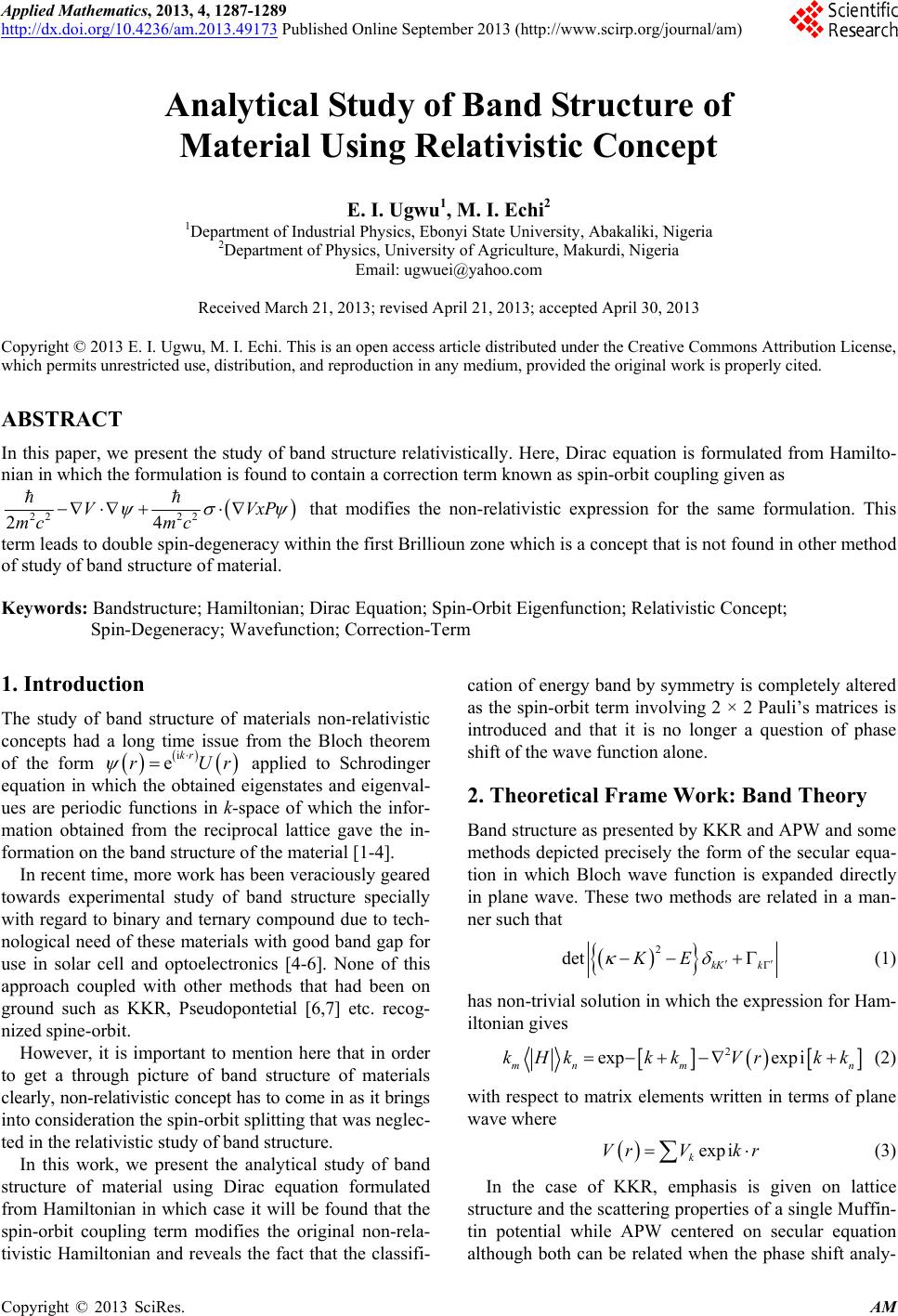 Applied Mathematics, 2013, 4, 1287-1289 http://dx.doi.org/10.4236/am.2013.49173 Published Online September 2013 (http://www.scirp.org/journal/am) Analytical Study of Band Structure of Material Using Relativistic Concept E. I. Ugwu1, M. I. Echi2 1Department of Industrial Physics, Ebonyi State University, Abakaliki, Nigeria 2Department of Physics, University of Agriculture, Makurdi, Nigeria Email: [email protected] Received March 21, 2013; revised April 21, 2013; accepted April 30, 2013 Copyright © 2013 E. I. Ugwu, M. I. Echi. This is an open access article distributed under the Creative Commons Attribution License, which permits unrestricted use, distribution, and reproduction in any medium, provided the original work is properly cited. ABSTRACT In this paper, we present the study of band structure relativistically. Here, Dirac equation is formulated from Hamilto- nian in which the formulation is found to contain a correction term known as spin-orbit coupling given as 22 22 24 V mc mc V xP r tivistic Hamiltonian and reveals the fact that the classifi- 2. Theoretical Frame Work: Band Theory e that modifies the non-relativistic expression for the same formulation. This term leads to double spin-degeneracy within the first Brillioun zone which is a concept that is not found in other method of study of band structure of material. Keywords: Bandstructure; Hamiltonian; Dirac Equation; Spin-Orbit Eigenfunction; Relativistic Concept; Spin-Degeneracy; Wavefunction; Correction-Term 1. Introduction The study of band structure of materials non-relativistic concepts had a long time issue from the Bloch theorem of the form applied to Schrodinger equation in which the obtained eigenstates and eigenval- ues are periodic functions in k-space of which the infor- mation obtained from the reciprocal lattice gave the in- formation on the band structure of the material [1-4]. i ekr rU In recent time, more work has been veraciously geared towards experimental study of band structure specially with regard to binary and ternary compound due to tech- nological need of these materials with good band gap for use in solar cell and optoelectronics [4-6]. None of this approach coupled with other methods that had been on ground such as KKR, Pseudopontetial [6,7] etc. recog- nized spine-orbit. However, it is important to mention here that in order to get a through picture of band structure of materials clearly, non-relativistic concept has to come in as it brings into consideration the spin-orbit splitting that was neglec- ted in the relativistic study of band structure. In this work, we present the analytical study of band structure of material using Dirac equation formulated from Hamiltonian in which case it will be found that the spin-orbit coupling term modifies the original non-rela- cation of energy band by symmetry is completely altered as the spin-orbit term involving 2 × 2 Pauli’s matrices is introduced and that it is no longer a question of phase shift of the wave function alone. Band structure as presented by KKR and APW and som methods depicted precisely the form of the secular equa- tion in which Bloch wave function is expanded directly in plane wave. These two methods are related in a man- ner such that 2 det kK k KE (1) has non-trivial solution in which the expression for Ham- iltonian gives 2 expexp i mn mn kk Vrkk (2) with respect to matrix elements written in terms of p kHk lane wave where exp i k VrV kr (3) In the case of KKR, emphasis is give st n on lattice ructure and the scattering properties of a single Muffin- tin potential while APW centered on secular equation although both can be related when the phase shift analy- C opyright © 2013 SciRes. AM 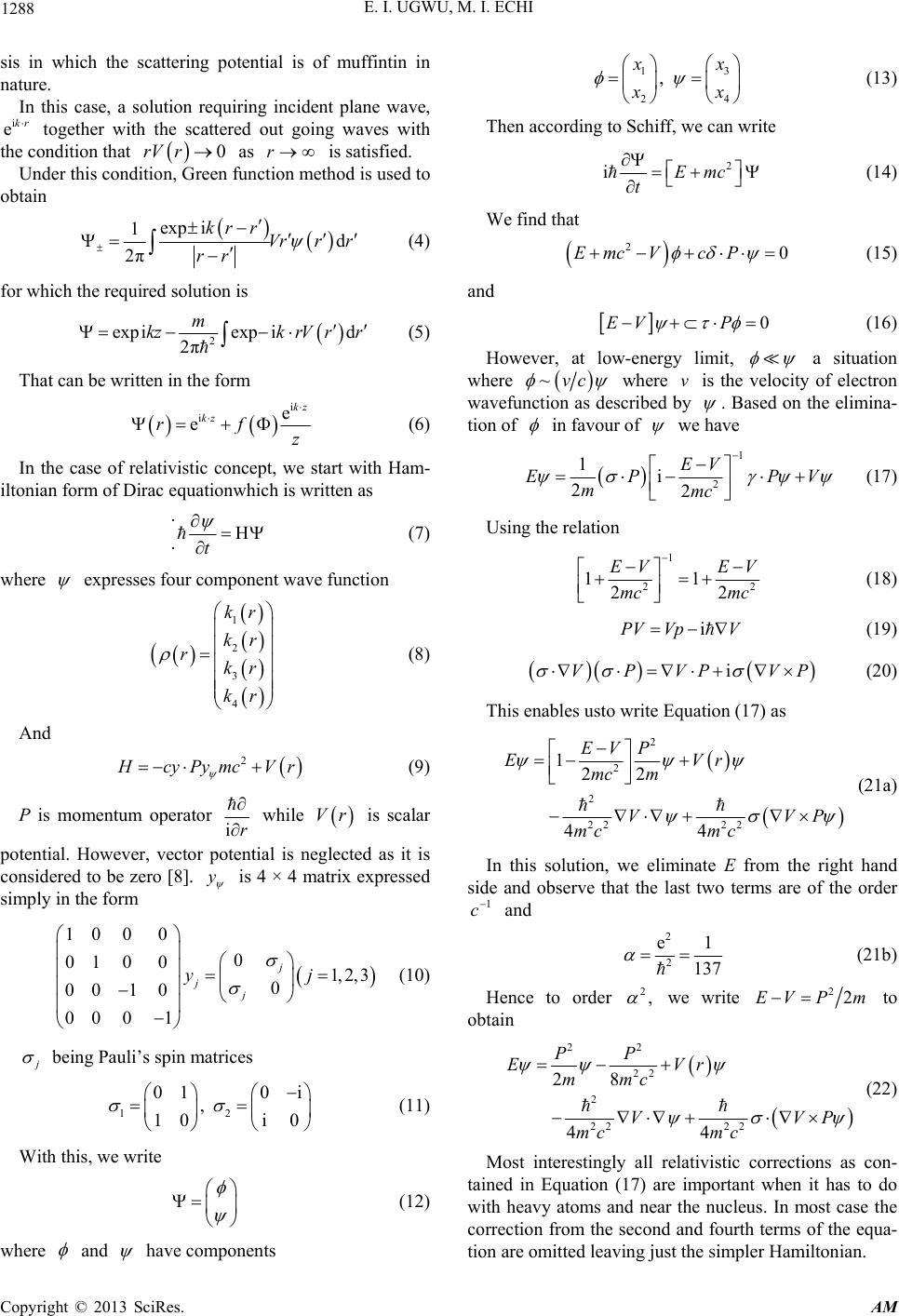 E. I. UGWU, M. I. ECHI 1288 sis in which the scattering potential is of muffintin in nature. In this case, a solution requiring incident plane wave, ob i ekr the c together with the scattered out going waves with ondition that 0rV r as r is satisfied. Under this condi functthod is used to tion, Greenion me tain exp i 1d 2π kr rVrr r rr (4) for which the required solution is 2 expiexp id 2π m kzk rVrr (5) That can be written in the form i ie e kz kz rf z (6) In the case of relativistic concept, we start with Ham- iltonian form of Dirac equationwhich is written as t (7) where expresses four component wave function (8) And 1 2 3 4 kr rkr kr kr 2 H cyPy mcVr (9) P is momentum operator ir while is scalar poten glected Vr tential. However, vector potial is ne as it is considered to be zero [8]. y is 4 × 4 matrix expressed simply in the form 10 0 0 0 01 001, 2, 3 0 001 0 00 01 j jj yj (10) j being Pauli’s spin matrices (11) With this, we write 12 i , 10i 0 01 0 (12) where and have components 4 13 2 , x x x x (13) Then according to Schiff, we can write 2 iEmc t (14) We find that 20mcVc P E (15) and 0EV P (16) However, at low-energy limit, a situation where ~vc where v is the velocity of electron wavefunscribed b ction as dey . Based on the elimina- tion of in favour of we ve ha 1 1EV 2 i 22 EP PV mmc (17) Using the relation 1 22 11 22 EV EV mc mc (18) iPV VpV (19) iVPVP VP (20) This enables usto write Equation (17) as 2 EVP 2 2 22 22 122 44 EVr mmc VVP mc mc (21a) In this solution, we eliminate E from the right hand si de and observe that the last two terms are of the order 1 c and 2 2 e1 137 (21b) Hence to order 2, we write 22EV Pm to obtain 22 22 2 22 22 28 44 PP EVr mmc VV mc mc P (22) Most interestingly all relativistic corrections as con- tained in Equation (17) are important when it has to do with heavy atoms and near the nucleus. In most case the correction from the second and fourth terms of the equa- tion are omitted leaving just the simpler Hamiltonian. Copyright © 2013 SciRes. AM 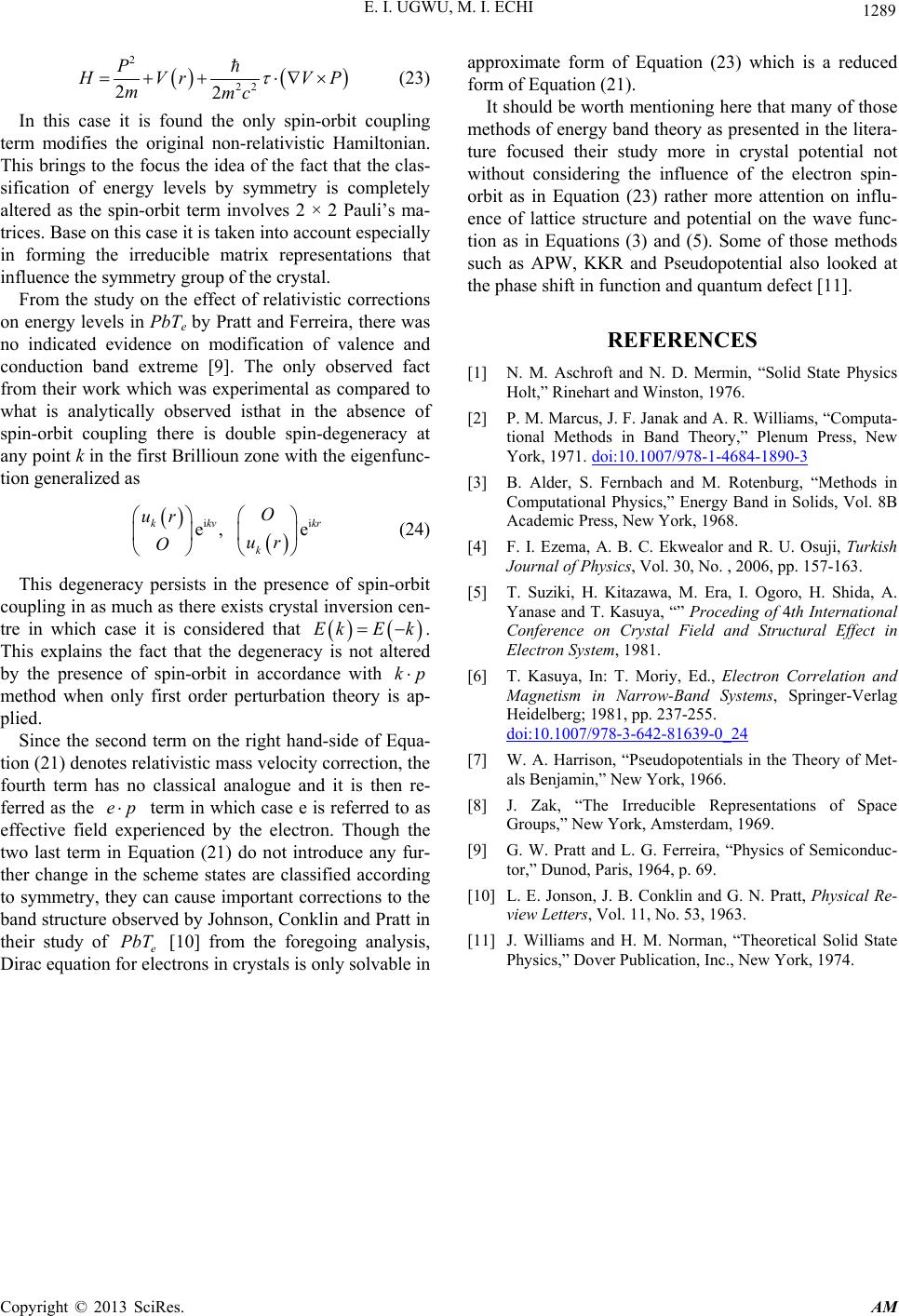 E. I. UGWU, M. I. ECHI Copyright © 2013 SciRes. AM 1289 2 22 22 P H VrV P mmc (23) In this case it is found the only spin-orb term modifies the original non-relativistic Ham Th it coupling iltonian. is brings to the focus the idea of the fact that the clas- sification of energy levels by symmetry is completely altered as the spin-orbit term involves 2 × 2 Pauli’s ma- trices. Base on this case it is taken into account especially in forming the irreducible matrix representations that influence the symmetry group of the crystal. From the study on the effect of relativistic corrections on energy levels in PbTe by Pratt and Ferreira, there was no indicated evidence on modification of valence and conduction band extreme [9]. The only observed fact from their work which was experimental as compared to what is analytically observed isthat in the absence of spin-orbit coupling there is double spin-degeneracy at any point k in the first Brillioun zone with the eigenfunc- tion generalized as O ur ii e, e kv kr k k ur O (24) This degeneracy persists in the presenc coupling in as much as there exists crystal inversion cen- tre e of spin-orbit in which case it is considered that EkE k . This explains the fact that the degeneracy is not altered by the presence of spin-orbit in accordance with kp method when only first order perturbation theory is ap- plied. Since the second term on the right hand-side of Equa- tion (21) denotes relativistic mass velocity correction, the fourth term has no classical analogue and it is then re- ferred as the ep term in which case e is referred to as effective field experienced by the electron. Though the two last term quation (21) do not introduce any fur- ther change in the scheme states are classified according to symmetry, they can cause important corrections to the band structure observed by Johnson, Conklin and Pratt in their study of e PbT [10] from the foregoing analysis, Dirac equation for electrons in crystals is only solvable in approximate form of Equation (23) which is a reduced form of Equation (21). It should be worth m in E entioning here that many of those m REFERENCES [1] N. M. Aschroolid State Physics illiams, “Computa- ethods of energy band theory as presented in the litera- ture focused their study more in crystal potential not without considering the influence of the electron spin- orbit as in Equation (23) rather more attention on influ- ence of lattice structure and potential on the wave func- tion as in Equations (3) and (5). Some of those methods such as APW, KKR and Pseudopotential also looked at the phase shift in function and quantum defect [11]. ft and N. D. Mermin, “S Holt,” Rinehart and Winston, 1976. [2] P. M. Marcus, J. F. Janak and A. R. W tional Methods in Band Theory,” Plenum Press, New York, 1971. doi:10.1007/978-1-4684-1890-3 [3] B. Alder, S. Fernbach and M. Rotenburg, “Methods in R. U. Osuji, Turkish , A. y, Ed., Electron Correlation and 4 Computational Physics,” Energy Band in Solids, Vol. 8B Academic Press, New York, 1968. [4] F. I. Ezema, A. B. C. Ekwealor and Journal of Physics, Vol. 30, No. , 2006, pp. 157-163. [5] T. Suziki, H. Kitazawa, M. Era, I. Ogoro, H. Shida Yanase and T. Kasuya, “” Proceding of 4th International Conference on Crystal Field and Structural Effect in Electron System, 1981. [6] T. Kasuya, In: T. Mori Magnetism in Narrow-Band Systems, Springer-Verlag Heidelberg; 1981, pp. 237-255. doi:10.1007/978-3-642-81639-0_2 the Theory of Met- resentations of Space of Semiconduc- G. N. Pratt, Physical Re- cal Solid State [7] W. A. Harrison, “Pseudopotentials in als Benjamin,” New York, 1966. [8] J. Zak, “The Irreducible Rep Groups,” New York, Amsterdam, 1969. [9] G. W. Pratt and L. G. Ferreira, “Physics tor,” Dunod, Paris, 1964, p. 69. [10] L. E. Jonson, J. B. Conklin and view Letters, Vol. 11, No. 53, 1963. [11] J. Williams and H. M. Norman, “Theoreti Physics,” Dover Publication, Inc., New York, 1974. |