

Paper Menu >>
Journal Menu >>
 Materials Sciences and Applicatio ns, 2011, 2, 1-5 doi:10.4236/msa.2011.21001 Published Online January 2011 (http://www.SciRP.org/journal/msa) Copyright © 2011 SciRes. MSA 1 Crystallinity, Microstructure and Mechanical Strength of Yttria-Stabilized Tetragonal Zirconia Ceramics for Optical Ferrule Sung-Dai Kim1, Kyu-Seog Hwang2* 1Department of Quality Non-Destructive Testing, Seoul Sanggye Vocational School, Seoul, Korea; 2Department of Biomedical En- gineering, Nambu University, Gwangju, Korea. Email: [email protected] Received October 8th, 2010; revised December 21st, 2010; accepted December 27th, 2010. ABSTRACT Yttria-stabilized zirconia ceramics were prepared by using different raw materials in order to compare commercially available optical ferrule. Injection-molded cylindrical green compacts were sintered in air at 1350˚C, 1400˚C and 1450˚C for 2 hrs, followed by furnace cooling. Crystallinity, microstructure and mechanical strength of the sintered body were eva luated b y using an X-ra y diffraction analyses , a field emission -scanning electron microscope, a universal tester, and a micro-hardness tester, respectively. For practical usage, the sample B sintered at 1350˚C was favorable because of high tetrago nality and good mechanical strength. Keywords: Zirconia, Tetragonality, Mechanical Strength 1. Introduction It is well known that yttria (Y2O3)-stabilized tetragonal zirconia (ZrO2) polycrystal (Y-TZP) possesses excellent mechanical properties and represents toughened zirconia ceramics [1,2]. The relationship between microstructure and mechanical properties in Y-TZP ceramics has been studied extensively over the past decade [3-5]. Generally, it has been found that Y-TZP ceramics have high strength and fracture toughness, making them attractive candi- dates for a number of demanding structural applications. It is also well established that these desirable mechanical properties are strongly influenced by grain size. For ex- ample, maximum strength is usually achieved with a small grain size (< 1 μm). Their excellent mechanical properties are derived from the stress-induced martensitic transformation of the metastable tetragonal to the mono- clinic phase [6]. The synthesis of fully tetragonal, pure, nano-crystal, uniformly aggregated, agglomerate free zirconia powder is the main emphasis in the production of advanced ce- ramics with a desirable microstructure and properties. The small grain size of the nanomaterials has a pronounced effect on many physical properties, such as increased strength and hardness. Throughout our previous work [7], we studied crystal- linity and microstructure of Y-TZP ceramics as a func- tion of the variation of raw materials provided by differ- ent suppliers with different particle-properties. From pre- vious results, we confirmed that the raw materials with fine particle size and high tetragonality could be sintered to dense Y-TZP at 1400˚C. In this work, in order to compare commercially avail- able sample A with two raw materials (denoted B and C), which exhibited relatively good sinterability in our pre- vious work [7], were selected for practical usage. Crys- tallinity, microstructure and mechanical strength were examined as a function of various sintering temperature. 2. Experimental Yttria-stabilized zirconia (YSZ) powders with composi- tion 97 mol% ZrO2-3 mol% Y2O3 have been provided by three different suppliers denoted as A, B and C (see Ref. [7]). Green bodies of the Y-TZP were prepared by mix- ing aqueous binder and YSZ powder at 100 ~ 150˚C for 24 hrs. After mixing, green compacts were formed with a ferrule ingot using a screw type injection-molding ma- chine. Cylindrical specimens for optical ferrule were sin- tered in air at atmospheric pressure at 1350˚C, 1400˚C and 1450˚C for 2 hrs, followed by furnace cooling. Crystallinity of the sintered specimens was determined 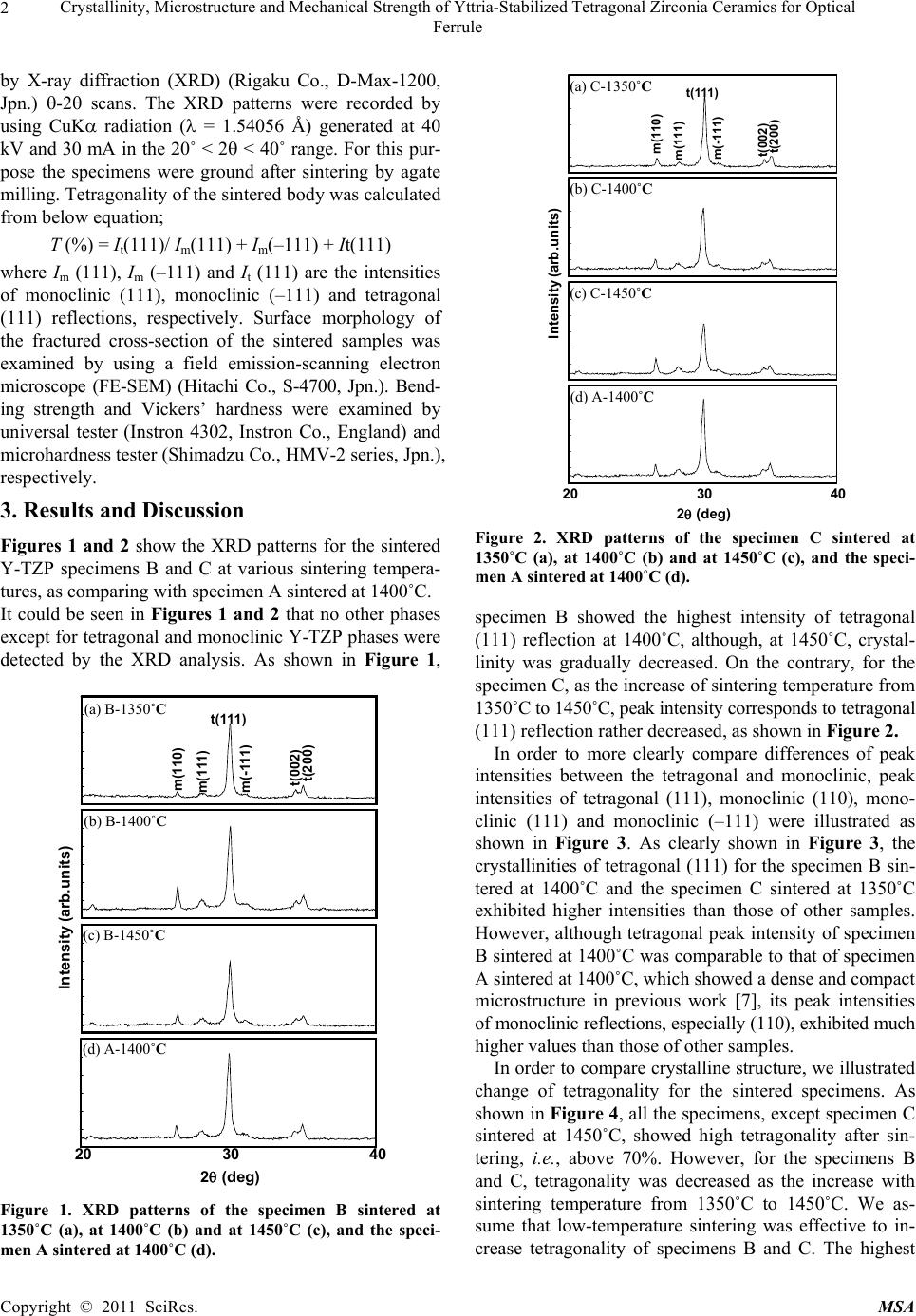 Crystallinity, Microstructure and Mechanical Strength of Yttria-Stabilized Tetragonal Zirconia Ceramics for Optical 2 Ferrule by X-ray diffraction (XRD) (Rigaku Co., D-Max-1200, Jpn.) θ-2θ scans. The XRD patterns were recorded by using CuKα radiation (λ = 1.54056 Å) generated at 40 kV and 30 mA in the 20˚ < 2θ < 40˚ range. For this pur- pose the specimens were ground after sintering by agate milling. Tetragon ality of the sin tered body was calculated from below equation; T (%) = It(111)/ Im(111) + Im(–111) + It(111) where Im (111), Im (–111) and It (111) are the intensities of monoclinic (111), monoclinic (–111) and tetragonal (111) reflections, respectively. Surface morphology of the fractured cross-section of the sintered samples was examined by using a field emission-scanning electron microscope (FE-SEM) (Hitachi Co., S-4700, Jpn.). Bend- ing strength and Vickers’ hardness were examined by universal tester (Instron 4302, Instron Co., England) and microhardness tester (Shimadzu Co., HMV-2 series, Jpn.), respectively. 3. Results and Discussion Figures 1 and 2 show the XRD patterns for the sintered Y-TZP specimens B and C at various sintering tempera- tures, as comparing with specimen A sintered at 1400˚C. It could be seen in Figures 1 and 2 that no other phases except for tetragonal and monoclin ic Y-TZP phases were detected by the XRD analysis. As shown in Figure 1, a) B-1350 1400 1450 -1400 Inte nsity (ar b.units) °C °C °C °C m(110) m(111) m(-111) t(111) t(002) t(200) 20 30 40 2θ(deg) b) B- c) B - d) A Figure 1. XRD patterns of the specimen B sintered at 1350˚C (a), at 1400˚C (b) and at 1450˚C (c), and the speci- men A sintered at 1400˚C (d). a) C- 1350°C b) C -1400°C c) C- 1450°C d) A-1400°C m(110) m(111) m(-111) t(111) t(002) t(200) Intensity (arb.units) 20 30 40 2θ(deg) (a) C-1350˚C (b) C-1400˚C (c) C-1450˚C (d) A-1400˚C Figure 2. XRD patterns of the specimen C sintered at 1350˚C (a), at 1400˚C (b) and at 1450˚C (c), and the speci- men A sintered at 1400˚C (d). specimen B showed the highest intensity of tetragonal (111) reflection at 1400˚C, although, at 1450˚C, crystal- linity was gradually decreased. On the contrary, for the spec imen C, as the in crea se of si nter ing temp era tur e from 1350˚C t o 1450 ˚C, peak intensity corresponds to tetragonal (111) reflection rather decreased, as shown in Figure 2. -1350˚C (a) B In order to more clearly compare differences of peak intensities between the tetragonal and monoclinic, peak intensities of tetragonal (111), monoclinic (110), mono- clinic (111) and monoclinic (–111) were illustrated as shown in Figure 3. As clearly shown in Figure 3, the crystallinities of tetragonal (111) for the specimen B sin- tered at 1400˚C and the specimen C sintered at 1350˚C exhibited higher intensities than those of other samples. However, although tetragonal peak intensity of specimen B sintered at 1400˚C was comparable to that of specimen A sintered at 1400˚C, which showed a dense and compact microstructure in previous work [7], its peak intensities of monoclinic reflections, especially (110), exhibited much higher values than those of other samples. (b) B-1400˚C -1450˚C (c) B (d) A-1400˚C In order to compare crystalline structure, we illustrated change of tetragonality for the sintered specimens. As shown in Figure 4, all the specimens, except specimen C sintered at 1450˚C, showed high tetragonality after sin- tering, i.e., above 70%. However, for the specimens B and C, tetragonality was decreased as the increase with sintering temperature from 1350˚C to 1450˚C. We as- sume that low-temperature sintering was effective to in- crease tetragonality of specimens B and C. The highest Copyright © 2011 SciRes. MSA 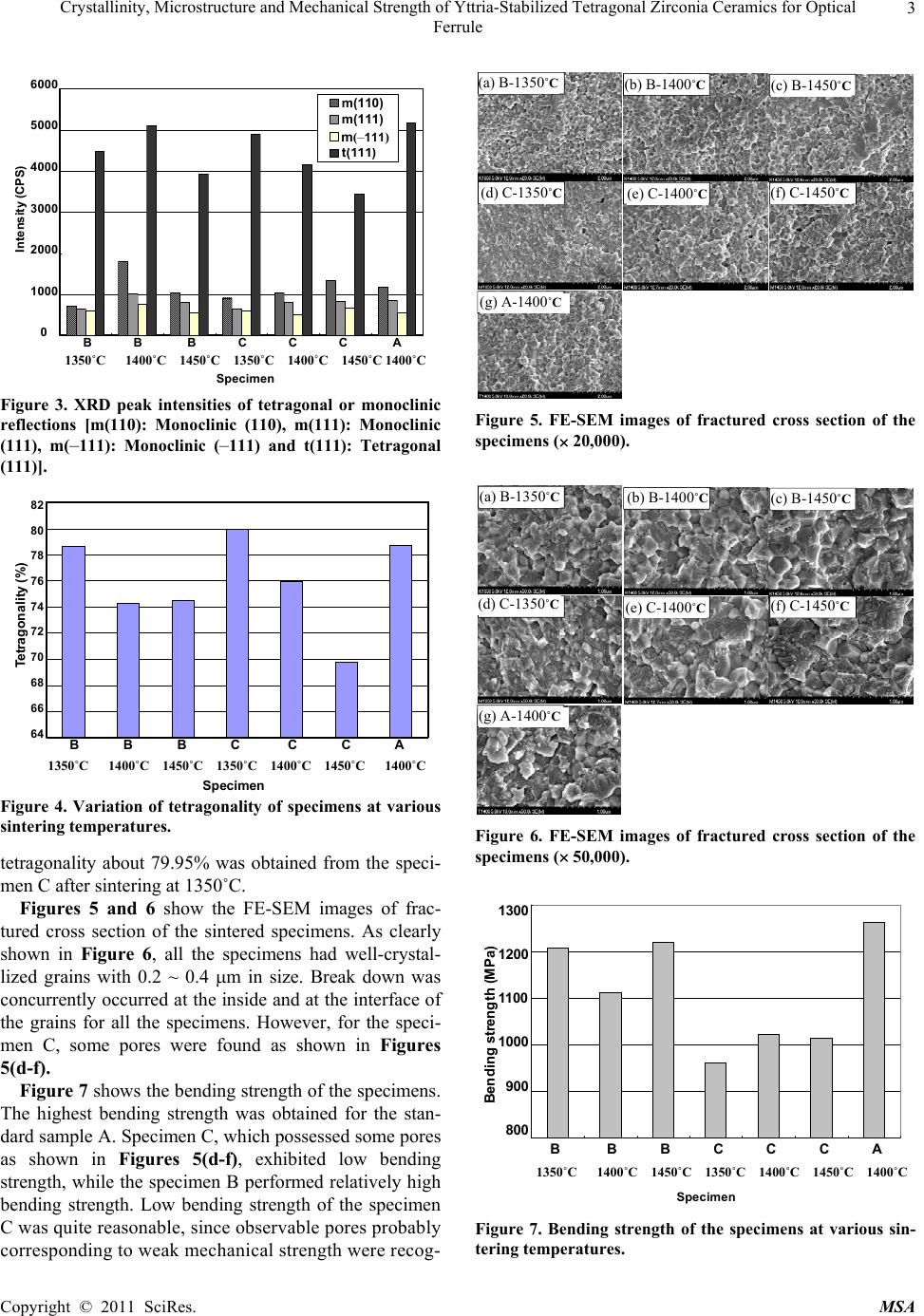 Crystallinity, Microstructure and Mechanical Strength of Yttria-Stabilized Tetragonal Zirconia Ceramics for Optical 3 Ferrule m(110) m(111) m(-111) t(111) BBB CCCA 1350 °C 1400 °C 1450 °C 1350 °C 1400 °C 1450 °C 1400 °C Specimen 6000 5000 4000 3000 2000 1000 0 Inten si ty (CPS) Figure 3. XRD peak intensities of tetragonal or monoclinic reflections [m(110): Monoclinic (110), m(111): Monoclinic (111), m(–111): Monoclinic (–111) and t(111): Tetragonal (111)]. B B B C C C A 1350°C 1400°C 1450°C 1350°C 1400°C 1450°C 1400°C Specimen Tetragonality(%) 82 80 78 76 74 72 70 68 66 64 Figure 4. Variation of tetragonality of specimens at various sintering temperatures. tetragonality about 79.95% was obtained from the speci- men C after sintering at 1350˚C. Figures 5 and 6 show the FE-SEM images of frac- tured cross section of the sintered specimens. As clearly shown in Figure 6, all the specimens had well-crystal- lized grains with 0.2 ~ 0.4 μm in size. Break down was concurrently occurred at the inside and at the interface of the grains for all the specimens. However, for the speci- men C, some pores were found as shown in Figures 5(d-f). Figure 7 shows the bending streng th of the specimens. The highest bending strength was obtained for the stan- dard sample A. Specimen C, which possessed some pores as shown in Figures 5(d-f), exhibited low bending strength, while the specimen B performed relatively high bending strength. Low bending strength of the specimen C was quite reasonable, since observable pores probably corresponding to weak mechanical strength were recog- a) B - 1350°Cb ) B -1400°Cc) B - 1450°C d) C - 1350°Ce) C - 1400°Cf) C - 1450°C g) A -1400°C (a) B-1350˚C(b) B-1400˚C ( c) B-1450˚C (d) C-1350˚C(e) C-1400˚C ( f) C-1450˚C (g) A-1400˚C m(–111) 1350˚C 1400˚C 1450˚C 1350˚C 1400˚C 1450˚C 1400˚C Figure 5. FE-SEM images of fractured cross section of the specimens (× 20,000). a) B - 1350°Cb ) B -1400°Cc) B- 1450°C d) C - 1350°Ce) C -1400°Cf ) C -1450 °C g) A -1400°C (d) C-1350˚C(e) C-1400˚C (f) C-1450˚C (g) A-1400˚C (a) B-1350˚C(b) B-1400˚C ( c) B-1450˚C 1350˚C 1400˚C 1450˚C 1350˚C 1400˚C 1450˚C 1400˚C Figure 6. FE-SEM images of fractured cross section of the specimens (× 50,000). 1300 1200 11 0 0 1000 900 800 B BBC CCA 1350°C 1400 °C 1450 °C 1350 °C 1400 °C 1450 °C 1400 °C Specimen Be nding st rengt h (MPa ) 1350˚C 1400˚C 1450˚C 1350˚C 1400˚C 1450˚C 1400˚C Figure 7. Bending strength of the specimens at various sin- tering temperatures. Copyright © 2011 SciRes. MSA 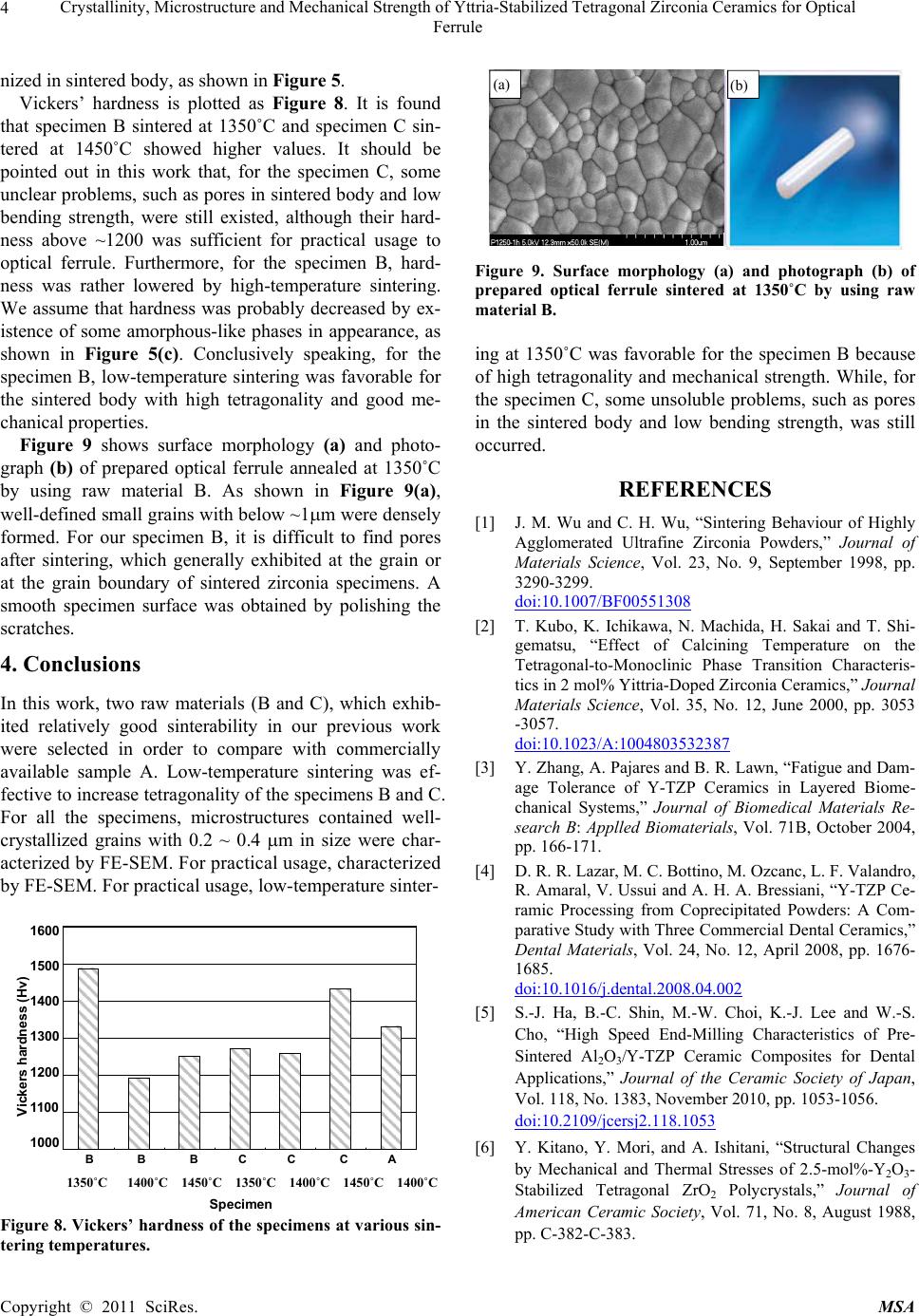 Crystallinity, Microstructure and Mechanical Strength of Yttria-Stabilized Tetragonal Zirconia Ceramics for Optical 4 Ferrule nized in sintered body, as shown in Figure 5. Vickers’ hardness is plotted as Figure 8. It is found that specimen B sintered at 1350˚C and specimen C sin- tered at 1450˚C showed higher values. It should be pointed out in this work that, for the specimen C, some unclear problems, such as pores in sintered body and low bending strength, were still existed, although their hard- ness above ~1200 was sufficient for practical usage to optical ferrule. Furthermore, for the specimen B, hard- ness was rather lowered by high-temperature sintering. We assume that hardness was probably decreased by ex- istence of some amorphous-like phases in appearance, as shown in Figure 5(c). Conclusively speaking, for the specimen B, low-temperature sintering was favorable for the sintered body with high tetragonality and good me- chanical properties. Figure 9 shows surface morphology (a) and photo- graph (b) of prepared optical ferrule annealed at 1350˚C by using raw material B. As shown in Figure 9(a), well-defined small grains with below ~1μm were densely formed. For our specimen B, it is difficult to find pores after sintering, which generally exhibited at the grain or at the grain boundary of sintered zirconia specimens. A smooth specimen surface was obtained by polishing the scratches. 4. Conclusions In this work, two raw materials (B and C), which exhib- ited relatively good sinterability in our previous work were selected in order to compare with commercially available sample A. Low-temperature sintering was ef- fective to increase tetragonality of the specimens B and C. For all the specimens, microstructures contained well- crystallized grains with 0.2 ~ 0.4 μm in size were char- acterized by FE-SEM. For practical usage, characterized by FE-SEM. For practical usage, low-temperature sinter- B BBC CCA 1350°C 1400 °C 1450 °C 1350 °C 1400 °C 1450 °C 1400 °C Sp ecimen Vi ckers hard ness ( Hv) 1600 1500 1400 1300 1200 1100 1000 Figure 8. Vickers’ hardness of the specimens at various sin- tering temperatures. a) b) Figure 9. Surface morphology (a) and photograph (b) of prepared optical ferrule sintered at 1350˚C by using raw material B. ing at 1350˚C was favorable for the specimen B because of high tetragonality and mechanical strength. While, for the specimen C, some unsoluble problems, such as pores in the sintered body and low bending strength, was still occurred. REFERENCES [1] J. M. Wu and C. H. Wu, “Sintering Behaviour of Highly Agglomerated Ultrafine Zirconia Powders,” Journal of Materials Science, Vol. 23, No. 9, September 1998, pp. 3290-3299. doi:10.1007/BF00551308 [2] T. Kubo, K. Ichikawa, N. Machida, H. Sakai and T. Shi- gematsu, “Effect of Calcining Temperature on the Tetragonal-to-Monoclinic Phase Transition Characteris- tics in 2 mol% Yittria-Doped Zirconia Ceramics,” Journal Materials Science, Vol. 35, No. 12, June 2000, pp. 3053 -3057. doi:10.1023/A:1004803532387 [3] Y. Zhang, A. Pajares and B. R. Lawn, “Fatigue and Dam- age Tolerance of Y-TZP Ceramics in Layered Biome- chanical Systems,” Journal of Biomedical Materials Re- search B: Applled Biomaterials, Vol. 71B, October 2004, pp. 166-171. [4] D. R. R. Lazar, M. C. Bottino, M. Ozcanc, L. F. Valandro, R. Amaral, V. Ussui and A. H. A. Bressiani, “Y-TZP Ce- ramic Processing from Coprecipitated Powders: A Com- parative Study with Three Commercia l Dental Ceramics,” Dental Materials, Vol. 24, No. 12, April 2008, pp. 1676- 1685. doi:10.1016/j.dental.2008.04.002 [5] S.-J. Ha, B.-C. Shin, M.-W. Choi, K.-J. Lee and W.-S. Cho, “High Speed End-Milling Characteristics of Pre- Sintered Al2O3/Y-TZP Ceramic Composites for Dental Applications,” Journal of the Ceramic Society of Japan, Vol. 118, No. 1383, November 2010, pp. 1053-1056. doi:10.2109/jcersj2.118.1053 [6] Y. Kitano, Y. Mori, and A. Ishitani, “Structural Changes by Mechanical and Thermal Stresses of 2.5-mol%-Y2O3- Stabilized Tetragonal ZrO2 Polycrystals,” Journal of American Ceramic Society, Vol. 71, No. 8, August 1988, pp. C-382-C-383. 1350˚C 1400˚C 1450˚C 1350˚C 1400˚C 1450˚C 1400˚C (a) (b) Copyright © 2011 SciRes. MSA  Crystallinity, Microstructure and Mechanical Strength of Yttria-Stabilized Tetragonal Zirconia Ceramics for Optical Ferrule Copyright © 2011 SciRes. MSA 5 doi:10.1111/j.1151-2916.1988.tb06399.x [7] S.-H. Yang, S.-B. Kim, B.-A. Kang, Y.-H. Yun, Y.-H. Kim and K.-S. Hwang, “Preparation of Yttria-Stabilized Tetragonal Zirconia Ceramics for Optical Ferrule,” Jour- nal of Materials Synthesis & Processing, Vol. 9, No. 5, September 2001, pp. 275-279. doi:10.1023/A:1015203602403 |