

Paper Menu >>
Journal Menu >>
 American Journal of Plant Sciences, 2013, 4, 1839-1845 http://dx.doi.org/10.4236/ajps.2013.49226 Published Online September 2013 (http://www.scirp.org/journal/ajps) Do Higher Resource Capture Ability and Utilization Efficiency Facilitate the Successful Invasion of Exotic Plant? A Case Study of Alternanthera philoxeroides Xuyan Geng, Shang Jiang, Bo Li, Xiaoyun Pan* Coastal Ecosystems Research Station of Yangtze River Estuary, Ministry of Education Key Laboratory for Biodiversity Science & Ecological Engineering, Institute of Biodiversity Science, Shanghai, China. Email: *[email protected] Received June 16th, 2013; revised July 20th, 2013; August 20th, 2013 Copyright © 2013 Xuyan Geng et al. This is an open access article distributed under the Creative Commons Attribution License, which permits unrestricted use, distribution, and reproduction in any medium, provided the original work is properly cited. ABSTRACT We tested the hypothesis that introduced populations may have higher resource capture ability and utilization efficiency than native ones of invasive plants. We compared ecophysiological traits including maximum photosynthetic rate (Pmax), apparent quantum yield (Q), specific leaf area (SLA), photosynthetic energy use efficiency (PEUE), photosynthetic ni- trogen use efficiency (PNUE), water use efficiency (WUE), mass-based and area-based leaf construction cost (CCmass and CCarea), and mass-based and area-based leaf nitrogen concentration (Nmass and Narea) between native (Argentina) and introduced (USA) populations of two varieties (North Apa and South Apo) of Alternanthera philoxeroides under com- mon garden conditions in China. For Apo and Apa, Pmax, Q, Nmass and WUE were not significantly different between native and introduced populations; introduced populations had significantly lower SLA and lower CCmas s but signifi- cantly higher Narea and CCarea than native ones. For Apa, the introduced populations showed significantly lower PEUE and lower PNUE while for Apo, PEUE and PNUE were not significantly different between native and introduced populations. The results indicated that introduced populations of A. philoxeroides do not show higher resource capture ability and resource utilization efficiency than their native ones in the common garden experiment, suggesting that these traits may not necessarily contribute to successful invasion of invasive plants. Keywords: Invasive Plant; Resource Use Efficiency; Construction Cost; Leaf Nitrogen 1. Introduction One mechanism which has been frequently mentioned and investigated empirically in the context of plant inva- sions is that higher resource capture ability and utiliza- tion efficiency may facilitate successful invasion [1-3]. Studies comparing leaf traits of invasive plants and na- tive plants have shown that invasive species have higher specific leaf area (SLA) [4,5], lower mass-based leaf construction cost (CCma s s ) [4,6-8], higher photosynthetic nitrogen use efficiency (PNUE) [3,4,9], higher photo- synthetic energy use efficiency (PEUE) [8,10] and higher water use efficiency (WUE) [9,11] than native species. However, some studies have detected that there are no significant differences in CCmass [12], PNUE [8] and WUE [6,8] between invaders and natives. A recent study also suggests that the populations in the introduced range of an invasive species have evolved a higher PEUE and a shorter payback time but not lower CCmass than those in the native range [13]. Do exotic invasive plants have generally evolved higher resource capture ability and utilization efficiency in their introduced ranges? To answer this question, we com- pared leaf-level physiological traits that are related to re- source capture and utilization efficiency, e.g., maximum photosynthetic rate (Pmax), apparent quantum yield, SLA, PNUE, PEUE, WUE, area-based leaf construction cost (CCarea) and CCmass, area-based leaf nitrogen contention (Narea) and mass-based nitrogen contention (Nmass), be- tween native (Argentina) and introduced (USA) popula- tions of two varieties of Alternanthera philoxeroides (al- ligator weed) under common garden conditions in Shang- hai, China. *Corresponding author. Copyright © 2013 SciRes. AJPS 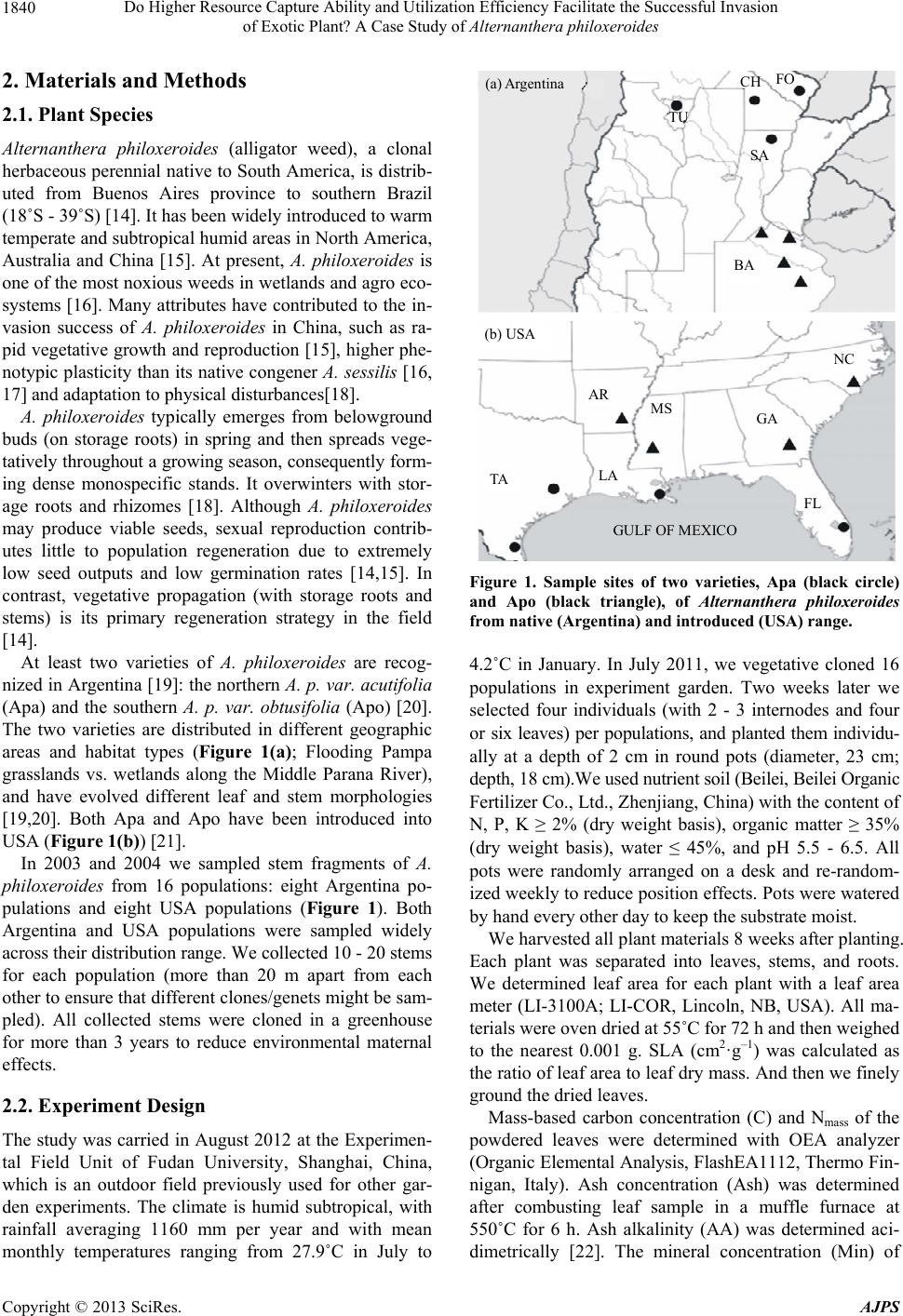 Do Higher Resource Capture Ability and Utilization Efficiency Facilitate the Successful Invasion of Exotic Plant? A Case Study of Alternanthera philoxeroides 1840 2. Materials and Methods 2.1. Plant Species Alternanthera philoxeroides (alligator weed), a clonal herbaceous perennial native to South America, is distrib- uted from Buenos Aires province to southern Brazil (18˚S - 39˚S) [14]. It has been widely introduced to warm temperate and subtropical humid areas in North America, Australia and China [15]. At present, A. philoxeroides is one of the most noxious weeds in wetlands and agro eco- systems [16]. Many attributes have contributed to the in- vasion success of A. philoxeroides in China, such as ra- pid vegetative growth and reproduction [15], higher phe- notypic plasticity than its native congener A. sessilis [16, 17] and adaptation to physical disturbances[18]. A. philoxeroides typically emerges from belowground buds (on storage roots) in spring and then spreads vege- tatively throughout a growing season, consequently form- ing dense monospecific stands. It overwinters with stor- age roots and rhizomes [18]. Although A. philoxeroides may produce viable seeds, sexual reproduction contrib- utes little to population regeneration due to extremely low seed outputs and low germination rates [14,15]. In contrast, vegetative propagation (with storage roots and stems) is its primary regeneration strategy in the field [14]. At least two varieties of A. philoxeroides are recog- nized in Argentina [19]: the northern A. p. var. acutifo lia (Apa) and the southern A. p. var. obtusifolia (Apo) [20]. The two varieties are distributed in different geographic areas and habitat types (Figure 1(a); Flooding Pampa grasslands vs. wetlands along the Middle Parana River), and have evolved different leaf and stem morphologies [19,20]. Both Apa and Apo have been introduced into USA (Figure 1(b)) [21]. In 2003 and 2004 we sampled stem fragments of A. philoxeroides from 16 populations: eight Argentina po- pulations and eight USA populations (Figure 1). Both Argentina and USA populations were sampled widely across their distribution range. We collected 10 - 20 stems for each population (more than 20 m apart from each other to ensure that different clones/genets might be sam- pled). All collected stems were cloned in a greenhouse for more than 3 years to reduce environmental maternal effects. 2.2. Experiment Design The study was carried in August 2012 at the Experimen- tal Field Unit of Fudan University, Shanghai, China, which is an outdoor field previously used for other gar- den experiments. The climate is humid subtropical, with rainfall averaging 1160 mm per year and with mean monthly temperatures ranging from 27.9˚C in July to (a) Argentina TU CH FO SA BA NC GA MS AR (b) USA TA LA FL GULF OF MEXICO Figure 1. Sample sites of two varieties, Apa (black circle) and Apo (black triangle), of Alternanthera philoxeroides from native (Argentina) and introduced (USA) range. 4.2˚C in January. In July 2011, we vegetative cloned 16 populations in experiment garden. Two weeks later we selected four individuals (with 2 - 3 internodes and four or six leaves) per populations, and planted them individu- ally at a depth of 2 cm in round pots (diameter, 23 cm; depth, 18 cm).We used nutrient soil (Beilei, Beilei Organic Fertilizer Co., Ltd., Zhenjiang, China) with the content of N, P, K ≥ 2% (dry weight basis), organic matter ≥ 35% (dry weight basis), water ≤ 45%, and pH 5.5 - 6.5. All pots were randomly arranged on a desk and re-random- ized weekly to reduce position effects. Pots were watered by hand every other day to keep the substrate moist. We harvested all plant materials 8 weeks after planting. Each plant was separated into leaves, stems, and roots. We determined leaf area for each plant with a leaf area meter (LI-3100A; LI-COR, Lincoln, NB, USA). All ma- terials were oven dried at 55˚C for 72 h and then weighed to the nearest 0.001 g. SLA (cm2·g–1) was calculated as the ratio of leaf area to leaf dry mass. And then we finely ground the dried leaves. Mass-based carbon concentration (C) and Nmass of the powdered leaves were determined with OEA analyzer (Organic Elemental Analysis, FlashEA1112, Thermo Fin- nigan, Italy). Ash concentration (Ash) was determined after combusting leaf sample in a muffle furnace at 550˚C for 6 h. Ash alkalinity (AA) was determined aci- dimetrically [22]. The mineral concentration (Min) of Copyright © 2013 SciRes. AJPS 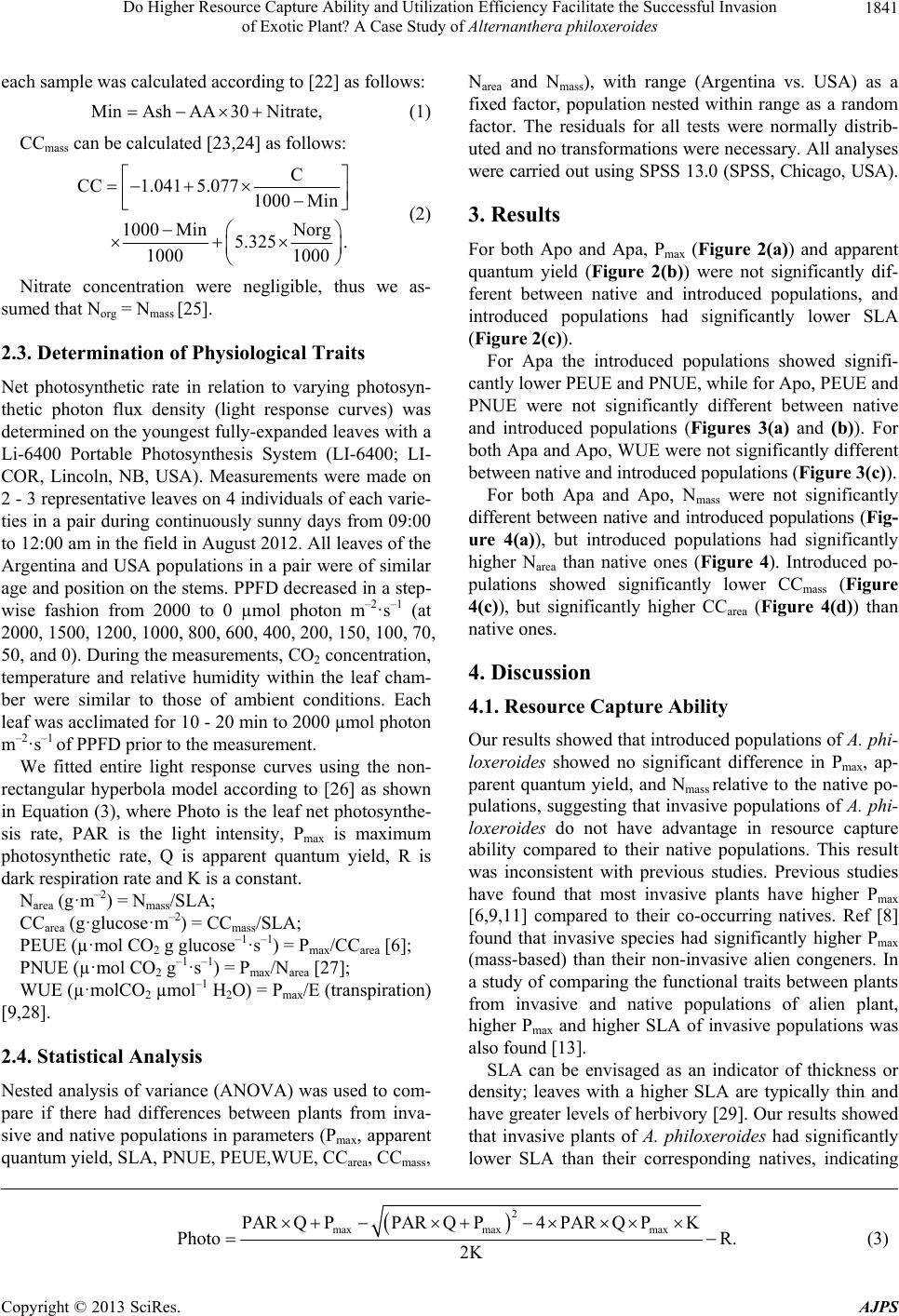 Do Higher Resource Capture Ability and Utilization Efficiency Facilitate the Successful Invasion of Exotic Plant? A Case Study of Alternanthera philoxeroides Copyright © 2013 SciRes. AJPS 1841 each sample was calculated according to [22] as follows: MinAsh AA30 Nitrate, (1) CCmass can be calculated [23,24] as follows: C CC1.041 5.077 1000 Min 1000 MinNorg 5.325 . 1000 1000 (2) Narea and Nmass), with range (Argentina vs. USA) as a fixed factor, population nested within range as a random factor. The residuals for all tests were normally distrib- uted and no transformations were necessary. All analyses were carried out using SPSS 13.0 (SPSS, Chicago, USA). 3. Results For both Apo and Apa, Pma x (Figure 2(a)) and apparent quantum yield (Figure 2(b)) were not significantly dif- ferent between native and introduced populations, and introduced populations had significantly lower SLA (Figure 2(c)). Nitrate concentration were negligible, thus we as- sumed that Norg = Nmass [25]. 2.3. Determination of Physiological Traits For Apa the introduced populations showed signifi- cantly lower PEUE and PNUE, while for Apo, PEUE and PNUE were not significantly different between native and introduced populations (Figures 3(a) and (b)). For both Apa and Apo, WUE were not significantly different between native and introduced populations (Fi gure 3(c )). Net photosynthetic rate in relation to varying photosyn- thetic photon flux density (light response curves) was determined on the youngest fully-expanded leaves with a Li-6400 Portable Photosynthesis System (LI-6400; LI- COR, Lincoln, NB, USA). Measurements were made on 2 - 3 representative leaves on 4 individuals of each varie- ties in a pair during continuously sunny days from 09:00 to 12:00 am in the field in August 2012. All leaves of the Argentina and USA populations in a pair were of similar age and position on the stems. PPFD decreased in a step- wise fashion from 2000 to 0 µmol photon m–2·s–1 (at 2000, 1500, 1200, 1000, 800, 600, 400, 200, 150, 100, 70, 50, and 0). During the measurements, CO2 concentration, temperature and relative humidity within the leaf cham- ber were similar to those of ambient conditions. Each leaf was acclimated for 10 - 20 min to 2000 µmol photon m–2·s–1 of PPFD prior to the measurement. For both Apa and Apo, Nmas s were not significantly different between native and introduced populations (Fig- ure 4(a)), but introduced populations had significantly higher Narea than native ones (Figure 4). Introduced po- pulations showed significantly lower CCmass (Figure 4(c)), but significantly higher CCarea (Figure 4(d)) than native ones. 4. Discussion 4.1. Resource Capture Ability Our results showed that introduced populations of A. phi- loxeroides showed no significant difference in Pmax, ap- parent quantum yield, and Nmass relative to the native po- pulations, suggesting that invasive populations of A. phi- loxeroides do not have advantage in resource capture ability compared to their native populations. This result was inconsistent with previous studies. Previous studies have found that most invasive plants have higher Pmax [6,9,11] compared to their co-occurring natives. Ref [8] found that invasive species had significantly higher Pmax (mass-based) than their non-invasive alien congeners. In a study of comparing the functional traits between plants from invasive and native populations of alien plant, higher Pmax and higher SLA of invasive populations was also found [13]. We fitted entire light response curves using the non- rectangular hyperbola model according to [26] as shown in Equation (3), where Photo is the leaf net photosynthe- sis rate, PAR is the light intensity, Pmax is maximum photosynthetic rate, Q is apparent quantum yield, R is dark respiration rate and K is a constant. Narea (g·m–2) = Nmass/SLA; CCarea (g·glucose·m–2) = CCmass/SLA; PEUE (µ·mol CO2 g glucose–1·s–1) = Pmax/CCarea [6]; PNUE (µ·mol CO2 g–1·s–1) = Pmax/Narea [27]; WUE (µ·molCO2 µmol–1 H2O) = Pmax/E (transpiration) [9,28]. 2.4. Statistical Analysis SLA can be envisaged as an indicator of thickness or density; leaves with a higher SLA are typically thin and have greater levels of herbivory [29]. Our results showed that invasive plants of A. philoxeroides had significantly lower SLA than their corresponding natives, indicating Nested analysis of variance (ANOVA) was used to com- pare if there had differences between plants from inva- sive and native populations in parameters (Pmax, apparent quantum yield, SLA, PNUE, PEUE,WUE, CCarea, CCmass, 2 max maxmax PAR QPPAR QP4PAR QPK Photo R. 2K (3) 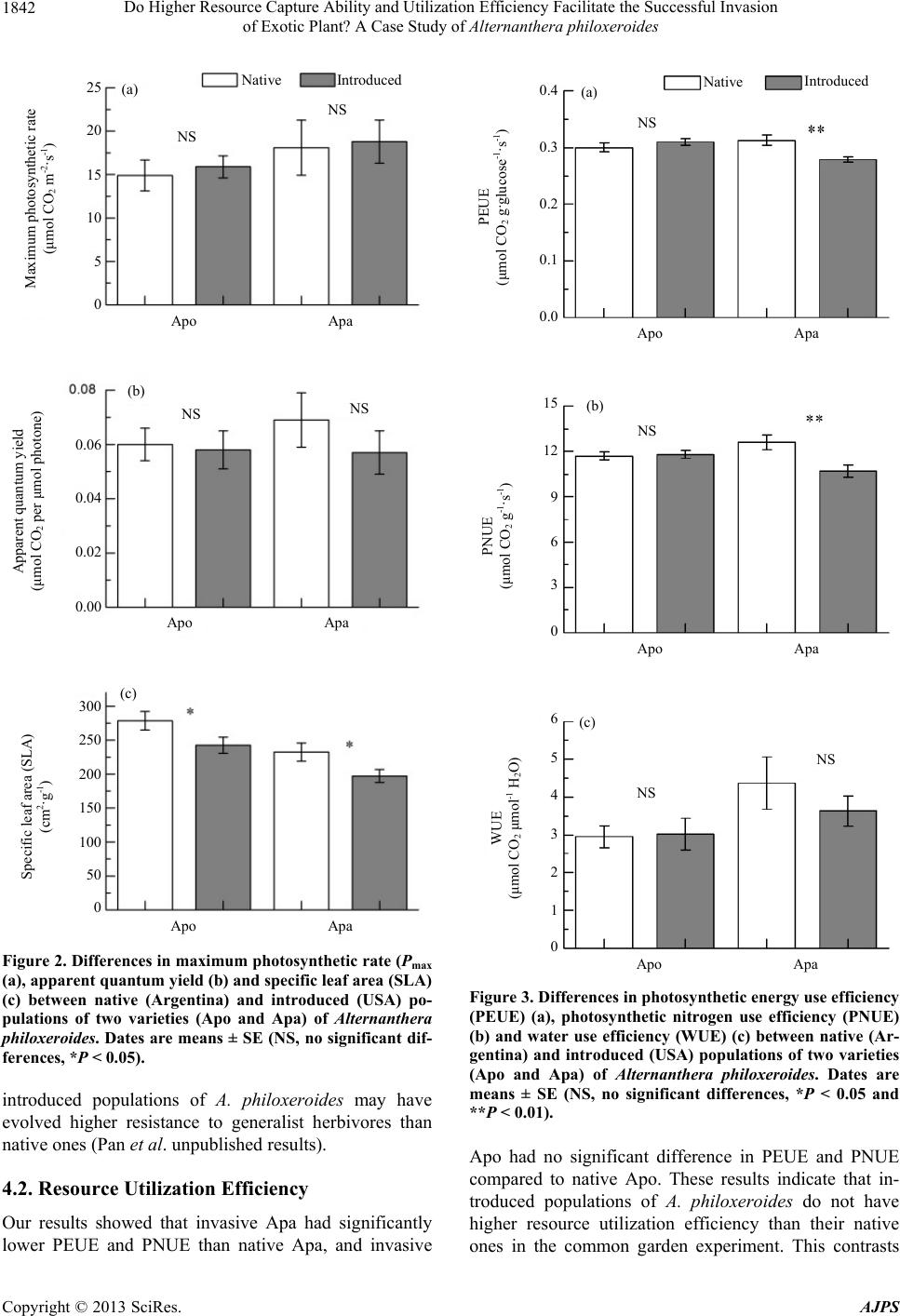 Do Higher Resource Capture Ability and Utilization Efficiency Facilitate the Successful Invasion of Exotic Plant? A Case Study of Alternanthera philoxeroides 1842 (a) N ative Introduced NS NS Apo Apa NS NS (b) Apo Apa (c) Apo Apa 0 50 100 150 200 250 300 Specific leaf area (SLA) (cm 2 ·g -1 ) 0.00 0.02 0.04 0.06 0 Maximum photosynthetic rate (μmol CO 2 m -2 ·s -1 ) Apparent quantum yield (μmol CO 2 per μmol photone) 5 10 15 20 25 Figure 2. Differences in maximum photosynthetic rate (Pmax (a), apparent quantum yield (b) and speci fic leaf area (SLA) (c) between native (Argentina) and introduced (USA) po- pulations of two varieties (Apo and Apa) of Alternanthera philoxeroides. Dates are means ± SE (NS, no significant dif- ferences, *P < 0.05). introduced populations of A. philoxeroides may have evolved higher resistance to generalist herbivores than native ones (Pan et al. unpublished results). 4.2. Resource Utilization Efficiency Our results showed that invasive Apa had significantly lower PEUE and PNUE than native Apa, and invasive (a) N ative Introduced NS Apo Apa PEUE (μmol CO2 g·glucose-1·s-1) 0.4 0.3 0.2 0.1 0.0 (b) NS Apo Apa 0 3 6 9 12 15 PNUE (μmol CO2 g-1·s-1) (c) NS NS Apo Apa 0 WUE (μmol CO2 μmol-1 H2O) 1 2 3 4 5 6 Figure 3. Differences in photosynthetic energy use efficiency (PEUE) (a), photosynthetic nitrogen use efficiency (PNUE) (b) and water use efficiency (WUE) (c) between native (Ar- gentina) and introduced (USA) populations of two varieties (Apo and Apa) of Alternanthera philoxeroides. Dates are means ± SE (NS, no significant differences, *P < 0.05 and **P < 0.01). Apo had no significant difference in PEUE and PNUE compared to native Apo. These results indicate that in- troduced populations of A. philoxeroides do not have higher resource utilization efficiency than their native ones in the common garden experiment. This contrasts Copyright © 2013 SciRes. AJPS 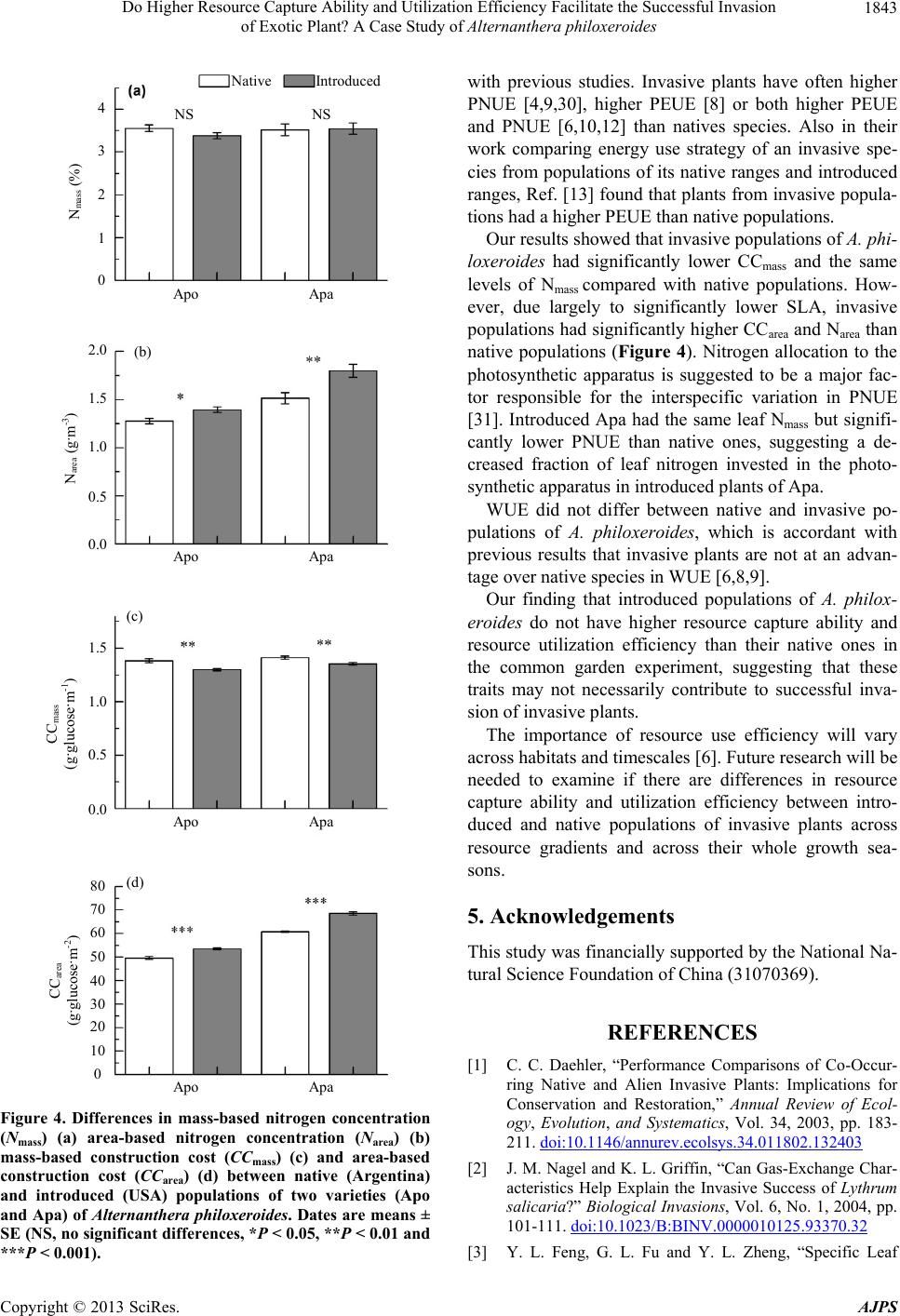 Do Higher Resource Capture Ability and Utilization Efficiency Facilitate the Successful Invasion of Exotic Plant? A Case Study of Alternanthera philoxeroides 1843 (b) N ative Introduced NS Apo Apa N area (g·m -3 ) 0 NS 1 2 3 4 N mass (%) 0.0 0.5 1.0 1.5 2.0 (c) (d) Apo Apa Apo Apa Apo Apa 0.0 0.5 1.0 1.5 CC area (g·glucose·m -2 ) CC mass (g·glucose·m -1 ) 0 10 20 30 40 50 60 70 80 Figure 4. Differences in mass-based nitrogen concentration (Nmass) (a) area-based nitrogen concentration (Narea) (b) mass-based construction cost (CCma ss ) (c) and area-based construction cost (CCarea) (d) between native (Argentina) and introduced (USA) populations of two varieties (Apo and Apa) of Alternanthera philoxeroides. Dates are means ± SE (NS, no significant differences, * P < 0.05, ** P < 0.01 and ***P < 0.001). with previous studies. Invasive plants have often higher PNUE [4,9,30], higher PEUE [8] or both higher PEUE and PNUE [6,10,12] than natives species. Also in their work comparing energy use strategy of an invasive spe- cies from populations of its native ranges and introduced ranges, Ref. [13] found that plants from invasive popula- tions had a higher PEUE than native populations. Our results showed that invasive populations of A. phi- loxeroides had significantly lower CCmass and the same levels of Nmass compared with native populations. How- ever, due largely to significantly lower SLA, invasive populations had significantly higher CCarea and Narea than native populations (Figure 4). Nitrogen allocation to the photosynthetic apparatus is suggested to be a major fac- tor responsible for the interspecific variation in PNUE [31]. Introduced Apa had the same leaf Nmass but signifi- cantly lower PNUE than native ones, suggesting a de- creased fraction of leaf nitrogen invested in the photo- synthetic apparatus in introduced plants of Apa. WUE did not differ between native and invasive po- pulations of A. philoxeroides, which is accordant with previous results that invasive plants are not at an advan- tage over native species in WUE [6,8,9]. Our finding that introduced populations of A. philox- eroides do not have higher resource capture ability and resource utilization efficiency than their native ones in the common garden experiment, suggesting that these traits may not necessarily contribute to successful inva- sion of invasive plants. The importance of resource use efficiency will vary across habitats and timescales [6]. Future research will be needed to examine if there are differences in resource capture ability and utilization efficiency between intro- duced and native populations of invasive plants across resource gradients and across their whole growth sea- sons. 5. Acknowledgements This study was financially supported by the National Na- tural Science Foundation of China (31070369). REFERENCES [1] C. C. Daehler, “Performance Comparisons of Co-Occur- ring Native and Alien Invasive Plants: Implications for Conservation and Restoration,” Annual Review of Ecol- ogy, Evolution, and Systematics, Vol. 34, 2003, pp. 183- 211. doi:10.1146/annurev.ecolsys.34.011802.132403 [2] J. M. Nagel and K. L. Griffin, “Can Gas-Exchange Char- acteristics Help Explain the Invasive Success of Lythrum salicaria?” Biological Invasions, Vol. 6, No. 1, 2004, pp. 101-111. doi:10.1023/B:BINV.0000010125.93370.32 [3] Y. L. Feng, G. L. Fu and Y. L. Zheng, “Specific Leaf Copyright © 2013 SciRes. AJPS 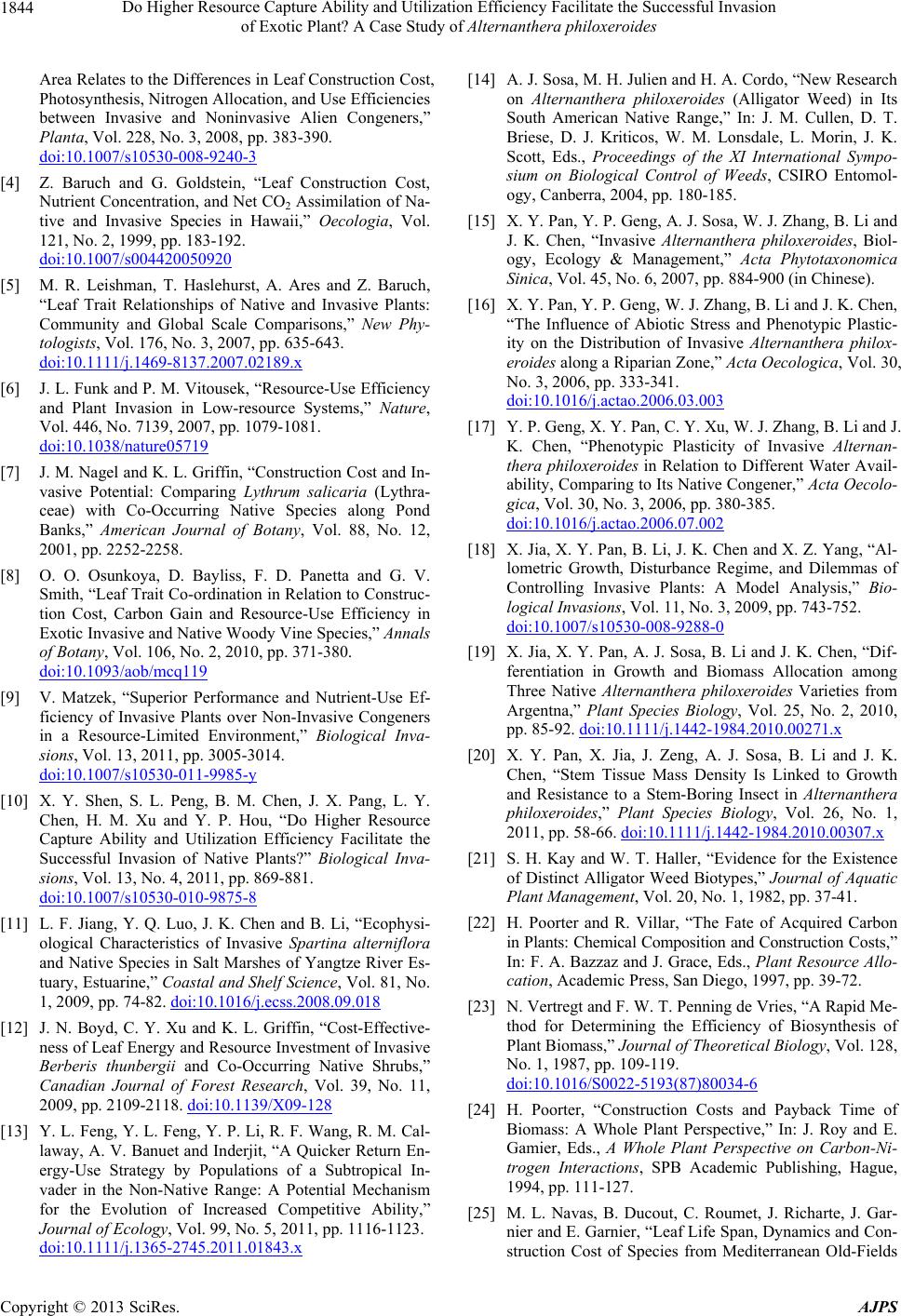 Do Higher Resource Capture Ability and Utilization Efficiency Facilitate the Successful Invasion of Exotic Plant? A Case Study of Alternanthera philoxeroides 1844 Area Relates to the Differences in Leaf Construction Cost, Photosynthesis, Nitrogen Allocation, and Use Efficiencies between Invasive and Noninvasive Alien Congeners,” Planta, Vol. 228, No. 3, 2008, pp. 383-390. doi:10.1007/s10530-008-9240-3 [4] Z. Baruch and G. Goldstein, “Leaf Construction Cost, Nutrient Concentration, and Net CO2 Assimilation of Na- tive and Invasive Species in Hawaii,” Oecologia, Vol. 121, No. 2, 1999, pp. 183-192. doi:10.1007/s004420050920 [5] M. R. Leishman, T. Haslehurst, A. Ares and Z. Baruch, “Leaf Trait Relationships of Native and Invasive Plants: Community and Global Scale Comparisons,” New Phy- tologists, Vol. 176, No. 3, 2007, pp. 635-643. doi:10.1111/j.1469-8137.2007.02189.x [6] J. L. Funk and P. M. Vitousek, “Resource-Use Efficiency and Plant Invasion in Low-resource Systems,” Nature, Vol. 446, No. 7139, 2007, pp. 1079-1081. doi:10.1038/nature05719 [7] J. M. Nagel and K. L. Griffin, “Construction Cost and In- vasive Potential: Comparing Lythrum salicaria (Lythra- ceae) with Co-Occurring Native Species along Pond Banks,” American Journal of Botany, Vol. 88, No. 12, 2001, pp. 2252-2258. [8] O. O. Osunkoya, D. Bayliss, F. D. Panetta and G. V. Smith, “Leaf Trait Co-ordination in Relation to Construc- tion Cost, Carbon Gain and Resource-Use Efficiency in Exotic Invasive and Native Woody Vine Species,” Annals of Botany, Vol. 106, No. 2, 2010, pp. 371-380. doi:10.1093/aob/mcq119 [9] V. Matzek, “Superior Performance and Nutrient-Use Ef- ficiency of Invasive Plants over Non-Invasive Congeners in a Resource-Limited Environment,” Biological Inva- sions, Vol. 13, 2011, pp. 3005-3014. doi:10.1007/s10530-011-9985-y [10] X. Y. Shen, S. L. Peng, B. M. Chen, J. X. Pang, L. Y. Chen, H. M. Xu and Y. P. Hou, “Do Higher Resource Capture Ability and Utilization Efficiency Facilitate the Successful Invasion of Native Plants?” Biological Inva- sions, Vol. 13, No. 4, 2011, pp. 869-881. doi:10.1007/s10530-010-9875-8 [11] L. F. Jiang, Y. Q. Luo, J. K. Chen and B. Li, “Ecophysi- ological Characteristics of Invasive Spartina alterniflora and Native Species in Salt Marshes of Yangtze River Es- tuary, Estuarine,” Coastal and Shelf Science, Vol. 81, No. 1, 2009, pp. 74-82. doi:10.1016/j.ecss.2008.09.018 [12] J. N. Boyd, C. Y. Xu and K. L. Griffin, “Cost-Effective- ness of Leaf Energy and Resource Investment of Invasive Berberis thunbergii and Co-Occurring Native Shrubs,” Canadian Journal of Forest Research, Vol. 39, No. 11, 2009, pp. 2109-2118. doi:10.1139/X09-128 [13] Y. L. Feng, Y. L. Feng, Y. P. Li, R. F. Wang, R. M. Cal- laway, A. V. Banuet and Inderjit, “A Quicker Return En- ergy-Use Strategy by Populations of a Subtropical In- vader in the Non-Native Range: A Potential Mechanism for the Evolution of Increased Competitive Ability,” Journal of Ecology, Vol. 99, No. 5, 2011, pp. 1116-1123. doi:10.1111/j.1365-2745.2011.01843.x [14] A. J. Sosa, M. H. Julien and H. A. Cordo, “New Research on Alternanthera philoxeroides (Alligator Weed) in Its South American Native Range,” In: J. M. Cullen, D. T. Briese, D. J. Kriticos, W. M. Lonsdale, L. Morin, J. K. Scott, Eds., Proceedings of the XI International Sympo- sium on Biological Control of Weeds, CSIRO Entomol- ogy, Canberra, 2004, pp. 180-185. [15] X. Y. Pan, Y. P. Geng, A. J. Sosa, W. J. Zhang, B. Li and J. K. Chen, “Invasive Alternanthera philoxeroides, Biol- ogy, Ecology & Management,” Acta Phytotaxonomica Sinica, Vol. 45, No. 6, 2007, pp. 884-900 (in Chinese). [16] X. Y. Pan, Y. P. Geng, W. J. Zhang, B. Li and J. K. Chen, “The Influence of Abiotic Stress and Phenotypic Plastic- ity on the Distribution of Invasive Alternanthera philox- eroides along a Riparian Zone,” Acta Oecologica, Vol. 30, No. 3, 2006, pp. 333-341. doi:10.1016/j.actao.2006.03.003 [17] Y. P. Geng, X. Y. Pan, C. Y. Xu, W. J. Zhang, B. Li and J. K. Chen, “Phenotypic Plasticity of Invasive Alternan- thera philoxeroides in Relation to Different Water Avail- ability, Comparing to Its Native Congener,” Acta Oecolo- gica, Vol. 30, No. 3, 2006, pp. 380-385. doi:10.1016/j.actao.2006.07.002 [18] X. Jia, X. Y. Pan, B. Li, J. K. Chen and X. Z. Yang, “Al- lometric Growth, Disturbance Regime, and Dilemmas of Controlling Invasive Plants: A Model Analysis,” Bio- logical Invasions, Vol. 11, No. 3, 2009, pp. 743-752. doi:10.1007/s10530-008-9288-0 [19] X. Jia, X. Y. Pan, A. J. Sosa, B. Li and J. K. Chen, “Dif- ferentiation in Growth and Biomass Allocation among Three Native Alternanthera philoxeroides Varieties from Argentna,” Plant Species Biology, Vol. 25, No. 2, 2010, pp. 85-92. doi:10.1111/j.1442-1984.2010.00271.x [20] X. Y. Pan, X. Jia, J. Zeng, A. J. Sosa, B. Li and J. K. Chen, “Stem Tissue Mass Density Is Linked to Growth and Resistance to a Stem-Boring Insect in Alternanthera philoxeroides,” Plant Species Biology, Vol. 26, No. 1, 2011, pp. 58-66. doi:10.1111/j.1442-1984.2010.00307.x [21] S. H. Kay and W. T. Haller, “Evidence for the Existence of Distinct Alligator Weed Biotypes,” Journal of Aquatic Plant Management, Vol. 20, No. 1, 1982, pp. 37-41. [22] H. Poorter and R. Villar, “The Fate of Acquired Carbon in Plants: Chemical Composition and Construction Costs,” In: F. A. Bazzaz and J. Grace, Eds., Plant Resource Allo- cation, Academic Press, San Diego, 1997, pp. 39-72. [23] N. Vertregt and F. W. T. Penning de Vries, “A Rapid Me- thod for Determining the Efficiency of Biosynthesis of Plant Biomass,” Journal of Theoretical Biology, Vol. 128, No. 1, 1987, pp. 109-119. doi:10.1016/S0022-5193(87)80034-6 [24] H. Poorter, “Construction Costs and Payback Time of Biomass: A Whole Plant Perspective,” In: J. Roy and E. Gamier, Eds., A Whole Plant Perspective on Carbon-Ni- trogen Interactions, SPB Academic Publishing, Hague, 1994, pp. 111-127. [25] M. L. Navas, B. Ducout, C. Roumet, J. Richarte, J. Gar- nier and E. Garnier, “Leaf Life Span, Dynamics and Con- struction Cost of Species from Mediterranean Old-Fields Copyright © 2013 SciRes. AJPS  Do Higher Resource Capture Ability and Utilization Efficiency Facilitate the Successful Invasion of Exotic Plant? A Case Study of Alternanthera philoxeroides Copyright © 2013 SciRes. AJPS 1845 Differing in Successional Status,” New Phytologists, Vol. 159, No. 1, 2003, pp. 213-228. doi:10.1046/j.1469-8137.2003.00790.x [26] G. D. Farquhar, S. von Caemmer and J. A. Berry, “A Bio- chemical-Model of Photosynthetic CO2 Assimilation in Leaves of C3 Species,” Planta, Vol. 149, No. 1, 1980, pp. 78-90. doi:10.1007/BF0038623 [27] C. Field and H. A. Mooney, “The Photosynthesis-Nitro- gen Relationships in Wild Plants,” In: T. J. Givnish, Ed., On the Economy of Plant Form, Function, Cambridge University Press, Cambridge, 1986, pp. 25-55. [28] J. M. Nagel, X. Z. Wang, J. D. Lewis, H. A. Fung, D. T. Tissue and K. L. Griffin, “Atmospheric CO2 Enrichment Alters Energy Assimilation, Investment and Allocation in Xathum strumarium,” New Phytologists, Vol. 166, No. 2, 2005, pp. 513-523. doi:10.1111/j.1469-8137.2005.01341.x [29] Y. Onoda, K. Hikosaka and T. Hirose, “Allocation of Ni- trogen to Cell Walls Decreases Photosynthetic Nitrogen- Use Efficiency,” Functional Ecology, Vol. 18, No. 3, 2004, pp. 419-425. doi:10.1111/j.0269-8463.2004.00847.x. [30] Y. L. Feng, Y. B. Lei, R. F. Wang, R. M. Callaway, A. V. Banuet, Inderjit, Y. P. Li and Y. L. Zheng, “Evolutionary Tradeoffs for Nitrogen Allocation to Photosynthesis ver- sus Cell Walls in an Invasive Plant,” PNAS, Vol. 106, No. 6, 2009, pp. 1853-1856. doi:10.1073/pnas.0808434106 [31] K. Hikosaka, “Interspecific Difference in the Photosynthe- sis-Nitrogen Relationship: Patterns, Physiological Causes, and Ecological Importance,” Journal of Plant Research, Vol. 117, No. 6, 2004, pp. 481-494. doi:10.1007/s10265-004-0174-2 |