

Paper Menu >>
Journal Menu >>
 Vol.3, No.6, 413-419 (2013) Open Journal of Preventiv e Me dic ine http://dx.doi.org/10.4236/ojpm.2013.36056 Study on little active and sedentary women: Comparison between protocols and prospects for admission in physical activity program A. D. P. Bankoff1*, C. A. Zamai1, J. Rocha2, P. R. Mendes Guimarães3 1Postural Assessment Laboratory, Faculdade de Educação Física (FEF), Unicamp, Campinas, Brazil; *Corresponding A u thor: [email protected] 2Department of Cardiology, Hospital de Clínicas (HC), Unicamp, Campinas, Brazil 3Policy Research Group, Institute of Mathematics, Statistics and Scientific Computation, Unicamp, Campinas, Brazil Received 15 May 2013; revised 20 June 2013; accepted 1 July 2013 Copyright © 2013 A. D. P. Bankoff et al. This is an open access article distributed under the Creative Commons Attribution License, which permits unrestricted use, distribution, and reproduction in any medium, provided the original work is properly cited. ABSTRACT The aim of this work was to study little active and sedentary women through physical assess- ments using anthropometric measurements and exercise testing using the Naughton and Bruce protocols. Approximately 53 women were eval- uated: Group 1—comprised of 17 completely sedentary women, aged 25-58 years, mean age 44.4 years, and Group 2—comprised of 36 wo- men who answered doing physical activities once or twice a week (low active), aged 28 - 54 years, mean age 39.5 years. The results Group 1— high weight, body mass index showing over- weight, heart rate above the target areas of your training, i.e., above 85% effort. Systolic blood pressure reached a high level in the seventh stage with 21 minutes of effort (177.3) and dia- stolic (92.7). Group 2—normal weight, body mass index recorded is considered thin, heart rate heart zones above the target of your training, i.e., above 85% effort also. Systolic blood pressure reached the highest level in phase 1 recovery (156.75). Diastolic blood pressure re corded pres- sure levels considered normal for the type of work done by the group. The values reported for the double product are considered normal for the type of effort made by both groups. Conclu- sion: The participants from group 1 are able to join physical activity programs from the results presented, specifically due to weight, BMI, heart rate and blood pressure. The participants from group 2 require more days of practice of physi- cal activities and longer hours to improve the levels of heart rate and blood pressur e. Keywords: Sedentary Lifestyle; Double Product; Heart Rate; Blood Pressure 1. INTRODUCTION A sedentary lifestyle is the lack or decrease of physical activity. A sedentary person is one who spends few calo- ries per week with occupational activities, not necessar- ily in sports activities. This entails a great risk to health: physical inactivity is associated with increased incidence of various diseases and ailments such as obesity, diabetes, increase bad cholesterol (LDL), fat deposits in arteries, hypertension and myocardial infarction [1]. Today, the leading causes of deaths in Brazil may be related to lack of physical activity. Only 13% of Brazil- ians prac tice exer cises and mo re than 60% of the popula- tion is completely sedentary. Sedentary lifestyle in- creases in 54% the cases of myocardial infarction and in 50% the risk of death from stroke. Every year, more than 300,000 die in Brazil by lack of physical activity. The risk of death from heart disease is reduced by 40% by becoming a little more active [2]. [3] reports that more and more people have acquired the habit of regular physical activity, whether spontane- ous or controlled by physical education professionals. Overall, this option of incorporating exercise habits to everyday life brings important benefits to the body in various organs and systems, favorably reflecting on the overall health of the individual. Obviously, this conduct in relation to physical exercise must be encouraged at various levels and segments of society, given its scien- tifically proven effectiveness with regard to disease pre- vention, health promotion and improved overall levels of quality of life. Physical assessment must precede any type of exercise program. It is of fundamental importance to carry physi- Copyright © 2013 SciRes. OPEN A CCESS  A. D. P. Bankoff et al. / Open Journal of Preventive Medicine 3 (2013) 413-419 414 cal assessments before starting a physical activity pro- gram, not only to check possible health problems of a general nature, but also to verify the evolution of the individual in the post-assessment [4]. Physical activity is a way to restore health from the harmful effects of work routine. It can be observed that the more the individual has an active life, the better their quality of life is. Furthermore, there are differences be- tween people who practice physical activity and those who do not, regarding the quality of life and psychologi- cal and cognitive aspects [4]. Exercise is a form of leisure and restores health from the harmful effects that the stressful work produces through routine. Thus, stress is the way the body responds to any stimulus that alters its equilibrium state, and this stimulus can be good or bad, real or imaginary [5]. Research conducted by the Society of Cardiology of the State of São Paulo [6] found that half of the state population has a sedentary life. In São José dos Campos, the also revealed that most residents do not engage in exercise as they should. “[6] Sedentary lifestyle can be included as the major risk factor for cardiovascular diseases and is a major cause of death in the country,” he said. According to the cardiologist, who also works with sports medicine, the lack of routine exercise increases the chances of devel- oping new diseases in the body. The study also showed that women are more sedentary than men: 57% are not physically active. Among m en, thi s num ber drops to 42%. The elders would also be more sedentary, since 56% of people over 35 do not exercise. From 14 to 17 years the rate is 30%, between 18 and 24 it is 43%, and from 25 to 34 it rises to 50%. [6] emphasizes that the ideal is to do aerobic exercises like swimming, running and walking three times a week, and more intense exercise as weight training twice a week. [7] investigated the association between anthropomet- ric indicators and metabolic variables in 69 subjects of both genders. The results showed that heart rate corre- lated with the intensity of effo rt, being related to fat per- centage and BMI. Blood pressure (systolic and diastolic) showed good correlation with BMI for the female group. In the male group, WHR was the anthropometric indica- tor that showed a higher association with blood pressure. The double product had a higher correlation with BMI, indicating that this variable reflects the work of the myocardium. 2. MATERIAL AND METHOD 2.1. Population Studied Fifty three women attended the Postural Assessment Laboratory/Electromyography of the School of Physical Education, University of Campinas, to participate in this study. After replying to a brief questionnaire and taken the measurements of height and weight, they were di- vided into two groups, namely: Group 1—comprised of 17 completely sedentary wo- men, aged between 25 to 58 years, mean age 44.4 years; Group 2—comprised of 36 women who answered do- ing physical activities once or twice a week (low active), aged 28 - 54 years, mean age 39.5 years. We reco rded in the average hours of this group, amounting 01:30 min- utes of physical activity per week for each woman. All participants are from administrative sectors of Unicamp. 2.2. Evaluations Conducted Anthropometric measurements (weight and height) and ergometry were done on both groups. Group 1 er- gometry was evaluated by the Naughton Protocol and Group 2 was evaluated by the Bruce Protocol. Noting that the Naughton Protocol is indicated for people com- pletely sedentary, the elderly and cardiac patients, and the Bruce Protocol is designed for trained people, ath- letes and low physical condition people [8]. 2.2.1. Material Used We used the Ergometry-TEB System, which is formed by an Ergometer APEX 2200 Treadmill, two monitors, configured for 06 protocols and others that meet the lim- its of speed and tilt of th e system. The system is prep ared to act in automatic, semi-automatic or emergency stop. It is a system made up of 13 simultaneous channels and allows the performance of exercise tests with the classic configuration of the three leads MV5, D2M and V2M, which is the configuration used. This System starts with the speed of 1.5 mph containing 07 stages. For anthropometric measurements we used a Welmy scale, with toesa, with capacity of up to 150 Kg. 2.2.2. Dat a Collection During the assessments, the women were wearing Bra and Shorts to facilitate the placement of the electrodes according to the selected derivations. The electrodes used were from the brand 3M (Electrode for cardiac monitor- ing) Ag/AgCl, with adhesive gel. All participants signed the Free Informed Consent prior to the start of the testings. The project was approved by the Ethics Com- mittee of UNIC AM P No. 431/2007 (Figure 1). The women were instructed to be at the site of evalua- tions (Postural Assessment Laboratory and Electromy- ography of the School of Physical Education, University of Campinas) one hour before the start of evaluations. They also received a week in advance from the labo- ratory a folder with the following guidelines: 1) Eat up to two hours before the start of the Protocol; 2) Avoid any kind of physical activity the day before the Protocol; 3) Bring appropriate attire for the realization of the Copyright © 2013 SciRes. OPEN A CCESS 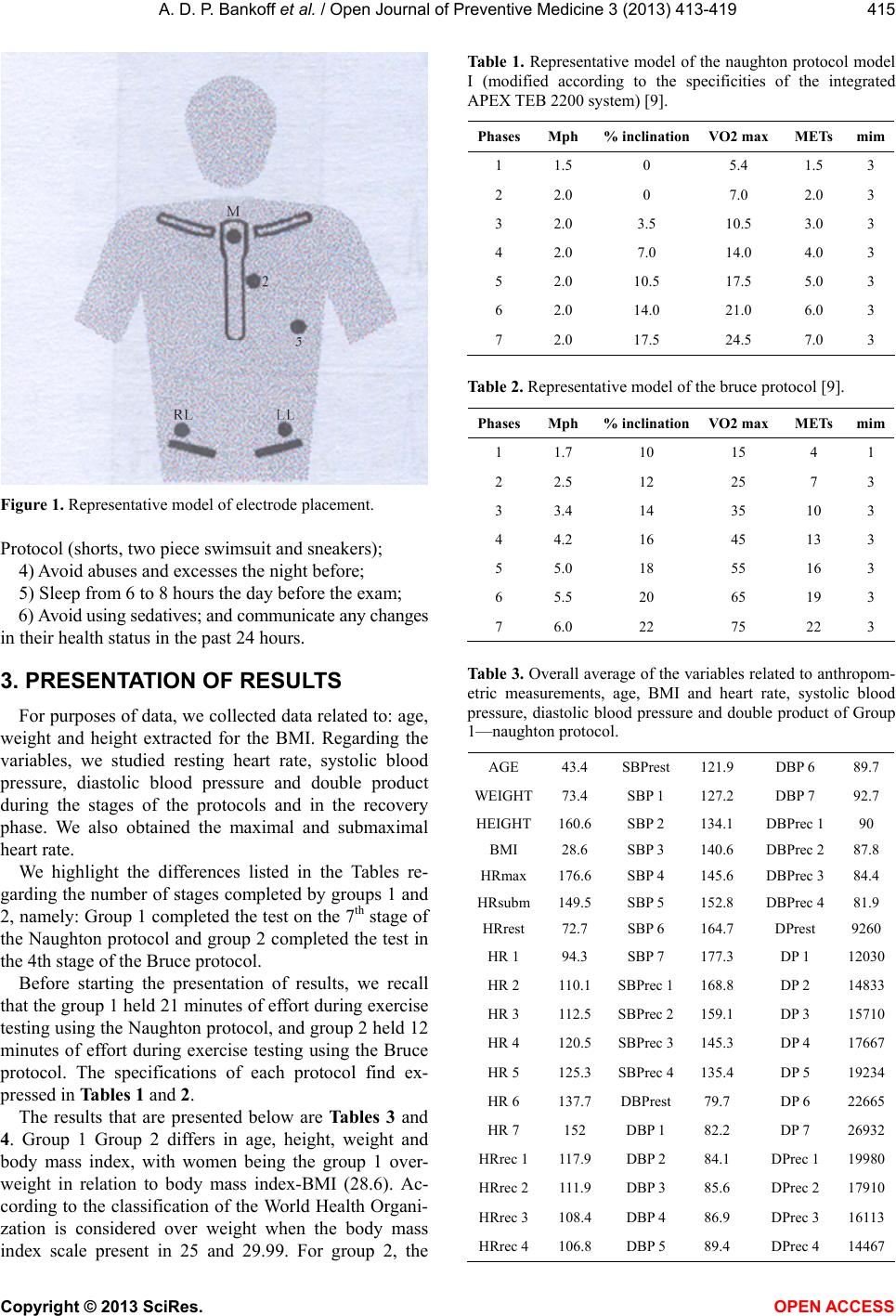 A. D. P. Bankoff et al. / Open Journal of Preventive Medicine 3 (2013) 413-419 415 Figure 1. Representative model of electrode placement. Protocol (shorts, two piece swimsuit and sneakers); 4) Avoid abuses and excesses the night before; 5) Sleep from 6 to 8 hours the day before the exam; 6) Avoid usi ng sedatives; and comm unicat e any chan ge s in their health status in the past 24 hours. 3. PRESENTATION OF RESULTS For purposes of data, we collected data related to: age, weight and height extracted for the BMI. Regarding the variables, we studied resting heart rate, systolic blood pressure, diastolic blood pressure and double product during the stages of the protocols and in the recovery phase. We also obtained the maximal and submaximal heart rate. We highlight the differences listed in the Tables re- garding the number of stages completed by groups 1 and 2, namely: Group 1 completed the test on the 7th stage of the Naughton protocol and group 2 completed the test in the 4th stage of the Bruce protocol. Before starting the presentation of results, we recall that the group 1 held 21 minutes of effort during exercise testing using the Naughton protocol, and group 2 held 12 minutes of effort during exercise testing using the Bruce protocol. The specifications of each protocol find ex- pressed in Tables 1 and 2. The results that are presented below are Ta b l es 3 and 4. Group 1 Group 2 differs in age, height, weight and body mass index, with women being the group 1 over- weight in relation to body mass index-BMI (28.6). Ac- cording to the classification of the World Health Organi- zation is considered over weight when the body mass index scale present in 25 and 29.99. For group 2, the Tabl e 1. Representative model of the naughton protocol model I (modified according to the specificities of the integrated APEX TEB 2200 system) [9]. Phases Mph % inclination VO2 max METs mim 1 1.5 0 5.4 1.5 3 2 2.0 0 7.0 2.0 3 3 2.0 3.5 10.5 3.0 3 4 2.0 7.0 14.0 4.0 3 5 2.0 10.5 17.5 5.0 3 6 2.0 14.0 21.0 6.0 3 7 2.0 17.5 24.5 7.0 3 Table 2. Representative model of the bruce protocol [9]. Phases Mph % inclination VO2 ma x METs mim 1 1.7 10 15 4 1 2 2.5 12 25 7 3 3 3.4 14 35 10 3 4 4.2 16 45 13 3 5 5.0 18 55 16 3 6 5.5 20 65 19 3 7 6.0 22 75 22 3 Table 3. Overall average of the variables related to anthropom- etric measurements, age, BMI and heart rate, systolic blood pressure, diastolic blood pressure and double product of Group 1—naughton protocol. AGE 43.4 SBPrest121.9 DBP 6 89.7 WEIGHT73.4 SBP 1 127.2 DBP 7 92.7 HEIGHT160.6 SBP 2 134.1 DBPrec 190 BMI 28.6 SBP 3 140.6 DBPrec 287.8 HRmax176.6 SBP 4 145.6 DBPrec 384.4 HRsubm149.5 SBP 5 152.8 DBPrec 481.9 HRrest72.7 SBP 6 164.7 DPrest 9260 HR 1 94.3 SBP 7 177.3 DP 1 12030 HR 2 110.1 SBPrec 1168.8 DP 2 14833 HR 3 112.5 SBPrec 2159.1 DP 3 15710 HR 4 120.5 SBPrec 3145.3 DP 4 17667 HR 5 125.3 SBPrec 4135.4 DP 5 19234 HR 6 137.7 DBPrest79.7 DP 6 22665 HR 7 152 DBP 1 82.2 DP 7 26932 HRrec 1117.9 DBP 2 84.1 DPrec 1 19980 HRrec 2111.9 DBP 3 85.6 DPrec 2 17910 HRrec 3108.4 DBP 4 86.9 DPrec 3 16113 HRrec 4106.8 DBP 5 89.4 DPrec 4 14467 Copyright © 2013 SciRes. OPEN A CCESS  A. D. P. Bankoff et al. / Open Journal of Preventive Medicine 3 (2013) 413-419 416 Table 4. Overall average of the variables related to anthropom- etric measurements, age, BMI and heart rate, systolic blood pressure, diastolic blood pressure and double product of Group 2—bruce protocol. AGE 39.51 HRrec 4 102.59 DBP 4 79.35 WEIGHT 62 SBPrest 111.21 DBPrec 180.13 HEIGHT 163 SBP 1 124.86 DBPrec 277.83 BMI 23.2 SBP 2 134.05 DBPrec 375 HRmax 180.48 SBP 3 145.81 DBPrec 474.86 HRsubm 153 SBP 4 150.8 DPrest 8061 HRrest 71.69 SBPrec 1 156.75 DP 1 12075 HR 1 97.02 SBPrec 2 144.72 DP 2 14629 HR 2 109.16 SBPrec 3 132.43 DP 3 18932 HR 3 130.87 SBPrec 3 123.51 DP 4 21594 HR 4 142 DBPrest 73.51 DPrec 1 18732 HRrec 1 121.24 DBP 1 75.67 DPrec 2 15156 HRrec 2 105.91 DBP 2 77.56 DPrec 3 13186 HRrec 3 100.56 DBP 3 79.05 DPrec 4 12629 body mass index presents standard (23.2) which is con- sidered healthy. The levels of heart rate, systolic and dia- stolic, and double product presented during physical ex- ertion are within acceptable standards for both popula- tions. Heart rate is a variable that can be used as a parameter to quantify the level of physical exertion of a particular exercise. An exercise is considered mild to moderate if performed at intensity between 65% e 85%, of maximum heart rate (HRmax). For women index is obtained by subtracting the age of 226, and then calculating the per- centage of the total. In our study group 1 averaged 43.4 years and a maximum heart rate of 176.6. For example: If the percentages requested are exactly those (65% and 85%), the result is: 226 43.4182.6. 182.6 65%119 beats per minute and 1 beats per minute. These are the minimum and maximum number of heartbeats per minute you should keep, i.e., the target areas of your training. Group 2, for example: 82.6 85%155 226 39.5186.4. If the percentages requested are exactly those (65% and 85%), the result is: 186 beats per minute and 186 beats per minute. In both groups, the women were above 85% of your maximum heart rate (g1 = 176.6, g2 = 180.4) . .4 65%121 158.4 85% As systolic blood pressure, group 1 showed a value considered high 177.3 mm Hg in the seventh stage of the Naughton protocol. Group 2 showed 150.8 mm Hg in the fourth stage, this considered within the normal range for exercise. In the recovery 1 group 2 had the highest blood pressure 156.7 mmHg. In this case we call active recov- ery because O2 levels remain consumed (ventilation is maintained at higher levels, facilitating gas exchange) and circulation remains very active. From the recovery 2 she established normal range. The diastolic blood pres- sure for the group 1 showed higher values during exer- cise (82.2 and 92.7), gro up 2 showed normal values (75.6 and 74.8). As for systolic and diastolic exercise is reported that systolic (maximum) during a session Exercise typically increases and, depending on the intensity of the Exercise, can reach values higher than 200 mm Hg. The diastolic blood pressure (minimum), during a session of Exercise usually does not in crease or increases only slig htly (to 15 mm Hg), and may even decrease. An increase in the va l- ues above these levels (systolic BP > 220 mm Hg or greater than 15 mm Hg increase in diastolic BP), are considered abnormal (systolic hypertensive response and/or diastolic efforts). Another important variable is the double product which is a measurement estimate cardiac effort and myocardial oxygen consumption. Its value is obtained by multiplying the heart rate (measured in beats per minute) for systolic blood pressure (measured in mm Hg). The reference values for the double product of an individual vary on average between 6000 at rest until 40,000 in ex- haustive exercises. The double product for both groups reported normal values even in recoveries, considering the physical performance of each group g1 totally seden- tary and g2 little active. Given the results, we can design and prescribe physi- cal activity program for both groups minimizing cardio- vascular risks . Summary of results: Group 1—high weight, body mass index showing overweight, heart rate above the target areas of your training, i.e., above 85% effort, and heart rate should be 155 beats per minute, however, showed 176.6 beats per minute. Systolic blood pressure reached a high level in the seventh stage with 21 minutes of effort (177.3) and diastolic (92.7). The double product recorded values considered normal for the type of effort made by the group. Group 2—normal weight, body mass index recorded is considered thin, hear t rate heart zones above the target of your training, i.e., above 85% effort, and heart rate should be 158 beats per minute, and however, it showed 180.4 beats per minute. Systolic blood pressure reached the highest level in phase 1 recovery (156.75). Diastolic blood pressure recorded pressure levels considered nor- mal for the type of work done by the group. The double product also re corded normal levels. 4. DISCUSSION The qualities of “sedentary and little active” physical fitness seem to go together, specifically in relation to the Copyright © 2013 SciRes. OPEN A CCESS  A. D. P. Bankoff et al. / Open Journal of Preventive Medicine 3 (2013) 413-419 417 events of the cardiac cycle (heart rate, systolic and dia- stolic blood pressure); however, group 2 is at an advan- tage compared to group 1 because they practice physical activities, thus influencing the quality of life. The amount of hours and the number of times per week that group 2 practices physical activities showed to not be sufficient to differentiate the results from group 1, who are com- pletely sedentary, although group 2 has completed the exercise testing using the Bruce protocol, on the 4th stage, considered a good result. The physical perform- ance of the group 2 in this study is consid ered better than when compared to group 1, also see the results when body weight and body mass index. Group 1 by body mass index presented is overweight, according to the World Health Organization and urgent need to change the lifestyle and physical exercise. [4,9] studied the events of the cardiac cycle in men and women through the ergometry system before and after initiating a physical activity program for six months. The results showed: at rest, regarding gender, heart rate showed no significant difference between the assessment and reassessment. Regarding SBP and DBP, there were differences between assessment and reassessment only for men. In the recovery period: heart rate showed no difference for both groups (male and female). As, for Systolic blood pressure, for both groups, there were dif- ferences regarding the assessment of the reassessment from the first minute up to the 6th minute. As for Dia- stolic blood pressure, there was no difference in the first minute. Regarding the levels of Maximum Heart Rate, both groups are at levels recommended for adults aged 20 to 55 years considered exhaustive, i.e., above 175 bpm [10]. As our data presented in Tabl es 3 and 4 and the follow- ing described [10] in relation to the amounts recorded Maximum Heart Rate activity can be considered exhaus- tive. Studies on the desired levels of heart rate extrapolate several decades; for example, [11] reported that a greater physical work capacity, kept a metabolic balance, could be achieved with a maximum limit of 170 beats per min- ute. According to [10], stress heart rate must be within a range of 135 and 174 bpm, i.e., exercise should have an intensity that can increase HR above 135 bpm, however, cannot exceed 17 4 bp m. The results presented in Tables 3 and 4 show that there was little difference between groups 1 and 2 in re- lation to the protocols used, as well as the physical fit- ness levels of both groups. According to [12] double product (DP) is a measure estimating cardiac stress and myocardial oxygen con- sumption and its value is determined by multiplying heart rate (measured in bpm) by systolic blood pressure (measured in mmHg). The double product can estimate the myocardial O2 consumption (MVO2) and is its best indirect predictor [13-16]. The correlation between double product and MVO2 is stronger (r = 0.92) than between MVO2 and HR (r = 0.88), [17]. There is also a linear relation be- tween MVO2/DP and blood flow in coronary arteries. Typical values for Double Product range from 6000 at rest (HR = 50 beats/min, SBP = 120 mm Hg) to 40,000 during intense exercise (HR = 200 beats/min, SBP = 200 mmHg). Changes in heart rate and blood pressure equally contribute to a change in double product [18]. The double product is a hemodynamic parameter that sets high correlation with MVO2, determined in stress ergometry, although the prediction is not possible in ex- ercises against resistance. Even so, the double product can be used as an evaluation index of cardiac stress in RE (resistance exercise), thus being recommended by the American College of Sports Medicine [18]. Regarding the systolic and diastolic blood pressure variables, the literature reports that, during exercise and physical activities, SBP and DBP tend to increase caus- ing a significant increase also in mean arterial pressure, even if for a short period of time. Separately, SBP and DBP show different behaviors during exercise. In ongo- ing activities of progressive intensity, SBP increases in direct proportion to the intensity of the exercise, due to the increase in cardiac out put [19,20] . We can see in Ta b l e s 3 and 4, from the resting phase until the 7th stage for group 1 and up to the 4 th stage for group 2, a gradual increase in systolic and diasto lic b lood pressure according to the increase of stress in the test. In the recovery phase, they decrease gradually. It is inter- esting to follow in the Tables 3 and 4 the behavior of the double product, taking into account that its value is de- termined by multiplyin g heart rate (measured in bpm) b y the systolic blood pressure (measured in mm Hg). Diastolic pressure varies little during aerobic exercise when compared to SBP and HR, as the systemic pressure during cardiac diastole tends to stay in rest levels. In ac- tivities with strong static co mponent, due to the capillary constriction by active muscles, coup led with the in crease in cardiac output, a significant elevation in DBP 25 can occur [21]. The research studies and discussion about the benefits of exercise and physical activity are old considering the scientific publications of [22] who describes that aerobic exercises (low intensity and long duration) are excellent for improving physical fitness and reducing body fat, reducing the risks of cardiovascular diseases. It was evident that group 2 needs to practice physical activities with greater intensity and higher weekly fre- quency so that changes and improvements can occur in the events of the cardiac cycles (HR, SBP and DBP). As Copyright © 2013 SciRes. OPEN A CCESS  A. D. P. Bankoff et al. / Open Journal of Preventive Medicine 3 (2013) 413-419 418 for group 1, taking into account the results presented, they are able to enter and start physical activities to im- prove the levels found, specifically weight, BMI, HR, SBP and DBP. [23,24] postulate that every adult individual should accumulate at least 30 minutes of physical activity at least 5 days a week, or if possible the entire week, of moderate intensity, which can be performed continuously or accumulated. However, the group of women consid- ered little active completed the stress test by the Bruce protocol in the 4th stage with the following specifica- tions: 4.2 mph, 16% incline, VO2Max 45, 13 METs and already amounted 10 minutes of test performance, which can be considered good for a exercise testing, consider- ing the physical fitness of the “little active” women. The women in group 1 that “self-declared” completely sed- entary, completed the exercise testing by the Naughton protocol on stage 7 with the following specifications: 02 Mph, 17.5% incline, VO2 Max 24.5, 7 METs and already amounted 21 minutes of test performance and yet, for the variables of the events of the cardiac cycle in accordance with the statistical analysis, the results were not different between groups 1 and 2 in most of the variables, as shown in Table 2. 5. CONCLUSIONS Participants in group 1 are able to particip ate in urgent and need physical activity programs from the results presented, specifically due to body weight, BMI, heart rate and blood pres s ure; Participants from group 2 require more days of prac- tice of physical activities and longer hours to improve the levels of heart rate and blood pressure; The results presented in Tables 3 and 4 show that there was little difference between groups 1 and 2 in re- lation to the protocols used, as well as the physical fit- ness levels of both groups; Both groups had high levels of heart rate in the effort applied during the exercise test protocol (Naughton and Bruce protocol). REFERENCES [1] Bankoff, A.D.P., Barros, D.D., Zamai, C.A., et al. (2000) Comparação das variáveis freqüência cardíaca, pressão arterial e porcentagem de gordura em motoristas seden- tários da Unicamp. Anais. Simpósio Internacional de Ciências do Esporte—Atividade Física, Fitness e Esporte, 23. CELAFISCS, São Paulo. [2] Pan American Health Organization (2007) Ministério da Saúde, Brasília. http://www.medicinadoesporte.com/ [3] de Marchi Netto, F.L. and Bankoff, A.D.P. (2007) A promoção da saúde pela via da atividade física e do esporte. Revista Vita et Sanitas, Trindade, 1, 25-35. [4] Bankoff, A.D.P. and Zamai, C.A. (2012) Effects of a physical activity program on cardiac cycle events in sed- entary individuals. Journal of Clinical & Experimental Cardiology, 1, 177-187. [5] Nahas, M.V. (2006) Atividade física, saúde e qualidade de vida: Conceitos e sugestões para um estilo de vida ativo. 4 Edition, Midiograf, Londrina. [6] Siqueira, S. (2012) Pesquisa revela que maioria da população está seden t á r ia . http://achevale.com.br/site/noticias.php?noticia=348 [7] Bankoff, A.D.P., Zago, L.C. and Zamai, C.A. (2007) Associação entre indicadores atropométricos e variáveis metabólicas. Revista Mineira de Educação Física, 15, 7- 19. [8] Araujo, C.G.S. (1986) Manual de Teste de Esforço. 2nd Edition, Ao Livro Técnico, Rio de Janeiro. [9] Bankoff, A.D.P. and Zamai, C.A. (2011) Effects of a phy- siccal activity program on cardiac cycle events in seden- tary individuals. 16th Annual Congress of the ECSS, 6th-9th July 2011, Liverpool. [10] Guedes, D.P. and Guedes, J.E.R.P. (1995) Exercício físico na promoção da saúde. Midiograf, Londrina. [11] Wahlund, H. (1998) Determination of physical capacity. Acta Physiologica Scandinavica, Stockholm, 215, 1-78. [12] Scott, K. and Powers, H.E.T. (2000) Fisiologia do exercí- cio: Teoria e aplicação ao condicionamento e ao desem- penho. Manole, São Paulo. [13] Foss, M.L. and Keteyian, S.J. (2000) Bases fisiológicas do exercício e do esporte. 6th Edition, Guanabara Koogan, Rio de Janeiro. [14] Chaitman, B.R. (1999) Prova de esforço ao exercício. In: Braunwald, E. Ed., Tratado de Medicina Cardiovascular, 5th Edition, Roca, São Paulo. [15] Kawamura, T. (2001) Avaliação da capacidade aeróbia e teste ergométrico. Revista Socesp, 11, 659-672. [16] Hui, S.C., Jackson, A.S. and Wier, L.T. (2000) Develop- ment of normative values for resting and exercise rate pressure product. Medicine and Science in Sports and Exercise, 32, 1520-1527. doi:10.1097/00005768-200008000-00023 [17] American College of Sports Medicine (ACSM) (2003) Manual de pesquisa das diretrizes do ACSM para os testes de esforço e sua prescrição. Guanabara Koogan, Rio de Janeiro. [18] McArdle, W.D., Katch, F.I. and Katch, V.L. (2003) Fisio- logia do exercício: Energia, nutrição e desempenho humano. 5th Edition, Guanabara Koogan, Rio de Janeiro. [19] MacDougall, J.D., Tuxen, D., Sale, D.G., Moroz, J.R. and Sutton, J.R. Arterial blood pressure response to heavy re- sistance exercise. Journal of Applied Physiology, 58, 785- 790. [20] American College of Sports Medicine (2000) ACSM’s Guidelines for Exercise Testing and Prescription. 6th Edi- tion, Lippincott Williams & Wilkins, Baltimore. [21] McArdle, W.D., Katch, F.I. and Katch, V.L. (2005) Fun- damentos de fisiologia do exercício. 6th Edition, Gua- nabara Koogan, Rio de Janeiro, 563-564. Copyright © 2013 SciRes. OPEN A CCESS  A. D. P. Bankoff et al. / Open Journal of Preventive Medicine 3 (2013) 413-419 Copyright © 2013 SciRes. OPEN A CCESS 419 [22] Cooper, K.H. (1972) Capacidade aeróbica. Forum, Rio de Janeiro. [23] Murphy, M. and Hardman, A. (1998) Training effects of sho r t a nd l ong bouts of b risk walking in sedentary wome n . Medicine and Science in Sports and Exercise, 30, 152-57. doi:10.1097/00005768-199801000-00021 [24] Agita São Paulo (2007) Ativi dade física e saúde: Acumul e 30 minutos por dia. São Paulo. |