

Paper Menu >>
Journal Menu >>
 American Journal of Plant Sciences, 2013, 4, 1758-1764 http://dx.doi.org/10.4236/ajps.2013.49216 Published Online September 2013 (http://www.scirp.org/journal/ajps) Asexual Propagation of Sheanut Tree (Vitellaria paradoxa C.F. Gaertn.) Using a Container Layering Technique Naalamle Amissah1*, Brain Akakpo1, Julius Yeboah2, Essie Blay1 1Department of Crop Science, College of Agriculture and Consumer Sciences, University of Ghana, Accra, Ghana; 2Cocoa Research Institute of Ghana (CRIG), Bole, Ghana. Email: *[email protected] Received July 5th, 2013; revised August 5th, 2013; accepted August 25th, 2013 Copyright © 2013 Naalamle Amissah et al. This is an open access article distributed under the Creative Commons Attribution Li- cense, which permits unrestricted use, distribution, and reproduction in any medium, provided the original work is properly cited. ABSTRACT In spite of the economic poten tial of the shean ut tree ( Vitellaria p arado xa), its domestication still has not b een achieved due to the long juvenile period of seed propagated plants and the absence of a reliable vegetative propagation method. Three experiments w ere conducted by using a modified container layering technique to inv estigate the effects of seaso n (rainy and dry season), light treatments (etiolation and natural light) and indole 3-butyric acid (IBA) on root formation in juvenile and mature sheanut trees. The effect of light treatments on the internal conditions such as level of sugars (soluble, insoluble and total sugars) and total free phenols in layered sheanut shoots was also considered. Rooting was generally lower in the mature trees (27.9%) compared to that in juvenile 4 year-old p lants (40.9%). Etiolation increased the levels of total sugars and phenols in shoots of 4-year-old plan ts and mature fruit bearing trees, but this increase did not significantly enhan ce rooting in both the juve nile and mature sheanut trees. The container layering technique holds promise as a method for the asexual propagation of sheanut planting material. Roots formed using this method looked healthy and were vertically orientated giving layered shoots a better chance at survival. Keywords: Etiolation; Container Layering Technique; Indolebutyric Acid; Sheanut Tree 1. Introduction Vitellaria paradoxa C.F. Gaertn (the sheanut tree) is a deciduous tree native to Tropical Africa and said to be indigenous to the Guinea and Sudan Savanna zone [1]. Shea butter, a product of its nut, is the main source of livelihood in the Northern regions of Ghana with the po- tential to alleviate rural poverty in these areas [2]. Shea butter has anti-microb ial properties and as such is widely used locally in h erbal medicine preparations as well as in the pharmaceutical and cosmetic industries [3,4]. Despite the social and economic importance of the sheanut tree, its tree populations are in the wild and domestication is still a challenge du e to the absence of a reliable propaga- tion technique. Propagation from seed, which is the cur- rent method used, is difficult, as seeds are recalcitrant an d have been found to lose viability sh ortly after harv est [1]. Where seedlings are produced, they possess a character- istic strong taproot system and do not transplant well. Vegetative propagation methods such as stem cuttings and airlayering have also proved unreliable [5-10]. There are reports of grafting having been used successfully on field plants [11]. However, grafting can only be used on already established fields. There is therefore the need to develop a reliable asexual propagation technique that would supply rootstock material to help with the domes- tication of sheanut trees. This research seeks to combine the use of practices and pre-treatments that have been shown to enhan ce rooting in wood y plants in conjunction with a container layering technique. Practices such as coppicing or severe pruning of tree crowns [12,13], etio- lation [14-17], and use of plant growth regulators such as Gibberellic acid (GA3) and Indole bu tyric acid (IBA) [12] have been found to enhance rooting of mature difficult- to-root woody plant species. The proposed container layering technique is one, in which layered shoots arising from the juvenile portion of the plant are rooted while still attached to the p arent plant. Frolich [18] was the first to use this method in the pro- pagation of avocardo varieties. Subsequently, the techni- que has been modified and used successfully in the pro- pagation of oak (Quercus spp.) shoots [17,19-21]. The objective of this study was to develop a reliable vegeta- *Corresponding a uthor. Copyright © 2013 SciRes. AJPS  Asexual Propagation of Sheanut Tree (Vitellaria paradoxa C.F. Gaertn.) Using a Container Layering Technique 1759 tive propagation technique for the multiplication of plant- ing material for domestication purposes by using the combined effects of etiolation and Indole 3-butyric acid. 2. Materials and Methods Three experiments were carried out on juvenile 4-year- old and mature fruit bearing trees using a container lay- ering technique (CLT) at the Cocoa Research Institute of Ghana-Bole Substation in the Northern Region from Sep- tember 2009 to October 2010. The technique used was a modification of that used on Quercus sp [21]. 2.1. Effect of Light and IBA Treatments on Rooting in Layered Juvenile Shea Trees during the Dry Season (October 2009 to February 2010) Four-year-old shea plants in polythene bags were cut back leaving a 4 cm stump above soil level and allowed to break bud. Upon budbreak fifty percent of the seed- lings were etiolated by placing 15.2 cm (diameter) PVC pipes of height 15 cm over the cut back stumps for 14 days. The PVC pipes were pushed into the soil in the poly bags to hold the pipes in place and covered with alu- minum foil to exclude light from the setup thus creating an ideal dark environment [0.00 µmol/m2/sec for photo- synthetically active radiation (PAR)]. The other 50% were grown in natural light. A 2 × 2 factorial experiment (2 IBA levels × 2 light levels) was used with each hor- mone-light combination represented by 25 plants. A completely randomized design was used with three rep- lications. When shoots reached a height of 8 - 10 cm seedlings in each treatment group had their basal 4 cm section painted with a solution of 8000 ppm or 10,000 ppm In- dole butyric acid (IBA) dissolved in 95% ethanol. After the IBA solution dried, cut PVC pipes were placed over the plants and the treated section of the shoots covered with a 2:1 (v/v) moist sterile rice-husk: sand mix. The shoots in the etiolated treatments were then weaned to light (greened) by making holes in the aluminum foil covering the top section of the PVC pipes, to introduce light gradually in to the setup. The aluminum foil was re- moved after greening of the shoots, by the seventh day, and subsequently, the sh oots were allowed to grow in na- tural light. Routine root inspection was done on three randomly selected stock plants per treatment to ascertain the level of root formation. The experiment was setup be- neath 50% shade.The treatments in the dry season (Oc- tober 2009 to February 2010) ex periment did not in clude a control (with a no IBA treatment). Previous studies conducted on sheanut at the research station showed poor rooting (1%) without the use of rooting hormones [8,9]. 2.2. Effect of Light and IBA Treatments on Rooting in Layered Juvenile Shea Trees during the Rainy Season (June 2010 to September 2010) The experiment was repeated in the rainy season (June to September 2010) using 4-year-old and mature bearing trees. For the 4-year-old trees, six (6) treatment combina- tions made up of IBA at 8000 ppm and 10,000 ppm and two light regimes (natural and etiolated) in a completely randomized design (CRD) was used with three replica- tions. Each treatment combination was represented by 20 plants per replicate. Layered propagules from experi- ments 1 and 2 were evaluated for rooting 10 weeks after IBA treatment (Figure 1(a)). Shoots were considered rooted when they possessed at least one root measuring not less than 1 cm.The setup was the same as in the dry season experiment. (a) (b) Figure 1. (a) Rooted 4-year-old and (b) mature sheanut shoots still attached to the stock plant, approximately ten weeks after treating with IBA. Copyright © 2013 SciRes. AJPS  Asexual Propagation of Sheanut Tree (Vitellaria paradoxa C.F. Gaertn.) Using a Container Layering Technique 1760 2.3. Effect of Light and IBA Treatments on Rooting in Layered Mature Shea Trees during the Rainy Season (June 2010 to September 2010) With the mature fruit bearing trees the same treatment combinations of IBA and light regimes as in experiment 2 was used. However, etiolation was achieved by placing a bottomless bucket (26 cm in diameter and 32 cm in height) over the cutback stump. The open end of each bucket was covered with aluminum foil, and the alumi- num foil held in place with elastic bands. There were 10 trees per treatment replicate (three replicates). Layered propagules were evaluated for rooting 10 weeks after IBA treatment (Figure 1(b)). 2.4. Data Collection and Statistical Analysis Two (2) shoots were taken before IBA treatment from each replicate and bulked per treatment for each of the three layering experiments. The samples were analyzed according to [22,23] for sugars and phenols respectively. Data collected at the end of the ten week rooting process were percentage rooting per treatment, number of roots per rooted shoot (NRPS) and length of the longest root per rooted shoot (LLR). Data collected were analyzed using ANOVA in GEN- STAT (Release 11.1). The Least Significant Difference (LSD) was used to determine differences among the means for the main effects. 3. Results and Discussion 3.1. Effect of Light and IBA Treatments on Rooting in Layered Juvenilesheanut Plants during the Dry and Rainy Seasons Light and indole 3-butyric acid (IBA) treatments had no significant effect on rooting, number of roots per shoot (NRPS) and the length of the longest root (LLR) in shoots of 4-year-old plants during the dry season experi- ment (Table 1). In experiment 2, light and IBA treatments significantly (p < 0.05) affected rooting. Shoots grown in light and treated with 10,00 0 ppm IBA (SRL10000) gave the highest rooting percentage of 53.3% (Table 2). In this experi- ment, light treatment (SRL10000) gave a significantly (p < 0.05) higher rooting percentage when compared with the etiolated treatments [SRE10000 (35.7%) and SRE8000 (30.9%)]. This experiment agreed with findings by [17] that etiolation did not play a significant role in the root- ing of Quercus bicolor layered shoots even though it significantly enhanced rooting in cuttings. The control treatments (no IBA) did not produce any roots, confirm- ing results on the importance of rooting hormones in promoting adventitious root formation in sheanut [8,10]. Table 1. Effect of light and indole 3-butyric acid treatments on rooting, number of roots per layered shoot and the length of the longest root in 4-year-old sheanut plants dur- ing the dry season. Treatment % Rooting NRPS LLR (cm) SDL8000 40.2 ± 9.1a 10 ± 1.6a 7.6 ± 3.3a SDE8000 52.3 ± 3.8a 9 ± 1.2a 6.4 ± 1.6a SDL10000 56.8 ± 6.5a 7 ± 1.9a 8.5 ± 0.4a SDE10000 46.1 ± 5.9a 6 ± 0.6a 5.7 ± 1.2a Data represent means ±S.E of three replicates. Means with different letters are significantly different at p < 0.05. NRPS—number of roots per shoot, LLR—length of the longest root, SDL8000 & SDL10000—layered light-g ro wn shoots during the d ry seas on, SDE8000 & SDE10000—layered etiolated shoots during the dry season. Numerical subscripts refer to concentrations of IBA in ppm. Table 2. Effect of light and indole-3 butyric acid treatments on rooting, number of roots and length of the longest root in 4-year-old sheanut plants duri ng the r ainy season. Treatment % Rooting NRPS LLR (cm) SRL0(Ctrl) 0 ± 0.0a 0 ± 0.0a 0 ± 0.0a SRE0(Ctrl) 0 ± 0.0a 0 ± 0.0a 0 ± 0.0a SRL8000 43.6 ± 6.3bc 5.0 ± 0.6b 3.9 ± 0.7bc SRE8000 30.9 ± 6.7b 5.0 ± 1.0b 2.9 ± 0.5b SRL10000 53.3 ± 4.5c 6.0 ± 0.7b 4.1 ± 0.2bc SRE1 0000 35.7 ± 6.7b 5.0 ± 0.7b 4.3 ± 0.7c Data represent means ±S.E of three replicates. Means with different letters are significantly different at p < 0.05. NRPS—number of roots per shoot, LLR—length of the longest root, SRL8000 & SRL10000—layered light-g ro wn seedlings during the rainy season, SRE8000 & SRE10000—layered etiolated seedlings during the rainy season. Numerical subscripts refer to concentra- tions of IBA in ppm. Contrary to expectation variability in rooting was not pronounced between the two seasons (Experiment 1 and 2). 3.2. Effect of Light and IBA Treatments on Rooting in Layered Juvenile Sheanut Plants during the Dry and Rainy Seasons Shoots not treated with IBA did not form roots as ob- served in Experiment 1 & 2. Results from experiment 3 showed significant (p < 0.05) differences between the treatments. Rooting was highest in the ME10000 treatment (37.7%) and lowest in the ME8000 (15.3%). The number of roots per shoot (NRPS) was not significantly (p < 0.05) different among the treatments. Length of the longest root on the other hand was significantly different among treatments, with ME10000 treatment having the longest LLR (4.4 cm) (Table 3) an indication that root formation took place earlier. Copyright © 2013 SciRes. AJPS  Asexual Propagation of Sheanut Tree (Vitellaria paradoxa C.F. Gaertn.) Using a Container Layering Technique 1761 Comparing the results of experiment 3 with those of experiment 2 (carried out in the rainy season) a signifi- cant (p < 0.05) difference was found between the rooting performance of layered shoots from mature trees and that of 4-year-old plants. The average rooting percentages for the 4-year-old plants was 40.3% while that of mature trees was 27.9% (Table 4). Table 3. Effect of light and IBA treatments on rooting in layered stems of mature sheanut trees during the rainy season. Treatment % Rooting NRPS LLR (cm) ML0(Ctrl) 0 ± 0.0a 0 ± 0.0a 0 ± 0.0a ME0 (Ctrl) 0 ± 0.0a 0 ± 0.0a 0 ± 0.0a ML8000 35.1 ± 7.3bc 5.0 ± 1.0b 3.2 ± 0.2b ME8000 15.3 ± 3.3b 3.0 ± 0.5b 2.9 ± 0.1b ML10000 23.6 ± 7.4bc 5.0 ± 1.3b 4.4 ± 0.4c ME10000 37.7 ± 9 .6b 4.0 ± 0.1b 3.3 ± 0.6b All data represent means ±S.E of three replicates. Means with different letters are significantly different at p < 0.05. NRPS—number of roots per shoot, LLR—length of the longest root, ML8000 & ML10000—layered lig ht- grown shoots of mature sheanut trees, ME8000 & ME10000—layered etiolated shoots of mature sheanut tr ees. Numerical sub scripts refer to concentrations of IBA in ppm. Table 4. Effect of light and IBA treatments on rooting in layered stems of sheanut plants and mature trees. Treatment % Rooting NRPS LLR (cm) SRL0(Ctrl) 0 ± 0.0a 0 ± 0.0a 0 ± 0.0a SRE0(Ctrl) 0 ± 0.0a 0 ± 0.0a 0 ± 0.0a SRL8000 43.6 ± 6.3cd 5.0 ± 0.6cd 3.9 ± 0.7b SRE8000 30.9 ± 6.7cd 5.0 ± 1.0cd 2.9 ± 0.5b SRL10000 53.3 ± 4.5d 6.0 ± 0.7d 4.1 ± 0.2b SRE10000 35.7 ± 6.7c 5.0 ± 0.7cd 4.3 ± 0.7b ML0 (Ctrl) 0 ± 0.0a 0 ± 0.0a 0 ± 0.0a ME0 (Ctrl) 0 ± 0.0a 0 ± 0.0a 0 ± 0.0a ML8000 35.1 ± 7.3c 5.0 ± 1.0cd 3.2 ± 0.2b ME8000 15.3 ± 3.3ab 3.0 ± 0.5c 2.9 ± 0.1b ML10000 23.6 ± 7.4bc 5.0 ± 1.3d 4.4 ± 0.4b ME10000 37.7 ± 9.6cd 4.0 ± 0.1bc 3.3 ± 0.6b All data represent means ±S.E of three replicates. Means with different letters are significantly different at p < 0.05. NRPS—number of roots per shoot, LLR—length of the longest root, SRL8000 & SRL10000—layered light-grown seedlings during the rainy season, SRE8000 & SRE10000—lay- ered etiolated seedlings during the rainy season, ML8000 & ML10000—lay- ered light-grown shoots of mature shea trees, ME8000 & ME10000—layered etiolated shoots of mature shea trees. Numerical subscripts refer to concen- trations of IBA in ppm. This difference in rooting may be due to the difference in age and size (thickness) of shoots being treated. Sh oots that developed from the mature cutback trees were ob- served to be vigorous growing, bigger and thicker than those from the 4-year-old plants and may have required a higher IBA concentration to be more effective in root formation. A combination of using other IBA solvents (methanol and acetone) and higher concentrations of ro ot- ing hormones may have enhanced rooting in shoots of mature plants. Number of roots per shoots (NRPS) between treat- ments were also significantly (p < 0.05 ) different. Length of the longest root (LLR) on the other hand did not differ significantly between treatments (Table 4). The differ- ences in the rooting percentages might be due to sensitive- ity of the shoot tissues to IBA penetration. Shoot growth in the cutback mature trees was observed to be more vig- orous than in the 4-year-old plants. 3.3. Effect of Light and IBA Treatments on Rooting in Layered Juvenile Sheanut Plants during the Dry and Rainy Seasons Light treatments also had no significant effect on the levels of sugars and total free phenols (TFP) in layered shoots during the dry season (Table 5). Similar trends were found in layered shoots during the rainy season except the total fr ee phenols were 1.7 times higher in etiolated shoots than in shoots grown in ambi- ent light prior to IBA treatment (Table 6). Light levels had a significant (p < 0.05) effect on solu- ble sugars in shoots from mature sheanut trees (Ta b le 7 ). Etiolated shoots contained higher soluble sugars (123.4 mg/g) than light grown shoots (81.3 mg/g). Light treat- ments had no significant effect on the levels of insoluble sugars and total free phenols. These findings were also contrary to those by [10] who found increased rooting in sheanu t cuttings that had high levels of phenols. The differences in phenols did not en- hance rooting as found by [24], who reported higher rooting percentages in Pinus cuttings treated with auxin, which resulted in lower phenolic acid contents. This did not also confirm the suggestion by [25] that propagules with high total phenol content had higher amounts of ortho-dihydroxyphenols, which decreased IAA-oxidase activity, increasing the con centration of endog enous IAA thereby increasing rooting. Findings from the current experiment were also contrary to those of [10] who ob- served higher rooting percentages in cuttings of sheanut plants that contain high level of phenols. It is possible that the effect of the phenols, although high in the lay- ered experiment may not have significantly influenced rooting because their effect was masked by the shoots be- ing attached to the parent plant unlike in cuttings where Copyright © 2013 SciRes. AJPS 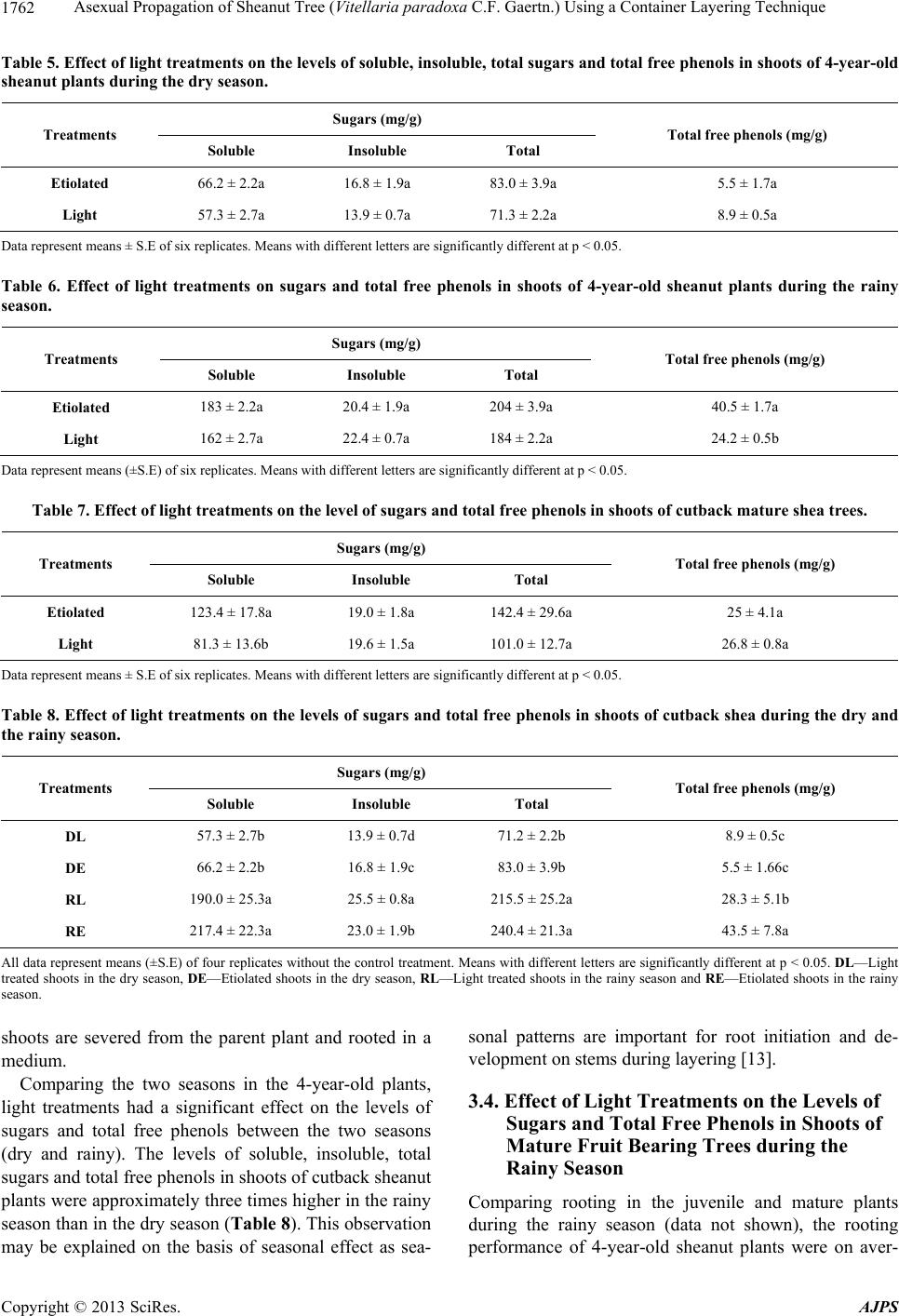 Asexual Propagation of Sheanut Tree (Vitellaria paradoxa C.F. Gaertn.) Using a Container Layering Technique Copyright © 2013 SciRes. AJPS 1762 Table 5. Effect of light treatments on the levels of soluble, insoluble, total sugars and total free phenols in shoots of 4-year-old sheanut plants during the dry season. Sugars (mg/g) Treatments Soluble Insoluble Total Total free phenols (mg/g) Etiolated 66.2 ± 2.2a 16.8 ± 1.9a 83.0 ± 3.9a 5.5 ± 1.7a Light 57.3 ± 2.7a 13.9 ± 0.7a 71.3 ± 2.2a 8.9 ± 0.5a Data represent means ± S.E of six rep licate s. Means with different letters are significantly different at p < 0.05. Table 6. Effect of light treatments on sugars and total free phenols in shoots of 4-year-old sheanut plants during the rainy season. Sugars (mg/g) Treatments Soluble Insoluble Total Total free phenols (mg/g) Etiolated 183 ± 2.2a 20.4 ± 1.9a 204 ± 3.9a 40.5 ± 1.7a Light 162 ± 2.7a 22.4 ± 0.7a 184 ± 2.2a 24.2 ± 0. 5 b Data represent means (±S.E) of six replicates. Means with different letters are significantly different at p < 0.05. Table 7. Effect of light treatments on the level of sugars and total free phenols in shoots of cutback mature shea trees. Sugars (mg/g) Treatments Soluble Insoluble Total Total free phenols (mg/g) Etiolated 123.4 ± 17.8a 19.0 ± 1.8a 142.4 ± 29.6a 25 ± 4.1a Light 81.3 ± 1 3 .6b 19.6 ± 1.5a 101.0 ± 12.7a 26.8 ± 0.8a Data represent means ± S.E of six rep licate s. Means with different letters are significantly different at p < 0.05. Table 8. Effect of light treatments on the levels of sugars and total free phenols in shoots of cutback shea du ring the dry and the rainy season. Sugars (mg/g) Treatments Soluble Insoluble Total Total free phenols (mg/g) DL 57.3 ± 2.7b 13.9 ± 0.7d 71.2 ± 2.2b 8.9 ± 0.5c DE 66.2 ± 2.2b 16.8 ± 1.9c 83.0 ± 3.9b 5.5 ± 1.66c RL 190.0 ± 25.3a 25.5 ± 0.8a 215.5 ± 25.2a 28.3 ± 5.1b RE 217.4 ± 22.3a 23.0 ± 1.9b 240.4 ± 21.3a 43.5 ± 7.8a All data rep resent mean s (±S.E) of four r eplicates with out the co ntrol t reatment. Means wi th diff erent lett ers are sign ificantly different at p < 0.05. DL—Light treated s hoots in the dry s eason, DE—Etiolated shoots in the dry season, RL—Light treated shoo ts in the rai ny season and RE—Etiolated shoots in the rainy season. shoots are severed from the parent plant and rooted in a medium. Comparing the two seasons in the 4-year-old plants, light treatments had a significant effect on the levels of sugars and total free phenols between the two seasons (dry and rainy). The levels of soluble, insoluble, total sugars and total f ree ph eno ls in shoo ts of cu tback sheanu t plants were approximately three times higher in th e rainy season than in the dry season (Table 8). This obser vation may be explained on the basis of seasonal effect as sea- sonal patterns are important for root initiation and de- velopment on stems during layering [13]. 3.4. Effect of Light Treatments on the Levels of Sugars and Total Free Phenols in Shoots of Mature Fruit Bearing Trees during the Rainy Season Comparing rooting in the juvenile and mature plants during the rainy season (data not shown), the rooting performance of 4-year-old sheanut plants were on aver-  Asexual Propagation of Sheanut Tree (Vitellaria paradoxa C.F. Gaertn.) Using a Container Layering Technique 1763 age higher (40.9%) than in the mature plants (27.9%). Etiolation did not enhance adventitious root formation but played a role in increasing the levels of total sugars and total free phenols (TFP) in the shoots. 4. Conclusion The container layering technique (CLT) holds promise for the rooting of sheanut trees. Roots formed using the CLT technique looked healthier. They were more in nu m- ber and had a vertical orientation giving the propagules had a better chance at survival, compared to earlier at- tempts at the CRIG, Bole Research Substation, where cuttings formed 1 - 2 roots that were b rittle and h ad more of a horizontal orientation and thus affected the chances of the plants survival. Further studies would need to be conducted to investigate the effects of auxins concentra- tions, combinations and timing of treatment on rooting. 5. Acknowledgements The authors wish to acknowledge Cocoa Research Insti- tute of Ghana (CRIG), Bole Substation in Northern Ghana for providing the plant material used for the pro- ject. REFERENCES [1] A. Nikiema and B. E. Umali, “Vitellaria paradoxa C.F. Gaertn. [Internet] Record from Protabase,” In: H. A. M. van der Vossen and G. S. Mkamilo, Eds, PROTA (Plant Resources of Tropical Africa, Wageningen, 2007. http://database.prota.org/search.htm [2] F. R. Irvine, “Woody Plants of Ghana with Special Ref- erence to Their Uses,” Oxford University Press, London, 1961. [3] J. N. Fobil, “Research and Development of the Shea Tree and Its Products,” 2008. www.solution.site.org/artman [4] J. B. Hall, D. P. Aebischer, H. F. Tomlinson, E. Osei- Amaning and J. R. Hindle, “Vitellariaparadoxa, a Mono- graph, Project B4850,” Forestry Research Progaramme, School of Agricultural Sciences, University of Wales, Bangor, 1996, p. 105. [5] A. Grolleau, “Contribution Al’Etude de la Multiplication Vegetative par Greffage du Karité (Vitellaria paradoxa Gaertn. f. = Butryospermum paradoxum Hepper),” Bois et Forets des Tropiques, No. 222, 1989, pp. 38-40. [6] Z. Teklehaimanot, H. Tomlinson, T. Lemma and K. Ree- ves, “Vegetative Propagation of Parkiabiglobosa (Jacq.) Benth, an Undomesticated Fruit Tree from West Africa,” Journal of Horticulture Science, No. 71, 1996, pp. 205- 215. [7] P. N. Lovett and N. Haq, “Evidence for Anthropic Do- mestication of the Sheanut Tree (Vitellaria paradoxa),” Agroforest System, No. 48, 2000, pp. 273-288. [8] K. Opoku-Ameyaw, F. M. Amoah and J. Yeboah, “Studies into Vegetative Propagation on the Sheanut Tree (Vitellaria paradoxa Gaertn),” Journal of Ghana Science Association, Vol. 4, No. 2, 2002, pp. 138-145. [9] H. Sanou, S. Kambou, Z. Teklehaimanot, M. Dembele, H. Yossi, S. Sina and L. Djingdia, “Vegetative Propagation of Vitellaria paradoxa by Grafting,” Agroforestry Sys- tems, Vol. 60, No. 1, 2004, pp. 93-99. doi:10.1023/B:AGFO.0000009408.03728.46 [10] J. A. Yidana, “Progress in Developing Technologies to Domesticate the Cultivation of Shea Tree (Vitellaria pa- radoxa L.) in Ghana,” Agricultural and Food Science Journal of Ghana, Vol. 3, 2004, pp. 249-268. [11] J. Yeboah, S. T. Lower and F. M. Amoah, “The Rooting Performance Shea (Vitellaria paradoxa C.F. Gaertn) Cut- tings Leached in Water and Application of Rooting Hor- mones in Different Media,” Journal of Plant Science, No. 4, 2009, pp. 10-14. doi:10.3923/jps.2009.10.14 [12] P. W. Hackett, “Juvenility, Maturation and Rejuvenation in Woody Plants,” Horticulture Reviews, Vol. 7, No. 109, 1985. [13] H. T. Hartmann, D. E. Kester, F. T. Davies Jr. and R. L. Geneve, “Plant Propagation: Principles and Practices,” 7th Edition, Prentice Hall, Upper Saddle River, 2001. [14] B. K. Maynard and N. Bassuk, “Etiolation as a Tool for Rooting Cuttings of Difficult-to-Root Woody Plants,” Combined Proceedings of International Plant Propaga- tors Society, 1985, pp. 448-495. [15] N. Amissah and N. Bassuk, “Severe Cutback of Stock Plant Influences Rooting in Shoots of Quercus bicolor and Quercus macrocarp,” Combined Proceedings of In- ternational Plant Propagators Society, 2005, pp. 436-438. [16] N. Amissah and N. Bassuk, “Effect of Light and Cutting Age on Rooting in Quercus bicolor, Quercus robur and Quercus macrocarpa Cuttings,” Combined Proceedings of the International Plant Propagators Society, 2007, pp. 286-292. [17] N. Amissah and N. Bassuk, “Cutting Back Stock Plants Promote Adventitious Rooting of Stems of Quercus bi- color and Quercus macrocarp,” Journal of Environmen- tal Horticulture, Vol. 27, No. 3, 2009, pp. 159-165. [18] E. F. Frolich, “Rooting Guatemalan Avocado Cuttings,” California Avocado Society Yearbook, 1951, pp. 136- 138. [19] N. Bassuk and B. Maynard, “Stock Plant Etiolation,” Hortscience, Vol. 22 1987, pp. 749-750. [20] J. Griffin and N. Bassuk, “Preliminary Progress on the Asexual Propagation of Oaks,” Combined proceedings of International Plant Propagation Society, 1996, pp. 487- 494. [21] N. Amissah and N. Bassuk, “Clonal Propagation of Quer- cusspp Using a Container Layering Technique,” Journal of Environmental Horticulture, Vol. 22, No. 2, 2004, pp. 80-84. [22] M. Dubois, K. A. Gilles, J. K. Hamilton, P. A. Rebers and F. Smith, “Colorimetric Methods for Determination of Sugars and Related Substances,” Journal of Analytical Chemistry, No. 28, 1956, pp. 350-356. doi:10.1021/ac60111a017 Copyright © 2013 SciRes. AJPS  Asexual Propagation of Sheanut Tree (Vitellaria paradoxa C.F. Gaertn.) Using a Container Layering Technique Copyright © 2013 SciRes. AJPS 1764 [23] T. Swain and W. E. Hillis, “The Phenolic Constituents of Prunus domestica,” Journal of the Science of Food and Agriculture, Vol. 10, No. 1, 1959, pp. 63-68. doi:10.1002/jsfa.2740100110 [24] A. Henrique, E. N. Campinhos, E. O. Ono and S. Z. Pinho, “Effect of Plant Growth Regulators in the Rooting of Pinus Cuttings,” Brazilian Archives of Biology and Technology, Vol. 49, No. 2, 2006, pp. 189-196. doi:10.1590/S1516-89132006000300002 [25] J. B. Coll, G. N. Rodrigo, B. S. Garcia and R. S. Tames, “Acido Abscisicoytros Inhibidores,” In: J. B. Coll, G. N. Rodrigo, B. S. Garcia and R. S. Tames, Eds., Fisiologia Vegetal, Madrid, 2002, pp. 369-379. |