

Paper Menu >>
Journal Menu >>
 Vol.5, No.9, 997-1000 (2013) Natural Science http://dx.doi.org/10.4236/ns.2013.59122 The study of formulation and performa nce of formate drilling and completion fluid system Bingren Wang1, Zehua Wang2*, Y u xue Sun2, Jiuzhou Sun1 1Northeast Petroleum University, Daqing, China 2Reservoir Protection Laboratory, Northeast Petroleum University, Daqing, China; *Corresponding Author: [email protected] Received 21 June 2013; revised 21 July 2013; accepted 28 July 2013 Copyright © 2013 Bingren Wang et al. This is an open access article distributed under the Creative Commons Attribution License, which permits unrestricted use, distribution, and reproduction in any medium, provided the original work is properly cited. ABSTRACT Formate drilling and completion fluid system is a new type of clean organic salt brine system which has been developed from inorganic salt brine drilling fluid system. It is beneficial to pro- tecte and find hydrocarbon reservoir. Due to the solid free system, the damage of solid phase particles on reservoir, especially low permeabi- lity oil and gas layer, can be greatly eliminated, at the same time, drilling fluid and completion fluid have greater compatibility. It will avoid that precipitation which is not compatible with drill- ing and completion fluid and generates dam- ages on reservoir. And because mud cake of the solid free system is thin and resilient, it is con- ductive to improve cementing quality greatly. Experiments show that the formate drilling and completion system has good rheological prop- erty, strong inhibition ability, good lubricating performance, good compatibility with reser- voir rocks and formation water at high tem- perature. Keywords: Formate; Drilling and Completion Fluid System; Solid Free System; Hydrocarbon Re servoir Protection 1. INTRODUCTION Formate drilling and completion fluid is a new type of clean brine system which has been developed from inor- ganic salt brine drilling fluid system. Currently there are mainly three kinds of formate: sodium formate, potas- sium formate and cesium formate. Compared with con- ventional drilling fluid, formate drilling fluid is charac- terized by no bentonite slurry. It is the theoretical foun- dation that formate drilling fluid can achieve strong in- hibitory, and it is also the key to being better than con- ventional water base drilling fluid. Some scholars have studied this before, such as Liuyu has published a paper of “Researches and uses of solids-free high density for- mate and high temperature crosslinking water base sys- tems as drill-in fluid” in 2005. Then he has applied the drilling fluid into Liaohe Oilfield and the petroleum- in-place has been increased. Wang Yongsheng has stud- ied the application effect of the formate drilling fluid in Yingtai gas field in 2012. And this drilling fluid system has helped to protect the reservoir and save the explora- tion cost. Based on the previous research, this paper is studied for some new findings and applications [1]. 2. THE BASIC NATURE OF FORMATE Formate has the characteristics of high solubility, high density, high pH value, low crystallization point. With the increase of alkali metal atomic weight, saturation concentration, saturation density and pH value become higher, and crystallization point becomes lower. Through indoor study, the following features of for- mate have been found: 1) There is the function of stabilizing shale. Shale is equivalent to the selective semi-permeable membrane in the non fractured low permeability shale formation (K ≤ 10 × 10−3 m2). In the high concentration brine, due to the low water activity, the osmotic pressure can promote the shale pore water reflux. This reflux will make formation stress and effective stress of near wellbore zone increase to stabilize borehole wall. 2) Formate has a good compatibility with the oilfield commonly used polymer, and can slow the speed of hydrolysis and oxidation degradation of many thicken- ers and filtrate reducers under high temperature and pressure. Copyright © 2013 SciRes. OPEN ACCESS 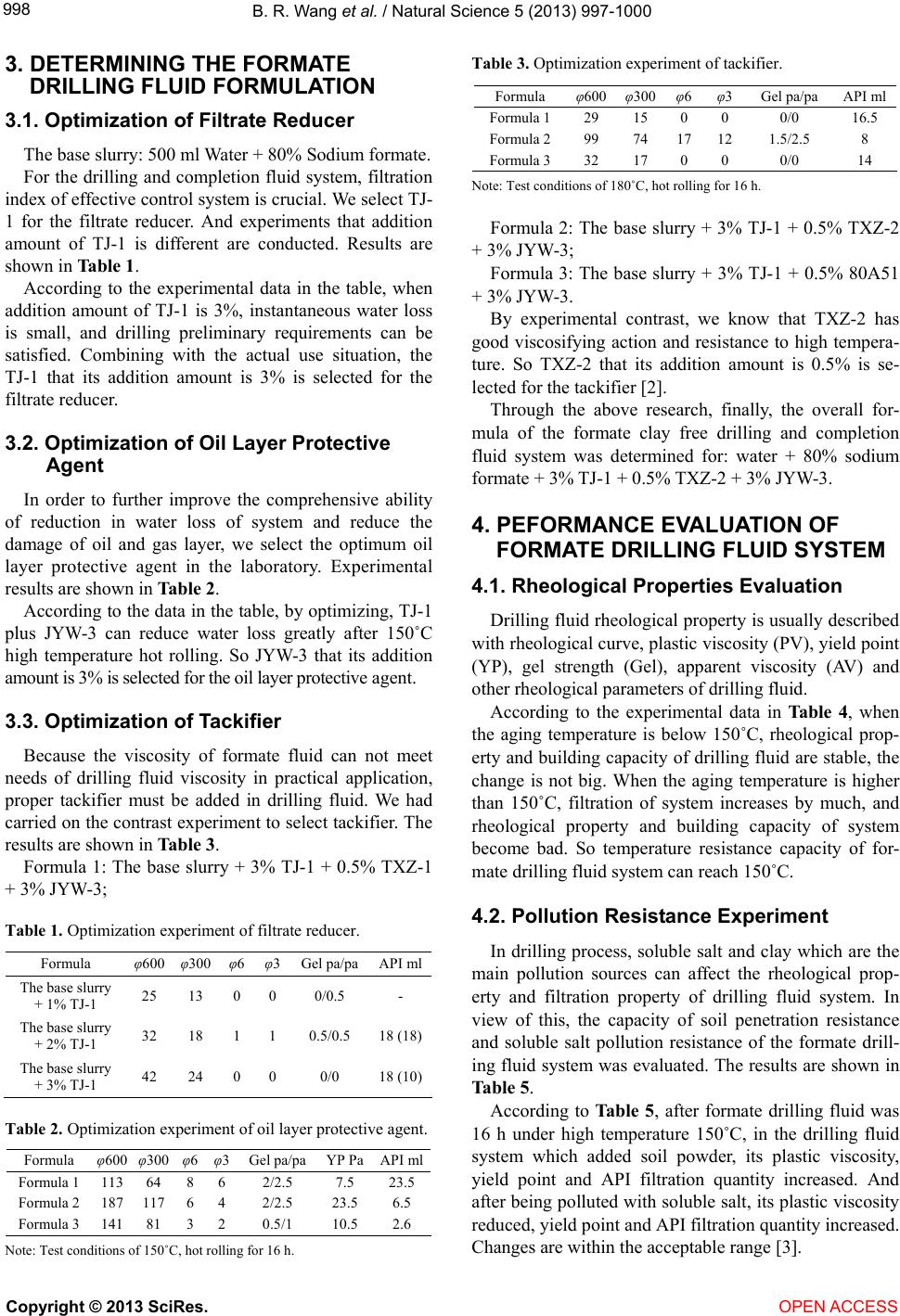 B. R. Wang et al. / Natural Science 5 (2013) 997-1000 998 3. DETERMINING THE FORMATE DRILLING FLUID FORMULATION 3.1. Optimization of Filtrate Reducer The base slurry: 500 ml Water + 80% Sodium formate. For the drilling and completion fluid system, filtration index of effective control system is crucial. We select TJ- 1 for the filtrate reducer. And experiments that addition amount of TJ-1 is different are conducted. Results are shown in Table 1. According to the experimental data in the table, when addition amount of TJ-1 is 3%, instantaneous water loss is small, and drilling preliminary requirements can be satisfied. Combining with the actual use situation, the TJ-1 that its addition amount is 3% is selected for the filtrate reducer. 3.2. Optimization of Oil Layer Protective Agent In order to further improve the comprehensive ability of reduction in water loss of system and reduce the damage of oil and gas layer, we select the optimum oil layer protective agent in the laboratory. Experimental results are shown in Table 2. According to the data in the table, by optimizing, TJ-1 plus JYW-3 can reduce water loss greatly after 150˚C high temperature hot rolling. So JYW-3 that its addition amount is 3% is selected for the oil layer protective agent. 3.3. Optimization of Tackifier Because the viscosity of formate fluid can not meet needs of drilling fluid viscosity in practical application, proper tackifier must be added in drilling fluid. We had carried on the contrast experiment to select tackifier. The results are shown in Table 3. Formula 1: The base slurry + 3% TJ-1 + 0.5% TXZ-1 + 3% JYW-3; Table 1. Optimization experiment of filtrate reducer. Formula φ600 φ300 φ6 φ3 Gel pa/pa API ml The base slurry + 1% TJ-1 25 13 00 0/0.5 - The base slurry + 2% TJ-1 32 18 11 0.5/0.5 18 (18) The base slurry + 3% TJ-1 42 24 00 0/0 18 (10) Table 2. Optimization experiment of oil layer protective agent. Formula φ600 φ300 φ6 φ3Gel pa/pa YP PaAPI ml Formula 1 113 64 8 62/2.5 7.5 23.5 Formula 2 187 117 6 42/2.5 23.5 6.5 Formula 3 141 81 3 20.5/1 10.5 2.6 Note: Test conditions of 150˚C, hot rolling for 16 h. Table 3. Optimization experiment of tackifier. Formula φ600 φ300 φ6 φ3 Gel pa/paAPI ml Formula 1 29 15 0 0 0/0 16.5 Formula 2 99 74 17 12 1.5/2.5 8 Formula 3 32 17 0 0 0/0 14 Note: Test conditions of 180˚C, hot rolling for 16 h. Formula 2: The base slurry + 3% TJ-1 + 0.5% TXZ-2 + 3% JYW-3; Formula 3: The base slurry + 3% TJ-1 + 0.5% 80A51 + 3% JYW-3. By experimental contrast, we know that TXZ-2 has good viscosifying action and resistance to high tempera- ture. So TXZ-2 that its addition amount is 0.5% is se- lected for the tackifier [2]. Through the above research, finally, the overall for- mula of the formate clay free drilling and completion fluid system was determined for: water + 80% sodium formate + 3% TJ-1 + 0.5% TXZ-2 + 3% JYW-3. 4. PEFORMANCE EVALUATION OF FORMATE DRILLING FLUID SYSTEM 4.1. Rheological Properties Evaluation Drilling fluid rheological property is usually described with rheological curve, plastic viscosity (PV), yield point (YP), gel strength (Gel), apparent viscosity (AV) and other rheological parameters of drilling fluid. According to the experimental data in Ta ble 4, when the aging temperature is below 150˚C, rheological prop- erty and building capacity of drilling fluid are stable, the change is not big. When the aging temperature is higher than 150˚C, filtration of system increases by much, and rheological property and building capacity of system become bad. So temperature resistance capacity of for- mate drilling fluid system can reach 150˚C. 4.2. Pollution Resistance Experiment In drilling process, soluble salt and clay which are the main pollution sources can affect the rheological prop- erty and filtration property of drilling fluid system. In view of this, the capacity of soil penetration resistance and soluble salt pollution resistance of the formate drill- ing fluid system was evaluated. The results are shown in Table 5. According to Ta bl e 5, after formate drilling fluid was 16 h under high temperature 150˚C, in the drilling fluid system which added soil powder, its plastic viscosity, yield point and API filtration quantity increased. And after being polluted with soluble salt, its plastic viscosity reduced, yield point and API filtration quantity increased. Changes are within the acceptable range [3]. Copyright © 2013 SciRes. OPEN ACCESS 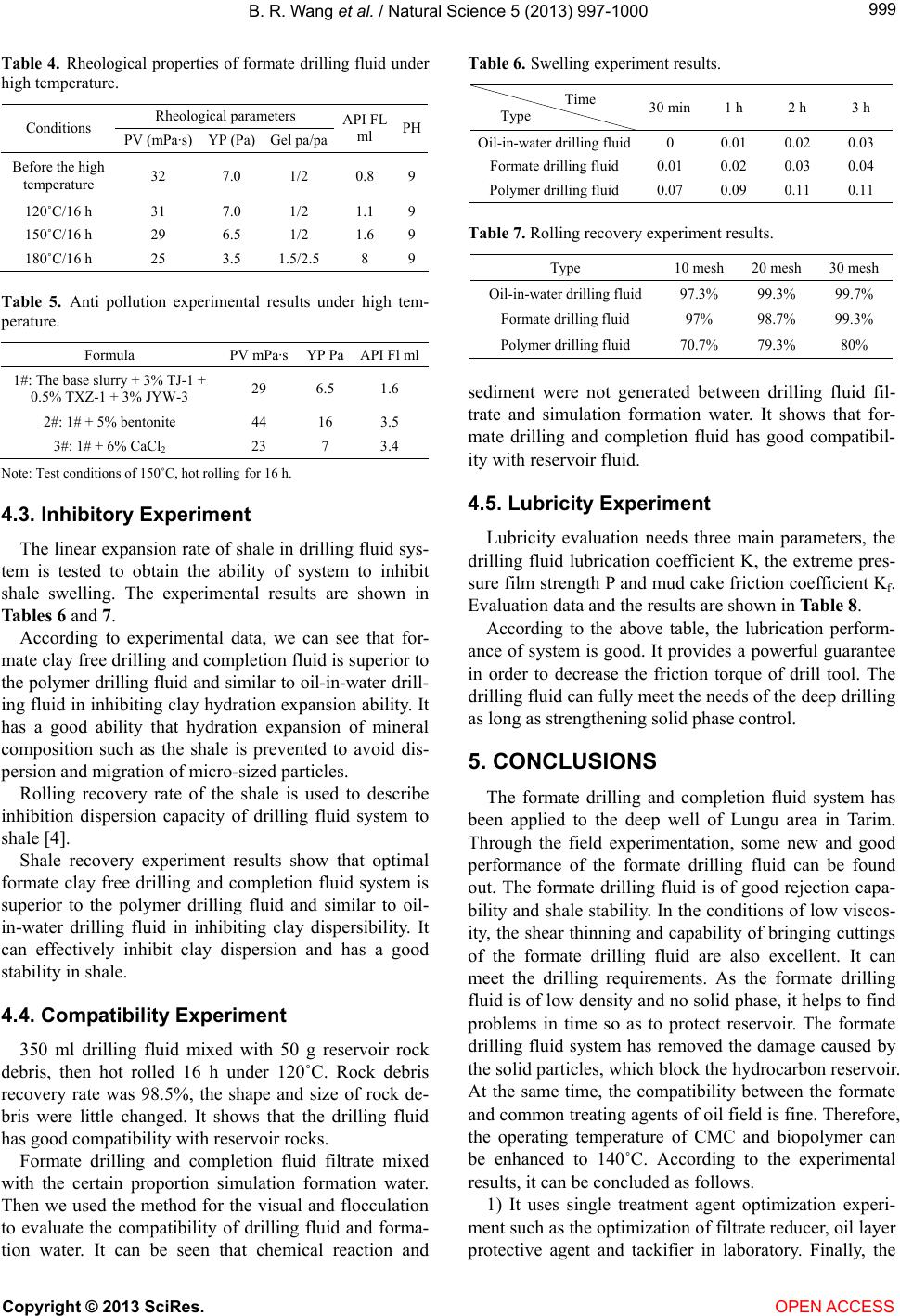 B. R. Wang et al. / Natural Science 5 (2013) 997-1000 999 Table 4. Rheological properties of formate drilling fluid under high temperature. Rheological parameters Conditions PV (mPa·s) YP (Pa) Gel pa/pa API FL ml PH Before the high temperature 32 7.0 1/2 0.8 9 120˚C/16 h 31 7.0 1/2 1.1 9 150˚C/16 h 29 6.5 1/2 1.6 9 180˚C/16 h 25 3.5 1.5/2.5 8 9 Table 5. Anti pollution experimental results under high tem- perature. Formula PV mPa·s YP Pa API Fl ml 1#: The base slurry + 3% TJ-1 + 0.5% TXZ-1 + 3% JYW-3 29 6.5 1.6 2#: 1# + 5% bentonite 44 16 3.5 3#: 1# + 6% CaCl2 23 7 3.4 Note: Test conditions of 150˚C, hot rolling for 16 h. 4.3. Inhibitory Experiment The linear expansion rate of shale in drilling fluid sys- tem is tested to obtain the ability of system to inhibit shale swelling. The experimental results are shown in Tables 6 and 7. According to experimental data, we can see that for- mate clay free drilling and completion fluid is superior to the polymer drilling fluid and similar to oil-in-water drill- ing fluid in inhibiting clay hydration expansion ability. It has a good ability that hydration expansion of mineral composition such as the shale is prevented to avoid dis- persion and migration of micro-sized particles. Rolling recovery rate of the shale is used to describe inhibition dispersion capacity of drilling fluid system to shale [4]. Shale recovery experiment results show that optimal formate clay free drilling and completion fluid system is superior to the polymer drilling fluid and similar to oil- in-water drilling fluid in inhibiting clay dispersibility. It can effectively inhibit clay dispersion and has a good stability in shale. 4.4. Compatibility Experiment 350 ml drilling fluid mixed with 50 g reservoir rock debris, then hot rolled 16 h under 120˚C. Rock debris recovery rate was 98.5%, the shape and size of rock de- bris were little changed. It shows that the drilling fluid has good compatibility with reservoir rocks. Formate drilling and completion fluid filtrate mixed with the certain proportion simulation formation water. Then we used the method for the visual and flocculation to evaluate the compatibility of drilling fluid and forma- tion water. It can be seen that chemical reaction and Table 6. Swelling experiment results. Time Type 30 min 1 h 2 h 3 h Oil-in-water drilling fluid0 0.01 0.02 0.03 Formate drilling fluid 0.01 0.02 0.03 0.04 Polymer drilling fluid 0.07 0.09 0.11 0.11 Table 7. Rolling recovery experiment results. Type 10 mesh 20 mesh 30 mesh Oil-in-water drilling fluid 97.3% 99.3% 99.7% Formate drilling fluid 97% 98.7% 99.3% Polymer drilling fluid 70.7% 79.3% 80% sediment were not generated between drilling fluid fil- trate and simulation formation water. It shows that for- mate drilling and completion fluid has good compatibil- ity with reservoir fluid. 4.5. Lubricity Experiment Lubricity evaluation needs three main parameters, the drilling fluid lubrication coefficient K, the extreme pres- sure film strength P and mud cake friction coefficient Kf. Evaluation data and the results are shown in Table 8. According to the above table, the lubrication perform- ance of system is good. It provides a powerful guarantee in order to decrease the friction torque of drill tool. The drilling fluid can fully meet the needs of the deep drilling as long as strengthening solid phase control. 5. CONCLUSIONS The formate drilling and completion fluid system has been applied to the deep well of Lungu area in Tarim. Through the field experimentation, some new and good performance of the formate drilling fluid can be found out. The formate drilling fluid is of good rejection capa- bility and shale stability. In the conditions of low viscos- ity, the shear thinning and capability of bringing cuttings of the formate drilling fluid are also excellent. It can meet the drilling requirements. As the formate drilling fluid is of low density and no solid phase, it helps to find problems in time so as to protect reservoir. The formate drilling fluid system has removed the damage caused by the solid particles, which block the hydrocarbon reservoir. At the same time, the compatibility between the formate and common treating agents of oil field is fine. Therefore, the operating temperature of CMC and biopolymer can be enhanced to 140˚C. According to the experimental results, it can be concluded as follows. 1) It uses single treatment agent optimization experi- ment such as the optimization of filtrate reducer, oil layer protective agent and tackifier in laboratory. Finally, the Copyright © 2013 SciRes. OPEN ACCESS 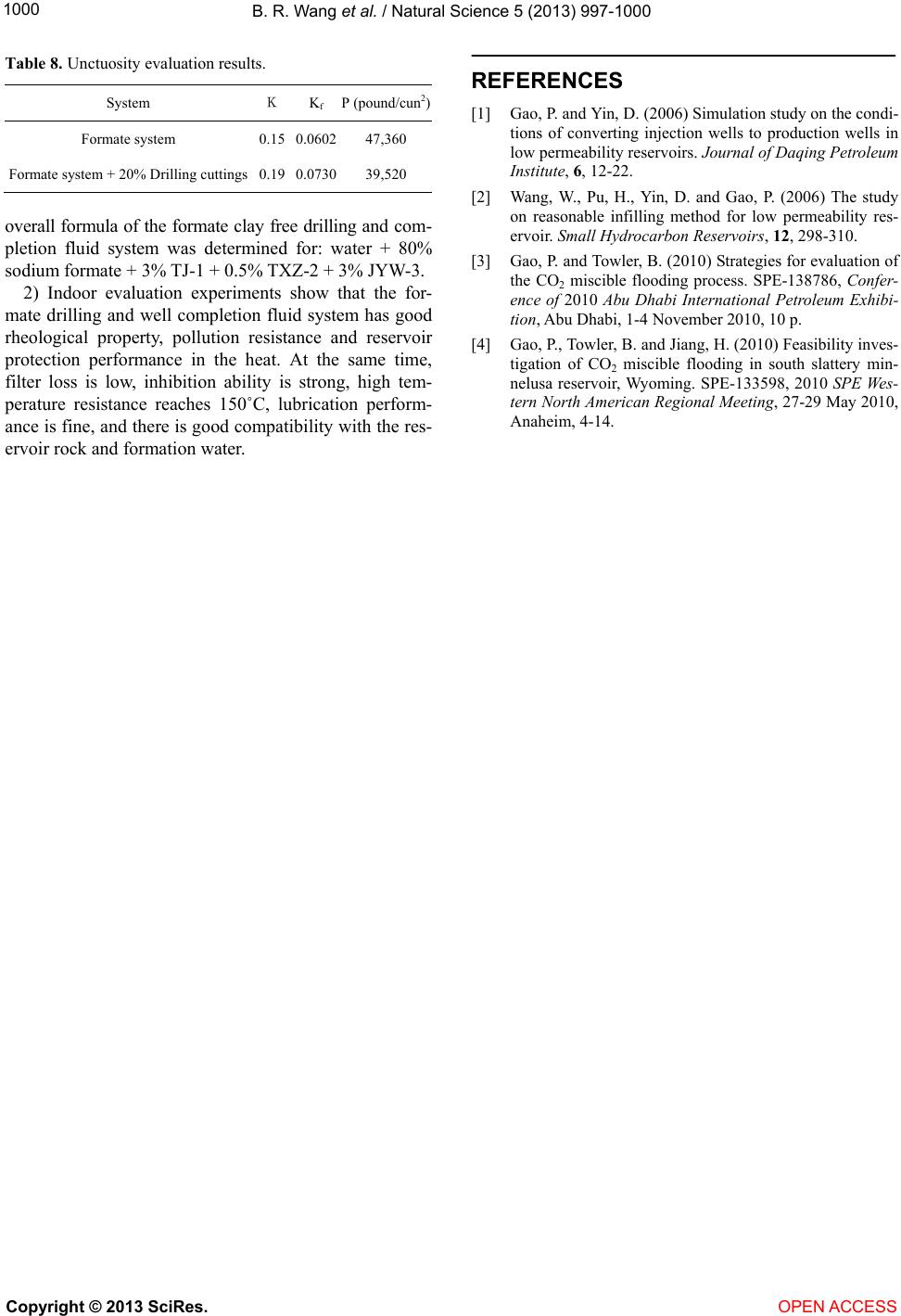 B. R. Wang et al. / Natural Science 5 (2013) 997-1000 Copyright © 2013 SciRes. 1000 Table 8. Unctuosity evaluation results. REFERENCES System K Kf P (pound/cun2) Formate system 0.15 0.0602 47,360 Formate system + 20% Drilling cuttings 0.19 0.0730 39,520 [1] Gao, P. and Yin, D. (2006) Simulation study on the condi- tions of converting injection wells to production wells in low permeability reservoirs. Journal of Daqing Petroleum Institute, 6, 12-22. [2] Wang, W., Pu, H., Yin, D. and Gao, P. (2006) The study on reasonable infilling method for low permeability res- ervoir. Small Hydrocarbon Reservoirs, 12, 298-310. overall formula of the formate clay free drilling and com- pletion fluid system was determined for: water + 80% sodium formate + 3% TJ-1 + 0.5% TXZ-2 + 3% JYW-3. [3] Gao, P . and Towler, B. (2010) Strategies for evaluation of the CO2 miscible flooding process. SPE-138786, Confer- ence of 2010 Abu Dhabi International Petroleum Exhibi- tion, Abu Dhabi, 1-4 November 2010, 10 p. 2) Indoor evaluation experiments show that the for- mate drilling and well completion fluid system has good rheological property, pollution resistance and reservoir protection performance in the heat. At the same time, filter loss is low, inhibition ability is strong, high tem- perature resistance reaches 150˚C, lubrication perform- ance is fine, and there is good compatibility with the res- ervoir rock and formation water. [4] Gao, P., Towler, B. and Jiang, H. (2010) Feasibility inves- tigation of CO2 miscible flooding in south slattery min- nelusa reservoir, Wyoming. SPE-133598, 2010 SPE Wes- tern North American Regional Meeting, 27-29 May 2010, Anaheim, 4-14. OPEN ACCESS |