

Paper Menu >>
Journal Menu >>
 Vol.5, No.9, 993-996 (2013) Natural Science http://dx.doi.org/10.4236/ns.2013.59121 Distribution and chromosomal va riation in the scincid lizard genus Lygosoma (Reptilia: Squamata) in Thailand Varanya Aranyavalai1*, Kanok Lertpanich2, Warawut Chulalaksananukul3 1Department of Biology, Faculty of Science, Chulalongkorn University, Bangkok, Thailand; *Corresponding Author: [email protected] 2Department of Agricultural Technique, Faculty of Agricultural Development and Resources Management, King Mongkut’s Institute of Technology Ladkrabang, Bangkok, Thailand 3Department of Botan y, Faculty of Science, Chulalongkorn University, Bangkok, Thailand Received 15 July 2013; revised 15 August 2013; accepted 22 August 2013 Copyright © 2013 Varanya Arany avalai et al. This is an open access article distributed under the Creative Commons Attribution Li- cense, which permits unrestricted use, distribution, and reproduction in any medium, provided the original work is properly cited. ABSTRACT The distribution of the scincid lizard genus Ly- gosoma in Thailand was studied and recorded on a map. In addition, the studies on chromo- somes of Lygosoma bowringii, L. khoratense and L. quadrupes were examined. The karyotype was determined for each individual on the basis of at least 10 well spread cells. L. bowringii and L. khoratense showed the same diploid number of 2N = 32 and identical chromosome morphol- ogy. The fundamental number (N.F.) equals 48. The karyotype of L. quadrupes is almost identi- cal to that of L. bowringii, but differs from the latter in having a telocentric p air 9. Thus, the N.F. value equal to 46. No sex chromosome hetero- morphisms is evident. Keywords: Di stribution; Chromosome; Skinks; Lygosoma; Thailand 1. INTRODUCTION Skinks are a hyper-diverse group of reptiles, contain- ing more than 1000 species ranging from temperate to tropical regions on all continents but Antarctica [1,2 ]. Of these, about 12 genera are recognized in Thailand [3] and probably some skinks are waiting for description. The genus Lygosoma described by Hardwicke & Gray, 1827 in family Scincidae has a long and complicated nomen- clatural history. The common name, writhing skinks, re- fers to the way these stubby-legged animals move, sn ake- like but slower and more awkward. The limbs are par- tially or almost completely reduced (varying from com- pletely developed four or five digital to hardly noticeable unidactylous or adactylous limbs). They are truly cos- mopolitan, distributed in Africa, Australia, South and Southeast Asia, Polynesia, and Central America. These skinks are seldom seen on the surface of the soil or leaf litter. Lygosoma feeds on insects and small invertebrates. Most species lay eggs, but a few are live-bearers. Very few record of this genus was subsequently made, and our knowledge about this secretive skink and its geographi- cal distribution remains minimal. Currently, most of the skink’s data are focused on taxonomic status. There are very few records of biology of skinks, making it difficult to available in applied works such as concentrating on captive breeding, and conserving skink species of pure genetic quality. Cytotaxonomic studies are especially mea- ger, despite their possible great contributions to the un- derstanding of the divergence and relationships of the species. This is due to the paucity of chromosomal data, especially for the species of Lygosoma. The aim of this research is to study sp ecies distribution, chromosome nu m- ber and describe karyotypes of the scincid genus Ly - gosoma in Thailand. Results revealed the presence of considerable intraspecific ch romosomal variations within the genus. 2. MATERIALS AND METHODS Field surveys were conducted in Thailand, including Bangkok, Phra Nakhon Si Ayutthaya, Nakhon Nayok, Chai Nat, Nakhon Sawan , Uttaradit, Phetchab un , Ph ich it, Kamphaeng Phet, Tak, Sukhothai, Phrae, Lampang, La m- phun, Nan, Chiang Mai, Mae Hong Son, Chiang Rai, Saraburi, Nakhon Ratchasima, Burirum, Khon Kaen, Ubon Ratchathani, Nongkhai, Nakhon Phanom, Suphan- Copyright © 2013 SciRes. OPEN ACCESS 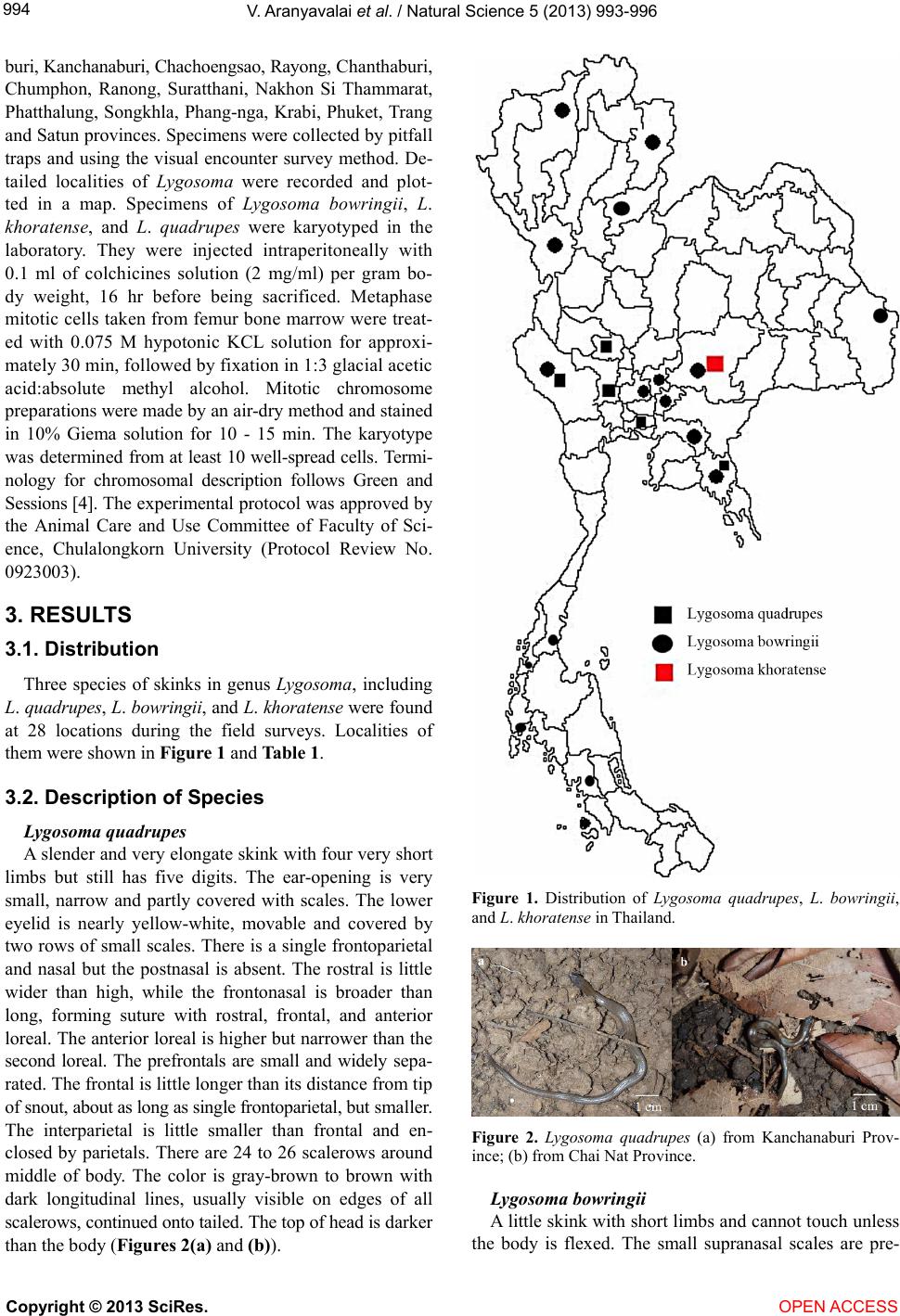 V. Aranyavalai et al. / Natural Science 5 (201 3) 993-996 994 buri, Kanchanaburi, Chachoengsao, Rayong, Chan th a bu r i , Chumphon, Ranong, Suratthani, Nakhon Si Thammarat, Phatthalung, Songkhla, Phang-nga, Krabi, Phuket, Trang and Satun provinces. Specimens were collected by p itfall traps and using the visual encounter survey method. De- tailed localities of Lygosoma were recorded and plot- ted in a map. Specimens of Lygosoma bowringii, L. khoratense, and L. quadrupes were karyotyped in the laboratory. They were injected intraperitoneally with 0.1 ml of colchicines solution (2 mg/ml) per gram bo- dy weight, 16 hr before being sacrificed. Metaphase mitotic cells taken from femur bone marrow were treat- ed with 0.075 M hypotonic KCL solution for approxi- mately 30 min, followed by fixation in 1:3 glacial acetic acid:absolute methyl alcohol. Mitotic chromosome preparations were made by an air-dry method and stained in 10% Giema solution for 10 - 15 min. The karyotype wa s det ermin ed from at least 10 well-spread cells. Termi- nology for chromosomal description follows Green and Sessions [4]. The experimental protocol was approved by the Animal Care and Use Committee of Faculty of Sci- ence, Chulalongkorn University (Protocol Review No. 0923003). 3. RESULTS 3.1. Distribution Three species of skinks in genus Lygosoma, including L. quadrupes, L. bowringii, and L. khoratense were found at 28 locations during the field surveys. Localities of them were shown in Figure 1 and Table 1. 3.2. Description of Species Lygosoma quadrupes A slender and very elongate skink with four very short limbs but still has five digits. The ear-opening is very small, narrow and partly covered with scales. The lower eyelid is nearly yellow-white, movable and covered by two rows of small scales. There is a single frontoparietal and nasal but the postnasal is absent. The rostral is little wider than high, while the frontonasal is broader than long, forming suture with rostral, frontal, and anterior loreal. The anterior loreal is higher but narrower than the second loreal. The prefrontals are small and widely sepa- rated. The frontal is little longer th an its d istan ce from tip of snout, about as long as single frontoparietal, but smaller. The interparietal is little smaller than frontal and en- closed by parietals. There are 24 to 26 scalerows around middle of body. The color is gray-brown to brown with dark longitudinal lines, usually visible on edges of all scalerows, continued onto tailed. The top of head is dar ker than the body (Figures 2(a) and (b)). Figure 1. Distribution of Lygosoma quadrupes, L. bowringii, and L. khoratense in Thailand. Figure 2. Lygosoma quadrupes (a) from Kanchanaburi Prov- ince; (b) from Chai Nat Province. Lygosoma bowringii A little skin k with short limbs and cannot to uch unless the body is flexed. The small supranasal scales are pre- Copyright © 2013 SciRes. OPEN ACCESS 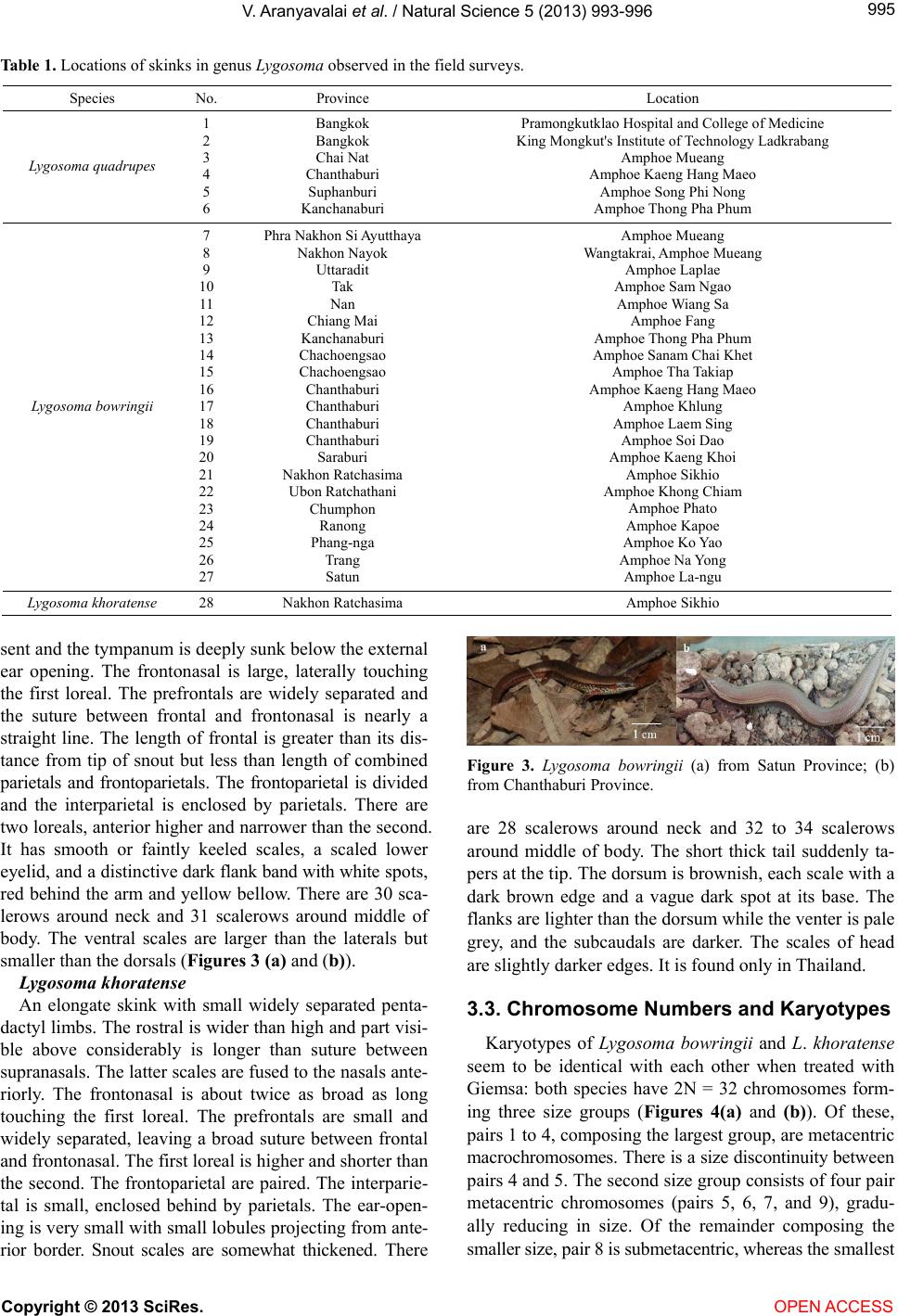 V. Aranyavalai et al. / Natural Science 5 (201 3) 993-996 Copyright © 2013 SciRes. 995 Table 1. Locations of skinks in genus Lygosoma observed in the field surveys. Species No. Province Location Lygosoma quadrupes 1 2 3 4 5 6 Bangkok Bangkok Chai Nat Chanthaburi Suphanburi Kanchanaburi Pramongkutklao H o s p i t a l a n d C o l l e ge of Medicine King Mongkut's Institute of Technology Ladkrabang Amphoe Mueang Amphoe Kaeng Hang Maeo Amphoe Song Phi Nong Amphoe Thong Pha Phum Lygosoma bowringii 7 8 9 10 11 12 13 14 15 16 17 18 19 20 21 22 23 24 25 26 27 Phra Nakhon Si Ayutthaya Nakhon Nayok Uttaradit Tak Nan Chiang Mai Kanchanaburi Chachoengsao Chachoengsao Chanthaburi Chanthaburi Chanthaburi Chanthaburi Saraburi Nakhon Ratchasima Ubon Ratchathani Chumphon Ranong Phang-nga Trang Satun Amphoe Mueang Wangtakrai, Amphoe Mueang Amphoe Laplae Amphoe Sam Ng a o Amphoe Wiang Sa Amphoe Fang Amphoe Thong Pha Phum Amphoe Sanam Chai Khet Amphoe Tha Takiap Amphoe Kaeng Hang Maeo Amphoe Khlung Amphoe Laem Sing Amphoe Soi Dao Amphoe Kaeng Khoi Amphoe Sikhio Amphoe Khong Chiam Amphoe Phato Amphoe Kapoe Amphoe Ko Yao Amphoe Na Yong Amphoe La-ngu Lygosoma khoratense 28 Nakhon Ratchasima Amphoe Sikhio sent and the tympanum is deep ly sunk below th e external ear opening. The frontonasal is large, laterally touching the first loreal. The prefrontals are widely separated and the suture between frontal and frontonasal is nearly a straight line. The length of frontal is greater than its dis- tance from tip of snout but less than length of combined parietals and frontoparietals. The frontoparietal is divided and the interparietal is enclosed by parietals. There are two loreals, anterior higher and narrower than the seco nd. It has smooth or faintly keeled scales, a scaled lower eye li d , a n d a di s ti n ct iv e dark flank band with white s po t s , red behind the arm and yellow bellow. There are 30 sca- lerows around neck and 31 scalerows around middle of body. The ventral scales are larger than the laterals but smaller than the dorsals (Figures 3 (a) and (b)). Figure 3. Lygo som a bowringii (a) from Satun Province; (b) from Chanthaburi Province. are 28 scalerows around neck and 32 to 34 scalerows around middle of body. The short thick tail suddenly ta- pers at the tip. The dorsum is brownish, each scale with a dark brown edge and a vague dark spot at its base. The flanks are lighter than the dorsum while the venter is pale grey, and the subcaudals are darker. The scales of head are slightly darker edges. It is found only in Thailand. Lygosoma khoratense An elongate skink with small widely separated penta- dactyl limbs. The rostral is wider than high and part visi- ble above considerably is longer than suture between supranasals. The latter scales are fused to the nasals ante- riorly. The frontonasal is about twice as broad as long touching the first loreal. The prefrontals are small and widely separated, leaving a broad suture between frontal and frontonasal. The first lo real is higher and shorter than the second. The frontoparietal are paired. The interparie- tal is small, enclosed behind by parietals. The ear-open- ing is very small with small lobules proj ecting from ante- rior border. Snout scales are somewhat thickened. There 3.3. Chromosome Numbers and Karyotypes Karyotypes of Lygosoma bowringii and L. khoratense seem to be identical with each other when treated with Giemsa: both species have 2N = 32 chromosomes form- ing three size groups (Figures 4(a) and (b)). Of these, pairs 1 to 4, composing the largest group, are metacentric macrochromosomes. There is a size discontinuity between pairs 4 and 5. The second size group consists of four pair metacentric chromosomes (pairs 5, 6, 7, and 9), gradu- ally reducing in size. Of the remainder composing the smaller size, pair 8 is submetacentric, whereas the smallest OPEN ACCESS 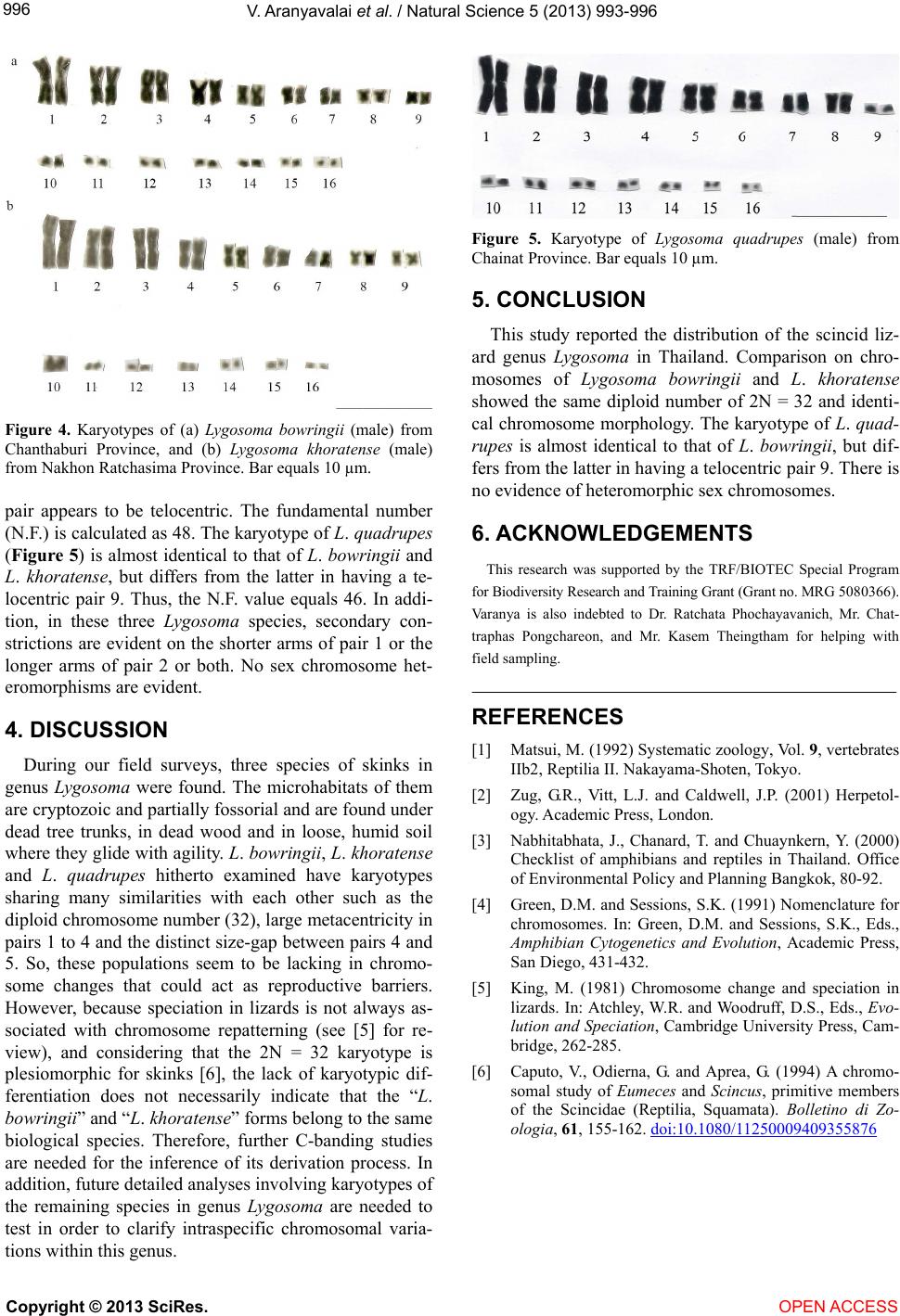 V. Aranyavalai et al. / Natural Science 5 (201 3) 993-996 996 Figure 4. Karyotypes of (a) Lygosoma bowringii (male) from Chanthaburi Province, and (b) Lygosoma khoratense (male) from Nakhon Ratchasima Province. Bar equals 10 µm. pair appears to be telocentric. The fundamental number (N.F.) is calculated as 48. The karyotype of L. quadrupes (Figure 5) is almost identical to that of L. bowringii and L. khora t ens e , but differs from the latter in having a te- locentric pair 9. Thus, the N.F. value equals 46. In addi- tion, in these three Ly gosoma species, secondary con- strictions are evident on the shorter arms of pair 1 or the longer arms of pair 2 or both. No sex chromosome het- eromorphisms are evident. 4. DISCUSSION During our field surveys, three species of skinks in genus Ly gosoma were found. The microhabitats of them are cryptozoic and partially fossorial and are found under dead tree trunks, in dead wood and in loose, humid soil where they glid e with agility. L. bowringii, L. khoratense and L. quadrupes hitherto examined have karyotypes sharing many similarities with each other such as the diploid chromosome number (32), large metacentricity in pairs 1 to 4 and the distinct size-gap between pairs 4 and 5. So, these populations seem to be lacking in chromo- some changes that could act as reproductive barriers. However, because speciation in lizards is not always as- sociated with chromosome repatterning (see [5] for re- view), and considering that the 2N = 32 karyotype is plesiomorphic for skinks [6], the lack of karyotypic dif- ferentiation does not necessarily indicate that the “L. bowringii” and “L. khora ten se ” fo r ms b e lon g to th e s ame biological species. Therefore, further C-banding studies are needed for the inference of its derivation process. In addition, future detailed an alyses inv olving karyotypes of the remaining species in genus Ly gosoma are needed to test in order to clarify intraspecific chromosomal varia- tions within this genus. Figure 5. Karyotype of Lygosoma quadrupes (male) from Chainat Province. Bar equals 10 µm. 5. CONCLUSION This study reported the distribution of the scincid liz- ard genus Lygosoma in Thailand. Comparison on chro- mosomes of Ly gosoma bowringii and L. khoratense showed the same diploid number of 2N = 32 and identi- cal chromosome morphology. The karyotype of L. quad- rupes is almost identical to that of L. bowringii, but dif- fers from the latter in having a telocentric pair 9. There is no evidence of heteromorphic sex chromosomes. 6. ACKNOWLEDGEMENTS This research was supported by the TRF/BIOTEC Special Program for Biodiversity Research and Training Grant (Grant no. MRG 5080366). Varanya is also indebted to Dr. Ratchata Phochayavanich, Mr. Chat- traphas Pongchareon, and Mr. Kasem Theingtham for helping with field sampling. REFERENCES [1] Matsui, M. (1992) Systematic zoology, Vol. 9, vertebrates IIb2, Reptilia II. Nakayama-Shoten, T ok yo. [2] Zug, G.R., Vitt, L.J. and Caldwell, J.P. (2001) Herpetol- ogy. Academic Press, London. [3] Nabhitabhata, J., Chanard, T. and Chuaynkern, Y. (2000) Checklist of amphibians and reptiles in Thailand. Office of Environmental Policy and Planning Bangkok, 80-92. [4] Green, D.M. and Sessions, S.K. (1991) Nomenclature for chromosomes. In: Green, D.M. and Sessions, S.K., Eds., Amphibian Cytogenetics and Evolution, Academic Press, San Diego, 431-432. [5] King, M. (1981) Chromosome change and speciation in lizards. In: Atchley, W.R. and Woodruff, D.S., Eds., Evo- lution and Speciation, Cambridge University Press, Ca m- bridge, 262-285. [6] Caputo, V., Odierna, G. and Aprea, G. (1994) A chromo- somal study of Eumeces and Scincus, primitive members of the Scincidae (Reptilia, Squamata). Bolletino di Zo- ologia, 61, 155-162. doi:10.1080/11250009409355876 Copyright © 2013 SciRes. OPEN ACCESS |