

Paper Menu >>
Journal Menu >>
 Open Journal of Genetics, 2013, 3, 171-173 OJGen http://dx.doi.org/10.4236/ojgen.2013.33019 Published Online September 2013 (http://www.scirp.org/journal/ojgen/) Variable β-globin haplotypes in Saudi β thalassemia population* Jameela Shinwari1#, Tahani Alshehri1,2#, Asma I. Tahir1, Abdullah Al Jefri3, Abdulkareem AlMomen4, Dana Bakheet1, Mohammad AlAnazi2, Arjumand Warsy2, Nada Al Tassan1† 1Department of Genetics, Research Centre, King Faisal Specialist Hospital & Research Centre, Riyadh, KSA 2Biochemistry Department, College of Science, King Saud University, Riyadh, KSA 3Pediatric Hematology/Oncology Department, King Faisal Specialist Hospital & Research Centre, Riyadh, KSA 4Hematology Department, King Khalid University Hospital, King Saud University, Riyadh, KSA Email: †[email protected] Received 27 April 2013; revised 31 May 2013; accepted 14 June 2013 Copyright © 2013 Jameela Shinwari et al. This is an open access article distributed under the Creative Commons Attribution License, which permits unrestricted use, distribution, and reproduction in any medium, provided the original work is properly cited. ABSTRACT Twenty two haplotypes were generated from a pool of 60 unrelated Saudi β thalassemia major patients us- ing previously described restriction sites in the β glo- bin gene. Linkage disequilibrium analysis of the po- lymorphic sites was also conducted, a few identified haplotypes were novel while the remainder was pre- viously reported, haplotype1222212 was the most frequent haplotype in the study group and a strong linkage disequilibrium between two polymorphic re- striction sites in these β thalassemia patients was un- covered. Keywords: SNPs; Haplotype; Linkage Disequilibrium; Restriction Sites 1. INTRODUCTION Single Nucleotide Polymorphisms (SNPs) are the most common and easily detected type of variation that occurs throughout the genome [1]. Models of DNA polymor- phisms along a single chromosome are known as haplo- types and are generated from combining the genotypes of closely related polymorphisms that are not separated by recombination. Naturally defined haplotypes arise as a result of genetic variations in different populations [2], such event appears clearly in the human β-globin gene cluster that is extremely polymorphic and variable in different populations, however, the polymorphic sites can act as genetic markers used to generate chromosomal haplotypes [3]. Generally, a mutation in the β globin gene that occurs on a chromosome with a specific hap- lotype is strongly linked to that haplotype [4], moreover, as many polymorphisms are found in the β-globin gene cluster [5], more than one β globin mutation can be asso- ciated with one haplotype and a single mutation may be found on several chromosome haplotypes [3]. Although seventeen sequence polymorphisms can be detected us- ing restriction endonucleases for haplotyping of the β-globin gene, yet in most haplotyping studies only seven sites are examined because the remaining poly- morphisms are specific to a particular racial group or linked uninformatively to sites already described. Hap- lotype analysis tracks the history of a mutation in order to know if there is a founder effect or a mutational hot- spot in a specific population. The polymorphic site can be described as 1 or (+) if a restriction enzyme cuts at the position, and if it does not cut then the site is described as 2 or (−). Thus, the sequence of polymorphic sites can be arranged to define the haplotype following the 5’ to 3’ order of the genes in the complex [6], the 5’ subhaplo- type is made up of 5 restriction sites and the 3’ subhap- lotype is made of two restriction sites covering the β- globin gene cluster. 2. METHOD 2.1. RFLP Genotyping of β-Globin Gene 60 Saudi β thalassemia major patients who were atten- ding clinics at King Faisal Specialist Hospital were taken into consideration, 10 samples were homozygous and 3 were heterozygous for the β-thalassemia mutations. Blood samples were collected by venipuncture in EDTA tubes and DNA was extracted from whole blood using the DNA purification system: PuregeneTM, (Gentra sys- *Competing Interests: None of the authors have any financial interest related to the work presented in this manuscript and they declare no competing interests. #Both authors contributed equality to the manuscript. †Corresponding author. OPEN ACCESS 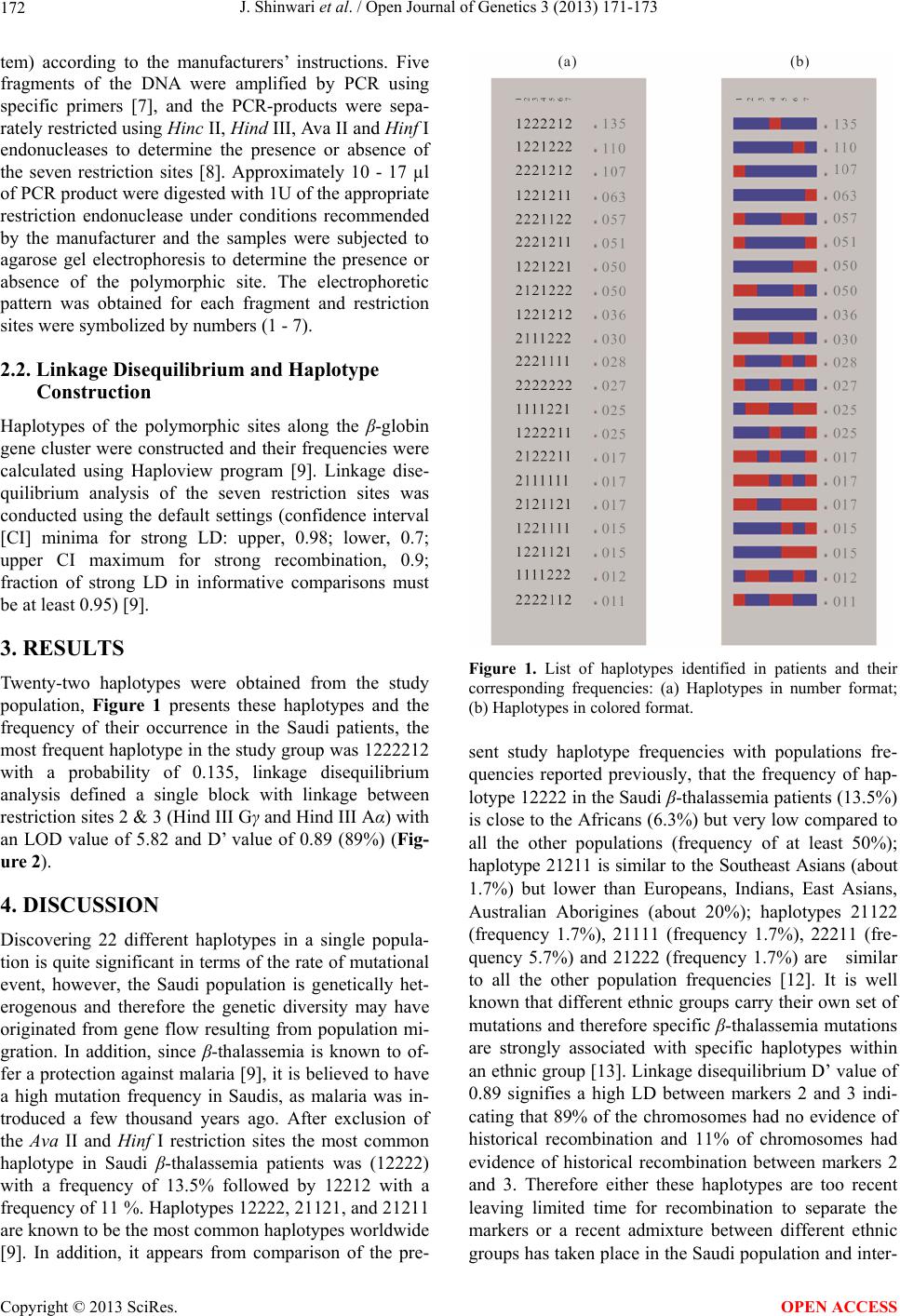 J. Shinwari et al. / Open Journal of Genetics 3 (2013) 171-173 172 tem) according to the manufacturers’ instructions. Five fragments of the DNA were amplified by PCR using specific primers [7], and the PCR-products were sepa- rately restricted using Hinc II, Hind III, Ava II and Hinf I endonucleases to determine the presence or absence of the seven restriction sites [8]. Approximately 10 - 17 µl of PCR product were digested with 1U of the appropriate restriction endonuclease under conditions recommended by the manufacturer and the samples were subjected to agarose gel electrophoresis to determine the presence or absence of the polymorphic site. The electrophoretic pattern was obtained for each fragment and restriction sites were symbolized by numbers (1 - 7). 2.2. Linkage Disequilibrium and Haplotype Construction Haplotypes of the polymorphic sites along the β-globin gene cluster were constructed and their frequencies were calculated using Haploview program [9]. Linkage dise- quilibrium analysis of the seven restriction sites was conducted using the default settings (confidence interval [CI] minima for strong LD: upper, 0.98; lower, 0.7; upper CI maximum for strong recombination, 0.9; fraction of strong LD in informative comparisons must be at least 0.95) [9]. 3. RESULTS Twenty-two haplotypes were obtained from the study population, Figure 1 presents these haplotypes and the frequency of their occurrence in the Saudi patients, the most frequent haplotype in the study group was 1222212 with a probability of 0.135, linkage disequilibrium analysis defined a single block with linkage between restriction sites 2 & 3 (Hind III Gγ and Hind III Aα) with an LOD value of 5.82 and D’ value of 0.89 (89%) (Fig- ure 2). 4. DISCUSSION Discovering 22 different haplotypes in a single popula- tion is quite significant in terms of the rate of mutational event, however, the Saudi population is genetically het- erogenous and therefore the genetic diversity may have originated from gene flow resulting from population mi- gration. In addition, since β-thalassemia is known to of- fer a protection against malaria [9], it is believed to have a high mutation frequency in Saudis, as malaria was in- troduced a few thousand years ago. After exclusion of the Ava II and Hinf I restriction sites the most common haplotype in Saudi β-thalassemia patients was (12222) with a frequency of 13.5% followed by 12212 with a frequency of 11 %. Haplotypes 12222, 21121, and 21211 are known to be the most common haplotypes worldwide [9]. In addition, it appears from comparison of the pre- Figure 1. List of haplotypes identified in patients and their corresponding frequencies: (a) Haplotypes in number format; (b) Haplotypes in colored format. sent study haplotype frequencies with populations fre- quencies reported previously, that the frequency of hap- lotype 12222 in the Saudi β-thalassemia patients (13.5%) is close to the Africans (6.3%) but very low compared to all the other populations (frequency of at least 50%); haplotype 21211 is similar to the Southeast Asians (about 1.7%) but lower than Europeans, Indians, East Asians, Australian Aborigines (about 20%); haplotypes 21122 (frequency 1.7%), 21111 (frequency 1.7%), 22211 (fre- quency 5.7%) and 21222 (frequency 1.7%) are similar to all the other population frequencies [12]. It is well known that different ethnic groups carry their own set of mutations and therefore specific β-thalassemia mutations are strongly associated with specific haplotypes within an ethnic group [13]. Linkage disequilibrium D’ value of 0.89 signifies a high LD between markers 2 and 3 indi- cating that 89% of the chromosomes had no evidence of historical recombination and 11% of chromosomes had evidence of historical recombination between markers 2 and 3. Therefore either these haplotypes are too recent leaving limited time for recombination to separate the markers or a recent admixture between different ethnic groups has taken place in the Saudi population and inter- Copyright © 2013 SciRes. OPEN ACCESS  J. Shinwari et al. / Open Journal of Genetics 3 (2013) 171-173 Copyright © 2013 SciRes. 173 OPEN ACCESS Figure 2. Linkage disequilibrium plot (LD plot) showing a strong linkage between marker 2 and 3 in the patient’s samples: The numbers in the blocks represent multi-allelic D’ with values ranging from 0 to 1(shown in percentage), Red squares indicate statistically significant (LOD >2) allelic association (linkage disequilibrium, LD) between pairs of markers, White squares indicate D’ values of <1 with no statistically significant evidence of LD, markers are numbered from 1 to 7 to the top. breeding between groups with different alleles has dis- torted the haplotype frequencies, causing linkage dis- equilibrium [14]. Performing similar studies on a larger β-thalassemia cohort would be essential for allowing the conduction of a significant linkage between haplotypes and disease causing mutations in the Saudi population. 5. ETHICAL APPROVAL This work was approved by KFSHRC IRB, Research Advisory Council (RAC) and Research Ethics Committee (REC) (RAC# 2080012). REFERENCES [1] Jeffreys, A.J. (1979) DNA sequence variants in the G gamma-, A gamma-, delta- and beta-globin genes of man. Cell, 18, 1-10. doi:10.1016/0092-8674(79)90348-9 [2] Clark, A.G. (2004) The role of haplotypes in candidate gene studies. Genetic Epidemiology, 27, 321-333. doi:10.1002/gepi.20025 [3] Pirastu, M., Galanello, R., Doherty, M.A., Tuveri, T., Cao, A. and Kan, Y.W. (1987) The same beta-globin gene mutation is present on nine different beta-thalassemia chromosomes in a Sardinian population. The Proceedings of the National Academy of Sciences of the United States of America, 84, 2882-2885. doi:10.1073/pnas.84.9.2882 [4] Orkin, S.H., Kazazian Jr., H.H., Antonarakis, S.E., Goff, S.C., Boehm, C.D., Sexton, J.P., Waber, P.G. and Giardina, P.J. (1982) Linkage of beta-thalassaemia mutations and beta-globin gene polymorphisms with DNA polymer- phisms in human beta-globin gene cluster. Nature, 296, 627-631. doi:10.1038/296627a0 [5] Labie, D. and Elion, J. (1996) Sequence polymorphisms of potential functional relevance in the beta-globin gene locus. Hemoglobin, 20, 85-101. doi:10.3109/03630269609027914 [6] Flint, J., Harding, R.M., Boyce, A.J. and Clegg, J.B. (1998) The population genetics of the haemoglobinopathies. Baillière’s Clinical Haematology, 11, 1-51. doi:10.1016/S0950-3536(98)80069-3 [7] Flint, J., Harding, R.M., Boyce, A.J. and Clegg, J.B. (1993) The population genetics of the haemoglobi- nopathies. Baillière’s Clinical Haematology, 6, 215-262. doi:10.1016/S0950-3536(05)80071-X [8] Weatherall, D.J., Clegg, J.B., Higgs, D.R. and Wood, W.G. (1989) The hemoglobinopathies. McGraw-Hill, New York. doi:10.3238/arztebl.2011.0532 [9] Barrett, J.C., Fry, B., Maller, J. and Daly, M.J. (2005) Haploview: Analysis and visualization of LD and haplo- type maps. Bioinformatics, 21, 263-265. doi:10.1093/bioinformatics/bth457 [10] Weatherall, D.J. and Clegg, J.B. (1981) The Thalassae- mia syndrome. 3rd Edition, Blackwell Scientific Publica- tions, Oxford. [11] Long, J.C., Chakravarti, A., Boehm, C.D., Antonarakis, S. and Kazazian, H.H. (1990) Phylogeny of human beta- globin haplotypes and its implications for recent human evolution. American Journal of Physical Anthropology, 81, 113-130. doi:10.1002/ajpa.1330810112 [12] Chen, L.Z., Easteal, S., Board, P.G. and Kirk, R.L. (1990) Evolution of beta-globin haplotypes in human popula- tions. Molecular Biology and Evolution, 7, 423-437. [13] Kazazian, H.H. Jr., Orkin, S.H., Antonarakis, S.E., Sex- ton, J.P., Boehm, C.D., Goff, S.C. and Waber, P.G. (1984) Molecular characterization of seven beta-thalassemia mu- tations in Asian Indians. EMBO Journal, 3, 593-596. [14] Kruglyak, L. (1999) Genetic isolates: Separate but equal? The Proceedings of the National Academy of Sciences of the United States of America, 96, 1170-1172. doi:10.1073/pnas.96.4.1170 |