

Paper Menu >>
Journal Menu >>
 Vol.4, No.9, 477-482 (2013) Agricultural Sciences http://dx.doi.org/10.4236/as.2013.49064 Influence of cutting size and packaging materials on the quality of fresh-cut winter squash (var. Ajijimang) Alexander Joel G. Gibe1, Ji Gang Kim2* 1Philippine Center for Postharvest Development and Mechanization, Munoz, Philippines 2National Institute of Horticultural and Herbal Science, Rural Development Administration, Suwon, Korea; *Corresponding Author: [email protected] Received 9 June 2013; revised 10 July 2013; accepted 15 August 2013 Copyright © 2013 Alexander Joel G. Gibe, Ji Gang Kim. This is an open access article distributed under the Creative Commons At- tribution License, which permits unrestricted use, distribution, and reproduction in any medium, provided the original work is prop- erly cited. ABSTRACT Winter squash (var. Ajijimang) washed in 100 mg·L−1 chlorine water and cut into 4 and 8 parts was packed in different packaging materials, 35 µm micro-perforated P-Plus (MPP), 50 µm poly- ethylene (PE), 80 µm nylon/PE (Ny/PE), and 90 µm PE films separately. Fresh-cut samples were then stored at 10˚C for up to 17 days. The 35 µm MPP having a high oxygen transmission rate (OTR) has the most stable gas exchange ratio while the 80 µm Ny/PE was the most unstable. Firmness of the mesocarp remained acceptable until the end of storage regardless of the cutting size. Soluble solids content (SSC) remained stable and even slightly increased to a certain extent within 6 days. An increase in pH after 10-day storage suggested the activity of micro- organisms within the packaging films. Strong off-odor was detected in samples packaged in 80 µm Ny/PE film after 13 days of storage. Mold was observed in all 1/4 cut samples on day 13 except the sample packaged with 80 µm Ny/PE film. However, no mold was found in all 1/8 cut samples except 35 µm MPP film on day 13. Se- vere mold invasion was apparent on the onset of the 17-day storage in 35 µm MPP film and 50 µm PE film. Samples cut into 8 parts and packed in 80 µm Ny/PE and 90 µm PE films had less mold incidence compared with other two packaging films. Fresh-cut winter squash packaged in 90 µm PE film maintained quality with shelf-life of 10 days at 10˚C. Winter squash as fresh-cut commodity, with the right packaging material has the potential for longer period of storage in retail stores. Keywords: Fresh-Cut; Packaging Films; Shelf-Life; Storage; Winter Squash 1. INTRODUCTION Fresh-cut commodities are gaining popularity in Korea for the last decade in response to an increased consumer demand for convenient food. However, fresh-cut produce has limited shelf-life due to rapid quality deterioration. Quality of fresh-cut produce depends mainly on the qual- ity of the intact product and its maintenance between harvest and preparation of the fresh-cut products, proc- essing method, and subsequent handling conditions [1]. Korean fresh-cut processors recognize the importance of postharvest handling of raw materials. Processors are aware that raw materials affect shelf-life of fresh-cut produce [2]. In winter squash (Cucurbita maxima D.), it is vital to wash newly harvested fruits with 200 ppm of NaOCl to control growth of spoilage fungi before storage or proc- essing [3]. The atmosphere surrounding fresh-cut proc- essed vegetables likewise is extremely important to ex- tend shelf-life. One of the most influential factors on its composition is the permeability of the film used for packaging [4] and the interaction between film oxygen transmission rates (OTR) and initial headspace O2 [5]. Polyethylene (PE) is one of the most commonly used materials in packaging. Polypropylene (PP) either un- perforated or micro-perforated is likewise gaining popu- larity. These films in different thickness possess a range of gas transmission rates. Fresh-cut products that nor- mally have elevated respiration rate require films with high gas transmission capabilities. Even within the package, fresh-cut vegetables are bound to deteriorate. The main spoilage mechanisms influencing processed products include oxidation, water loss and the activity of Copyright © 2013 SciRes. OPEN ACCESS  A. J. G. Gibe, J. G. Kim / Agricultural Sciences 4 (2013) 477-482 478 microorganisms. Reducing the respiration rate and inhib- iting agents of spoilage with the right packaging films having appropriate gas transmission rates and right tem- perature at storage would result in longer shelf-life of packed commodity. Green rind winter squashes commonly known as but- tercup is a popular variety that has an appealing yellow orange flesh with high soluble solids content (SSC) of 13 to 17% [6,7]. Cultivar Ajijimang is another green rind winter squash more appealing for its higher SSC of 17 to 19% [8]. Ajijimang is a potential variety as fresh-cut winter squash that may be used for ready-to-cook com- modity. Oftentimes, the fruit is cut in halves or in quarter covered with a 15 μm polyvinyl chloride (PVC) wrap and displayed at 15˚C to 20˚C shelves in supermarkets in Korea. The cut squash fruits often last for 2 to 3 days. Optimum modified atmosphere (MA) packaging is effec- tive in prolonging the shelf-life of fresh-cut produce by matching film permeability for O2 and CO2 to the respi- ration rate of the packaged commodity. The respiration rate of fresh-cut produce is influenced by storage tem- perature, cut size, etc. Little information exists on opti- mum packaging film for different sized fresh-cut winter squash. To date, vacuum packaging with Ny/PE film and PVC wrap are utilized for covering cut winter squash. In the present experiment, different films were assessed as packaging material for fresh-cut winter squash (var. Aji- jimang) prepared in different cuts. 2. MATERIALS AND METHODS 2.1. Materials, Fresh-Cut Processing, and Packaging Winter squash (Cucurbita maxima D., cv. Ajijimang) grown in a plastic house in Suwon was harvested 45 days after flowering. The fruits were conditioned for a month for further maturation at room temperature (25˚C ± 2˚C). The squash material was subjected to further storage of three months at 12˚C. The average weight of intact win- ter squash was 1.8 kg. Three months stored Ajijimang were washed with 100 ppm of sodium hypochlorite (NaOCl) prior to cutting. The squash was cut into quarter (1/4) and eight parts (1/8) with seeds removed and washed with cold sterile water to remove cellular exudates released during cutting of winter squash. Samples were air dried for a few minutes to remove surface water. After surface drying, fresh-cut squash were packaged in 35 μm micro-perforated P-Plus (MPP), 80 µm Nylon/PE (Ny/PE), 50 µm PE, or 90 µm PE films. Fresh-cut squash samples in packages (20 25 cm) were then stored at 10˚C for up to 17 days. Oxygen transmission rates (OTR) of 50 and 90 µm PE films (Samkyoung Chemistry Ltd., Korea) were 1850 mL· m−2·d−1 and <1300 mL·m−2·d−1 at 10˚C [9], respec- tively. 35 µm MPP film (Amcor, UK) with an OTR of 11,648 mL·m−2·d−1 at 10˚C and 80 µm NY/PE film (Da- san Polybag, Korea) with an OTR of about <100 mL· m−2·d−1 at 25˚C [10] were also used to pack different cutting sizes of winter squash. 2.2. Gas Composition Analyses Oxygen (O2) level and accumulation of carbon dioxide (CO2) within the package of different films containing fresh-cut winter squash were monitored in every sam- pling occasion. Gases were measured using a gas moni- toring devise (PBI-Dansensor CheckMate II, Denmark) by placing the needle directly into the packages. 2.3. Texture Measurements In every period of analysis, samples of each cut in triplicate representing a treatment were sliced twice horizontally making a 5 cm-thick cut in the middle. The top slice represented the stalk side while the bottom slice represented the underside of the fruit where the calyx is located. The middle slices were analyzed for firmness while top and bottom parts were analyzed for soluble solids content and change in pH. In each sampling occa- sion, cut samples from the middle section of the fruit were analyzed for firmness by using a texture analyzer (Model TA-XT2-5, Stable Microsystems, UK). Two spots per replicate on flat surface of sliced samples were pricked with a cylindrical probe of 3 mm in diameter mounted on a drill stand at 3 mm per second speed and deformation distance of 8 mm. 2.4. Soluble Solids Content and pH Juice samples used for soluble solids content (SSC) and pH measurements were obtained by grating of peeled samples and squeezing of the squash samples from each replicate with a hand juicer. Samples were then filtered through two layers of cotton gauze. Soluble solids content and pH of the juice were measured at room temperature with a digital refractometer (Model PAL-1, Atago Co., Japan) and a pH meter (Model Titro- Line Easy, Schott, UK), respectively. 2.5. Mold Infection and Off-Odor Development Incidence of mold infection was monitored throughout the storage period. The incidence rate was calculated by the weight of all mold infected pieces in each package, divided by the total fresh weight of the sample and mul- tiplied by 100 to obtain percentage. Off-odor was evalu- ated immediately after opening the packages and scored on a five-point scale where 0 = none; 1 = slight; 2 = moderate; 3 = strong; and 4 = severe [5]; a score of 3 or Copyright © 2013 SciRes. OPEN ACCESS  A. J. G. Gibe, J. G. Kim / Agricultural Sciences 4 (2013) 477-482 479 above was considered unacceptable. 3. RESULTS AND DISCUSSION 3.1. Gas Composition Any vegetables when processed or cut will have in- creased metabolic activity as a result of an increased sur- face area exposed to the atmosphere. The respiration rate increases as the cutting allows oxygen to diffuse into the interior cells more rapidly [11]. Winter squash in two different cuts were packaged in four different films with different OTRs. Levels of O2 and CO2 within the pack- age as the squash were stored at 10˚C are presented in Figure 1. Fresh-cut winter squash packaged in 35 µm MPP film has the most stable gas concentrations/ex- change within the package for the entire storage period of 17 days. This type of film has a high OTR of 11,648 mL· m−2·d−1 at 10˚C [9] and therefore allows higher gas exchange. On the other hand, O2 concentration in pack- age prepared with 80 µm Ny/PE film decreased rapidly to zero from 18% while CO2 increased tremendously within three days. This film has a very low OTR of about <100 mL·m−2·d−1 at 25˚C [10] and level of CO2 keeps on accumulating as storage progressed which resulted in ballooning of the package. CO2 levels within the package even reached 60 % in 10 days. Both 50 and 90 µm PE films exhibited better gas exchange in the presence of fresh-cut winter squash. Although O2 levels in those films reached anaerobic conditions from 3 days until the end of the storage period, ballooning was not observed Figure 1. Levels of O 2 and CO2 concentration in fresh-cut winter squash packaged in different films (µm) and stored at 10˚C for 17 days. Each symbol is the mean of three replicate measurements; vertical lines represent SE. (●) 50 µm PE, (○) 90 µm PE, (▲) 35 µm MPP, (∆) 80 µm Ny/PE. neither in the two PE films tested. However, the level of CO2 in 50 µm PE film was lower than 90 µm PE film because CO2 diffusion in 50 µm PE film was faster due to a higher OTR compared to 90 µm PE film [9]. 3.2. Firmness Mesocarp of fresh-cut Ajijimang was highly firm ini- tially at 36.9 N when preconditioned one month after harvest. Firmness of fresh-cut winter squash was gener- ally maintained for 10 days regardless of the cut and packaging film (Figure 2). Slicing plant tissues generally results in loss of firmness causing direct water loss due to cell leakage [12]. As minimally processed vegetables are stored, loss in turgor pressure and textural breakdown due to enzymatic hydrolysis of cell compounds becomes apparent [13]. The mechanism of physical spoilage in fresh-cut winter squash is unique. The breakdown of tissues may have been very slow due to its high starch content. The result only suggests that firmness is not go- ing to be a problem in winter squash as a fresh-cut com- modity. More so, with the right packaging film and stor- age temperature, other quality attributes will likewise be preserved. 3.3. Soluble Solid Content and pH Winter squashes are not only known for its excellent nutritive value and eating quality, its seeds and flesh likewise contain high level of Vitamin E and carotenoids, respectively as anti-oxidants [14,15]. In the same way, winter squash which has high sugar content is attractive. It is therefore important that give attention to SSC as a quality attribute of fresh-cut winter squash. Levels of SSC in fresh-cut Ajijimang increased slightly from 17.2% to 18.6% and were maintained within 10 days of storage (Figure 3(a)). The same trend was true with 80 µm Ny/PE film (data is not shown). Fresh-cut winter (a) (b) Figure 2. Firmness of fresh-cut winter squash packaged in different films (µm) and stored at 10˚C for 17 days. Each sym- bol is the mean of three replicate measurements; vertical lines represent SE. (●) 50 µm PE, (○) 90 µm PE, (▲) 35 µm MPP, (∆) 80 µm Ny/PE. Copyright © 2013 SciRes. OPEN ACCESS  A. J. G. Gibe, J. G. Kim / Agricultural Sciences 4 (2013) 477-482 480 (a) (b) Figure 3. Levels of soluble solid content (SSC) and pH in fresh-cut winter squash packaged in two different films (µm) and stored at 10˚C for 17 days. Each symbol is the mean of three replicate measurements; vertical lines represent SE. (●) 1/4 Cut + 50 µm PE, (○) 1/4 Cut + 90 µm PE, (▲) 1/8 Cut + 50 µm PE, (∆)1/8 Cut + 80 µm PE. squash from Ajijimang, in this case, continued to ripen within the specified period of time. The same findings were observed by Roura et al. [16] in diced squash (C. moschata) packed and covered with 15 µm PE wrap where SSC and sugar/titratable acidity ratios increased during storage at 10˚C ± 2˚C. Soluble solids content in fresh-cut winter squashes although initially very high were at a plateau and started to decline after 10 days. These findings suggest the importance of selecting pro- per maturity and preconditioning details of squash varie- ties as fresh-cut vegetable. It appears that packaging films used facilitated maintenance in quality in terms of increasing or maintaining SSC in storage. However, sur- face drying was noticeable early in storage even within 6 days in 35 µm MPP film package. The RH during stor- age period ranged from 45% to 60%. Increasing the RH would improve dryness of fresh-cut surface. It is worth interesting to note that pH of fresh-cut win- ter squash increased slowly during storage. Increase in pH became prominent after 10 days of storage (Figure 3(b)) signifying higher microbial activity which is con- sistent with the visible growth of fungi on day 13 for winter squash packed in 50 µm PE film (Figure 5) and possible bacterial accumulation or other fermenting or- ganisms in squash packed in 90 µm PE film. 3.4. Spoilage and Off-Odor The main causes of deterioration mechanisms influ- encing processed products include oxidation, water loss and the activity of microorganisms. All three mecha- nisms were observed in fresh-cut winter squash depend- ing on the films used. 35 µm MPP film is capable of ex- changing more balanced gases however surface of fresh-cut winter squash dries up within the package. Ap- pearance of mold spots in fresh-cut squash packaged in 35 µm MPP film was apparent on day 10 (data is not (a) (b) Figure 4. Decay incidence of fresh-cut winter squash packaged in different films stored at 10˚C for 13 and 17 days. Each sym- bol is the mean of three replicate measurements; vertical lines represent SE. (□) 50 µm PE, (■) 90 µm PE, (■) 35 µm MPP, (■) 80 µm Ny/PE. shown) while the activity of molds in fresh-cut squash packaged in other three films occurred later. No mold activity was recorded in fresh-cut winter squash packed with 80 µm Ny/PE film on day 13 in both 1/4 and 1/8 cut samples (Figure 4). High CO2 levels in both 90 µm PE and 80 µm Ny/PE film suppressed fungal growth for at least or over 10 days. Suppression of fungi in MPP film, on the other hand, was less than 10 days. A decrease in temperature has a tremendous effect on lowering respire- tion rates, thereby lowering microbial activity. Moreover, its affects on permeability of gases through the package- ing films also slow microbial growth [17]. Occurrence of mold growth was evident in either 90 µm PE or 80 µm Ny/PE film. Off-odor development was not detected in fresh-cut squash packed in 35 µm MPP film until 6 days (Figure 5). On the other hand, the absence of O2 inside the pack- age for other three films encouraged fermentative me- tabolism resulting in the development of off-odor within 3 days in squash packaged in 80 Ny/PE film (Figure 5). Sour smell was produced and became stronger in 6 days as the package is opened. However, the sour smell dis- appears once the fresh-cut winter squash are aerated for a few minutes. It also worth noting that off-odor develop- ment was much intense in fresh-cut winter squash cut into 8 parts than 4 parts in 50 µm PE, 90 µm PE, and 35 µm MPP film. Higher number of cuts probably increased respiration which can cause more off-odor development of samples packaged in only 80 µm Ny/PE film. Both 80 µm Ny/PE and 90 µm PE films was best in suppressing respiration by reducing O2 levels to almost zero and similarly increasing CO2 levels within three days (Figure 1). This condition suppressed sensitivity of fresh-cut winter squash of further ripening and the growth of mi- croorganisms [11]. The CO2 levels on day 3 were 12 to 14% in 90 µm PE film and 30 to 40% in 80 µm Ny/PE film that was more than enough to cause such suppres- sion. In these conditions, off-odor development in winter Copyright © 2013 SciRes. OPEN ACCESS 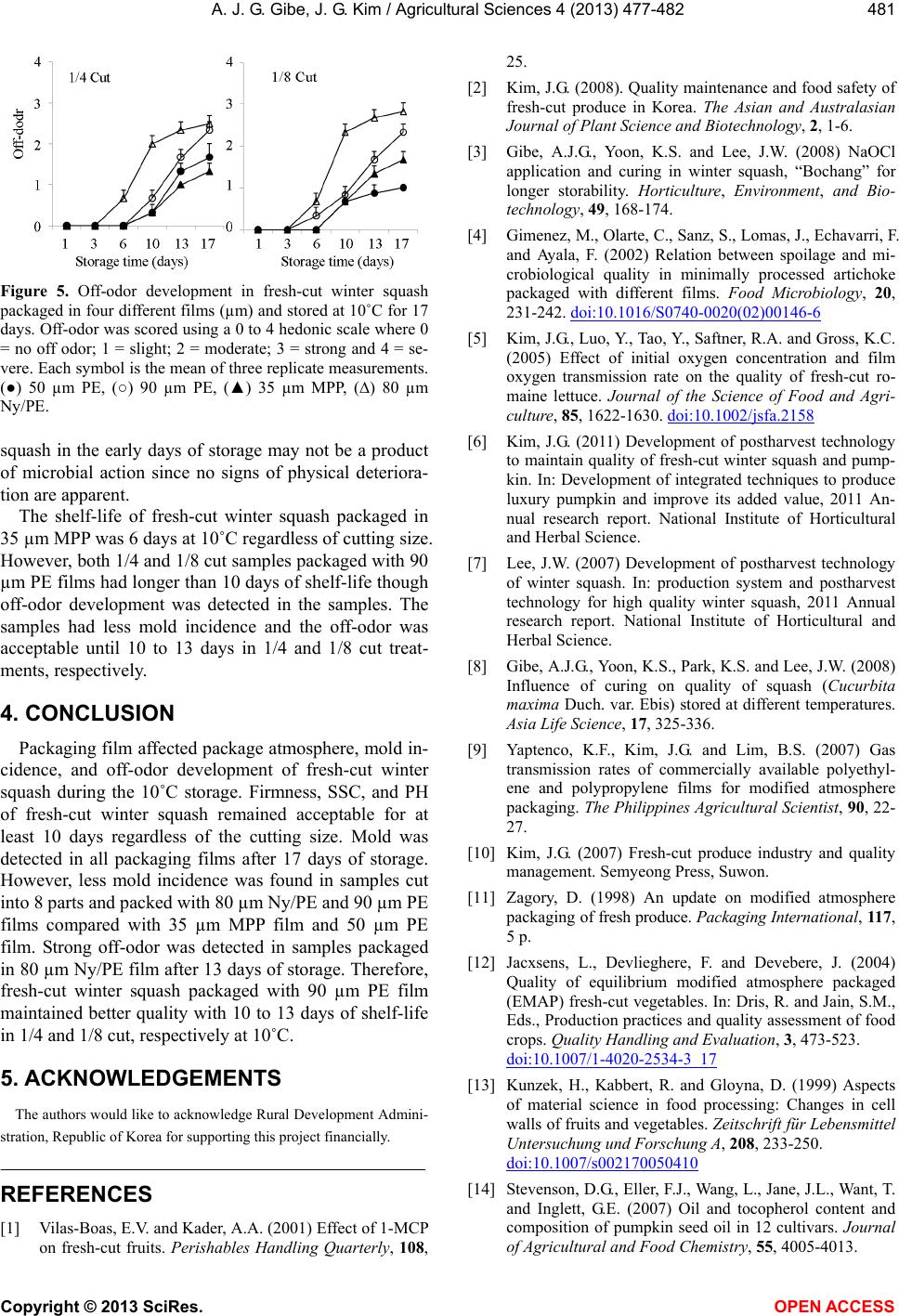 A. J. G. Gibe, J. G. Kim / Agricultural Sciences 4 (2013) 477-482 481 Figure 5. Off-odor development in fresh-cut winter squash packaged in four different films (µm) and stored at 10˚C for 17 days. Off-odor was scored using a 0 to 4 hedonic scale where 0 = no off odor; 1 = slight; 2 = moderate; 3 = strong and 4 = se- vere. Each symbol is the mean of three replicate measurements. (●) 50 µm PE, (○) 90 µm PE, (▲) 35 µm MPP, (∆) 80 µm Ny/PE. squash in the early days of storage may not be a product of microbial action since no signs of physical deteriora- tion are apparent. The shelf-life of fresh-cut winter squash packaged in 35 µm MPP was 6 days at 10˚C regardless of cutting size. However, both 1/4 and 1/8 cut samples packaged with 90 µm PE films had longer than 10 days of shelf-life though off-odor development was detected in the samples. The samples had less mold incidence and the off-odor was acceptable until 10 to 13 days in 1/4 and 1/8 cut treat- ments, respectively. 4. CONCLUSION Packaging film affected package atmosphere, mold in- cidence, and off-odor development of fresh-cut winter squash during the 10˚C storage. Firmness, SSC, and PH of fresh-cut winter squash remained acceptable for at least 10 days regardless of the cutting size. Mold was detected in all packaging films after 17 days of storage. However, less mold incidence was found in samples cut into 8 parts and packed with 80 µm Ny/PE and 90 µm PE films compared with 35 µm MPP film and 50 µm PE film. Strong off-odor was detected in samples packaged in 80 µm Ny/PE film after 13 days of storage. Therefore, fresh-cut winter squash packaged with 90 µm PE film maintained better quality with 10 to 13 days of shelf-life in 1/4 and 1/8 cut, respectively at 10˚C. 5. ACKNOWLEDGEMENTS The authors would like to acknowledge Rural Development Admini- stration, Republic of Korea for supporting this project financially. REFERENCES [1] Vilas-Boas, E.V. and Kader, A.A. (2001) Effect of 1-MCP on fresh-cut fruits. Perishables Handling Quarterly, 108, 25. [2] Kim, J.G. (2008). Quality maintenance and food safety of fresh-cut produce in Korea. The Asian and Australasian Journal of Plant Science and Biotechnology, 2, 1-6. [3] Gibe, A.J.G., Yoon, K.S. and Lee, J.W. (2008) NaOCl application and curing in winter squash, “Bochang” for longer storability. Horticulture, Environment, and Bio- technology, 49, 168-174. [4] Gimenez, M., Olarte, C., Sanz, S., Lomas, J., Echavarri, F. and Ayala, F. (2002) Relation between spoilage and mi- crobiological quality in minimally processed artichoke packaged with different films. Food Microbiology, 20, 231-242. doi:10.1016/S0740-0020(02)00146-6 [5] Kim, J.G., Luo, Y., Tao, Y., Saftner, R.A. and Gross, K.C. (2005) Effect of initial oxygen concentration and film oxygen transmission rate on the quality of fresh-cut ro- maine lettuce. Journal of the Science of Food and Agri- culture, 85, 1622-1630. doi:10.1002/jsfa.2158 [6] Kim, J.G. (2011) Development of postharvest technology to maintain quality of fresh-cut winter squash and pump- kin. In: Development of integrated techniques to produce luxury pumpkin and improve its added value, 2011 An- nual research report. National Institute of Horticultural and Herbal Science. [7] Lee, J.W. (2007) Development of postharvest technology of winter squash. In: production system and postharvest technology for high quality winter squash, 2011 Annual research report. National Institute of Horticultural and Herbal Science. [8] Gibe, A.J.G., Yoon, K.S., Park, K.S. and Lee, J.W. (2008) Influence of curing on quality of squash (Cucurbita maxima Duch. var. Ebis) stored at different temperatures. Asia Life Science, 17, 325-336. [9] Yaptenco, K.F., Kim, J.G. and Lim, B.S. (2007) Gas transmission rates of commercially available polyethyl- ene and polypropylene films for modified atmosphere packaging. The Philippines Agricultural Scientist, 90, 22- 27. [10] Kim, J.G. (2007) Fresh-cut produce industry and quality management. Semyeong Press, Suwon. [11] Zagory, D. (1998) An update on modified atmosphere packaging of fresh produce. Packaging International, 117, 5 p. [12] Jacxsens, L., Devlieghere, F. and Devebere, J. (2004) Quality of equilibrium modified atmosphere packaged (EMAP) fresh-cut vegetables. In: Dris, R. and Jain, S.M., Eds., Production practices and quality assessment of food crops. Quality Handling and Evaluation, 3, 473-523. doi:10.1007/1-4020-2534-3_17 [13] Kunzek, H., Kabbert, R. and Gloyna, D. (1999) Aspects of material science in food processing: Changes in cell walls of fruits and vegetables. Zeitschrift für Lebensmittel Untersuchung und Forschung A, 208, 233-250. doi:10.1007/s002170050410 [14] Stevenson, D.G., Eller, F.J., Wang, L., Jane, J.L., Want, T. and Inglett, G.E. (2007) Oil and tocopherol content and composition of pumpkin seed oil in 12 cultivars. Journal of Agricultural and Food Chemistry, 55, 4005-4013. Copyright © 2013 SciRes. OPEN ACCESS  A. J. G. Gibe, J. G. Kim / Agricultural Sciences 4 (2013) 477-482 Copyright © 2013 SciRes. OPEN ACCESS 482 doi:10.1021/jf0706979 [15] Lee, J.W., Kim, S.J., Kim, J.B. and Gibe, A.J.G. (2008) Build-up of tocopherols in winter squash (Cucurbita maxima Duch var. Ebis) cured and stored under different conditions. Horticulture , Environment, and Biotechnol- ogy, 49, 239-243. [16] Roura, S.I., Del Rosario-Moreira, M. and Delvalle, C.E. (2004) Shelf-life of fresh-like ready-to-use diced squash. Journal of Food Quality, 27, 91-101. doi:10 .1111/j.1745- 4557.2004.tb00640.x [17] Garcia, E. and Barret, D.M. (2007) Preservative treat- ments for fresh-cut fruits and vegetables. Department of Food Science and Technology, University of California Davis, 32 p. |