

Paper Menu >>
Journal Menu >>
 Vol.4, No.9, 466-472 (2013) Agricultural Sciences http://dx.doi.org/10.4236/as.2013.49062 Isolation and expression characterization of CBF2 in vitis amurensis with stress Chang Dong1,2, Jianmin Tao1, Meng Zhang1, Yang Qin2, Zhiying Yu1, Bailin Wang2, Binhua Cai1, Zhen Zhang1* 1College of Horticulture, Nanjing Agricultural University, Nanjing, China; *Corresponding Author: [email protected], 2Department of Horticulture, Heilongjiang Academy of Agricultural Science, Harbin, China Received 5 June 2013; revised 5 July 2013; accepted 1 August 2013 Copyright © 2013 Chang Dong et al. This is an open access article distributed under the Creative Commons Attribution License, which permits unrestricted use, distribution, and reproduction in any medium, provided the original work is properly cited. ABSTRACT The transcription factor VaCBF2, which interacts with C-repeat/DRE and its promoter, was iso- lated from Vitis amurensis. The VaCBF2 amino acid sequence contained a conserved AP2 do- main of 56 amino acids and a potential nuclear localization sequence. The sequence of VaCBF2 showed a high level of homology with other CBF2 family members. Phylogenetic analysis showed that the amino acid sequences may be CBF2 proteins with evolutionary relationship. Quantitative reverse-transcription polymerase chain reaction analysis indicated that the ex- pression of VaCBF2 gene in tissues (roots, stems, leaves, and petioles) was induced by low tem- perature, high salinity, and application of ab- scisic acid and salicylic acid in a time-depen- dent manner but to different extents in the cold- hardy V. amurensis and the less cold-hardy Vitis vinifera. The presence of cis-elements such as MYC and ABRE in VaCBF2 promoter further con- firmed that this promoter was a component of the CBF transduction pathway involved in plant response to multiple stresses. Keywords: Vitis amurensis ; Stress; CBF2; Expression 1. INTRODUCTION Abiotic stresses such as low temperature, drought, and salinity can adversely affect crop growth and develop- ment. Thus, improving stress tolerance in breeding is important. Plants respond and acclimate to environmen- tal stresses by activating network events from stress per- ception to effector gene expression [1]. Over the past years, the C-repeat element-binding factor (CBF)/dehy- dration responsive element binding (DREB) cold re- sponse pathway is the most recognized freezing tolerance pathway in plants [2]. All CBF proteins specifically bind to the C-repeat element (CRT)/dehydration responsive ele- ment (DRE) in the promoter region of downstream genes [3,4]. These proteins regulate their downstream gene expression and enhance the tolerance of plants to low temperature, drought, and high salinity. Thus, CBF regu- lation has a fundamental function in cold acclimation [5]. Arabidopsis CBF1, CBF2, and CBF3 are major tran- scriptional factors affecting cold-inducible gene expres- sion [6,7]. CBF4 from Arabidopsis is weakly induced by cold stress [8], whereas DREB2A is induced by drought and salinity [9]. These transcript profiles suggest that CBFs have different expression levels in plants and that a degree of cross-talk exists between these pathways [10]. Furthermore, CBFs widely exist in herbaceous plants that are responsive to cold [11]. Puhakainen et al. [12] demonstrated that the CBF pathway also exists in woody trees. Since then, CBF orthologs have been reported in various woody plants, including Vitaceae [13], poplar [14], blueberry [15], peach [5], and apple [4]. Among woody species, a positive correlation also exists between the cold tolerance and CBF transcript level of woody species [4,5,14,16]. Therefore, the CBF cold pathway appears to be conserved in woody plants. Vitis amurensis is one of the most widely used species for freeze-tolerant rootstock and winemaking in grape cultivation. In this study, the VaCBF2 gene was isolated from V. amurensis. We also compared CBF2 gene expres- sion in the leaves of cold-tolerant wild V. amurensis and cold-sensitive Vitis vinifera “Manicure Finger” at different times of cold treatment. Results confirmed the V. amu- rensis transcript patterns in roots, stems, leaves, and peti- oles at different times of low temperature, high salinity, Copyright © 2013 SciRes. OPEN ACCESS  C. Dong et al. / Agricultural Sciences 4 (2013) 466-472 467 and abscisic acid (ABA) and salicylic acid (SA) treatments. 2. MATERIAL AND TREATMENTS Sixty-day-old in vitro samples of wild V. amurensis and V. vinifera “Manicure Finger” grown in Murashige and Skoog (MS) medium under a 16 h light/8 h dark re- gime at 25˚C were subjected to the following treatments for stress-responsive gene expression: cold stress by transferring to 4˚C, salinity stress by supplying 200 mM NaCl, and hormonal treatments by directly supplying ABA (10 μM) or SA (5 μM) to plants at different times. 2.1. Isolation of the VaCBF2 Gene Sixty-day-old in vitro samples of wild V. amurensis were grown in MS medium under a 16 h/8 h dark regime at 25˚C. Total RNA was extracted from non-stressed or cold-stressed plants in vitro using the Lagonigro’s me- thod [17]. First-strand cDNA was synthesized using Pri- mer Mix according to the instructions of ReverTra Ace RT Kit (TOYOBO, Japan). The complete coding se- quence was amplified using the gene-specific primers C2F (5’-TCATCAACATCCTCTCCTTCTCG-3’) and C2R (5’-GCTAAAAGTGTGTATGGCAGTGA-3’). The prim- ers were designed based on the genome of Vitis (http://www.vitisgenome.it). Amplification was carried out under the following conditions: 94˚C for 4 min; 36 cycles of 94˚C for 30 s, 60˚C for 45 s, and 72˚C for 60 s; and a final extension at 72˚C for 10 min. The polymerase chain reaction (PCR) products were cloned and sequenc- ed by pMD19-T vector. Sequence alignments were con- ducted using DNAMAN software (Version 5.2.2, Lynnon Biosoft). 2.2. Promoter Isolation of VaCBF2 The isolation of the promoter sequence was carried out using a Universal Genome Walker Kit (Clontech, USA) on 10 ng of V. amurensis genomic DNA digested by four blunt-end-generating restriction enzymes (EcoRI, DraI, SacI, and StuI). After purification, the restriction frag- ments were ligated with Genome Walker adaptors. PCR was amplified on each restriction fragment set using the primers C2-R1 (5’-GCTAAAAGTGTGTATGGCAG- TGA-3’) and C2-R2 (5’-CTTCACTCACCCATTTGT- TCTCATT-3’) for first- and second-step PCRs, respec- tively. Finally, the PCR products were cloned into pMD 19-T simple vector and sequenced. The sequences were analyzed online by Plant CARE. 2.3. Expression Analysis of VaCBF2 by Real-Time Quantitative Reverse Transcription (qRT)-PCR RNA and cDNA were obtained as described above. qRT-PCR was performed in 20 mL volumes containing 10 mL of SYBR Premix Ex Taq mix (TaKaRa), 0.2 mM forward primer (5’-TGAGAACAAATGGGTGAGTG- 3’), 0.2 mM reverse primer (5’-TGATGGAGGTTGCT- GAAAA-3’), and 1 mL of diluted (1:10 v/v) cDNA. The PCR regime consisted of denaturation at 94˚C for 4 min, followed by 40 cycles of 95˚C for 10 s, 60˚C for 20 s, and 72˚C for 20 s. Melting curve analysis was performed from 80˚C to 95˚C at 0.5˚C intervals. VaCBF2 transcript levels were normalized with grape malate dehydrogenase gene as an internal control using the forward primer 5’-GCATCTGTGGTTCTTGCAGG-3’ and reverse pri- mer 5’-CCCTTTGAGTCCACAAGCCAA-3’. The data of 0.5 h of V. vinifera in leaves at 4˚C were used as basis for relative comparison. Relative expression was calcu- lated relative to a calibrator using the formula 2−ΔΔCt. Two independent replicates were performed per experiment. 3. RESULTS 3.1. Identification of VaCBF2 Gene from V. amurensis The sequence of the V. amurensis cDNA clone includ- ed one open reading frame (ORF). Compared with the GenBank database, this sequence resulted in an iden- tical coding sequence to the CBF2 cDNA from V. vinif- era and V. riparia. This result clearly indicated that the gene in V. amurensis did not have introns interrupting its ORF. The coding regions encoded polypeptides of 250 amino acids with a molecular mass of 27.55 kD and a theoretical isoelectric point of 10.23. The amino acid alignment of the sequence revealed that 97% and 96% of the residues were identical to the CBF2 of V. riparia and V. vinifera, respectively. Moreover, the degrees of similarity to the CBF2 of Parthenocissus inserta and Eucalyptus grandis were high (94% and 73%, respec- tively). Sequence alignment against various CBF pro- teins suggested that this cDNA encoded a CBF-type pro- tein in V. a mure n sis (Figure 1). Therefore, the isolated cDNA was named VaCBF2. In other plants, basic resi- dues similar to CBF2 were included in their N-terminal regions. These residues potentially represented an un- clear localization signal (NLS) and putative APETALA 2/ethylene response factor (AP2/ERF) DNA-binding do- main. VaCBF2 also contained acidic C-terminal frag- ments that can act as the transcriptional activation do- main, but the LWSY signature was modified from LW- SY to LWNHDFL in the grape protein. In addition, po- tential recognition motifs for CBF protein were de- tected, such as DSAWR, Domain III, and Domain IV (Figure 1). These results indicated that VaCBF2 from V. amurensis was a CBF2 or tholog of other plants but with unique features. Copyright © 2013 SciRes. OPEN ACCESS 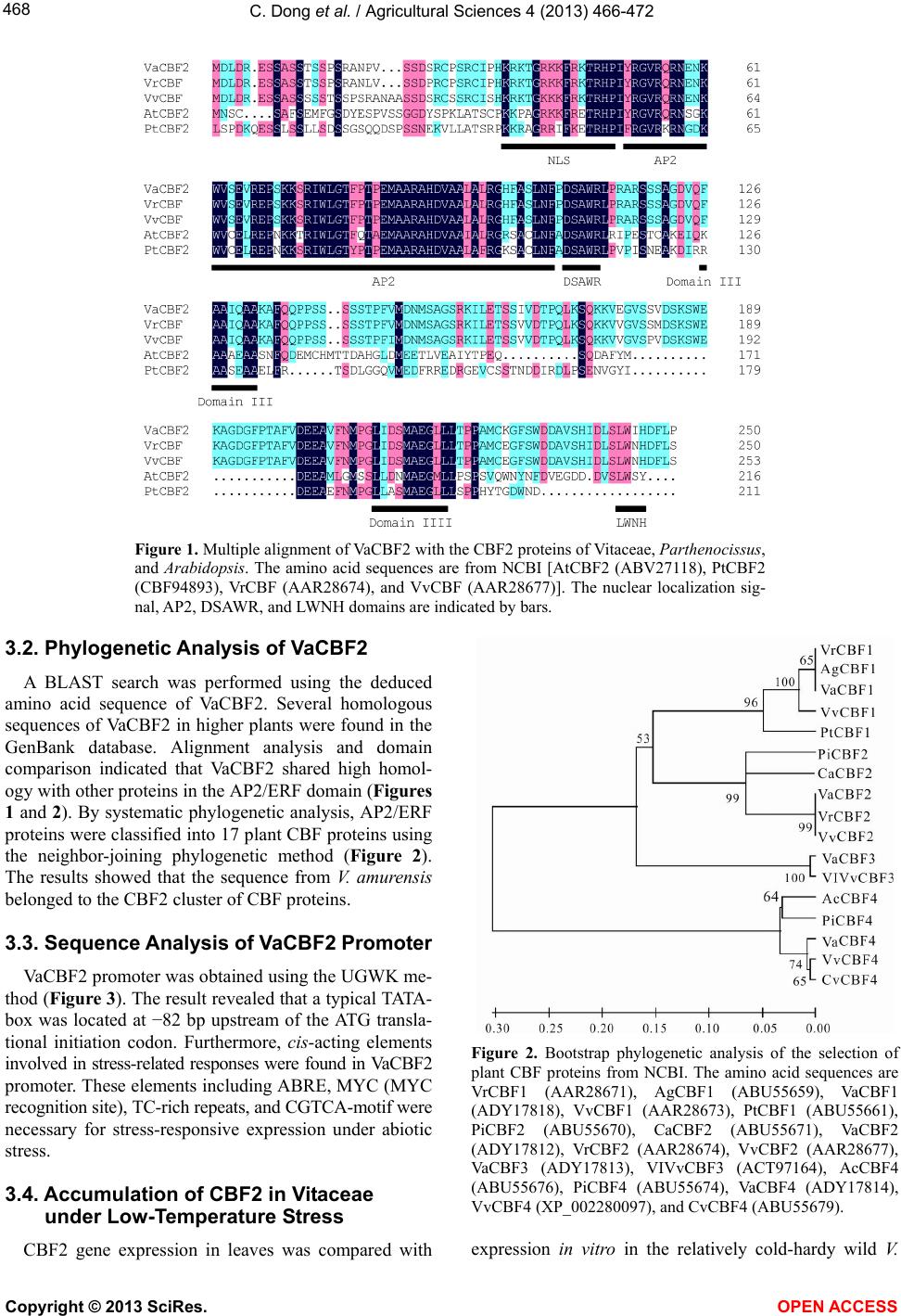 C. Dong et al. / Agricultural Sciences 4 (2013) 466-472 Copyright © 2013 SciRes. 468 Figure 1. Multiple alignment of VaCBF2 with the CBF2 proteins of Vitaceae, Parthenocissus, and Arabidopsis. The amino acid sequences are from NCBI [AtCBF2 (ABV27118), PtCBF2 (CBF94893), VrCBF (AAR28674), and VvCBF (AAR28677)]. The nuclear localization sig- nal, AP2, DSAWR, and LWNH domains are indicated by bars. 3.2. Phylogenetic Analysis of VaCBF2 A BLAST search was performed using the deduced amino acid sequence of VaCBF2. Several homologous sequences of VaCBF2 in higher plants were found in the GenBank database. Alignment analysis and domain comparison indicated that VaCBF2 shared high homol- ogy with other proteins in the AP2/ERF domain (Figures 1 and 2). By systematic phylogenetic analysis, AP2/ERF proteins were classified into 17 plant CBF proteins using the neighbor-joining phylogenetic method (Figure 2). The results showed that the sequence from V. amurensis belonged to the CBF2 cluster of CBF proteins. 3.3. Sequence Analy sis of VaCBF2 Promoter VaCBF2 promoter was obtained using the UGWK me- thod (Figure 3). The result revealed that a typical TATA- box was located at −82 bp upstream of the ATG transla- tional initiation codon. Furthermore, cis-acting elements involved in stress-related responses were found in VaCBF2 promoter. These elements including ABRE, MYC (MYC recognition site), TC-rich repeats, and CGTCA-motif were necessary for stress-responsive expression under abiotic stress. Figure 2. Bootstrap phylogenetic analysis of the selection of plant CBF proteins from NCBI. The amino acid sequences are VrCBF1 (AAR28671), AgCBF1 (ABU55659), VaCBF1 (ADY17818), VvCBF1 (AAR28673), PtCBF1 (ABU55661), PiCBF2 (ABU55670), CaCBF2 (ABU55671), VaCBF2 (ADY17812), VrCBF2 (AAR28674), VvCBF2 (AAR28677), VaCBF3 (ADY17813), VIVvCBF3 (ACT97164), AcCBF4 (ABU55676), PiCBF4 (ABU55674), VaCBF4 (ADY17814), VvCBF4 (XP_002280097), and CvCBF4 (ABU55679). 3.4. Accumulation of CBF2 in Vitaceae under Low-Temperature Stress expression in vitro in the relatively cold-hardy wild V. CBF2 gene expression in leaves was compared with OPEN ACCESS 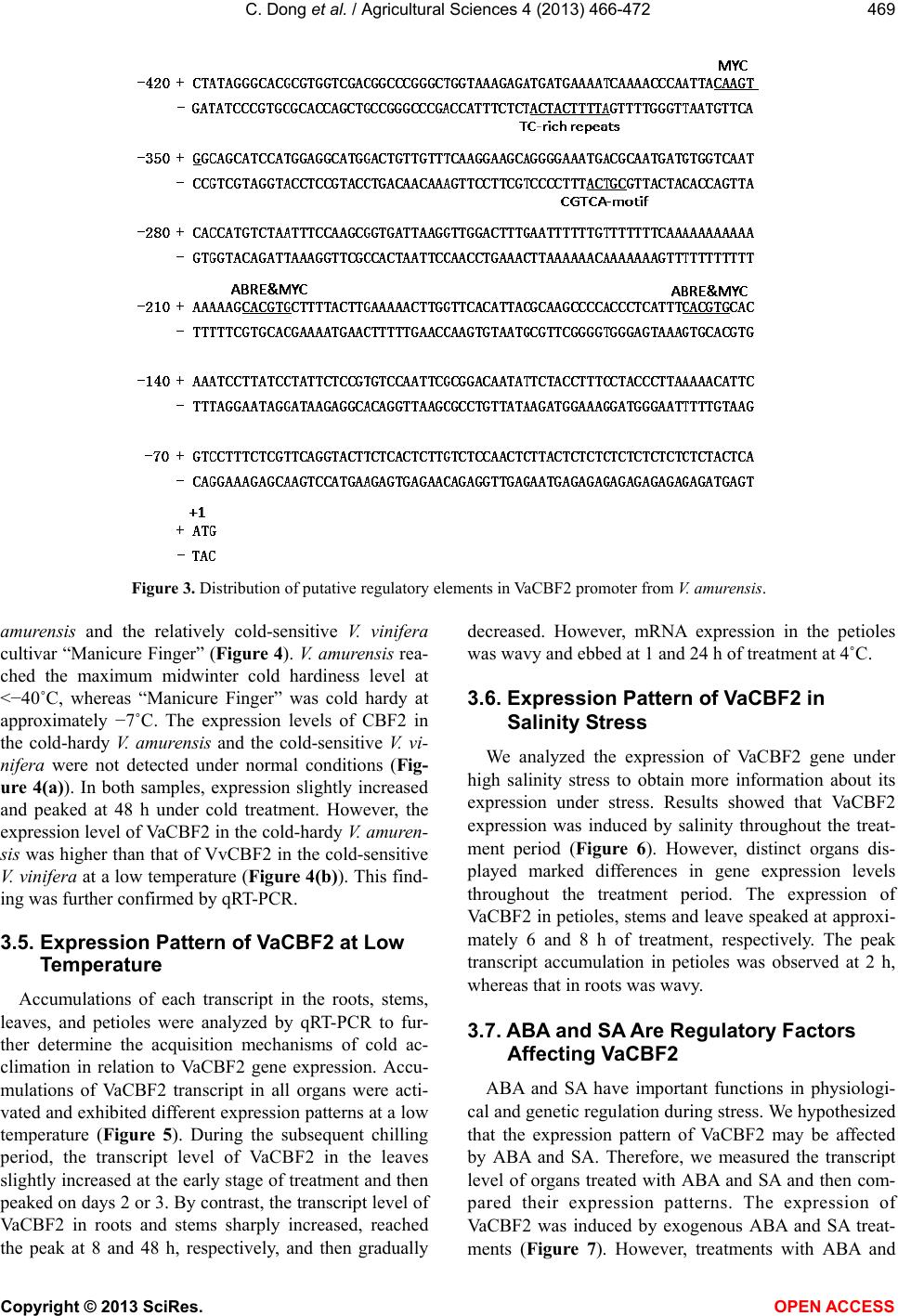 C. Dong et al. / Agricultural Sciences 4 (2013) 466-472 469 Figure 3. Distribution of putative regulatory elements in VaCBF2 promoter from V. amurensis. amurensis and the relatively cold-sensitive V. vinifera cultivar “Manicure Finger” (Figure 4). V. amurensis rea- ched the maximum midwinter cold hardiness level at <−40˚C, whereas “Manicure Finger” was cold hardy at approximately −7˚C. The expression levels of CBF2 in the cold-hardy V. amurensis and the cold-sensitive V. vi- nifera were not detected under normal conditions (Fig- ure 4(a)). In both samples, expression slightly increased and peaked at 48 h under cold treatment. However, the expression level of VaCBF2 in the cold-hardy V. amuren- sis was higher than that of VvCBF2 in the cold-sensitive V. vinifera at a low temperature (Figure 4(b)). This find- ing was further confirmed by qRT-PCR. 3.5. Expression Pattern of VaCBF2 at Low Temperature Accumulations of each transcript in the roots, stems, leaves, and petioles were analyzed by qRT-PCR to fur- ther determine the acquisition mechanisms of cold ac- climation in relation to VaCBF2 gene expression. Accu- mulations of VaCBF2 transcript in all organs were acti- vated and exhibited different expression patterns at a low temperature (Figure 5). During the subsequent chilling period, the transcript level of VaCBF2 in the leaves slightly increased at the early stage of treatment and then peaked on days 2 or 3. By contrast, the transcript level of VaCBF2 in roots and stems sharply increased, reached the peak at 8 and 48 h, respectively, and then gradually decreased. However, mRNA expression in the petioles was wavy and ebbed at 1 and 24 h of treatment at 4˚C. 3.6. Expression Pattern of VaCBF2 in Salinity Stress We analyzed the expression of VaCBF2 gene under high salinity stress to obtain more information about its expression under stress. Results showed that VaCBF2 expression was induced by salinity throughout the treat- ment period (Figure 6). However, distinct organs dis- played marked differences in gene expression levels throughout the treatment period. The expression of VaCBF2 in petioles, stems and leave speaked at approxi- mately 6 and 8 h of treatment, respectively. The peak transcript accumulation in petioles was observed at 2 h, whereas that in roots was wavy. 3.7. ABA and SA Are Regulatory Factors Affecting VaCBF2 ABA and SA have important functions in physiologi- cal and genetic regulation during stress. We hypothesized that the expression pattern of VaCBF2 may be affected by ABA and SA. Therefore, we measured the transcript level of organs treated with ABA and SA and then com- pared their expression patterns. The expression of VaCBF2 was induced by exogenous ABA and SA treat- ments (Figure 7). However, treatments with ABA and Copyright © 2013 SciRes. OPEN ACCESS 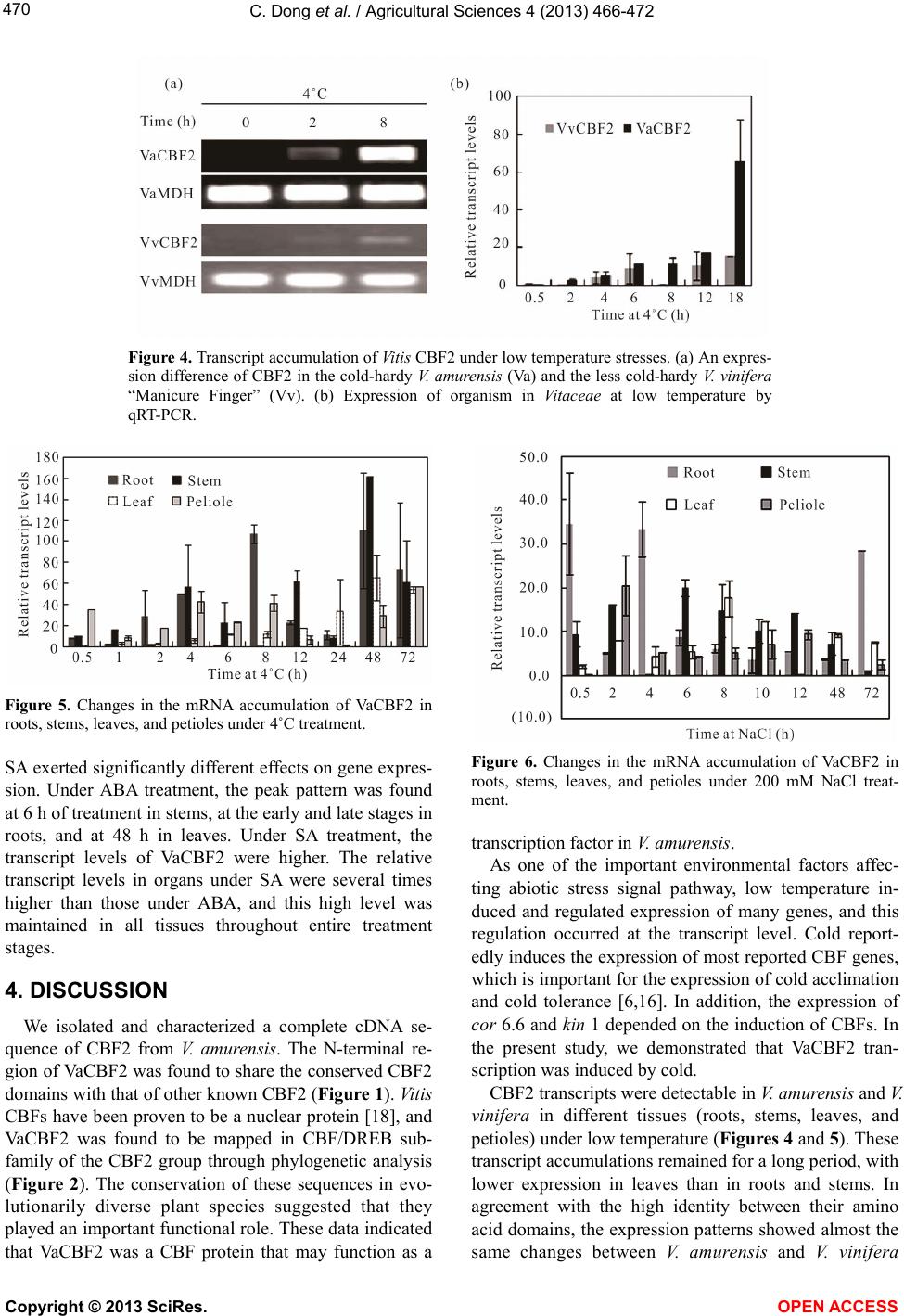 C. Dong et al. / Agricultural Sciences 4 (2013) 466-472 470 Figure 4. Transcript accumulation of Vitis CBF2 under low temperature stresses. (a) An expres- sion difference of CBF2 in the cold-hardy V. amurensis (Va) and the less cold-hardy V. vinifera “Manicure Finger” (Vv). (b) Expression of organism in Vitaceae at low temperature by qRT-PCR. Figure 5. Changes in the mRNA accumulation of VaCBF2 in roots, stems, leaves, and petioles under 4˚C treatment. SA exerted significantly different effects on gene expres- sion. Under ABA treatment, the peak pattern was found at 6 h of treatment in stems, at the early and late stages in roots, and at 48 h in leaves. Under SA treatment, the transcript levels of VaCBF2 were higher. The relative transcript levels in organs under SA were several times higher than those under ABA, and this high level was maintained in all tissues throughout entire treatment stages. 4. DISCUSSION We isolated and characterized a complete cDNA se- quence of CBF2 from V. am ur e nsis. The N-terminal re- gion of VaCBF2 was found to share the conserved CBF2 domains with that of other known CBF2 (Figure 1). Vitis CBFs have been proven to be a nuclear protein [18], and VaCBF2 was found to be mapped in CBF/DREB sub- family of the CBF2 group through phylogenetic analysis (Figure 2). The conservation of these sequences in evo- lutionarily diverse plant species suggested that they played an important functional role. These data indicated that VaCBF2 was a CBF protein that may function as a Figure 6. Changes in the mRNA accumulation of VaCBF2 in roots, stems, leaves, and petioles under 200 mM NaCl treat- ment. transcription factor in V. amurensis. As one of the important environmental factors affec- ting abiotic stress signal pathway, low temperature in- duced and regulated expression of many genes, and this regulation occurred at the transcript level. Cold report- edly induces the expression of most reported CBF genes, which is important for the expression of cold acclimation and cold tolerance [6,16]. In addition, the expression of cor 6.6 and kin 1 depended on the induction of CBFs. In the present study, we demonstrated that VaCBF2 tran- scription was induced by cold. CBF2 transcripts were detectable in V. amurensis and V. vinifera in different tissues (roots, stems, leaves, and petioles) under low temperature (Figures 4 and 5). These transcript accumulations remained for a long period, with lower expression in leaves than in roots and stems. In agreement with the high identity between their amino acid domains, the expression patterns showed almost the same changes between V. amurensis and V. vinifera Copyright © 2013 SciRes. OPEN ACCESS 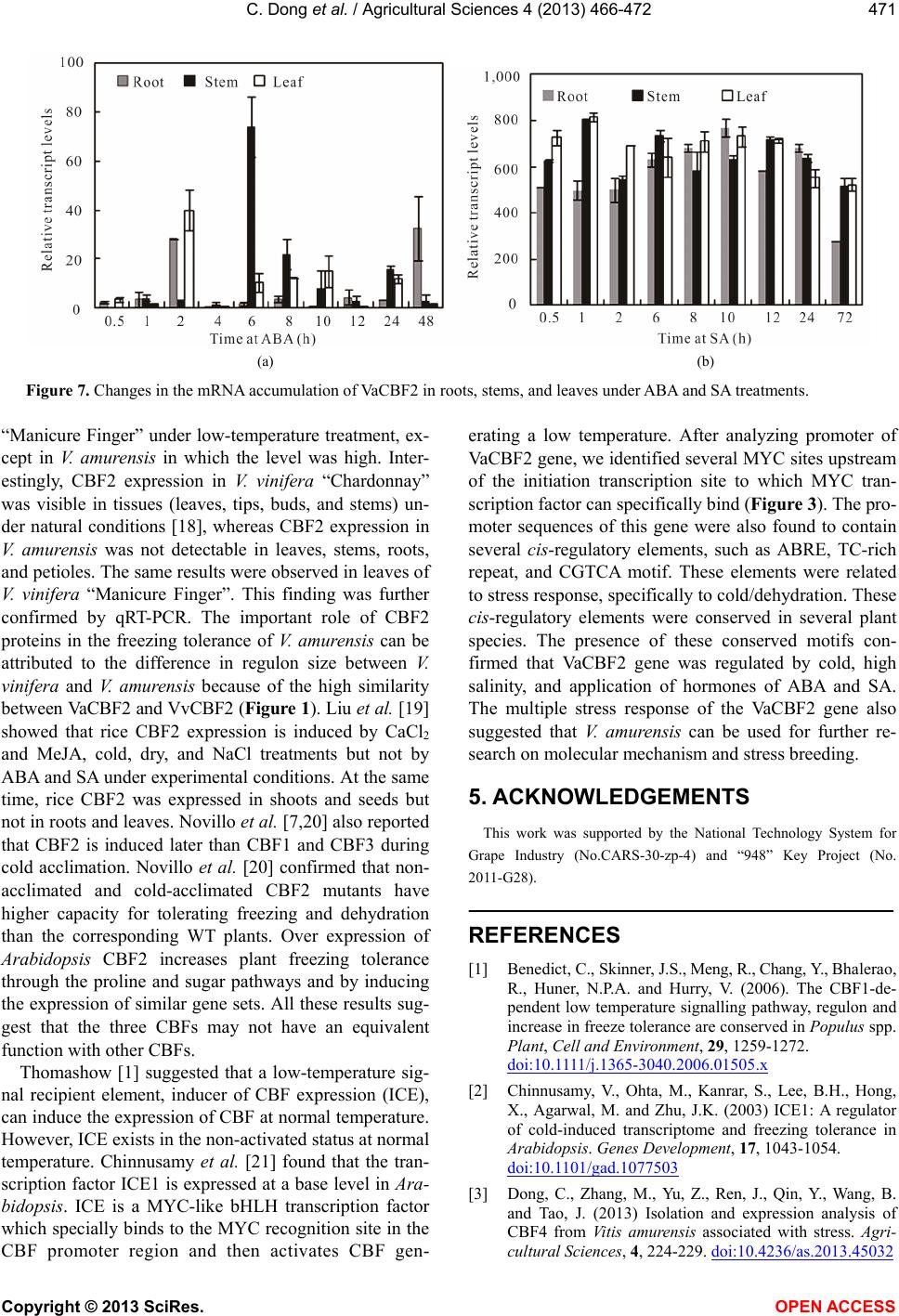 C. Dong et al. / Agricultural Sciences 4 (2013) 466-472 471 (a) (b) Figure 7. Changes in the mRNA accumulation of VaCBF2 in roots, stems, and leaves under ABA and SA treatments. “Manicure Finger” under low-temperature treatment, ex- cept in V. amurensis in which the level was high. Inter- estingly, CBF2 expression in V. vinifera “Chardonnay” was visible in tissues (leaves, tips, buds, and stems) un- der natural conditions [18], whereas CBF2 expression in V. amurensis was not detectable in leaves, stems, roots, and petioles. The same results were observed in leaves of V. vinifera “Manicure Finger”. This finding was further confirmed by qRT-PCR. The important role of CBF2 proteins in the freezing tolerance of V. amurensis can be attributed to the difference in regulon size between V. vinifera and V. a mur e nsis because of the high similarity between VaCBF2 and VvCBF2 (Figure 1). Liu et al. [19] showed that rice CBF2 expression is induced by CaCl2 and MeJA, cold, dry, and NaCl treatments but not by ABA and SA under experimental conditions. At the same time, rice CBF2 was expressed in shoots and seeds but not in roots and leaves. Novillo et al. [7,20] also reported that CBF2 is induced later than CBF1 and CBF3 during cold acclimation. Novillo et al. [20] confirmed that non- acclimated and cold-acclimated CBF2 mutants have higher capacity for tolerating freezing and dehydration than the corresponding WT plants. Over expression of Arabidopsis CBF2 increases plant freezing tolerance through the proline and sugar pathways and by inducing the expression of similar gene sets. All these results sug- gest that the three CBFs may not have an equivalent function with other CBFs. Thomashow [1] suggested that a low-temperature sig- nal recipient element, inducer of CBF expression (ICE), can induce the expression of CBF at normal temperature. However, ICE exists in the non-activated status at normal temperature. Chinnusamy et al. [21] found that the tran- scription factor ICE1 is expressed at a base level in Ara- bidopsis. ICE is a MYC-like bHLH transcription factor which specially binds to the MYC recognition site in the CBF promoter region and then activates CBF gen- erating a low temperature. After analyzing promoter of VaCBF2 gene, we identified several MYC sites upstream of the initiation transcription site to which MYC tran- scription factor can specifically bind (Figure 3). The pro- moter sequences of this gene were also found to contain several cis-regulatory elements, such as ABRE, TC-rich repeat, and CGTCA motif. These elements were related to stress response, specifically to cold/dehydration. These cis-regulatory elements were conserved in several plant species. The presence of these conserved motifs con- firmed that VaCBF2 gene was regulated by cold, high salinity, and application of hormones of ABA and SA. The multiple stress response of the VaCBF2 gene also suggested that V. amurensis can be used for further re- search on molecular mechanism and stress breeding. 5. ACKNOWLEDGEMENTS This work was supported by the National Technology System for Grape Industry (No.CARS-30-zp-4) and “948” Key Project (No. 2011-G28). REFERENCES [1] Benedict, C., Skinner, J.S., Meng, R., Chang, Y., Bhalerao, R., Huner, N.P.A. and Hurry, V. (2006). The CBF1-de- pendent low temperature signalling pathway, regulon and increase in freeze tolerance are conserved in Populus spp. Plant, Cell and Environment, 29, 1259-1272. doi:10.1111/j.1365-3040.2006.01505.x [2] Chinnusamy, V., Ohta, M., Kanrar, S., Lee, B.H., Hong, X., Agarwal, M. and Zhu, J.K. (2003) ICE1: A regulator of cold-induced transcriptome and freezing tolerance in Arabidopsis. Genes Development, 17, 1043-1054. doi:10.1101/gad.1077503 [3] Dong, C., Zhang, M., Yu, Z., Ren, J., Qin, Y., Wang, B. and Tao, J. (2013) Isolation and expression analysis of CBF4 from Vitis amurensis associated with stress. Agri- cultural Scie nces , 4, 224-229. doi:10.4236/as.2013.45032 Copyright © 2013 SciRes. OPEN ACCESS 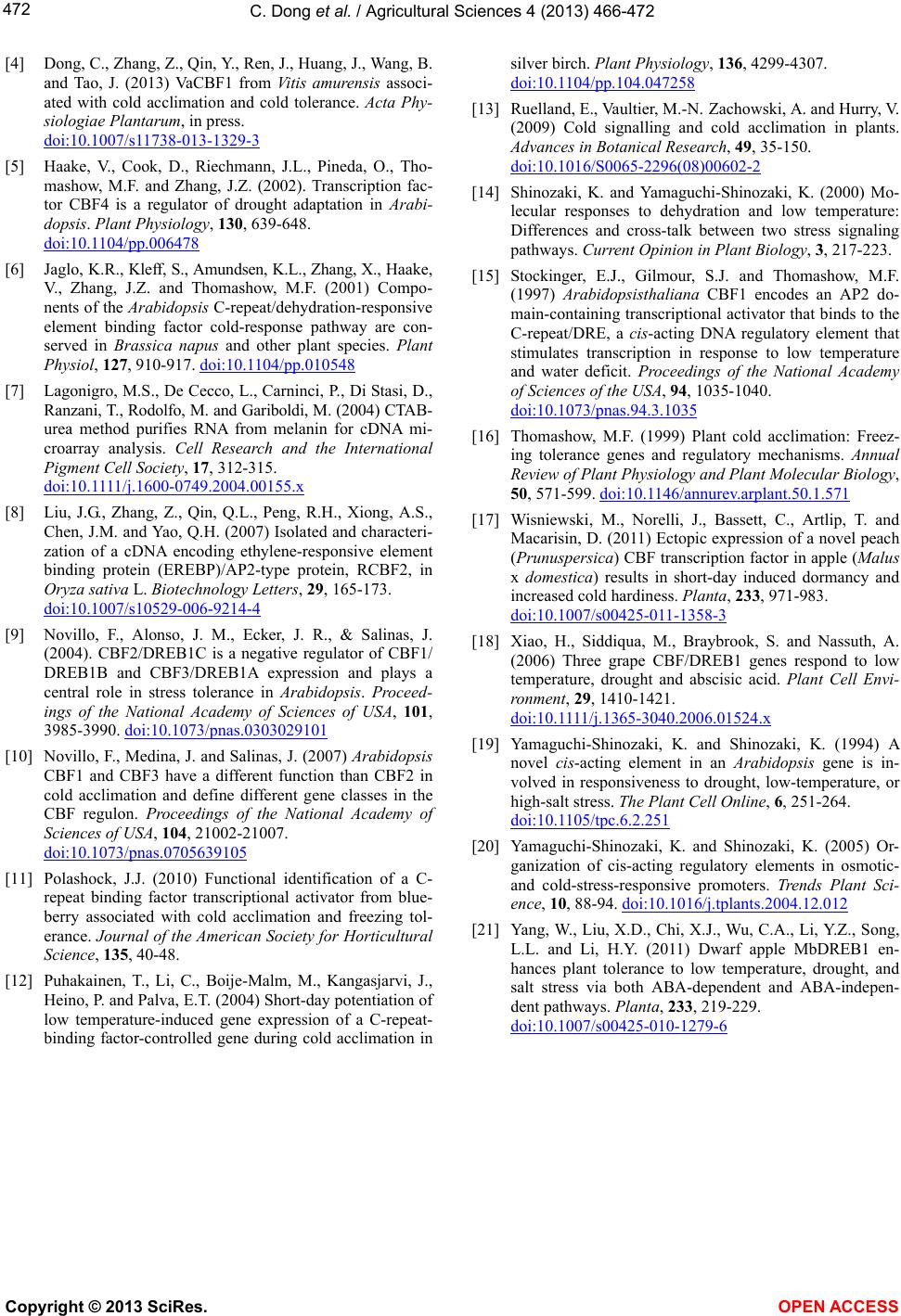 C. Dong et al. / Agricultural Sciences 4 (2013) 466-472 472 [4] Dong, C., Zhang, Z., Qin, Y., Ren, J., Huang, J., Wang, B. and Tao, J. (2013) VaCBF1 from Vitis amurensis associ- ated with cold acclimation and cold tolerance. Acta Phy- siologiae Plantarum, in press. doi:10.1007/s11738-013-1329-3 [5] Haake, V., Cook, D., Riechmann, J.L., Pineda, O., Tho- mashow, M.F. and Zhang, J.Z. (2002). Transcription fac- tor CBF4 is a regulator of drought adaptation in Arabi- dopsis. Plant Physiology, 130, 639-648. doi:10.1104/pp.006478 [6] Jaglo, K.R., Kleff, S., Amundsen, K.L., Zhang, X., Haake, V., Zhang, J.Z. and Thomashow, M.F. (2001) Compo- nents of the Arabidopsis C-repeat/dehydration-responsive element binding factor cold-response pathway are con- served in Brassica napus and other plant species. Plant Physiol, 127, 910-917. doi:10.1104/pp.010548 [7] Lagonigro, M.S., De Cecco, L., Carninci, P., Di Stasi, D., Ranzani, T., Rodolfo, M. and Gariboldi, M. (2004) CTAB- urea method purifies RNA from melanin for cDNA mi- croarray analysis. Cell Research and the International Pigment Cell Society, 17, 312-315. doi:10.1111/j.1600-0749.2004.00155.x [8] Liu, J.G., Zhang, Z., Qin, Q.L., Peng, R.H., Xiong, A.S., Chen, J.M. and Yao, Q.H. (2007) Isolated and characteri- zation of a cDNA encoding ethylene-responsive element binding protein (EREBP)/AP2-type protein, RCBF2, in Oryza sativa L. Biotechnology Letters, 29, 165-173. doi:10.1007/s10529-006-9214-4 [9] Novillo, F., Alonso, J. M., Ecker, J. R., & Salinas, J. (2004). CBF2/DREB1C is a negative regulator of CBF1/ DREB1B and CBF3/DREB1A expression and plays a central role in stress tolerance in Arabidopsis. Proceed- ings of the National Academy of Sciences of USA, 101, 3985-3990. doi:10.1073/pnas.0303029101 [10] Novillo, F., Medina, J. and Salinas, J. (2007) Arabidopsis CBF1 and CBF3 have a different function than CBF2 in cold acclimation and define different gene classes in the CBF regulon. Proceedings of the National Academy of Sciences of USA, 104, 21002-21007. doi:10.1073/pnas.0705639105 [11] Polashock, J.J. (2010) Functional identification of a C- repeat binding factor transcriptional activator from blue- berry associated with cold acclimation and freezing tol- erance. Journal of the American Society for Horticultural Science, 135, 40-48. [12] Puhakainen, T., Li, C., Boije-Malm, M., Kangasjarvi, J., Heino, P. and Palva, E.T. (2004) Short-day potentiation of low temperature-induced gene expression of a C-repeat- binding factor-controlled gene during cold acclimation in silver birch. Plant Physiology, 136, 4299-4307. doi:10.1104/pp.104.047258 [13] Ruelland, E., Vaultier, M.-N. Zachowski, A. and Hurry, V. (2009) Cold signalling and cold acclimation in plants. Advances in Botanical Research, 49, 35-150. doi:10.1016/S0065-2296(08)00602-2 [14] Shinozaki, K. and Yamaguchi-Shinozaki, K. (2000) Mo- lecular responses to dehydration and low temperature: Differences and cross-talk between two stress signaling pathways. Current Opinion in Plant Biology, 3, 217-223. [15] Stockinger, E.J., Gilmour, S.J. and Thomashow, M.F. (1997) Arabidopsisthaliana CBF1 encodes an AP2 do- main-containing transcriptional activator that binds to the C-repeat/DRE, a cis-acting DNA regulatory element that stimulates transcription in response to low temperature and water deficit. Proceedings of the National Academy of Sciences of the USA, 94, 1035-1040. doi:10.1073/pnas.94.3.1035 [16] Thomashow, M.F. (1999) Plant cold acclimation: Freez- ing tolerance genes and regulatory mechanisms. Annual Review of Plant Physiology and Plant Molecular Biology, 50, 571-599. doi:10.1146/annurev.arplant.50.1.571 [17] Wisniewski, M., Norelli, J., Bassett, C., Artlip, T. and Macarisin, D. (2011) Ectopic expression of a novel peach (Prunuspersica) CBF transcription factor in apple (Malus x domestica) results in short-day induced dormancy and increased cold hardiness. Planta, 233, 971-983. doi:10.1007/s00425-011-1358-3 [18] Xiao, H., Siddiqua, M., Braybrook, S. and Nassuth, A. (2006) Three grape CBF/DREB1 genes respond to low temperature, drought and abscisic acid. Plant Cell Envi- ronment, 29, 1410-1421. doi:10.1111/j.1365-3040.2006.01524.x [19] Yamaguchi-Shinozaki, K. and Shinozaki, K. (1994) A novel cis-acting element in an Arabidopsis gene is in- volved in responsiveness to drought, low-temperature, or high-salt stress. The Plant Cell Online, 6, 251-264. doi:10.1105/tpc.6.2.251 [20] Yamaguchi-Shinozaki, K. and Shinozaki, K. (2005) Or- ganization of cis-acting regulatory elements in osmotic- and cold-stress-responsive promoters. Trends Plant Sci- ence, 10, 88-94. doi:10.1016/j.tplants.2004.12.012 [21] Yang, W., Liu, X.D., Chi, X.J., Wu, C.A., Li, Y.Z., Song, L.L. and Li, H.Y. (2011) Dwarf apple MbDREB1 en- hances plant tolerance to low temperature, drought, and salt stress via both ABA-dependent and ABA-indepen- dent pathways. Planta, 233, 219-229. doi:10.1007/s00425-010-1279-6 Copyright © 2013 SciRes. OPEN ACCESS |