

Paper Menu >>
Journal Menu >>
 Vol.4, No.9, 449-454 (2013) Agricultural Sciences http://dx.doi.org/10.4236/as.2013.49060 Genetic variation of oregano (Origanum vulgare L.) for etheric oil in Albania Fetah Elezi1, Fatbardh Plaku1, Alban Ibraliu1, Gose Stefkov2, Marija Karapandzova2, Svetlana Kulevanova2, Sali Aliu3* 1Department of Plant Production, Agricultural University in Tirana, Tirana, Albania 2Faculty of Pharmacy, University Ss.Cyril and Methodius, Skopje, Macedonia 3Faculty of Agriculture, Department of Crop Science, University of Prishtina, Prishtina, Kosovo; *Corresponding Author: [email protected] Received 11 January 2013; revised 11 February 2013; accepted 15 March 2013 Copyright © 2013 Fetah Elezi et al. This is an open access article distributed under the Creative Commons Attribution License, which permits unrestricted use, distribution, and reproduction in any medium, provided the original work is properly cited. ABSTRACT In this study are presented the results of studies for oregano in 16 locations (sites) of Albania for the content of the quantity of oils and their frac- tions. Albania is the one of the important diver- sity centers for Oregano because of their adap- tation to diverse agro ecological conditions as a result of natural selection. The design of the experiment was based on split plot methods. From the total samples collected, were selected 16 mostly widespread samples of natural popu- lations of origano (Origanum vulgare L. sp. vul- gare and sp. hirtum). Essential oil isolation from oregano was performed by hydro distillation. Identification of the components was made by comparing mass spectra of components in es- sential oils with those from Nist, Wiley and Ad- ams mass spectra libraries. The results show that the total oil content varies from 3.45% to 0.1%. The populations of Oregano in the part of southern Albania have a higher amount of ethe- ric oil compared with those of the North part. The higher content of car vacrol in 55.63%, of the samples was determined in sites of the south- ern part of Albania, while in the other two inves- tigated area central and north part it was 55.63% and 48.49% respectively. The same indicators were realised also for content of linalool and thymol, while North area has sites with high content of caryophyllen-oxide and β-pinen 3. But, in all sites, the oils of thymol and carv acrolit were dominant. Keywords: Origanum; Essential Oil; Carvacrol; Thymol 1. INTRODUCTION The genus Origanum is a member of the Lamiaceae family and has a complex taxonomy [1]. O. vulgare plays a primary role among culinary herbs in world trade [2]. It is distributed all over Europe, West and Central Asia up to Taiwan [3]. The use of O. vulgare as medicinal plant is believed to be due to biological properties of p-cymene and carvacrol. Bernáth [4] has noted that there are intras- pecific taxa of oregano having no “oregano” character that is based on the presence of carvacrol. Oregano is the common name for a general aroma and flavour primarily derived from more than 60 plant species used all over the world as a spice [5]. Four main groups of plants com- monly used for culinary purposes can be distinguished, i.e., Greek oregano (Origanum vulgare ssp. hirtum (Link) Ietswaart); Spanish origano (Coridohymus capitatus (L.) [2]; Turkish oregano (Origanum onites L.); and Mexican oregano (Lippia graveolens HBK [6]. Origano is the commercial name of those Origa num species that are rich in the phenolic monoterpenoids, mainly carvacrol and occasionally thymol [7]. A number of chemically related compounds i.e. p-cymene; γ-terpinene, carvacrol methyl ethers, thymol methyl ethers, carvacrol acetates and thymol acetates; as well as p-cymenene, p-cy- men-8-ol, p-cymen-7-ol, thymoquinone, and thymohy- droquinone are present in the oil of Origanum vulgare which is extremely rich in essential oils (up to 7%) with carvacrol as a major constituent present in very high quantity (75% - 95%), followed by p-cymene (4% - 14%) and γ-terpinene (1% - 10%). It seems possible that the uses of the plant in traditional medicine can be attributed to the known biological properties of p-cymene and car- vacrol [8]. Many of the studies confirmed the medicinal effects of oregano for human health. The Origanum spe- cies, which are rich in essential oils, have been used for thousands of years as spices and as local medicines in Copyright © 2013 SciRes. OPEN ACC ESS  F. Elezi et al. / Agricultural Sciences 4 (2013) 449-454 450 traditional medicine [9]. About 20 European public in- stitutions hold genetic resources of different species of oregano [10]. Marjoram (Origanum vulgare L.) is one of medicinal aromatic plants found wholesale almost in all areas of Albania, which is a perennial plant usually grows in dry area in smaller groups. Oregano plants are collect- ed from natural habitats and used as raw materials in the pharmaceutical, cosmetic and food industry [11]. But many countries start to cultivate it in different areas. In botanical aspects, the oregano populations differ from one to another, that is they vary depending on the content and composition of essential oils [12]. From the quantity and quality of essential oils the values of this plant were determined [11,12]. The different results showed that the effects of oregano antioxidante are associated with high content of essential oils, thymol and carvacrols, and these are the main ingredients in oregano oil. The con- tents of Thymol and Carvacrol in oregano give it differ- ent properties [13]. According to the studies, carvacrol is a powerful bactericidal agent, and provides protection against mold and other common bacteria. The main ob- jective in our study was to investigate the different re- gions and to find the variation for oil content in oregano plant populations. 2. MATERIAL AND METHODS 2.1. Collection Sites The research expedition was organized in 2012 in the whole territory of Albania. During this expedition are identified and collected 62 accessions. At each location were taken of the 50 samples which derived a main rep- resentativ sample. From the total samples collected, were selected 16 samples mostly widespread of natural popu- lations of origano (Origanum vulgare L. sp. vulgare and sp. hirtum). Those samples you perform analyzes for content of oils and their components. The confirmation of 53 essential oil was made to analyses: β-Pinene, p- Cymene, γ-Terpinene, Linalool, Terpinene-4-ol, Thymol, Carvacrol dhe Caryophyllene oxide. The overground parts of the flowering plants (20 - 25 cm from the top) were collected during the summer of 2012. The plant material was air dried, packed in paper bags and kept in a dark and cool place until analysis. Plant identity was verified and voucher specimens were deposited at the Institute of Pharmacognosy, Faculty of Pharmacy, Skopje. 2.2. Essential Oil Isolation Essential oil isolation from oregano was performed by hydro distillation in all-glass Clevenger apparatus fol- lowing this procedure: 20 g of the plant material was stored in 500 mL flask where 250 mL of water R was used as distillation liquid and 0.5 mL of xylene R was added in the graduate tube. The Distillation was per- formed for 2.5 h with a rate of 2 - 3 mL/min. GC and GC-MS analyses: Agilent 7890А Gas Chro- matography system equipped with flame ionization de- tector (FID) and Agilent 5975C Mass Quadrupole detec- tor as well as capillary flow technology which enable simultaneous analysis of the sample on both detectors. HP-5 ms (30 m × 0.25 mm, film thickness 0.25 m) cap- illary column was used. Operating conditions were as follows: GC Method for essential oils: oven temperature 60˚C (0 min), 3˚C/min to 240˚C (held for 1 min) and 10˚C/min to 280˚C (held for 1 min); helium as carrier gas at a flow rate of 1 mL/min; injector T = 220˚C and FID T = 270˚C. 1 L of injection volume was injected at split ratio 1:1. The mass spectrometry conditions were: ionization voltage 70 eV, ion source temperature 230˚C, transfer line temperature 280˚C and mass range from 50 - 500 Da. The MS was operated in scan mode. GC Method for Head Space: oven temperature 60˚C, 20˚C/min to 280˚C; helium as carrier gas at a flow rate of 1 mL/min; injector T = 260˚C and FID T = 270˚C. 1000 L of injec- tion volume was injected at split ratio 1:1. The mass spectrometry conditions were: ionization voltage 70 eV, ion source temperature 230˚C, transfer line temperature 280˚C and mass range from 50 - 500 Da. The MS was operated in scan mode. Head Space method: Incubation Temperature 80˚C, Incubation Time 5.00 m:ss, Syringe Temperature 85˚C, Agitator Speed 500 rpm, Fill Speed 500 µl/s, Pullup Delay 500 ms, Inject to GC, Injection speed 500 µl/s, Pre Inject Delay 500 ms, Post Inject De- lay 500 ms, Flush Time (m:ss) 0:10, GC Run time (m:ss) 10:00. Identification of the components: Identification of the components was made by comparing mass spectra of components in essential oils with those from Nist, Wiley and Adams mass spectra libraries, by AMDIS (Auto- mated Mass Spectral Deconvolution and Identification System) and by comparing literature and estimated Ko- vat’s (retention) indices that were determined using mix- ture of homologous series of normal alkanes from C9 to C25 in hexane, under the same above mentioned condi- tions. The percentage ratio of the components was com- puted by the normalization method of the GC/FID peak areas and average values were taken into further consid- eration (n = 3). 2.3. Statistical Analyses All statistical analyses were performed with the SPSS software (version 15.0, SPSS) [14]. Means values and variation coefficients were used in the statistical analyses. Effects of the studied traits were evaluated by ANOVA. In order to assess the differentiation of plants of oregano based on all variables that were measured, the Canonical Discriminate Analyses (CDA) was applied. Copyright © 2013 SciRes. OPEN ACCE SS 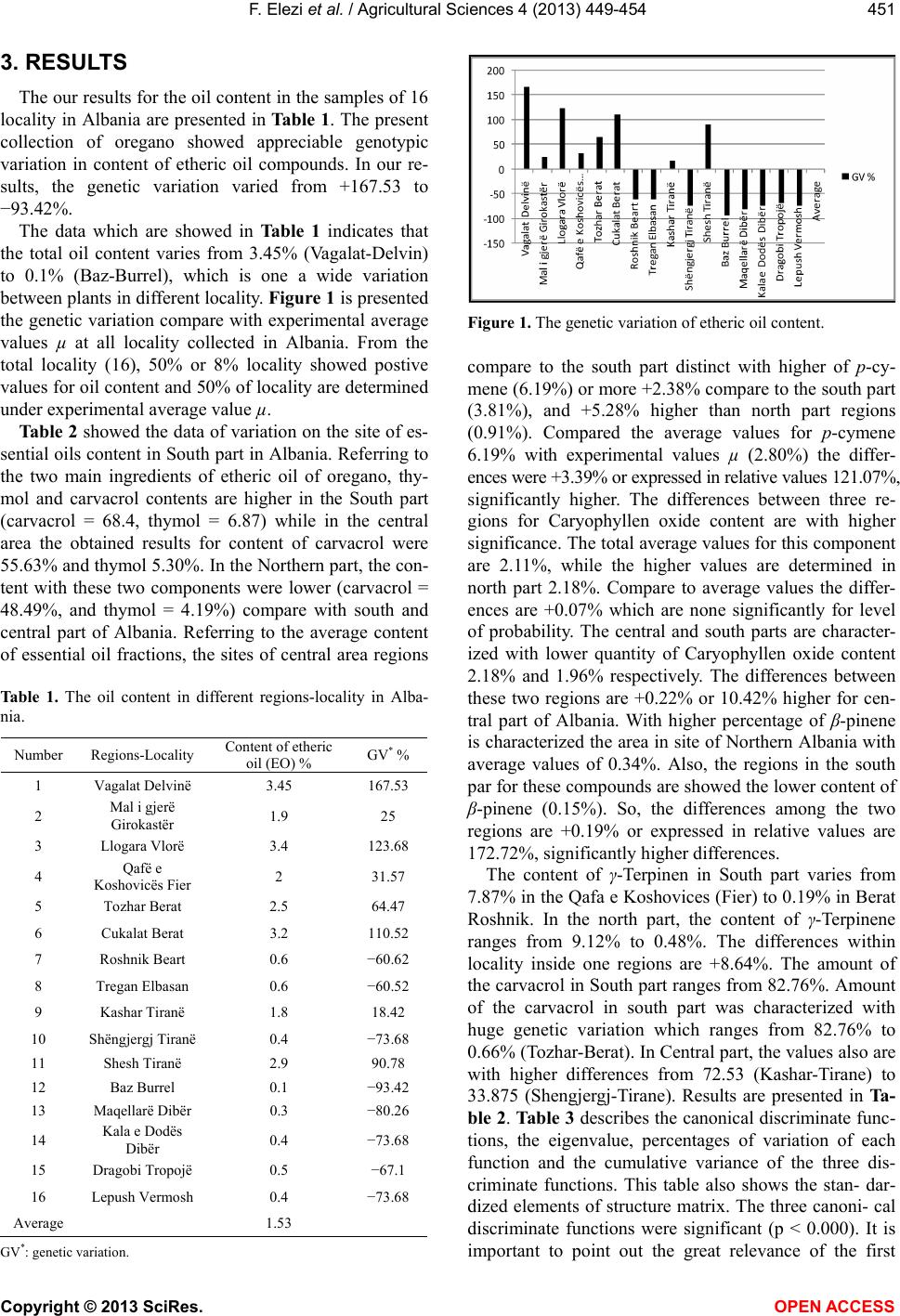 F. Elezi et al. / Agricultural Sciences 4 (201 3) 449-454 451 3. RESULTS The our results for the oil content in the samples of 16 locality in Albania are presented in Table 1. The present collection of oregano showed appreciable genotypic variation in content of etheric oil compounds. In our re- sults, the genetic variation varied from +167.53 to −93.42%. The data which are showed in Ta bl e 1 indicates that the total oil content varies from 3.45% (Vagalat-Delvin) to 0.1% (Baz-Burrel), which is one a wide variation between plants in different locality. Figure 1 is presented the genetic variation compare with experimental average values µ at all locality collected in Albania. From the total locality (16), 50% or 8% locality showed postive values for oil content and 50% of locality are determined under experimental average value µ. Table 2 showed the data of variation on the site of es- sential oils content in South part in Albania. Referring to the two main ingredients of etheric oil of oregano, thy- mol and carvacrol contents are higher in the South part (carvacrol = 68.4, thymol = 6.87) while in the central area the obtained results for content of carvacrol were 55.63% and thymol 5.30%. In the Northern part, the con- tent with these two components were lower (carvacrol = 48.49%, and thymol = 4.19%) compare with south and central part of Albania. Referring to the average content of essential oil fractions, the sites of central area regions Tab le 1. The oil content in different regions-locality in Alba- nia. Number Regions-Locality Content of etheric oil (EO) % GV* % 1 Vagalat Delvinë 3.45 167.53 2 Mal i gjerë Girokastër 1.9 25 3 Llogara Vlorë 3.4 123.68 4 Qafë e Koshovicës Fier 2 31.57 5 Tozhar Berat 2.5 64.47 6 Cukalat Berat 3.2 110.52 7 Roshnik Beart 0.6 −60.62 8 Tregan Elbasan 0.6 −60.52 9 Kashar Tiranë 1.8 18.42 10 Shëngjergj Tiranë 0.4 −73.68 11 Shesh Tiranë 2.9 90.78 12 Baz Burrel 0.1 −93.42 13 Maqellarë Dibër 0.3 −80.26 14 Kala e Dodës Dibër 0.4 −73.68 15 Dragobi Tropojë 0.5 −67.1 16 Lepush Vermosh 0.4 −73.68 Average 1.53 GV*: genetic variation. Figure 1. The genetic variation of etheric oil content. compare to the south part distinct with higher of p-cy- mene (6.19%) or more +2.38% compare to the south part (3.81%), and +5.28% higher than north part regions (0.91%). Compared the average values for p-cymene 6.19% with experimental values µ (2.80%) the differ- ences were +3.39% or expressed in relative values 121.07%, significantly higher. The differences between three re- gions for Caryophyllen oxide content are with higher significance. The total average values for this component are 2.11%, while the higher values are determined in north part 2.18%. Compare to average values the differ- ences are +0.07% which are none significantly for level of probability. The central and south parts are character- ized with lower quantity of Caryophyllen oxide content 2.18% and 1.96% respectively. The differences between these two regions are +0.22% or 10.42% higher for cen- tral part of Albania. With higher percentage of β-pinene is characterized the area in site of Northern Albania with average values of 0.34%. Also, the regions in the south par for these compounds are showed the lower content of β-pinene (0.15%). So, the differences among the two regions are +0.19% or expressed in relative values are 172.72%, significantly higher differences. The content of γ-Terpinen in South part varies from 7.87% in the Qafa e Koshovices (Fier) to 0.19% in Berat Roshnik. In the north part, the content of γ-Terpinene ranges from 9.12% to 0.48%. The differences within locality inside one regions are +8.64%. The amount of the carvacrol in South part ranges from 82.76%. Amount of the carvacrol in south part was characterized with huge genetic variation which ranges from 82.76% to 0.66% (Tozhar-Berat). In Central part, the values also are with higher differences from 72.53 (Kashar-Tirane) to 33.875 (Shengjergj-Tirane). Results are presented in Ta- ble 2. Table 3 describes the canonical discriminate func- tions, the eigenvalue, percentages of variation of each function and the cumulative variance of the three dis- criminate functions. This table also shows the stan- dar- dized elements of structure matrix. The three canoni- cal discriminate functions were significant (p < 0.000). It is important to point out the great relevance of the first Copyright © 2013 SciRes. OPEN ACC ESS 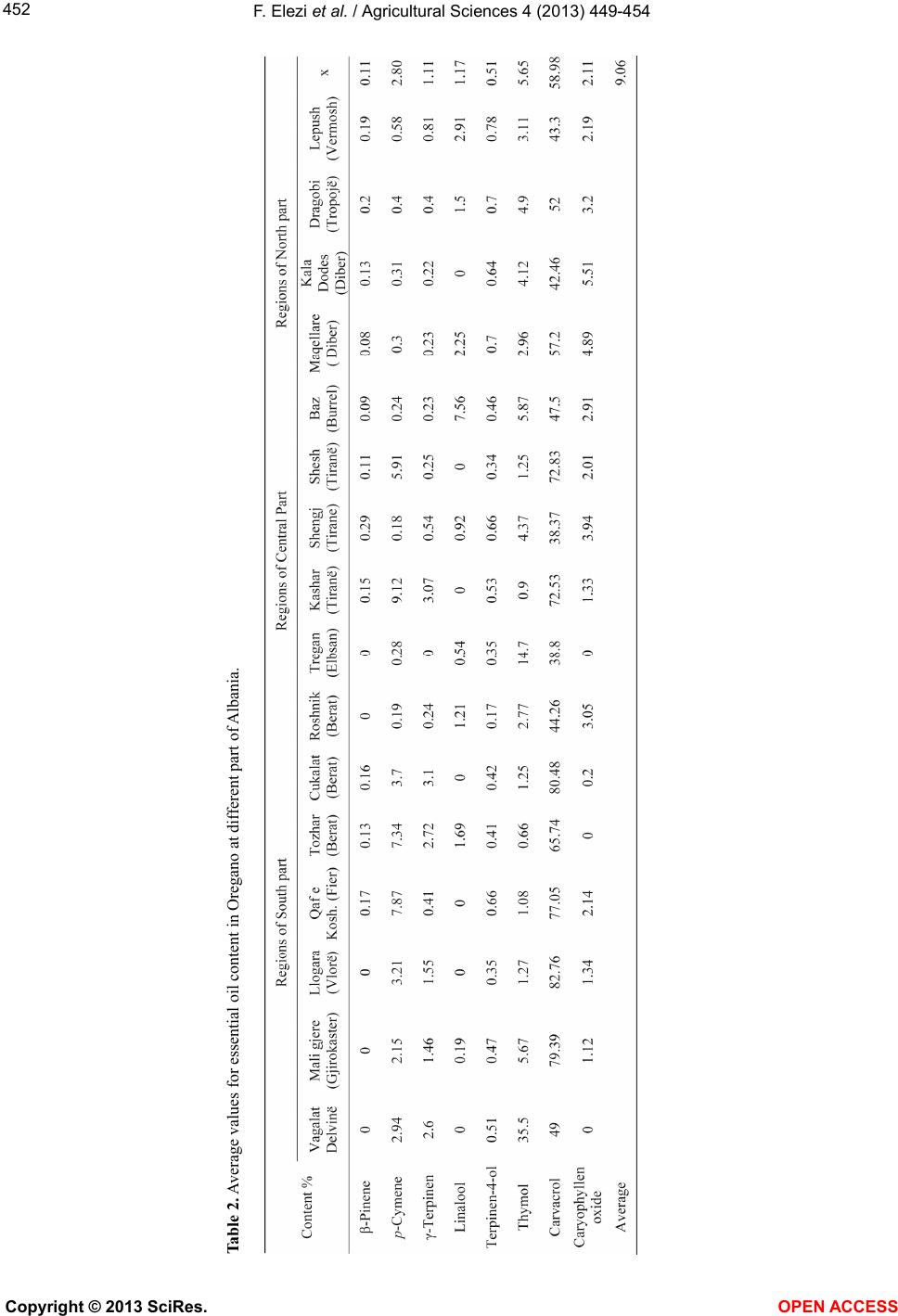 F. Elezi et al. / Agricultural Sciences 4 (201 3) 449-454 Copyright © 2013 SciRes. 452 Table 2. Average values for essential oil content in Oregano at different part of Albania. OPEN A CCESS 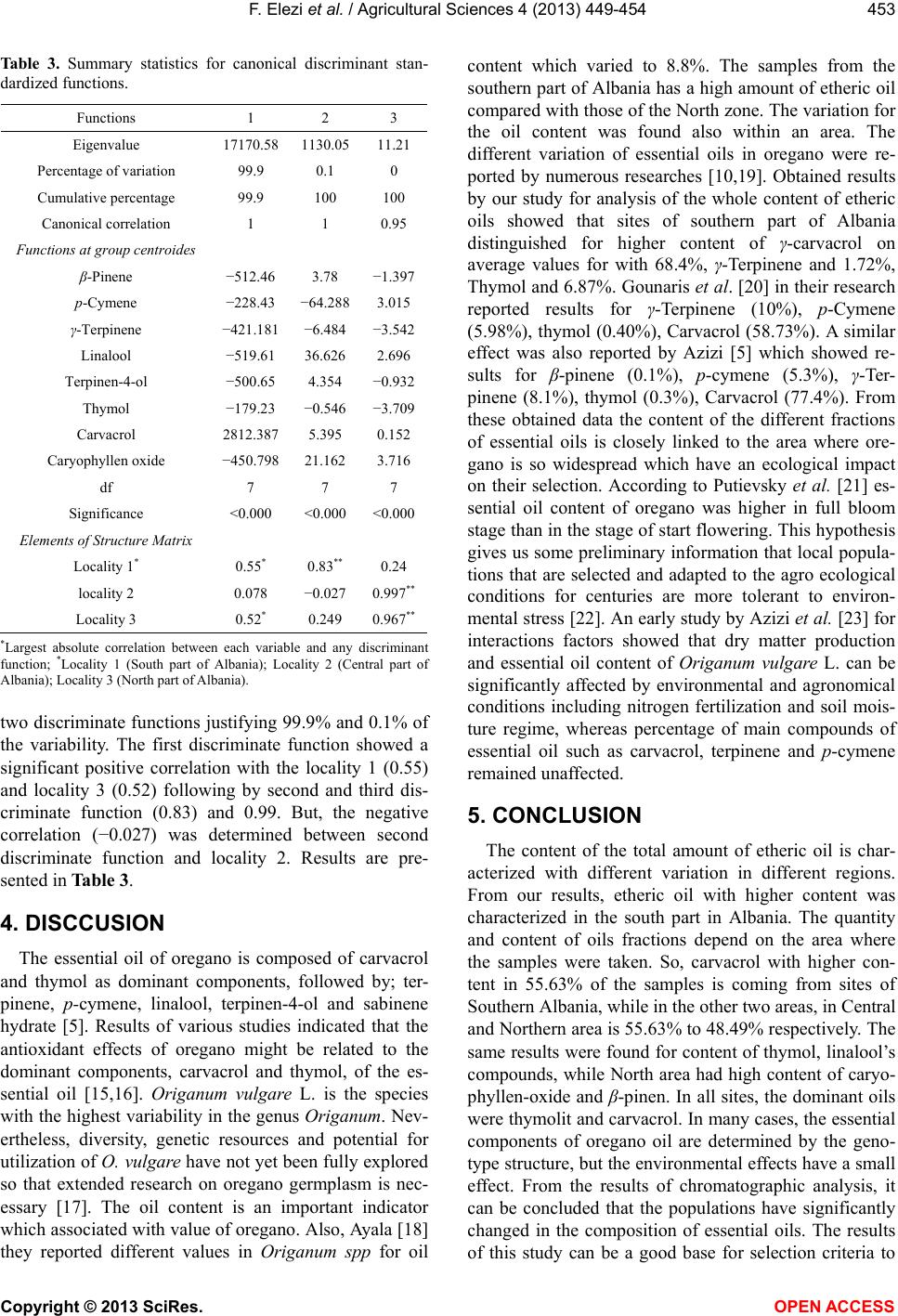 F. Elezi et al. / Agricultural Sciences 4 (201 3) 449-454 453 Table 3. Summary statistics for canonical discriminant stan- dardized functions. Functions 1 2 3 Eigenvalue 17170.58 1130.05 11.21 Percentage of variation 99.9 0.1 0 Cumulative percentage 99.9 100 100 Canonical correlation 1 1 0.95 Functions at group centroides β-Pinene −512.46 3.78 −1.397 p-Cymene −228.43 −64.288 3.015 γ-Terpinene −421.181 −6.484 −3.542 Linalool −519.61 36.626 2.696 Terpinen-4-ol −500.65 4.354 −0.932 Thymol −179.23 −0.546 −3.709 Carvacrol 2812.387 5.395 0.152 Caryophyllen oxide −450.798 21.162 3.716 df 7 7 7 Significance <0.000 <0.000 <0.000 Elements of Structure Matrix Locality 1* 0.55* 0.83** 0.24 locality 2 0.078 −0.027 0.997** Locality 3 0.52* 0.249 0.967** *Largest absolute correlation between each variable and any discriminant function; *Locality 1 (South part of Albania); Locality 2 (Central part of Albania); Locality 3 (North part of Albania). two discriminate functions justifying 99.9% and 0.1% of the variability. The first discriminate function showed a significant positive correlation with the locality 1 (0.55) and locality 3 (0.52) following by second and third dis- criminate function (0.83) and 0.99. But, the negative correlation (−0.027) was determined between second discriminate function and locality 2. Results are pre- sented in Table 3. 4. DISCCUSION The essential oil of oregano is composed of carvacrol and thymol as dominant components, followed by; ter- pinene, p-cymene, linalool, terpinen-4-ol and sabinene hydrate [5]. Results of various studies indicated that the antioxidant effects of oregano might be related to the dominant components, carvacrol and thymol, of the es- sential oil [15,16]. Origanum vulgare L. is the species with the highest variability in the genus Origanum. Nev- ertheless, diversity, genetic resources and potential for utilization of O. vulgare have not yet been fully explored so that extended research on oregano germplasm is nec- essary [17]. The oil content is an important indicator which associated with value of oregano. Also, Ayala [18] they reported different values in Origanum spp for oil content which varied to 8.8%. The samples from the southern part of Albania has a high amount of etheric oil compared with those of the North zone. The variation for the oil content was found also within an area. The different variation of essential oils in oregano were re- ported by numerous researches [10,19]. Obtained results by our study for analysis of the whole content of etheric oils showed that sites of southern part of Albania distinguished for higher content of γ-carvacrol on average values for with 68.4%, γ-Terpinene and 1.72%, Thymol and 6.87%. Gounaris et al. [20] in their research reported results for γ-Terpinene (10%), p-Cymene (5.98%), thymol (0.40%), Carvacrol (58.73%). A similar effect was also reported by Azizi [5] which showed re- sults for β-pinene (0.1%), p-cymene (5.3%), γ-Ter- pinene (8.1%), thymol (0.3%), Carvacrol (77.4%). From these obtained data the content of the different fractions of essential oils is closely linked to the area where ore- gano is so widespread which have an ecological impact on their selection. According to Putievsky et al. [21] es- sential oil content of oregano was higher in full bloom stage than in the stage of start flowering. This hypothesis gives us some preliminary information that local popula- tions that are selected and adapted to the agro ecological conditions for centuries are more tolerant to environ- mental stress [22]. An early study by Azizi et al. [23] for interactions factors showed that dry matter production and essential oil content of Origanum vulgare L. can be significantly affected by environmental and agronomical conditions including nitrogen fertilization and soil mois- ture regime, whereas percentage of main compounds of essential oil such as carvacrol, terpinene and p-cymene remained unaffected. 5. CONCLUSION The content of the total amount of etheric oil is char- acterized with different variation in different regions. From our results, etheric oil with higher content was characterized in the south part in Albania. The quantity and content of oils fractions depend on the area where the samples were taken. So, carvacrol with higher con- tent in 55.63% of the samples is coming from sites of Southern Albania, while in the other two areas, in Central and Northern area is 55.63% to 48.49% respectively. The same results were found for content of thymol, linalool’s compounds, while North area had high content of caryo- phyllen-oxide and β-pinen. In all sites, the dominant oils were thymolit and carvacrol. In many cases, the essential components of oregano oil are determined by the geno- type structure, but the environmental effects have a small effect. From the results of chromatographic analysis, it can be concluded that the populations have significantly changed in the composition of essential oils. The results of this study can be a good base for selection criteria to Copyright © 2013 SciRes. OPEN ACC ESS 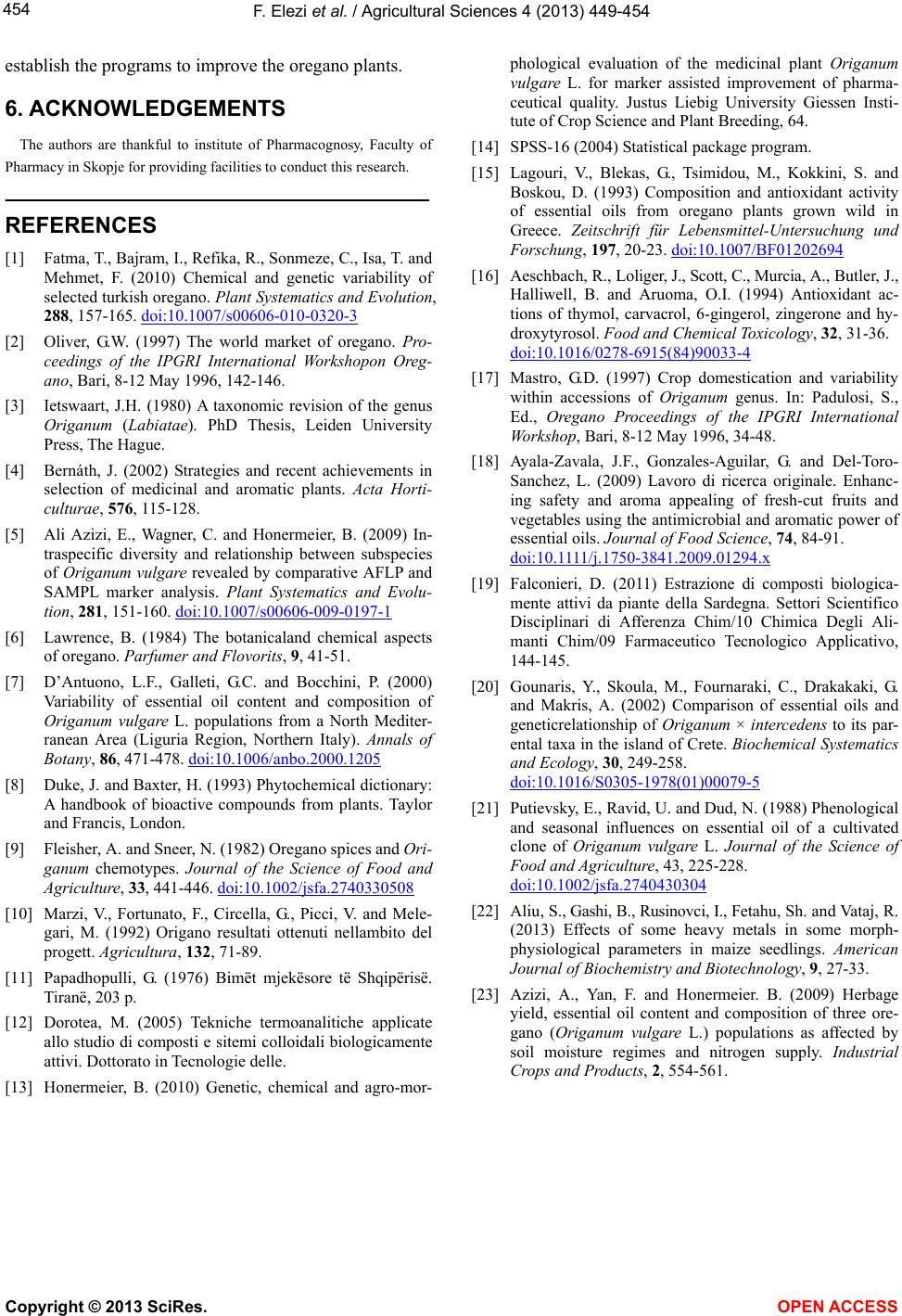 F. Elezi et al. / Agricultural Sciences 4 (201 3) 449-454 454 establish the programs to improve the oregano plants. 6. ACKNOWLEDGEMENTS The authors are thankful to institute of Pharmacognosy, Faculty of Pharmacy in Skopje for providing facilities to conduct this research. REFERENCES [1] Fatma, T., Bajram, I., Refika, R., Sonmeze, C., Isa, T. and Mehmet, F. (2010) Chemical and genetic variability of selected turkish oregano. Plant Systematics and Evolution, 288, 157-165. doi:10.1007/s00606-010-0320-3 [2] Oliver, G.W. (1997) The world market of oregano. Pro- ceedings of the IPGRI International Workshopon Oreg- ano, Bari, 8-12 May 1996, 142-146. [3] Ietswaart, J.H. (1980) A taxonomic revision of the genus Origanum (Labiatae). PhD Thesis, Leiden University Press, The Hague. [4] Bernáth, J. (2002) Strategies and recent achievements in selection of medicinal and aromatic plants. Acta Horti- culturae, 576, 115-128. [5] Ali Azizi, E., Wagner, C. and Honermeier, B. (2009) In- traspecific diversity and relationship between subspecies of Origanum vulgare revealed by comparative AFLP and SAMPL marker analysis. Plant Systematics and Evolu- tion, 281, 151-160. doi:10.1007/s00606-009-0197-1 [6] Lawrence, B. (1984) The botanicaland chemical aspects of oregano. Parfumer and Flovorits, 9, 41-51. [7] D’Antuono, L.F., Galleti, G.C. and Bocchini, P. (2000) Variability of essential oil content and composition of Origanum vulgare L. populations from a North Mediter- ranean Area (Liguria Region, Northern Italy). Annals of Botany, 86, 471-478. doi:10.1006/anbo.2000.1205 [8] Duke, J. and Baxter, H. (1993) Phytochemical dictionary: A handbook of bioactive compounds from plants. Taylor and Francis, London. [9] Fleisher, A. and Sneer, N. (1982) Oregano spices and Ori- ganum chemotypes. Journal of the Science of Food and Agriculture, 33, 441-446. doi:10.1002/jsfa.2740330508 [10] Marzi, V., Fortunato, F., Circella, G., Picci, V. and Mele- gari, M. (1992) Origano resultati ottenuti nellambito del progett. Agricultura, 132, 71-89. [11] Papadhopulli, G. (1976) Bimët mjekësore të Shqipërisë. Tiranë, 203 p. [12] Dorotea, M. (2005) Tekniche termoanalitiche applicate allo studio di composti e sitemi colloidali biologicamente attivi. Dottorato in Tecnologie delle. [13] Honermeier, B. (2010) Genetic, chemical and agro-mor- phological evaluation of the medicinal plant Origanum vulgare L. for marker assisted improvement of pharma- ceutical quality. Justus Liebig University Giessen Insti- tute of Crop Science and Plant Breeding, 64. [14] SPSS-16 (2004) Statistical package program. [15] Lagouri, V., Blekas, G., Tsimidou, M., Kokkini, S. and Boskou, D. (1993) Composition and antioxidant activity of essential oils from oregano plants grown wild in Greece. Zeitschrift für Lebensmittel-Untersuchung und Forschung, 197, 20-23. doi:10.1007/BF01202694 [16] Aeschbach, R., Loliger, J., Scott, C., Murcia, A., Butler, J., Halliwell, B. and Aruoma, O.I. (1994) Antioxidant ac- tions of thymol, carvacrol, 6-gingerol, zingerone and hy- droxytyrosol. Food and Chemical Toxicology, 32, 31-36. doi:10.1016/0278-6915(84)90033-4 [17] Mastro, G.D. (1997) Crop domestication and variability within accessions of Origanum genus. In: Padulosi, S., Ed., Oregano Proceedings of the IPGRI International Workshop, Bari, 8-12 May 1996, 34-48. [18] Ayala-Zavala, J.F., Gonzales-Aguilar, G. and Del-Toro- Sanchez, L. (2009) Lavoro di ricerca originale. Enhanc- ing safety and aroma appealing of fresh-cut fruits and vegetables using the antimicrobial and aromatic power of essential oils. Journal of Food Science, 74, 84-91. doi:10.1111 /j.1750-3841.2009.01294.x [19] Falconieri, D. (2011) Estrazione di composti biologica- mente attivi da piante della Sardegna. Settori Scientifico Disciplinari di Afferenza Chim/10 Chimica Degli Ali- manti Chim/09 Farmaceutico Tecnologico Applicativo, 144-145. [20] Gounaris, Y., Skoula, M., Fournaraki, C., Drakakaki, G. and Makris, A. (2002) Comparison of essential oils and geneticrelationship of Origanum × intercedens to its par- ental taxa in the island of Crete. Biochemical Systematics and Ecology, 30, 249-258. doi:10.1016/S0305-1978(01)00079-5 [21] Putievsky, E., Ravid, U. and Dud, N. (1988) Phenological and seasonal influences on essential oil of a cultivated clone of Origanum vulgare L. Journal of the Science of Food and Agriculture, 43, 225-228. doi:10.1002/jsfa.2740430304 [22] Aliu, S., Gashi, B., Rusinovci, I., Fetahu, Sh. and Vataj, R. (2013) Effects of some heavy metals in some morph- physiological parameters in maize seedlings. American Journal of Biochemistry and Biotechnology, 9, 27-33. [23] Azizi, A., Yan, F. and Honermeier. B. (2009) Herbage yield, essential oil content and composition of three ore- gano (Origanum vulgare L.) populations as affected by soil moisture regimes and nitrogen supply. Industrial Crops and Products, 2, 554-561. Copyright © 2013 SciRes. OPEN ACCE SS |