

Paper Menu >>
Journal Menu >>
 Vol.5, No.9, 979-986 (2013) Natural Science http://dx.doi.org/10.4236/ns.2013.59119 Family tree and population: Distinction and similarity of the analysis on example of hemophilia Andrey N. Volobuev, Peter I. Romanchuk, Vladimir K. Malishev Samara State Medical University, Samara, Russia; [email protected] Received 24 June 2013; revised 24 July 2013; accepted 1 August 2013 Copyright © 2013 Andrey N. Volobuev et al. This is an open access article distributed under the Creative Commons Attribution Li- cense, which permits unrestricted use, distribution, and reproduction in any medium, provided the original work is properly cited. ABSTRACT On the basis of Hardy-Weinberg law the distinc- tion in the philosophy of the description of a family tree and a population is considered. With the help of introduction of the equivalent con- stant mutagen factor both in a family tree and in a population, the analysis of hemophilia is led. Influence of selection at presence of hemophilia is considered. On the basis of idea of Danforth and Haldane about the balance mutagenesis and selection at presence of hemophilia, the inter- relation of selection parameter and the equiva- lent constant mutagen factor is found. It is shown, that dynamics of development of hemophilia in a family tree and in population are similar. Keywords: Alleles; Equivalent Constant Mutagen Factor; Family Tree; Population; Hemop hilia; Balance of Selection and Mutagenesis 1. INTRODUCTION Mathematical genetics is a completely special section of biophysics. It enables to understand those or other phe- nomena in human community, to explain and predict de- velopment of this community as from the point of view of health of people, and social processes in community. It allows us to understand the purposes and problems of human community for improvement of the life. The mathematical genetics is based on Hardy-Weinberg law which was found by English mathematician Hardy and German doctor Weinberg in 1908. This law in the elementary kind of two alleles of a gene determines that relative frequencies of genotypes in generations correspond to terms of binomial expansion , so where p and q there are alleles frequencies in a population or that is more correct in a family tree. Relative frequencies of genotypes remain constant from generation to generation in case of an ideal 2 qp population (number of individuals is very large, there is pan-mixing, there is no selection, mutation, migration of individuals, etc.) [1]. The population will consist of set of family trees which periodically contact among themselves. The exponent 2 specifies that two different-sex species are necessary for reception of posterity. And the persons are the man and the woman. Hardy-Weinberg law in genetics has the same funda- mental role as, for example, 2-nd Newton law in me- chanics. But in the relation to world around these two laws of genetics and mechanics there is an important dis- tinction. The exponent 2 at the Hardy-Weinberg law re- flects concrete conditions of life occurrence in the Earth. It is possible to assume that on other manned planets it exponent can have other value. If three different-sex spe- cies, for example, are necessary for reception of posterity at the Hardy-Weinberg law there should be an exponent 3. The second Newton law undoubtedly has the same kind everywhere in Universe. Extremely important topic of mathematical genetics is that there are mutations. The mutations explain geneti- cally dependent hereditary diseases. Mutations allow to explain process of evolution of organisms. Mutations un- derlie animals and plants breeding. Mutations are spontaneous and induced [2]. During induced mutations there is an interaction of the mutagen factor and a species with an exposed mutation. Process of a mutation has stochastic character. The species under action of the mutagen factor with some probability can be subjected to mutations, and can not be subjected. During the mutation the mutagen factor has the im- portant role. It is possible to classify mutagen factors into two groups: determined and stochastic. 1 qp The determined mutagen factors can be constant or functionally time-dependent. There is pertinently to present the following mechani- cal analogy. Copyright © 2013 SciRes. OPEN ACCESS  A. N. Volobuev et al. / Natural Science 5 (2013) 979-986 980 In a room there is an air ball-analogue of the mutagen factor. Molecules of air in a room play a role of species. The model mutation is an impact of a molecule with a ball. The probability of a mutation depends on a state of a molecule, in this case distances from a ball. With a ball it can cooperate, and the distant molecule and a near mole- cule can depart from a ball during thermal movement not having heat around it. But the probability of a mutation depends on behavior of a ball. The ball can not change the volume—the constant mutagen factor. It can increase at blow-up and reduce at blow-away. The probability of mutations is changing. For example, at full blow-away a ball probability of mutations become equal to zero. The ball can periodically or aperiodically change the volume. All these processes with a ball are model of the determined mutagen factors [3]. The ball also can change the volume completely sto- chastic and it is the model of stochastic mutagen factor [4]. 2. ACTION OF THE CONSTANT MUTAGEN FACTOR ON A COUPLED WITH THE Х-CHROMOSOME GENOME The intensive use of the mobile communication, insuf- ficient protection against electromagnetic radiation of computers on a workplace result to that there is a con- stant mutagen electromagnetic background which is a source of the changes touching a genofund of a human population. Therefore is of interest to consider existence and development genome in conditions of influence of some constant mutagen factor. At action of the constant mutagen factor there is proba- bly occurrence of the selection resulting in change of genic frequencies in one direction [2]. Let’s consider action of the constant mutagen factor on two-alleles genome coupled with the Х-chromosome. For this purpose we shall assume, that alleles A and a are coupled with the Х-chromosome. The frequency of domi- nant alleles A we shall designate at men m and at women p f p. For recessive alleles a it is accordingly and m q f q. At crossing in the first generation there is a ratio of genotypes at women, according to product (pf + qf) (pm + qm). Thus: :: f mmffmmf A AppAa pqpqaaqq. (1) Men have gemizygote on genes in the Х-chromosome the frequency ratio determined by that the Х-chromo- some of the woman at crossing passes to the man’s de- scendant: : f f A paq. (2) Distribution (1) can be used also for the description of blood system АВO. In spite of the fact that to this system corresponds three-alleles ensemble of the genes the two alleles A and B are dominant and their general frequency can be designated at men pm and at women pf. Alleles O has in this case frequency at men m at women q f q. The ratio (1) for blood system АВO is not frequency distribution of genotypes of blood but the genotype fre- quency aa (or a genotype OO), and also phenotype fre- quency corresponding to a blood group I it the ratio re- flects truly. For example, frequency of alleles O at men and women in Berlin is equal , [2]. 0,6057 qq fm The basic demonstration of existence Х-coupled reces- sive inheritance for a blood system АВO consists that the destruction at disease of blood, for example, hemophilia are men and daughters phenotypic are healthy. For the first time the mathematical genetics laws has applied Haldane to a problem of hemophilia on basis of Danforth idea about an equilibration of frequency of mu- tations and selection. Occurrence of hemophilia there is usually concern to spontaneous mutations. However, for- mally meaning balance of mutations and selection, and also a constancy of occurrence of a family tree mutation (otherwise illness quickly would disappear) it is possible to calculate a task of a hemophilia assuming action of some equivalent constant mutagen factor. Action of se- lection will be appreciated further. For a finding of recessive alleles a frequency in a new generation it is necessary to add frequency of homozy- gote aa and half of frequency of heterozygote Aa from a ratio (1). It is similarly necessary to act and for alleles A. Using this way of calculation of allele frequencies we find that change of alleles a frequency in generations of women equally: 1 1 2 fn fn mn qqq 1 . (3) Let’s assume: 1 1 mnf n qq b2 , (4) where 1 2 mn fn q bq it is some constant factor which we shall name the constant mutagen factor. This factor specifies that alleles frequency a at the woman of the previous generation not in accuracy is equal to alleles frequency at the man of the following generation. Such situation develops if alleles frequency a in a female part of a population during to live before the reproductive period is reduced due to the arisen mutations resulting in Copyright © 2013 SciRes. OPEN ACCESS  A. N. Volobuev et al. / Natural Science 5 (2013) 979-986 981 impossibility to posterity. [2]. According to (4) Eq.3 becomes: 1 1 2 fn fn fn qqbq 2 . (5) For the solution of the Eq.5 we shall search as qfn = an where a there is constant. Substituting this formula in (5), we shall find: 1 1 2 nnn aaba 2 . (6) Having divided the both parts of the equation on 2n a , we shall receive some characteristic equation: 210 22 b аа , (7) which solutions are two roots 1 11 4 a and 2 11 4 a where 18b we shall name the reduced constant mutagen factor. At b = 1 or 3 the expression (5) describes genome equilibrium condition at absence mutagenesis. Hence the general solution of the Eq.5 looks like: 12 11 11 44 nn fn qC C , (8) where 1 and 2 there are constants. The solution (8) with account of initial conditions describes change of alleles a frequency at women in generations with account of the mutagen factor action. C C Constants 1 and 2 we shall find proceeding from initial conditions: at n = 0, qfn = qf0 and at n = 1 accord- C C ing to (3) 00 12 mf fn f qq qq . We believe that in zero generation of men and women action of the mutagen factor is absent. Thus: 00 1 21 2 mf qq C , 00 2 21 2 mf qq C . Substituting constants 1 and 2 in the formula (8), we receive the solution of the Eq.5 as: C C 0 11 0 121 1 24 11 nn fn m n nn f qq q , (9) where for the further transformations it is convenient to use the function of integer argument: 11 4 nn n Fn . (10) In this case, the formula (9) will be transformed to a kind: 00 12 fn mf qqFnqFn 1. (11) If number of generations there is n then at 11 4 a limit 1 lim 0 4 n if n is integer. In this case frequency . On Figure 1, the depend- ence plotted under the formula (11) of alleles a frequency at women from number of generation n at various values of the mutagen factor b is shown. Initial alleles a fre- quency at women was accepted 0 at men 0 0 fn q 0.7 f q 0.3 m q . Curve АВO is plotted for frequency of blood alleles O at women and initial frequencies of it alleles 00 0.6057 fm qq . The equivalent constant mutagen factor for curve АВO was accepted equal . 0.b8 From Figure 1, it is visible that at absence of the muta- gen factor influence 1b the alleles a frequency at women gradually drawing near to equilibrium frequency 00 20.57 3 mf f qq q that coincides with [5]. At oc- currence of the mutagen factor there is a decrease in al- leles a frequency and if all over again are observed jumps of frequency then there is a smooth decrease. Let’s find change of alleles a frequency in generation of women: 11 00 00 1221 fn fn fn mf fm qqq qqFnq Fnq Fn 1 . (12) Figure 1. Dependence of alleles a (or O) frequency at women from number of generation n at various sizes of the mutagen factor b. Copyright © 2013 SciRes. OPEN ACCESS  A. N. Volobuev et al. / Natural Science 5 (2013) 979-986 982 On Figure 2, the calculation of change of alleles a fre- quency used under the formula (12) is shown depending on generation of women n at various values of the mu- tagen factor b. Apparently from Figure 2, the approach to equilib- rium state of genome 1 is observed only at absence of the mutagen factor influence, i.e. at 0 fn q 1b . Otherwise there is a constant decrease in alleles a fre- quency in generations. And approximately to the seventh generation the constancy of such decrease is established: in 10-th generation at size , at b = 0.8 size . 0.b 0.021 10. fn q 014 1fn On Figure 3, change of alleles blood O frequency is shown in generations of women at the equivalent con- stant mutagen factor b = 0.8. q Figure 2. Change Δqf(n−1) of alleles a frequency depending on number of generation of women at various values of the mutagen factor b. Figure 3. Change Δqf(n−1) of alleles blood O frequency in generations of women at the equivalent constant mutagen factor b = 0.8. The mutagen factor acting on alleles O can result, for example, in hemophilia. In 10-th generation, size Δqf(n−1) = −0.02. It specifies, that there is a gradual reduction of healthy alleles O frequency at women and during too time increase at them destructive alleles O frequency. According to the formula (11), see Figure 1, at the sec- ond generation healthy alleles O frequency at women to become equal 20.492 f q . Hence, frequency destructive alleles has increased at them by size 0.6057 0.4920.113 . Also increase fre- quency destructive alleles O at men of the third genera- tion since it is transferred the man. At men destructive alleles O phenotypic it can be shown as hemophilia. On Figure 4 according to [2], the family tree of the European royal houses in which men frequently were ill hemophilia is shown. Distribution of the Х-chromosome in a family tree is shown also. The circle leads round the Х-chromosome having destructive alleles O which caus- es hemophilia. Black squares there are designate men which are sick of hemophilia. From this family tree the gradual increase in number of men which are sick of hemophilia is well visible. The shown family tree not full since on it is possible to conclude that in the third gen- eration all men are sick of hemophilia. Actually it is far from being so. And now in the given royal dynasty the share of sick hemophilia men are not too great. Accord- ing to the submitted family tree in the first generation from four men one is sick of hemophilia, and in the sec- ond generation from seven men three are sick of hemo- philia. Rough calculation of increase in frequency sick of hemophilia in a considered dynasty in the first and sec- ond generation at men has size 310.178 74 . Corresponding reduction of a share of genotypic healthy women in the zero and first generation, counted up under the formula (12) is equal 0.106, see Figure 3. If should be more full family tree results apparently should be more close. 3. CONNECTION BETWEEN STANDARD PARAMETER OF SELECTION AND THE CONSTANT MUTAGEN FACTOR In a family tree where the hemophilia is observed, there is selection resulting in decrease of genic frequencies in particular of alleles O to one direction. Action of selection there is intensive enough. For ex- ample, the life period of the men which are sick of he- mophilia makes 1/3 from life period of healthy people [2]. Ability to leave offspring at men in comparison with healthy men is reduced. Therefore, not all men of a fam- ily tree take part in reception of offspring and destructive alleles O eliminate from a family tree. However is possi- ble the balance of mutagenesis and selection resulting to Copyright © 2013 SciRes. OPEN ACCESS 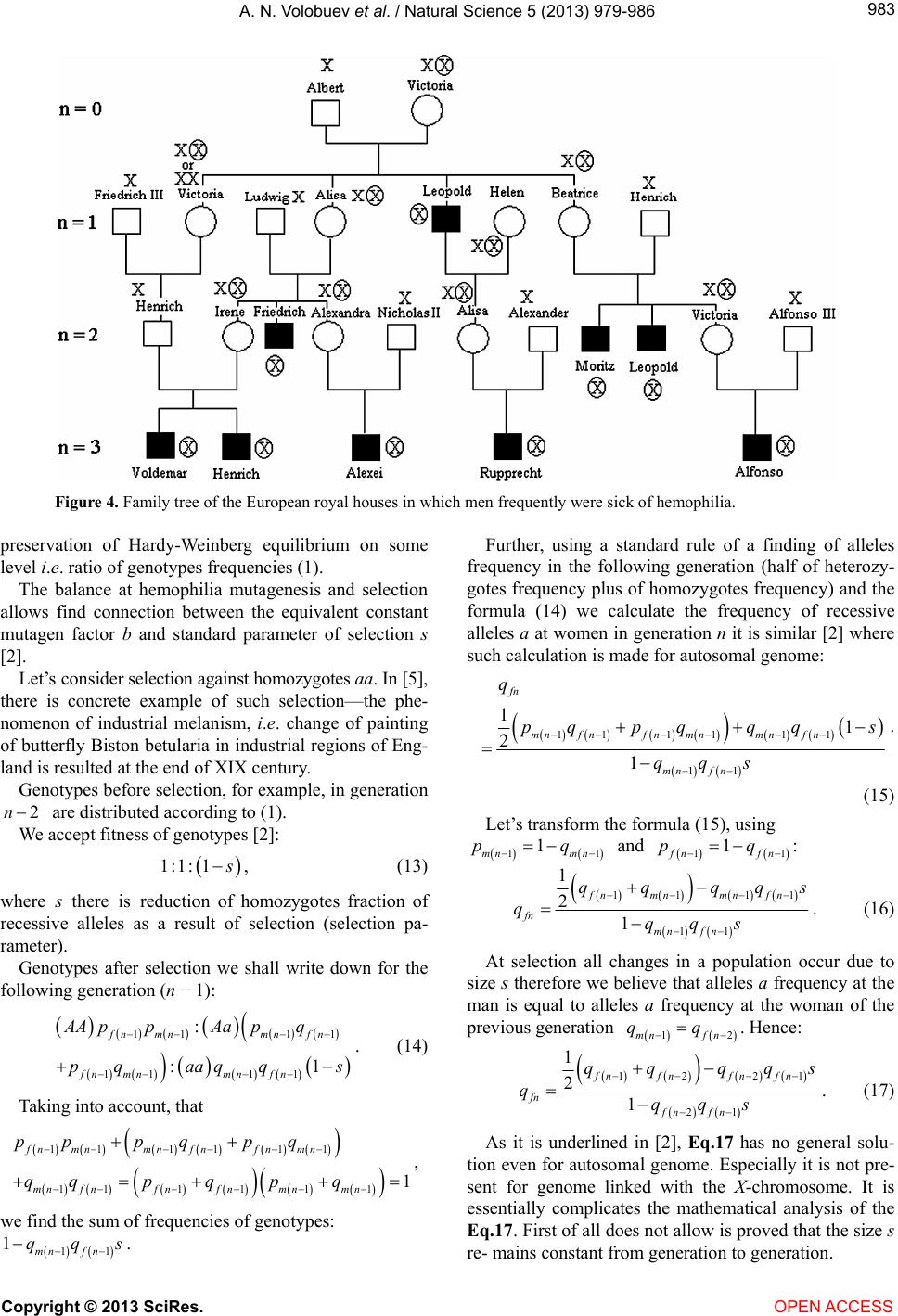 A. N. Volobuev et al. / Natural Science 5 (2013) 979-986 Copyright © 2013 SciRes. 983 Figure 4. Family tree of the European royal houses in which men frequently were sick of hemophilia. Further, using a standard rule of a finding of alleles frequency in the following generation (half of heterozy- gotes frequency plus of homozygotes frequency) and the formula (14) we calculate the frequency of recessive alleles a at women in generation n it is similar [2] where such calculation is made for autosomal genome: preservation of Hardy-Weinberg equilibrium on some level i.e. ratio of genotypes frequencies (1). The balance at hemophilia mutagenesis and selection allows find connection between the equivalent constant mutagen factor b and standard parameter of selection s [2]. Let’s consider selection against homozygotes aa. In [5], there is concrete example of such selection—the phe- nomenon of industrial melanism, i.e. change of painting of butterfly Biston betularia in industrial regions of Eng- land is resulted at the end of XIX century. 11 1111 11 11 2 1 fn mnf nf nmnmnf n mnf n q pq pqqqs qqs . (15) Genotypes before selection, for example, in generation are distributed according to (1). 2nLet’s transform the formula (15), using 11 1 mn mn pq and : 11 1 fn fn pq We accept fitness of genotypes [2]: 1:1: 1 s , (13) 11 1 11 1 2 1 f nmnmnf n fn mnf n q qqqs qqqs 1 2 . (16) where s there is reduction of homozygotes fraction of recessive alleles as a result of selection (selection pa- rameter). OPEN ACCESS Genotypes after selection we shall write down for the following generation (n − 1): 11 11 11 11 : :1 f nmnmnf n f nmnmnf n AA ppAapq pq aaqqs . (14) At selection all changes in a population occur due to size s therefore we believe that alleles a frequency at the man is equal to alleles a frequency at the woman of the previous generation 1mnf n qq . Hence: Taking into account, that 1111 11 111 11 1 1 fnmnmnfnfn mn mn fnfnfnmnmn pppq pq qqp qpq , 12 2 21 1 2 1 fnfnfn fn fn fn fn qq qq qqqs 1 s . (17) As it is underlined in [2], Eq.17 has no general solu- tion even for autosomal genome. Especially it is not pre- sent for genome linked with the Х-chromosome. It is essentially complicates the mathematical analysis of the Eq.17. First of all does not allow is proved that the size s re- mains constant from generation to generation. we find the sum of frequencies of genotypes: . 11 1mnfn qqs 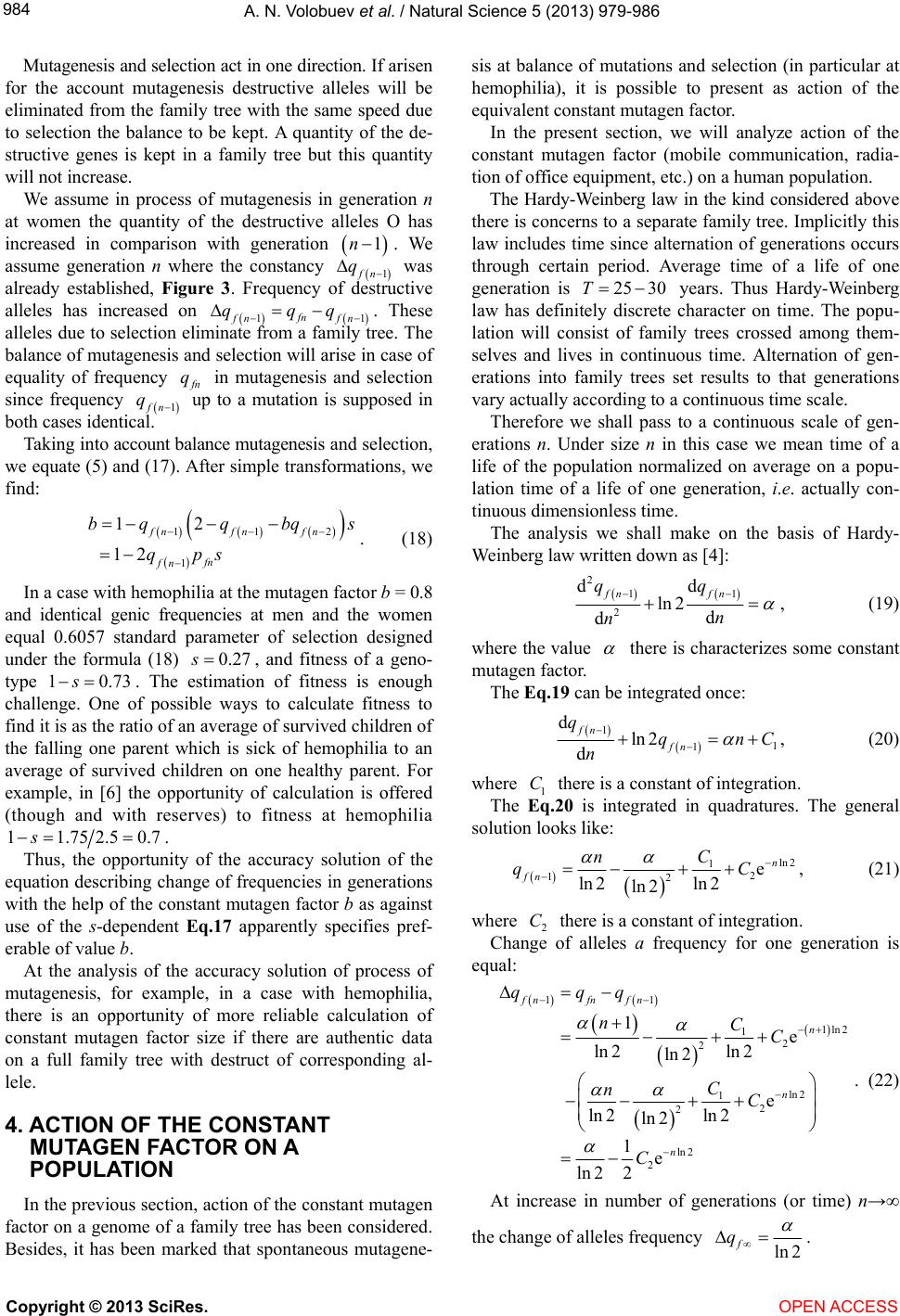 A. N. Volobuev et al. / Natural Science 5 (2013) 979-986 984 Mutagenesis and selection act in one direction. If arisen for the account mutagenesis destructive alleles will be eliminated from the family tree with the same speed due to selection the balance to be kept. A quantity of the de- structive genes is kept in a family tree but this quantity will not increase. We assume in process of mutagenesis in generation n at women the quantity of the destructive alleles O has increased in comparison with generation 1n . We assume generation n where the constancy 1fn q q was already established, Figure 3. Frequency of destructive alleles has increased on 11 fn fnfn . These alleles due to selection eliminate from a family tree. The balance of mutagenesis and selection will arise in case of equality of frequency qq f n in mutagenesis and selection since frequency fn up to a mutation is supposed in both cases identical. q 1 q Taking into account balance mutagenesis and selection, we equate (5) and (17). After simple transformations, we find: 11 1 12 12 fnfn fn fn fn bqq bq qps 2 s 3 . (18) In a case with hemophilia at the mutagen factor b = 0.8 and identical genic frequencies at men and the women equal 0.6057 standard parameter of selection designed under the formula (18) , and fitness of a geno- type . The estimation of fitness is enough challenge. One of possible ways to calculate fitness to find it is as the ratio of an average of survived children of the falling one parent which is sick of hemophilia to an average of survived children on one healthy parent. For example, in [6] the opportunity of calculation is offered (though and with reserves) to fitness at hemophilia 0.27s 10.7s 11.752.50.s 7. Thus, the opportunity of the accuracy solution of the equation describing change of frequencies in generations with the help of the constant mutagen factor b as against use of the s-dependent Eq.17 apparently specifies pref- erable of value b. At the analysis of the accuracy solution of process of mutagenesis, for example, in a case with hemophilia, there is an opportunity of more reliable calculation of constant mutagen factor size if there are authentic data on a full family tree with destruct of corresponding al- lele. 4. ACTION OF THE CONSTANT MUTAGEN FACTOR ON A POPULATION In the previous section, action of the constant mutagen factor on a genome of a family tree has been considered. Besides, it has been marked that spontaneous mutagene- sis at balance of mutations and selection (in particular at hemophilia), it is possible to present as action of the equivalent constant mutagen factor. In the present section, we will analyze action of the constant mutagen factor (mobile communication, radia- tion of office equipment, etc.) on a human population. The Hardy-Weinberg law in the kind considered above there is concerns to a separate family tree. Implicitly this law includes time since alternation of generations occurs through certain period. Average time of a life of one generation is 25 30Т years. Thus Hardy-Weinberg law has definitely discrete character on time. The popu- lation will consist of family trees crossed among them- selves and lives in continuous time. Alternation of gen- erations into family trees set results to that generations vary actually according to a continuous time scale. Therefore we shall pass to a continuous scale of gen- erations n. Under size n in this case we mean time of a life of the population normalized on average on a popu- lation time of a life of one generation, i.e. actually con- tinuous dimensionless time. The analysis we shall make on the basis of Hardy- Weinberg law written down as [4]: 2 11 2 dd ln 2d d fn fn qq n n , (19) where the value there is characterizes some constant mutagen factor. The Eq.19 can be integrated once: 1 1 1 dln 2 d fn fn qqn n C , (20) where there is a constant of integration. 1 The Eq.20 is integrated in quadratures. The general solution looks like: С ln 2 1 2 12e ln 2ln 2 ln 2 n fn C n qС , (21) where there is a constant of integration. 2 Change of alleles a frequency for one generation is equal: С 11 1ln2 1 2 2 ln 2 1 2 2 ln 2 2 1e ln 2ln 2 ln 2 e ln 2ln 2 ln 2 1e ln 22 fn fn fn n n n qqq nCС C nС С . (22) At increase in number of generations (or time) n→∞ the change of alleles frequency ln 2 f q . Copyright © 2013 SciRes. OPEN ACCESS 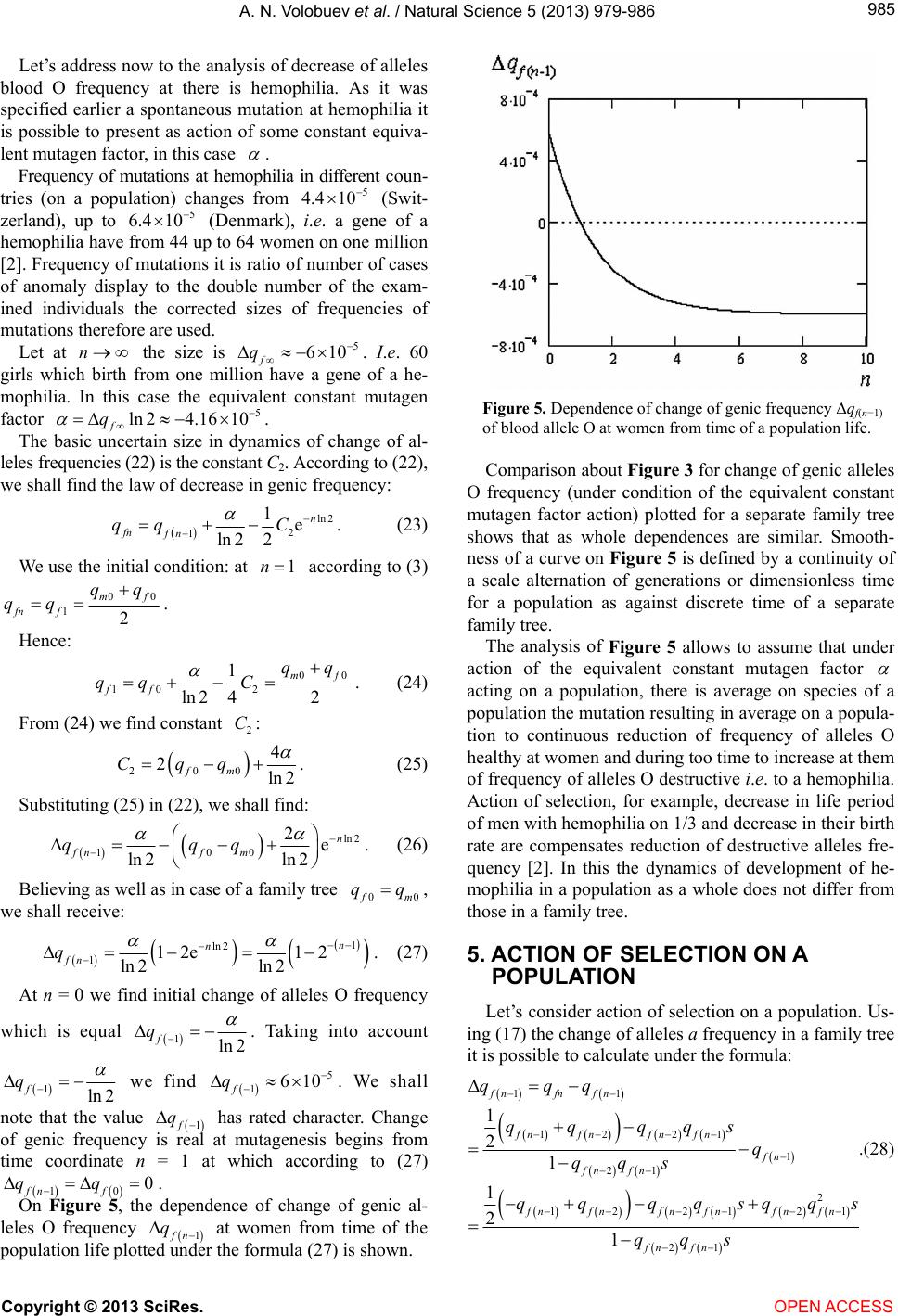 A. N. Volobuev et al. / Natural Science 5 (2013) 979-986 985 Let’s address now to the analysis of decrease of alleles blood O frequency at there is hemophilia. As it was specified earlier a spontaneous mutation at hemophilia it is possible to present as action of some constant equiva- lent mutagen factor, in this case . Frequency of mutations at hemophilia in different coun- tries (on a population) changes from 5 4.4 10 (Swit- zerland), up to (Denmark), i.e. a gene of a hemophilia have from 44 up to 64 women on one million [2]. Frequency of mutations it is ratio of number of cases of anomaly display to the double number of the exam- ined individuals the corrected sizes of frequencies of mutations therefore are used. 5 6.410 Let at the size is . I.e. 60 girls which birth from one million have a gene of a he- mophilia. In this case the equivalent constant mutagen factor . n lnq 5 610 f q 5 10 2 4.16 f The basic uncertain size in dynamics of change of al- leles frequencies (22) is the constant C2. According to (22), we shall find the law of decrease in genic frequency: ln 2 2 1 1e ln 22 n fn fn qq С . (23) We use the initial condition: at according to (3) 1n 00 12 mf fn f qq qq . Hence: 0 10 2 1 ln 242 mf ff qq qq С 0 . (24) From (24) we find constant : 2 С 200 4 2ln 2 fm Сqq . (25) Substituting (25) in (22), we shall find: ln 2 00 1 2e ln 2ln 2 n fm fn qqq . (26) Believing as well as in case of a family tree 00 f m qq , we shall receive: 1 ln 2 112e 12 ln 2ln2 n n fn q . (27) At n = 0 we find initial change of alleles O frequency which is equal 1ln 2 f q . Taking into account 1ln2 f q we find . We shall 5 1610 f q note that the value 1f has rated character. Change of genic frequency is real at mutagenesis begins from time coordinate n = 1 at which according to (27) . q 0 10fn f On Figure 5, the dependence of change of genic al- leles O frequency 1fn at women from time of the population life plotted under the formula (27) is shown. qq q Figure 5. Dependence of change of genic frequency Δqf(n−1) of blood allele O at women from time of a population life. Comparison about Figure 3 for change of genic alleles O frequency (under condition of the equivalent constant mutagen factor action) plotted for a separate family tree shows that as whole dependences are similar. Smooth- ness of a curve on Figure 5 is defined by a continuity of a scale alternation of generations or dimensionless time for a population as against discrete time of a separate family tree. The analysis of Figure 5 allows to assume that under action of the equivalent constant mutagen factor acting on a population, there is average on species of a population the mutation resulting in average on a popula- tion to continuous reduction of frequency of alleles O healthy at women and during too time to increase at them of frequency of alleles O destructive i.e. to a hemophilia. Action of selection, for example, decrease in life period of men with hemophilia on 1/3 and decrease in their birth rate are compensates reduction of destructive alleles fre- quency [2]. In this the dynamics of development of he- mophilia in a population as a whole does not differ from those in a family tree. 5. ACTION OF SELECTION ON A POPULATION Let’s consider action of selection on a population. Us- ing (17) the change of alleles a frequency in a family tree it is possible to calculate under the formula: 11 12 21 1 21 2 1221 2 21 1 2 1 1 2 1 fn fn fn fnfnfn fn fn fn fn fnfnfn fnfn fn fn fn qqq qq qqs q qqs qq qqsqq qqs 1 s .(28) Copyright © 2013 SciRes. OPEN ACCESS 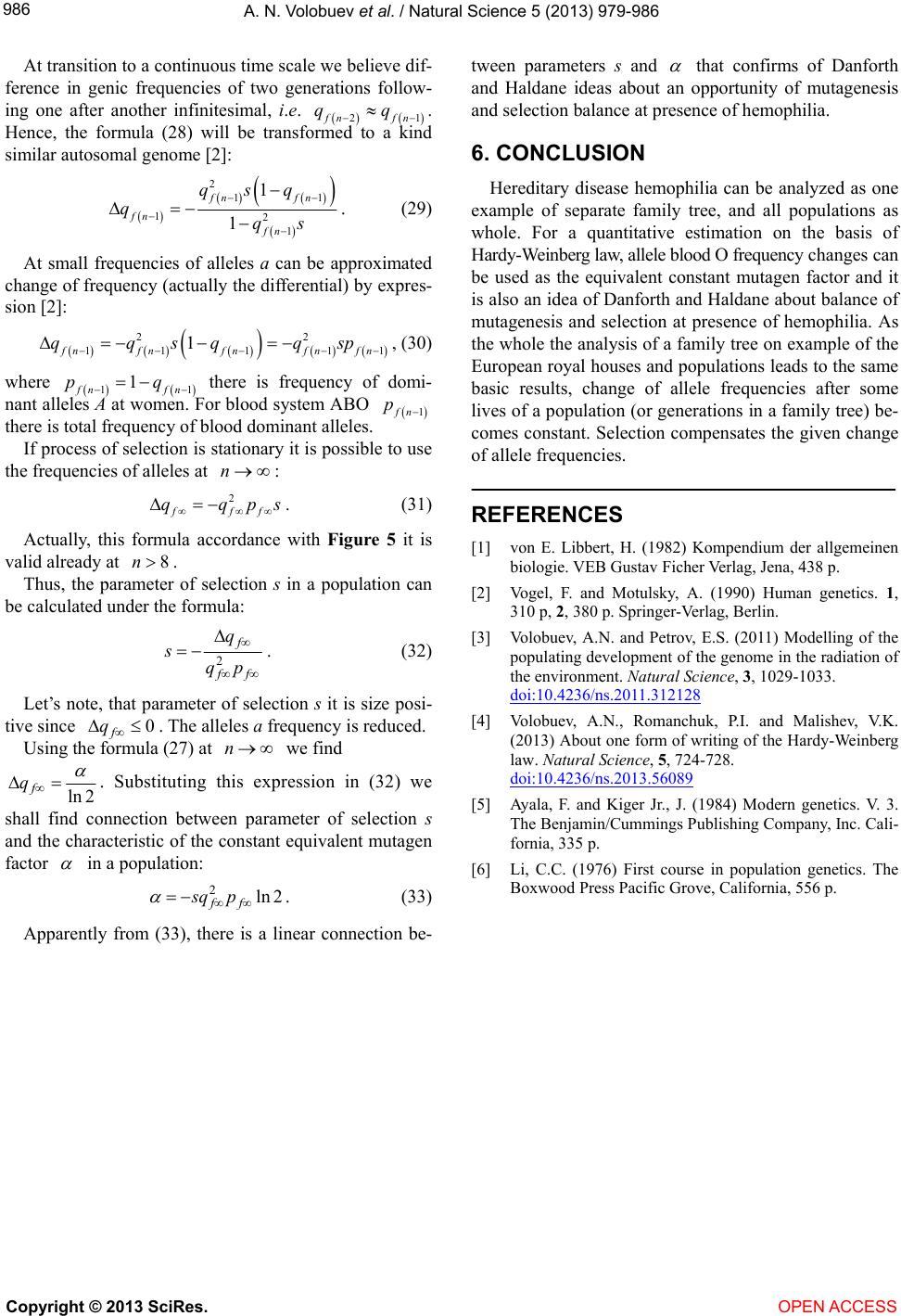 A. N. Volobuev et al. / Natural Science 5 (2013) 979-986 Copyright © 2013 SciRes. 986 At transition to a continuous time scale we believe dif- ference in genic frequencies of two generations follow- ing one after another infinitesimal, i.e. 21fn fn qq . Hence, the formula (28) will be transformed to a kind similar autosomal genome [2]: OPEN ACCESS 2 1 12 1 1 1 fn fn fn fn qsq qqs 1 1 . (29) At small frequencies of alleles a can be approximated change of frequency (actually the differential) by expres- sion [2]: 22 111 1 1 fnfnfnfn fn qqsq qsp , (30) where 11fn fn there is frequency of domi- nant alleles A at women. For blood system ABO 1pq 1fn p there is total frequency of blood dominant alleles. If process of selection is stationary it is possible to use the frequencies of alleles at : n 2 fff qqp s . (31) Actually, this formula accordance with Figure 5 it is valid already at . 8n Thus, the parameter of selection s in a population can be calculated under the formula: ff f pq q s2. (32) Let’s note, that parameter of selection s it is size posi- tive since . The alleles a frequency is reduced. 0qf Using the formula (27) at we find n 2ln f q. Substituting this expression in (32) we shall find connection between parameter of selection s and the characteristic of the constant equivalent mutagen factor in a population: 2ln 2 ffpsq . (33) Apparently from (33), there is a linear connection be- tween parameters s and that confirms of Danforth and Haldane ideas about an opportunity of mutagenesis and selection balance at presence of hemophilia. 6. CONCLUSION Hereditary disease hemophilia can be analyzed as one example of separate family tree, and all populations as whole. For a quantitative estimation on the basis of Hardy-Weinberg law, allele blood O frequency changes can be used as the equivalent constant mutagen factor and it is also an idea of Danforth and Haldane about balance of mutagenesis and selection at presence of hemophilia. As the whole the analysis of a family tree on example of the European royal houses and populations leads to the same basic results, change of allele frequencies after some lives of a population (or generations in a family tree) be- comes constant. Selection compensates the given change of allele frequencies. REFERENCES [1] von E. Libbert, H. (1982) Kompendium der allgemeinen biologie. VEB Gustav Ficher Verlag, Jena, 438 p. [2] Vogel, F. and Motulsky, A. (1990) Human genetics. 1, 310 p, 2, 380 p. Springer-Verlag, Berlin. [3] Volobuev, A.N. and Petrov, E.S. (2011) Modelling of the populating development of the genome in the radiation of the environment. Natural Science, 3, 1029-1033. doi:10.4236/ns.2011.312128 [4] Volobuev, A.N., Romanchuk, P.I. and Malishev, V.K. (2013) About one form of writing of the Hardy-Weinberg law. Natural Science, 5, 724-728. doi:10.4236/ns.2013.56089 [5] Ayala, F. and Kiger Jr., J. (1984) Modern genetics. V. 3. The Benjamin/Cummings Publishing Company, Inc. Cali- fornia, 335 p. [6] Li, C.C. (1976) First course in population genetics. The Boxwood Press Pacific Grove, California, 556 p. |