

Paper Menu >>
Journal Menu >>
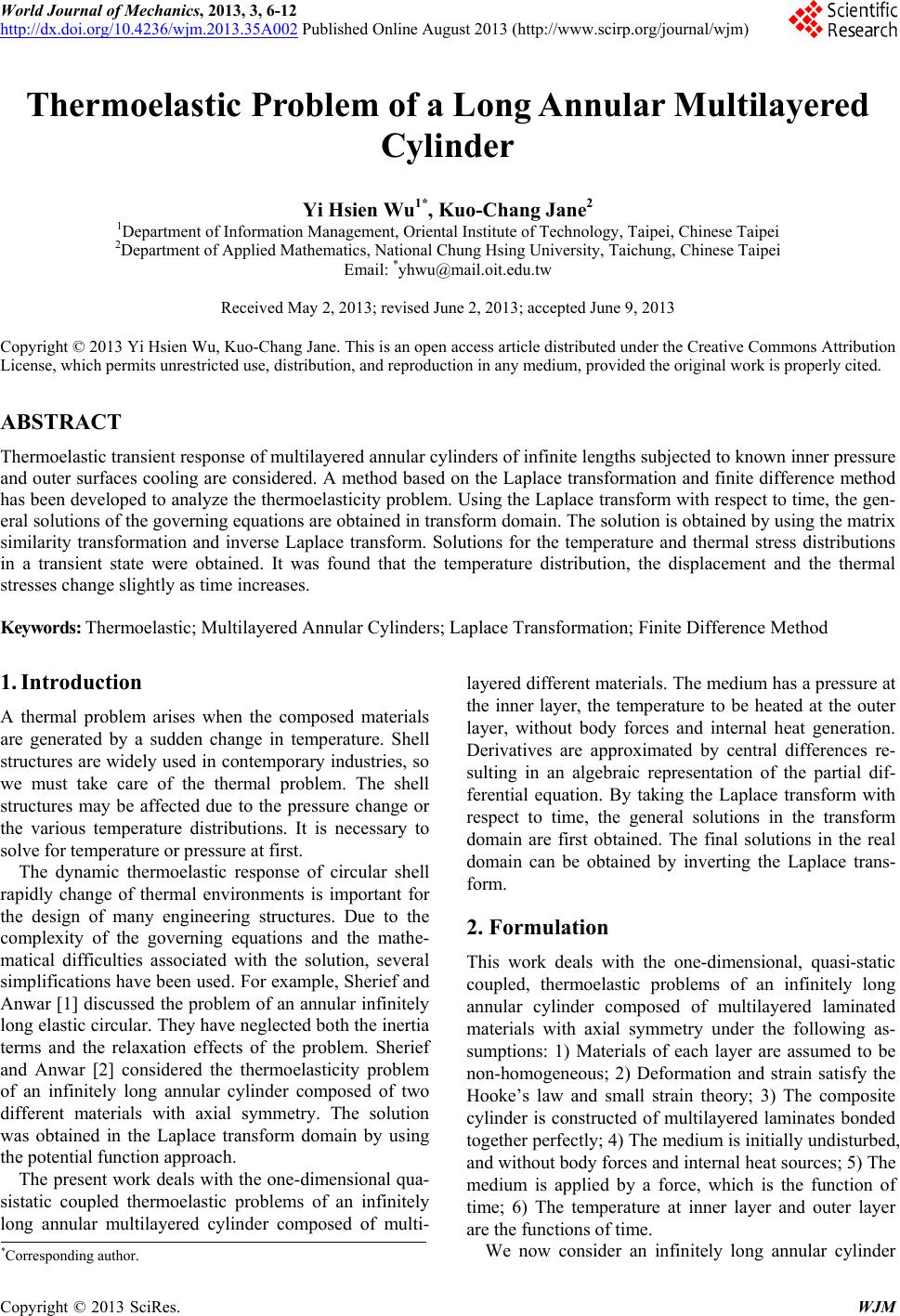 World Journal of Mechanics, 2013, 3, 6-12 http://dx.doi.org/10.4236/wjm.2013.35A002 Published Online August 2013 (http://www.scirp.org/journal/wjm) Thermoelastic Problem of a Long Annular Multilayered Cylinder Yi Hsien Wu1*, Kuo-Chang Jane2 1Department of Information Management, Oriental Institute of Technology, Taipei, Chinese Taipei 2Department of Applied Mathematics, National Chung Hsing University, Taichung, Chinese Taipei Email: *[email protected] Received May 2, 2013; revised June 2, 2013; accepted June 9, 2013 Copyright © 2013 Yi Hsien Wu, Kuo-Chang Jane. This is an open access article distributed under the Creative Commons Attribution License, which permits unrestricted use, distribution, and reproduction in any medium, provided the original work is properly cited. ABSTRACT Thermoelastic transient response of multilayered annu lar cylinde rs of infinite leng ths subjected to known inner pressure and outer surfaces cooling are considered. A method based on the Laplace transformation and finite difference method has been developed to analyze the thermoelasticity problem. Using the Laplace transform with respect to time, the gen- eral solutions of the governing equations are obtained in transform domain. The solution is obtained by using the matrix similarity transformation and inverse Laplace transform. Solutions for the temperature and thermal stress distributions in a transient state were obtained. It was found that the temperature distribution, the displacement and the thermal stresses change slightly as time increases. Keywords: Thermoelastic; Multilayered Annular Cylinders; Laplace Transformation; Finite Difference Method 1. Introduction A thermal problem arises when the composed materials are generated by a sudden change in temperature. Shell structures are widely used in contemporary industries, so we must take care of the thermal problem. The shell structures may be affected due to the pressure change or the various temperature distributions. It is necessary to solve for temperature or pressure at first. The dynamic thermoelastic response of circular shell rapidly change of thermal environments is important for the design of many engineering structures. Due to the complexity of the governing equations and the mathe- matical difficulties associated with the solution, several simplifications have been used. For example, Sherief and Anwar [1] discussed the problem of an annular infinitely long elastic circular. They have neglected both the in ertia terms and the relaxation effects of the problem. Sherief and Anwar [2] considered the thermoelasticity problem of an infinitely long annular cylinder composed of two different materials with axial symmetry. The solution was obtained in the Laplace transform domain by using the potential functio n approach. The present work deals with the one-dimensional qua- sistatic coupled thermoelastic problems of an infinitely long annular multilayered cylinder composed of multi- layered different materials. The medium has a pressure at the inner layer, the temperature to be heated at the outer layer, without body forces and internal heat generation. Derivatives are approximated by central differences re- sulting in an algebraic representation of the partial dif- ferential equation. By taking the Laplace transform with respect to time, the general solutions in the transform domain are first obtained. The final solutions in the real domain can be obtained by inverting the Laplace trans- form. 2. Formulation This work deals with the one-dimensional, quasi-static coupled, thermoelastic problems of an infinitely long annular cylinder composed of multilayered laminated materials with axial symmetry under the following as- sumptions: 1) Materials of each layer are assumed to be non-homogeneous; 2) Deformation and strain satisfy the Hooke’s law and small strain theory; 3) The composite cylinder is constructed of multilayered laminates bonded together p erfectly; 4) Th e medium is initiall y undisturb ed, and without body forces and internal heat sources; 5) The medium is applied by a force, which is the function of time; 6) The temperature at inner layer and outer layer are the functions of time. We now consider an infinitely long annular cylinder *Corresponding a uthor. C opyright © 2013 SciRes. WJM 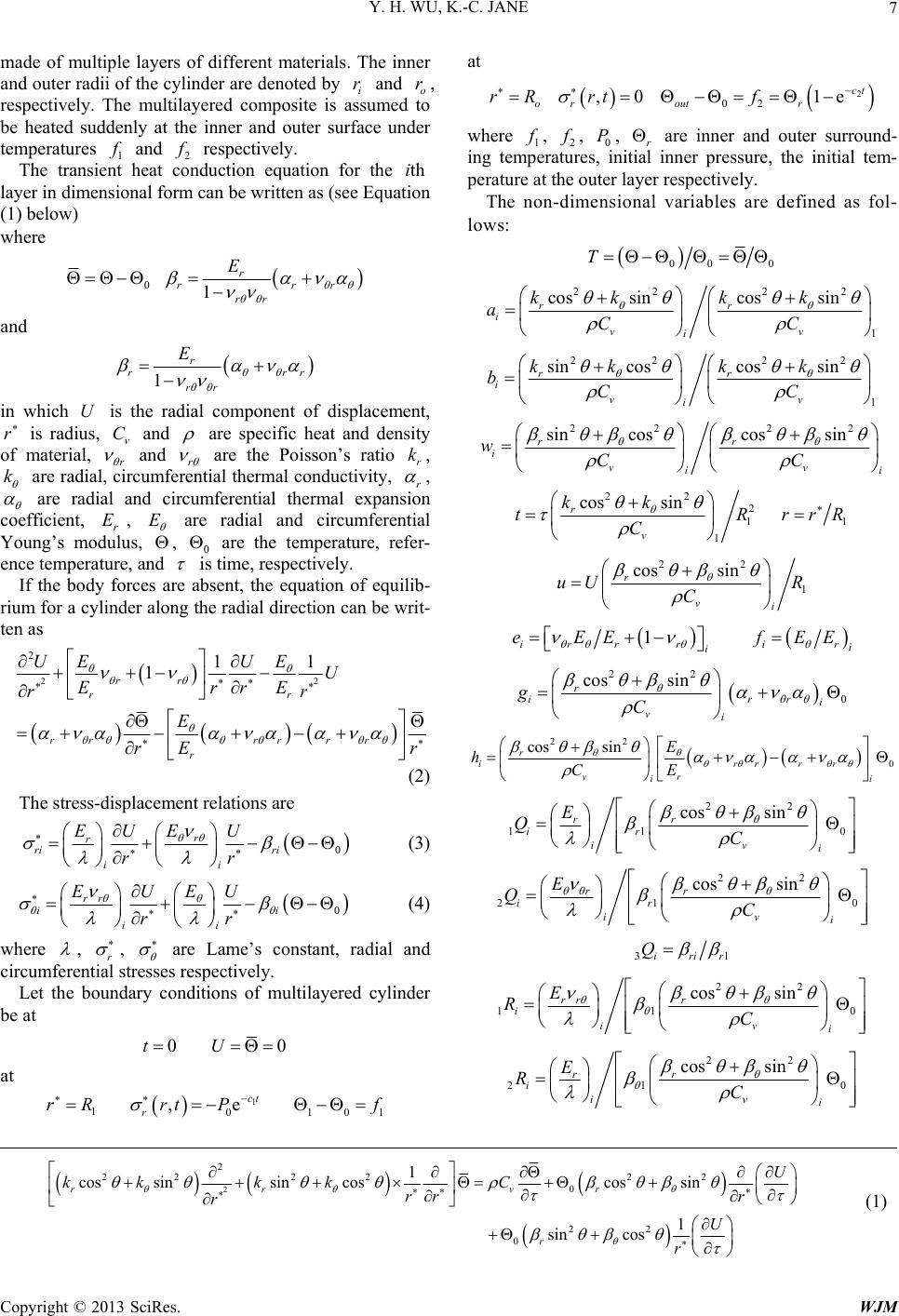 Y. H. WU, K.-C. JANE 7 made of multiple layers of different materials. The inner and outer radii of the cylinder are denoted by i and o, respectively. The multilayered composite is assumed to be heated suddenly at the inner and outer surface under temperatures r r 1 f and 2 f respectively. The transient heat conduction equation for the layer in dimensional form can be written as (see Equation (1) below) thi where 0 1r rr rr Er and 1r rr rr E r in which is the radial component of displacement, is radius, and U rv C are specific heat and density of material, r and r are the Poisson’s ratio , r k k are radial, circumferential thermal conductivity, r , are radial and circumferential thermal expansion coefficient, r, E E are radial and circumferential Young’s modulus, , 0 are the temperature, refer- ence temperature, and is time, respectively. If the body forces are absent, the equation of equilib- rium for a cylinder along the radial direction can be writ- ten as 22 211 1 rr rr rrrr rr r EE UU U EErr rr E E rr (2) The stress-displacement relations are 0 r r ri ri ii E EU U rr (3) 0 rr ii ii EE UU rr (4) where , r , are Lame’s constant, radial and circumferential stresses respectively. Let the boundary conditions of multilayered cylinder be at 0t 0U at 1 rR 1 0 ,e ct rrt P 10 at o rR ,0 rrt 2 02 1e ct out r f where 1 f , 2 f , 0, r P are inner and outer surround- ing temperatures, initial inner pressure, the initial tem- perature at the outer layer respectively. The non-dimensional variables are defined as fol- lows: 00 T0 22 22 1 cos sincos sin rr ivv i kk kk aCC 22 22 1 sincoscos sin rr ivv i kk kk bCC 22 22 sincoscos sin rr ivv ii wCC 22 2 1 1 cos sin r v kk tR C 1 rrR 22 1 cos sin r vi uU R C 1 irr r i eEE ir i f EE 22 0 cos sin r ir i vi gC r 22 0 cos sin r irr vr i i E hCE rr 22 11 cos sin r r ir ivi E QC 0 22 21 cos sin rr ir ivi E QC 0 31irir Q 22 11 cos sin rr r iivi E RC 0 22 21 cos sin r r iivi E RC 0 1 f 2 2 22 2222 0 22 0 1 cos sinsincoscossin 1 sin cos rr vr r U kk kkC rr r r U r (1) Copyright © 2013 SciRes. WJM 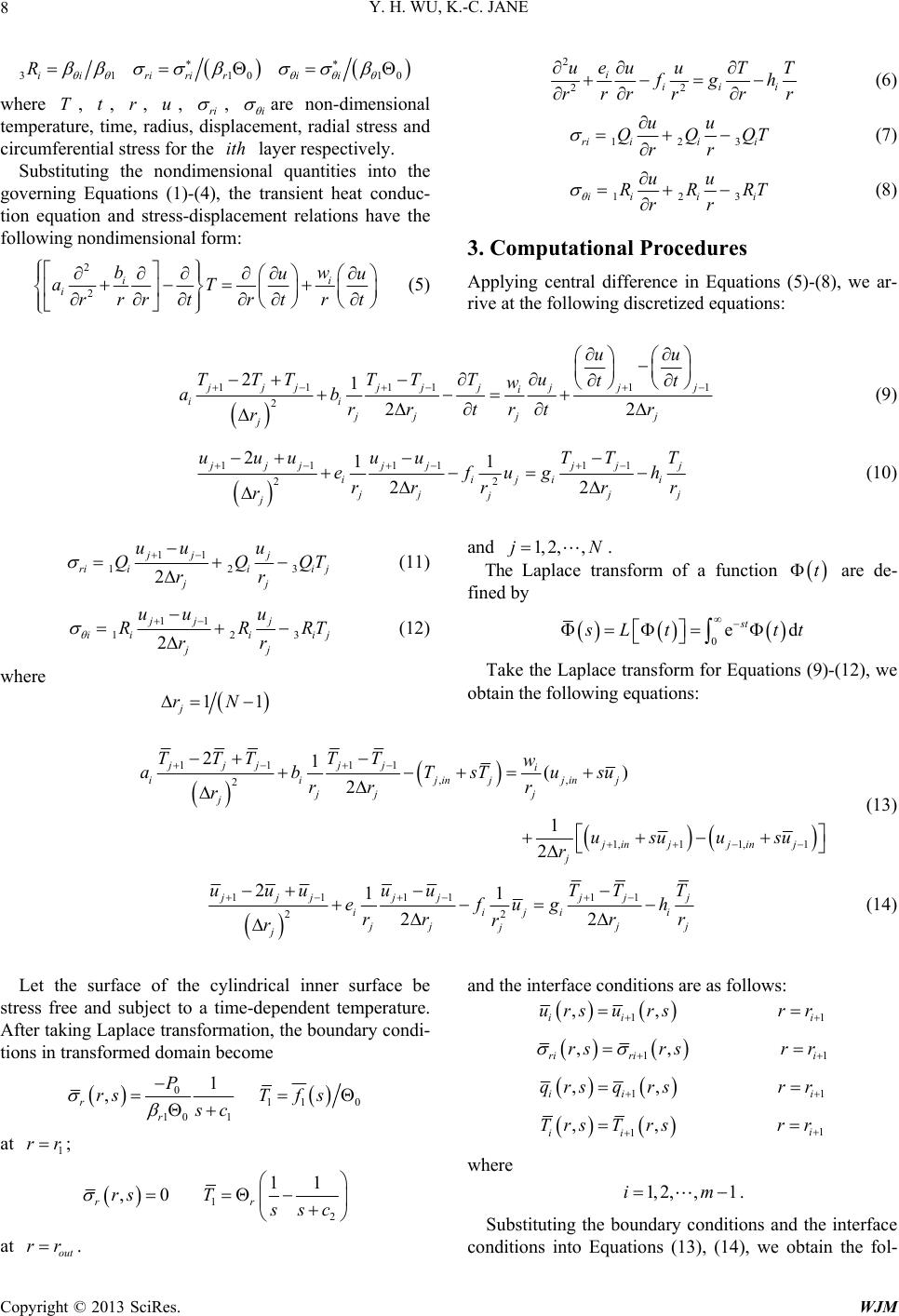 Y. H. WU, K.-C. JANE 8 31ii R 10riri r 10ii where , , Tt r , , ri u , i are non-dimensional temperature, time, radius, displacement, radial stress and circumferential stress for the layer respectively. ith Substituting the nondimensional quantities into the governing Equations (1)-(4), the transient heat conduc- tion equation and stress-displacement relations have the following nondimensional form: 2 2i ib u aT rrtr trtr 2 22 iiii e uuu TT f gh rrrrrr (6) 123ri iii uu QQQ rr T (7) 123iii i uu RRR rr T (8) i w u (5) 3. Computational Procedures Applying central difference in Equations (5)-(8), we ar- rive at the following discretized equations: 1111 1 2 21 22 jjjjjjjjj i ii jj jj j uu TTTTTTu tt w ab rr trtr r 1 (9) 1111 11 22 211 22 j jjjjj j iijij i j jj j j uuuuuTT efug rr r r r j T h r (10) 11 12 2 jjj riiii j jj uu u QQ rr 3 QT (11) 11 12 2 jj j iii i jj uu u RR rr 3j RT (12) where 11 j rN and 1, 2,,jN . The Laplace transform of a function are de- fined by t 0ed st s Lt t t Take the Laplace transform for Equations (9)-(12), we obtain the following equations: 1111 ,, 2 1,1 1,1 21() 2 1 2 jjjjji iijin jjin j jj j j jinj jinj j TTTTTw abTsTusu rr r r usuusu r (13) 1111 11 22 211 22 j jjjjj jj iijii j jj j j uuuuuTT T efug rr r r r j h r (14) Let the surface of the cylindrical inner surface be stress free and subject to a time-dependent temperature. After taking Laplace transformation, the boundary condi- tions in transformed domain become 0 10 1 1 , rr P rs s c 11 Tfs 0 at ; 1 rr , rrs 0 12 11 r T s sc at . out rr and the interface conditions are as follows: 1 , ii ursu rs , 1i rr 1 , ri ri rs rs , 1i rr 1 , ii qrsqrs , 1i rr 1 , ii Trs T rs , 1i rr where 1, 2,,1im . Substituting the boundary conditions and the interface conditions into Equations (13), (14), we obtain the fol- Copyright © 2013 SciRes. WJM 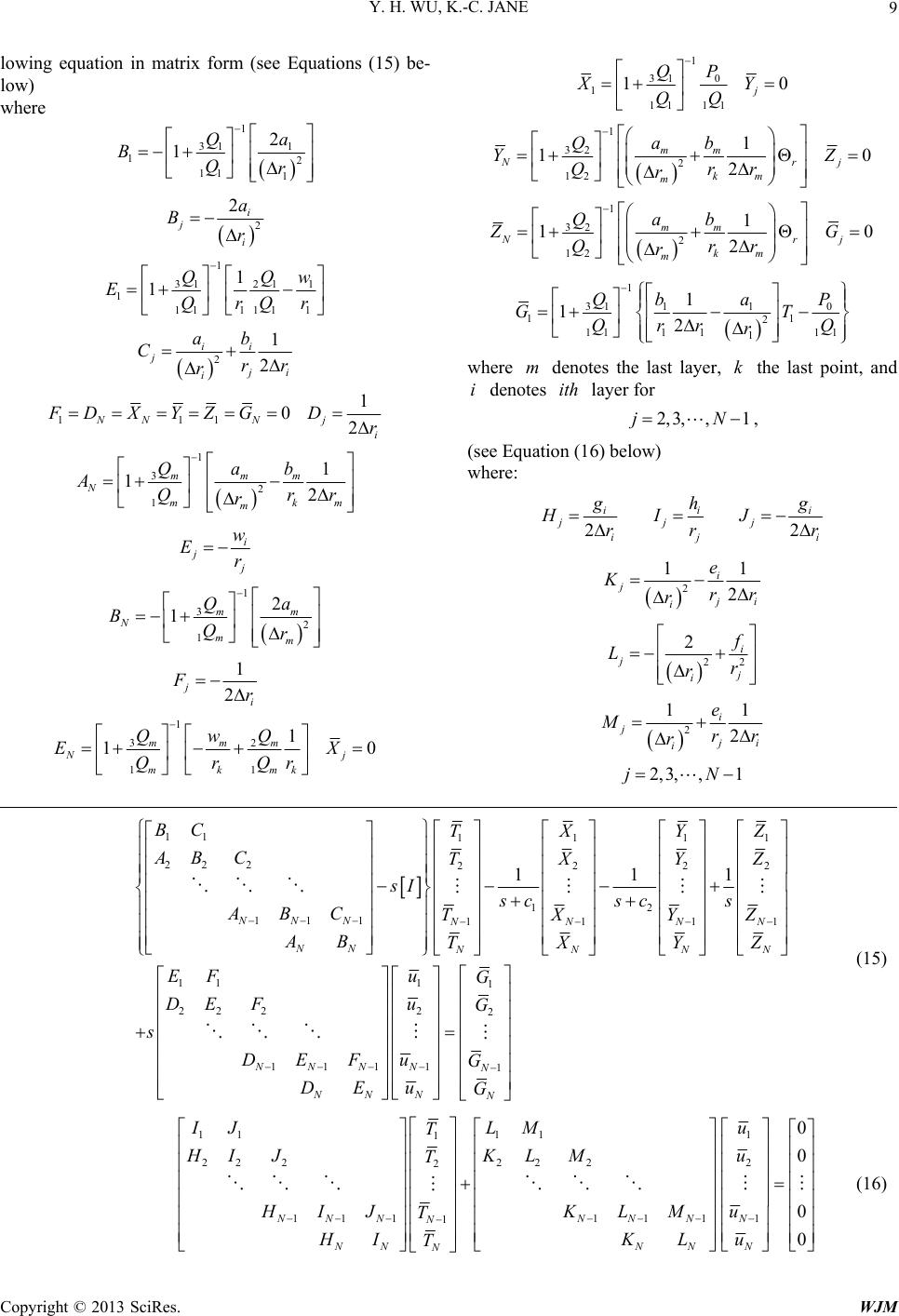 Y. H. WU, K.-C. JANE 9 lowing equation in matrix form (see Equations (15) be- low) where 1 31 1 12 11 1 2 1Qa BQr 2 2i j i a Br 1 31 21 1 111111 1 1 1QQw EQrQr 2 1 2 ii j j i i ab Crr r 111 0 NN N FD X YZG 1 2 ji Dr 1 32 1 1 12 mmm Nmk m Qab AQr r m r i j j w Er 1 32 1 2 1mm Nmm Qa BQr 1 2 ji Fr 1 32 11 1 1mmm Nmkmk r 1 31 0 11111 1QP XQQ 0 j Y 1 32 2 12 1 12 mm N r km m Qab YQrr r QwQ EQrQ 0 j X 0Z j 1 32 2 12 1 12 mm N r km m Qab ZQrr r 0G j 1 31 0 11 11 2 111 111 1 1 12 QP ba GT QrrQ r where denotes the last layer, the last point, and denotes it layer for mk ih 2,3, ,1jN , (see Equation (16) below) where: 2i ji g Hr i j j h Ir 2 i ji g Jr 2 11 2 i j j i i e Krr r 22 2i jj i f Lr r 2 11 2 i j j i i e Mrr r 2,3, ,1jN 11 111 22 2222 12 111 111 11 22 111 NNN NNN NN NNN BC TXY AB CTXY sI scsc s ABC TXY AB TXY EF DE F s 1 2 1 N N Z Z Z Z 11 22 2 11111 NNNN N NNN N uG uG DEFuG DEu G (15) 111 11 1 2222 222 2 11 11 111 1 0 0 0 0 NN NN NNN N NNN NN N IJLM u T HIJKL Mu T HIJKLM u T HIK Lu T (16) Copyright © 2013 SciRes. WJM 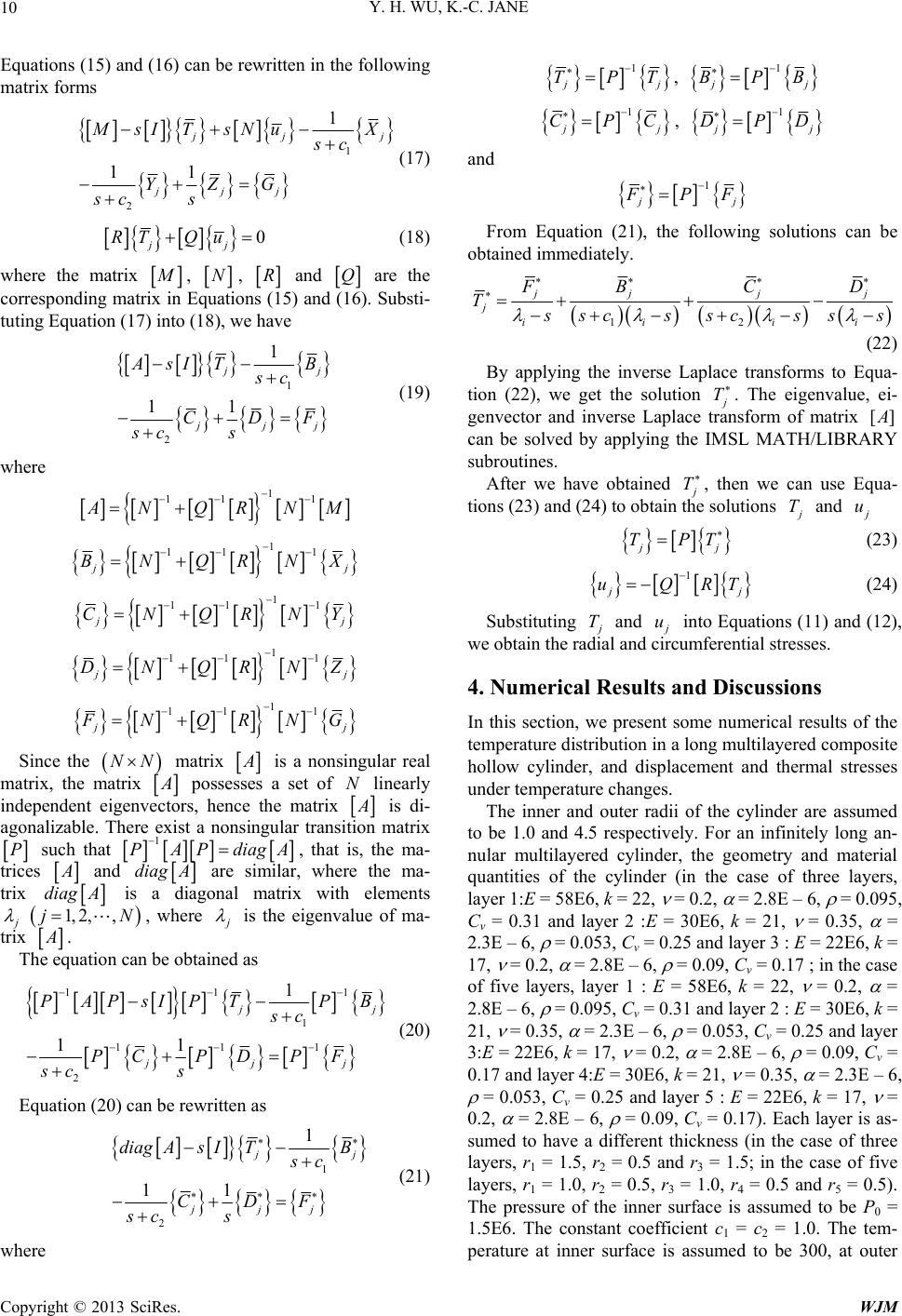 Y. H. WU, K.-C. JANE 10 Equations (15) and (16) can be rewritten in the following matrix forms 1 2 1 11 j jj jjj M sITsN uX sc YZG sc s (17) 0 jj RT Qu (18) where the matrix M , N, R and Q are the corresponding matrix in Equations (15) and (16). Substi- tuting Equation (17) into (18), we have 1 2 1 11 j j j jj A sI TB sc CDF sc s (19) where 1 11 1 A NQRNM 1 11 1 j j BNQRNX 1 11 1 j j CNQRNY 1 11 1 j j DNQRNZ 1 11 1 j j F NQRNG Since the matrix NN A is a nonsingular real matrix, the matrix A possesses a set of linearly independent eigenvectors, hence the matrix N A is di- agonalizable. There exist a nonsingular transition matrix P such that , that is, the ma- trices P gA 1 PA dia A and diag A are similar, where the ma- trix diag 1, 2jA,N is a diagonal matrix with elements j, where , j is the eigenvalue of ma- trix A . The equation ca n be o bt ai n ed as 11 1 111 2 1 11 1 j j jj PAPsIPT PB sc PCPD PF sc s j (20) Equation (20) can be rewritten as 1 2 1 11 j j jjj diagAs ITB sc CDF sc s (21) where 1 j j TPT , 1 j j BPB 1 j j CPC , 1 j j DPD and 1 j j F PF From Equation (21), the following solutions can be obtained immediately. 12 jj j jii i FBC D Tj i s scsscs ss (22) By applying the inverse Laplace transforms to Equa- tion (22), we get the solution j T. The eigenvalue, ei- genvector and inverse Laplace transform of matrix can be solved by applying the IMSL MATH/LIBRARY subroutines. ][A After we have obtained j T, then we can use Equa- tions (23) and (24) to obtain the solutions j T and j u j j TPT (23) 1 j j uQRT (24) Substituting j T and j u into Equations (11) and (12), we obtain the radial and circumferential stresses. 4. Numerical Results and Discussions In this section, we present some numerical results of the temperature distribution in a long multilayered co mposite hollow cylinder, and displacement and thermal stresses under temperature changes. The inner and outer radii of the cylinder are assumed to be 1.0 and 4.5 respectively. For an infinitely long an- nular multilayered cylinder, the geometry and material quantities of the cylinder (in the case of three layers, layer 1:E = 58E6, k = 22, = 0.2, = 2.8E – 6, = 0.095, Cv = 0.31 and layer 2 :E = 30E6, k = 21, = 0.35, = 2.3E – 6, = 0.053, Cv = 0.25 and layer 3 : E = 22E6, k = 17, = 0.2, = 2.8E – 6, = 0.09, Cv = 0.17 ; in the case of five layers, layer 1 : E = 58E6, k = 22, = 0.2, = 2.8E – 6, = 0.095, Cv = 0.31 and layer 2 : E = 30E6, k = 21, = 0.35, = 2.3E – 6, = 0.053, Cv = 0.25 and layer 3:E = 22E6, k = 17, = 0.2, = 2.8E – 6, = 0.09, Cv = 0.17 and layer 4:E = 30E6, k = 21, = 0.35, = 2.3E – 6, = 0.053, Cv = 0.25 and layer 5 : E = 22E6, k = 17, = 0.2, = 2.8E – 6, = 0.09, Cv = 0.17). Each layer is as- sumed to have a different thickness (in the case of three layers, r1 = 1.5, r2 = 0.5 and r3 = 1.5; in the case of five layers, r1 = 1.0, r2 = 0.5, r3 = 1.0, r4 = 0.5 and r5 = 0.5). The pressure of the inner surface is assumed to be P0 = 1.5E6. The constant coefficient c1 = c2 = 1.0. The tem- perature at inner surface is assumed to be 300, at outer Copyright © 2013 SciRes. WJM 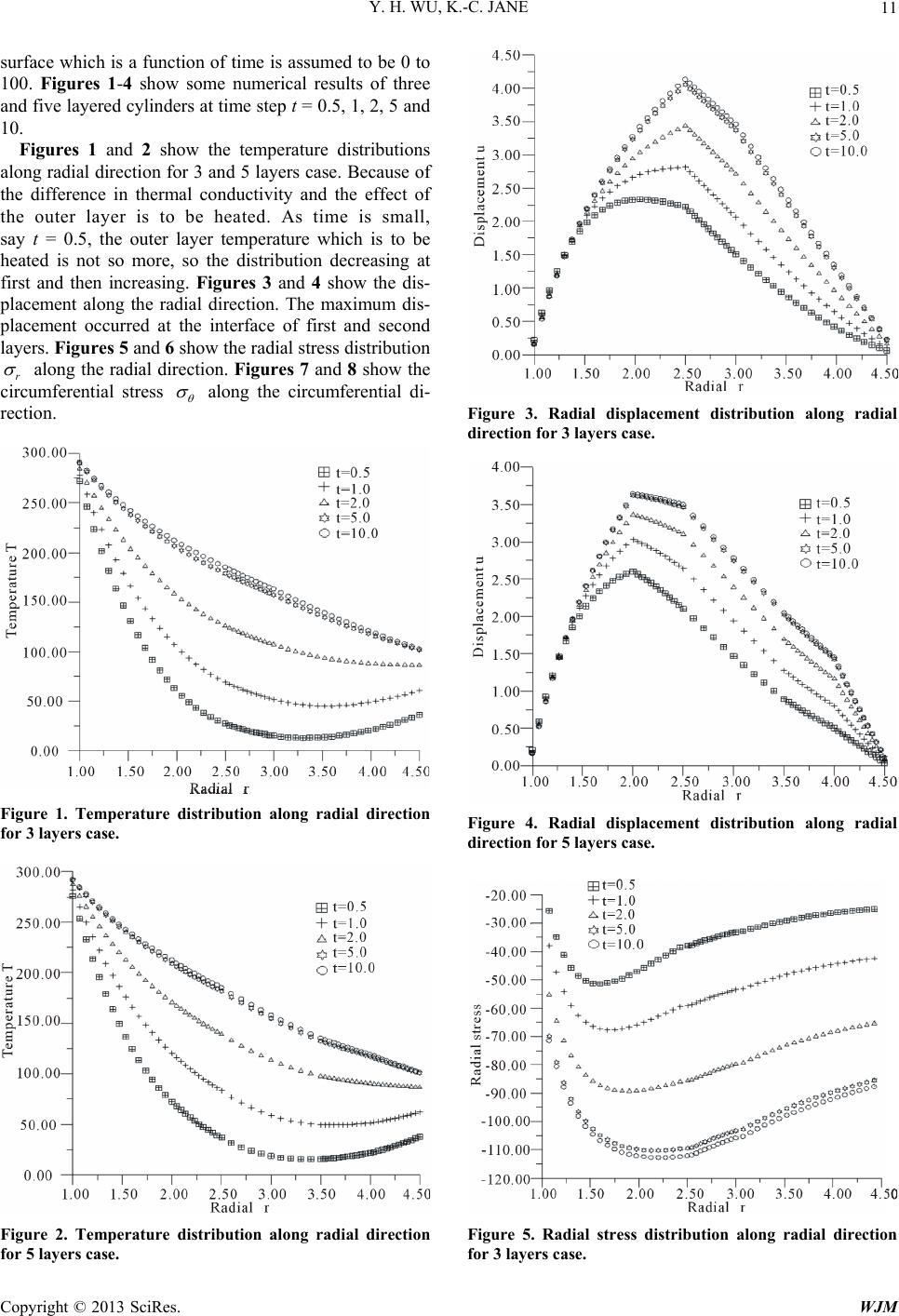 Y. H. WU, K.-C. JANE 11 surface which is a function of time is assumed to be 0 to 100. Figures 1-4 show some numerical results of three and five layered cylinders at time step t = 0.5, 1, 2, 5 and 10. Figures 1 and 2 show the temperature distributions along radial direction for 3 and 5 layers case. Because of the difference in thermal conductivity and the effect of the outer layer is to be heated. As time is small, say t = 0.5, the outer layer temperature which is to be heated is not so more, so the distribution decreasing at first and then increasing. Figures 3 and 4 show the dis- placement along the radial direction. The maximum dis- placement occurred at the interface of first and second layers. Figures 5 and 6 show the radial stress distribution r along the radial direction. Figures 7 and 8 show the circumferential stress along the circumferential di- rection. Figure 1. Temperature distribution along radial direction for 3 layers case. Figure 2. Temperature distribution along radial direction for 5 layers case. Figure 3. Radial displacement distribution along radial direction for 3 layers case. Figure 4. Radial displacement distribution along radial direction for 5 layers case. Figure 5. Radial stress distribution along radial direction for 3 layers case. Copyright © 2013 SciRes. WJM 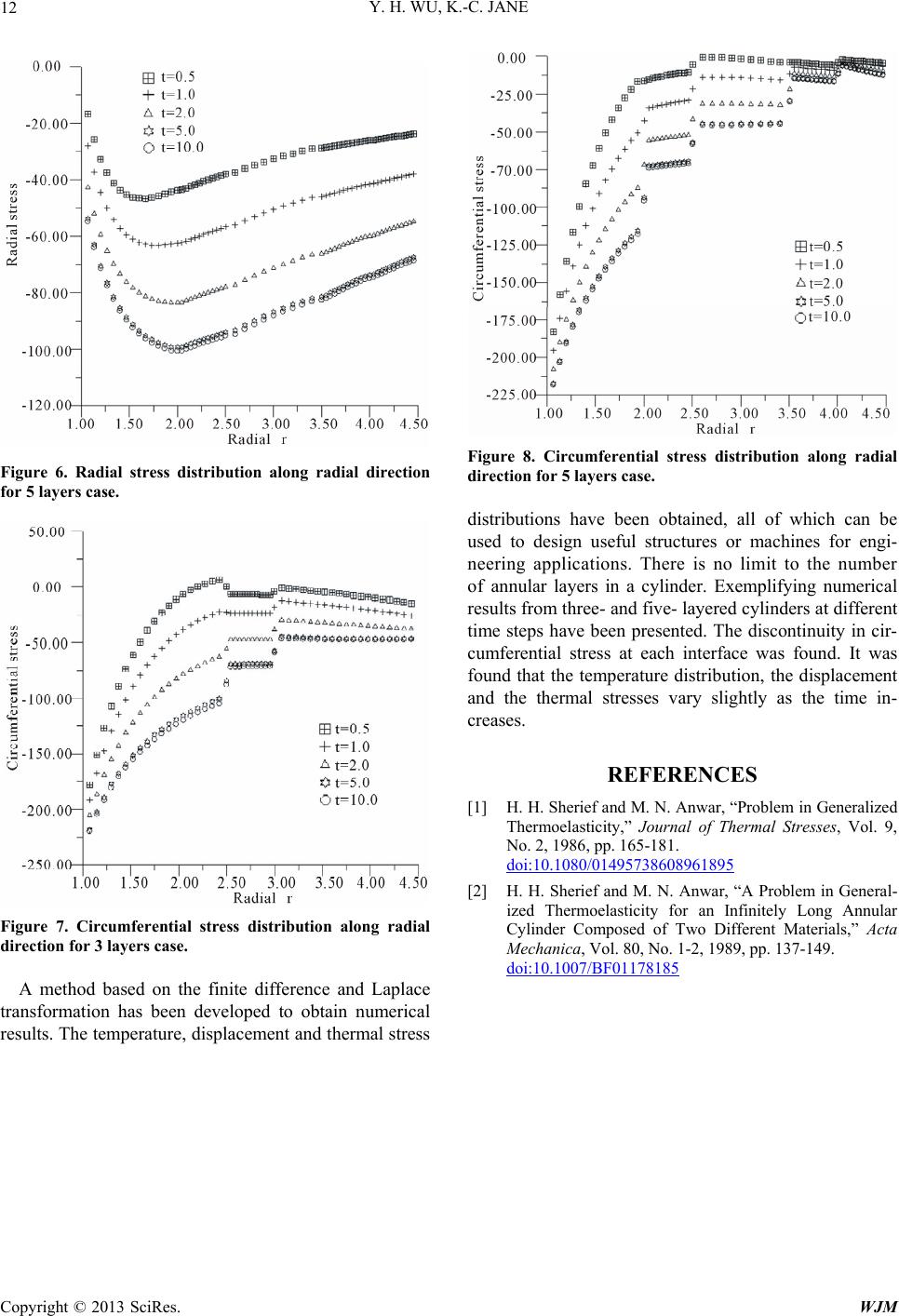 Y. H. WU, K.-C. JANE Copyright © 2013 SciRes. WJM 12 Figure 8. Circumferential stress distribution along radial direction for 5 layers case. Figure 6. Radial stress distribution along radial direction for 5 layers case. distributions have been obtained, all of which can be used to design useful structures or machines for engi- neering applications. There is no limit to the number of annular layers in a cylinder. Exemplifying numerical results from three- and five- layered cylinders at different time steps have been presented. The discontinuity in cir- cumferential stress at each interface was found. It was found that the temperature distribution, the displacement and the thermal stresses vary slightly as the time in- creases. REFERENCES [1] H. H. Sherief and M. N. Anwar, “Problem in Gene ralized Thermoelasticity,” Journal of Thermal Stresses, Vol. 9, No. 2, 1986, pp. 165-181. doi:10.1080/01495738608961895 [2] H. H. Sherief and M. N. Anwar, “A Problem in General- ized Thermoelasticity for an Infinitely Long Annular Cylinder Composed of Two Different Materials,” Acta Mechanica, Vol. 80, No. 1-2, 1989, pp. 137-149. doi:10.1007/BF01178185 Figure 7. Circumferential stress distribution along radial direction for 3 layers case. A method based on the finite difference and Laplace transformation has been developed to obtain numerical results. The temperature, displacement and thermal stress |